
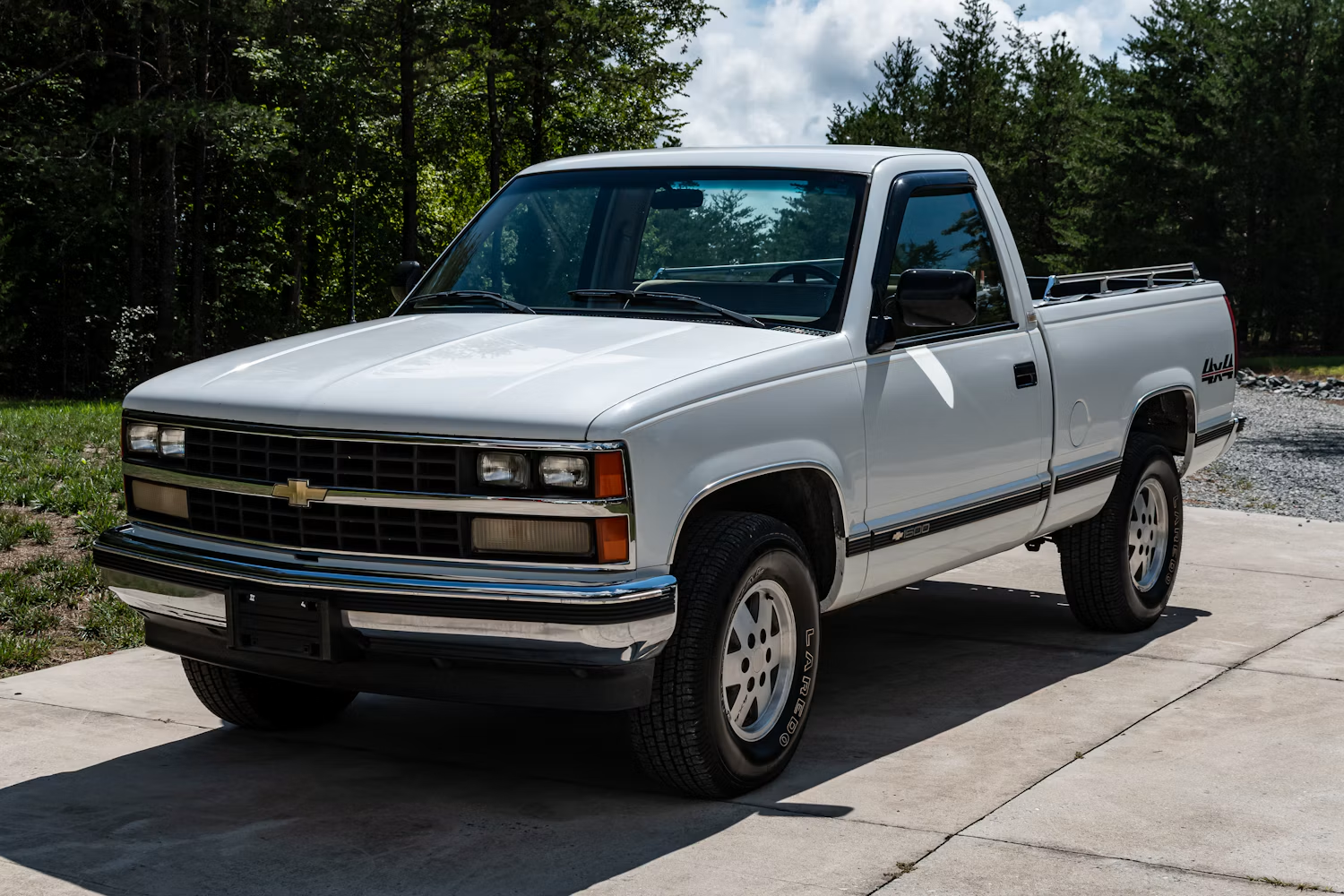
When I was a kid, the local Chevy dealer was within biking distance, and I remember distinctly when their new 1988 trucks were introduced. After almost 15 years of production, the Chevy Squarebody was practically an institution, but the rounded GMT400 was a revelation because it was brand spanking new from the tires on up, and I studied the brochure for trim variations from the basic Cheyenne all the way up to the Cadillac of pickups, the Silverado. This 1988 K1500 Silverado short bed takes me back to those days, and it’s for sale on Hagerty Marketplace in Archdale, North Carolina.
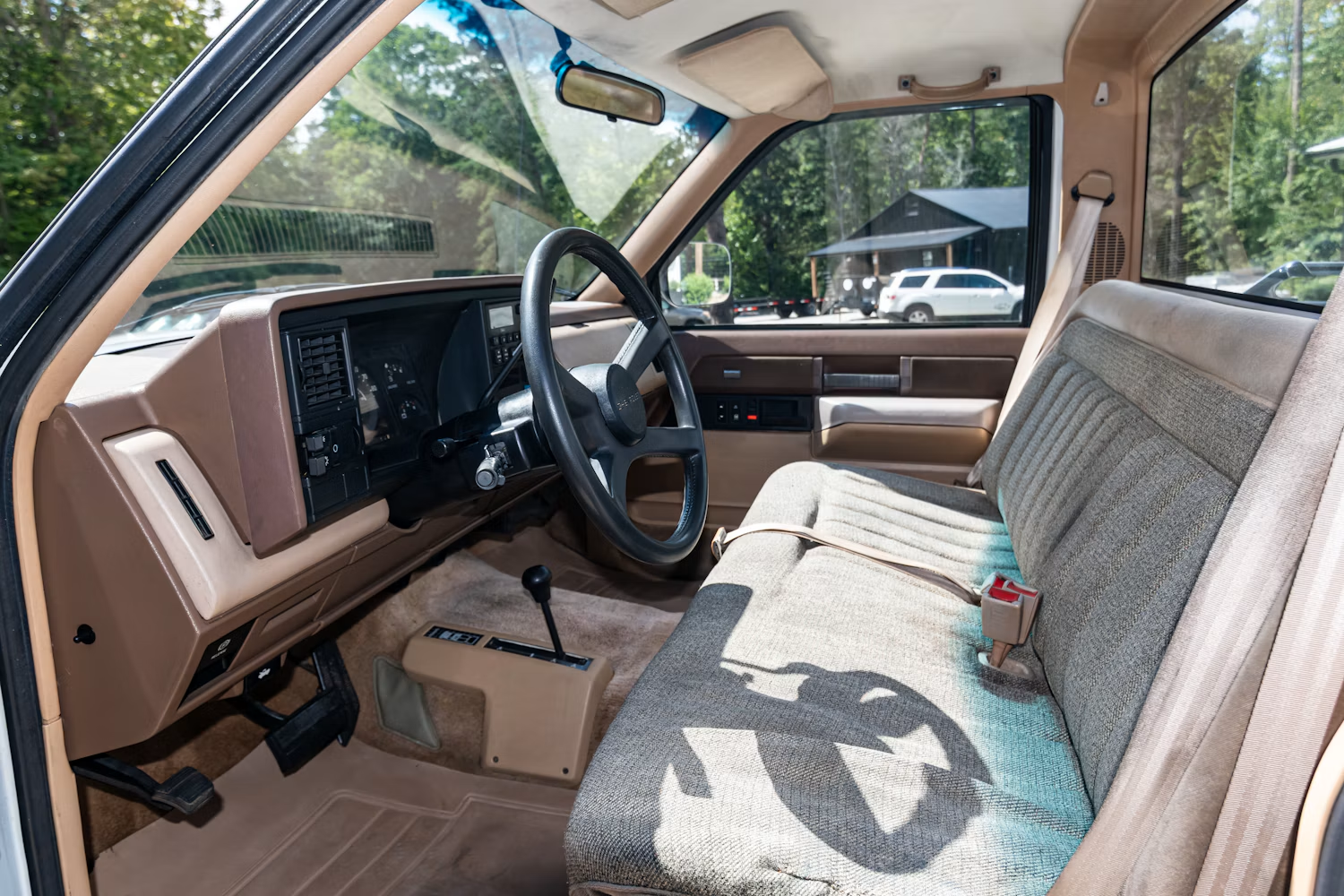
The nice thing about this K1500, which is Chevrolet nomenclature for a half-ton 4X4, is that it was owned by the seller’s father since 1990, and its condition belies the 146,700 miles it shows on the odometer. Aside from some upholstery issues, the interior looks great, and the truck is well optioned with power windows, power locks, and air conditioning.
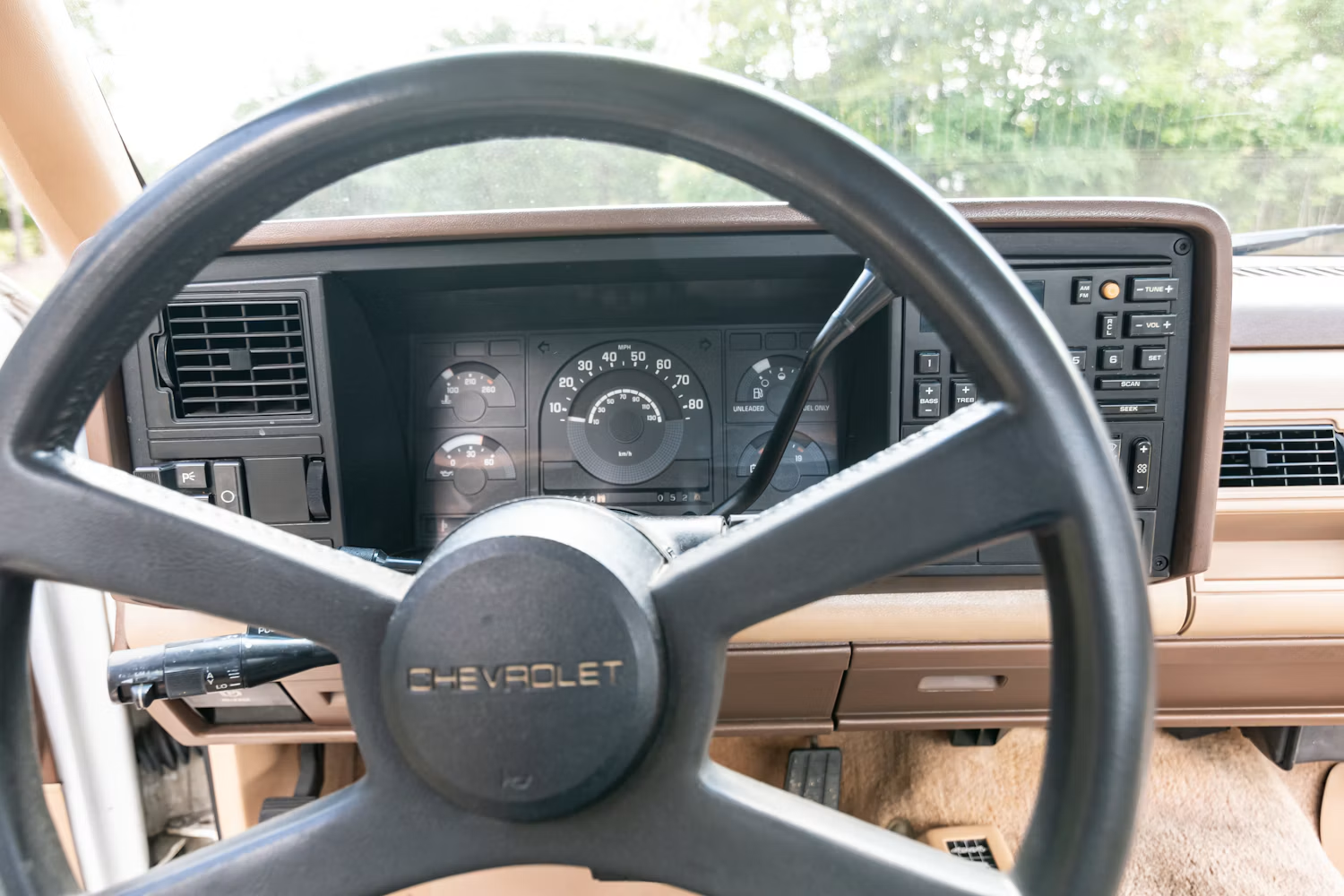
The Squarebody’s instrument panel looked like 1973 right up to the end, so the new gauge cluster with semicircular “bars” to show speed, volts, oil pressure, fuel, and engine temperature was a welcome introduction into a new decade that was already almost gone in 1988. The radio, climate controls, and lighting controls all fell easily within the driver’s reach, and it’s hard to argue that you need much more than this in a truck even today, almost 40 years later (although an air bag or two might be nice).
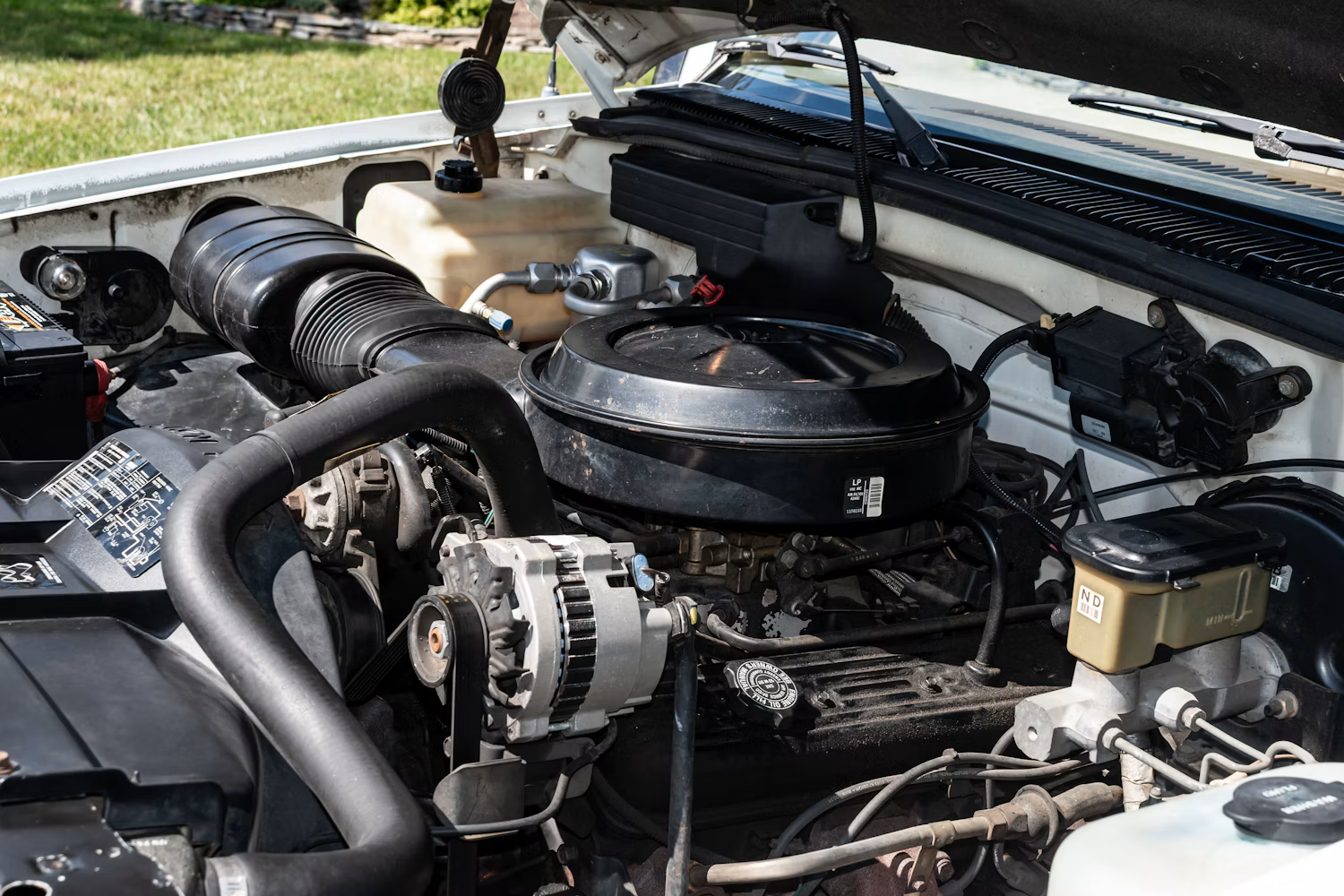
The engine, too, is perfectly suited to today’s fast-paced roads. It’s the throttle-body-injected 350, which produced a healthy 210 horsepower and 300 lb-ft of torque in K1500 tune. This truck has a four-speed automatic, and 3.42:1 axle ratios were standard. The seller has included cold start and driving videos which both show that the engine sounds great and has good oil pressure, but I would imagine that it would take a lot to hurt a truck-spec Chevy small block.
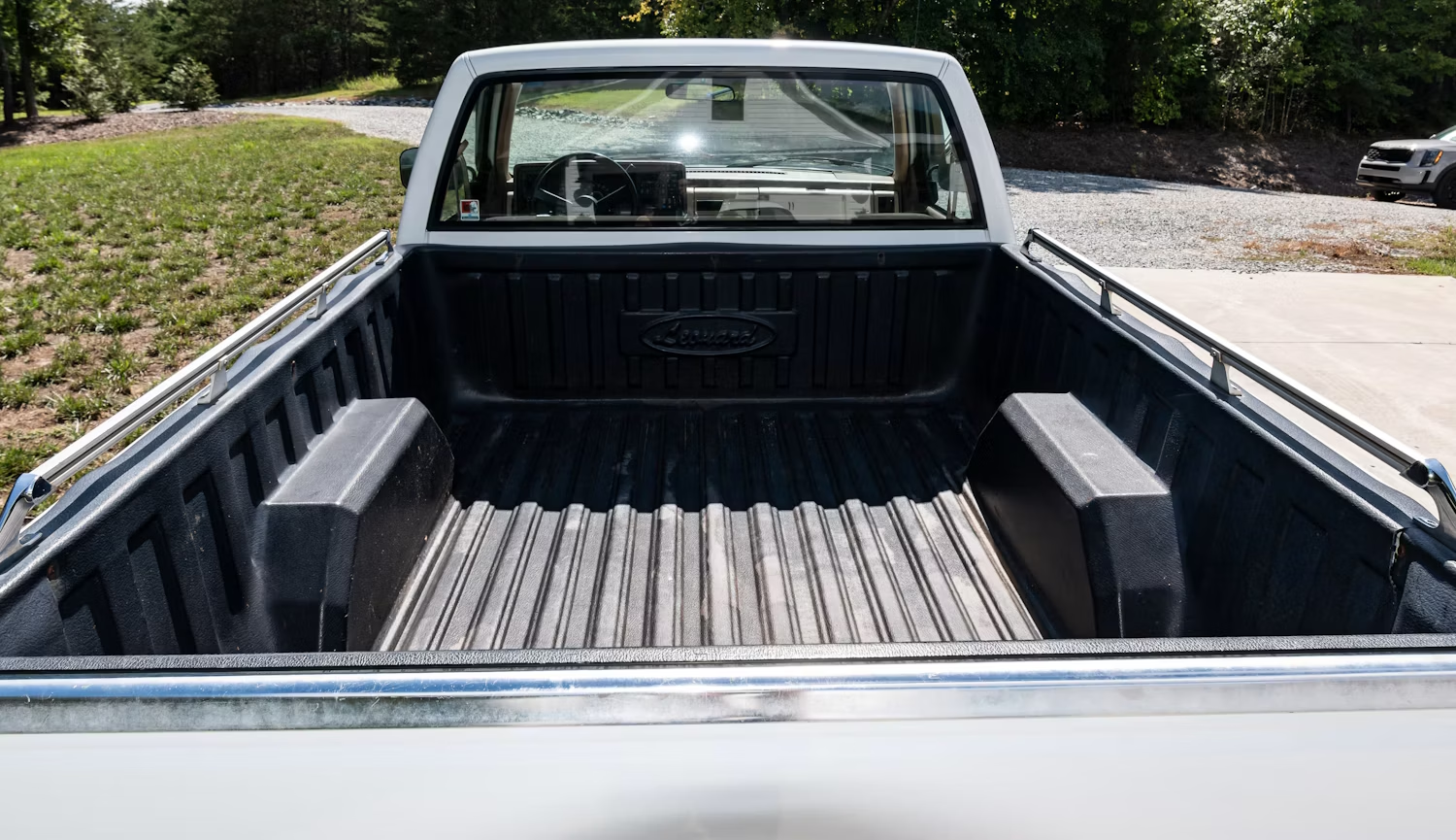
The truck comes with a drop-in bedliner, so you won’t have to be afraid of carrying parts to the machine shop or your rental storage garage. It looks like a great place to drop a set of winter tires to swap onto your daily driver, if you drive a 2023 Challenger in the winter as I do.
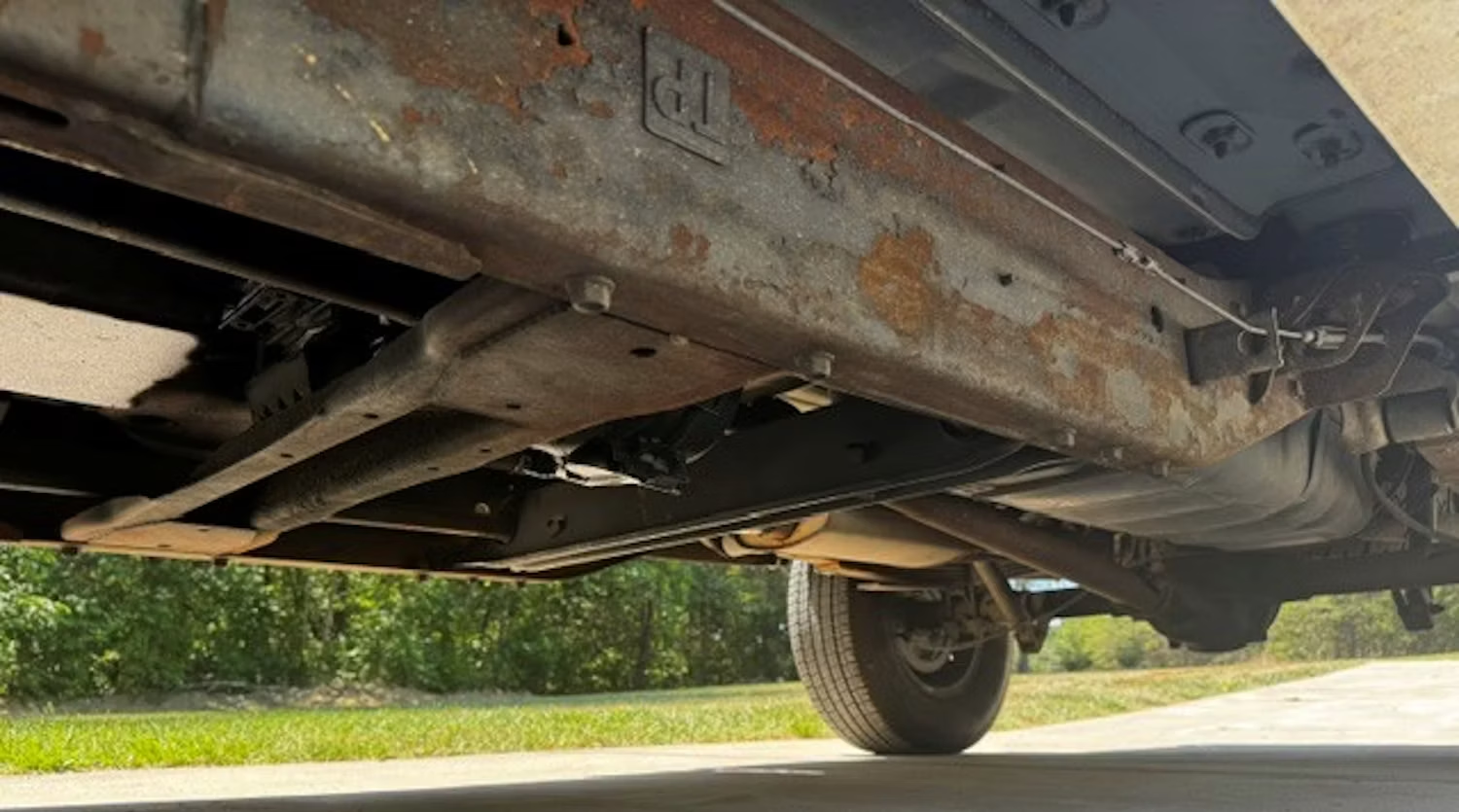
The undercarriage has some surface rust, but nothing alarming.
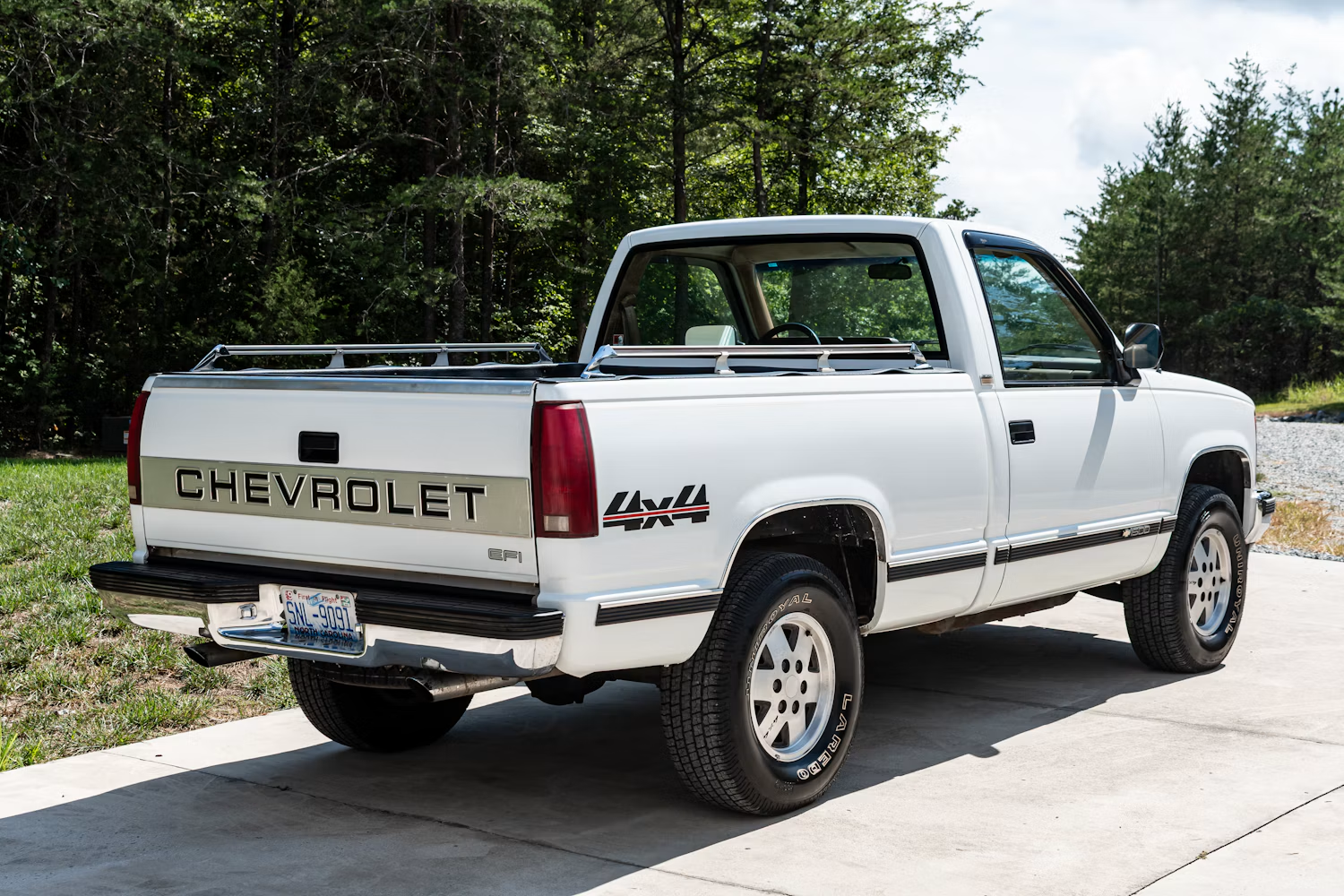
There’s a lot to like about a 1988 Chevy Silverado. First, it’s like a new truck in significant ways; it has fuel injection, overdrive, and it is aerodynamic enough that fuel mileage is roughly the same (it’s 12 city/16 highway, maybe a bit worse than a new truck). Second, this short bed K1500 is only 194.1 inches in length, shorter than my aforementioned Dodge Challenger, not to mention any new pickup, so it will be easy to park and easy to drive. And finally, to many people, this is an “old body style,” or “OBS,” which doesn’t make a lot of sense to me but makes it officially…old. Like it or not, these trucks are hot collectibles, and even though this one has some wear and tear that is appropriate for its age, it’s a well-maintained example of a truck that’s been a part of the American landscape so long that it’s hard to imagine an America without it. Move over, Squarebodies.
Related Reading
My 2000 Chevrolet Silverado 1500: It Only Took One Drive — How Truck Life Won Me Over (by Tyler Schild)
Curbside For Sale: Showroom Condition 2001 Chevrolet Silverado – Who Wants a Nearly New 20 Year Old Truck? (by Tom Halter)























There was so much to these trucks that broke precedent in 1988. Welded modular frame design with a boxed front section, IFS on 4X4 models, rear wheel ABS, flush-mount glass and electronic HVAC controls to name a few features. Ride and handling were superior to contemporary Ford and Dodge trucks, with no loss of load carrying or towing capability. Known inside GM as the GMT-400 series, the trucks were successfully launched in the spring of 1987 with very few issues and strong sales. A GM greatist hit.
This was the less square model ? It still looks about as “aerodynamic” as my house.
More aerodynamic for the time. But considering the reduced frontal area compared to today’s behemoths, it probably has less overall drag.
It’s interesting that the square body was actually called the “round line”. And like most new vehicles, was advertised with aerodynamic properties as well.
Yeah, take a look at the truck in here: https://www.curbsideclassic.com/curbside-classics-american/curbside-classic-1977-chevrolet-c10-pickup-gms-deadly-sin-33-wheres-the-extended-cab/
My uncle had one of the old generation trucks and bought a 1988 K2500 Silverado truck.This then-five year old noticed it.
See my pic below… 1975, and as aerodynamic as a barn door.
What always surprised me about this generation is that it took FOUR FULL MODEL YEARS for the Blazer and Suburban versions.
That’s for sure. Anyone know if there was a reason why?
Figured they had no competition for the Suburban so why spend $$$ to improve the product when you are the only name in town.
I dont get it either, cause they didnt update the heavy duty crew cab models either until 4 years later. Meanwhile Ford kept updating the Bronco and crew cab trucks.
I also think the GMT400 was a paradigmn shift for GM from the 14th floor executives on what programs got priority. GM had spent billions of dollars in the late 70s/80s revamping their car line to just lose even more billions of dollars and see their market share collapse. Meanwhile trucks were earning a tidy profit despite almost no $$$ being spent on them for 10-15 years. GM spent A LOT of $$$ on the GMT400, it was a great truck and showed that spending $$$ on trucks was about the only way the company could stay viable. You look at GM’s car lines in the 90s and they pretty much stayed stagnat in terms of engineering or any real $$$ spent on them(c5 Corvette excluded)
Collectable or not they sure are a popular used import, that one would need laser cleaning and undercoating for compliance then undercoating again after it passed but thats not a biggie, surface rust is a nono here even on a heavy chassis rail, A guy I worked with has exactly this pickup but in green,
It’s a very handsome design and the dash is delightfully 1980s retro! Problem, I recall, is the quality of the materials used. My GM rides of similar design and age, cracked into pieces, melted and shredded. This beautiful truck needs to be garaged or it will do the same. The sun is not this truck’s friend. Love the design, just aware that the next owners will need replacement interior pieces, fabrics and carpeting. They’re brittle with age.
Great design, strong engine, but 1980-90 era GM materials will be an issue. Keep this garaged!
LMC truck makes about every single interior part for these trucks. There are a couple other companies that have a phone book thick “catalog”(I mean website) for these trucks as well.
The aftermarket parts industry is quite insane. All you really need is a chassis, a vin and a title to build one of these trucks
My employer switched from Ford to Chevy with these models. Must have been a pricing issue. The field force guys were not happy and complained a lot – especially about the gimmicky dash controls. One vivid memory of mine: I rode to a project with the serviceman who promptly locked his keys in the truck. I pulled the key to my recently acquired Chevy Corsica out of my pocket and it worked to unlock the truck. What were the odds for that!!!
Ive owned two, both white of course, I like them so much. Factory ordered a C1500 short bed Cheyenne Work Truck in ’93.
Current one is the very last production 2000 K2500, also base trim regular cab. Dash and steering wheel look different to house exploding gas (not air) bags. But, mine has the most common C6P 8600lb GVW option, so they were never installed.
350 now called Vortec 5.7, with port injection it went up to 255hp. Automatic is still only four speeds, bulletproof 4L80E. ABS is four wheel.
I’ll take a “squarebody” any day, here’s my all original ’75 GMC in Colorado, pic taken yesterday at my son’s house at 8800 ft. elevation
Sweet truck. I too would prefer a squarebody, simply because when given the option, I’ll usually take the older every time.
I had a 1990 2WD, Short Bed, 350, 3.73 rear axle.
A decent looking truck is the best I can say about. Other than that it was a complete POS.
At a mere 65kmi the drive train was junk from the vaunted 350 to the rear end. I recall replacing the U-joints at about 30kmi. I was all too happy to trade that pile in for a 1994 Dodge-a vastly superior truck.
I don’t DISlike these trucks but they’re still common as dirt as work trucks to date, in 2026, in the rust belt! In recent years I’ve noticed a strong push by automotive “influencers” to pick these up and that’s around the first time I’ve ever heard them referred to as “obs”, a term/acronym so stupid I refuse to say it aloud.
Personally I’ll take the long lived squarebody, next to one of those these look like a New Beetle compared to an old Beetle. It also bothers me the stepside bed(the least practical, now extinct and naturally my favorite bed) became stylized and streamlined with the body, rather than the erstwhile 1950s bed carried over one generation to the next with only its bolted on fenders updated to match the new style, which to me was the entire charm of the stepside!!!
I also remember this generation really accelerating the trend of suburban commando pickup trucks, when extended cabs firmly displaced the standard cab as the norm by the end of the run.
I’ll take a 92-96 F series or 94-02 Ram, personally
I agree on the OBS moniker, for both the Chevy and the Ford. How can you call something the “old body style” when there was a generation (or ten) before it? Whatever.
Additionally, this was the generation of truck where it became more difficult to tell one generation from the next. I’m usually pretty good with GM trucks, but for the life of me, I couldn’t tell you if a modern F150 or Ram is a 2011 or a 2026. That’s probably on me though.
It’s not just you. GM, Dodge and Ford have had the same styling themes since 1988, 1994, and 1997. I can only differentiate the older models.
I probably am biased because nearly every guy in my family had one of these trucks when I was growing up, but I like them. There’s a reason these trucks took over the suburbs; they’re civilized and economical enough for daily use, in fact, they’re actually more comfortable than some cars, but they’re tough enough to work like the equivalent fords and dodges too. They’re at home in the ‘burbs and on the farm. The only place this gen lost out was with the diesel compared to cummins and powerstroke, but where they won was variety. You could get one for whatever your needs and tastes demanded.
At the time, the extended cab was a relevation. It didn’t add much extra length, and it was a place to store valuable tools that you wouldn’t want in a toolbox. If you went hunting, it was a place to put sleeping bags and guns without having to borrow or buy a camper shell. If you were a self employed carpenter, mason, plumber, drywaller, etc. who didn’t have a dedicated work truck, you could take the kids to school and go straight to the jobsite if your wife had to work early. It could take the whole family to the lake on weekends while towing a camper or a boat, but still be useful as a truck on the weekdays. To blue collar dads of the 90’s, 00’s, and 10’s it was king.
Sadly, most of these trucks may be gone in another 10 years. They’re tough, easy (-ish) to fix, somewhat reliable but tolerant of moderate neglect like most old chevies, and parts are common and relatively cheap, but they’re being run into the ground. They might be better off than later GM trucks and will probably end up being more common, but rust is their biggest enemy. The first half of this generation like the truck in this article also had fragile interiors, as mentioned. The second half fixed that, and may have one of the best GM interiors ever. I think they’ll end up more common, both because they got vortec with the refresh (it may have just been the trucks I was around, but in my memories TBI was about like having a carb on cold mornings) and because at least IMO build quality seems to be better.
The OBS name for the gmt400s came from them being compared to the chevies that came after them, and I think it fits. The new ones all the way to at least 2019 copied their style. Millions of these things are still pounding the pavement 30 years after the last ones rolled off the line, so you have to give them credit. I doubt any GM trucks built after these will be doing that, at least in those numbers.
Don’t get me wrong, I wasn’t trying to take a dig at anything fundamental about them(other than the OBS nickname). What I truly like about them is they ultimately offered the last gasp of real variety! Today in 2026 the crew cab/shortbed 4×4 basically defines the typical median $70,000 pickup truck, that’s most that’s available outside the odd straggler 2wd base with a standard cab shortbed, a combo very well common in the GMT400 era.
I think my bigger gripe today with them is the counterpoint to your assertion that “most of these trucks may be gone in another 10 years”. I disagree. Obviously the used and abused examples still at work today probably will, just as the squarebodies before and the generation before that etc. but to the enthusiasts that proudly call these OBS they seem to be the next horizon of of Chevy truck to collect or customize to their heart’s content. And I personally don’t really don’t consider them all that extraordinary to their F series and Ram peers(the former I consider more rugged and the latter I find the more attractive). I get the vibe that OBS is the fallback for Chevy truck fans to get now, now that the once ubiquitous squarebodies are now so overpriced
Hunh, I’ve always heard OBS used to reference old Fords, not these.
I had a ’97 K2500 XCSB Cheyenne for ~10 years, was good looking and a decent tow pig for our cars and campers but had to put a replacement motor in it at ~120k miles so not a favorite.
People also use that name for Fords…
Most collectible of this generation of truck will be the SS-454 versions. The majority of them came fully loaded, even with a graphic equalizer for the stereo. One can bet there were no block-off plates on the dash of an SS-454.
One aspect that sets it apart and makes it one of the last full-size pickups to remain on a human scale: is its height. It’s truly ridiculous, these days, that a basic, entry-level Silverado stands taller than a 1990s-era GMC TopKick. Why must a basic truck ,the kind often used by public utility services,be so tall and take up so much space on the streets?
Yet if you go back 30 years from the 1990’s to the 1960’s, the scale of the trucks did not change much.
I actually looked up how close to CDL territory a new Sierra or Silverado HD was; it turns out it’s not so close…but it looks that way.
Apparently history repeats itself. The recent models from all three have been rehashes of the same theme every redesign.
Bought my ’88 K1500 5.7L TH700 with 170K miles on it in the fall of 1997.
Currently has WAY over 310,000, but since the odometer has been broken for two years, I can only guess that it’s now around 325K.
THREE major problems with the GMT400 “Half Ton” 1500 series trucks:
1. Almost all the 1500s have the terrible, fragile, brittle “8.5 inch” rear axle. Whether “open” or “Locking”, the differential carrier can shatter for no apparent reason. The 8.5″ axle was originally intended for Compact and Intermediate cars with small-block engines. The full-size cars didn’t get the 8.5 until after they’d been downsized to what was the “Intermediate” size/weight. GM had NO BUSINESS shoving this axle under a full-size truck. The axle was “upgraded” in ’89 to give it stronger axle shafts…but that wasn’t the weak part. They upgraded the wrong thing. Aftermarket differential carriers are a significant upgrade, but there’s a better way…
2. The rear brakes are the “Leading/Trailing Shoe” drums of 254mm (10 inch drums.) They’re not just undersized, they’re designed in a way that almost nobody operates properly. The design relies on the park-brake to keep the shoes adjusted, and nobody uses the park brake. Therefore the shoes are perpetually out of adjustment, leading to low brake pedal and insufficient stopping power. Excessive wear on the front shoe on each rear brake is typical.
BOTH of these problems are rectified by swapping to a 6-lug 2500-series axle–the so-called “semi-float 14-bolt”; the 9.5″ axle design. Swap a C2500 (2WD) axle into a C1500, swap a K2500 axle (4WD) into a K1500–the widths between C and K are different. Match gear ratio to the current axle, especially for 4WD. (Must match the front differential.) This gets you a MUCH stronger axle, AND gives you the wonderful 11.150 Duo-Servo drum brakes.
The only other stuff that needs to be changed on the K1500 is the U-bolts and hardware, the U-bolt plates from the 9.5″ axle, and a conversion U-joint at the axle-end of the rear driveshaft. C1500s are a little more complex since the original wheels are 5-lug, you also need the 6-lug rear wheels to match the donor axle, and then you can’t rotate tires front-to-rear since the fronts are still 5-lug.
3. Regular-cab 1500s up to…’92, I think, usually have the weakest power brakes ever fitted to a GMT400 vehicle. The front calipers are “low drag” units, with very small caliper pistons and thin rotors. These are option code “JN3”. JN5 or JB5 as supplied on extended-cab trucks gives you a larger-diameter master cylinder, a bigger power booster, thicker rotors, and low-drag calipers with bigger pistons. This is ALMOST as good an upgrade as replacing the rear axle described above.
Aside from the brake and rear axle problems of most 1500s, other common problems are:
The Turbo-Hydramatic 700-R4 transmission is weak. The ’88 version is upgraded from ’86 and earlier, but still no Hercules.
Nobody bleeds the Rear Wheel Anti-Lock (RWAL) unit even though it has it’s own bleeder screw in ’88 and ’89, some ’90. Newer RWAL have no bleeder screw, are more-difficult to properly flush the air and old fluid out of.
Later Edit: Do not trust the Genuine GM Service Manual for 1988. There were so many errors and omissions that they issued a Service Manual Supplement to correct most (not all) of them. My service manual has a copyright date of 1986! The ’88 model year was very long.
Great information! Thanks, Schurkey…
Nothing much inside changed over 10 years since I occasionally drive my son’s 1999 K2500 Suburban The GMT400 has gained a following as the square body trucks have become either expensive or rustbuckets. There are a still a lot of this generation in Oregon where the salt doesn’t eat them. The Suburban is doubly unusual as a 3/4 ton chassis with base W/T trim so it has a vinyl front bench, manually shifted transfer case and the gray plastic plastic grille with 2 square lights instead of the more common chrome with 4 rectangular or two composite lights. It’s been a workhorse pulling car trailers to odd places
One quirk is that because the platform was deigned for a diesel there are two battery trays and on gas engined models there is a large plastic box in place of a second battery for storing odds and ends, or for a deep cycle house battery for camper set ups.