
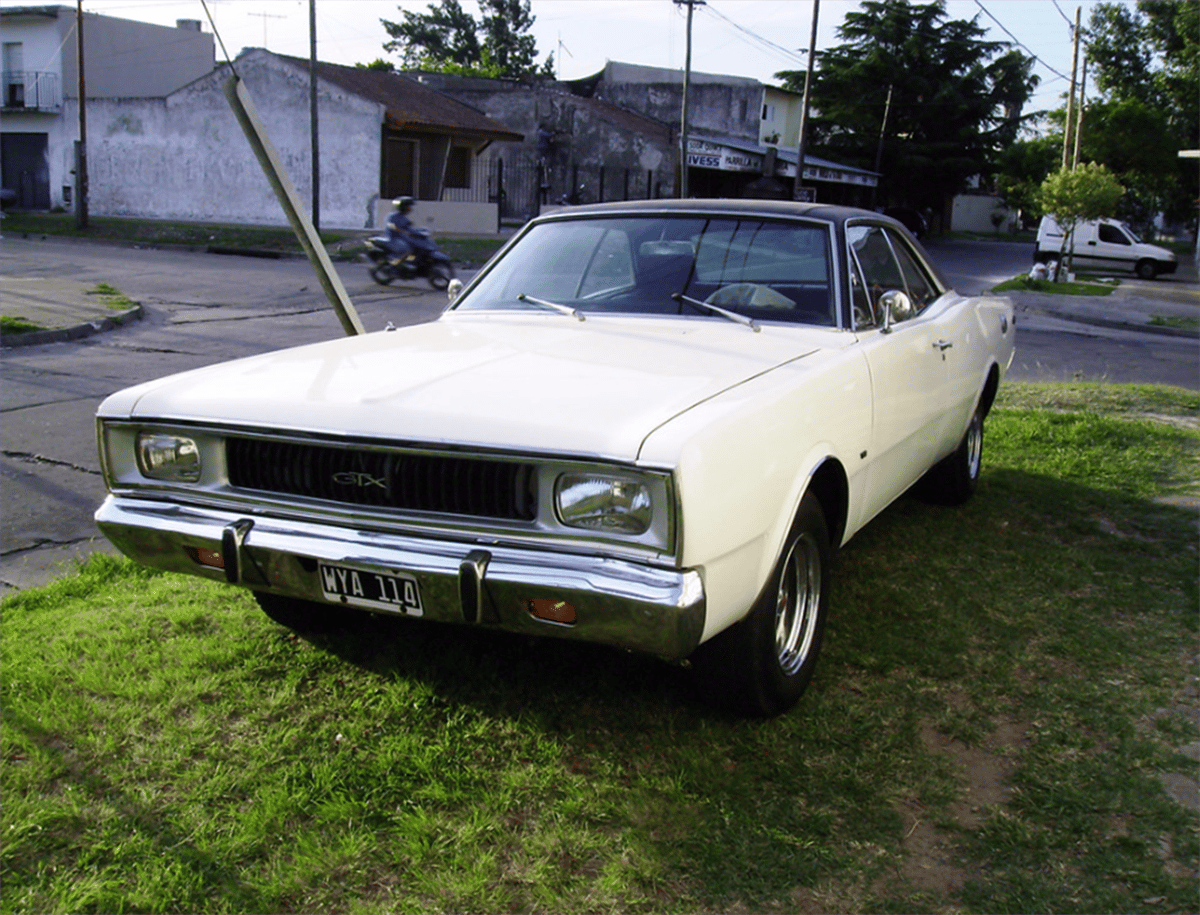
What had curvy body lines à la ’68-’70 Dodge Coronet, rode a 1966 A-body platform, shifted via a 4-speed manual, and offered old-school muscle car flavor well into the late 1970s? A South American Mopar: Argentina’s muscular 1970-1979 Dodge GTX, powered by Chrysler’s 318CID V-8 with 212HP. It wasn’t the most powerful A-body ever by US standards, but the GTX was Argentina’s mightiest factory performance model, a halo car that still enjoys a loyal following today.

Before we get too carried away, let’s backtrack a bit. Assembly of Chrysler products had begun at Argentina’s Chrysler Fevré factory in 1960, starting with trucks in 1960 and the Valiant in 1962, with the usual engineering tweaks required by local needs. Local variations on the A-body formula started early, with Argentina’s Valiant III appearing in 1964, using the looks and stretched wheelbase of the American Dodge Dart. From then on, Argentina’s A-body branch turned toward Dodge, discarding the Valiant name in 1968, and with Dodge taking over wholly that year, wearing the updated looks of the American 1967 A-body line (with minor styling tweaks).

1969 offered updated looks that mixed and matched MoPar styling themes, with headlights shared with the Renault 12 (and others), and that spoke to styling intentions that couldn’t happen in the US yet.
Darts came in Polara, GT and Coronado models, and the advertising above made comparisons to Argentinian Fords; though AMC’s Ambassador and Chevy’s Nova were also contenders in that segment.

Talking about which, such American models were generally upper class material in Argentina; their larger size, higher fuel consumption, and lofty acquisition costs meant that yearly, they sold in the low four figures at best. But “US built” (or US origin in this case) still carried strong positive connotations, and they served as halo cars for US carmakers that had set up Argentinian production. Of course, each maker’s focus was to also offer a volume seller; in the case of Chrysler-Fevré, that would eventually be the Dodge 1500 (Cricket/Hillman Avenger).

Choosing to increase their halo car credentials, the GTX arrived in 1970 wearing “fuselage-light” styling to take over the Dart GT’s sporty mantle, and with Chrysler appropriately boasting about the 318CID’s found in the GTX as the “…nation’s most potent V8”. For shifting, the car came with Chrysler-Fevré 4-speed unit, derived from Chrysler’s 3-speed A-230 (now, the A-230/4).
That said, there was still some tweaking going on, since the Slant Six A-119 in 155HP tune was still offered in ’70-’71 on the GTX. Realizing that muddied the waters, the A-119 Six was dropped for ’72 (moving to a new model, the Polara Coupé), leaving the GTX solely devoted to its Muscle Car role until production ceased in 1979.

Early GTXs still wore fuzzy detailing upfront, similar to the 1968 lineup, while the vinyl top was part of the package. Elsewhere on the body, the fuselage hips gave them a distinctive look that hinted at the powertrain underneath.

As for performance, the car delivered on what its buyers expected, offering American style straight-line acceleration, smooth highway cruising, and a comfortable cabin for long-distance travel. Not sure how this translated to Buenos Aires (never been there; South American readers, fill in those details), but that worked in that nation’s long stretches between cities.

Further styling updates arrived for 1972, with a generally cleaner look.

As for the interiors, faux wood was the norm. Also, they look Dart-Valiant in feel, but one can see that some details are tailored to local market expectations.

Old American iron has a following just about everywhere, with Argentina not being an exception. These GTXs clearly have their fans, and they perform the usual styling upgrades now expected in such survivors.
And while my brain is still going through cognitive dissonance seeing that GTX badge on a Dodge, I’ll admit it looks mighty pretty on those fuselage-light rear fenders.

There’s definitely more to this rabbit hole of South American Chryslers, like the A-body remaining in production in Argentina all the way to 1981. But that will do it for today’s brief look at South America’s funhouse mirror study of American-derived models built there.
Related CC reading:
Dodge Coronado – The A-Body Lived On, Until 1981 In Argentina























Wow. You sure untapped a big source there, Rich. Though it’s logical form an enthusiast’s point of view to look at the hardtop coupe with a V8, there were also slant 6 coupes, and lots of variations on the 4 door sedan theme. And a very interesting spcimen was the Diesel. It had what I think was a Perkins 4.236. I don’t believe it was ever purchased as family cars, but they were theoretically good for taxicabs. Here in Montevideo, Uruguay, 25 minutes away from Buenos Aires by plane and quite a lot by car or bus because of the river crossing needed at the time, bridges coming in the mid to late 70s, Polaras and Chevys with Perkins were the typical big taxis of the day. It was quite common for them to keep the three on the tree, or just to attach the lever from the floor when the movemements got older, but the gearbox was the same. You could lose your teeth in one of those cars, never thought for the vibration of the Perkins. They competed for fares with 1971 Mercedes 115 220D, so you can figure the taxi skyline of Montevideo. Back to the Dodges….as taxicabs, they were so low, that older or bigger people had to bend over in order to get in. So, a 5 meter car, give or take, that was uncomfortable to get in or out, was not good as a taxi. That wasn’t the reason for their short tenure, though. I believe the culprit there was the self disintegration due to incompatibility with the Perkins clatter and the superior result owners got from their Mercedes.
On the other end of the scope, you had the Coronado, which in full deluxe trim debuted a few years later, and which by 1980 or so was automatic, with power steering and air conditioning (not integral with the dash though, more clearly as an afterthought hanging below it), Very expensive, you would see it along with the IKA Torinos and the Falcon Sprints in Punta del Este. From about 1979 onwards, Argentinians were able again to buy imported cars, which quickly destroyed most upper priced local old models.
The overall shape and looks of these GTX models reminds me an awful lot of the `66 Cutlass–esp. from the rear! The greenhouse is such that it makes the car appear the size of a two-door `69-`70 US-made Polara. But that weak 212HP 318….these needed at least the 360 V8 to be considered any kind of ‘muscle’ car.
I’ recognize that dashboard anywhere. Same one I had in my ’69 Barracuda. Interesting how mixing and matching parts in different ways can lead to so many unique variations of the same basic car.
Impressive how extensively the US A Body was restyled, including a whole new greenhouse with curved windows. It’s a very effective disguise, not unlike the ones undertaken in Australia. I wondered if some elements of the greenhouse might have been shared with the Australian cars, but apparently not.
Sorry for the sidetrack, but what’s with the “DIVOLVO S. A.” in the ad in the 2nd picture? Even as a Certified Volvo Nut™, I have no knowledge of Volvo’s exports to South America. So I did some digging.
DIVolvo S.A. was a Chilean company that imported and sold cars from Volvo. The company also acted as the continent-wide distributor and service trainer for Volvo. They also had a factory that assembled ~3000 CKD cars, mostly 122S models.
Sure would be neat to find one of those cars!
This Argentinian version of the Dodge looks beautiful.
If I’m not mistaken, a similar one was made for Spain called the Dodge 3700, almost identical except for the headlights and taillights.
A bit sad to see the fate of this Dodge GTX in the Argentinian movie “Commando Azules”.
Those engines sound like angry lawnmowers.
In typical poor movie fashion, and in spite of the poor driving, there is NO way that the Celica would have caught up with the Dodge considering all the stops it made! Somewhat entertaining, but totally removed from reality! The Celica sounded like a V-8 when started, but quickly devolved into a chainsaw/lawnmower frenzy. I like the styling of the Dodge, except that I feel the rear wheel well opening arched is too high. Always very interesting to see the evolution of American styles into local forms. I await the further rabbit hole of this post!! 🙂
Awesome, Buenos Aires Bullitt!!
If they could a kept that body style here in the states, it would a been a “seller”!
I have more cognitive dissonance over the European-style headlights on a fuselage body Chrysler product than the GTX badge on a Dodge!
The designers actually seemed to yearn for those headlights if you go by the concept cars of the era, like this swinger
Err roadrunner* there was also a dart swinger concept with those headlights but uploaded the wrong picture
I know that 212 hp seems a bit underpowered by american standards, but it really was the most powerfull engine available in the country… until the arrival of the 215 hp Torino GS 200. By 1973 horsepower in the GTX increased to 230 hp. An intereseting race between IKA-Renault and Chrysler that was ultimately won by the latter. Ford and GM played second fiddle in this war.
I had similar thoughts, in my experience, the 318 punched well above its weight
Always loved these, unfortunately my love is limited to pictures of them.
Amazing the expensive to tool areas like the greenhouse have nothing in common with the 66 or the 67 A bodies, and all the better for it. The only thing I find a bit awkward is the rear wheel arch is cut a bit too high, exposing a lot of empty space from certain angles.
But I suppose big fat tires can hide a lot of that.
On second thoughts the wheel arch isn’t too high, it’s the lack of a suitable splash shield.
I love seeing what appears to be the “Super-Lite” in photo #6. I had never heard of that feature before it being brought up on CC