
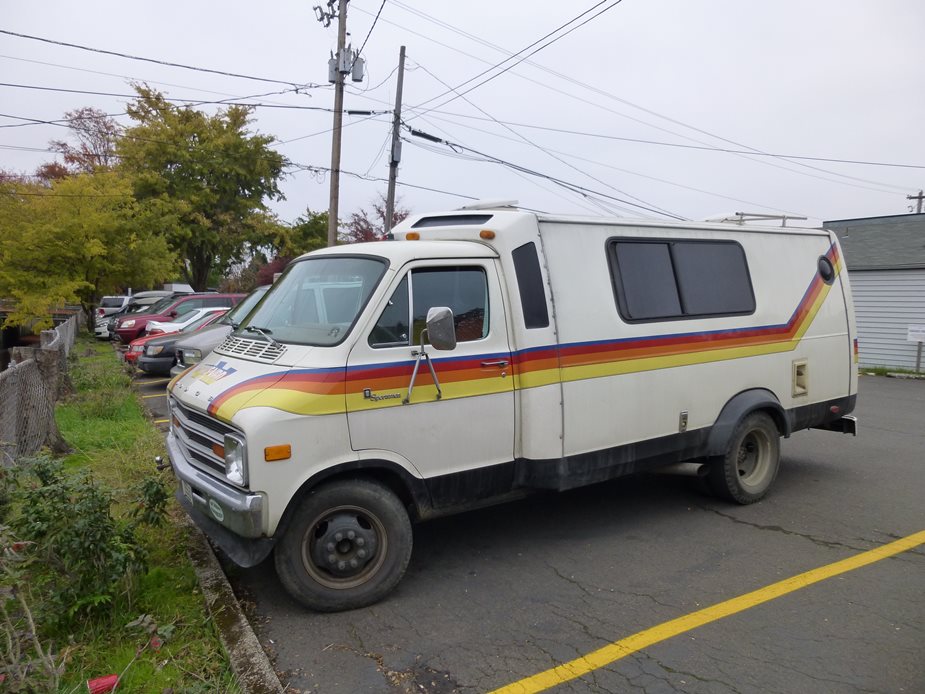
With an enlarged fiberglass body behind the cab of a full-sized van, the 1971 Chinook defined the Class B motor home. It got off to a bit of a slow start, due to the energy crisis, but sometime around 1976 the RV market had once again exploded, as is its wont during times of economic expansion and stable or dropping fuel prices. Thus, a raft of Chinook competitors sprung up in the late 1970s, the Trans Van being perhaps the most significant one. Chinook survived until recently; however, Trans Van, like so many other competitors, did not. Since Trans Vans are getting a bit hard to come by anymore, I was rather happy to recently see this well-cared-for example–and its two big exhausts hint at what’s under the hood.

The Trans Van didn’t have the raised center roof section of the Chinook, so it wasn’t nearly as user-friendly when it came to genuine camping and such. Instead, the Trans Van was closer to a cross between a conversion van and a camper, and its sales pitch relied more on bold graphics. Eventually, the brand developed a bit of a hillbilly rep.

This rear entry was a hallmark of the Chinook (as well as most of its imitators), as it allowed unbroken space in the front part of the cabin for seating/sleeping areas. The bath was conveniently located in the very back, just to the left of the entry door. This allowed a lower floor back there, which made entering the john a bit less onerous.

I’m guessing at the exact year of this one, but since it has the same vintage front end as my ’77 Chinook, and since the new front end came along in 1979, we’ll split the difference.

I can’t be certain of what’s under the hood either, but I’m going to guess it’s the 440. This one is sporting two mighty big exhausts, one on each side. And the 440 became popular in these chassis around 1978 or thereabouts, as the energy crisis faded from memory and folks were sure that gas would stay at 55¢ a gallon forever. Needless to say, these 440 powered Chinooks and Trans Vans were the hot rods of the RV world at the time. As appealing as all that torque is, I’m quite glad my Chinook still had the 360. Except every once in a while…

Note: a rerun of an older post.























I may have said this the first time around, but I once crewed for a vintage race car owner/driver who had one of these. The 440 was fabulous at towing the car on an open trailer, with spare parts and tires inside. Once at the track, it became a sort of base camp/crew lounge. The inability to stand up inside might have limited its use for “real camping”, but it was perfectly suited for track duty.
Friend of mine had a motorhome on a Dodge chassis with a 360. He was a car guy, the kind for whom a 360 would not be enough. He and his brother transplanted a 440 4-barrel from a retired police car into it.
For a backyard project it all went together well and looked like a professional job.
Taillights from a ’71-77 Dodge van are a nice touch.
Those paint stripes and porthole windows couldn’t be any more ’70s if they tried
That’s definitely a ’78, that style of marker light on the front fenders was one year only although the regular Dodge van used the red rear version from ’78 right up to the mid ’90s.
I would love to find an airdam like this one has for my ”78 Plymouth PB200 Voyager van.
Camping in style. A very cool rig. I love the paint scheme.
In the 80s, my great aunt and uncle had something similar. Pretty sure it was a 70s Dodge. Wasn’t a dually, just single basic pickup truck wheels, but basically the same otherwise. Tiny kitchen to the right and bathroom to the left on the rear drop-down section, then the rest stepped up with a low ceiling. Just like this with no cabover sleeping area. Every time they came up here from downstate we would camp in it. They’re both long since passed.
I always liked the Trans Vans ever since seeing auto swapper ads as a kid. Would be fun to have one to take on weekend trips. But my practical side would rather have something FWD, with lighter running gear, to (hopefully) be easier to work on. Of course those go for a ton of money.
Dodge stopped installing the 440 in pickups and vans after the ’77 model year, so either you’ve got the year of the van wrong, or someone replaced a smaller engine with the big block…or, it just doesn’t have a 440 in it.
Distributor’s up front, right? If not, its an LA engine. 360 at the largest.
Nice rig .
It appears to maybe be one piece of fiberglass ? .
That’s the #1 thing when looking at old RV’s & Trailers, the one piece ones don’t develop leaks .
-Nate
1978 was officially the last year. Chrysler had a leftover supply of them and some of them found their way into 1979 later motor homes.
Well ahead of it’s time!
Can cis people use it too?