
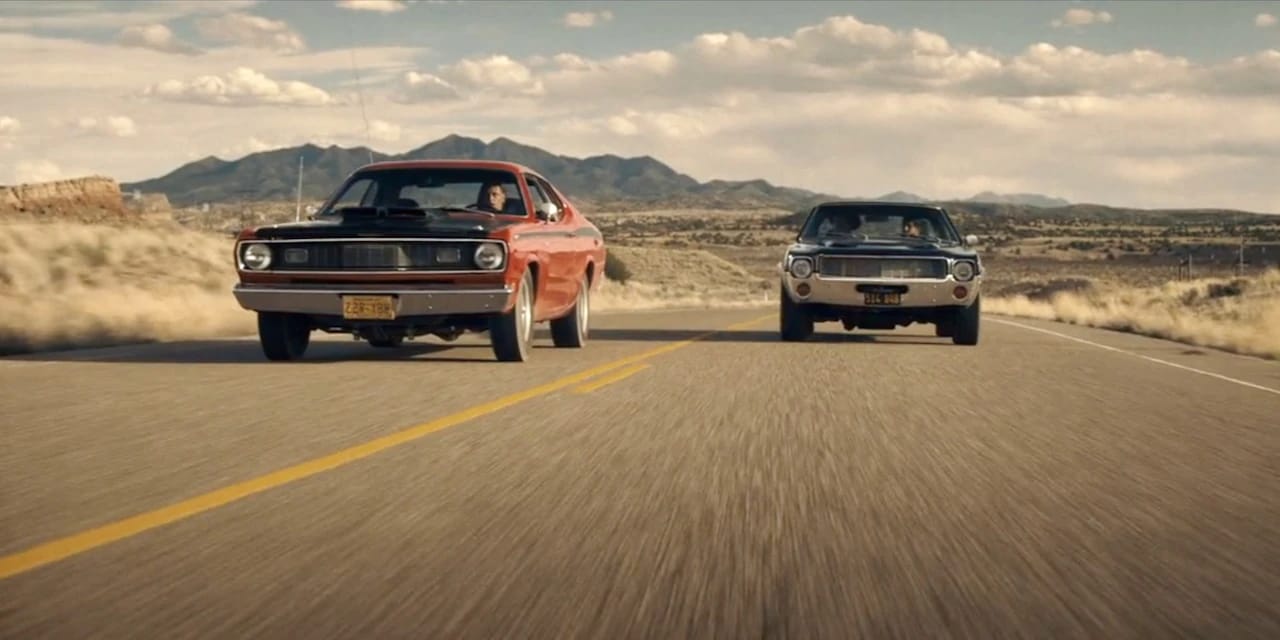
Although it’s already been canceled after its one and only season, the 2025 HBO Max show Duster is a car lover’s dream. Set in Phoenix in 1972, it’s full of car chases, tire-smoking power slides, and period-appropriate vintage cars, including the hero’s 1970 Plymouth Duster 340, which lent the show its name and logo.
Sometimes, it seems hard to get traction, so to speak, with CC articles about television shows. Maybe it’s the fact that CC’ers are too busy behind the wheel. Or perhaps the problem is our fractured media landscape, where nearly every viewing suggestion involves having to subscribe to another streaming service or drop $5 into some mega-platform’s pocket.
Far be it from me to advise you how to spend your hard-earned simoleons, but as a bit of a far-flung correspondent from the land of Popular Culture (don’t get me started on a certain Ms. Swift and her fiancee, who I’ve been told plays some kind of sport), I’m here to talk about Duster, the streaming series on HBO Max (formerly known as Max, and before that HBO Max, and before that simply as HBO). It features lots of cars — maybe more cars than humans, which might well be more of a feature than a bug for many of us.
If you’re a reluctant user of streaming services, Duster is only eight episodes long, short enough to binge over the course of a 7-day free trial. I’m just saying.

Brevity may not a quality celebrated by many media reviewers, but it’s one that I find too often lacking. Duster was canceled at the end of its first (and, as it turns out, only) season, so the viewer doesn’t have to invest the seeming decades it takes to watch many streaming series nowadays. Less than 400 minutes will do you for Duster, and then that’s literally all she wrote.
Duster was produced by J.J. Abrams in collaboration with screenwriter LaToya Morgan. I don’t know if Abrams is a car guy, but he does seem to venture regularly into the action film genre, so I’m going to guess that he cares more than a little about things that go fast and that careen around a set. Morgan served as Duster‘s showrunner. I know nothing more about her than what I can read, but that indicates that among other things she’s a successful comic book writer. After watching the entirety of Duster, that comic book sensibility definitely comes across in the show’s strong, sometimes cartoonish visuals. Duster looks something like a comic book, about cars.
The comic book aesthetic comes through numerous places throughout the series, including the opening credits sequence, created by a French animation studio named “Meat Department” (excellent company name), which features a car chase between what look like animated Matchbox cars. (Follow that link to read about Meat Department’s computer animation process for the Duster title sequence. Fascinating stuff.)
The main automotive character on the show is a 1970 Plymouth Duster 340, driven by main human character Jim Ellis, a talented delivery and getaway driver for a local gangster in Phoenix, Arizona, in 1972. I’m told that the fellow who plays Ellis is Josh Holloway, who had an important role in another J.J. Abrams show, Lost. In fact, I can’t remember much about that show, as I only watched a few episodes before I too was lost. I hear it went on for a while, unlike Duster. A fact that some may say is a blessing in disguise for Duster.

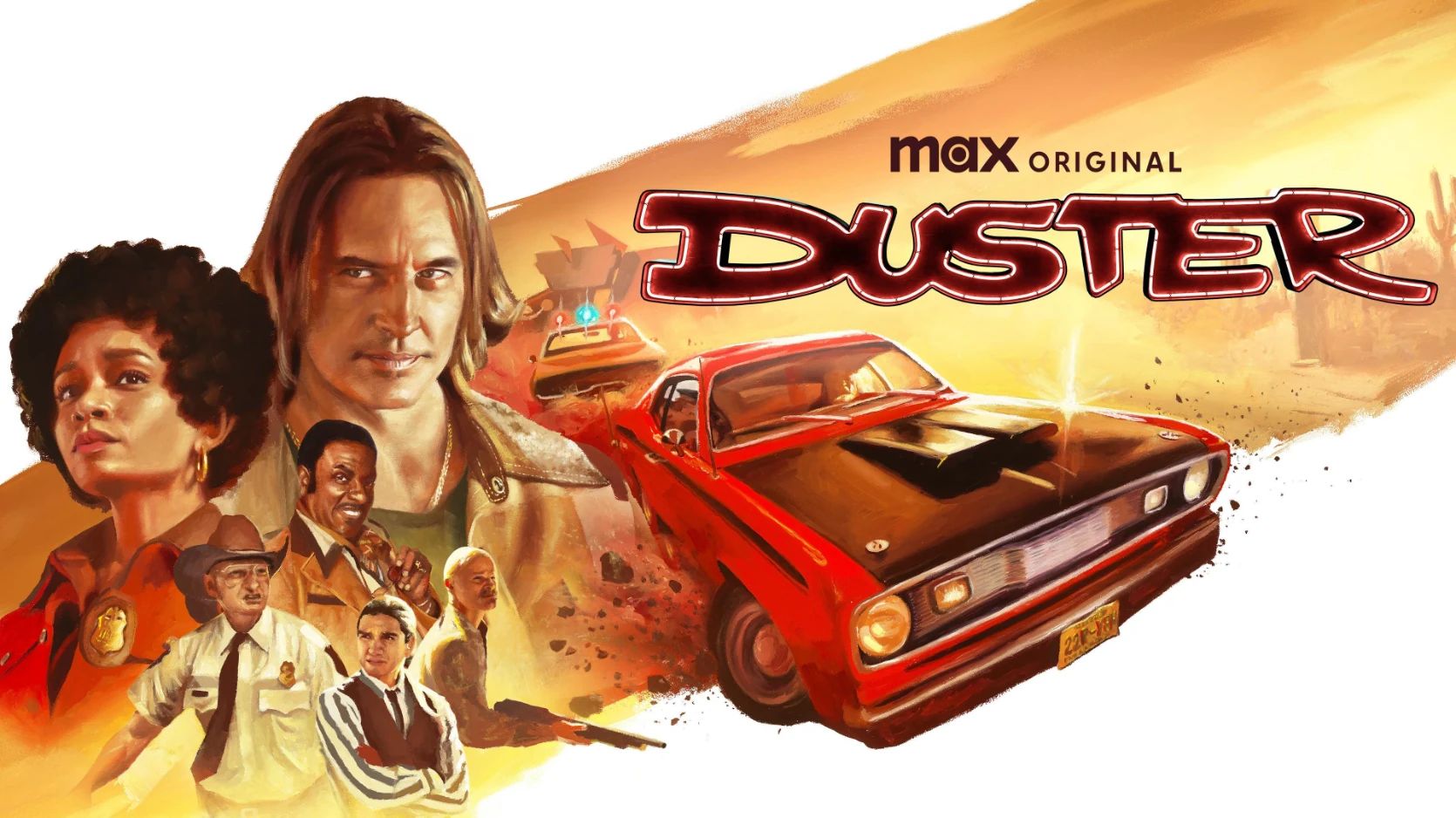
The “Duster” logo of Jim/Josh’s Duster 340 inspires the typeface used on the show’s title sequence and all of the promotional material for the show.

Fortunately, the producers do not make the mistake of portraying the Duster 340 as a Duster Twister, a different model that Plymouth released a year after the Duster debuted. Jim’s Duster lacks the little dust devil tornado thing that conveys the Twister connection. However, the show’s Duster 340 does have a set of aftermarket hood scoops — which makes it look a bit like a 1972 Duster Twister, which came with a different set of nonfunctional hood scoops — as well as the factory-optional rear spoiler.

In short, there is no need on camera to reference the Duster Twister logo, and thus no potential copyright issues related to Taz, the Looney Tunes Tasmanian Devil character. (Taz, of course, was the character that Plymouth wanted to license for the Twister, just as they had several years earlier with the Road Runner, but Warner Bros., having by then wised up to that whole IP thing, decided to hold out for larger bucks. Which unfortunately never arrived.)
HBO Max is also now part of Warner Bros. in some way that I cannot entirely follow: It’s said that somehow in all of the machinations of which media conglomerate glomed with what other glomerate that some of the fallout may have been the cancellation of various production deals and series. If there’s any truth to any of that, maybe Warner Bros. got the last laugh on a Duster 50 years later.
It’s also quite possible — and I say this as someone who watched all eight episodes of Duster — that the show just wasn’t interesting enough to people who might not have been there largely present to look at the cars. True, Duster is compelling in terms of the cars as well as the overall art direction of the show. It also has an absolutely killer 1970s funk and R&B soundtrack. But the narrative is rather slow, and I struggled at times to make sense of some of the character bits. (Jim drives around with a little girl named Luna, who thinks he’s her uncle, but is actually his daughter with his ex-girlfriend Izzy, who tells Luna her father was Jim’s brother, who is dead, except that maybe he’s not?)

Well, never mind that. When was the last time you saw a 1970 Duster, a 1936 Lincoln, and a 1967 Jeep in the same shot? We’ll get back to that Lincoln and the Jeep in a moment. First, get a look at this 1964 Ford Galaxie trying to force Jim’s Duster off the road:

Whooops, no such luck:

Hopefully no iconic saguaro cacti were harmed in the production of Duster.
Unfortunately, a real 1964 Galaxie 500 probably WAS harmed at the conclusion of this shot. This scene was one of the more memorable car crashes in the series, and the producers acknowledged that sometimes it was necessary to sacrifice cars. In those cases, they tended to choose models where they could secure both fully functioning “hero” cars and also rusty, sacrificial versions of the same cars.
Altogether, there were four Dusters used in the series’ production: the hero car used for close-ups and three others that may not have had entirely authentic engines and transmissions, but were up to the rigors of filming, and in some cases, getting banged up.

Fortunately for my peace of mind, when the show features cars near and dear to my heart, there’s more driving and careening than there is flat-out wrecking. One memorable scene surprisingly shows a couple of baddies tearing after Jim’s Duster in a BMW Bavaria! Well, I’ll be. I can’t recall the last time I saw a Bavaria involved in an actual moving car chase.

This Bavaria is (at least so far as the externals go) the real thing, down to the faded roundel.

Unless one replaced the roundel, it would have faded since 1972 … just like mine. I’m not sure why the production didn’t replace it with a clean copy (as it wouldn’t have looked like that in 1972), but maybe they’re hard to find now. BMW has discontinued producing even the rear roundel for my 2008 wagon, so, yeah, they may not be making E3 hood emblems any more. Shame.
In the show, the Duster dusts the Bavaria. Still, the BMW remains shiny side up, and hopefully ready to be featured in some other film some other day. There’s a good chance that will happen, as many of the reported over 250 vintage cars utilized in Duster were sourced via the Picture Car Warehouse, which maintains a huge inventory of vehicles from the 1920s through the modern day.
In fact, browsing the Picture Car Warehouse inventory, I likely found the Bavaria utilized in the above shots. (The company has two identical Bavarias, one with a manual transmission and another with an automatic, with, no surprise, the authentic “Automatic” script removed from the car’s rear. You can guess which one the baddies/actors in the show were likely driving.)

Some of the coolest parts of the show are the street scenes, which is what’s happening when there’s not some kind of sort of boring (and at least for your author, sometimes difficult to follow) dialog happening. A Volvo 145? Excellent. Right there with a 1971 Mercury Cougar and a similar-vintage Ford LTD.
Duster is filmed in Arizona and New Mexico, and the earth tones of the Southwest seem to be a big part of the show’s color palate. As I prepared these screen captured images for this post, it really became clear that so many had a dusty brown color. This is clearly intentional on the part of the show’s art directors. Plus, the period cars used tend to heavily favor the browns, ochres, and various shades of light blue that were all the rage in the early 1970s.

It would be remiss to discuss Duster and not mention one of the more bizarre vehicle choices for the show. What you’re looking at here is supposed to be a 1936 Lincoln Model K V-12 Limousine as modified by Howard Hughes. The resulting “Aero-Mobile” is a vehicle suiting the man who brought the world both the Spruce Goose and Jane Russell’s bra. Meaning, it’s decidedly weird.
In Duster, a replica Aero-Mobile features in a subplot involving Howard Hughes. Hughes was still alive in 1972, albeit at the height of his notorious eccentric period, obsessed with Kleenex, nudity, codeine, and Baskin-Robbins 31 Flavors Banana Nut ice cream. The Aero-Mobile is real, but the actual car is valued at over $1 million, likely more than the production’s budget.

The Duster/Aero-Mobile plot thread involves one of the recurring characters driving the flathead Lincoln too fast flat out and managing to overheat it. What follows is an equally inexplicable sequence where the car is limped into a roadside garage (in the middle of the Arizona desert) that is willing to work on it, and proceeds to put the Lincoln on a lift to examine the clearly over-boiling radiator. Then, after having seemingly nothing done to it besides some twiddling with something on the underbody roughly under left side wheelwell, the car is driven away at speed. Riiiiiiiight.
It seems that a lot more attention was put to visual composition in Duster than accurate wrenching.

Once again, never mind: I’m not recommending Duster as a tutorial on prewar cooling systems. Not when there’s gorgeous scenery, artfully composed shots, and the chance to spot a 1960 Studebaker Lark. I also think that’s the back end of the same Jeep Gladiator that appeared elsewhere in this same episode (and in an earlier screenshot above). This rear view confirms that it is the so-called “Thriftside” version of the Gladiator. (Thriftside being the stepside bed versus the smoother and presumably more fancy “Townside”.) The Thriftside does look somehow more authentic for this rustic, hard-working setting. It’s unfortunate that the Lark isn’t a 1962, as that could have allowed for further TV show — and equine — connections.

Duster really excels in properly populating its background with authentic-looking cars, and this is what inspired me to bring the show to your attention. The screenshot above is from a scene that involves a drive through the Navajo nation community of Leupp that exemplifies the producers’ attention to choosing background vehicles that are older and more utilitarian than those that would likely be found in the more urban locations featured elsewhere in the show. Someone carefully thought this through and then went out and found the proper cars. I think that’s worth praising.

Urban locations such as Tuscon and Albuquerque are used as the primary backdrops, and allow the show to feature a wealth of vehicles you’d commonly see on the streets in 1972.

And, just as in real life, some of the same cars keep turning up. That 1968 Ford Ranch Wagon at the right in the screenshot above appears several more times during the eight episodes, in entirely unrelated scenes.

As do several other brown Ford products, such as the brown LTD sneaking into the left side of the above shot.

So, take a look and see if Duster takes you at least a little way back to 1972, to a time when comic books, fabulous R&B coming out of monaural radio speakers, and go-fast cars filled your days. Maybe have a big dish of banana nut ice cream to go with it. (Ben & Jerry’s makes a decent version if, like Howard, you’re into that stuff.) If you weren’t around in 1972, then maybe Duster can be something of a window into a kind of short-lived lost world — one that may or may not have had quite as many brown or blue cars as you see on screen.
Except as otherwise noted, all of the blurry screen captures accompanying this article were taken by the author and are intended solely as (lo-fi) fair use illustrations in a discussion of HBO’s acclaimed copyrighted programming.
Related Reading
Curbside Classic: 1972 Plymouth Duster 340 – The Tweaker (by Paul N)
COAL: 1972 BMW Bavaria – Right Place, Wrong Time (by me)
Vintage Car Life Road Test: 1970 Plymouth Duster 340 – “Re-Roofed Budget-Racer Valiant” (by Aaron Severson)























Almost sounds like Jason Shafer’s Louis Broderick character brought to the small screen. Maybe his attorney should look into having his material filched! 🙂
Wow, now I have to watch an episode or two of Duster. And I do need to schedule an appointment with my attorney to update my trust.
At one time I had an elaborate back story about Louis, but time and other distractions killed that.
The Duster logo and image are a fascinating marketing story. It’s well-known how neither Warner Bros. nor some in Chrysler management thought the 1968 Road Runner would be a success in any form, which explains the low $50k price to license the cartoon image. When the car turned out to be a hit, over just the first two years, the big sales numbers meant that the cost of those little decals turned out to be less than $0.50 per car. So, when Chrysler went back to use the Tasmanian Devil character, obviously, WB wanted a whole lot more.
But the interesting thing is what, exactly, would Chrysler have called their new A-body coupe if they had gotten the rights? With all those syllables, ‘Tasmanian Devil’ doesn’t exactly roll off the tongue. My best guess would have been ‘Taz’ as he was colloquilly known. So, the Plymouth Duster would have been the Plymouth Taz?
And then there’s the whole personality thing. The Road Runner was a whimsical little guy with a winning attitude. Taz was more on the other side as a foil to being constantly outsmarted by Bugs Bunny, closer to Wile E. Coyote than the Road Runner. Not exactly the same.
Combine that with an alterate idea floated for the Duster 340 as the Duster ‘CK’ (as in ‘Clark Kent’) which I’m sure DC Comics would have wanted a bunch to use, as well. Would it have been the Plymouth Taz CK?
In the end, everything seemed to turn out for the best using the Duster name and a similar (but not legally contentious) dust-devil image. I have no doubt that there were many at Warner Bros. gnashing their teeth over that one, and you can bet they checked with their lawyers.
I remember hearing a rumor that Chrysler wanted to build a Neon Road Runner in the ’90s – basically the Neon ACR with cartoon decals and an ad campaign – but by that time WB had a licensing/product placement agreement with GM.
There was the Warner Bros. Edition of the Chevy Venture minivan with Looney Tunes characters, so that sounds plausible.
Hmm, maybe I’ll binge watch this while my wife’s at work. I’m not an expert on 1960’s pickups, but isn’t the one pictured in the photo at the Navajo Resrvation a Dodge, not an F100?
Yup definitely a Dodge, and the brown car in the second to last photo is the Cougar again, not the LTD.
I like Tassie Devils I have stuffed toy one in my Hillman on the dash, it has only ridden in classic cars they are cool critters, many late nights on the verandah watching those Devils and Quolls come out to play.
Nobody sent Plymouths here that late in the 20th century, so Dusters and their kind only showed up later as used imports and very few are here so just another car we could not buy and dont really relate to, expecting anything accurate in US movies is a faith I lost long ago, sound off I bet its entertaining though.
I had not heard of this one, and should check it out. Any show that goes to the trouble of finding a Studebaker Lark should be rewarded!
The 68 Ford wagon you point out looks to me like a 67, though my view of the taillight isn’t very clear.
My thoughts exactly (re. the Lark)!
Glad to see some love for “Duster”. I really enjoyed it and wish it had been given a second season.
Nice article and thanks for the links as well .
I love the Desert although I choose to live in town and this show sounds interesting .
I avoid the T.V. for the plague it is but maybe, just maybe…..
-Nate
Thanks, Nate.
re. TV…as we used to say back in the day.
https://thebaffler.com/salvos/r-i-p-kill-your-tv-zaitchik
It’s of course only gotten more complicated in our robot-controlled universe.
Thanks Jeff. This showed up on my HBO Max (or whatever it’s called this afternoon…) a while back, and I was curious about it. Sounds like it has the virtues and defects of current productions (we’ll throw this potential storyline here and there, see if it gains interest, and we’ll take it from there… later!), but with enough car content that will make it worth the effort of checking out.
“Duster” is what I would classify as “a pretty good time.”
As Jeff says, it rambles an awful lot. You know the feeling of getting up to go to the kitchen and forgetting what you were looking for once you’re there? The show’s plot is like that. I think it probably would have been better if they’d treated it more like old-school network TV, where each episode’s plot is done in one and you’re not expected to keep track of subplots even the show’s writers kept spacing out on. It’s also more violent than the typical ’70s show, and every now and then, it gets a bit gruesome, because it’s on HBO Max.
However, it looks cool, it sounds cool, there are lots of neat cars, and hero Jim Ellis has a kind of mellow macho swagger that feels like James Garner in “The Rockford Files” (probably on purpose). He can fight when not in his car, but he’d rather not if he doesn’t have to; he likes women, but he’s never tense about it, and you can see why women like him. Unlike a lot of modern streaming show characters, he’s not a twitchy dweeb or a rage monster — he just wants to do his (criminal) job and not get hassled.