
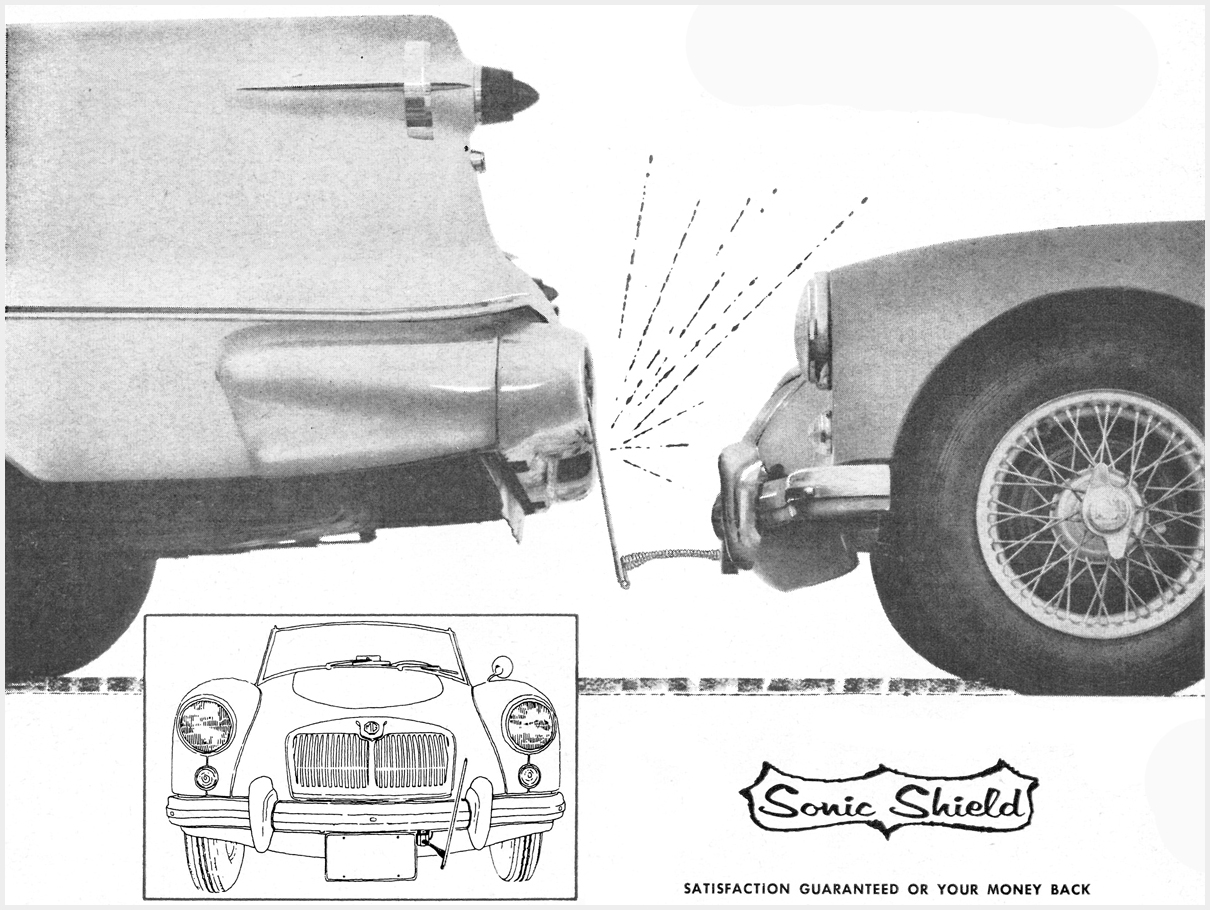
Who hasn’t parked somewhere, only to find that someone later parked their own car inches from your bumper – or worse, backed up until hitting your car? That scenario is even more troublesome when cars have different bumper heights, since actual bodywork could be damaged by a minor tap. A California engineer must have thought he’d solved this problem with a device that could attach to a car’s bumper, connect to the horn, and then sound the horn if another car got too close. When I came across a full-page ad for the “Sonic Shield” in a 1957 magazine, I figured it was too good not to highlight here.
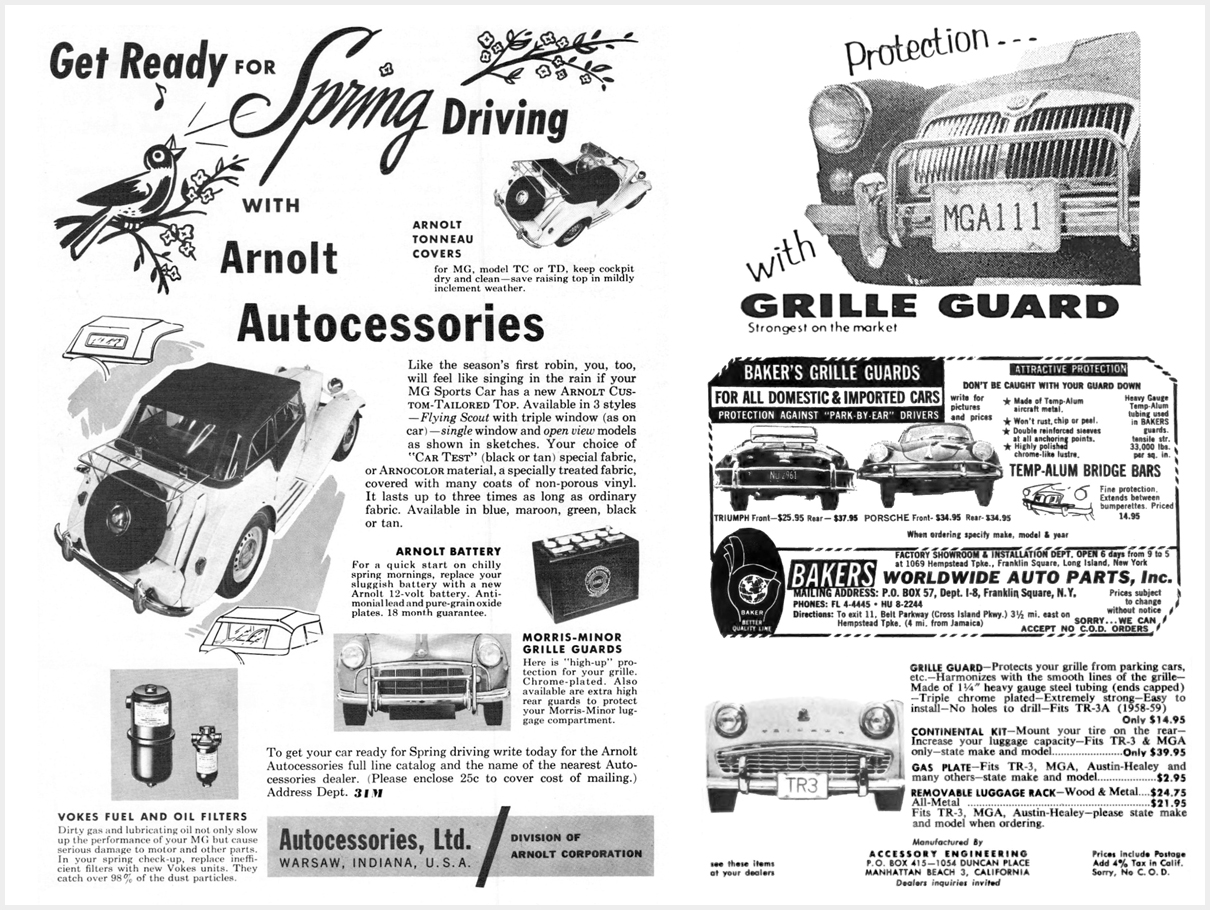
Sonic Shield was certainly not the only bumper enhancer available to consumers at the time. Bumper bars, or grille guards, were common, especially for low-riding sports cars. “Bumper overriding” – where a striking vehicle makes contact above the other car’s bumper – can turn even parking-speed contact into a major headache.
What makes our featured product different is that instead of being a bumper reinforcement, it’s more like an alarm.
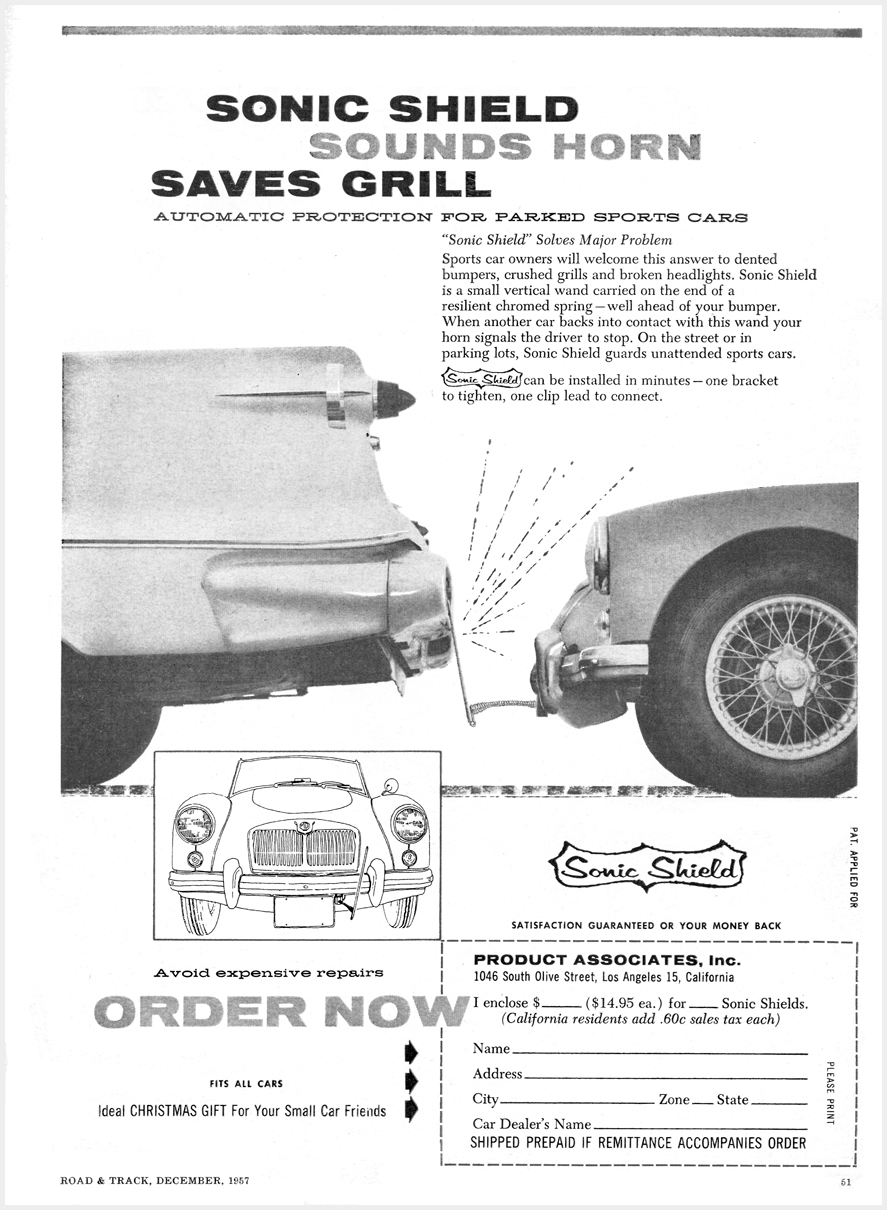
Here’s the full Sonic Shield ad, billed as “automatic protection for parked sports cars.” The ad (from the December 1957 issue of Road & Track) explains how this works:
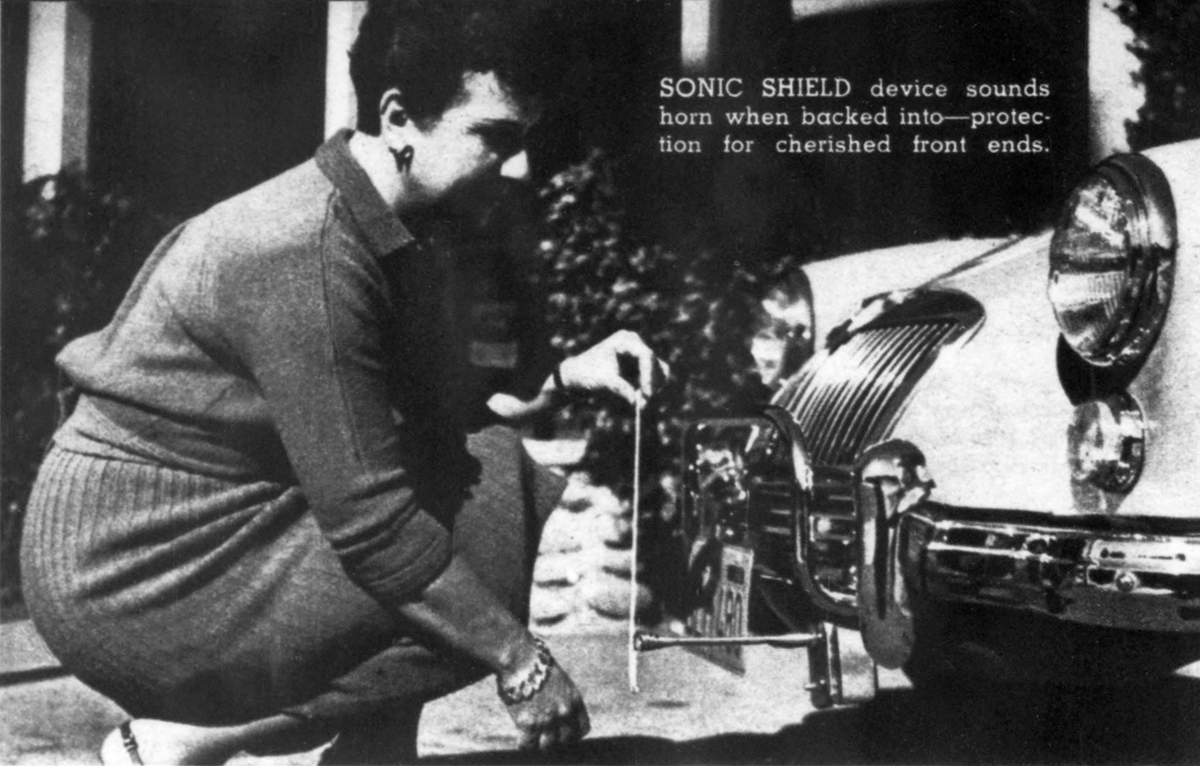
Sonic Shield is a small vertical wand carried on the end of a resilient chromed spring – well ahead of your bumper. When another car backs into contact with this wand your horn signals the driver to stop. On the street or in parking lots, Sonic Shield guards unattended sports cars.
Sonic Shield can be installed in minutes – one bracket to tighten, one clip lead to connect.
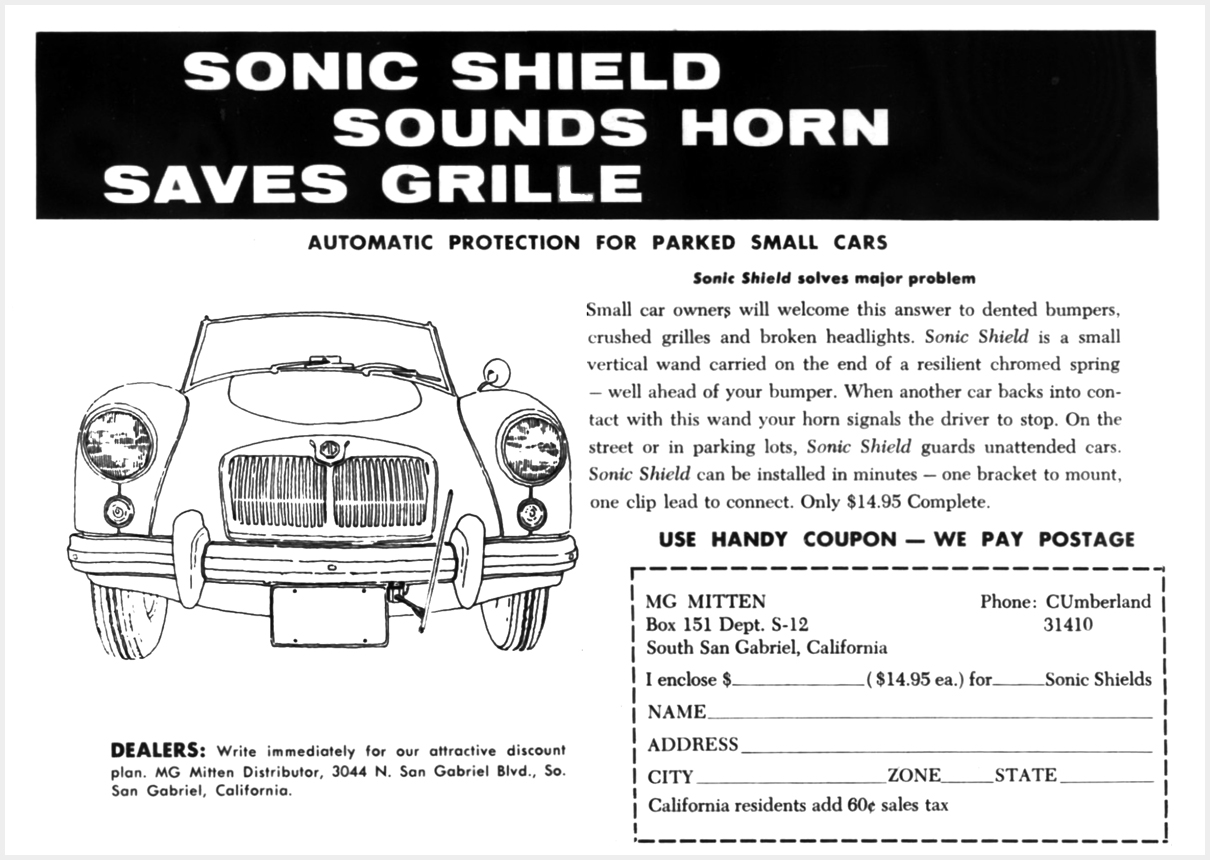
Most other Sonic Shield references that I have found came from MG Mitten, the California sports car accessories retailer that ran monthly ads in many enthusiast publications. These were smaller ads, though the price of $14.95 per unit (about $176 in 2026 dollars) was the same.
In trying to dig up more information about this obscure product, I hit a wall with the company listed in the full-page ad. “Product Associates, Inc.” brings up few hits. But then I noticed the small print “PAT. APPLIED FOR.” Eventually, I found the Sonic Shield’s patent, which shed some light on its inner workings, and also on its inventor.
James T. Blakistone of Alhambra, California was listed as Sonic Shield’s inventor. Looking at an inventor’s background is always a good place to start, and what I found intriguing here was that in the 1950s and ’60s, Mr. Blakistone received ten patents, yet the other nine involve data processing systems. So he didn’t appear to be an auto-centric tinkerer.
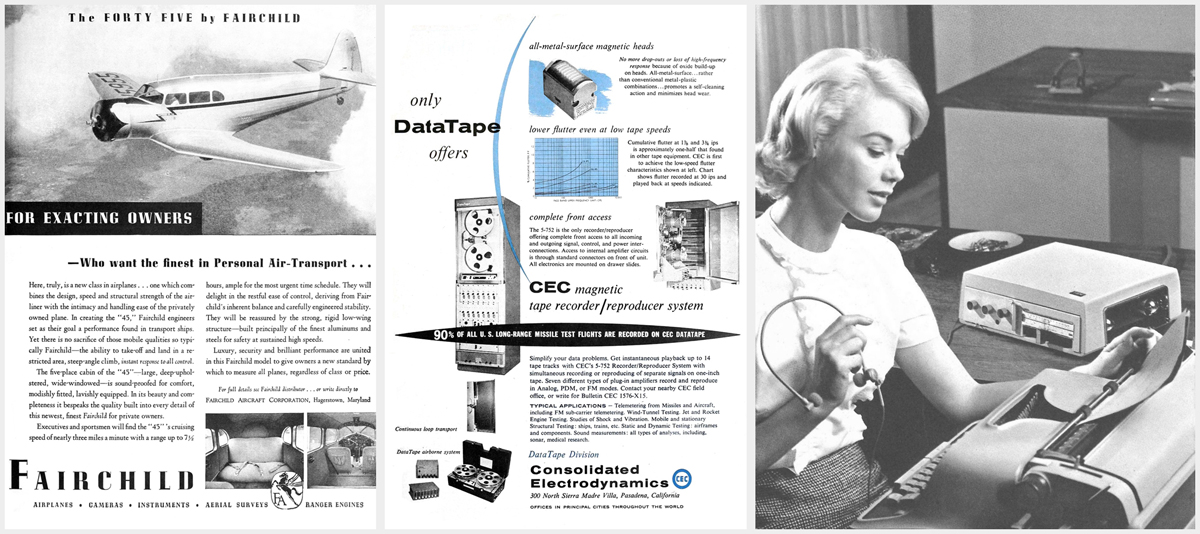
From what I can tell, Seattle native Thomas Blakistone (he usually went by his middle name) attended the Massachusetts Institute of Technology in the late 1930s. After college, our inventor worked as an engineer with Fairchild Aviation Corporation in New York, then in the 1940s moved to Southern California. In the Golden State, Mr. Blakistone began working in the field that would see him through to the end of his career – data processing. His work may have started with the types of data recording used in the aviation industry, though he quickly migrated to audio transcription machines. In other words, nothing automotive.
One can only speculate how a data processing engineer developed a product to help with parking. That’s lost to history (or, more likely, was never recorded history to begin with), but a reasonable guess is that he owned a sports car that suffered damage due to a bad parker.
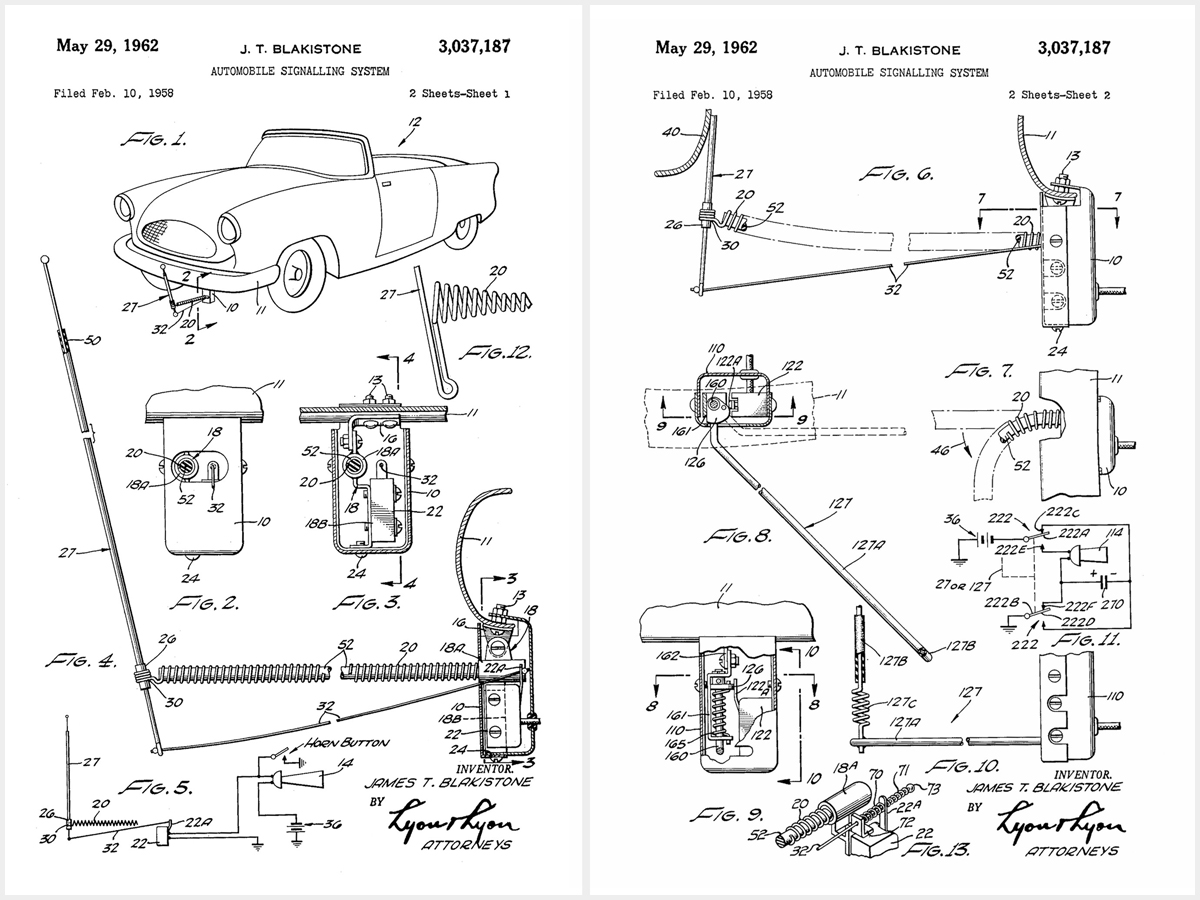
A glance at the Patent’s drawings explains this product’s operation. The most visible aspect was a ten-inch-long vertical wand attached to a spring that protruded from underneath a car’s bumper. This arrangement clamped on to the bumper’s lower edge, and a car backing up too close would make contact with this wand before harming any bodywork.
The wand-and-spring contraption connected to an actuating member for a single pole/single throw switch, and that in turn connected to the car’s horn. When an offending car’s bumper made contact with the wand, the switch closed, and the horn activated. Cleverly, the switch only closed when the wand bent in such direction indicating that a car with a higher bumper made contact (the horn wouldn’t sound if a bumper of similar height made contact, or if the car was driven close to a wall).
If the geometry of the bumper contact was just right… well, everyone within a few blocks probably noticed. The Sonic Shield didn’t just emit a gentle beep – instead, the horn sounded until the wand was no longer being bent. This likely diminished the real-world practicality of using the Sonic Shield. A beep could have a desired, but not obnoxious, effect of letting another driver know he’s too close. But a continuous honk until the car moves? That would come off as a bit spiteful.
Another practical flaw likely came with the product’s installation. The advertised claim that Sonic Shield “can be installed in minutes” was probably true, but there was no quick-release feature. Car owners would either spend “minutes” after parking lying on the ground fussing with dirty under-bumper clamps – or would need to drive around with a proboscis-looking thing sticking out from in front of their car. Neither seems like a great option on a routine basis. Sonic Shield’s usefulness likely took a big hit with the lack of an easy setup.
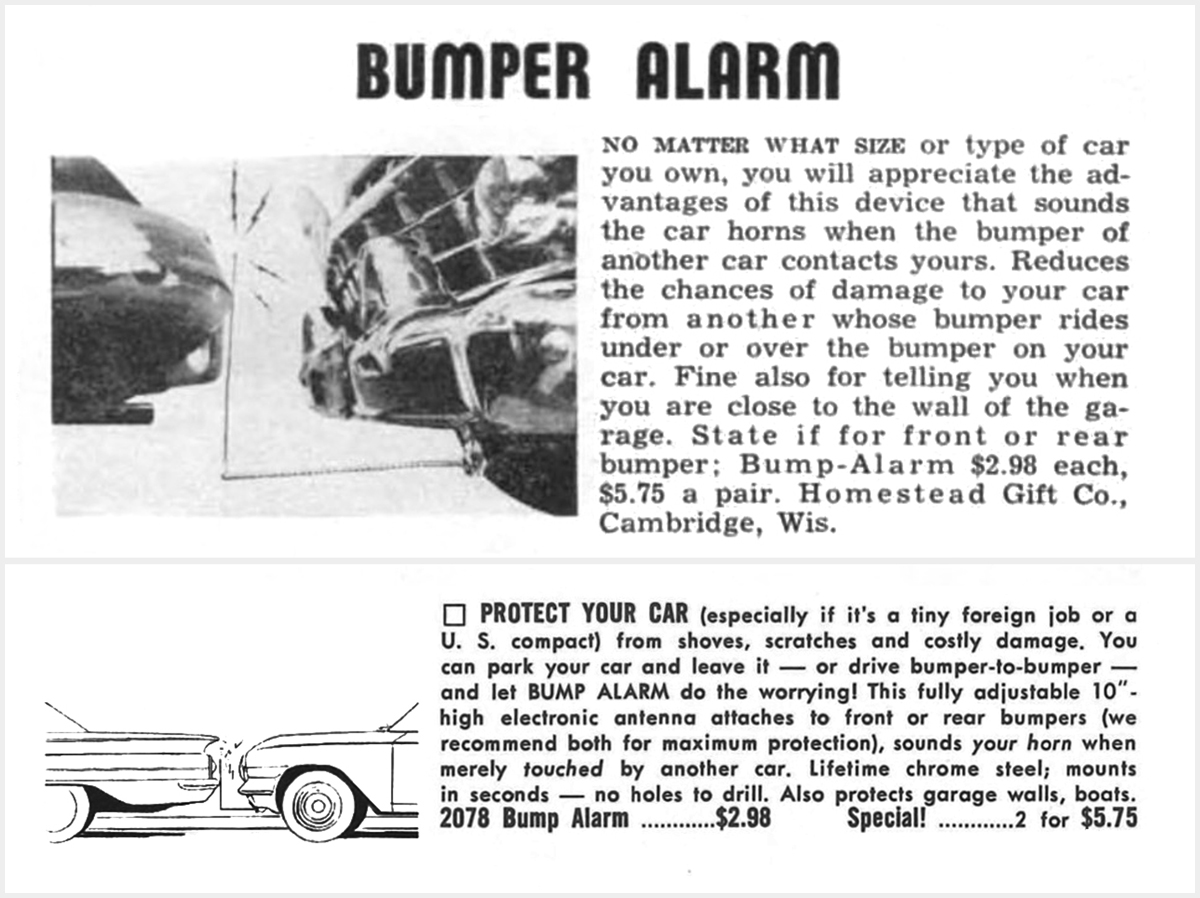
No information exists on the Sonic Shield’s market success, though it probably wasn’t great. The product disappeared from MG Mitten ads after about a year. In 1960, a seemingly identical product popped up from other retailers under the names of “Bump Guard” or “Bumper Guard,” at a vastly lower price. Instead of $14.95 for the original, here it was advertised for $2.98 – and from a company in Wisconsin.
The last Bumper Guard ads appear to be from 1962, which is ironic because in May of that year, the US Patent Office issued Mr. Blakistone his patent, which had been submitted nearly four years earlier. Undoubtedly, this was a hollow victory for the inventor – rewarded with the ultimate confirmation of novelty, just as the product itself slipped off the market after not selling even at a bargain price. There appears to be no evidence of this product re-emerging in the auto accessories market after the patent was issued.
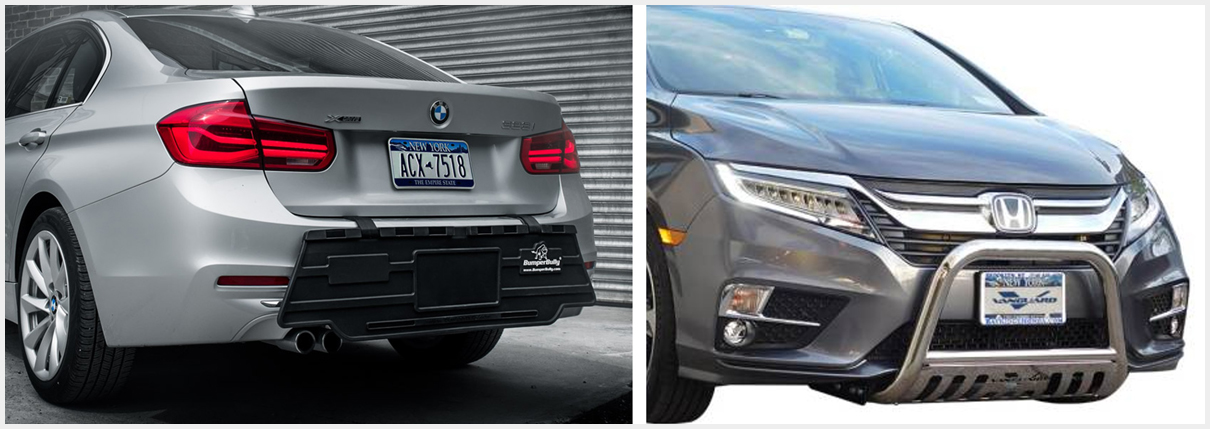
This nuisance that Sonic Shield attempted to solve – minor parking contact between vehicles – is still a problem. Though the US government standardized car bumper heights in the 1970s, those standards became largely irrelevant with the increased popularity of light trucks, which are exempt from those requirements. Modern solutions for parking damage tend to involve rubber mats that flip down from the trunk, or bull bars that give any car making contact a mighty punch.
Mr. Blakistone deserves credit for devising an imaginative solution to an everyday problem. However, his invention was likely too much of a hassle for most people to use. That very impracticality is what makes the Sonic Shield fascinating in retrospect. One can just imagine quite a few sports car owners received Sonic Shields as Christmas gifts in 1957 – we can only wonder how many of those were still in use through 1958.










Very interesting device! The ultimate extension of a curb feeler!
Having had, twice, a low car hit by a taller vehicle who was reversing, i can certainly appreciate the usefulness, but I agree with your observation: the lack of quick release is a pretty big negative point. I certainly wouldn’t drive around with such a device attached
Terrific juxtaposition of towering Imperial fins, vs. the [literally] down-to-earth MGA.
Great idea. Modern cars have sensors in the bumpers to warn the driver if they get to close to an object. Would be nice to have a blast of an air-horn if another car is getting too close to your parked car. Twice I have have the corners of my bumper rubbed by another car parking, nothing I can not rub out. I want my parked car to blast a train engine air-horn that will rattle the glass of the other car before they bump me.
People park by ear in New York.
Police will no longer take a report for or investigate a “property crime,” referring you to “insurance.”
Not only in NY…I’m just imagining any place in larger French cities where people deliberately push parked cars with their own to gain those crucial centimetres of space in the eternal quest for the answer to “will it fit or not?”.
Besides, a marred bumper irks me less than the scratched paint or even the dents in the doors caused by those, ahem, “contemporaries” who don’t give a flying *yessir* on a rolling bagel about the property of others and flee the scene afterwards.
Maybe someone should invent a device which incinerate their vehicles on the spot if incidents like these happen?
I can see this from beginning to end: he got the delicate low front end of his MGA or Porsche clipped by a big car and was furious. Being the the brilliant inventor he was, this was his answer. But he failed to see how ridiculous it would look driving around with this on the front end of your 356. And from that picture of the woman with the unit on an MGA, it looks like it hangs quite low, so the next steep driveway curb and…bang!…off it goes. Good riddance!
Modern car “bumpers” are hardly that. Even the smallest touch leaves damage.