
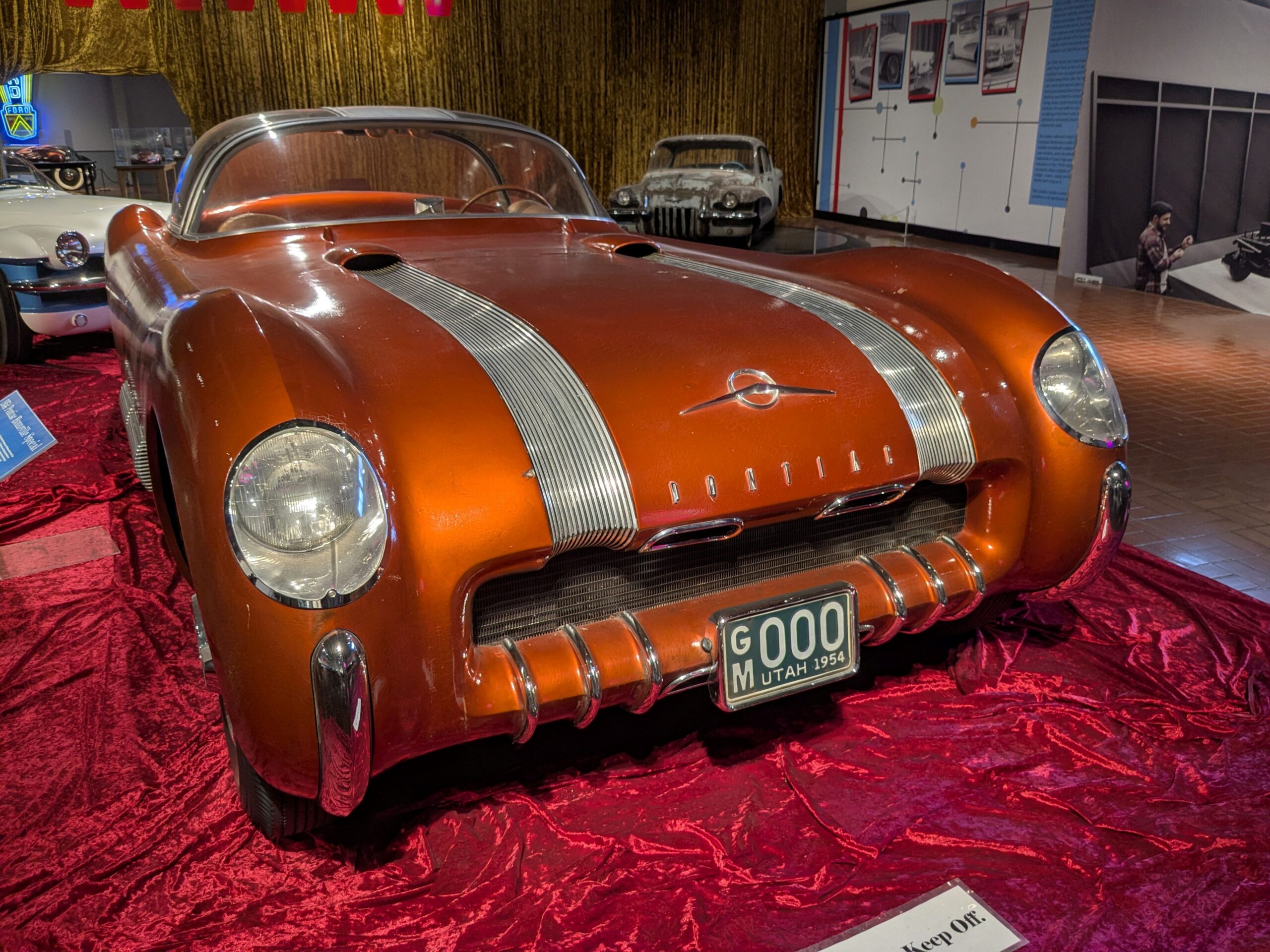
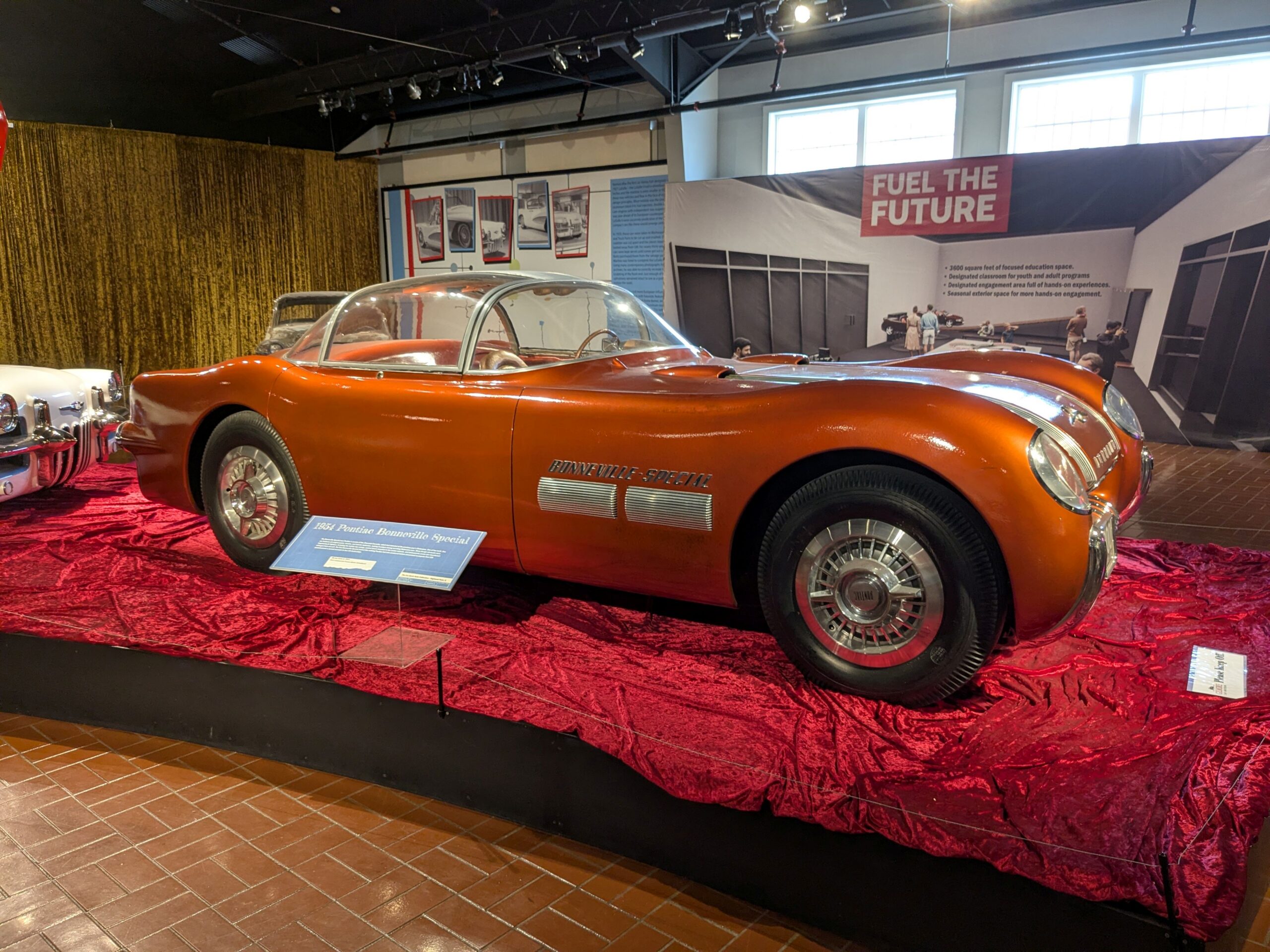
As I sat contemplating a room full of General Motors Motorama dream cars, I said to my lovely bride, “I don’t want to live a life where I don’t get misty in a room full of Motorama dream cars.” Luckily, I don’t have to, as the Gilmore Car Museum in Hickory Corners, Michigan, has showcased the collection of Joe Bortz, a well-known dream-car fanatic, as the centerpiece of its 2026 season. One of the standouts is this completely original 1954 Pontiac Bonneville Special.
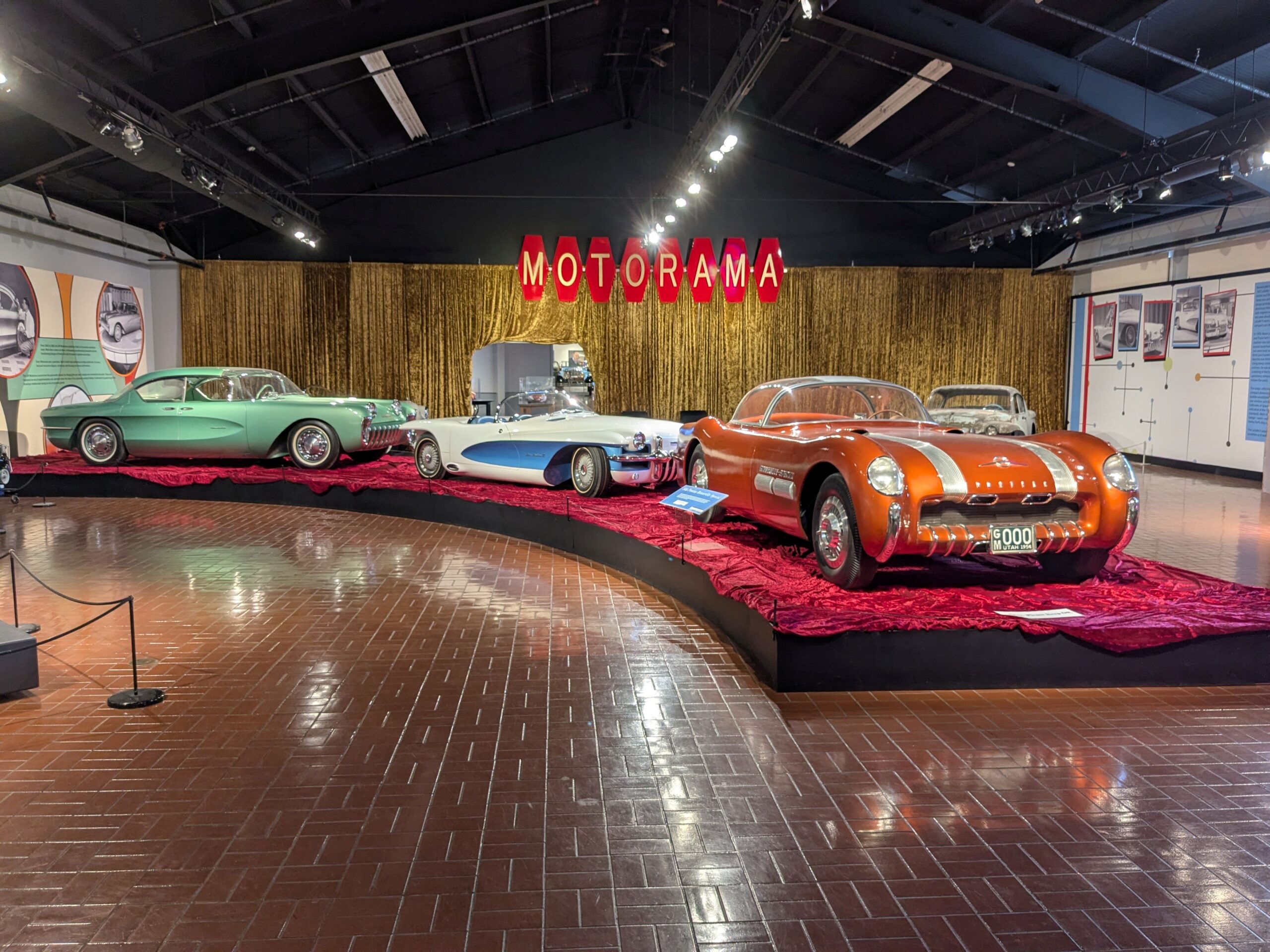
Mr. Bortz is very obliging with his collection, as it’s made the rounds to museums such as the Petersen in Los Angeles, not to mention multiple car shows. I’ve seen several of his cars independently over the years, but the opportunity to see them all together might be my last, so I made the five-hour round trip twice this year. For car weirdos like myself, it’s a holy experience. I’ll highlight some of the other cars, including the LaSalle II and the Biscayne, over the coming winter months.
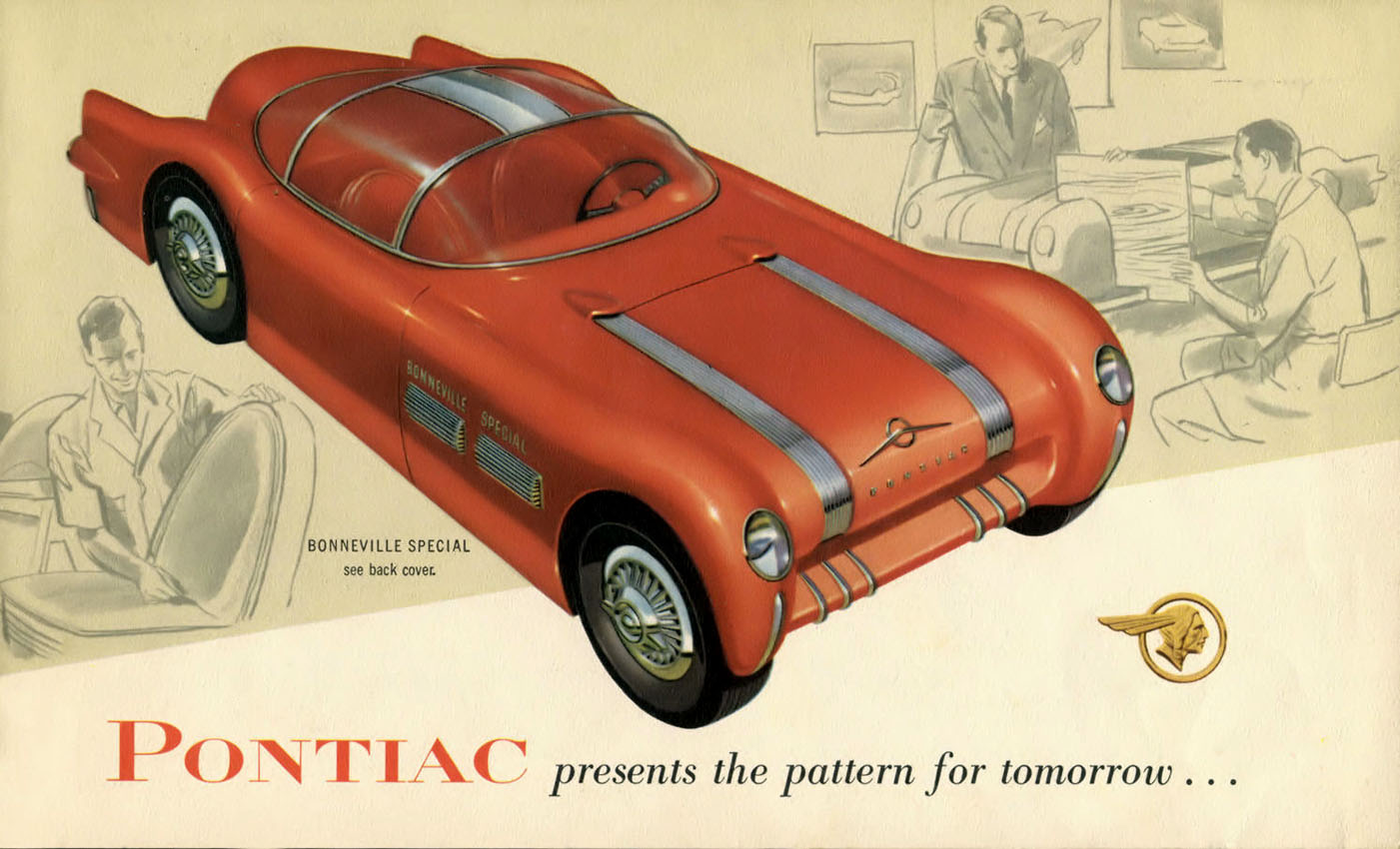
For those who are unfamiliar with Motorama, it was the pinnacle of General Motors’s might in the 1950s and early 1960s, a postcard for corporate excess in its most artistic manner. GM pumped out dozens of dream cars, mostly in fiberglass, for their not-quite-annual events that traveled to several major U.S. cities. Many of the dream cars were scrapped, but the way Mr. Bortz was able to save many of them is worth looking into. There are two excellent books on the subject of the Motorama that are worth seeking out:
- The GM Motorama: Dream Cars of the Fifties by Bruce Berghoff
- GM’s Motorama: The Glamorous Show Cars of a Cultural Phenomenon by David W. Temple
I’ve used Mr. Temple’s excellent book for its discussion of the Bonneville Special.
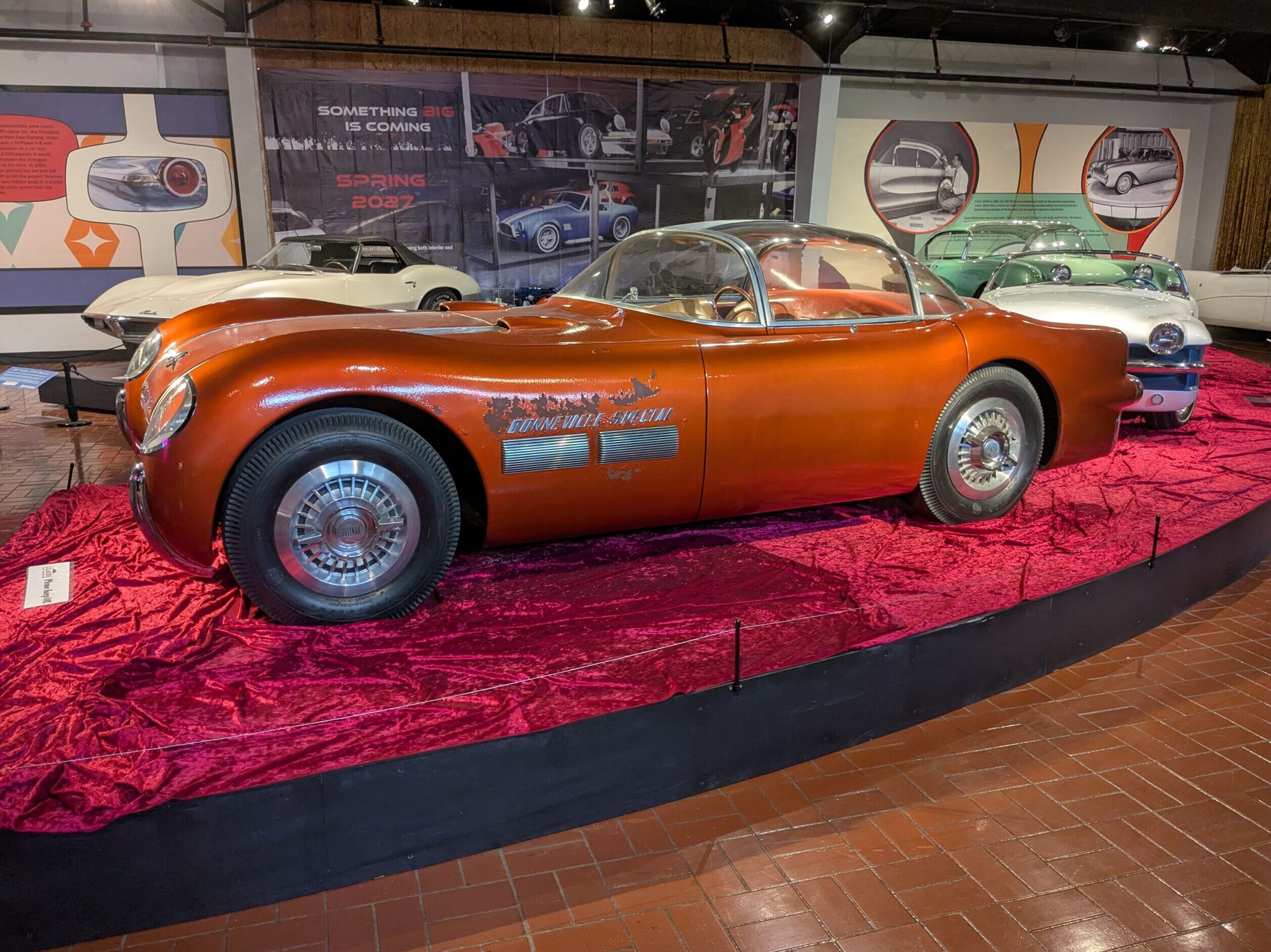
The first thing one notices about the Bonneville Special is its exaggerated proportions, with an almost comically long nose.
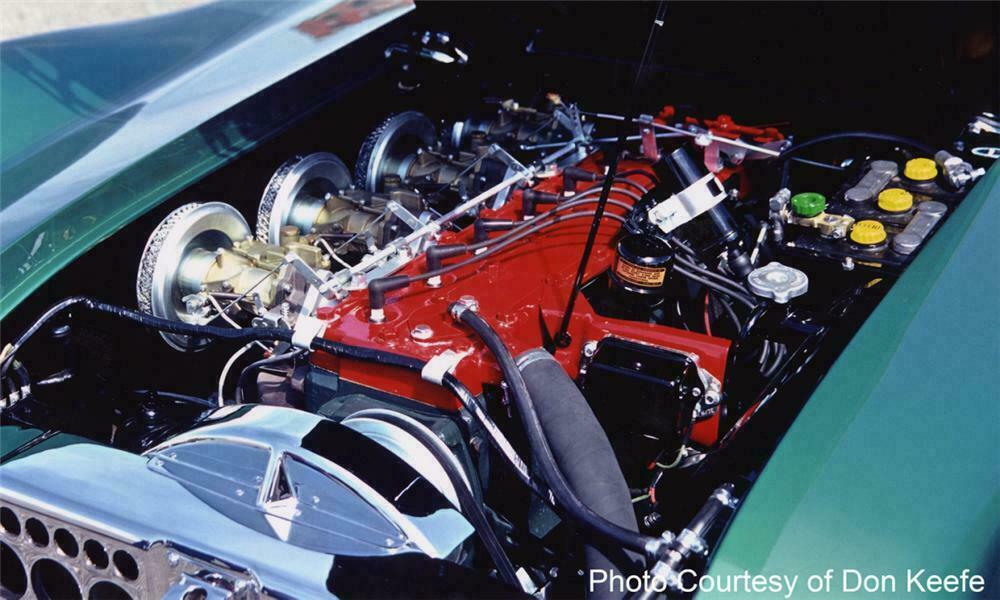
The nose was stretched to fit the last of Pontiac’s straight-eight engines, a 268-cubic-inch unit that was bolted to a GM Hydra-Matic transmission. General Motors claimed that the big flathead eight pumped out 230 horsepower through four sidedraft Carter YH carburetors (similar to the production Corvette). Whether those numbers are accurate or not, who knows, who cares. It was an almost open insider secret that Pontiac’s V8 was on its way, but apparently, the division didn’t want to hurt the already slow sales of the 1954 Pontiacs, so they gave the Bonneville Special a hot straight-eight.
You might notice that the fenders of the Bonneville Special above are painted green; there is indeed a second Bonneville Special floating around, which was built to tour dealers after the success of the original. Its most recent sale at auction brought in more than three million dollars.
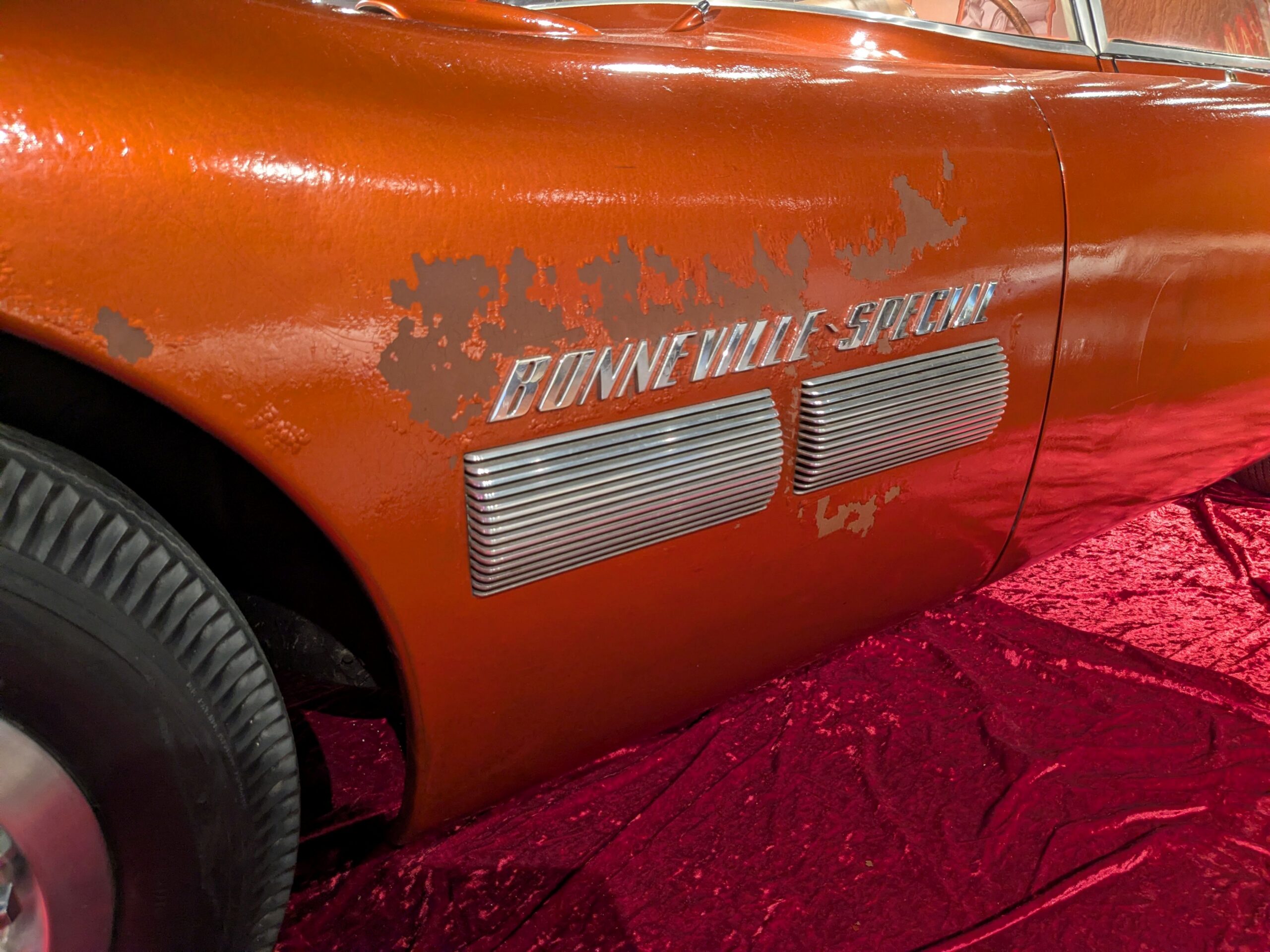
The original Bonneville Special is completely unrestored, as you can see by its peeling paint. Temple’s book quotes a GM stylist in saying that “the cars arrived at the Waldorf with the paint still drying,” so it’s no wonder that the original paint is in poor condition (but who would dare touch it?). One of the car’s highlights are these simulated fender-mounted “oil coolers,” which a Bonneville Salt Flats racer might need. On a dream car, oil coolers are unnecessary, but they simply look right by breaking up that long fender and giving showgoers something to talk about.
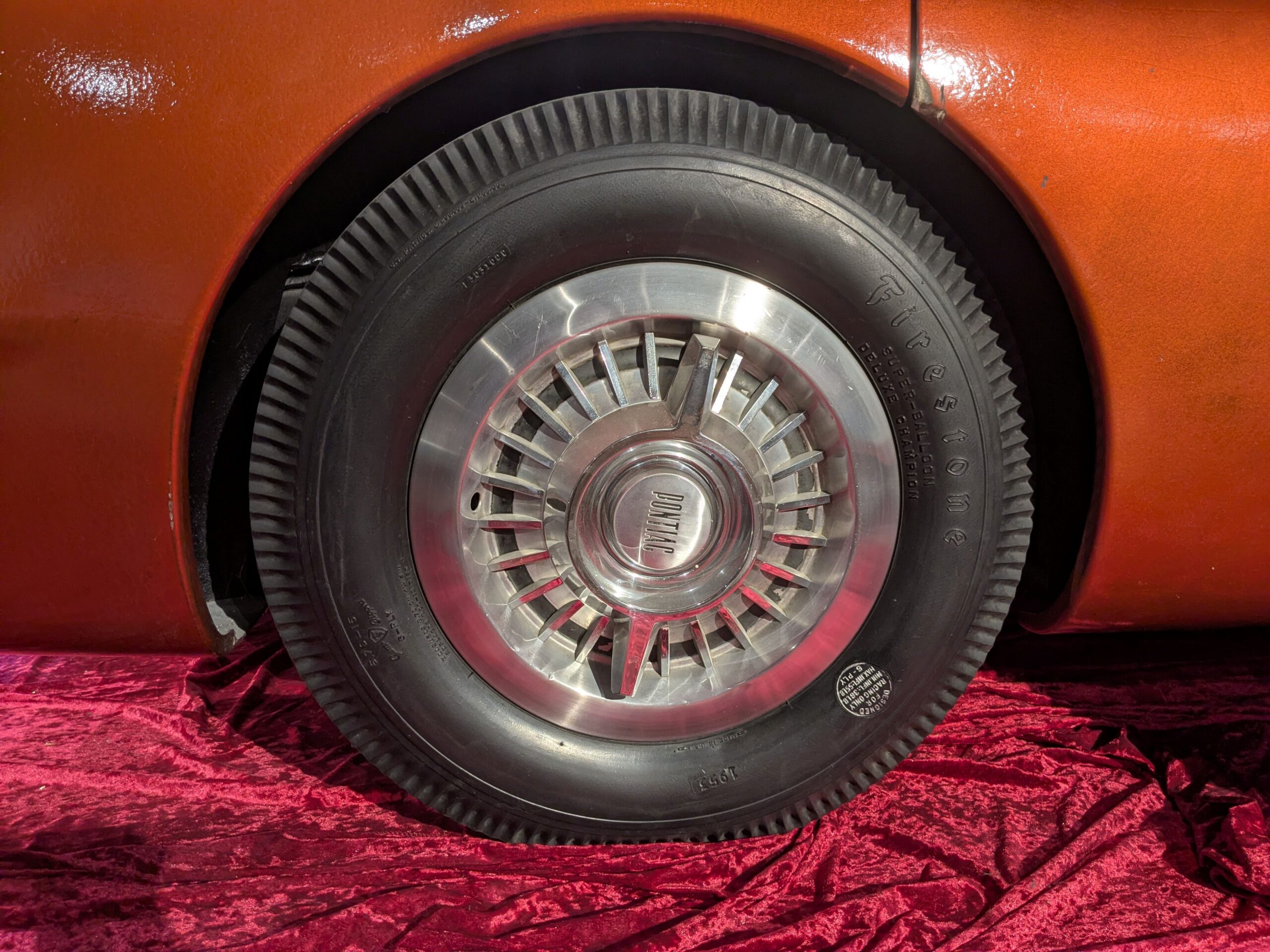
As do the turbine wheels with “knock-off” spinners. The number of man-hours and the amount of expertise needed to create these cars that would never see a production line was staggering. Harley Earl’s stylists would regularly put in “five months of 12- to 24-hour work days” to bring the cars to life, and the details such as these intricate wheels were the result. We’ll never see the likes of Motorama again.
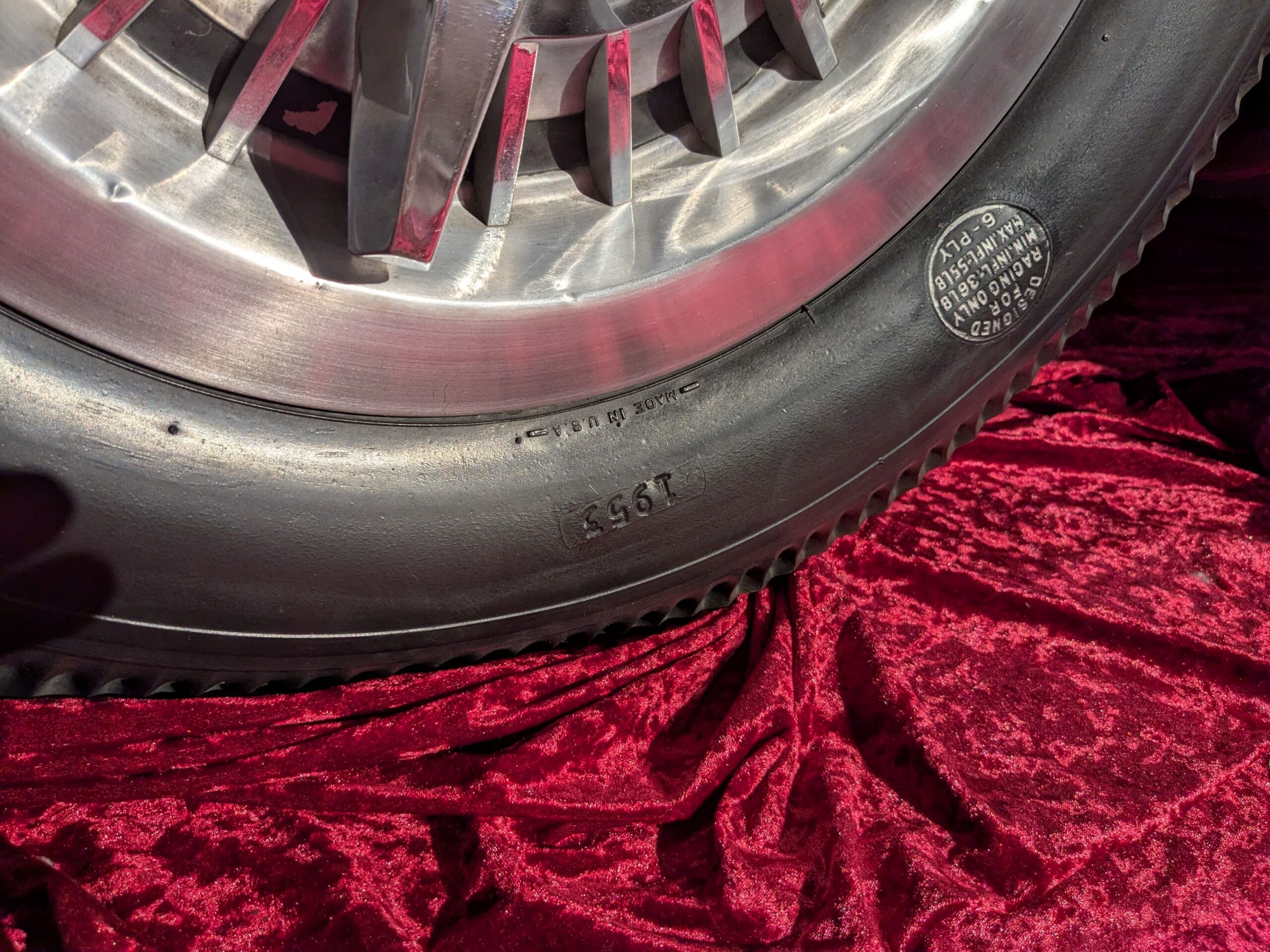
Joe Bortz has said that most of the air in the Bonneville’s tires is original, as are the tires themselves, a set of racing Firestones with 1953 date codes.
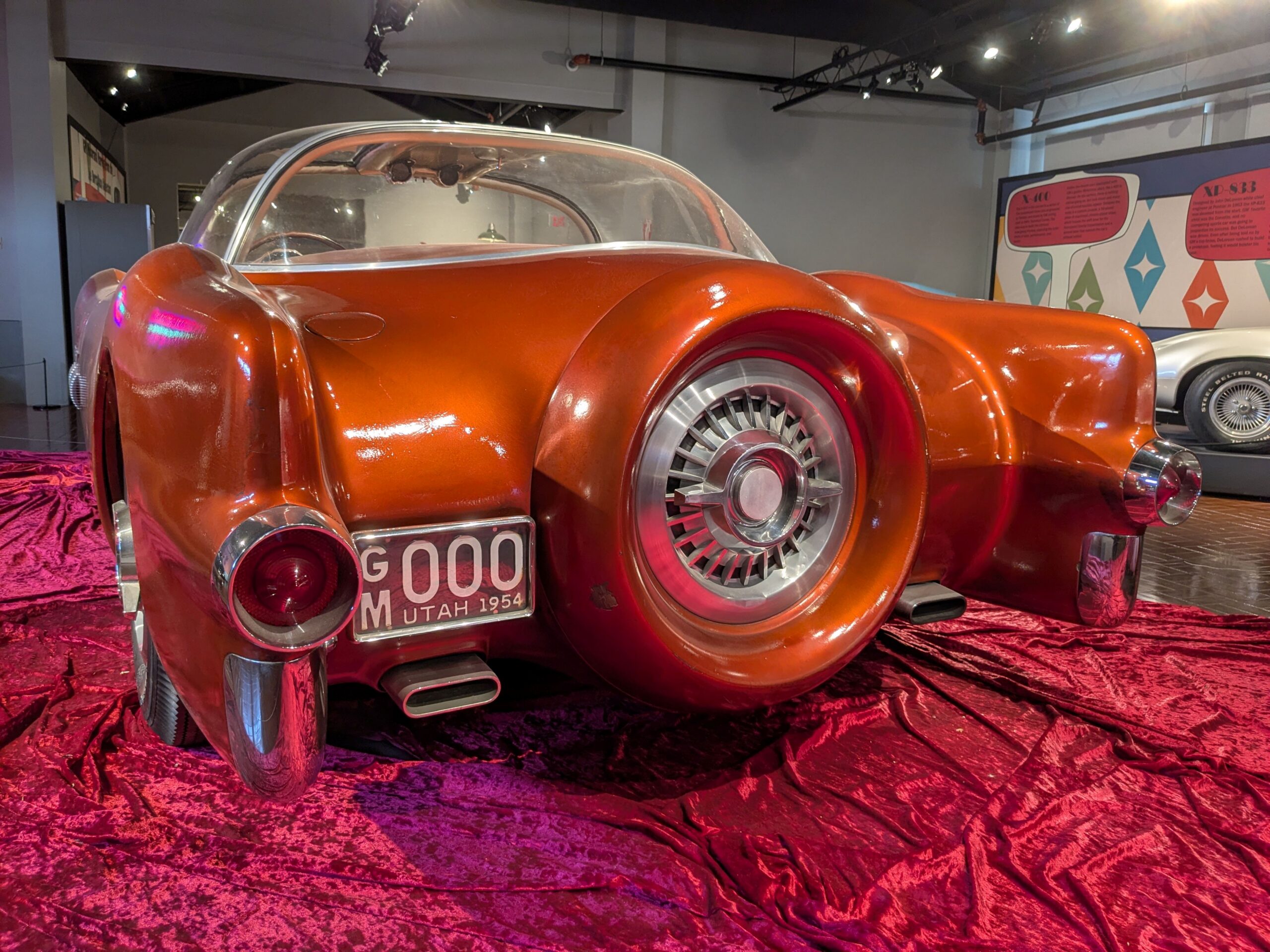
Perhaps the most controversial view of the Bonneville is from the rear, with a giant vertical continental spare that doesn’t quite fit the car’s racing image (but does manage to look like a huge jet exhaust). Stylists Homer LaGassey and Paul Gillan originally designed the car without the spare, but Bill Mitchell made the change, and the tire replaced a “central blade.” One of the exhaust outlets was a dummy, but the Utah plate was not; Harley Earl (who was apparently delighted with how the car turned out) was able to convince the state of Utah to make a plate just for this car. Say what you want about Harley Earl, but he was a master of sweating the details, a true genius. The Bonneville’s taillights were straight from the Pontiac parts bin.
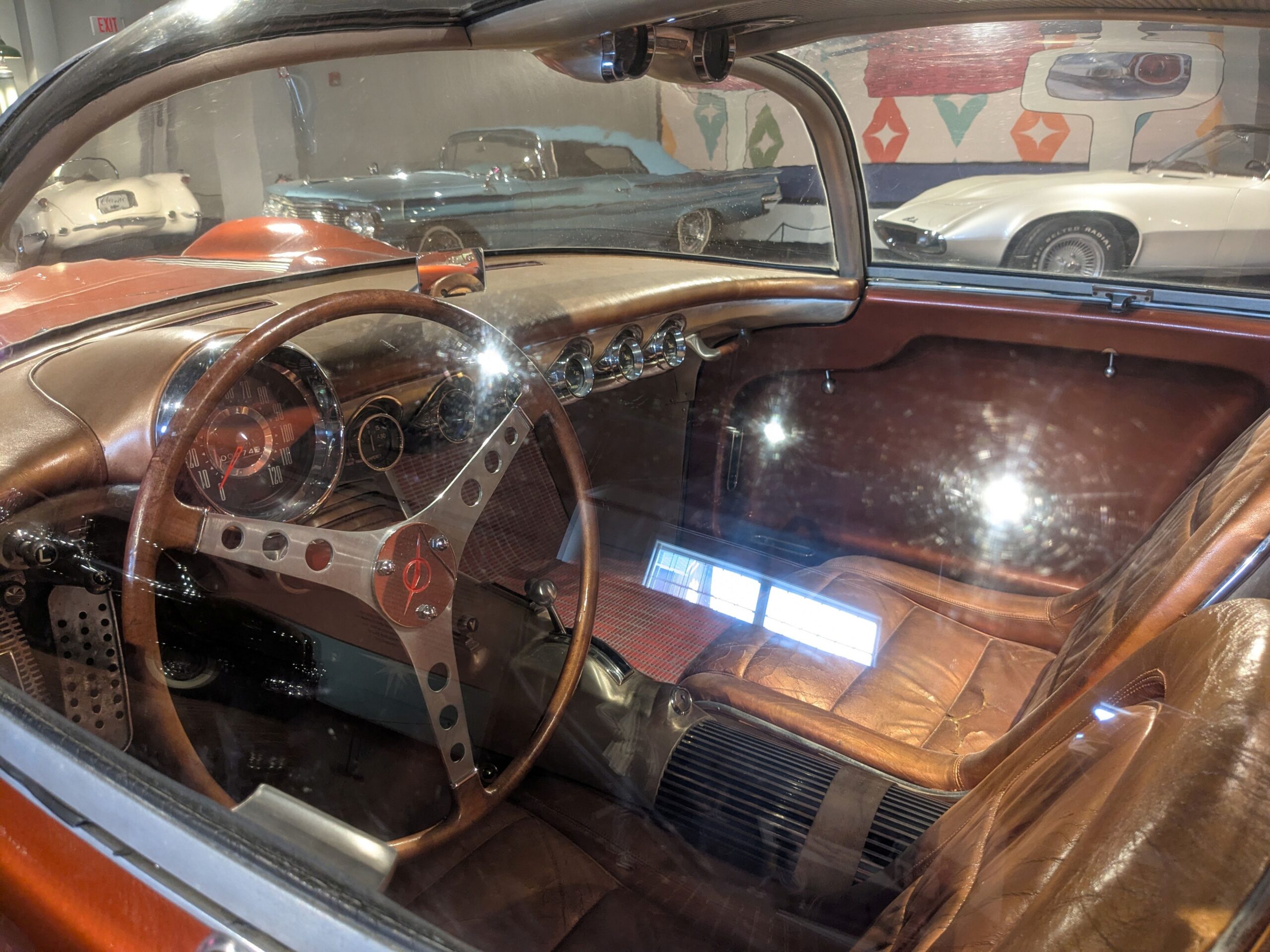
And many of the gauges were straight out of the junkyard: LaGassey and Gillan “went to an aircraft salvage yard in Detroit to buy various tachs, clocks, and altimeters.” Few of them were functional, but the Bonneville was never meant to be a perfectly operating vehicle. Notice the ribbed console (later used by another copper-colored dream car, the Chrysler Turbine) and Corvette-like steering wheel. Even the gas pedal looks like it came out of an airplane.
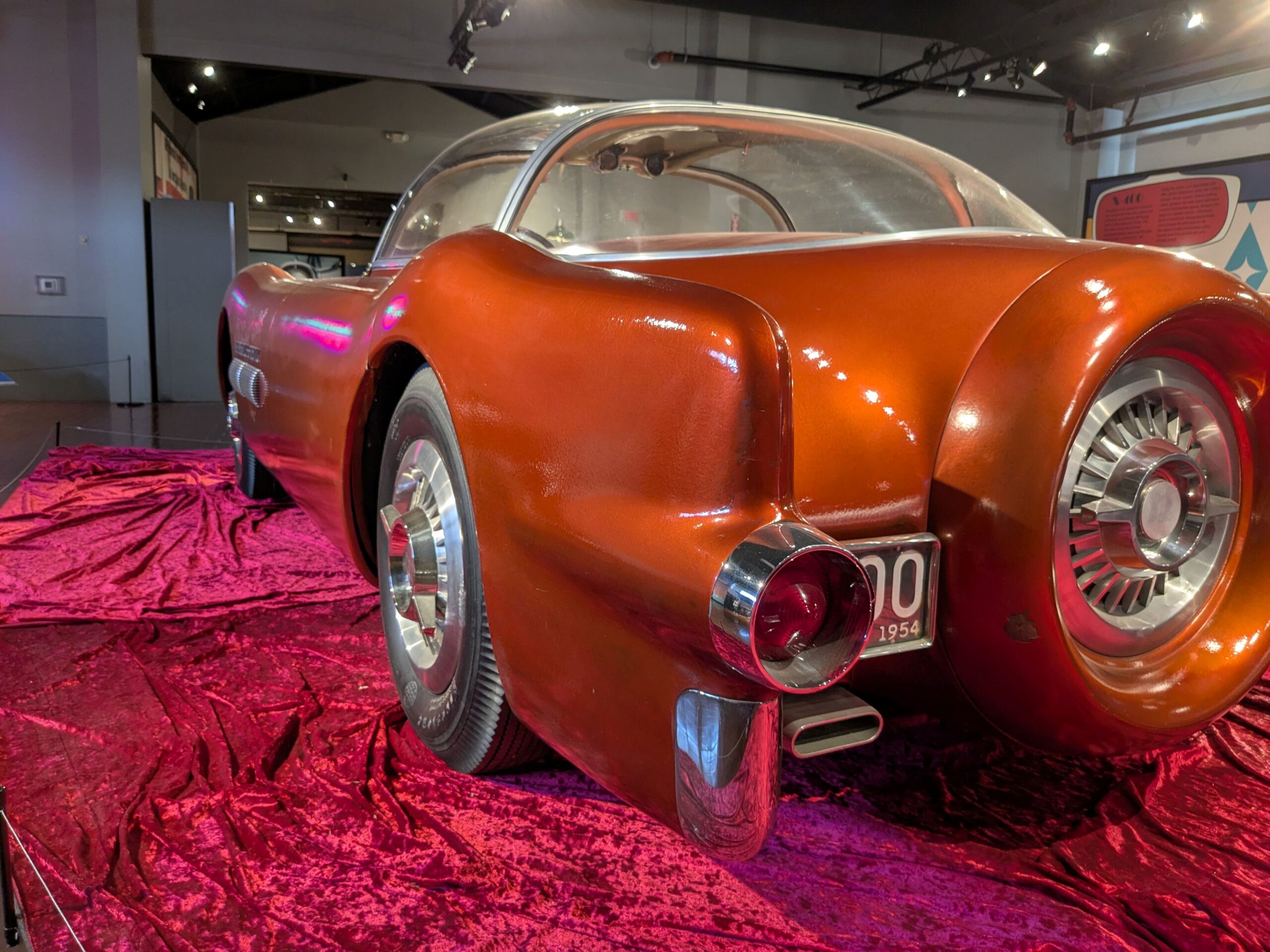
The dramatic humps over the wheels added flair to the Bonneville Special’s beltline, and the canopy of course looked as if were lifted straight from an jet fighter, just like the gauges did.
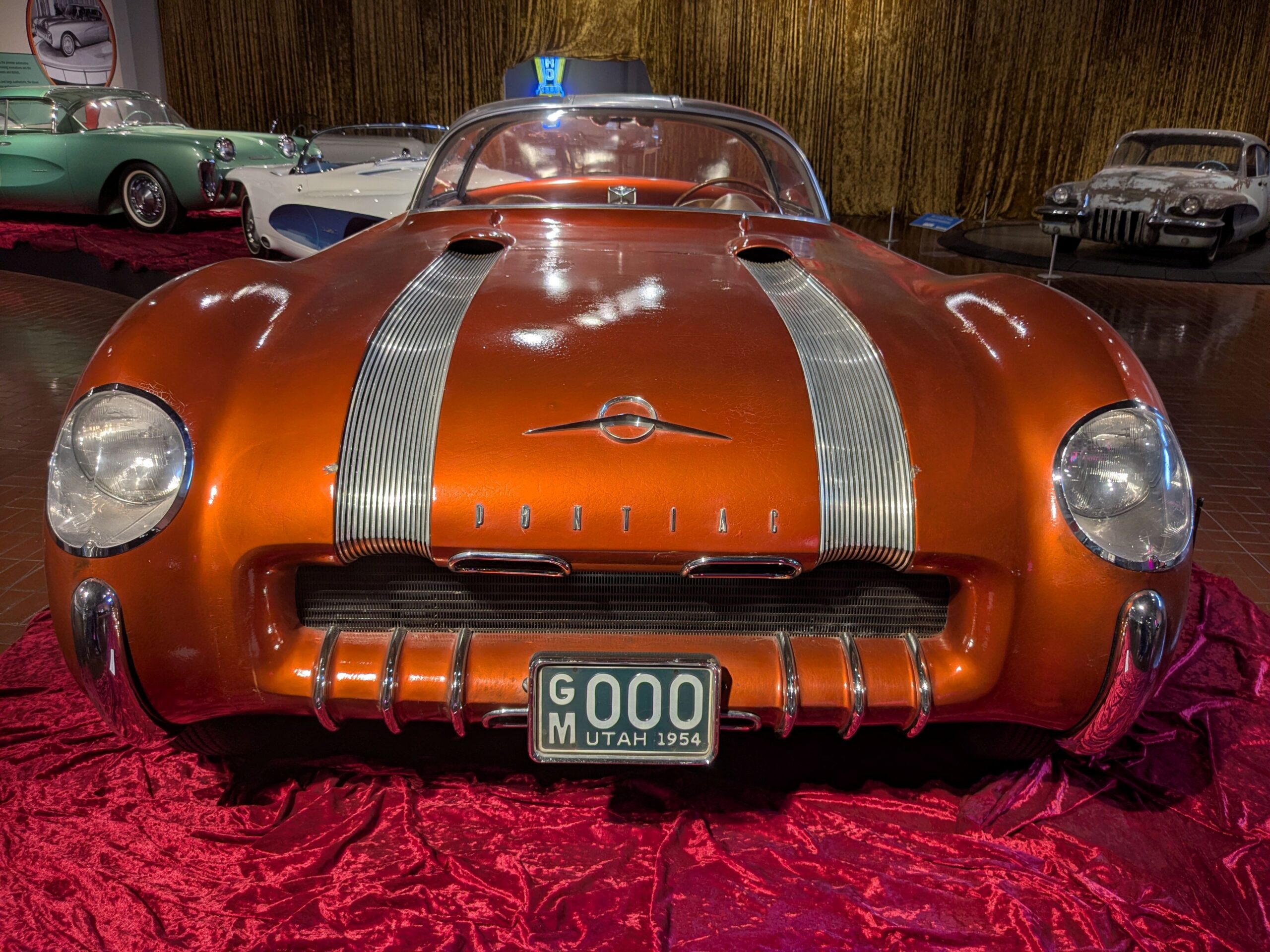
In fact, the only part of the car that could really be correlated to Pontiac itself (aside from the engine) were its famous “silver streaks,” a design motif that Bunkie Knudsen would soon remove from those cars from Pontiac, Michigan. The front end might be its best view, with no grille, just a radiator sitting beneath those streaks and the Bonneville’s low, long hood.
The Bonneville Special may not be a traditionally beautiful car, but like most of the Motorama dream cars, it was unequivocally striking, a jaw-dropper that set people talking and excited them about future products from Pontiac. It may have been an evolutionary dead-end, as evidenced by the fact that GM Corporate did not allow Pontiac to have a two-seat sporty car until 1984, but what a glorious dead-end it was.
Related Reading























Lovely.
I’ll add that aside from the silver streaks, the jet exhaust rear treatment does remind me of the large central radio speaker (I think that’s what it is) on the dash of actual 1954 Pontiacs. That held a clock and was right smack dab in the center of the dash. Beyond that, this Bonneville dream car was pure fantasy…it must have been truly fantastic to see at the Motorama 72 years ago.
I have seen the occasional single photo, but never a wide array of views like you have captured. This is indeed a holiday for eyes! I love the color on this, but then again, I am a sucker for copper (and copper adjacent) cars.
I also love how they made the old straight 8 go out in at least some kind of glory.
Given the condition of the paint I can believe it was still wet when getting to the display stand! Wow…what a rough orange-peel finish that car had! I’ve seen the green one up close and it’s alot better of a paint job than this one. I can only imagine how that was evident to even the untrained eye under the bright lights on display!
The `55 Pontiac Strato-Streak sedan is one car I wish was saved. Suicide doors, the new OHV V8, and an interesting interior it had. There was a two door coupe as well that year I wish were saved. Question: Has Joe Bortz finished restoring the LaSalle II sedan yet? Not sure how old these photos are to know. That is the one `55 Motorama I’d love to see completed the most! I remember freaking out when I found that Bortz discovered it in Warhoop’s (sp?) scrap yard!
No, the LaSalle II four-door is in the background of these pictures (unrestored), and I took them exactly one week ago. I don’t think he plans to restore that car; I’m sure that restoring the roadster cost a fortune, and it’s kind of neat to see it how he found it.
Also, I would imagine that the paint on the Bonneville looked a lot better when it was new; something’s obviously gone wrong over the years and I think the wrinkling effect is a part of it.
I only “know” this car from a couple of factory photos, so it’s great to practically see it in-the-flesh, warts and all, in 2026.
The professional journal “SAE Transactions” has many 1950s articles announcing new V-8 from Detroit, replacing a venerated straight-8. They all seem to mention the stylists wanting (demanding) lower hood lines. Here’s the opening of Pontiac’s writeup—paper presented in Detroit in January 1955:
In the mid ’80s I was selling collector cars and had an all original gold ’57 Olds Super 88 convertible with 38k original miles, white/gray/black leather interior. I had it advertised in “Journey With Olds” the OCA magazine and one day got a call from Joe Bortz. He was very interested and had lots of questions, very nice gentleman. A sale didn’t happen, he was concentrating on acquiring GM “dreamercars” at the time, I think if mine had been a 98 Starfire convertible he might have, but even. those are common compared to what’s his amazing collection.
Being an Olds guy my favorites are the ’53 Starfire XP Rocket, the ’54 F-88, and the ’56 Golden Rocket. The latter its thought to no longer exist, one F-88 was auctioned for $1.6? million some years ago, not sure who has the ’53 Starfire, maybe Mr. Bortz?
From what I’ve read, the ’53 Starfire didn’t survive. I did get a lot of pictures of the ’53 Wildcat that I’ll post at some point.
’53 Olds Starfire XP
I am fascinated by these cars. I saw them at the Petersen exhibit. Nothing quite like seeing them in person. They are artifacts of a bygone era. The Temple book is interesting; I will have to check out the other one.
I was fortunate to be at the Blackhawk Museum when Harley Earl’s Le Sabre and Y Job were on exhibit.
Too bad GM Heritage Center doesn’t have tours.
The Heritage Center does group tours, Lori; I’ve been lucky enough to go through it three or four times. Right now, they’re in the middle of moving from Sterling Heights to Grand Blanc, and I don’t think they’re back open yet. I’m not sure how they’ll handle tours in the future, but if you can manage it, it’s worth it.