
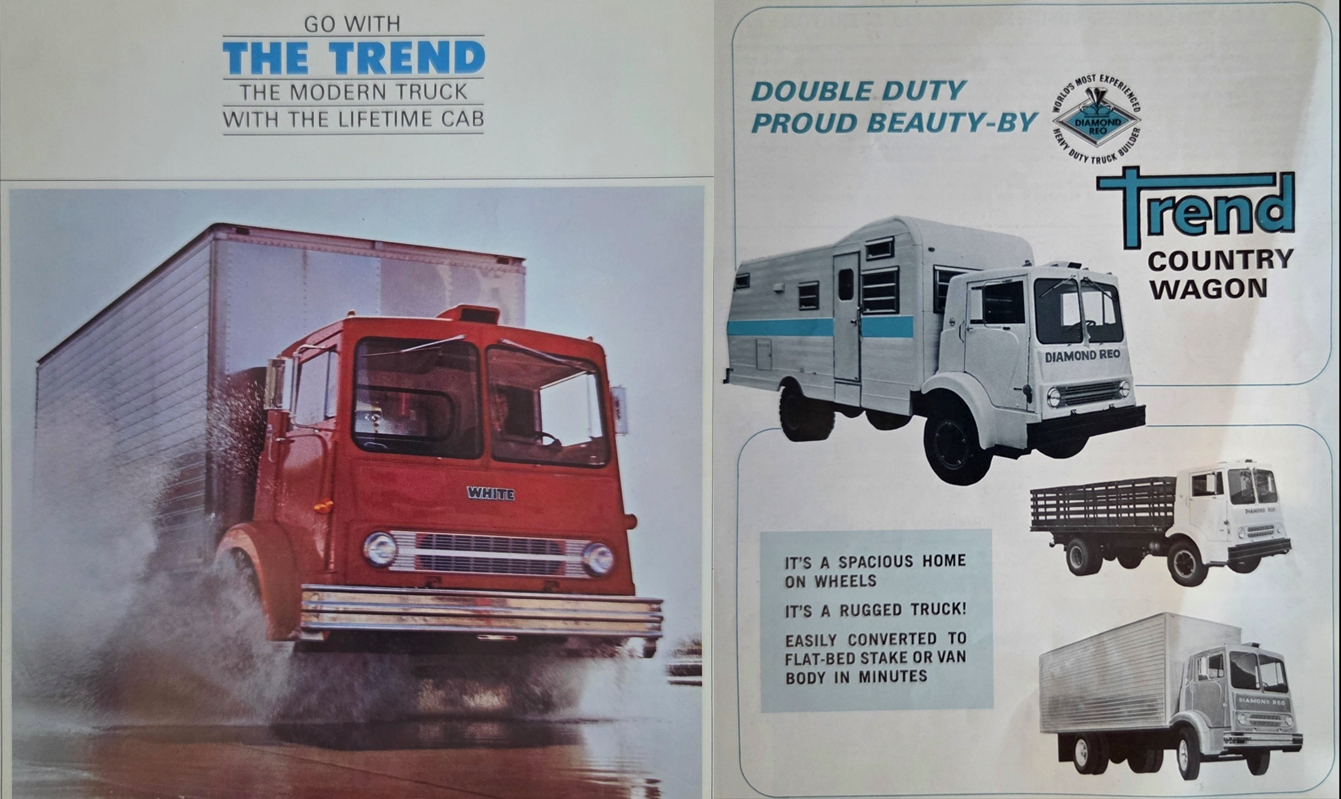
By the mid-1960’s, White Motors offered a very wide range of commercial trucks. Thanks to their acquisitions of Autocar, Diamond T, and REO, along with their marketing agreement with Freightliner, White offered trucks for just about every requirement, from over-the-road to heavy duty vocational and plenty of specialty models for specific applications like refuse and aircraft refuelers. However, despite this wide variety of makes and models, White was weak in one important market: The low-cost basic medium duty truck.
Their answer was the Trend, which featured a lightweight plastic body, a Chevy 327 V8, and a “Country Wagon” version with an RV body that could be swapped out with a regular truck body. Not too surprisingly, the Trend was a total flop.
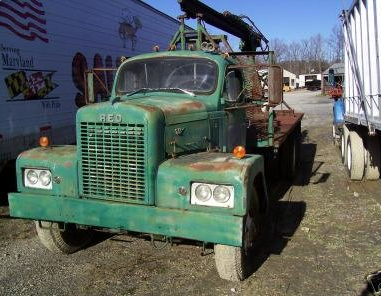
White’s primary offering in the basic 20k-25k GVW medium duty market was the lighter REO manufactured models that were sold under the Diamond-T, Reo, and White nameplates. While these were solid well-respected trucks, they were not competitive with offerings from the ‘Big 3’ and International. Trucks like the Chevy C-60, Ford F-600, and IH Loadstar offered a low price and high efficiency, thanks to their passenger car/light truck derived 6 and V-8 engines. The old REO derived trucks still featured an Art-Deco cab designed in the late 30’s (updated with a one-piece windshield and squared-off fenders with quad headlights!) and the ‘Gold Comet’ wet-sleeve OHV 6 cylinder ‘130’ engine. The Gold Comet was an expensive heavy-duty engine that was not competitive in cost or output with engines like the Chevy 292 or Ford 300. In addition, White did not have a suitable V-8 available for a medium duty truck.
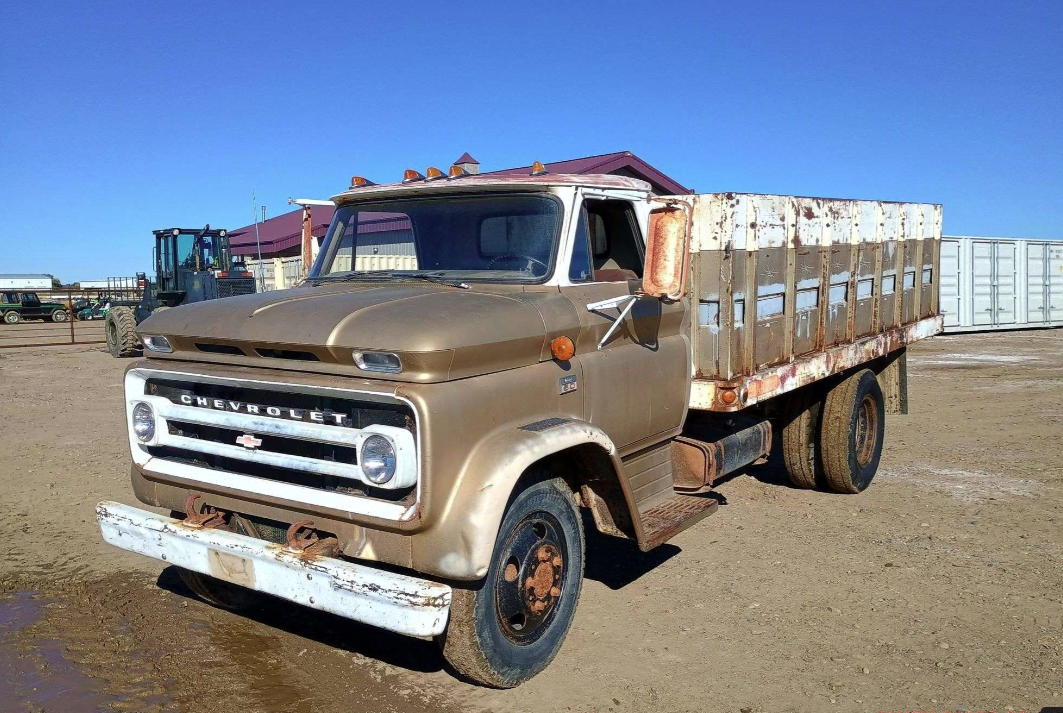
White sought to fill this gap in their model line-up with an innovative truck that would match the competition and offer a few advantages while being competitive in price to what the Big-3 and IH were selling in large numbers, like this Chevy C-60. The fact that a large percentage of these low-cost medium duty trucks were being purchased by farmers was not lost on White. This was of keen interest to White Motor, as by this time through the acquisition of Oliver, Minneapolis-Moline, and Cockshutt, White had become a big player in the agricultural equipment business. White wanted to sell their ag equipment customers trucks as well, much like International Harvester had been doing for years.
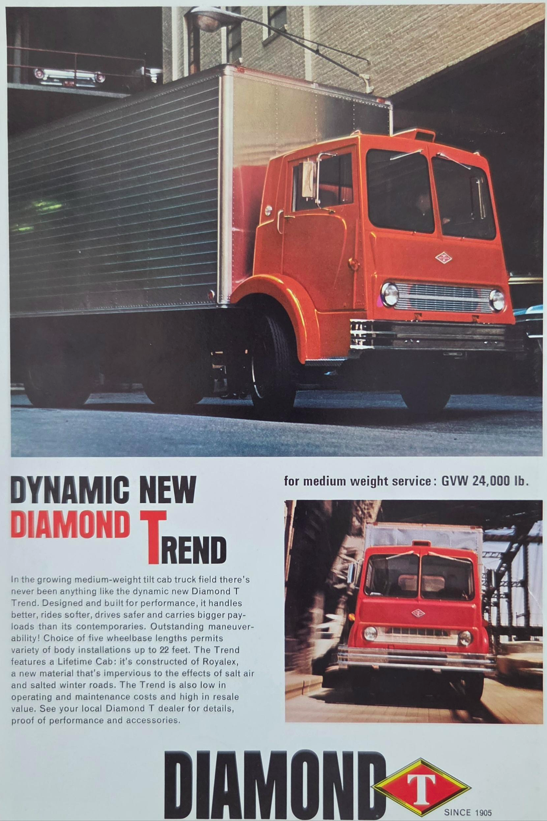
White named the new truck the Trend, and it was nothing if not interesting. As White did not have an existing light truck cab to use on their new medium duty, they were not constrained to a conventional cab design. And, since the cab-over configuration did offer the advantages of shorter overall length and a tighter turning radius, White decided to go the tilt-cab route.
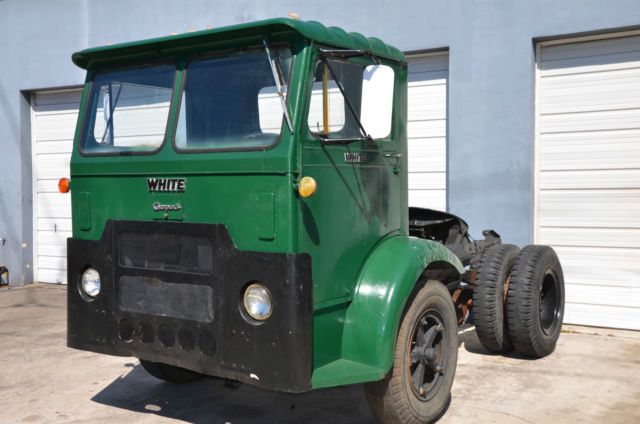
White’s smallest tilt-cab truck at the time was the 1500 ‘Compact’ model (above), ostensibly a replacement for the old 3000 series. Unfortunately, the 1500’s cab was still too large and heavy for what White had in mind, so White designed a new cab that was optimized for a medium duty truck.
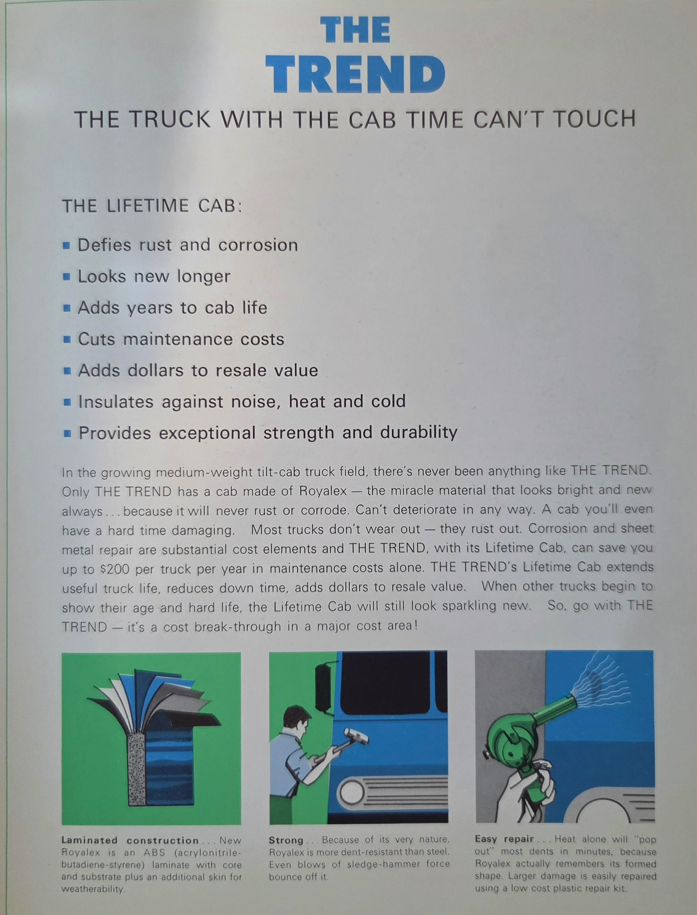
White chose to make the cab out of a new ‘miracle’ material developed by U.S. Rubber known as Royalex, sometimes referred to as ‘Synthetic Steel’. Royalex was a composite material made by bonding vinyl, ABS foam, and ABS plastic, offering very good durability, corrosion resistance, and insulating qualities. Royalex was also claimed to be particularly resistant to dents, and if dented could be straightened with a heat gun. The cab’s Royalex outer panels were supported by an aluminum frame on top of a steel understructure, and the cab doors were galvanized steel.
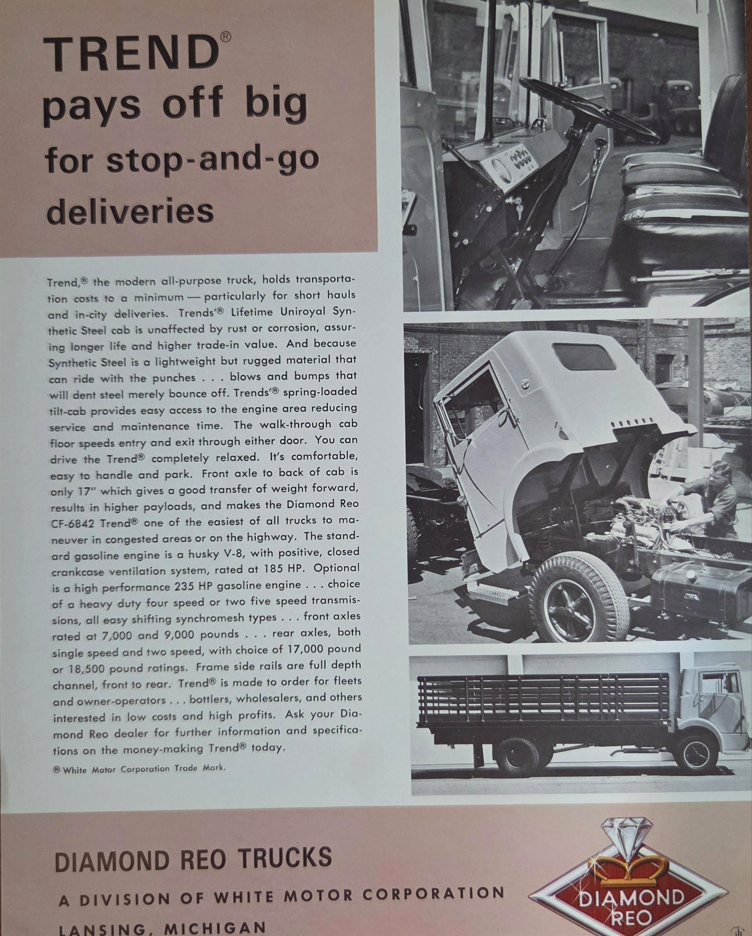
The tilting mechanism used coil springs like the Diamond-T tilt cabs (thank you, Murty Bros.). The Trend cab design was very angular and nondescript, perhaps due to the way it was constructed, but the doors had a ‘sweep’ embossed in the outer surfaces reminiscent of the White 3000. As White didn’t manufacture a suitable engine for the Trend, they procured a “thoroughly proven 185 h.p. V-8 engine” in the form of the heavy-duty Chevrolet ‘High-Torque’ 327. The truck Small Block was teamed with a New Process 435 4 speed transmission, another very commonly used component. Timken axles, leaf spring suspension and a basic ladder frame in 5 wheelbases rounded out the mechanical specifications and ensured the new truck would be reliable and easily serviced. In summary, the Trend offered a tough corrosion resistant cab, a proven engine and transmission, and a simple and straightforward chassis. It seemed like a recipe for success…
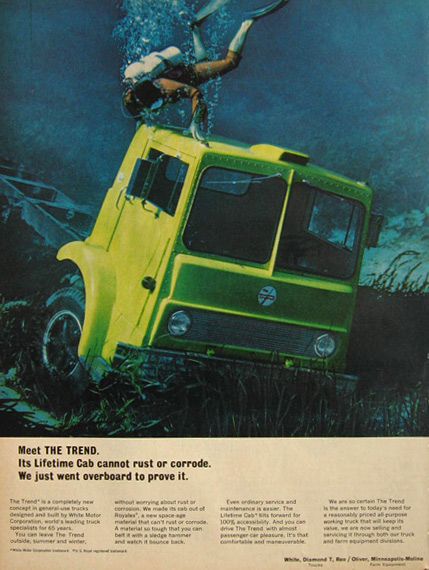
The Trend went on sale in 1966 at White and Diamond-T, and Reo dealers, badged respectively. The ad campaign for the new truck stressed corrosion resistance and durability the “Lifetime” Royalex cab, even going so far as to picture a Trend underwater and encouraging salesmen to demonstrate the strength of the Trend’s cab by hitting it with sledgehammers.
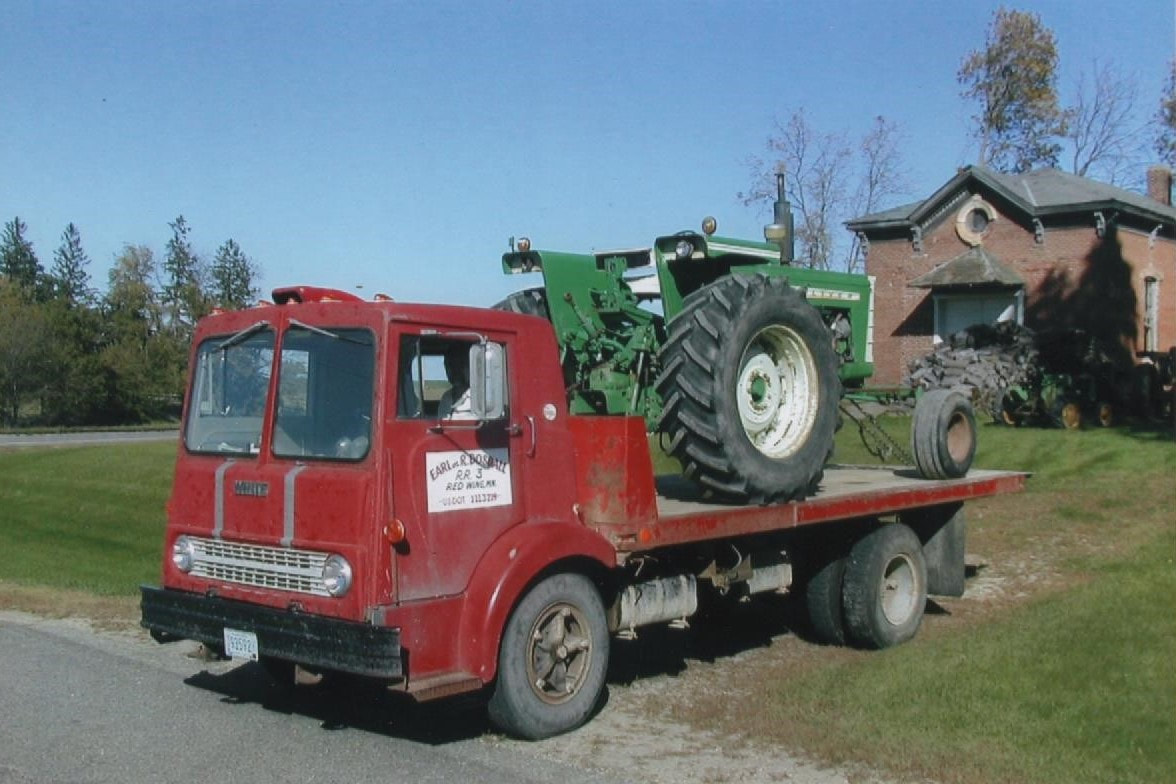
As sales to agricultural customers were specifically targeted, Oliver, Minneapolis-Moline and Cockshutt dealers were encouraged to use Trend trucks for their businesses. White went so far as to give Oliver and Minneapolis-Moline dealers the opportunity to sell and service the Trend. Soon after the Trend went on sale, White added a few options to the trucks including the 235 h.p. Chevy 366 V-8, the 140 h.p. Cummins V-6 diesel, and Clark 5 speed transmissions. In 1967 with the consolidation of Diamond-T and REO, Trends were sold as Diamond-Reo’s. In 1969 the 327 was replaced by the Chevy ‘truck’ 350 as the standard engine. 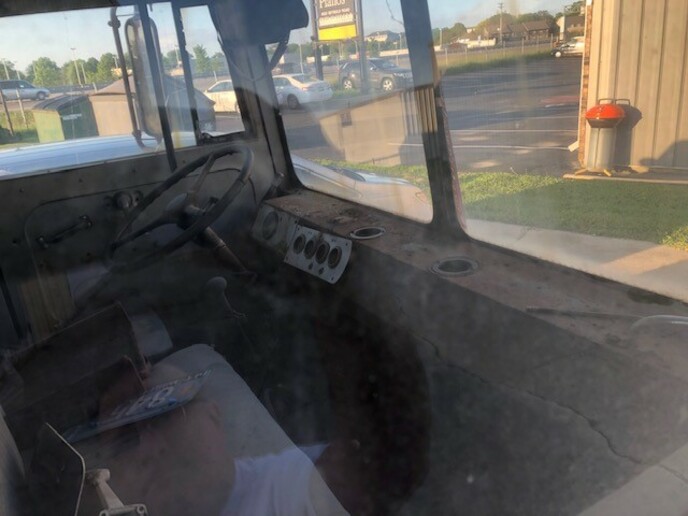
Unfortunately, despite the Trend’s innovative design and a marketing well supported by an extensive ad campaign in many applicable trade publications, the new truck didn’t sell very well. It sold so poorly in fact the Trend is barely remembered today, Royalex cab and all. I have been unable to find a specific reason for the Trend’s low sales, but a few factors could explain the trucks’ unpopularity. First off, the Trend was rather crude, even for a medium duty truck of the 1960’s. The cab interior was not well finished and much of the interior aluminum framework was exposed. This coupled with flat glass and exposed exterior rivets gave the truck a very cheap appearance. Despite the innovative features of the cab, it proved to be rather heavy and expensive to manufacture.
From a mechanical perspective the Trend was competitive, but since the major components were purchased by White rather than manufactured, the Trend could have been at a cost disadvantage to its major competitors. Attempting to market the Trend through White’s ag dealers was a sound idea, but farmers tend to be very brand loyal and it could have been tough to lure them away from the trucks they had been buying for years. The crude appearance probably didn’t help. Unfortunately, I have not been able to find out the production numbers or list prices of the Trend, but information does support the Trend was manufactured from 1966 to 1971.
Another mystery is where the Trend was built. The most likely places were the White plant in Cleveland or the REO plant in Lansing. I suspect the Trend may have been built in Lansing as Diamond-Reo sales were only fair at the time. In addition 1971 was the year White sold Diamond-Reo off, so if the Trend was built in Lansing that could have been a reason why production of the Trend ended that year.
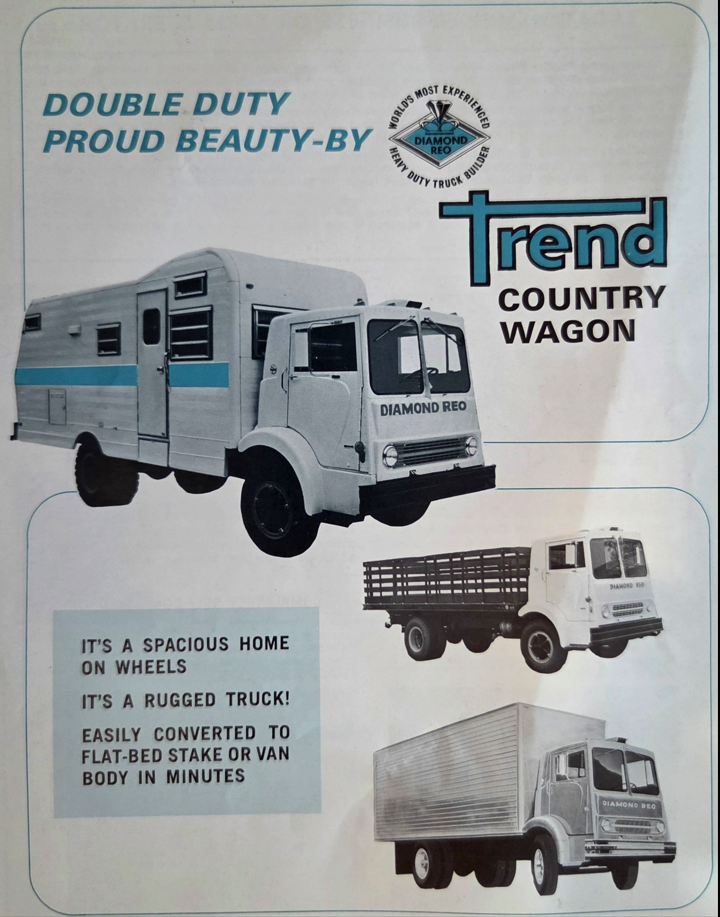
As Trend was marketed as a general-purpose medium duty truck, most of the ads that didn’t show the Trend underwater or being smacked with a sledgehammer pictured the truck with a stake or van body. However, White explored another application for the Trend that was either completely ridiculous or decades ahead of its time: recreational vehicle. Perhaps stemming from the emphasis put on marketing the Trend to farmers, White offered a motorhome body for the Trend, along with a quick-change jack system for changing bodies.
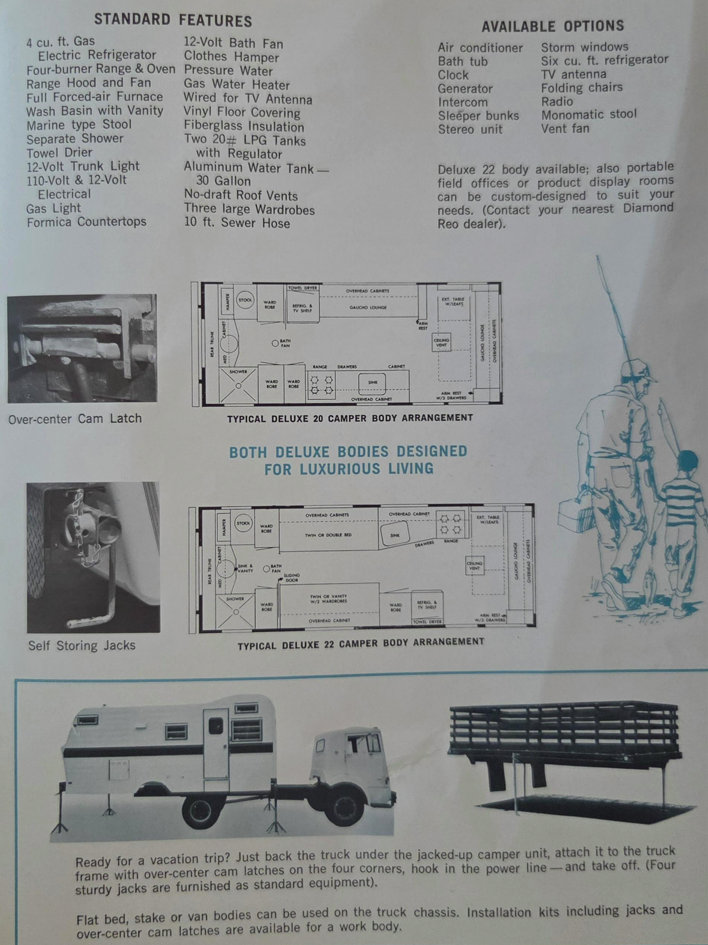
Since farmers typically use their trucks periodically throughout the year, such as at harvest time, when the truck was not being used for farm chores it could be easily turned into a motorhome for recreational use. One minute a smelly stake bed farm truck, the next a “Double Duty-Proud Beauty” Trend Country Wagon luxury motorhome. Pure genius! The motorhome body was available in 2 lengths, referred to as the ‘Deluxe 20’ and ‘22’ models.
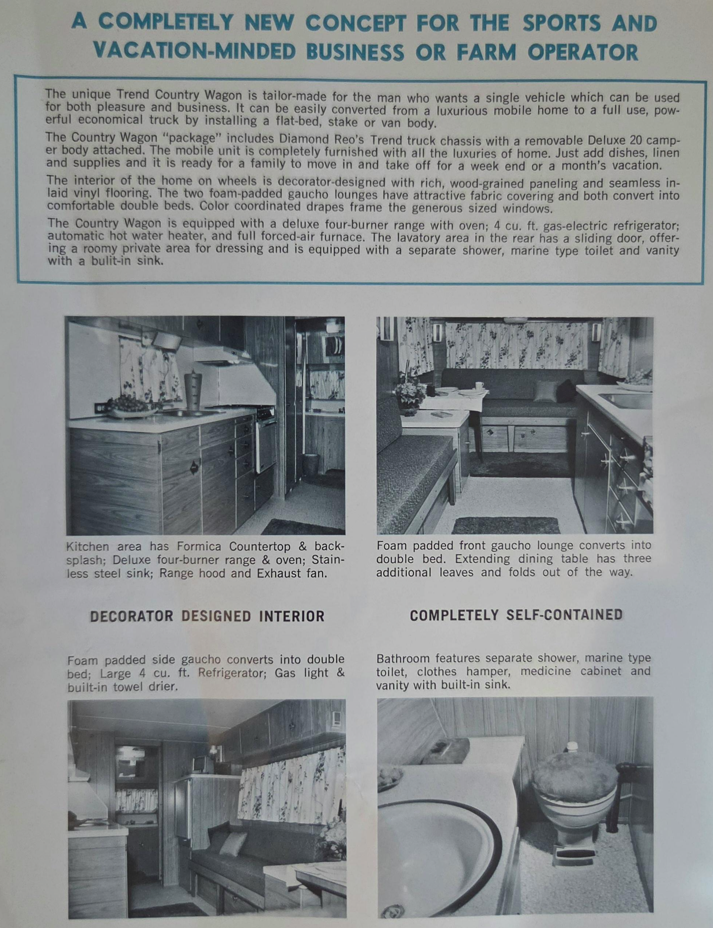
The way the brochure is written it appears the ‘Deluxe’ may be the brand name of the camper body, but I have been unable to find an R.V. manufacturer operating under that name during the time period. Whoever built the body seems to have done a good enough job as they were well-equipped, self-contained, and according to the ad copy, featured a decorator designed interior. Too bad the decorator didn’t do anything to the interior of the Trend cab while he or she was at it. At least one Trend Country Wagon has been restored.
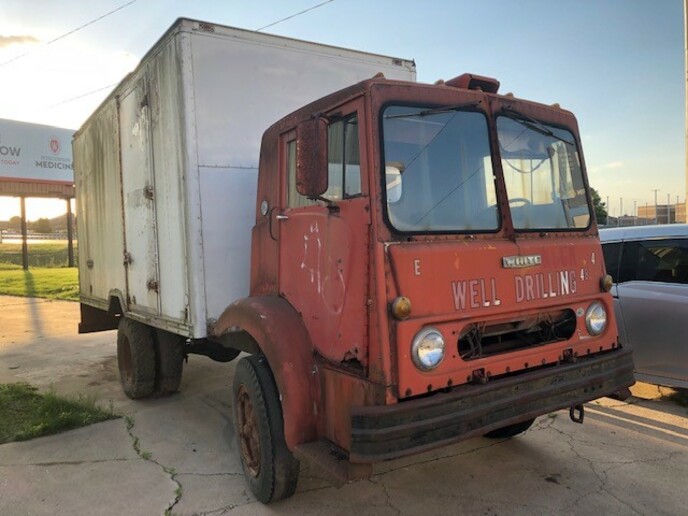
In retrospect, at least as far as I can find out, the Trend didn’t live up to White’s hopes of offering a high-volume medium duty truck. In production from 1966 to 1971 it appears to have sold in very small numbers, and the truck is not well remembered. It didn’t seem to have any well-known issues or fatal flaws, and when the Trend is mentioned on various old truck forums about all you hear is “I saw one once” or “a farmer I knew had one”. If I saw five of them in the last 50 years I would be surprised, the only Trend I specifically remember was one that sat for years at a truck repair shop in Hawthorne, CA. (the one above is in Wisconsin).
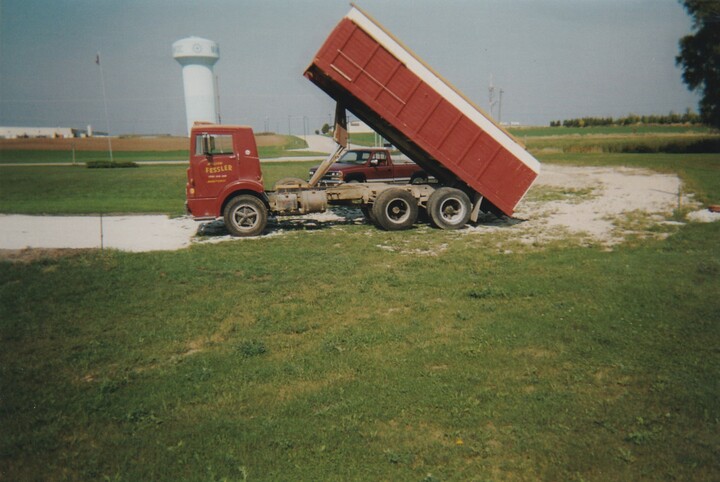
This one appears to be a still-working grain truck.
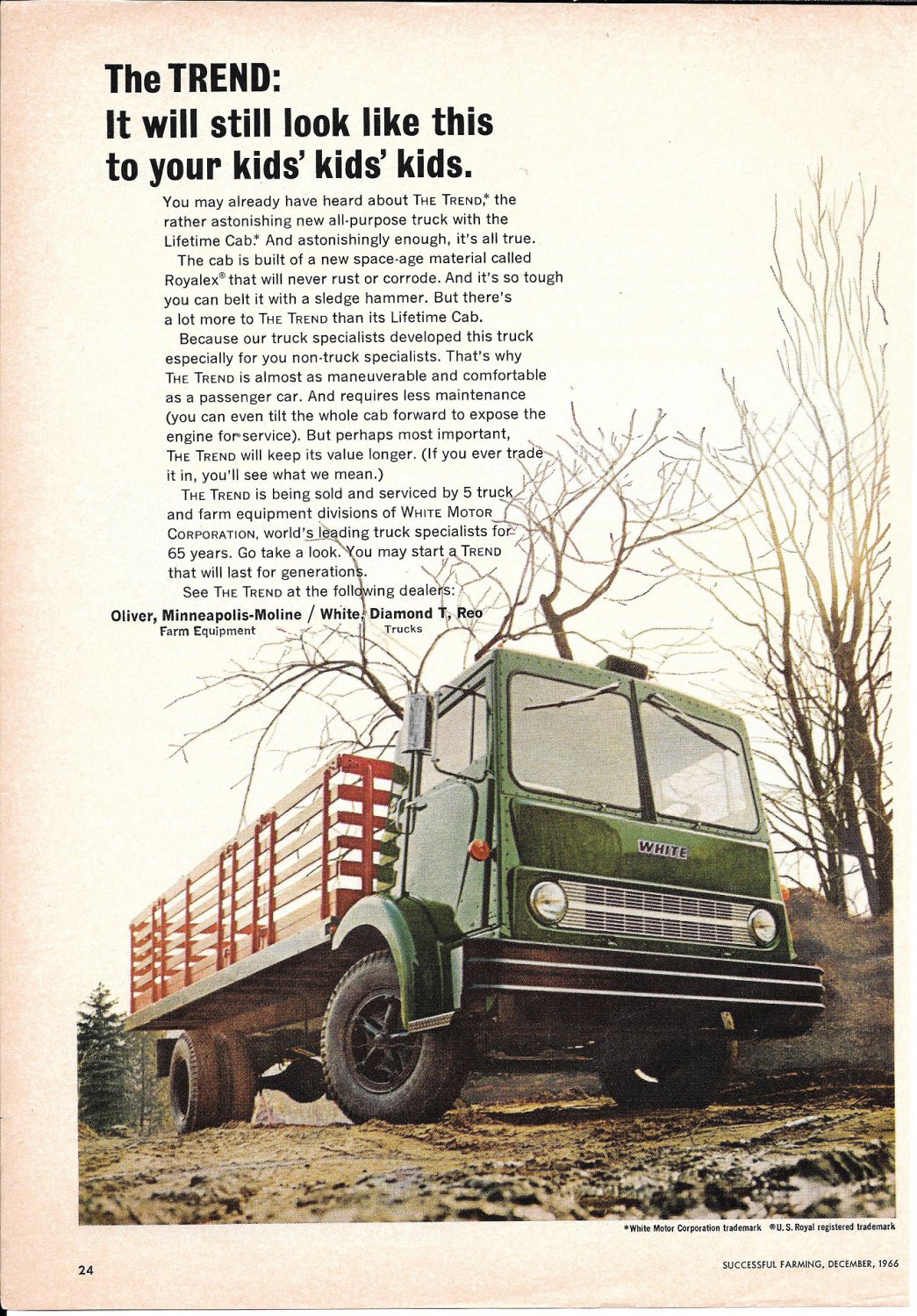
It is ironic that the Trend’s basic formula, that of a gasoline powered light medium duty cabover truck, has been very successfully used by Isuzu for the last 35 years. Royalex never found much application in commercial vehicles but was successfully used in the manufacture of canoes. In addition, expensive recreational vehicles based on medium duty trucks are not uncommon these days. So, there you have it. An obscure largely forgotten medium duty truck that in some was decades ahead of its time but just didn’t make it. The Trend wasn’t a trend in the end, and could probably be considered a White ‘deadly sin’. White went on to declare bankruptcy in 1980 and was subsequently bought by Volvo AB.























U. S. Royal had another potential volume customer for use of composite material in vehicle body construction in Glenn Pray, who chose their material “Royalite” for his Cord 8/10 project.
The 8/10 was an 8/10ths size, composite bodied replica of the Cord 810 roadster, sitting on 13” wheels and powered by a Corvair flat six & transaxle, rotated 180° and powering the front wheels. It was a delightful thing, much more interesting than the Ford V8 RWD vehicle that followed when the Corvair project failed.
https://www.hemmings.com/stories/replicar-visionary-glenn-pray-s-cord-8-10-was-ahead-of-its-time/
The use of Royalex or other sheet thermoplastic, molded using the thermoforming process rather than injection molding, was brief but ultimately dead end trend for vehicle bodywork or other large automotive panels. The mold tooling is cheap as usually it’s only one-sided, unlike “matched metal” injection molding molds, but finish quality is often poor and the part edges require trimming or routing which is time consuming.
Borg-Warner had a plastics division and developed a sports car with a thermoformed body, the Piranha, whose design was actually bought by the AMT model company with plans to sell it both full size and 1/25th scale, in the 1960’s. The most common application of thermoforming in the automotive world today is pickup truck bed liners.