

All cars end up (or will end up) as scrap sooner or later. For many, it’s sooner. For a lucky few, it’s later. Or perhaps much later. But that’s just measuring time. As a wise man once said: “It’s not the years, honey. It’s the mileage.” And viewed that way, what’s a true benchmark? 200,000 miles? 500k? How about 1 million? That’s rare, especially for a “car” as opposed to a heavy duty truck. It’s doubly rare for a car that’s not a diesel even though this is a Peugeot, known for their diesels. So let’s take a look at this magnificent beast of burden that defied the odds…

Ah, the 505, Peugeot’s last large car to be sold in the United States and meet with some success (as opposed to the 604…). Introduced here in 1980 and withdrawn after 1991, it was a more modern successor to the legendary 504 and of course offered in sedan as well as significantly structurally altered wagon, or in Peugeot-speak “Break” form. And if you ask the average Ami about Peugeot, well, break they did is what you will generally hear. All too well and all too often for our unwashed masses so Peugeot took their toys and went back home, leaving a small contingent of deployed troops to soldier on in our hills and valleys, our paths and freeways, and of course our specialist mechanics shops and oil-splattered driveways for years and decades to come.

This lion surely sleeps tonight, and here he has wandered off from the front of the car and taken the rest of the grille with him but the distinct headlight shapes make it clear what this car is even without that famous logo. There’s no accounting for what made this one achieve (and slightly exceed) the mythical benchmark of 1 million miles, and we don’t know if it’s on engine number one or number eight. But that doesn’t really matter as even if one of us has a literal heart transplant we don’t stop the count at that point. No, it’s only when finally laid to rest that we refer to the total no matter how it got there.

It is surely just as remarkable though that this one is NOT a diesel; if it were we’d be nodding sagely and murmuring about the devil’s slimy syrup that clearly motivates better than the more highly refined sharper fluid that most of our chariots consume. No, this one likely slurped the same lowest common denominator fuel from off-brand filling stations that we all seek out to save a few francs as soon as the price on the pump starts with a 3 or 4 again.
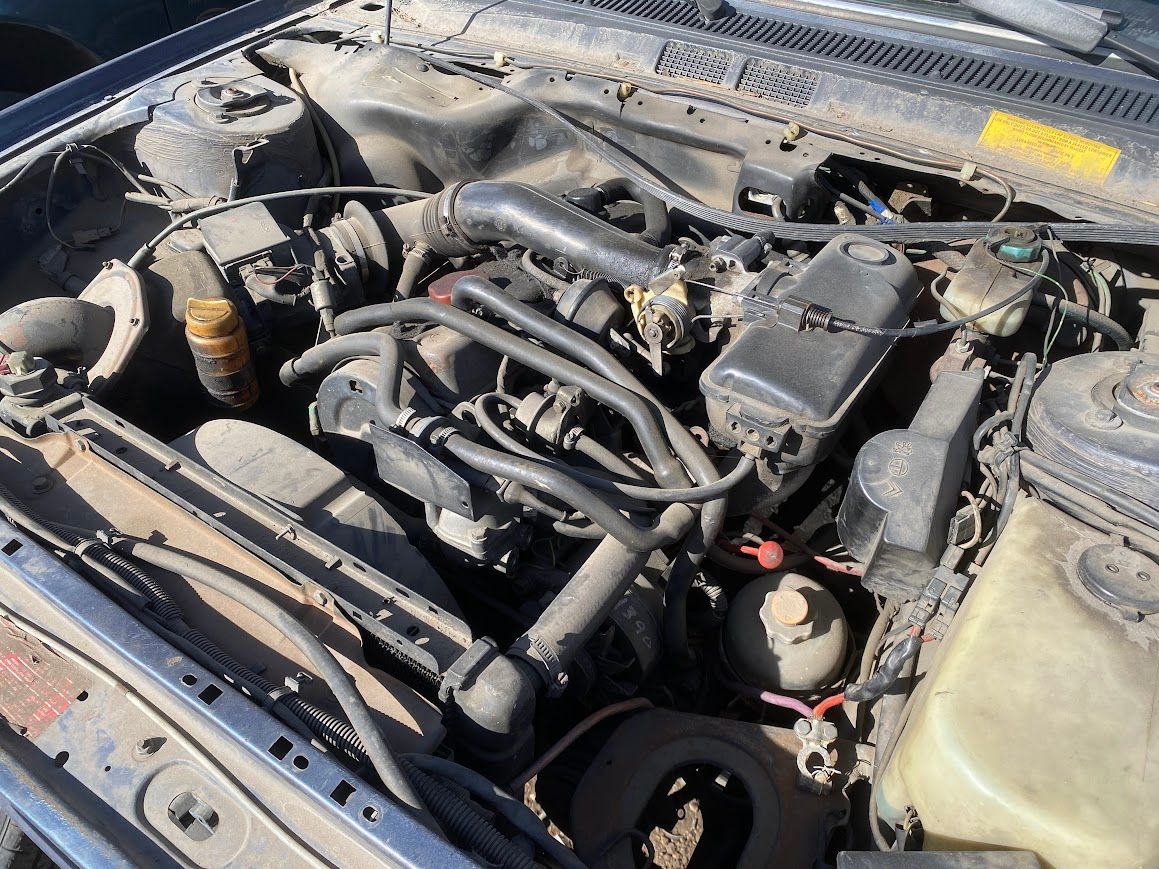
It’s not even a V6, no, but a lowly 4 cylinder co-developed with Renault that many of us would have scoffed at the idea of being able to achieve a lofty mileage. Maybe in a lightweight tin of a car such as a Volvo 1800 driven by an Irv-type or some such. Maybe a Toyota of some sort but even then with some odd eastern mythology that’s obviously some weird voodoo, how DO they do it? But not a car made by… the French!
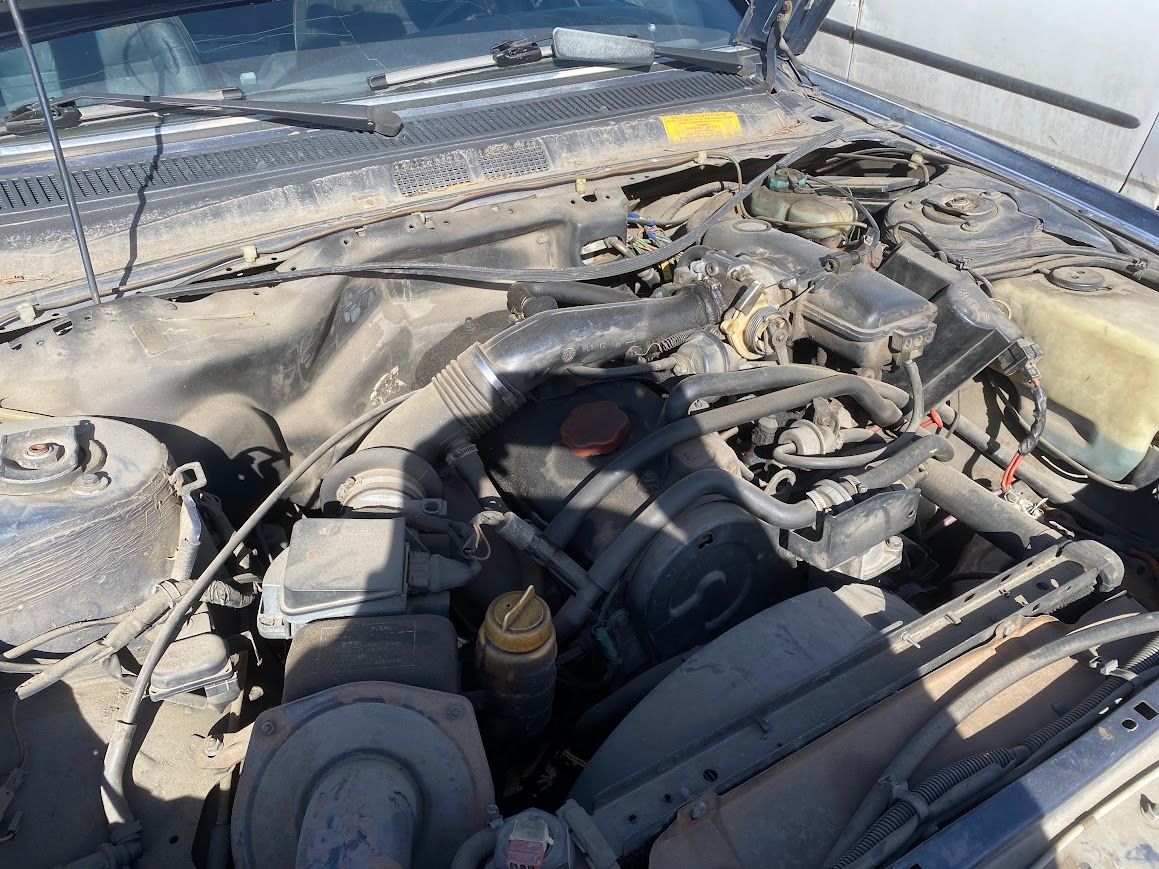
As far as the power goes, well, 120hp from the Douvrin’s 2.2 liters (excuse me, litres) is almost laughable. It’s not a lot, I’ll grant you, but clearly it was enough, just like a simple baguette with some brie on it is plenty to get one across the alps instead of a Hellcat’s triple cheeseburger with a super sized order of freedom fries’ 707hp. No doubt helping is the fact that this capacious wagon has a remarkably low weight of just under 3200 pounds – but could be equipped with a third row of seats to seat up to 8! The 5-speed manual transmission is surely part of the reason it made it this far, generally being more durable than automatic versions.

The clearcoat left the paint party some miles ago, yet the overall shape of the wagon (and the 505 model line in general) has endured to my eyes as a quite attractive one. There was a nip and a tuck around 1986 or so that kept it elegant, and in general it (along with most Peugeots) was seen to be driven by those sometimes variously described as enlightened or perhaps a little eccentric. And often with enough money to not care if it needed more fettling than something like a Cressida. And of course those who considered a big Peugeot perhaps more of a Mercedes than a Mercedes itself; sometimes (many times?) all four were embodied within the same person!

Laying next to a corner of this car was this alloy wheel, the style of which I consider to be the correct and definitive choice for a 505, so deliciously 1980s-style. Give me 4 of these, a turbo under the hood, perhaps some black paint with tan leather inside, and Jimmy’d be a happy lad, I reckon…

…Especially when coupled to a 5-speed manual transmission. Here with that ergonomically interesting shift knob that looks…backwards. Yet I recall a friend back in college pontificating to me and several others that this is the correct shape/orientation for a shift knob as it allows a cupping hold to pull it back and a shove of the open palm against the edge to move it forward. Hence the reason his own Civic Si sported its Honda shift knob with the pattern upside down as he rotated it 180 degrees from stock and drove it like this one would have been. Go figure.

Pulling back we can see the updated interior with, in this case, blue leather seats in the middle of a moody ocean of more blue all around. There’s wear on the driver’s seat but clearly the car racked up some serious lengthy sessions rather than just being used around town with entries and exits. It sure does look comfortable though and all things considered has held up quite well.

I’m guessing the empty spot at the upper right is reserved for a boost gauge on the Turbo models, but otherwise these Jaeger gauges do a fine approximation of a set of VW/Audi/Porsche VDO gauges at least in regard to typeface and general style. Works for me. But of course you are here to see the little big number in the middle that is somewhat hard to make out here. Let’s embiggen it!

I’ll admit I was baffled for a little while when I first saw it for two reasons, the first of which I’ll explain after the next picture. But here the first digit is clearly a “0” on its way up from the “9” that preceded it. And then the last five digits are 03456 and I’ll just presume that there should be a 1 ahead of everything instead of hoping for a 2 like a madman… One question is why is the first “0” still so far behind given that 3456 miles have elapsed since the big event? I have no answer beyond that perhaps it is emulating french bureaucracy; there simply is no rushing things along, it will just take time but get there it will. Or, I will grant that the odometer is a little tired, it has worked very hard to get to 1,003,456 miles. You’d be dragging a little ass too if you walked this far, so get off that high horse!

My initial confusion was due to the auction tag on the car denoting 903,456 miles. I couldn’t decide which it was (900k vs a million), but after looking closely at the odometer for some time and realizing that it wasn’t between the 8 and the 9 but rather the 9 and the 0, the correct first digit must be the zero instead of the nine as that’s the only way it can move, it would not be moving from zero to nine and there clearly is no part of an 8 visible. But I do have to say I was mighty excited even when I thought it was “just” 903,456 miles.

After those thoughts and calculations, a rest would be in order and my, that back seat would have been perfect for that. Legroom for miles, and more soft blue leather to lose oneself in. Of course it also can fold.

Which then makes evident why the 505 wagon is considered the “workhorse of Africa”, the place where Peugeots regularly rack up mileage and age (and loads) that makes the average Dodge Ram Dually with a Cummins diesel look like a pampered toy. (I think I folded the seat wrong, it should lay flat if you pull the bottom cushion into the footwell first). As I alluded to earlier, the wagons are not just a sedan with a wagon body, in fact they have a substantially longer wheelbase and each side of the axle carries two coil springs for a total of four in the rear which gives it a much larger load capacity (1265 pounds) than most wagons, never mind the sedan version, without compromising the ride quality. Incidentally that’s more of a load than many current 1500 series crew cab pickups can boast.

At first glance the revised dashboard looks late ’80s modern and of course you know I generally approve of such, but there are naturally some eccentricities present as well.

For instance, they redesigned the entire dashboard from what was originally fitted, and the vertical climate control was what they considered an improvement? Mon dieu! Note that the ashtray was considered more important for the driver. And what’s above it, does that symbol denote this is where you stash your…stash?

Here’s the whole thing in a sort of cathedral style perspective to be gazed at appreciatively. I suppose it might be a little cliff-like if you’ve ever seen a Honda of the same era, but at least there aren’t any buttresses supporting it.

In closing, I will say I was a little gobsmacked by this 505. I did not expect a Peugeot to be my first million-mile find, in no small part simply due to the dearth of them around here these days. There has though been a bit of an influx of 505 wagons in particular in the local junkyards as of late with no less than five wagons over the last month or so, split between diesels and gassers, but none of the others with anything remotely close to this mileage. Either someone’s “collection” finally got put out to pasture or a particular repair shop closed up shop and got rid of their spares supply but most of them seemed fairly complete. I did meet and have an interesting conversation with a fellow named Luther (who hailed from Liberia, but didn’t know Joseph D.) who was removing an engine from one of them in order to send it back to his homeland proving that there is always demand for parts from vehicles with a good reputation somewhere on this planet of ours. Au revoir, mes amis!
Related Reading:
1989 Peugeot 505 Wagon: The Last Of The World’s Great Wagons
1988 Peugeot 505 V6: Stopgap Flagship
1987 Peugeot 505 STX: Vintage Road & Track Road Test























Mes Amies,
Oi, bien sur a Peugeot. Fantastic. I bought a fairly used Peugeot 403 whilst in
the Armed Service in l960’s. My preference was the 403! I also took my French
Driver’s License test in a Peugueot in a 203.
The Peugeot’s were alwasy fantastic…..Always the car to go to in Africa…in difference
to the Land Rover’s.
Love the poor guy….
jpb
Great car.
The Peugeots of the 80s (504 and 505) were indestructible, especially the diesel ones.
Luther had a good idea. I was thinking you could put that into a container, ship it to Africa and they could get another couple of decades out of that 505.
Lack of rust is another reason that one made it to a million. I remain envious of your climate.
A handsome creature, if rather forlorn. Its boxy lines accord much better with the US bumpers than most other imports. Interior design courtesy Paul Bracq (or someone in this team). Still see the odd one in the wild down here.
One would, however, hardly call it the Mercedes Pagoda of dashboards, Proffessore A, would one? Perhaps Msr Bracq was on his holidays.
I secretly wanted one of these in the 90’s. They were dirt cheap, more so than post 60 Minutes Audis and much more so than high mile 300TD Estates. It’s Frenchness, scared me off, plus there was only one small dealer in my large city, and most Indy mechanic shops seemed to have little specialization in them usually working mainly on other European cars. The ride quality and seat comfort in these was superb, and they looked like a proper high end car to me.
I had to rack my brains, I think the Citation had both a vertical radio and climate controls, so it’s not just French eccentricity.
Quite the find! And still impressive even if it is “only” 903k miles. The Volvo 122S had the climate control sliders oriented vertically. From driver’s side rightward (on LHD vehicles) it was ignition key, fan speed, climate sliders, then ashtray, with the radio way over in front of the passenger.
Peugeot “breaks” are the best. Out late lamented 504 Diesel wagon, bought as a result of the ’79 gas shortage, has to be one of the Top 5 of all of the cars we’ve owned (out of 200+) over 60 years of driving. I’d dearly love another
Well, I knew Pugs are tough but that mileage!
I had a 94 Peugeot 405 1.9 diesel and took it to 180000 miles, looks like just ran in compared!
Mine was developing lots of little niggly faults so I traded it in, still regret that as looking back it had no rust even in the UK climate at near 20 years old.
In an episode of Top Gear, Jeremy Clarkson arrives on the screen, driving a Peugeot diesel wagon in Africa and he makes the announcement that these were the most durable cars ever built and most of them have over a million miles now. He then goes on to describe other cars that Peugeot built as excelent. He then puts on a French accent and says “we at Peugeot built some of the finest cars ever built, what should we do now? I know, we’ll build the worst.” You can imagine what the rest of the episode looked ike.
Top Gear was right for once. The 207 and 307 weren’t nice to drive or own. (The 407 also looked appalling, though apparently was a good driver). Pug really lost its mojo for a good decade there.
Indeed – and a 505 with the Douvrin four drove really nicely. So did the ’06 models.
the ’07 series were bafflingly awful.
Thing is, the French did make very durable cars, usually with cylinder liners so even if it did need a rebuild, it was possible.
As mentioned heretofore, they couldn’t do rust protection so getting them to Africa early was essential.
Since the French cannot even spell ‘electronic’ correctly, these older, simple models were fine, whereas anything vaguely modern is best ran away from in the finest Monty Python tradition.
I’ve been singing the praises of classic RWD Pugs since I fell in love with my first 404 back in 1977. And our 404 wagon was my favorite of the six that passed through my hands. But this one takes the cake.
I would love to know the back story of its life. Any chance the junkyard would give the previous owner’s contact info?
I have a tenant (originally from Africa) who has one just like this one, with the same engine. I texted him about this million mile car and asked him how many miles his has: “189,000”. I told him he’s got a long way to go.
I can see the ad now……. “Barn find! 3456 original miles!”
Awesome find, Mr Klein. One in a million. Or one with a million. They really built those things, didn’t they.
Of course, when you think RWD Peugeot, Africa is the default backdrop. Colorado works just as well, if not better. Actually, these were still seen fairly regularly in Thailand when I lived there a decade ago, so a setting of pagodas and palm trees would also work… As would a European village,vi guess.
A bona fide world car, the 505, just like its predecessors (the postwar ones, at least). True that the Diesels were usually the most durable, but don’t underestimate the Douvrin. If it had the PRV though, it would never have made it to six digits.
Truly impressive if it is with the first engine and transmission, but this one is overall still looking pretty good even in the junkyard.
The 505 was the last Pug which truly deserved its inofficial title of the “French Mercedes”…I really do wonder what had happened with the workers in the factories when they had to assemble the successors as the quality took a sharp downturn since. The most famous/notorious example/evidence is the 407 which more often than not found the way to the junkyards after only 5 years.
Quel malhéur!
Posters might lament that the standard 2.2 litre engine was slow, but that’s not the kind of car a Peugeot is. My university gf had a 505 sedan and it simply wafted down the road in supreme comfort. It never felt under powered in any way because it’s not that kind of car. It’s a Peugeot, meaning it is supremely comfortable. Speed didn’t matter.
Unless you want speed to matter.
That symbol on the thing above the ashtray resembles a Chemex-type pourover coffee brewing carafe, so that may be a cupholder for your coffee tumbler. Guess that means no smoking until you’ve finished your coffee.
Or maybe it’s meant to resemble a sack of coins, if it’s a bin for spare change?
It comes out at an angle and indeed has slots for coins. And not a single Australian denomination fitted in it!
Les Français et ne pas fumer? Impossible! (At least back in the heydays of the 505)
The coin compartment was a must as the French have toll roads as well, and of course they designed it to hold Francs only. Dollars or Deutschmarks? Psh!
This entire thing is mind-blowing. First, a Peugeot here in the U.S. It’s also a wagon / break. Gasoline-powered. A four-cylinder. With a 5-speed. And leather! And one million miles. I’d like to think this was some embassy car that was well taken care of. Or perhaps from a French expatriate. The actual backstory has to be as fascinating as the car.
I had a sedan with this blue dash till about 2013: it IS a cliff, an ugly one, especially compared to the elegant, low-set first series one I had years before (which was itself most Honda-esque). Though both were ergonomically adventurous by going where no-one went before or since – for example, the tape/radio in this one is inoperable with the car in Park as the gearstick’s too close – the later dash was awfully squeakous. Btw, I detested that silly golf-club knob. One always ended up holding in a strange fingertip plucking motion, rather as if changing a pongy nappy than a gear.
It’s well-recorded that the old pushrod four was very durable (and very cheap to rebuild) but not so recognized that the injected Dourvin ohc seems even more so. Never heard of them breaking, apart from the odd angry head gasket. Same goes for the Simca turbo one. Still, a million’s eye-popping, and i do wonder if the wear on the seats and gearstick and pedals is commensurate with that. I have faith that the French mastered the unreliable instrument as well as they had other electricals and dads of car dooery generally (mostly the annoying minor bits).
Still, a great find. My fave will always be the 404, then 504, then this, in terms of the driving whole, with that order reversed for the looks. The 505’s were and are classy-looking dames.
You might be a little less happy in your black leathered turbo than you think, given your Audi leanings, when the sloppy driveline, gravelly engine and fairly high wind noise began to bug you. Though you’d have a ride (and quietness of ride) and handling mix beyond anything the Germans were ever able to turn out.
Chrysler Oz had the shifter around the right way in 71 justy, couple less gears in the box but.
See, that’s normal.
Say, I wonder, if they turned it around, would the other two gears it needed to win Bathurst might’ve shown up?
Interesting car, I don’t se any rust .
I wonder of those in Africa et al, would be interested in buying then shipping an entire car like this ~ yes, it’s well used but doesn’t look used up to me .
-Nate
I drove the earlier version – never thought of the dash as ‘Honda-esque’ but I can see that now.
You lot are just not seeing that gear knob correctly – it’s the perfect shape for comfortable changing if one has a cigarette (Gauloises or Gitanes) between one’s fingers and one may dut the ash off once into third.
You see, even Soichiro Honda didn’t think of that.