
Sometimes as a boy I had some interesting conversations with my father. He was a much older man than most first-time fathers (47 when I was born), and never seemed to know how to relate to me. If he was in the mood, he could talk about cars I’d never heard of. Like the Essex he used to own, and the Terraplane that ‘replaced’ Essex. The Model T Ford he learnt to drive on. Or cars friends had owned – Moon, Ballot, Studebaker, Hupmobile, Citroen. Sometimes there would be a photograph, like the ’35 Chev Sloper (‘Master Close-coupled coupe with Knee-Action’) he owned before the war. Occasionally we’d visit an engineer friend of his who restored Bugattis. But mostly Dad seemed to discourage my interest in cars.
To this day, I’ve no idea why.

But one occasion sticks in my mind, for it highlights the difference in attitudes that comes with age. I’d seen an American mail-order model car catalog, and noticed many interesting kits that I’d never seen in the shops here. Particularly I was taken by a 1940 Ford, and wanted to get that model.
Dad’s response: “What do you want to make a model of a new car for?”
New? This was 1974, and he thought 1940 was new? Fast forward to today: thirty-four years back was 1992; would I think a 1992 car was new? No. I am older now than he was then, and while I would not think a 1992 car was particularly interesting, (not like one from twenty or thirty years earlier!), I would not see it as new. I can remember when it was new, but I know that time has moved on.

Today we’ll move back in time to those prewar years. I’m not a great builder of ‘the classics’, nor of cars of this era in general. I think this is because cars of this era were few and far between when I was a boy. I can count on one hand the number of prewar cars I used to see on the street when I was growing up.
As it happens, I’ve built some of them. Of course, like the 1940 Ford above.

Like this Model A Ford roadster, driven by an elderly lady doing her shopping every Friday morning. I still remember the sound of the old Ford as she turned the corner into our street, a mixture of the hiss of an unsilenced air intake and the burr of a slow-revving big four. Hers was more of a navy blue; this colour looks more interesting.
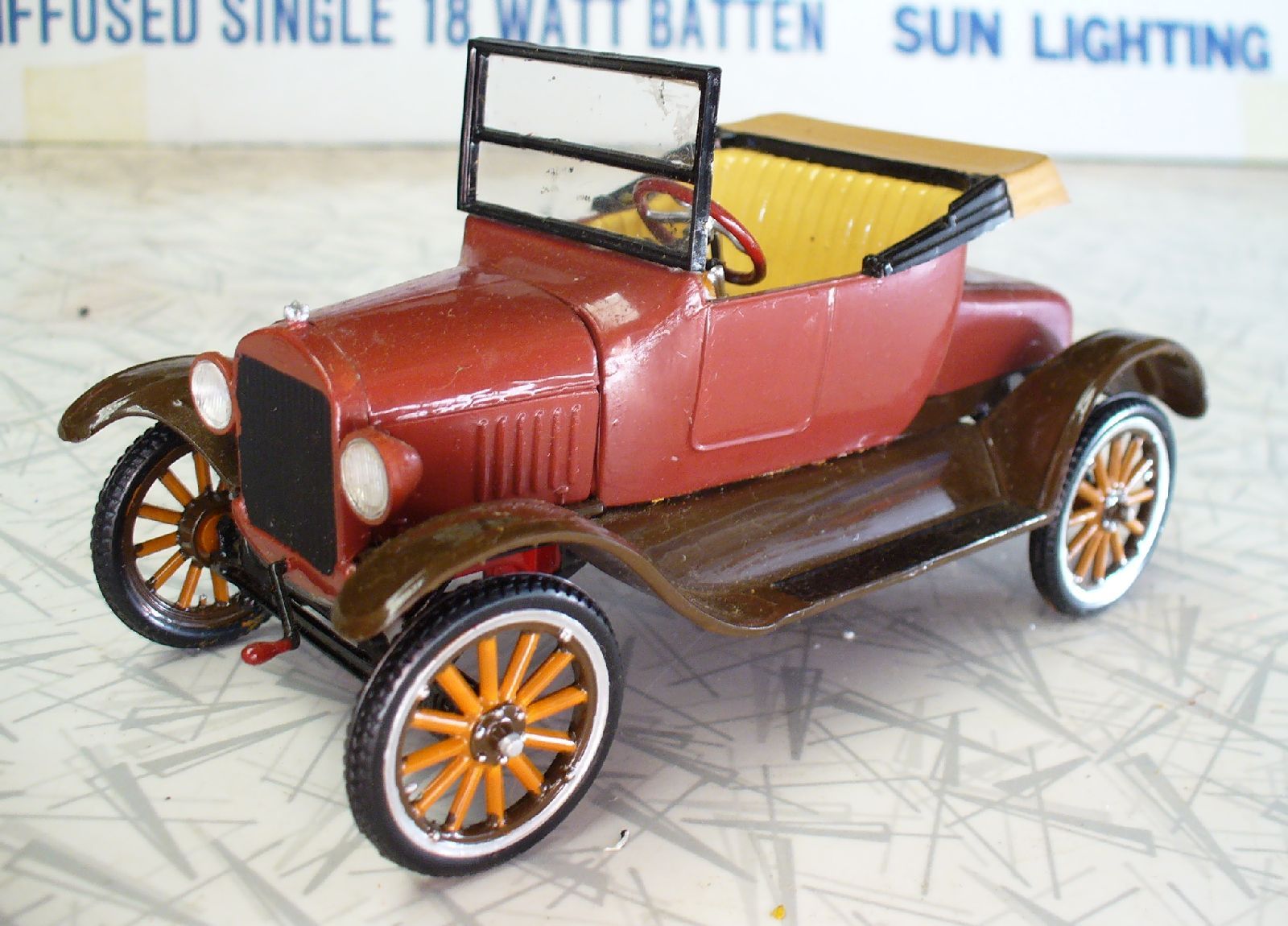
Most of the ones we will look at today are older builds, from back in the seventies. This T Ford is a seventies build. I ‘knew’ Ts of this era were black but I also knew this was Australia, where we don’t always play by the rules. I didn’t research the minutiae or what colours Ford Australia used on what in 1923 – I just looked at the paints I had and said ‘that one!’. As a teen would.

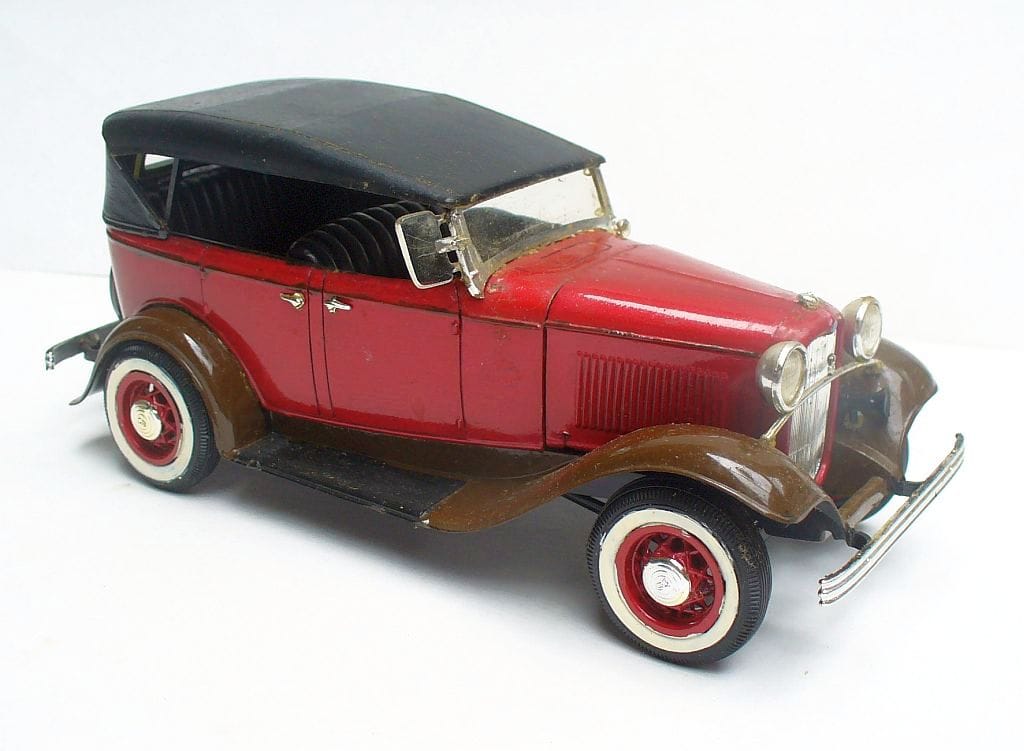
We’ve had a bit of a look at the prewar years before, (Hot Rods and Customs: Cruising Woodward) but that was a story on hot rods. This time we’re looking at unmodified oldies. Occasionally I’ll build a twenties or thirties car these days, but that’s usually because I already have the kit. This 1925 T dates from about ten years back. I played it safe and painted it black.

Australia was much later than the US in adopting closed bodies. For a twenties or early thirties car, the open ‘tourer’ body was the norm, probably because it was cheaper. I have a 1934 school geography textbook which proudly shows “The latest type of Motor-car, 1934”, and the photo is of a Chevrolet tourer. Not a sedan. I’m not sure a four-door open body like that was even available in the US then! This 1927 T is a build from about ten years back.

Of course, not all cars were big. Smaller cars tended to come from Britain, being part of the Empire and all that. Auntie Merle had her own car before the war, a small British Standard Flying Nine, with an open body. This ‘Austin Seven’ is actually a German kit of a BMW 3/15, a Seven built under licence and gradually improved.

Here’s a 1932 Ford sedan. Being an American kit, this is the American body. Some years the differences between these and the local Fords were under the skin in constructional techniques, other times they were more visually obvious. We didn’t get a two-door sedan in Australia after 1929; already we had shown our preference for four doors.

We did get coupes here, but ours were only the five-window style, and had a higher roofline that the US ones. In fact, all our ’33-4 Ford bodies look rather like the ’32 US ones in that regard. I did try modifying one ’34 coupe to the Aussie body, but got in over my head and never did finish it.

Another older build, this 1936 Ford roadster is another of those kits I asked an obliging shopkeeper to get in for me – that makes it a 1975 build. The colours aren’t correct of course; by 1936 body and fenders were almost always the same colour. On the off-chance they weren’t, the fenders would have been black. But this looks better.

Another (later) seventies build. I used to pass a ’38 Chevy sedan on the walk to school, so naturally I built the AMT ’37. This Chevrolet was not as easy to assemble as AMT’s Fords, the body to chassis fit being determined by the inner fender panels, which I got wrong. The body seems to sit higher on the chassis than the Fords, or maybe that’s just the way AMT made them.

About twenty years ago I decided to revisit the 1937 Chevy kit, and made this convertible. The off-white would have been a startling colour here before the war.

Meanwhile, here’s the same year’s Ford as a coupe – sitting a bit low and with contrasting paint on the wheels and hood side vents. Not quite a hot rod, but I used to see this sort of thing sometimes, perhaps a holdover from the fifties. This is one of my ‘mainstreamer’ builds; the kit was a hot rod, but I used parts from my spares box to build a stock Ford.

I mentioned this all started because of a 1940 Ford. I eventually got that kit, but built it as a hot rod, so that’s outside the scope of today’s story. However, here is a 1939, built from the same kit, in stock form, that I built a decade or so later. The wipers are on the cowl as per 1940, rather than being mounted above the screen as on a real ’39.

Here’s a 1941 Plymouth. Two, in fact. AMT came out with this in 1975, when I built the white one. I built the red one in the early eighties. We’ve seen a few of these before (you may remember the battered and rusty green one), though I haven’t built enough to dedicate an entire story to them.


AMT came out with this 1941 Ford Woody kit in the nineties, initially as a rod but later in this stock version. It had some unexpected assembly ‘challenges’ for a newish kit, but eventually built up to this nice rendition of a ‘41. The ‘wood’ is all hand-painted. I actually like doing that sort of thing.
What about The Classics, you ask? Not today. Not this month, maybe even not this year, as I need to find some models and take some photos first. Maybe even build a few more? Anyway, it’ll be something postwar next time. See you then!























I like how you did all of these .
Light colored cars were in he 1920’s & 1930’s but usually only owned by the rich or women .
One of my dream cars is the 1937 Chevrolet Business Coupe .
-Nate
Thanks Nate.
Thanks for that note about light coloured cars. The few prewar cars I saw in my childhood were always very dark colours, usually black or navy blue, but there were occasional light shades in old photographs. And, of course, Hollywood movies – though we know those don’t necessarily depict real life….
Here’s another Chevy for you.
This was very cool. Peter, I appreciate that you often include the approximate build year which helps me place the context of what was going on in the world at the time, and also around how old you were when a model was built.
I can’t easily identify year / make / model from a certain point back in time, but I recognized the lead-off 1940 Ford almost immediately. I have so much appreciation for the looks of those these days.
Bully for you for having taken aesthetic liberties with colors and such when you had originally built some of these in the ’70s. Isn’t that part of the fun of miniaturized versions of cars we find interesting?
Like you, I was also born when my dad was solidly in his mid-40s. In some respects, I felt like that was an asset, and in as many others, a liability.
Thanks for another great browse through your model collection.
Thanks Joseph. I remembered you saying your dad was older; from other comments it seems that isn’t as unusual as I felt at the time. I remember at any school function he seemed so much older than other fathers.
As to putting things in context, I’ve always been fascinated with history, not to the point of ever studying it formally, but rather trying to grasp the big picture, and what life was like for the ordinary people of the time. Some of my non-CC writing is in a historical setting, though weird things happen…
Just this past week I’ve been painting some model bodies for assembly later in the year. Most are variations on cars I have done in the past – different body styles and such. Some are appropriate factory colours, others are not (but plausible), while one is decidedly not! Let’s just say I’ve taken Ford’s 1967 colour chart and ‘pulled forward’ a colour from 1970 or so!
I recall a similar conversation with my father about making models of “new” cars.
At some point before I was born, Dad put together a very detailed model of a Duesenberg. I have no idea what prompted him to do so, but by the time I was a kid, it was falling apart. However, he was proud enough about the Duesenberg that he still kept it on a bookshelf (on the top, where folks couldn’t see the falling-off pieces).
At some point, I told him that I’d like to try a model as well, but since I wasn’t interested in prewar cars, I wanted to make cars as new as possible. Like for the ’60s (which was as new as models seemed to be). Dad gave me an answer just like your dad did.
I eventually talked him into it, but my lack of artistic skill produced some pretty sad results. And eventually, the Duesenberg was transferred to my bedroom, where it was parked until I moved out of the house.
I could rarely talk to my dad about models, Eric. I think he thought once I got the 1940 Ford, that would be the end of it all. He was not pleased when I was still building models five years later, thinking I should be out socialising more. But that sort of thing was just so not me. Now it’s over fifty years later…
If your Dad’s Duesenberg was the Monogram kit, it’s very tricky. Being such an old car, many of the parts look little like bits from a more modern car, and there are lots of little parts to fall off, things that are more integrated and enclosed nowadays. From memory Monogram has offered about three different bodies for this chassis, maybe four.
I’m pretty sure that’s it! His was dark green.
Nice work as usual, Peter. As a side note, I am the youngest of four kids, and my parents were also in their 40s when I was hatched.
Thanks! Seems having an older father isn’t as odd as I thought. Maybe it just seemed that way because I was an only.
My Dad was of a similar age (46) when I was born so I can relate to that age difference (my mother was 18 years younger than him), though we had shared interests in cycling and he was quite supportive of my modelling most of the time. Now I’ve passed the age he passed away at I do wonder what his perception of past and old was. No good thinking about popular music culture was in the ’30s, ’40s or ’50s as he was into classical music and opera.
Still, I think we can all agree those 1920s vehicles are ‘funny old cars’ with lots of exposed greasy bits out front. I’m currently detailing/rebuilding an H0 1923ish Bentley and having to replace a lot of the compromises that would detract from the head-on view. Even in the larger scales I can imagine some of these parts in plastic must be a bit delicate.
Nice selection again, Peter. The Woodie looks good in that combination. If I had to pick a a favourite I think the cool 1937 Chevy convertible would be my pick. As you say, in a pre-War setting it would stand out, but without having to shout.
Bernard, your comments reminded me about some things I’d long forgotten. I feel the generation gap is never so wide as when the older person denies there is any such gap!
I think is all the ‘exposed technical thingies’ of twenties-and-earlier cars that makes me appreciate the mid-thirties onward; the mechanical parts become subordinate to the shape of the whole.
I do have a 1/24 scale Bentley of that era – packed away somewhere. I can only imagine trying to recreate it in HO scale – I’m glad it’s you and not me! Every time I hunt for a piece I have dropped, I remind myself things could be worse, it could have been an HO part!
Sometimes, I can be quite surprised how quickly cars become older even though I still think of them as new.
However, a 1940 car in 1974 to be considered new is unusual.
I wonder if your dad thought 1920s cars were better suited to scale modeling perhaps.
I like the older models here, the 36 Ford Roadster maybe my favourite, I can just imagine those colours being a thing back in the day.
I like the Plymouths too because Mopar… I built a red one once but it didn’t survive
Its great you still have these old builds and they are in fantastic condition. My younger years were too topsy turvy for such fragile things to last this long.
I still have some of my old Matchbox cars though, but only because they were stored safely with my parents for years.
Thanks jonco. As I get older, the more I find myself understanding the old folk of my childhood, how decades ago would seem like yesterday to them – though mercifully I’m not living as though it was yesterday.
I’ve often thought back to that exchange with Dad. In 1940 he would have been thirty, possibly peak car-interest age if not for the war. Even ‘putting myself in his shoes’ and thinking about cars from when I was thirty – I still see them as old cars, not new. New to me might be 10-15 years old: I tend to think of having a touch screen as the division between “old car’ and ‘new car’.
Some of the oldest models have been packed away in boxes for decades now, that’s how they’ve kept so well. I think having no siblings was a great help too.
Since you liked the Plymouths, here’s another one.
My father was about 38 when I was born, coincidentally.
We did build a Duesenberg SJ together, since it was really too involved for my years with a die-cast body etc. Almost certainly brought back from the USA…
My father did this on random occasions – models of the Cutty Sark, the Visible V8 (in the days when it had a real ignition system), a Cooper…really a bit eclectic.
So I can blame his interest in model engineering for mine.
I tend to agree with the old farts that older cars, etc make more interesting kits. If one is working at 1/32 or 1/2or 25 scale, an ‘interesting’ shape stands out more than an aero blob.
Here’s Peter’s model of a Xiaomi SU7 – or is it a Model S Tesla, or does anybody care..?
AMT’s US conventionals look more impressive than an Italieri Eurobox – not least because of the paint schemes.
History (even casual study) is important – one cannot know where we are or where we are going, if one does not know where we came from…
Hey, thanks Nick. It must’ve been wonderful to be able to share in the construction of models with your dad. And such a wide range of subjects too. I can see that feeding into an interest in model engineering.
I think it was being surrounded by older people as I was growing up that has given me my interest in history. My grandmother told me stories of growing up in the 1880s, when everything was horse-drawn, bicycles as we know them were the new craze, and the city of Melbourne was barely fifty years old. Nick, I treasure those memories, and have passed them on to my kids; the grandkids are a bit young to care yet. But knowing someone who was around when such-and-such happened really anchors history and makes it a live thing,
Both my kids ‘helped’ me in making a model or two, and have grown up to have an interest in handcrafts (my daughter) and model-building/engineering HO gauge trains (my son, a heavy-diesel fitter).
Your picture was probably too big to come through, but I get your point; I build few newer cars for that reason.
I built a few of these – 36 and 39/40 Ford and that Chevy coupe. The only Model As I built were from metal kits made by Hubley.
JP, I think those Ford and Chevy kits were pretty much a part of any car nut’s repertoire in our younger days. Although I occasionally saw the Hubley kits in a store, I stuck with the cheaper (and simpler to work with) plastic.
Another entertaining post. Very enjoyable. Thank you, sir.
And thank you. Something newer next time, I think