

We don’t all like the term Malaise Era, which in today’s case will cover the 1973 and 1976 model years. But before I heard that term, I always used to think of the next five-ten years as the Brougham Era. Arguably that sounds more positive, and takes the accent off the cars’ deficiencies: extreme weight, drivability, fuel economy, and (depending on the brand) good old build quality. Think instead of the comfiness inside your transportation module, isolating you from that bad old world outside, encapsulating you in a haven of velour, leather and carpet, decorated by only the finest of plastiwood and plastichrome.
What’s that? I’ve swapped malaise for nausea? There’s no pleasing some folks!
But seriously, I won’t go into the cars’ deficiencies (which we all know). No sense going over old ground, and potentially stirring up bad feelings. Heaven knows, there’s enough of that in the world. Some people love these cars. So, I’ll just comment on a few things pertinent to the cars (or the models) as we look at them.

1974 Charger
I think of these as the last Chargers. They went from being a sharp stylish performance flagship to – this. I tried. The next year’s Charger was unmistakably a Personal Luxury coupe; this one was halfway there. Styling had been ‘normalised’ about as far as the shell allowed, and the SE had all the good Brougham stuff slathered on inside and out, but some of it sat rather awkwardly on this bodyshell. Help was on the way – unless you were a performance fan.

1974 Barracuda
The ponycar that aimed to beat all comers in the Muscle Car era was facing a different era now. Buyers’ priorities had changed: what could Plymouth do? Changes were minimal, which hinted at lack of a future for the Barracuda. This is an MPC annual kit built (for a change) as the drag version, mainly because I liked those decals. Makes a change from ‘71’s ‘billboards’.

1974 Matador
And then there was AMC. Were they unaffected by the woes of the world around them, or were they totally misreading trends, out of step with a changing world? Judging by sales, it was the latter. Like it or not, the formal look was in, and AMC’s swoopy huge coupe looked way out of line. Lack of buyers told them so. Very imposing beasts when you see them in the metal, especially in X form.

1974 Ford Pinto
Ford’s attempt at a small car got huge crash bumpers, which must have done horrible things to a small light car, adding so much weight to the ends where it affects manoeuvrability. I’ve removed them here. It always struck me as odd that Ford should choose a two-box sedan with the same profile as the hatch, rather than going for a more conventional look. We still had performance cars Down Under, hence the black paint and stripes. I tidied this up a few months ago; it now has 428 power. Legal for a model.

1974 Plymouth Satellite
A lovely-looking design for ’71, it was looking a bit awkward for ’74. Sure, the loop bumper had to go, but this new-for-’73 front looked rather strangely-contoured – I almost said contorted (that would work, too). It still had taillights in the bumper out back, but that revised quarter window shape (also ’73) gave a ‘formal’ looking C-pillar but also a massive blind spot. That’s something I don’t miss about seventies cars!

1975 Oldsmobile Cutlass
Here’s a ’75 Cutlass from Johan. Very simple to put together, basically an unassembled dealer promotional car. Considering GM was about to downsize their big cars, it always surprised me that they made these ‘intermediates’ so large in the first place, even though they were originally slated for a ’72 introduction. Did they really feel the previous bodies weren’t big enough? Really?

1975 Gremlin
Ah, the Gremlin. Was it a stroke of genius, borne out of desperation, or what? But it’s the sort of thing you’d expect from a company that brought back the ’54 Rambler for ’58 – taking daring chances, making use of what you had. I rather liked the look, but not the big thirsty six up front – though I guess with US gas prices that didn’t matter so much. Oh, that’s right: gas crisis….
Another AMT annual, updated from year to year and re-released about ten years ago.
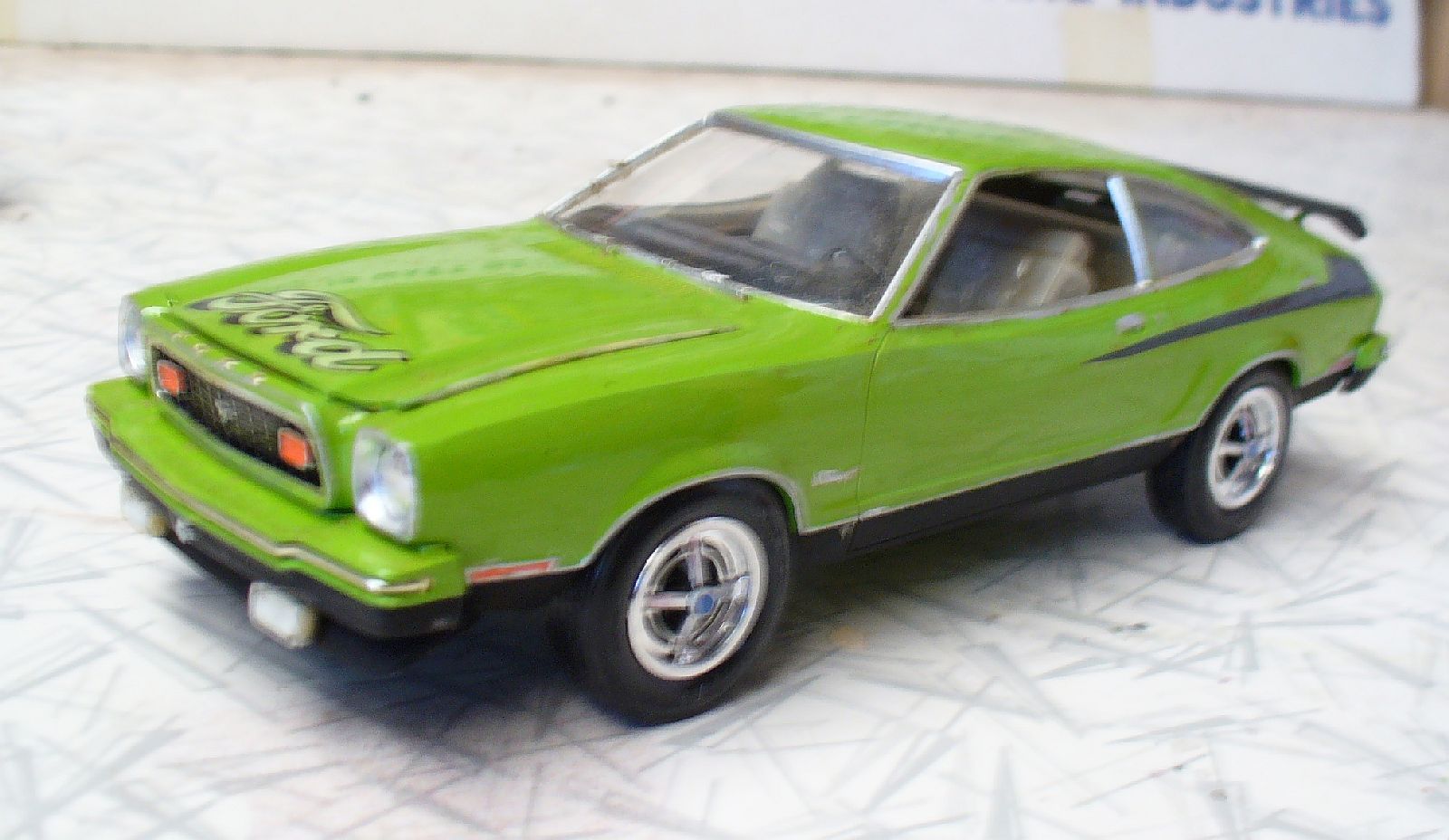
1975 Mustang II
Ford had downsized the Mustang ahead of the crisis. We’ve deconstructed and reconstructed the Mustang II here previously, but it was a hit with the public. This is an AMT annual kit, updated each year, and re-released as a ’78 about ten years back. We’ll see that in a future instalment. MPC also did one, which I feel was the better of the two. My cousin had that one.

1975 Corvette
The Corvette had the advantage of being a sports car, designed like a supercar, looking unlike anything else save an exotic. As such, change mightn’t have been necessary except for government regulations, but as this shape had been around since 1968 some freshening was in order. Fortunately it didn’t get broughamed.

1976 Eldorado
This might not have been the last of its shape, but I couldn’t pass up adding a big Eldo to the story. This Johan kit has an amazingly-detailed front end and chassis, really showcasing the FWD setup.

1976 Camaro
This is an AMT kit I bought and built back in ’76. It was a bit rough and simple, and suffered a lack of QC, one front fender being mal-formed. Art imitates life? As a development of the popular 1971 kit, the tooling was probably getting worn out. Definitely not as sharp as it was; still, it reflected the latest changes.

1976 Caprice
Not that I’m a great fan of these cars, but I had to get this because it represents the end of an era. It’s amazing now to look back on these cars and think of the added bulk, the size, the weight that simply wasn’t needful for carrying six people in comfort – yet which, for some reason, some of us had come to accept it as normal.

1976 Chevy Nova
Chevy rebodied the Nova. It really had been looking a bit past it; the 1973 update hadn’t done it many favours. The platform carried over largely unchanged, meaning the dash-to-axle proportion was longer than ideal for a modern sedan. The new style body made the sedan’s passenger compartment look cramped; that wasn’t such a problem with this hatchback.

1976 Dodge Dart Sport
Duster by another name, this car was hanging on with few changes since its debut as the Demon in ‘71. Just a more formal-looking front end and reshaped taillights; everything else was government-inspired. An MPC kit re-released several times over the years,

1976 Gran Torino.
This is a recent Revell kit of the Starsky and Hutch car, turned into a regular Gran Torino. Well, with a few changes. The opera windows were a pain to install, and I had some work to get the rear ride height down, then fiddle the front height to suit. Revell made a stock Gran Torino kit after I built this (that’s always the way!), but it doesn’t have the opera windows – must have been too much work for Revell’s tool engineers; I can’t blame them…

1976 Gremlin
Another Gremlin? Yes, this one has the new front for ’76 along with restyled stripes. Also, as this one was re-released about 15 years ago it gave me the chance to build a better one.

1976 Matador
AND another Matador? Afraid so. Not a reissue (they wouldn’t surely…?), I picked this up about twenty years back, and built it for an online competition. No prizes, but there was some good-natured ribbing at my choice of subject matter. That was the whole point.

1976 Pacer
AND a Pacer? Yep. Strange to say, I love the design of these cars. Design, I said, not anything else. Certainly not engineering.
Okay, that’s enough for today. We’ll carry on through the Great Brougham Era some other time.























So much modeling work represented here of an era of cars with only mixed appreciation or admiration by automobile fans, and for good reason. That said I love them.
It would seem that the reason many thought that the biggest models of that time like the Caprice were not outlandishly large was the slow and incremental upsizing that occurred over 20 or so years starting in the mid-late ’50s through the mid ’70s. We just got used to them. Plus the larger post-war family size only slowly declined during those time, making such cars still useful for those families with 3, 4, 5 kids, large families were very common during the years of my youth, and the cheap gas didn’t hurt either.
I love Pacers too. Today, they (the design, that is) seem like postcards from a past future that never happened.
Pretty much how I feel about them too. AMC seemed to have a vision for a Jetsons-type future. Just a shame AMC’s engineering couldn’t take advantage of the Pacer’s package. You’ll see more Pacers in the next episode!
Thanks Randerson. You raise some interesting points here.
About modelling work: It was a labour of love.
About size: Food for thought indeed. Other countries had large family cars once, for those who could afford to run them. But then from the mid-fifties on, so many US cars grew beyond a size we had a need for, or indeed could afford to run, or indeed could fit in our cities. I think it’s only when seen outside the context of the US roadscape that the sheer size of these beasts becomes apparent. I shudder to think of how today’s drivers would cope in a city full of ’76 Chevys!
I love literally all of these. What is it with me and underdog appreciation syndrome? Seriously, though, I tend to appreciate forgotten survivors just because I just don’t see any of them, especially in scale model form such as these.
I mean, you already had me with one Matador… and then you included *another* one.
I like the ’74 Chrysler products because that with the exception of the success that was the ’75 Cordoba, 1974 seems to have been the last gasp of things seeming like business as usual, sort of, before everything got dire.
The ’74 Dodge Charger SE reminds me of an athlete dressed in disco duds. It kind of works, but…
Great assortment and thoughts about them as per usual, Peter!
Thanks Joseph. I totally get your assessment of the ’74 Charger – athlete in disco duds indeed. Capable of great moves, but maybe not that sort. Later seventies cars aren’t often seen in the model groups I frequent – especially not Matadors! Occasionally Gremlins or Pacers though. There are rumours of a third Matador emerging from my workshop some time…
Nothing wrong with appreciating the underdog. It’s odd to think these sort of things used to be common as dirt once upon a time. The other day I was looking at video footage of streets I know taken ten years ago, and I was amazed how many of the cars I hadn’t seen for – oh, about ten years! Change creeps up around us so slowly, but when we notice it, it can make us feel suddenly old.
Another great batch of cars, Peter, and the colors are so appropriate for the times.
Regarding that ’76 Caprice, I recall seeing for the first time the 1974 coupes (the first with the huge rear side windows that didn’t open) on a car carrier at a rest stop on the Pennsylvania Turnpike. I thought they looked odd — and still do today. Yes, and they were enormous!
Thanks. For a while there in the sixties and seventies we had something of an explosion in colour choices.
I used to be able to buy touch-up paint for all those colours; while obsolete colours are still available (to order) they now come at an uneconomical cost for painting models. Probably about half of today’s group are ‘real car’ colours, either Duplicolor cans or Testors’ attempt at them (sometimes less successful than others). I don’t always use them on the ‘right’ cars though – while the Vette is the appropriate Chevy yellow, the Nova is a Honda red, and the Satellite a Ford blue.
Funny how some design choices look odd when you first see them, but become ‘normal’ with the passing of time, while others remain strange forever. While the big window on the Chevy seems natural in a way the big closed-in pillar with opera window does not, which one looks odd today?
These models evoke some mixed feelings for me. I think I built examples of most of these models, except perhaps the Mopars, which I could never find in the stores near me. I spent hours detailing these models and actually developed some pretty decent painting and gluing skills, though never achieving the kind of workmanship displayed here. That was the fun.
On the other hand, these cars were all representative of some of Detroit’s worst efforts, with huge bumpers grafted onto swoopy shapes, lots of fake bric-a-brac endemic to the Brougham era, and, of course, engines strangled by much-needed emissions controls. What an era to be nostalgic about. Oh well, at least by the time I owned a car in the mid-80s things were on an upward trajectory.
Thanks William. I got into building these American models just as the real cars were changing, as the emohasis seemed to shift from performance (that I could understand!) to… strangeness.
It’s curious to look back on those days. Even more curious from outside the US, to see all those regulations you suddenly got bombarded with working at cross purposes. You had those huge colonnade intermediates, crash bumpers adding weight when you want to save fuel, emission controls affecting drivability, and so on. Engineers must have felt they were in a neverending tug-of-war. Did anyone in government understand what they were doing? It made me wonder whether someone like Tom McCahill would come out and say “Keep your ’72; the ’73’s not as good.”. That would’ve really put the cat among the pigeons!
Peter: I guess I’m sort of an oddball, I liked the Matador, Gremlin (and Javelin!), and the Mustang II. I thought that the 74 Charger (non SE, as your model) was better looking. The “Broughamification” of the 75 Charger, complete with filigreed Charger nameplates totally turned me off! I found the 73-74 Satellite to be somewhat awkward looking compared to the previous body style, but I came to accept it. During this “Malaise” period, I think we were so desperate for something/anything that hearkened back to the “glory” days that we grasped at the few straws that Detroit threw out! BTW: You don’t perchance have or know of a kit for the 1980-82 Dodge Mirada/Mirada CMX do you? 🙂
Ah, the Mirada CMX – now that was hearkening back to the glory days! Or trying to. It was never done as a kit, I’m afraid. Possibly there might be one in resin or a 3D print (either a kit or the files); the trick would be finding it. And being able to check out the quality.
Nothing odd about liking the underdogs of this world. But it was a strange time. As a reader of US car magazines I saw this in the adverts; sporty bodyshells grew the barnacles of broughamhood, text which indicated the guys behind the ad were clueless, or that the manufacturer had suddenly forgotten all they ever knew about performance cars – as if they had had a stroke.
It’s interesting to ponder that although model kits through the sixties always were the top luxury or performance models, through the seventies we never got models of the Brougham versions. The kit manufacturers must have realised they’d have little appeal to your typical model builder.
The malaise era covers any car with a opera window or extremely large non movable quarter windows….And that includes the new 2026 Dodge Charger coupe with its huge fixed quarter windows…..Now a “30 Ford Model A 5 window coupe does not qualify with its small quarter windows even though they don’t roll down.Malaise isn’t just about non performance it’s about styling too.