

So what else have I built mega -multiples of? Let’s see.
Justy doesn’t want me to do ’60 Fords, and I’ve said I’ll warn him in advance if when I do. There’s a pile of ’51 Chevys and shoebox Fords, but we covered those in the early fifties story. Step-down Hudsons and ’53 Studebakers were covered back when I did Independent’s Day. I’ve done Camaros and Mustangs.
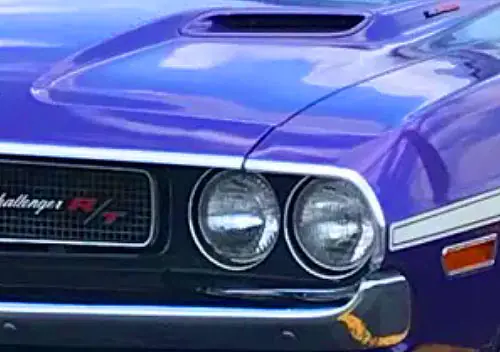
Looks like we’re back to Mopars again, and from the muscle era too, with the E-bodies: Barracudas and Challengers.

These E-bodies were developed at a time when ponycars were selling up a storm – except for the Barracuda. The original huge-back-window job with the Valiant front end was replaced by a beautifully-styled car which shared no sheetmetal with the Valiant, yet it still didn’t sell as hoped. Even with a 383, which would’ve been a tight fit and a pain to work on. Time to rethink their ponycar strategy.

Drag racing was big. Ability to fit a big block, even a Hemi, seemed essential, though more for bragging rights than actual sales numbers, I suspect. Besides, the old model offered a big block. So the new Barracuda (which would have a Dodge counterpart for the first time) was made 5.3 inches (14cm) wider to better fit the bigger engines. From a non-US point of view, this seems a huge increase. The Barracuda was 6 inches shorter than before, making it rather stumpy for its girth; you get the impression it’s all about the engine. By comparing pictures, the length seemed to have come off the tail; fair enough, but that didn’t leave much of a trunk. Wheelbase was the same 108 inches (274.3 cm) as before. So rather than being compact-based, as other ponycars were, the new E-body was more of a cut-down intermediate. Definitely no Valiant here! Coupe and convertible only; the fastback which began the line was no more.

As befits a Dodge, the Challenger was larger again: 1.2 inches (3cm) wider than the already-wide new Barracuda, 4.6 inches (11.7cm) longer, and on a 110 inch (279.4cm) wheelbase. So it was bigger but not ridiculously so – if you accept the new Cuda’s width as a sensible starting point, that is.
Barracudas

The Barracuda body seems notoriously difficult for some kit makers to capture in scale. MPC produced an annual kit from 1970-74, which seems to have been the only really decent one. Johan also did a ’70-’71 coupe; Mopar folk say the body is more accurate than the MPC but to my mind it’s let down by the chassis detail. The pink drag car above is an MPC built in ’74; the blue and silver one (at the end) is a later reissue; early eighties, I think.


Monogram added a ’71 Hemi Cuda to their muscle car range in 1982. As with many of the older Monogram bodies, it has issues. Somehow the windows seem too large, with too much curvature in the base of the windows in plan view (hard to describe; the photos might show it). The rear side marker lights are about twice the length they should be, and the headlights are too widely-spaced up front, cramping the grille segments into inaccurate proportions.


Notwithstanding that, I’ve built quite a few of them. Some have been turned into regular Barracudas; two have even lost their Hemis.


It’s still available under the Revell brand.

At one stage in the nineties, I cooked up a ‘what if?’ or ‘phantom’ Cuda, using a Monogram Cuda with a resin Hemi Six (long out of production), Weber carbs from a Cobra and Olds wheels from my spares box – to make this E49 hemi-six powered Cuda.


Monogram’s ’71 Cuda was revised in the nineties to offer a convertible body. This removes the roofline’s side window issue, but the grille panel still needs revising.

Revell has had several goes of their own at the ‘Cuda, wanting to produce a ‘70. They could have simply rebodied the Monogram ’71, but oh no! Their first fail was an ill-advised attempt to base a Cuda off the Monogram Challenger kit. The resultant body was horrible, being too long with a wrong roofline which looked too long and flat; neither Cuda nor Challenger. This tool was later revised to look more like what it should have been in the first place, but still had the Challenger’s wheelbase, with wrong proportions for a Cuda. I didn’t get that one; once bitten……

Now under German management, Revell has had another go. After having seen what Revell of Germany is capable of with their European car kits, we had high hopes. While better than previous efforts (which wouldn’t be very hard), the new ’70 Cuda kit still has problems. Wheel arch flares are too prominent, the rear end/taillight panel has shape issues, and the stock rear spring hangers foul the rear pan, preventing it from fitting properly. Oops! That’s a fault I haven’t seen for decades!

Wonder what happened to the old MPC tool? AMT, you guys got that one?
Challengers

Challenger kit history is rather simpler, with one unexpected and somewhat strange addition.

As with the Cuda, MPC did the Challenger annual kits from 1970 to 1974, and made a fantastic job of the bodies, with a variety of options.

In the late seventies, AMT produced a beautiful Challenger convertible, later releasing a version with a vinyl-roofed hardtop as an optional part. Somehow the roof doesn’t look quite right.

Monogram produced a Challenger T/A. The body looked much more accurate than their Cuda. Unusually it was molded in a metallic plum-coloured plastic, and came with a sachet of Turtle Wax to polish the body ‘for that real car shine’. Nice thought, but mine suffered the same problem as almost every attempt at a metallic plastic: flow marks. These are swirly lines in the plastic with unrealistic distribution of the metallic particles. This comes from the flow of the plastic into the mould. Polishing this body just emphasized the flow marks. As I said, a nice thought. Shape though? I reckon they nailed it.


Moulded in plain plastic, this kit has been reissued time and time again – if it’s not in their catalog now, just wait a few minutes….

For some reason, Revell decided they needed a Challenger in 1/25 as well as the Monogram one in 1/24. It seems they had a tool that was made for a diecast Challenger, and decided to run it in plastic. I hear there can be problems with doing this. Revell’s big problem was that this tool lacks the extreme bodyside curvature of the real thing, having disappointingly flat sides. I’ve heard this was necessary to get the metal body out of the mould, but it spoils the look of the model.

But wait; there’s a stranger in town. Otaki of Japan released a motorized kit of the ’73 Rallye. Initially as a stock Challenger, later versions included a flamed street machine and a SWAT version with a working light bar. It had opening doors, and interior detail, but the centre console (hiding the battery box) was very wide. I left my interior black, so it doesn’t show. It also has an opening hood, showing off the characteristic wide valve covers of… a Hemi, last available in ’71. Nice thought, guys.

Though Otaki is no more, the tool was picked up by Doyusha which released a very-raked street machine version. ARII seems to have it now, restored to stock configuration; there’s one on eBay as I write.






Seems like some of these model company’s had as many quality issues as Chrysler itself did.
It’s a bit like that. From the buyer’s point of view it’s so frustrating when they announce something you really want and then flub the execution – be it in full size or in scale.
Peter, impressive collection as always. Reading the title i was half hoping to see a white Challenger in honor of Vanishing Point, a movie that made me fall in love with that car (and indirectly with the ‘Cuda as well).
A pity the E car arrived at the tail end of the pony car craze
Thank you, Gianluca. I’ve never been a great one for TV or movie cars, and generally don’t even think of using white as a colour when there are as many great choices as Mopar had then. Also, give me a kit moulded in colour and I’ll usually want to change that colour. That’s just me!
When magazines ran stories on the new US cars back in the sixties and seventies (I’m Australian), the photos they ran never seemed to show white cars. The publicity shots always seemed to feature the new colours, not the carryover white (or black).
It seemed Plymouth and Dodge just could not win. No matter what they produced in this class, success eluded them.
Peter: As always, your Mopar models delight me. I lusted after a Barracuda, but ended up with a Challenger. In true model builder fashion, I took my base ’74 Challenger, and by dint of ordering and installing every OEM part that I could get my hands on, and even changing the color, made it into the car that I wanted it to be! I still own it with 69k actual miles. The convertible & T/A models are exquisite! The front end of the Otaki model is too flat, however. Once again, a superb article!! 🙂
Thanks Moparman. Nice Challenger! I enlarged the photo to take a good look, It makes me want to get out the tools and – but no, a ’74 kit would take some finding, and I don’t think I’ve got quite that shade of blue.
The Otaki model has quite a few shape and proportion issues, as many Japanese kits often did back in the seventies (except for Tamiya, which is how they got their reputation). However, unlike some kits back then, you can instantly tell what it is. Even if the front is flat!
Hi Peter,
You always seem to be able to make a “silk purse from a sow’s ear” as the old saying goes. I have several Cuda and Challenger projects in the works or planned, including a slant six AMT Challenger ragtop and a base model Monogram Challenger coupe with small block, bench seat, column shift and more mainstream wheels, possibly steelies with hubcaps. I really enjoy your work and I’m glad I discovered you on CC! Take care sir!
Bob Kremer
Well hello Bob! Good to see you here. What’s it been, twenty years since we discovered each other’s work in Tom’s group? Maybe longer.
I’ve been writing on here for three years now, and covered all sorts of topics – but I still haven’t shown all my models (which was kind of the initial aim) though we’re nearly there. Call it mission creep…
I like your mainstream ideas. It seems strange to think of a Challenger with a bench seat and column shift. The car would certainly have the width to make full use of a bench, but I’d reckon they wouldn’t have sold many like that, would they? I covered my mainstreamers pretty early on:
https://www.curbsideclassic.com/blog/miniatures-toys/cc-in-scale-building-styles-doing-it-mainstream/
Wow, the 12th Hemi Cuda! And in Emerald Green! I’m surprised you put Donks on a car so rare. Hopefully, you have the original wheels for when it goes to the Mecum Auctions…
All kidding aside, what a great collection again Peter. It’s amazing how off some of these manufacturers’ proportions are with some of these in the interest of saving money on their mass production.
Oh, and you were like Nostradamus with that “What If?” project with the Hemi Six. Doesn’t Stellantis now have an engine called a “Hurricane” that is a Hemi Six that they are putting in some Chargers? From what I understand, some unsatisfied MOPAR fans petitioned hard enough to bring back the Hemi V-8, but at least we have choices! Even an electric one now.
Thanks Rick. Proportions with models are a funny thing, but somehow the E-bodies seem to attract more faults than usual.
The wheels on that green Cuda (it’s actually a Kawasaki colour) are a bit outside the usual for me, but they’re not really donk-wear, ‘only’ about 18s. I’d built so many with the various Mopar wheels and the usual Cragars that when the kit came with this option I used them.
Regarding the hemi six – not really prophetic, though I see what you’re getting at. This was the basic seventies Aussie Valiant engine – well, in single carb form. It replaced the Slant Six down here. While the triple-Weber 265 was factory-available, it was very rare and you tended to only see it in specific Charger R/T packages, though there are stories of other bodystyles coming out of the factory with it, even a wagon!
My 1:18 E-body Cudas have off proportions too, both the Ertl and quite expensive Highway 61s, the Ertls being oddly chunky out back with the H61s being a little pinched. I can’t quite put my finger on it but no model I’ve ever seen has quite gotten the Challenger front end exactly right either, on my Ertls the shape is too oval and trim is too big(almost like it’s got a loop bumper) and on the Highway 61 the shape is mostly right but the headlights are too big and positioned wrong. They’re all among my favorite models in my collection but I have to squint a little when I look at them!
It’s interesting you mention the side curvature(or lackthereof) of diecast molds, as its most definitely something I’ve encountered in my collection but oddly the E bodies are all pretty good, I think the worst offenders I have are otherwise all Ertl; 68-69 Chargers, 71 Roadrunner/GTX and pretty much all their Camaros really struggle in that area. Some like the E bodies are remarkably good, there seems to be no rhyme or reason to it
Well, in a way I’m kind of glad to hear that somebody else sees a problem with these – it’s not just me then. But I feel for you, Matt, with those H61s. When you pay a premium price for something, you expect to get better quality in some way, you expect to get something better than the cheapies offer. It seems to be a problem with modern society – ‘premium’ brands which do nothing better than the cheaper ones, and ultimately have no reason for being. Image is imaginary, without quality, the brand is nothing.
That’s very interesting that your diecast E-bodies’ side curvature is okay, yet some other cars by the same company aren’t. How strange that Ertl can get some right in that regard, but not others.