

Initially I was going to write an article about pony cars. Then it dawned on me – I’ve built too many of the things. Funny, that. So I wrote a Pony Car Sampler back in February ’25, with the intention of covering things more in depth. To keep things going, I covered Camaros (Tribal) in August.
That kind of eased the pressure. Now it became just Mustangs and Mopars. Oh, and Firebirds – I think I may just have enough for a story on them. Muscle Mopars need special treatment, possibly over several articles; there are so many of the things! But checking the files turned up too many Mustangs for just one article. Then too many Mustangs for just the 1965-73 generation. That was a surprise. There are some cars that are drastically over-represented among my models. Mustangs are one of those cars.
Even as a child I knew what a Mustang was. I’ve read that Ford Australia imported a batch of them (289/automatic hardtops, converted to RHD with local Falcon bits) in 1965 as a teaser to the styling of the new Falcon. I’ve mentioned before about how the first 1/25 scale model I built was a ’65 Mustang, so although I’d never seen one, I knew what they were.
1965-66

When you start looking into these early Mustangs, it’s stunning the degree of personalization that was possible. It’s almost like Ford offered almost Rolls-Royce levels of personalization – well, at least compared to the norm for inexpensive compact cars. And the norm back then was to offer far more choice than we have today. Progress?
My ‘collection’ of early early Mustangs is quite patchy, AMT initially brought out the ’64 ½ as a convertible with optional vinyl-roofed hardtop, as stock, custom, show car or fictional race versions. For ’66 they retooled this to a fixed-roof ’66 coupe without the vinyl top (which is periodically reissued), and also a fastback (which isn’t). In 2023 they added a new fastback body, probably the more desirable shape; I don’t have one of those. But even as it is I’ve built at least seven of these ’65-66 models; five AMT ‘66s, and two of the unrelated Shelby kit from Monogram: enough.
Here’s a ’65 Shelby GT350R, the race version. Ever the nonconformist, I didn’t like the idea of the commonly-seen blue stripes on white, so reversed it, and chose a dark metallic blue:

Now we come to a corral of AMT ’66 coupes, in a variety of colours. I wasn’t after specifically factory colours, but most of these are pretty close. Likewise the interiors. I noticed that the interior pattern represented the upgraded ‘pony’ interior (so called from the galloping ponies pressed into the vinyl on the seat backs), so I two-toned some in close-to-factory colours.
As with most of my builds these are pretty much stock, except for the wheels and engine on the maroon car. Even then, it’s just a Cobra intake, finned valve covers and Shelby wheels, which may all probably have been available as dealer options:


One more Shelby. This was the GT350-H, the Hertz ‘rent-a-Shelby’. I wasn’t concerned about the backstory, just figured a red Shelby with gold stripes was what I needed:

1967-‘68
Then we come to the ’67-68 models. For years decades only the AMT ’68 Shelby was available, but AMT came out with a newly-tooled ‘67 fastback in 1994, followed by a Shelby version (which I still haven’t built).
1967
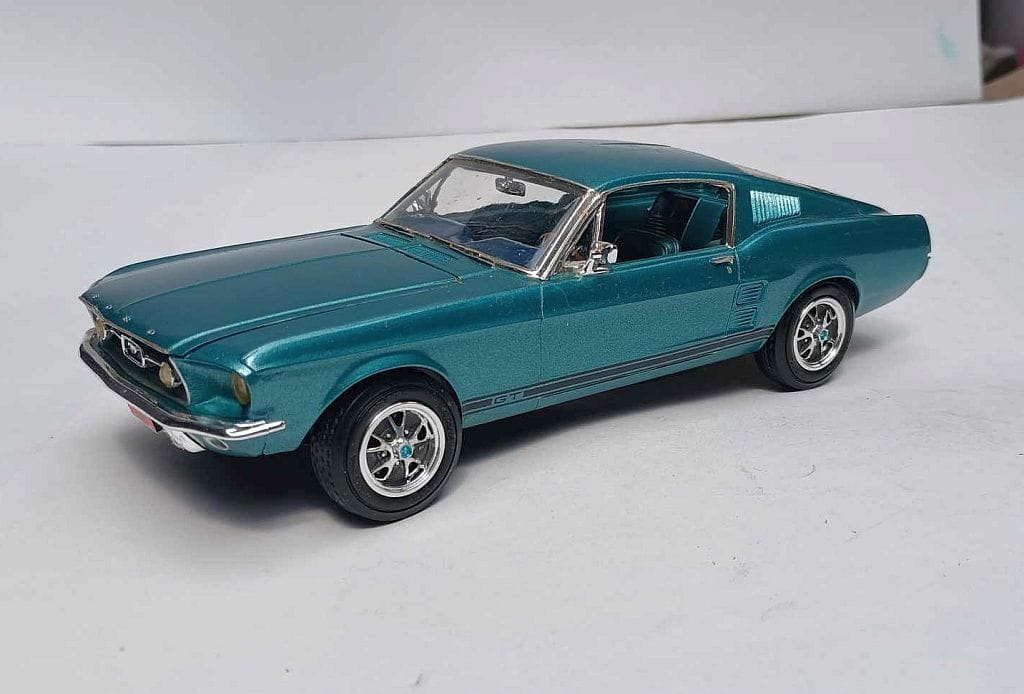


1968
In 2008, Revell issued a ’68 fastback, initially as the Bullitt car, then as a regular GT fastback.


And here’s the AMT Shelby, for so long the only Mustang available for these years.


I think we’ll leave it there for today. Mustangs, first generation, part 2 (1969-73) to follow.























@Peter: Beautiful models, as usual, I can’t even begin to pick a favorite! I’ve never owned a Mustang, but I’ve ridden in a ’73, and I lust after a Mustang II, due to fond memories of one that I had access to, and drove on several trips. Unfortunately, every time I find the V-8, standard shift, fastback Mach 1, it’s always on the wrong coast; the price for one creampuff that I actually wanted to bid upon, quickly exceeded the amount of disposable income that I could spend, LOL!! Oh, well, I think I still have the model that I built somewhere! 🙂
Thanks Moparman. As is often the case in other countries, I’ve never been in a Mustang nor known anybody who had one. I think what attracts me to them is, firstly, the childhood memory of that first kit, and secondly, the styling of these early ones, basically a rebody of dad’s old Falcon – wtih a nod to the degree of personalisation that was possible with that amazing options list (wallet permitting, of course!).
At least in your hunt for the Mustang of your dreams, you stand a good chance of finding one on your side of the country, some time – if only so many other folks your age weren’t looking for one too!
Your readers really appreciate your collection! Nostalgia burnishes memories, but my memories of a 1966 289 AT are that you could really feel the Falcon roots of the car.
Thanks Dan. Having the use of the 200/manual Falcon family car for four years until I got my own car, I know what a Falcon feels like. Interesting that once I got my car, Dad preferred driving my Cortina to his Falcon – until I moved away.
Great looking models, Peter, exceptional detail. When we were kids, there was a Post breakfast cereal, Rice Krinkles, that had Matchbox size plastic cars included in the box. In 1965, they gave Mustangs. My friend and I wanted a fleet of Mustangs, so we started eating Rice Krinkles for breakfast, lunch, and snacks. “Mom, we’re out of cereal. We need to buy more Rice Krinkles!”
Thanks Dave. Fun, weren’t they? Here in Australia we also had little plastic toys in cereal boxes. I can’t remember what cereal it was; but Auntie Grace kept them for me. In 1965 they were doing little Matchbox-size cars, but rather than your Mustangs (which would’ve been great), we got little Holdens, Falcons and Valiants as eleven- or twelve-piece kits – body split down the middle, front grille/bumper, maybe a rear piece, and four wheels with plastic pins to attach them. I remember having a Valiant wagon and a Falcon sedan. I don’t think they survived.
Peter, these are all just great, and you have a gift for picking out the best lead shot. I can certainly understand breaking up the first generation Mustang’s run, and I could assume then that you’d be featuring a post later that includes the 1969 – ’70 and 1971 – ’73 subsets.
I love the AMT packaging for that Aspen Gold hardtop.
Thanks, Joseph. Sometimes the lead shot is a given, other times I have to go back and think “Now which of these would attract me to read on?” Occasionally Rich changes it on me, but putting myself in the reader’s position seems to work well.
Even with all of these, there were some Mustangs that got left out. Like this one – I referred to it in the text but forgot to include the picture!
The next Mustang piece will indeed cover those years. Quite how I cover the generations after that I’m not sure, as Mustang coverage gets a bit patchy. But I’ve always loved these early ones.
Thanks for these terrific pics!
I still think these earlier model years produced the best designs that came off the assembly line.
The 66/67 fastbacks are my absolute favorites. With the stance and profiles, they are both sleek and menacing, especially the early Shelby GT 350’s.
Well done!
Thanks BPM. There’s a certain ‘rightness’ about these earlies that the later designs sometimes struggled to recapture.
Thanks for bringing back some memories Peter.
My first 1/25 scale AMT kit was a 66 Mustang fastback ($2.98 CDN), I later bought a 68 Mustang GT fastback and by that time the price of a kit had risen to $3.25 CDN. As a young married couple my wife spotted a light blue 65 Mustng Promo in a pawn shop. Bought it for me as a birthday gift for $8.00. I still have it. I recently bought a Corvette C7R race car kit (1/25th scale) and I am very impressed with the quality of this kit. Being a long time Mustang fan I’ve considered buying some 60’s Mustang kits but as we live in a garage suite, there is only so much space and my wife does not want model cars all over the house. So, I have my best stored away downstairs in the garage. A small number can be displayed in the office of our home.
Thanks Garry. Glad to bring back memories.
Storage can be a problem. When I started building as a teenager, they were parked on almost every horizontal piece of furniture in my room – looking around me fifty-odd years later, not much has changed! And the overflow is parked in the shed.
That C7R is a great kit; I don’t have it but I’ve had a good look at one.
Waaaaaaaay back in the day, I built that Shelby model. I painted it chocolate brown, not for any aesthetic reason, but because I only had brown paint. It looked okay. A brown Shelby is still a Shelby! Say, have you ever done a RHD conversion on a model? Unless you did that with a car with a symmetrical dashboard, I imagine that would be a bit tricky.
Actually Mike, I have done the occasional RHD conversion. Not on a Mustang though, but I’ve swapped a ’58 Thunderbird – easy as it was symmetrical, as you say – and somehow, lost in the mists of time, I did a ’71 Charger. Definitely asymmetrical, and from memory I carved a vaguely appropriate shape out of wood; I used wood a bit in the early days. Generally these days I leave well alone, though I have used aftermarket dashes on occasion – this ’56 Ford has a cast white-metal piece. Sometimes they’ll be available in resin.
Good job on the Ford! You really go above and beyond with attention to detail.
I have built one Mustang, and modeled it after my high school best friend’s ’65.
That looks really nice, Ed.
I especially like the dark blue GT350R .
I remember the Hertz GT350-H, I wonder how quickly they were torn up or wrecked .
I too like the basic looks of the ’65’s, I never did get one but did log many miles in old Falcons back then so I’m not sure I would have retained my good consideration of an early Mustang had I had one, I remember Falcons & Comets as poor handlers with mediocre seats and fairly slow .
-Nate
Nate, there are stories about how the GT350-H fared in rental service, I’m sure you’ve heard them too. As to how much is truth and how much plausible-sounding fiction, who knows? My main memories of the Falcon I had access to were the off-the-line torque of the 200 six, and that obstreperous column shift.