

Having exhausted intermediate Mopars, I thought I might see if I might manage similar stories on Ford and GM’s intermediates. Straight away we hit a snag with GM: four marques in this segment, with very patchy representation from Buick and Oldsmobile. I’ll have to do some further research for them; Pontiac and Chevy should prove no problem; in fact I’ve drawn up a list of potential Pontiacs already. Chevys might take a while, as there are so many. So let’s have a look at mid-size Fords today.
1962-64

The action starts in 1962. These ‘compact Fairlanes’ were quite popular here in Australia when I was a boy. I could always see the Falcon that lurked not far below the surface, but they were usefully larger without the excessive overhangs of the full-size Fords – Ford Australia sold these in place of the Galaxie in the early sixties, though I believe a few Galaxies came in ‘64. That would probably sound almost heretical to an American or Canadian, but made a lot of sense in my country. Two words: gas prices.

Annual kits were made, but this is a nineties Revell kit of the ‘Thunderbolt’ drag special. Being me, I turned it into a rather extreme street car. The purple one still uses the Thunderbolt’s distinctive teardrop hood bulge; the grey one is a later version of the kit that included a stock hood and ‘street’ exhaust.

This yellow one made use of a transkit – a set of parts designed to transform one kit to another version. In this case the parts (no longer available) included a flat hood, bench seat and wheel covers – to which I added whitewalls and an early Windsor small-block. Ford’s 1964 Phoenician Yellow adds to the realism. We’ll skip the unfortunate looking 1965s.
1966-67

Our next stop is 1966. Better get comfortable; we’ll be here for a while! There was an annual kit in 1966, which was revised to a 1967 then to my knowledge never reappeared. AMT produced a new kit of the Fairlane GT/GTA in 1992 – yes, they provided a choice of four-speed or C6 to go behind the well-detailed 390. It’s a shame they didn’t take a bit more time with the body though; the roofline isn’t quite right. I’ve attempted to fix this on all of mine by raising the upper edge of the front and rear windshields – which helps but I think the roof height and curvature isn’t quite right either.

Didn’t stop me building them. The ultimate fix would be to turn them into a convertible, but that didn’t appeal to me. Down here we only had the Fairlane as a four-door sedan.

Then AMT released another version, the Fairlane 427. This was a very limited production car for 1966, only in white, intended for competition but nowhere near as specialised as the earlier Thunderbolt. For this blue one, I deleted the hood scoop. Just a regular Fairlane 500, ignore the badge…

As we know, I don’t do many white models, so this 427 appeared in dark green with a black roof.

My third was a different blue, with lowered front and billet wheels then in fashion…..

While my fourth was a purple and black beater. A beater 427? Around my bench, yes, that sort of thing happens! Rumours abound of another GT kit awaiting a turn at the bench. But AMT weren’t through just yet!

There was also this thing called a Mercury Cyclone, a Fairlane with a nose-and-tail job. AMT popped a new body and interior on the Fairlane’s underbody and mechanicals and called it good. Unfortunately, the Cyclone body was even more of a rush job – the lower body engraving behind the doors was a different shape on the left and right sides. Oops!
How big is an Intermediate, anyway?
As an aside, it’s fascinating to see how an ordinary intermediate sedan ballooned in size during this period. If we look at two-year intervals, we see this.
Ford – Intermediate four door sedans
| WB” | length” | width” | |
| 1964 | 115.5 | 197.6 | 72.2 |
| 1965 | 116.0 | 197.0 | 74.0 |
| 1968 | 116.0 | 201.1 | 74.5 |
| 1970 | 117.0 | 206.2 | 76.4 |
| 1972 | 118.0 | 215.1 | 79.3 |
| ZF* | 116.0 | 198.9 | 74.6 |
(*ZF refers to the new Australian-bodied ’72 Fairlane, we stuck with a face-, tail- and roof-lifted ’66 body until then.)
As we’ve seen before, Mopar’s intermediates began as downsized big cars; by 1970 Ford’s intermediates had grown to near-enough match Mopar’s intermediates. Was all that added bulk really necessary though? Did it add space, or was it just for show? Back to the models.
1968-69

We jump another year to 1969, though 1968 was largely the same. AMT made annual kits of the Torino Cobra, as a convertible with optional vinyl roof to turn it into a hardtop, as here. Never reissued.

Or as this lovely fastback (‘Sportsroof’), which has been repeatedly reissued.

Later versions of the kit have the proper C-stripe decals. Model companies are more aware of the importance of such things to older builders nowadays.

Naturally the Talladega version was done too. AMT added parts to their Cobra Sportsroof kit, while Monogram started from scratch. This one’s the Monogram kit.
1970-71
All change for 1970? So it seemed, though the wagon still mated the new front clip to an old body. But those hardtops! The ‘70 and similar ’71 were 5” longer and 2” wider than before, on an inch more wheelbase – but this was not the ultimate stretch of the old Falcon platform. (Us Aussies took it out to a 121” wheelbase for the P5 LTD.)

These looked a lot sleeker and more modern, but would prove to be not as aerodynamic for racing as the previous year.

Monogram released the GT in 2000, as part of a short-lived Pro-Modeler line. It provided pages of printed resource material added to the instructions, along with better-quality decals and some photoetched parts – along with separate plated wipers, door handles, and badges. The photoetched parts included the GT badges, side vents and the fine taillight overlay. Here the Pro-Modeler kits cost about 50% more than their usual kits. Deep breath!
 Revell effectively took over Monogram (not how the business press tells it, but from a product perspective it looked like it), and simplified the GT kit to make a Cobra – with a different hood, more basic interior and different grille and taillights. The photoetch, special decals and resource material were no more – but you could now find plenty of information online though. Oh, and it was a lot cheaper now without those bonus goodies. Regular kit price, in fact, So, I built a few, naturally …

 Ford Australia used this Torino’s design themes on a 111” wheelbase for the XA Falcon hardtop, and the succeeding XB (Mad Max car) and XC. And we thought these seemed a huge car!
  (The Torino was nearly a foot and a half longer than the XA Falcon, on six inches more wheelbase.)
Was this the end?
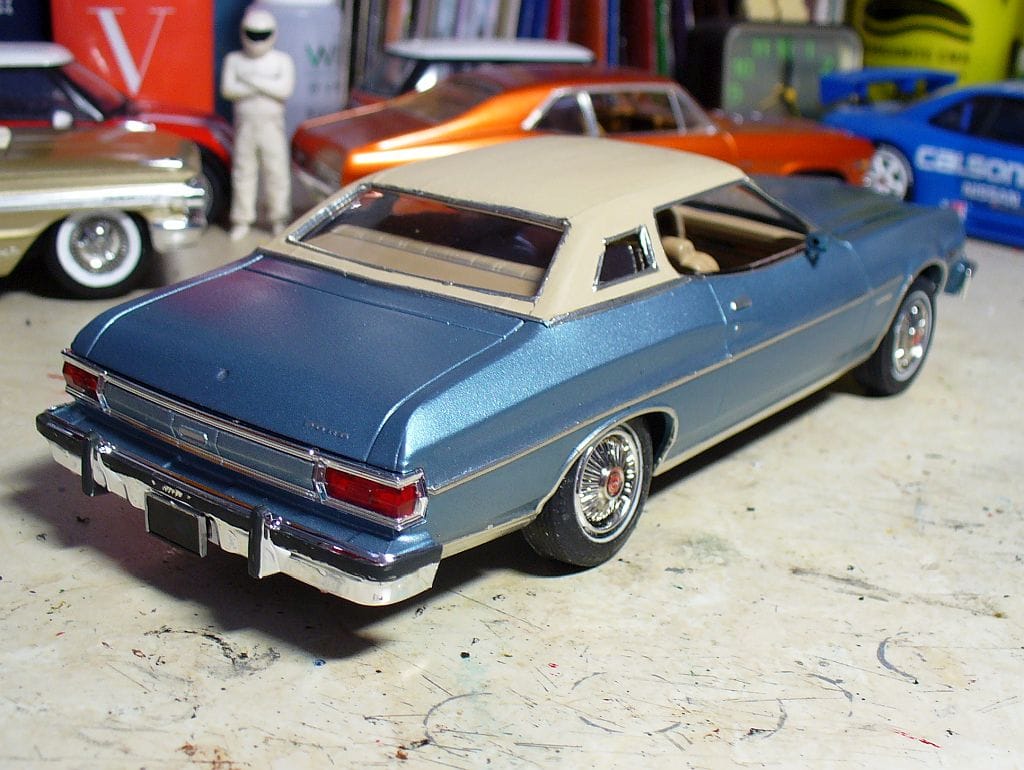
I could finish the story here, with the end (in North America anyway) of the LWB Falcon platform. But I have one more model which kind of fits. For 1972 the Torino/Gran Torino (Gran’s Torino?) had nothing in common structurally with earlier models, being larger body on frame cars, almost up to full size dimensions; an inch short of eighteen feet long. It must have made sense to somebody at the time… 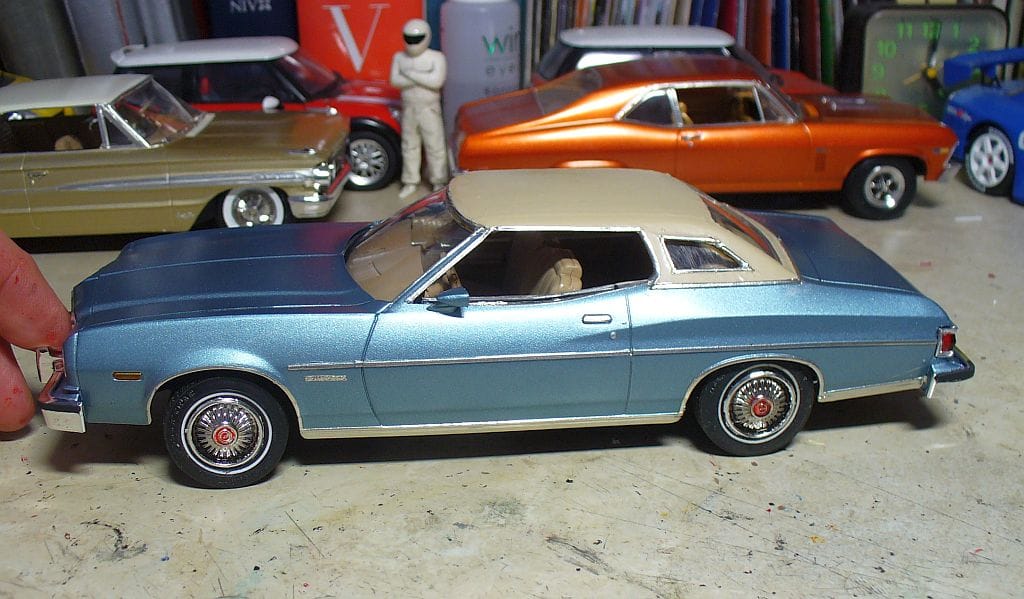 But the name carried on, so I’ll include this generation. The car was never made in kit form at the time, and had it not been for the TV series Starsky and Hutch we would probably never have had a model of it. Revell released the Starsky and Hutch kit in 2015 (yes, forty years after the show!), with a non-Starsky car following in 2017. This is my own mainstream version of a ’76 Gran Torino, with an added vinyl roof and opera window – a feature Revell didn’t include on their stock version – maybe they realised how thick the plastic was there? Hey, you guys tooled it that way!
  That’s it for this week! See you next time.























Peter: Ooooh those delectable candy colored 66-67 Fairlanes!! I like the green one best. Always were one of my favorites; the 69 Torino had me totally smitten, and I didn’t care for the 70 restyle at all although in time I came to accept it. An elderly co-worker bought a 1976 Gran Torino Elite. While looking it over, I remarked on the (odd to me) fact that this “loaded “luxo” barge had a full complement of gauges, whereupon he replied that “he didn’t care for that at all”! 🙂
Thanks Moparman. I think it’s because of a sort of family connection (Dad’s Falcon) that I like those ’66 Fairlanes so much, also because they were the last ones with a visible connection to what was sold here – even though we got four headlights with the Falcon hood and fenders (pic). The ’68-9 just look right; and as for the ’70, it looks so much like a stretched-out version of our Falcon hardtop bodies – especially when painted in Falcon colours as I did here.
This post brings back a memory of a 1970 Torino model that I built when I was a kid. For some strange reason, I painted it a particularly odious hue that can only be described as Pepto-Bismol Pink. 10-year-old Actually Mike was not exactly a man of subtle and refined taste! Mercifully, I have no photos of it to share. I much prefer the author’s work over my own…
Thanks Mike. There’s no accounting for the tastes of a ten-year-old! Now you’ve got me curious where you even got paint that colour back then…
IIRC, the Pepto Bismol color was “achieved” with a coat of grey paint followed by a coat of pink. A lot of work to make something ugly!
It might be worth to mention the kits/diecasts versions of the “red tomato” Gran Torino from Starsky & Hutch. 😉
https://www.toywonders.com/ProductCart/pc/Greenlight-Hollywood-Starsky-Hutch-Ford-Gran-Torino-Hardtop-1976-1-24-scale-diecast-model-car-Red-84042-p18553.htm
And there’s also a diecast version of the 1972 Gran Torino from the Clint Eastwood movie of the same name. 🙂
https://diecastsociety.com/review-ixo-ford-gran-torino-1972/
Thanks for those links Stéphane. Diecasts are outside my area of knowledge, although I do pick up the occasional one. With the TV and movie tie-ins, I’m not surprised these were made.
“We’ll skip the unfortunate looking 1965s.” Thank you. One of the worst annual styling updates, ever. So many nice looking Fords here, at least through the 60s. I’m not too keen on what came along in the 70’s.
And thank you. First time I saw the American ’65 Fairlane was in the American Car Spotters Guide. My initial reaction was sheer disbelief. A complete reskin, wasted. People jokingly talk about my country being in an alternate universe, but when I see cars like that I’m glad we never got them.
Yes, Ford got it right with the rest of the sixties. The ’70-1 I’d have issues with over-the-shoulder rear vision, but as a piece of sculpture it’s quite attractive. ’72 on is just a no from me.
You got me curious about the 1965 Fairlane kit, because of course my favourite of the pre 66 Fairlanes is the 65, I know I know, some things you just can’t explain.
Just for fun here it is, pretty rare though.
Picture didn’t load, but I won’t try again, nobody needs to see it. 🙂
It was the AMT 3 in 1 kit.
Oh, the kit may have been quite a good representation, it may have had the greatest optional goodies ever, but I felt the subject the subject was rather….. homely. Sorry jonco43. Not having got it in my country means I’ve never seen one on the road, either. That’s not a problem with an attractive car, but…
I’ve just seen the kit online, took a bit of doing to get the photo to behave. Looks like it was reissued in custom-only form later in the sixties, then turned into a modified stocker.
No need to apologise, I realise I have no position here to defend.
Maybe I like them because it was the one we didn’t get here, maybe it’s like the last kitten to be adopted in the litter and it looks sad, I don’t know.
The first time I saw one was the pale yellow hardtop Paul did the CC on here.
Thanks for persevering with the picture
Thanks for an interesting run though of the era, made cheerfully colourful in your unique style, Peter. You make a good point about the size of these ‘intermediates’ growing to what was ‘full size’ a decade earlier. Of course over here you’d rarely see them outside of movies or the Matchbox model versions.
I find the Australian scene of the time interesting mixing these (big by our standards) cars with more familiar to me British designs plus the Australian designs from Holden and BMC(Australia).
I assume the yellow Fairlane has poseable steering. Makes a change from straight on most models feature.
Thanks Bernard. I’ve found it fascinating how our countries have different ideas about car sizes; small, medium/standard and large. And I was curious how a car that started off as a sensibly-sized big car became so large. Once I checked the figures I could see it was the late fifties over again, and figured it was growth inspired by the competition.
Our Holdens started off much the same size as a Vauxhall Velox, which in the fifties was a decent size car. Large car to you, probably, and compact to the Americans. And yes, I remember Matchbox (and Corgi, and Dinky) models of cars I’d never seen. BMC Australia, now there’s a story and a half!
Yes, the yellow one in the lede photo has poseable steering, a feature of the Pro-modeler kits I neglected to mention. An unusual feature for America, but almost universally standard in Japanese kits.
These are all cool, Peter – and I especially enjoyed the graph that showed the dimensional growth of Ford’s intermediates over the years. Fascinating.
My appreciation for the 1970 – ’71 generation has only grown over the years.
Thanks Joseph. I was curious about the growth, and the figures weren’t hard to find. Interesting that Ford Australia kept our Fairlane just below five metres in length (we went metric in ’74); maybe there was some psychological barrier there, or perhaps our parking space sizes (currently 2.4 x 5.4m) were felt to dictate a practical upper limit to car size. Prestige takes a dive when you can’t find a parking spot big enough!
My first new car was a 1964 Ford Galaxie 500 two-door hardtop in Prairie Bronze Metallic, and I have always unsuccessfully searched for a scale model of that car. I see two pictures of a ‘64 Galaxie, possibly a convertible, in the background of the photos of your ‘76 Gran Torino. Could you possibly let me know the source of that model, especially as a hardtop, and if it might still be available?
Henry, you’re in luck.
That ’64 Galaxie hardtop is an AMT kit that appears in the catalog every decade or so. It’s a curbside kit, meaning it has no engine detail, probably based on the promo tooling, and Spotlight Hobbies (who I can recommend from experience) have several in stock at the moment.
spotlighthobbies.com/category/unbuilt-kits/?ixwpst[pa_vehicle-model-year][]=1896&title=1&excerpt=1&content=1&categories=1&attributes