

It’s been my custom since I started writing these pieces to do a retrospective at the end of each year, but this year has been unusually busy at the bench (and at the keyboard, not so much in the garden), so I thought I’d give a mid-year report. If I keep going at this rate, there’ll be too many by December, and it’ll take two episodes. Like Tatra’s Tokyo car-spotting. Already there are more than I’ve shown previously for a full year’s work.

A very stalled model
I’ve mentioned before about finishing off stalled models – ones that got sidelined for whatever reason. Sometimes it’s an assembly problem I can’t figure out – maybe the instructions are unclear (Heller Citroen DS), sometimes a part won’t fit as drawn (Heller Citroen DS) – sometimes it’s more of a ‘me’ problem. Sometimes it’s as simple as losing interest, sometimes it’s as complex as losing a piece (like half a JAP crankcase for a vintage Morgan – try scratchbuilding that!).

My bench o’erfloweth
Anyway, so far this year has been very much Stalled Builds Revisited. I thought we’d look at the stalled builds I’ve finished so far – how much I had done when they got stalled (that’s the % figure), what it was that stopped progress, and the finished product.

A stalled Fujimi Enthusiast Model
Now, not all model kits are created equal. Some brands display a skill level from 1 to 5. Level 1 kits are like unassembled toys. Easy. It’s never the Level 1s that give problems. Think of a level 5 kit as like trying to tune a highly-strung race engine back before electronic ignition and computerized fuel management became a thing. There might be a razor edge combination of optimum timing and mixture settings to get the very best out of the engine – and you have to find it, or the team can’t win. Level 5 kits are sort of like that. They give me trouble, especially Fujimi EM-series kits. I’ve spoken before about Hasegawa’s small parts; these have even more of them. There is one of those stalled that I haven’t finished yet.
And if you’re modifying a kit, that can be a whole other level of headache – or not. Of the stalled models I’ve finished so far, there were none that were particularly difficult – IF everything had gone according to plan.

‘69 Corvair Fitch Sprint – 95%
This 1969 Corvair represents the ‘Fitch Sprint’ aftermarket ‘tuner’ version. I started it last year. It needed bodywork to integrate the kit’s optional roof overlay specific to this version, otherwise there would have been a scale two-inch step in the roof profile, and I wasn’t having that! A vinyl roof would be a handy cop-out, but no. Not suitable. Lots of putty and sanding. Aside from that, there were no problems. I had done the hard part, just had to repaint the roof, and find the ‘right’ wheels and tyres.

’36-’43 Toyoda AA – 95%
This had lovely thin pinstripe decals to be applied to the body sides, and around the grille and spare tyre cover. I messed up one, so (wisely) put it aside to finish later. Five years later, done. Just have to be in the right mood for decals – that doesn’t only happen once in five years though!

‘58 Plymouth Fury – 90%
This Plymouth was built up as a faux-Fury, from AMT’s Belvedere kit. It just needed final assembly, but there was some body to chassis interference I couldn’t figure out at the time. Back in the box it went. Fixed some 15 years later, after two hours’ work with a clear head (and different meds).

‘79 VW Westfalia camper – 90%
I had high hopes for this one, but body and chassis warpage reared their ugly heads near the end of the build. Others have had similar problems, so I heard a few days ago. It took some careful clamping and fresh super glue to fix the body shell over the chassis and interior.

‘75 Ford Pinto – 80%
This one was a rework of a 1975 build that I’d never been happy with. I took out the old Pontiac V8 (the only spare V8 I had at the time!) and found an unused FE-block. Hey, I don’t have to steer it! Also made a new grille and bumpers. Three hours work.

‘83 Nissan Skyline R30 ‘2000RS Turbo Aero Custom’ – 70%
I started this one last year, but messed up the paint. I hate it when that happens. It’s either strip and repaint, or sand and repaint, depending on how bad it is. This got sanded and recoated. That mad overkill bodykit…so eighties!

‘32 Chevrolet Cabriolet – 60%.
This had been stalled for about 15 years, painted, and half-assembled. The kit dates from the mid-sixties. Some parts weren’t quite moulded right and needed fettling, and even then, the parts fit is decidedly iffy in places. Needed an extra dose of patience.
‘56 Chrysler 300B – 60%
I’d painted and assembled the chassis and engine, done most of the interior, and just needed to do the body! As I recall, choosing a colour was the problem. No, I do know they didn’t come in a blue mica. Mine does.

‘03 Honda Integra – 40%
Or Acura RSX, as the box calls it. A nicely-detailed tuner kit. One of those ones where the engine and chassis had some work done, and some body kit options had been added, but no paint. Purple with blue graphics seemed the way to go here.

‘62 Impala – 40%.
The basic engine and suspension assembly was done, but no painting. This would prove to be a common state of affairs.

‘95 Veilside Supra – 30%
I’d done some basic engine and chassis assembly, but needed to better integrate the bodykit parts. File, putty, sand, repeat. Not my favourite job, but not too bad on this car.

‘87 Toyota Crown S130 – 30%
Yep, a tuner Crown, from the boys at Insurance. Some chassis and interior work had been done from two years ago. Initially I had been going to replicate a striking local car, but thought better of it, so it’s not purple. Then I got stuck choosing the colour scheme. Think this suits it better.

‘48 Ford convertible – 20%
I had a great burst of enthusiasm when the kit first came out, then got distracted. Other things came along. The chassis and engine had been started, but no painting done yet. I wanted a period colour that looked interesting.

‘68 Shelby GT 500 – 20%.
The basic chassis had been assembled, as far as I could go without painting, but the engine had been pinched for another kit. Eventually I tracked down a spare 428. The rest was easy.


‘69 Camaros – all at 20%
Three Camaros in one box! A nice surprise. A Z/28 coupe, and two big block RS convertibles, not just the one kit I remembered. I’d assembled the basic engines and chassis, then packed them away – why, I don’t recall. Must’ve just got distracted, as they weren’t hard to finish.


’78-9 Ford F350 – 20%
Another case where I found multiple kits in one box. Both had their engines assembled, but only one chassis was done. Hmm – why was that? Investigation showed that there were the necessary parts for either 4WD and 2WD versions, so I built up one chassis each way. The blue one’s the 4WD.
…..
So that’s the state of things so far. Twenty stalled kits finished in five months. There are others awaiting attention: a Ferrari 330 P4 (90%), a couple of 1937 Chevrolets (95%), and a 1957 Chevrolet with big block power (80%). And…..
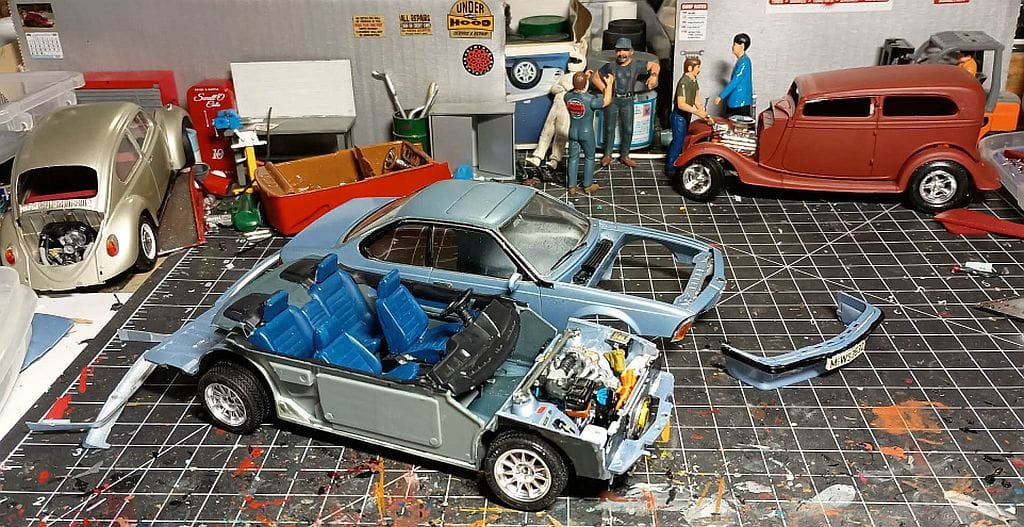
Hartge H6S – 85%
There’s also a BMW Hartge H6S (a tuned E24 635), at about 85%. This is one of those infamous Fujimi EM (Enthusiast Model) kits, with something like 230-240 parts, about double to triple the usual number. 40-odd are for the engine alone. I was doing this for the OMSG Facebook group summer build. I only started it in December, so it’s not stalled, exactly, but I haven’t worked on it for four months now. Doing the easier stuff first….
Back to the bench!























Hi Peter…Your models look awesome. I also have been building them since the 60’s. Have you ever seen or heard of a 1/24 scale 1949/1950 Dodge or Plymouth model? Thanks, Norm
Thanks Norman. No joy I’m afraid. There’s nothing between AMT’s ’41 Plymouth and Moebius’ ’55 Chrysler 300. I’d have thought an early postwar coupe, or a ’49-50 Plymouth Suburban would be an interesting subject – but no. You’d have to look at the resin aftermarket.
There was a modeler who thoroughly modified an AMT ’41 Plymouth into a ’48 Plymouth, and entered it in a model contest last week in Grapevine, Texas. The other judge in the Automotive category thought the wheels and tires weren’t perpendicular enough to be satisfactory (he thought the fronts had too much toe-in). It lost out on the contest theme (models of subjects that were painted black), but I do recall it won People’s Choice. It did lose Best Automotive to an excellently done Jungle Jim funny car.
That would take a fair bit of work! Most of it would be up front, which is the least-accurate part of the AMT ’41. I remember some years ago a guy who owned a real ’41 pointed out things AMT got wrong – and left me wondering how come I never noticed them.
When I saw it in the background of the lead picture, I thought that the 1932 Chevrolet was one of those old Hubley metal kits. But that doesn’t appear to be true. Parts fit is similarly variable on those and the metal body doesn’t do much to make them appear more realistic.
Don, I’ve never built a Hubley kit, though I understand they can be a handful. This was an AMT re-release of a sixties MPC tool, in their ‘Connoisseur Classics’ series of the late eighties. In all fairness to the MPC guys, it was good for its time, but we’ve moved on in sixty years. I bought a second one with the intention of making the Aussie Moonlight Speedster body – but after my experience with this, that project is unlikely.
Chrysler actually did have a very similar color, they called it Stardust Blue Metallic. It was perhaps slightly lighter in color, but very pretty indeed in 2 tone with white on a Newport hardtop I saw once. Nice modeling work!
Thanks. I’ve seen a photo of that colour; it’s very attractive. Not quite what I used here. I had been going to two-tone this, but thought better of it.
I like the variety and detail work you put into these .
I built plastic (and Hubley) models in the 1960’s as a child but never reached you level of competence .
-Nate
Thanks Nate. It does take practice, and I still make the odd mistake now and then.
Fantastic as ever Peter 🙂
Thanks Scott. No Nissans in this lot!
Well done for tackling so many UFOs, Peter, especially getting round to actually finishing them too. I’m a great starter, but not so good at finishing.
Great variety as ever, of course. I’ve never seen that (after market) variation on the Corvair before. It kind of works in a late ’60s fashion.
All power to your elbow!
Thanks Bernard. I first encountered this Corvair variation in a kit I bought about 1973. Back in those days of course, if you wanted info about a strange car you had to check magazines and books. Eventually I found out what a Fitch Sprint was, but this is the first time I’ve used that roof piece.
Thanks for this look behind the scenes!
I find the sheer quantity of your stalled projects interesting, in part because I’ve noticed the same phenomenon with my daughter’s artwork. One of my daughters is an insanely talented artist, but for every completed painting or drawing, she probably has a dozen that are perpetually stalled. I suppose a lot of artistically-talented people are similar (I’m a very un-artistic person, so I wouldn’t know!).
And thank you, Eric.
I think it is something to do with the artistic temperament. My daughter is also a talented artist and musician (she plays flute). Left to her own devices she will finish a picture, but if it’s something somebody else wanted her to draw, it often remains unfinished.
I notice the same things in model groups on the internet; lots of unfinished builds, sometimes to the point of celebration if a particular person (whom I won’t name) actually finishes something!
My daughter is the same way – she says that when people (either us or her teachers) pressure her to finish a picture, she loses interest. Working on it has to be her idea. I’m a bit concerned because next year, for her senior year of high school, she’s taking a class where she’s required to complete a full portfolio of paintings. Then she’ll have no choice but to complete them. I hope she’s able to do that without getting burned out and discouraged.
Definitely an “artistic temperament!”
The fitch sprint is one of my favorite cars ever, the second gen Corvair coupe is beautiful to begin with but flying buttresses make it that much better!!! I think I’ve seen that model before and in its complete form with the top not fitting very well so kudos for making it actually fit correctly!
Sadly most of my full blown model projects look something like the DS, missing pieces bad fitting pieces etc just kill my spirit even if it’s gone well up to that point. I’ve got a couple models in a similar state.
Thanks Matt. Yes, the Fitch Sprint was on the bench for much of last year, and the holdup was making the roof fit right. Or at least, fit without such a step at the front. It basically meant building up the rest of the roof gradually to blend it in. It wasn’t really feasible to file down the new roof section to match the existing roof.
I’d like to think that one of these days I’ll finish the DS. I’ve been thinking that for the past 45 years now, though.
I love seeing the workbench / assembly line where all the magic happens. If it wasn’t for all the other models in the background of your shots, I might be tempted to think that “Peter Wilding” is just a clever alias for Santa Claus and that you’re building all of these for a December delivery deadline. Fabulous work, as always.
Solid build, white hair and beard all present and correct, but don’t ask me to go shinnying down any chimneys!
That Fujima model has studs on the rotors!? Probably has tie rods also. Ok, then…
Indeed it has studs on the rotors. I think all their EM-series kits do. I’ve also seen them on a Porsche 911R and a Ferrari 328. You might think they’re separate parts, but no – somehow they mould them in place without breaking!
The tie rod is just a single piece here; you need to get a Heller vintage kit like their Delahaye 135 for functioning multi-piece tie rods, drag links, idler arms and all the other bits. Yes, in 1/24 scale. And yes, they’re a handful.
Love the Chrysler, they always look best in a single tone, When Exner was very good…
I also love the Citroen ! with the dust, I think it makes a great display item, like an unfinished restoration in an old French barn. Are the pillars separate pieces? or were they cut for other reasons.
Thanks jonco. About those pillars – thereby hangs a tale. I cut them.
Due to a mistake in the instructions, it was impossble to fit the body to the chassis, as the rear seat got in the way. And yet the seat had to go there, surely?
On reading a build article in a model magazine a friend unearthed, the staff encountered the same problem. It seems the seat should have been fitted up inside the body, then that assembly fitted to the chassis. At this point, it was either cut the pillars so I could attach the front and back body sections separately, or ‘unglue’ the rear seat. I made the cuts, confirmed this would get me out of trouble here – and lost enthusiasm.
.
Quite agree with Jonco about the big Cit.
It needn’t be a French barn, either. I seem to have seen many an old DS in garages right here in just such a state, the restoration stalled, or simple repair lost in a despairing maze of triple-handed backward left-thrusting plumbing. (Not so much ran-when-parked as ran-then-farked, as it were). Garage owner always says the (older) owner says he’ll “pick it up soon” – which, of course, we all know means “the owner’s estate will pay for its removal after the funeral in ten years time”.
Remove the box, and somehow preserve the exact dust covering it has now, like a tableau. God knows, there’s proof you’ve got the extraordinary skills needed.
Always enjoy these tours in the Wilding model factory. I’m never not impressed and always look forward to the next one.
Thanks Paul. Work isn’t usually this frenetic, but it’s been a good year for the bench. Since writing this I finished the 330P4 and the ’37 Chevys. And a Talbot-Lago Record – I figure you and Tatra will know what that is – and maybe nobody else!
Next report in about six months.
I do!
Of course, how could I forget?
What an enjoyable post! Great cars, interesting backstories and more than a glimpse of the “inside” of the works.
Thank you. I wasn’t sure how this would work out. Seems I needn’t have worried, from the amount of comments. There’s a whole lot more I could have said about some of them – but considering how many there were, I thought it best to be fairly brief.