
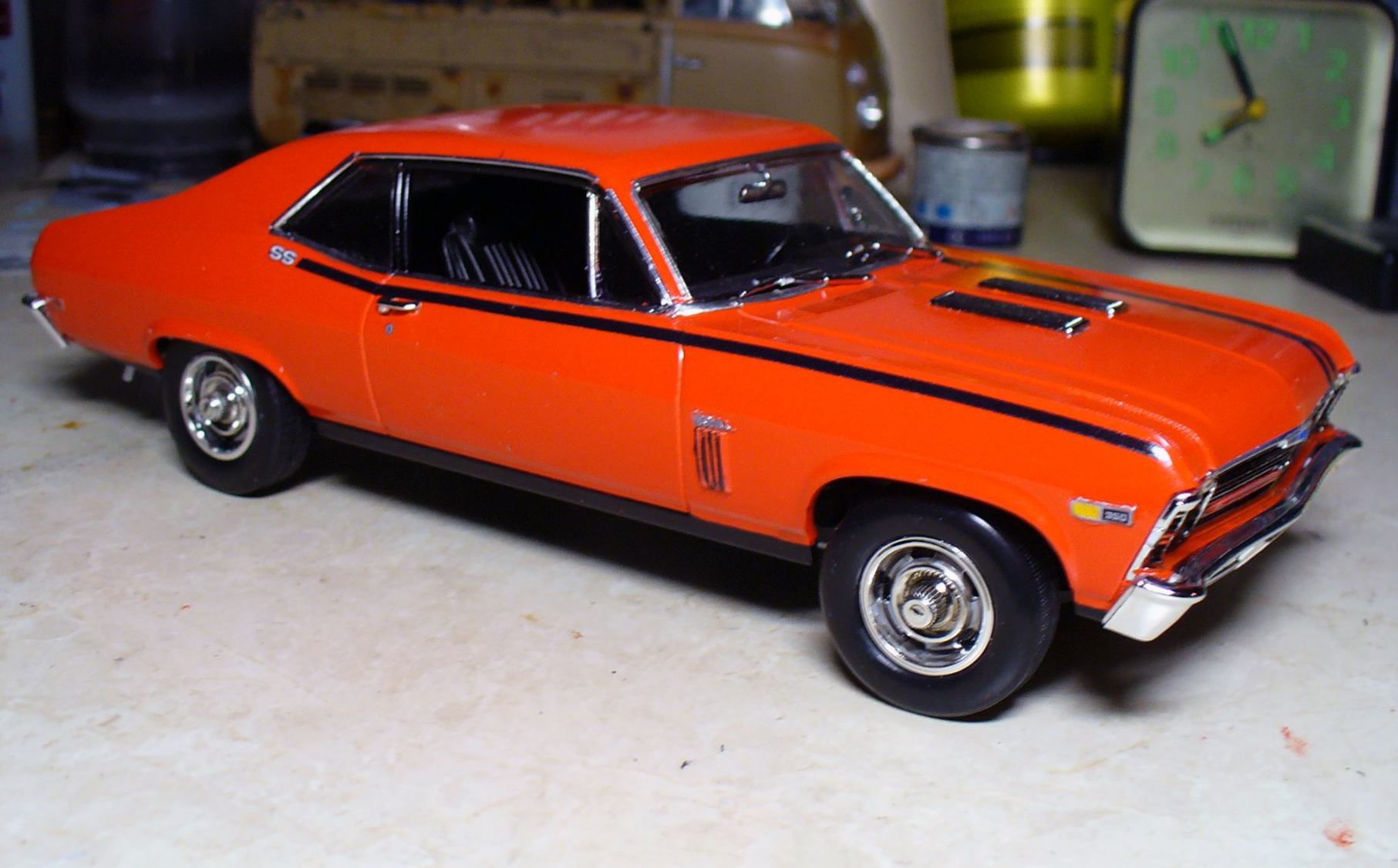
Today’s visit to the workbench brings us a collection of smallish Chevrolets in miniature. They may not have been the smallest cars Chevrolet ever built, but these compact classics offered plenty of variety—and, as these scale models show, plenty of possibilities for builders, whether their tastes run to factory stock, custom touches, or something ready to hit the drag strip.
I’m saying smallish because there were smaller ones – Vegas and Monzas, Chevettes, and various foreign cars wearing the Chevy badge. So, various Chevukis, Chevoos and even a Chevota, if I remember rightly. (Were there any Chevuzus? Never mind!) Today’s story isn’t about them, but about the original compact Chevy (Corvair), and the Chevy II/Nova which joined the range when it became obvious that the Corvair wasn’t answering the foreign small-car invasion as successfully were the conventional cars from Ford and Chrysler Corporation.
Part 1 – Corvairs
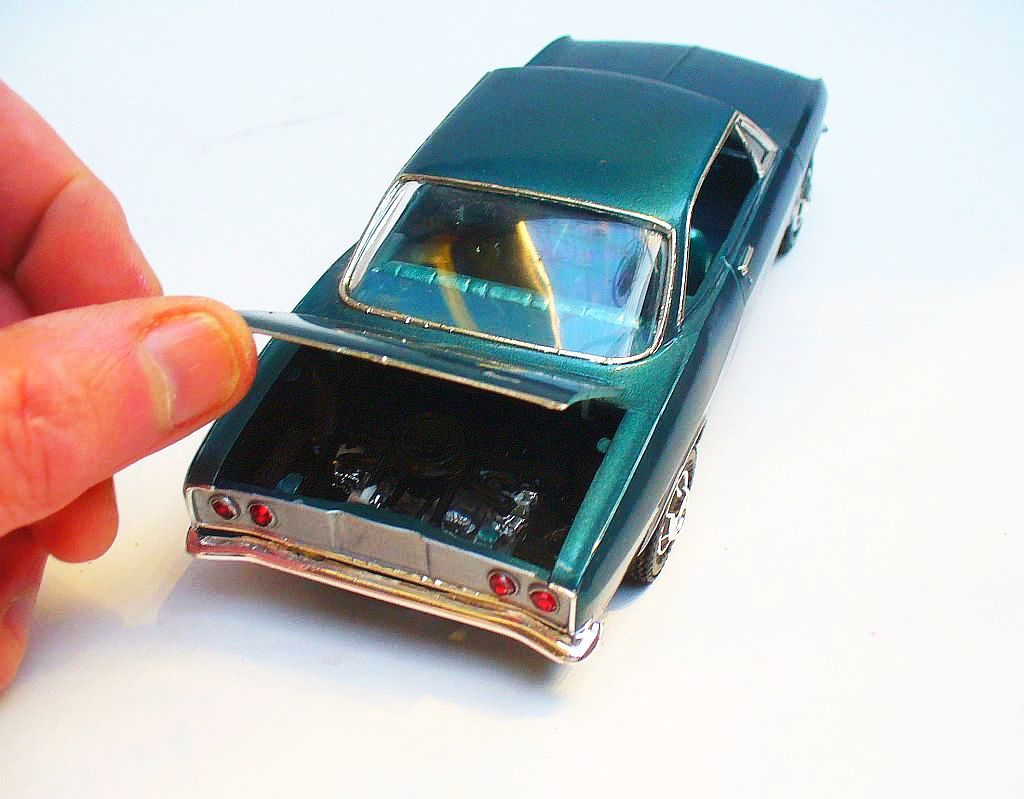
The Corvair story needs no repetition; many of you would know it better than I do. That said, although models were made of first-generation Corvairs, I don’t have any. That’s primarily because they were before I got into models, and they were never reissued – which is hardly surprising considering the bad rep the car itself got. Because of this, they’re rare, and out of my price range. However, if AMT were to dust off some tooling and bring back, say, the ’64 Monza Spyder, I’d be tempted.
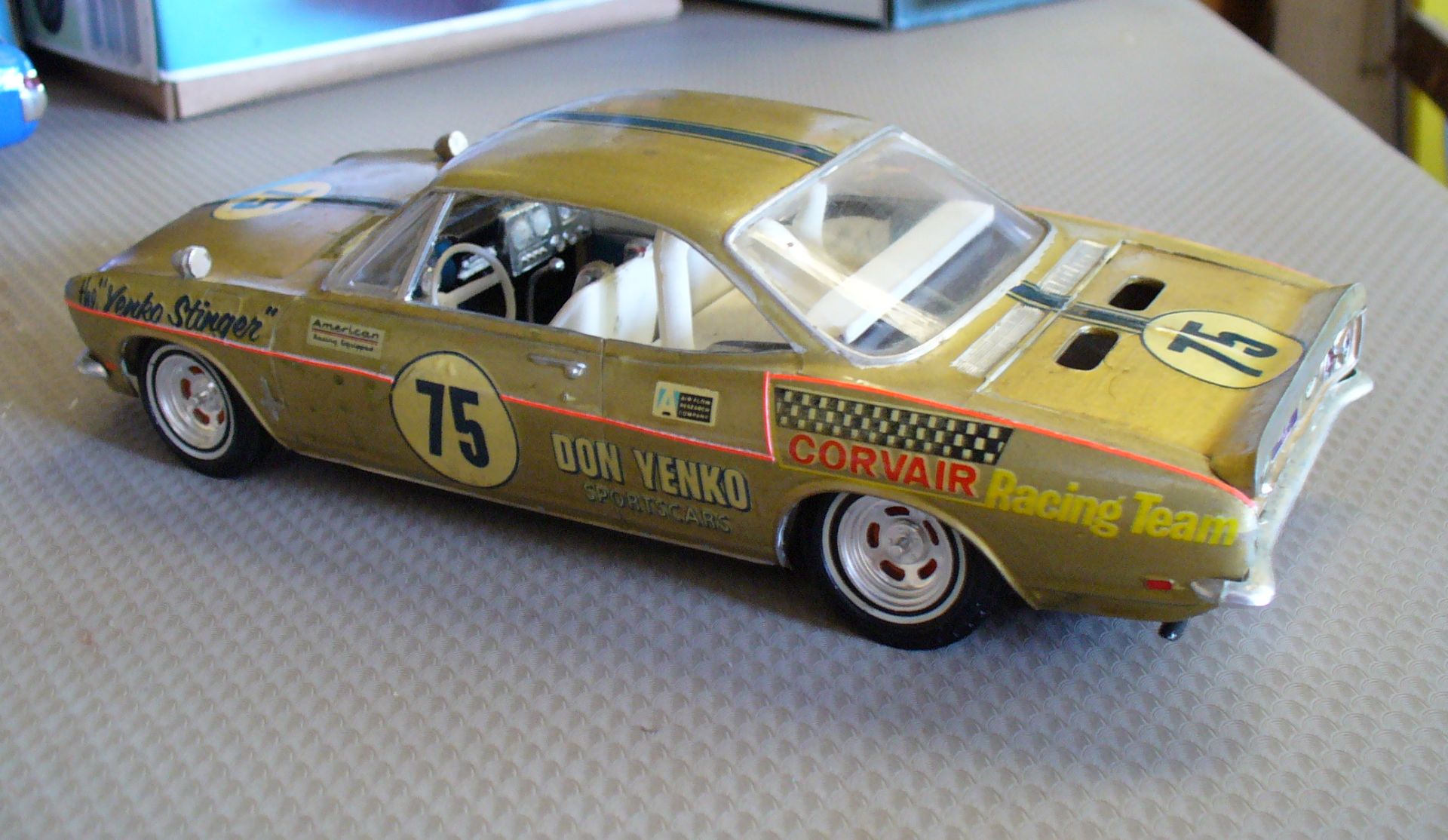
That brings us to the second-gen cars. Big smile on my face here! One of the first American car kits I bought was a ’69 Corvair purchased in 1972. As often happened in my early modelling days, I was amazed at the variety of optional parts offered, and could not make up my mind. Eventually I settled for this rally version. I think all of these parts have been in every subsequent reissue, except for these decals.
The ’69 has been in and out of AMT’s range many times. Or is it a ’68? While AMT calls it a ’69 I’ve read that the upholstery pattern in the kit is actually still the ’68 style. That sort of thing used to happen quite a bit with model cars; car builders weren’t thought to be as demanding of accuracy as military builders, and often things that ought to have been changed for a new version, weren’t. Sometimes it was obvious, other times not. They treat us better nowadays.
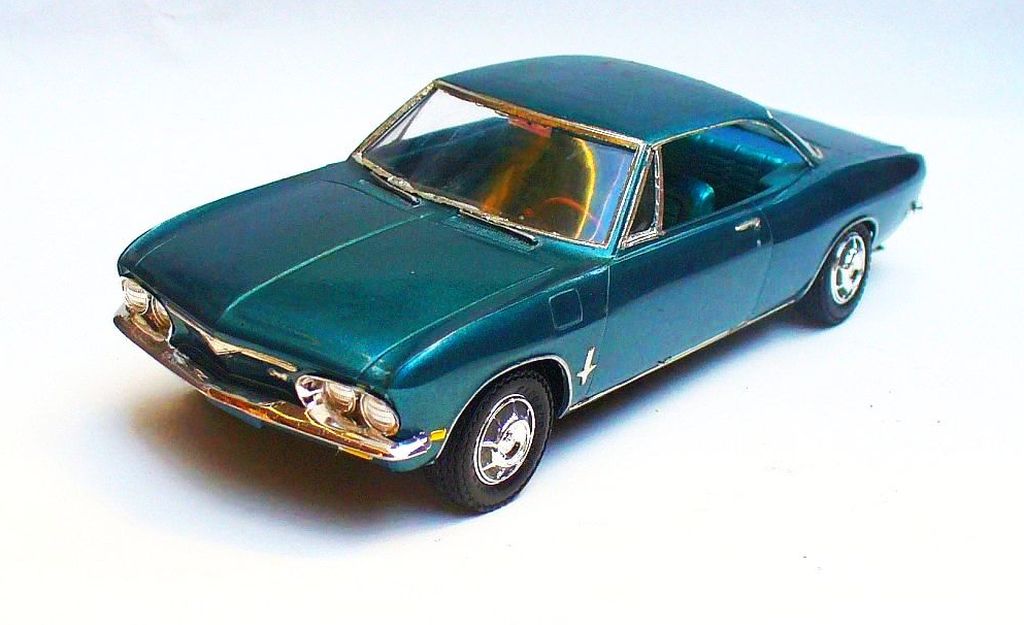
My next Corvair was the Prestige series reissue of the late eighties. It came with a display base/pen stand, but more usefully a sheet of reference material – detail photos, and information about the real car, some seemingly taken from dealer brochures. And some adhesive foil for the chrome trim. None of that survived, but the model sure did.
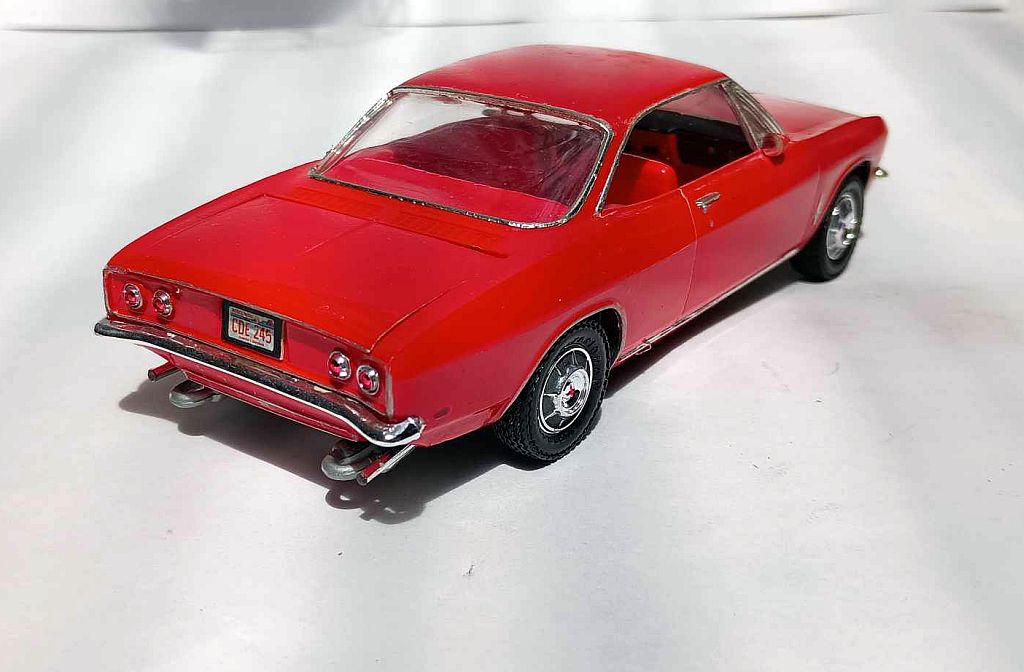
One of the beauties of this kit is the amount of optional equipment provided. Sure the slot mags are only 13” and look tiny today, but that was quite a reasonable size when these cars were new. As well as the stock and rally/race versions, parts are also included for a mild custom, wild custom/show car, and the roof overlay and vented engine cover with spoiler for the Fitch Sprint version. Every now and then you come across parts not referred to in the instructions – like some (but not all) parts from the Turbo setup in the ’69 annual kit.
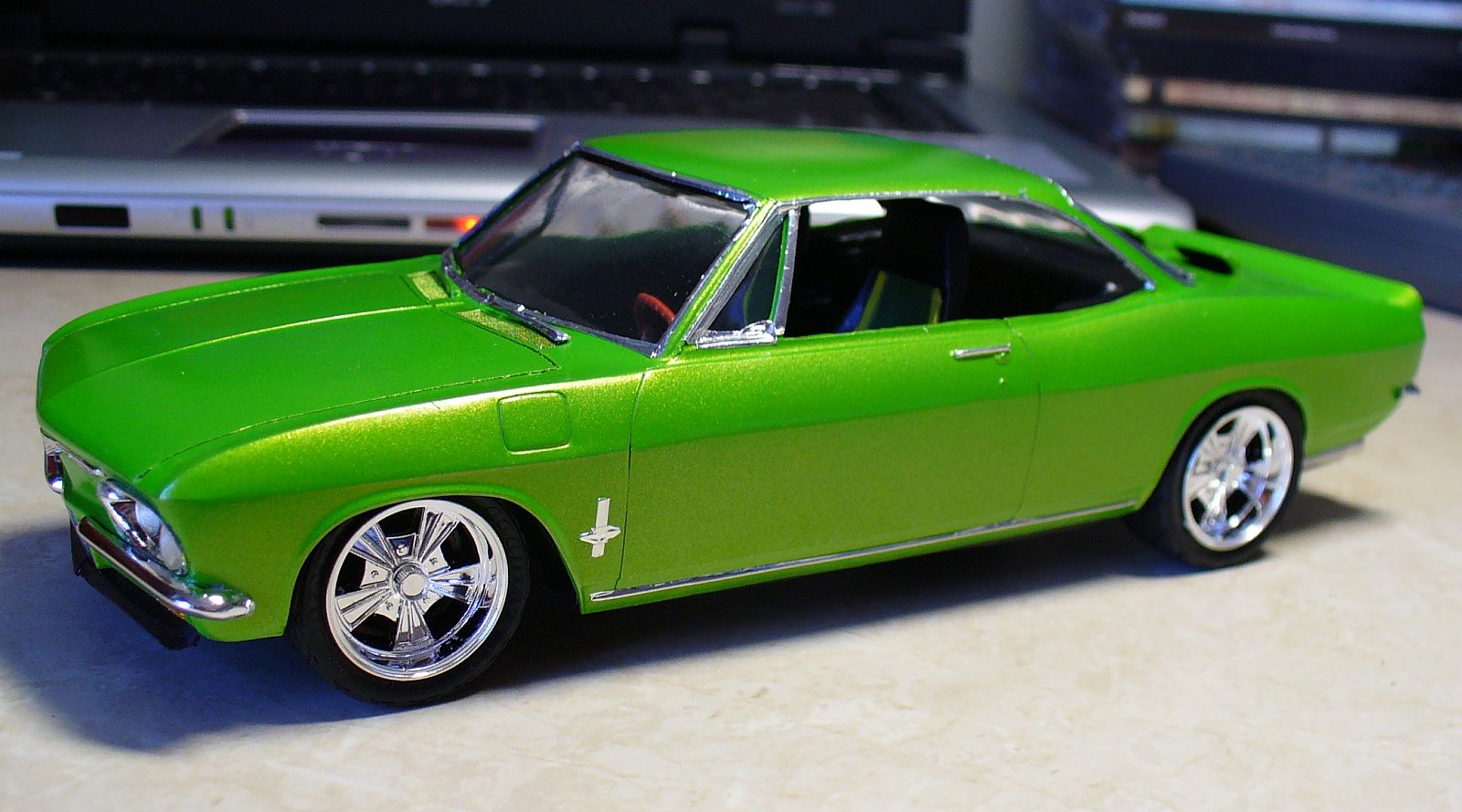
Another Corvair turned out as a hot street machine. The wheels were options I didn’t use from another kit, and I felt the lowered front, large exhausts and flamboyant paint called for something outrageous. These scale out to about 19 inches, though the tyres are little wider than stock.
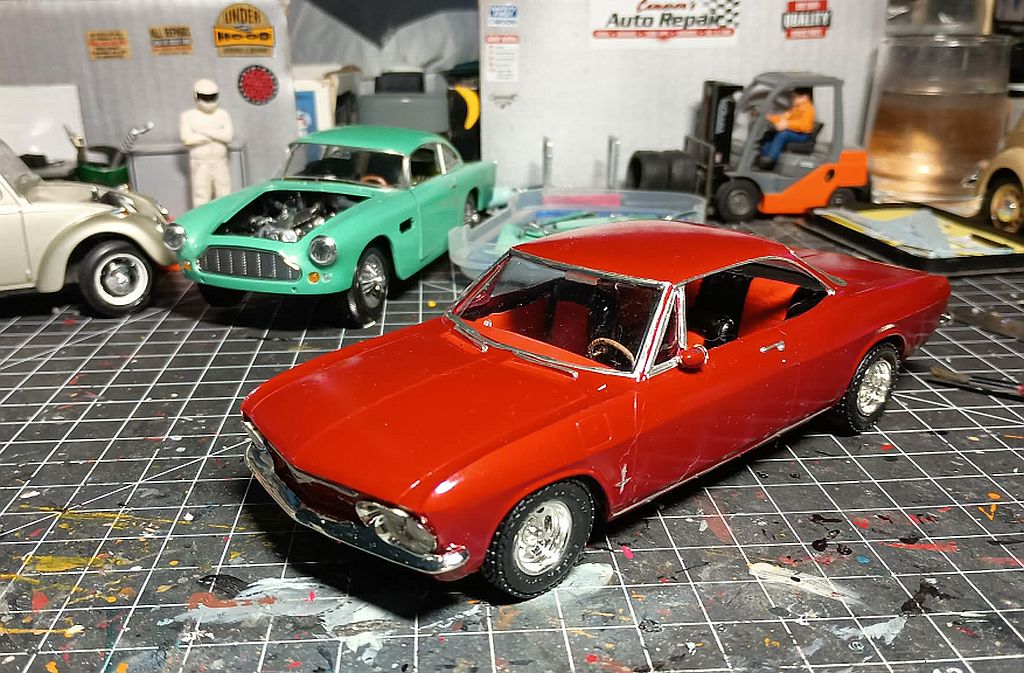
A less modified version is this recent build. It has the four-carb engine with separate air cleaners (I think they all do) but runs a lowered front, the slot mags and a red and black interior using the custom buckets.
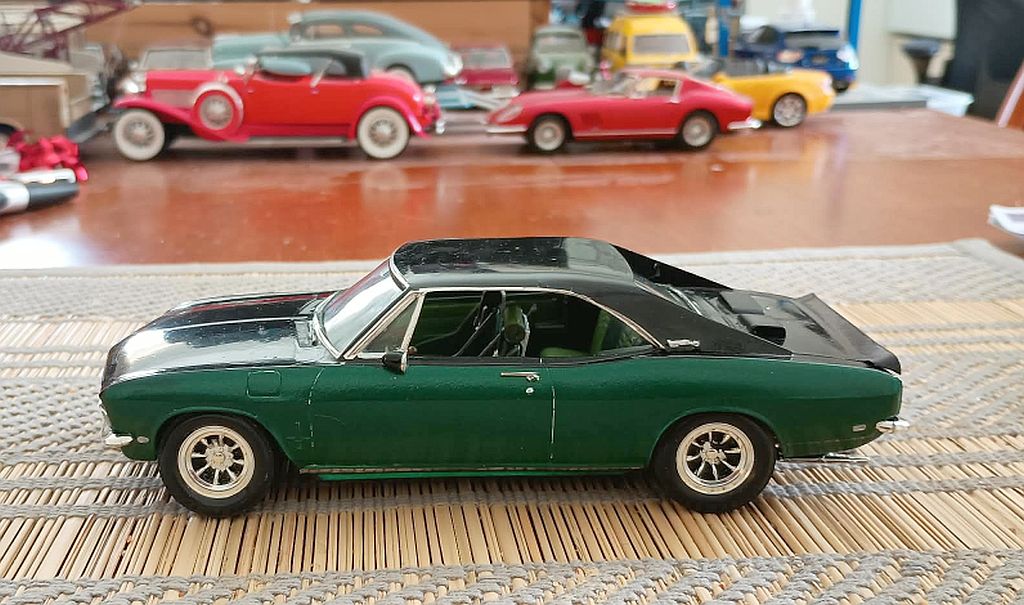
Here’s the Fitch Sprint version, to which I added 14” Minilite mags, extra driving lights (from the rally version), custom engine cover scoops and a larger exhaust made from aluminium tubing. And Japanese registration, for a friend.
Do I have more? You bet, but they’re not finished. One sits on an early Porsche 911 platform, one is getting a twin turboed and intercooled version of a Corvair engine, and one is being turned into a phantom second-generation hardtop wagon – with four doors, of course! Long-term projects, all.
Part 2 – Chevy IIs and Novas
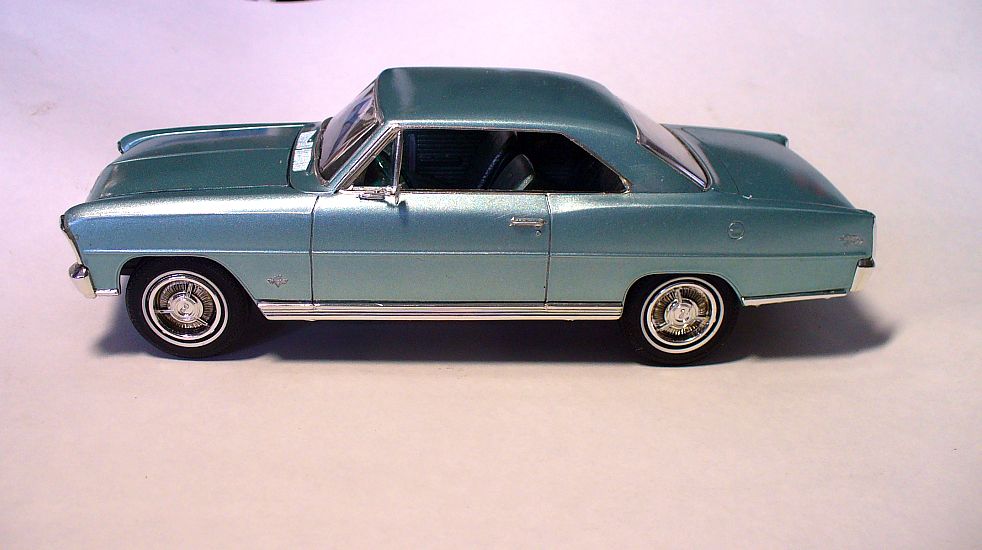
1962-67
These always seem to have been popular cars to modify. AMT produced the annual kits back in the sixties, and brought back their 1963 Chevy II wagon kit a few years back, now available in several versions – curbside (no engine), a Coca-Cola wagon with crates, full detail with a trailer, even a mid-engined funny car! I don’t have any of these.
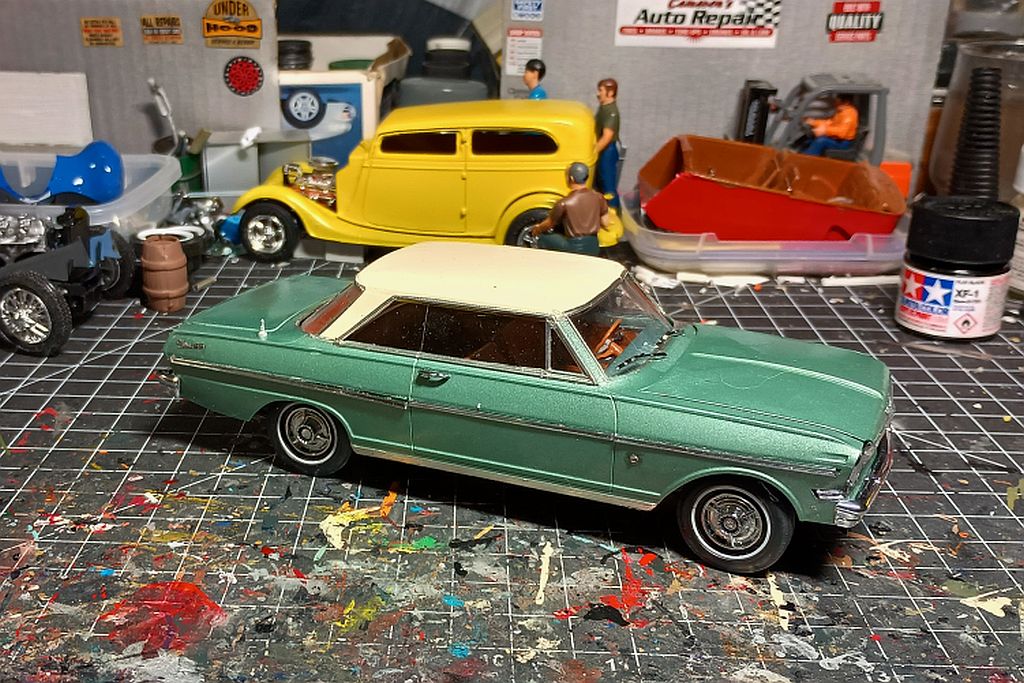
But you may be thinking of Nova hardtops. I have this ’63 by the Chinese firm Trumpeter; and what a peculiar kit it is. A strange combination of ultra-detail (photoetched metal parts to assemble functional hood hinges like the originals, proper chrome plating with a copper undercoat) and near enough/couldn’t-be-bothered (rear bumper ‘fit’, fan belt doesn’t match pulley positions, right-angle kinks in exhaust). They don’t make car kits any more for good reason if the Nova was representative.
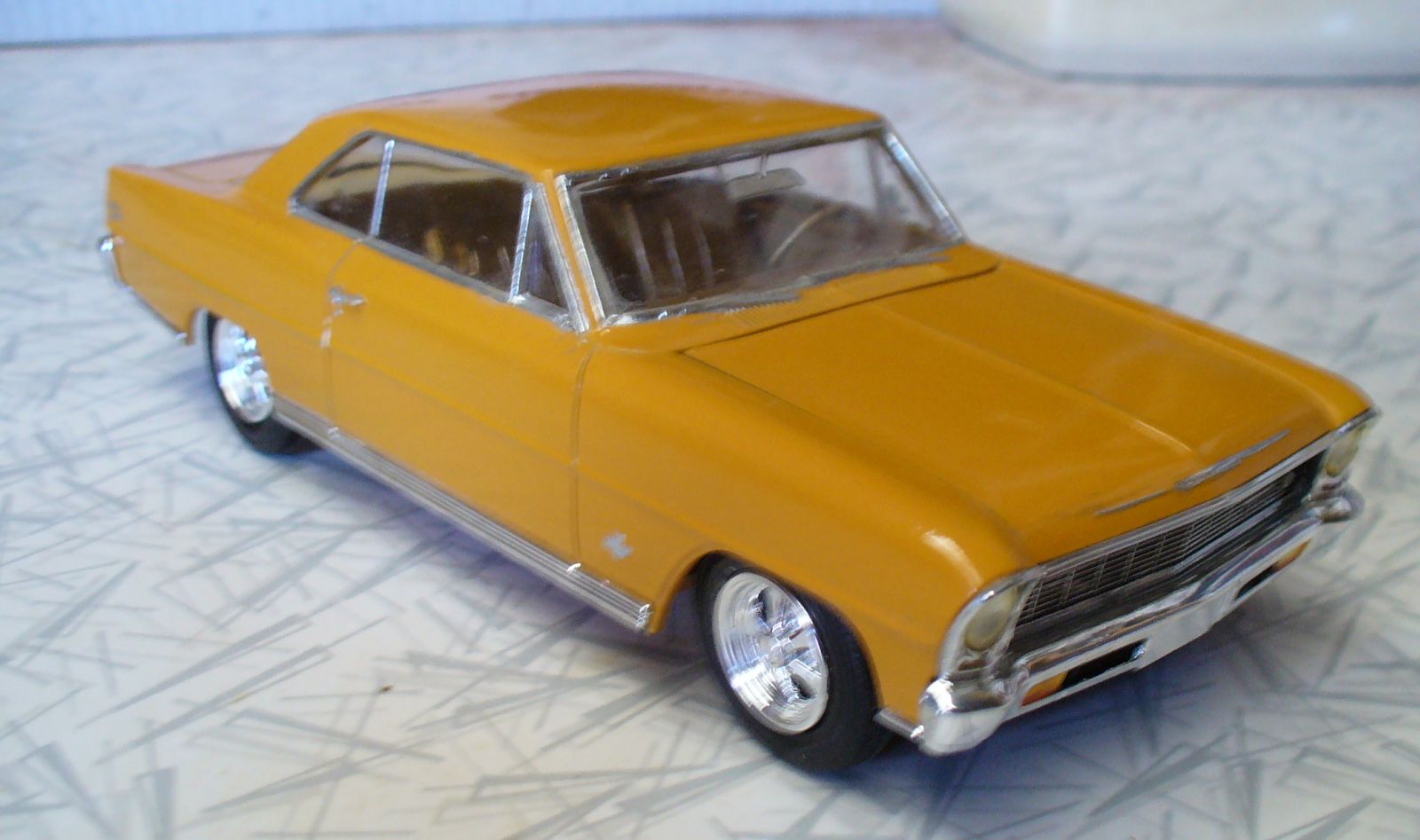
Two companies do later Nova SS hardtops. AMT were first to the party with a lovely ’66, with a later Pro Street version I have yet to build up. These have been in and out of the range for the past twenty-odd years.
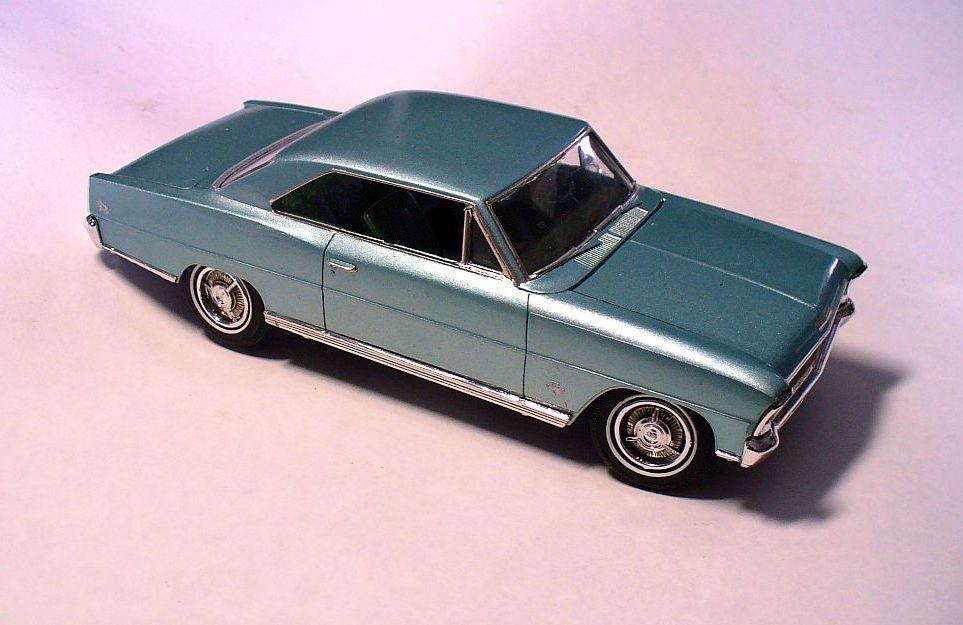
More recent times have seen Moebius join in with several variations of the ’64 and ‘65s, which I don’t have, They’ve just recently re-released Trumpeter’s ’63 under their own name. I’ve no idea whether they improved it. Even bringing the instructions up to Moebius’ usual excellent standard would be a start.
1968-74
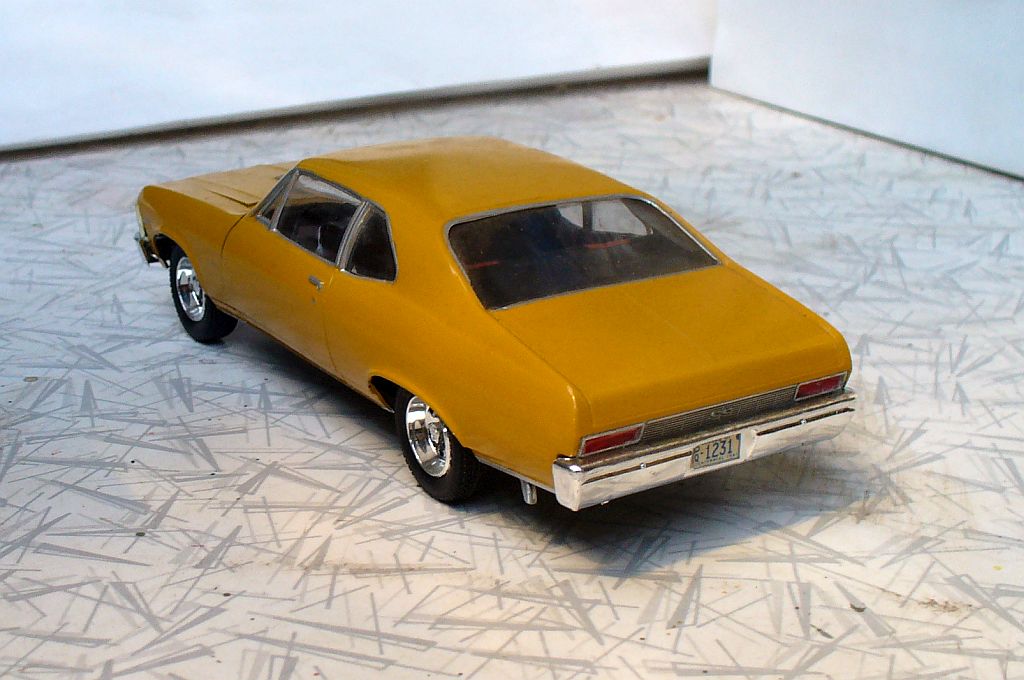
The first to the party was AMT. Their ‘72 is an odd kit, having separate front fenders to enable them to use the same body tooling for a Pontiac Ventura II kit (which didn’t last long). This has left the Nova with fenders that don’t fit flush without considerable work. Continual use of the tooling (Novas are popular subjects) hasn’t helped the fit at all.
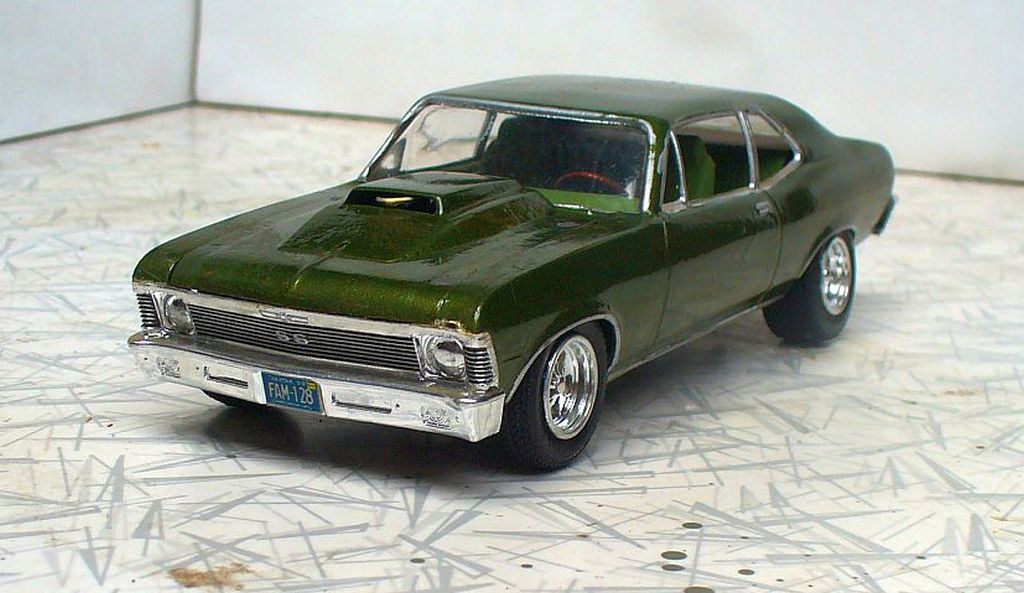
It comes as a 2-in-1 with stock or drag versions. Although the kit continually returns to the catalog, they seem to have made no effort to update or improve it. The drag parts are still 1972-spec, and the tool is showing signs of wear around the window frames.
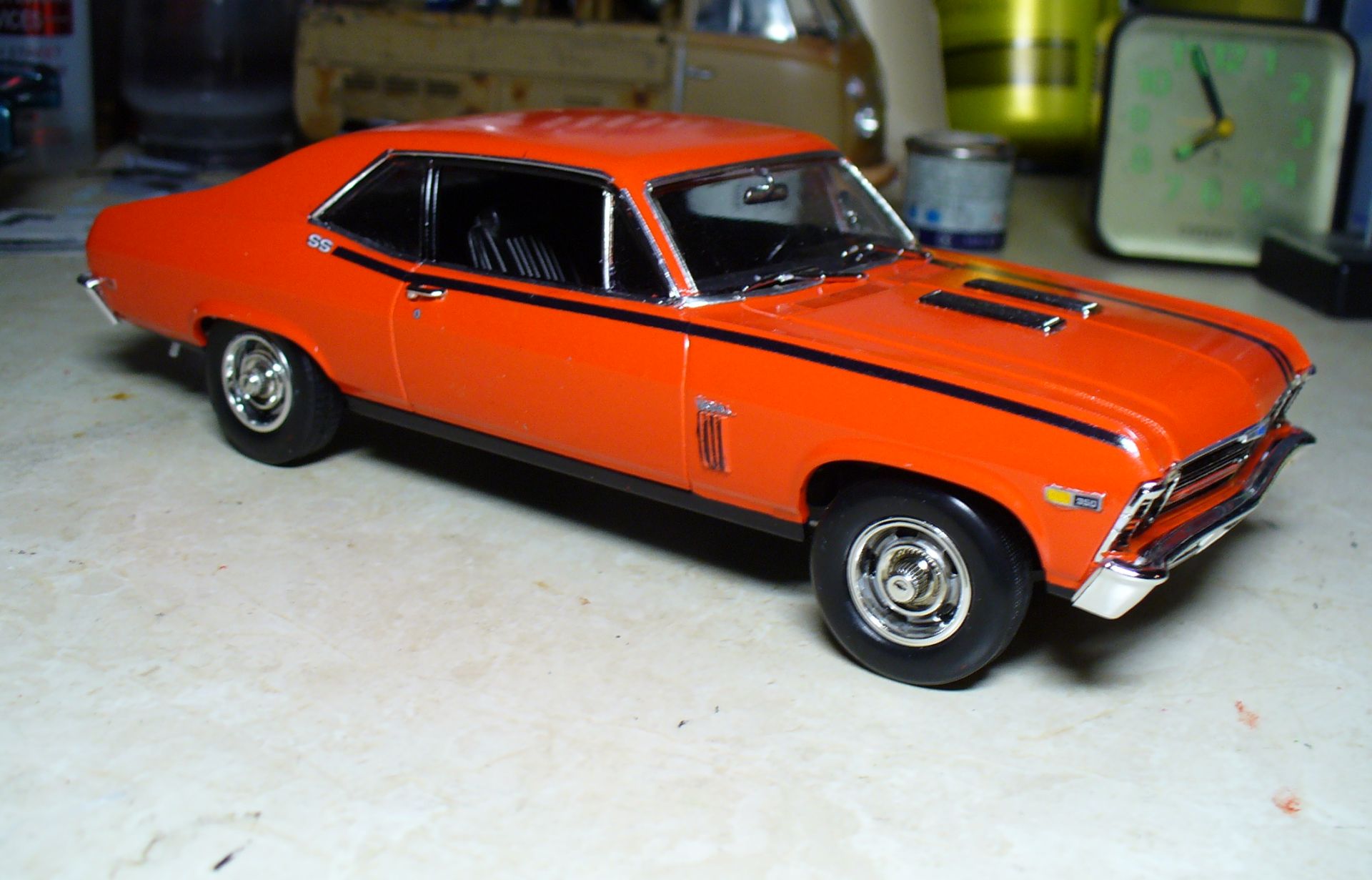
Revell released a new kit of the ‘69 Nova SS350 in 2008. Way better then AMT’s 36-year-older tool, it is thoroughly up to date, comes with optional drag parts and builds up with no hiccups. Mine bears an imaginary graphics scheme.
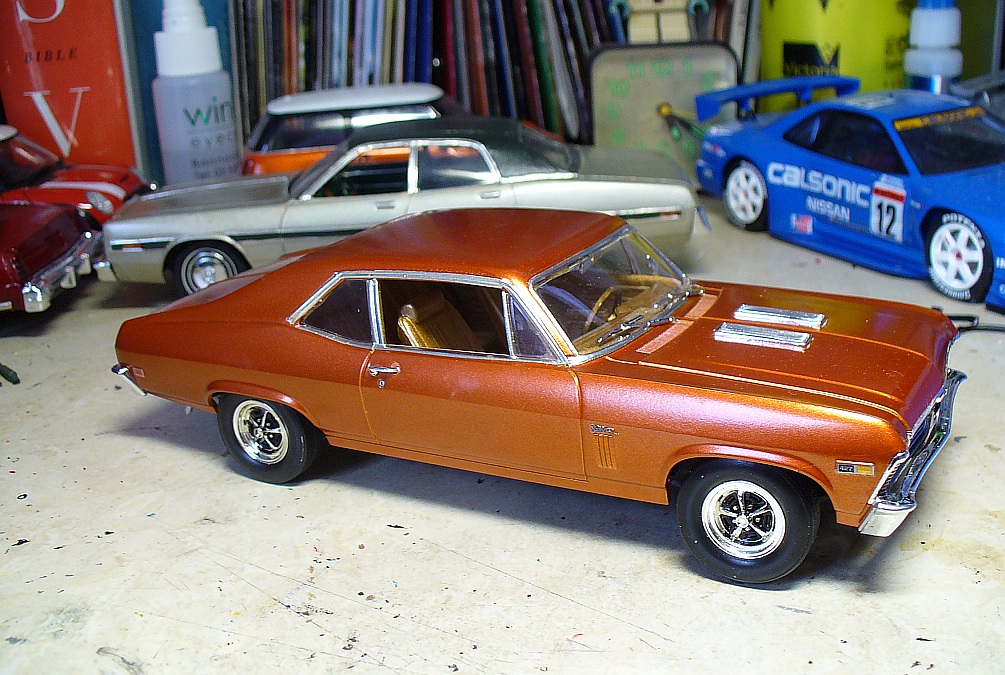
The following year saw a Yenko version with a big block underhood. Rather than use the Yenko graphics provided, I went for an unusual colour scheme.
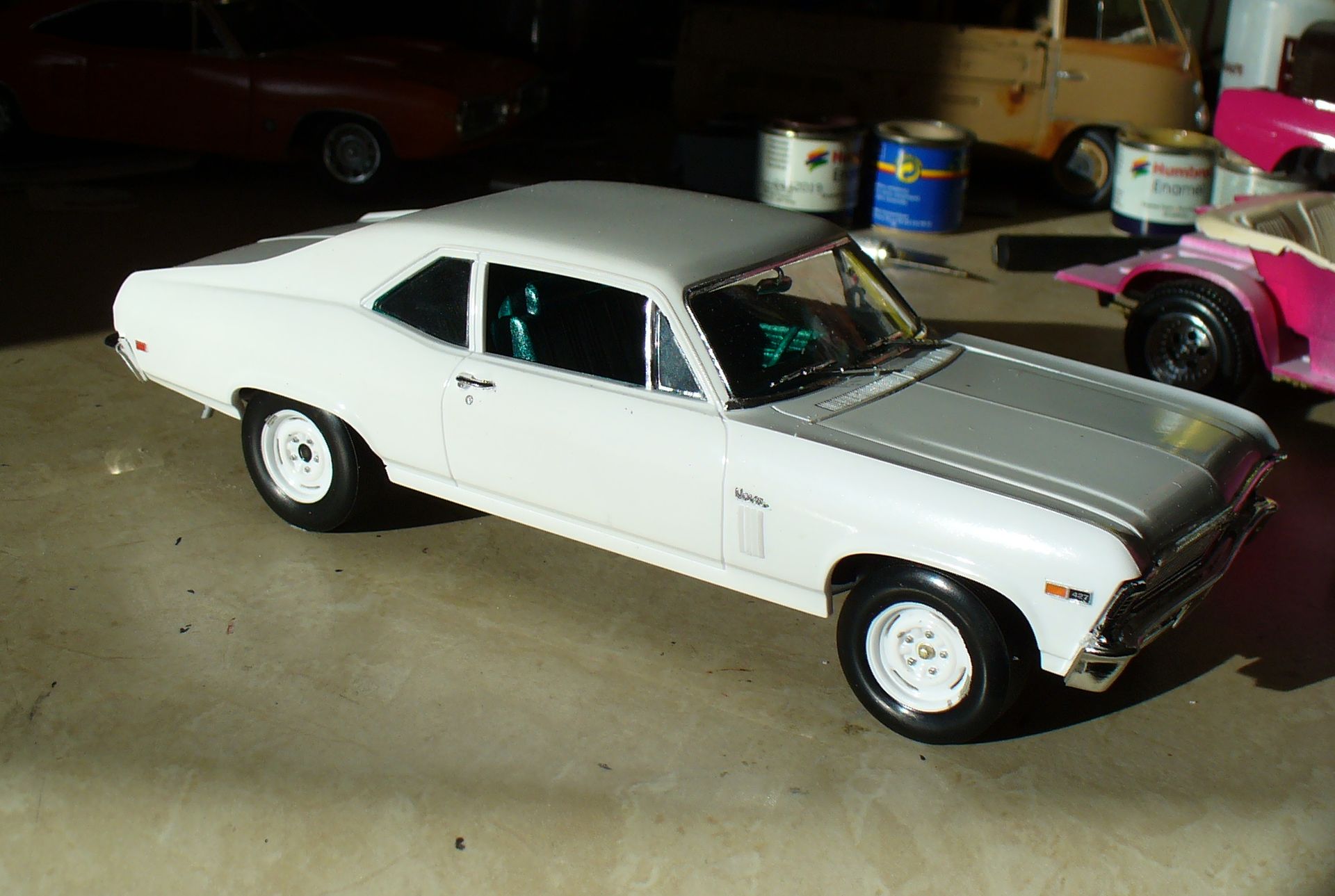
A few years later came this COPO version, with SS details removed and wide steel wheels. A great base kit for building just an ordinary Nova. Plain white wrapper here.
1975-79
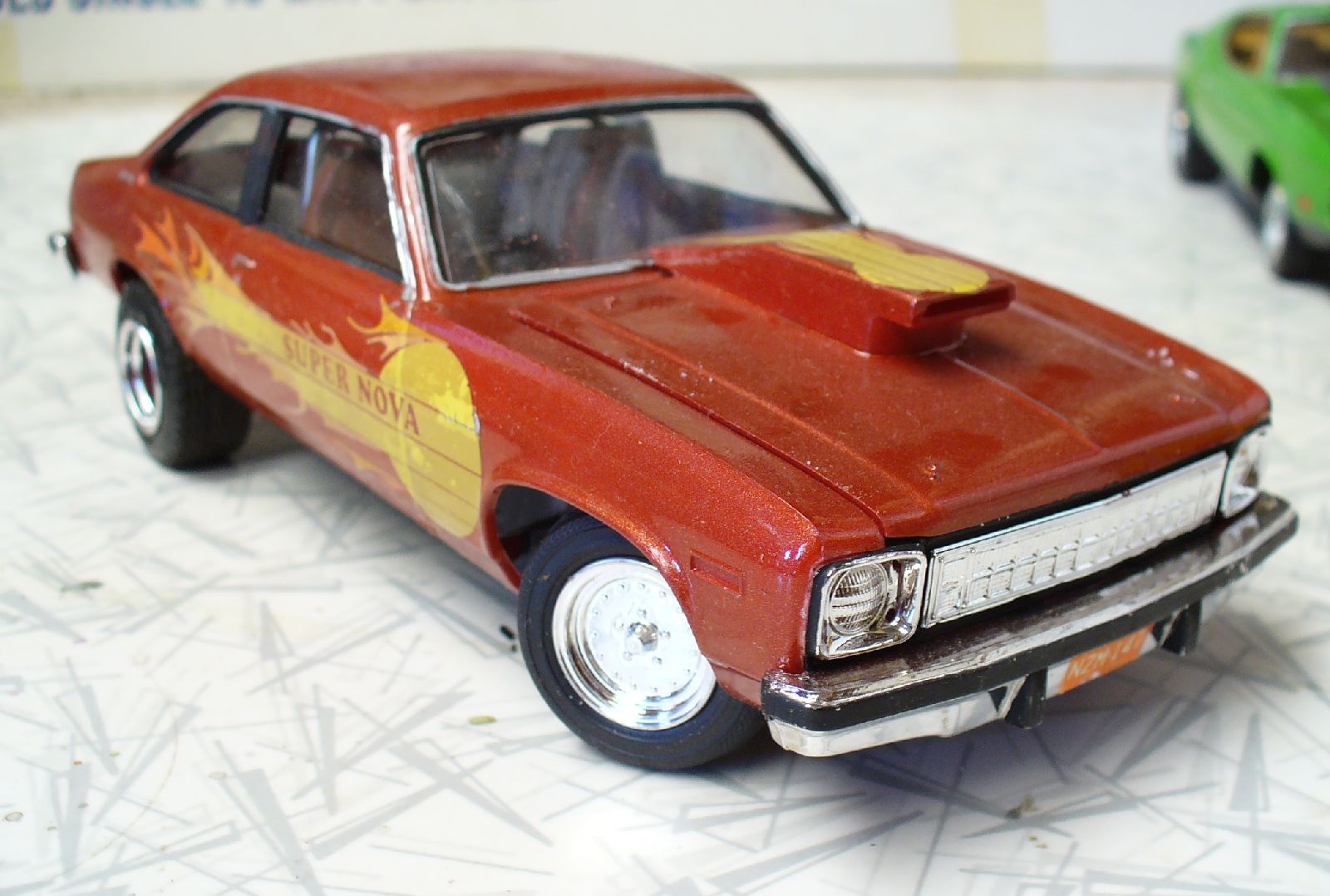
Both MPC and AMT produced kits of this generation.
As well as AMT’s annual kit, they also produced a Pro Street version, which has reappeared in their Street Machine and later Street Custom series.
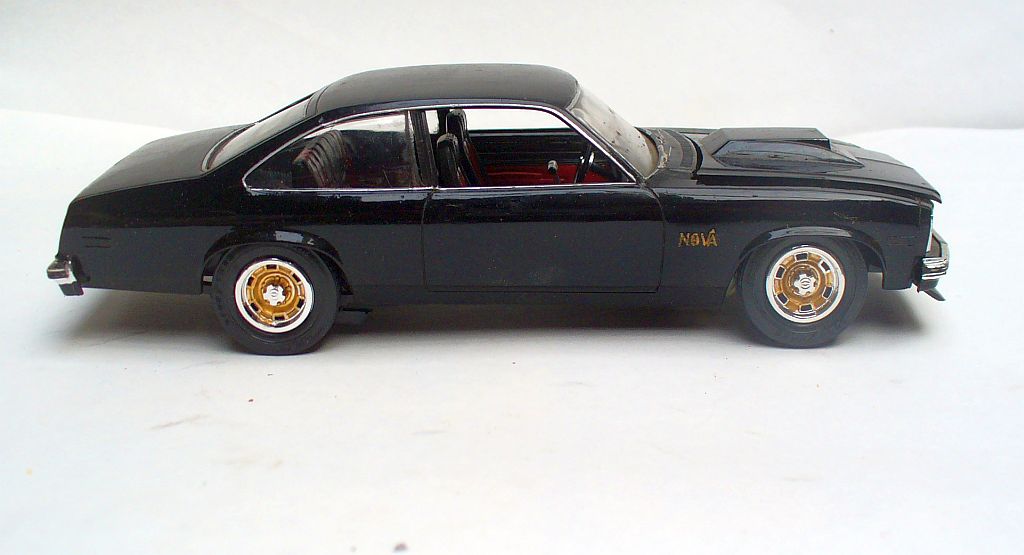
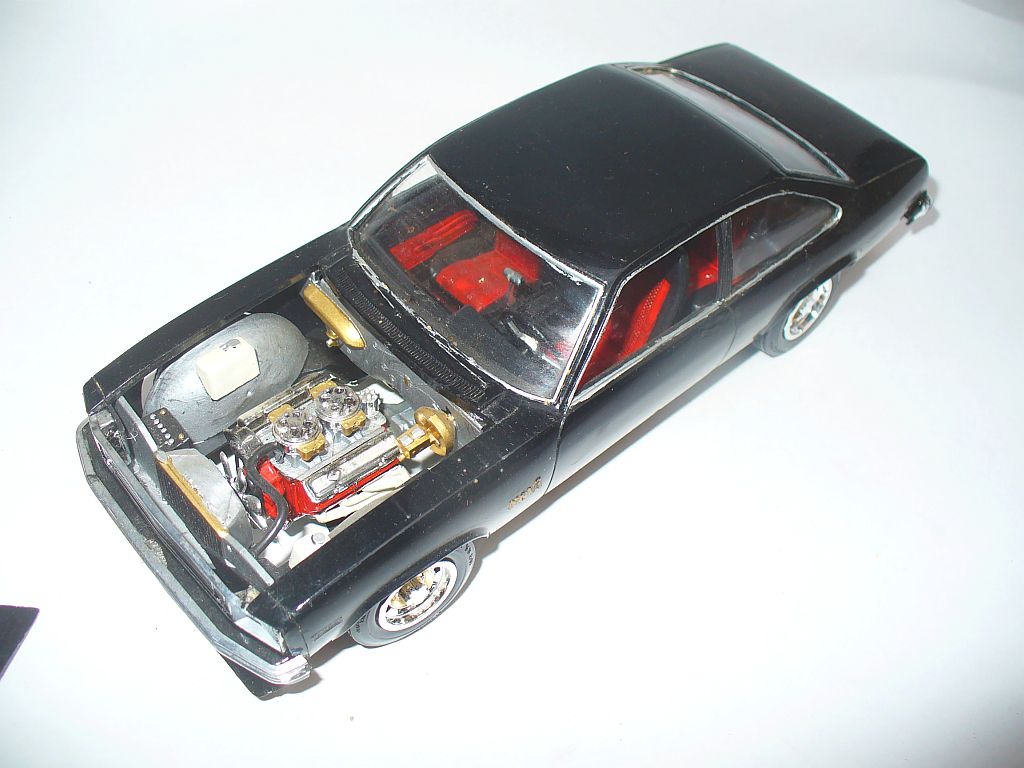
This was built from the MPC 1979 annual, which reappeared in the line in 2024. As is common in the later seventies, it’s a much more finely detailed kit than the AMT.
That’s all for today; see you next week!























Some nice stuff here, especially the Corvairs. Looking forward to an entire post on Vega’s and their H Body brethren!
Thanks, dman. Corvairs have always fascinated me. Not for the bad rep they got, but as a vehicle, the concept of a rear-engined car that size. If only the bean counters had been bound and gagged.
As for a full story on H-bodies, Um… you might be waiting a while! From memory I have two Vegas and five Monzas, with another Monza on the way. Enough for a story? Not really, but we’ll see.
Great as usual! Where do you store them all?
Love the SS Nova the 350’s great, the 396 even better. The ’68-74 Nova was one of my faves from then. Understated.
Thanks, Usedtowas. They’re stored in my backyard shed, basically a large double garage. Initially they were packed away in an an old wardrobe, then two, then they spread to shelves….. That’s in addition to the 80 or so displayed inside.
There is a certain appeal about those Novas, a ‘something’ missing from the earlier (and later) cars. Earlier this year I was shocked to see a Yenko Nova at a local gas station. There’d been a show on, and I guess he was filling up for the drive home. Any Nova would be an incredible sight here, but a Yenko? And it sure sounded like a big block!
Peter: You’re tickling my Chevy itch with these! That lime green Corvair! The 66-67 Novas! The tan 69 Nova! Just, WOW!! 🙂
Moparman has a Chevy itch? Take two Hemis and call me in the morning…
Yeah, some cars I just build; others are special somehow. The Corvairs, well, I’ve always had a ‘Corvair thing’, but the Novas I can’t explain as easily. But the Revell Novas are great kits. I think I put extra care into them – and in today’s story it shows.
Yes, there was a “Chevuzu”. They were the Geo Storm and the Geo Spectrum. The Spectrum was sold starting in ’85, but later became the Chevy Spectrum after the Geo name was phased out . It was a small front wheel drive sedan based off the Isuzu I-mark. The Geo Storm was a front drive coupe based on the 2nd-generation Isuzu Impulse, sold from 1989 to 1992, I think. The Storm exists in 1/25 scale, but only as a dealer promo. I know a modeler who painted one tan, and displayed it with a bumper sticker that said ‘DESERT STORM’.
Thanks Jason. When I wrote that I couldn’t think of a Chevuzu, only Geos (Geuzus?) – but I thought GM probably did one, as we had plenty of Holduzus down here. This badge was on the first Geminis.
Love the ‘Desert Storm’ – sounds like the kind of thing I’d do!
There was the Chevrolet Spectrum, same car as the later FWD Holden Gemini from 1985-89; we not only got it for longer but also as a 3-door hatchback, since America was still buying 2-door small cars in the ’80s. Hasegawa does a facelifted version of the JDM Isuzu sedan, pretty nice kit.
More great one Peter, thanks!
When I was 10 or so (late 60’s/ear;y 70’s) I got to see a completed model of a Corvair, and was very impressed. Not sure which generation as 10 year old me did not know about car generations, but it left quite the impression so these brought back great memories. I think I like the blue coloured one in the 2nd and 4th photos best.
A few questions:
Like USEDTOWAS asks, where do you store these, but also how? Once completed, aren’t they generally much smaller than the box they came in? The 2 I have kept are stored together in a shoe box with some TP for protection.
Any ’63 Acadian versions of the Chevy II in model form? My mom’s first car was one of those, a 4 door in some sort of gold with a gold/beige interior colour. And a metal dash I hit once on a sudden stop, but no lost teeth fortunately.
Looking at the engine detail in that last photo, do you ever add extras like plug wires?
I also enjoy looking at what is in the background of your photos and wondering when some of those will get their time to shine.
Looking forward to next week!
Thank you, Trainman. Long response here!
Not sure which story will run next week, there’s a few in the works. Stories like today’s have a wider appeal than, say, big JDM Toyotas or Nissans (done but not online yet), so it’s a case of editorial balancing by Rich. Having said that I’m often surprised by the response to an article: five comments when I got up this morning was great.
As regards storage, I line the box with tissues or paper towels, and place two or three models (also wrapped in tissues) on their sides. Any remaining space is lightly packed with crumpled tissues. The idea is to cushion the model from damage if the box is knocked; it’s not sufficiently cushioned if the box should be dropped – but that’s not likely.
There is no Acadian yet, but Moebius just recently produced a Mercury M100 version of their bumpside Ford pickup – so I wouldn’t be surprised if their Nova kit range sprouted an Acadian offshoot. There’s always the chance that some Canadian resin caster may do the Acadian-specific parts for a conversion.
I have rarely done plug wires, due to poor eyesight and increasingly shaky hands – that might not show in the finished model but I know the extra effort I have to put into them compared with even two years ago.
As for what’s in the background in my photos, yes, that always raises questions online. Having done these articles for three years now, there’s not a whole lot left that I haven’t shown. If you notice I have missed something, you can always ask!
Thanks Peter for the reply, it is much appreciated.
I totally get it around things like plug wires as I too am dealing with issues, notably around eyesight, when working on my HO and N scale trains. Needing a lot more magnification and very good lighting. I am thankful that the items I want to get are now available ready to run, and I don’t have to do the big kit bashes or scratch built models like in the past to get Canadian specific prototypes.
Too bad about the lack of an Acadian, was worth asking.
Indeed it was worth asking. I’m pretty sure I’ve seen a photo of a photoetch set for a Nova that included Acadian scripts. I did see an Acadian on a model site ( forum.modelcarmakers.com ), about a month back, but the builder made the grille and taillights himself.
I sometimes make some HO scale buildings and static display locos; when I see some of my son’s scratchbuilt HO locos and rolling stock I’m stunned by the precision he (and other builders) manage in that scale. And N scale? Reckon you’d need a shrink-ray for that!
While I’d agree the Revell 69 Nova kit is easier to assemble than the AMT kit, it is far from accurate. The wheel openings are far too squared off and the rear panel sits upright, when it should be angled in towards the rear bumper. The section of the body from the lower body line to the bottom of the rocker panels, quarter panels and front fenders is too straight up and down as well. It should taper in towards the bottom. It probably looks fine to most but, since I’ve had a 68 SS in my garage since 1977, the inaccuracies are glaringly obvious to me.
I understand perfectly, Jimmy. If you’re used to working on the real thing, you’d be like “How did they get this so wrong?” I’ve felt that with some diecasts of cars I’ve owned.
I’ve heard that comment about the rear panel before, but only having seen one Nova in my entire life, and that rather briefly (it was a Yenko, after all!), I’ve not noticed the other faults. There are certainly differences between the Revell and AMT bodies in the lower body section, the AMT having more of that tuck-under effect you describe. What’s your opinion of the side windows – does the AMT have too much top-to-bottom curvature, or is the Revell’s side glass too flat?
The Corvairs have a nice combination of quite delicate lines together with generous ‘coke bottle’ curves. The 68-74 Novas don’t quite pull it off. Still, nice selection. Thanks Peter. My fave would be the metallic blue Corvair (2nd & 4th pictures). A contemporary hard top wagon sounds good though!
Thanks Bernard. I think the Corvair really resonates with me because it’s a larger rear-engine car than we have any experience of. Having seen a Corvair on the road, it was smaller than I expected, only 5″ longer than a VW411 but 4″ wider. And as you say the lines are so delicate, and nicely-integrated, without the squared-off boxiness of the Nova’s front and rear ends.
I love the Fitch Sprint, I love second gen Corvairs in general but those buttresses make it a stunner, and I’ve seen a few in person! (The Corvair club used to have meets at the now demolished Pheasant Run resort which I used to go to for the show/swap meet and watch the autocross.)
You’re model is probably how I’d build one if I had one, minilites suit them very well
Thanks Matt. I’d thought of building one for ages. The black over green colour scheme came from the box art of the 1968 release of the Yenko Stinger – I used a slightly darker green. The Minilites were from an MPC ’71 Mustang. The larger diameter wheels (14″ I assume) seems to make an amazing difference to the car. Possibly the Corvair kit’s slot mags could be undersized, and/or the Minilites oversized.