
Few Japanese sports cars have enjoyed the enduring popularity of Nissan’s Z model, and few have been reproduced in kits as often. Today’s gallery traces the evolution of Nissan’s legendary sports car through a collection of scale models, showcasing not only the cars themselves but also the kits that have kept the Z’s legacy alive on hobby benches for decades. Let’s get going.
Origins
The story begins with the 1960s Fairlady SP310, which followed on from a still-earlier roadster; best forgotten, that one. But that early sixties Fairlady 1500 was somewhat more serious: based on the platform of the Bluebird sedan (rather than using the old pickup chassis), but fitted with the larger Cedric engine at first instead of the Bluebird’s 1200. The 1600 (SP311) of 1965 gained a larger four, still with OHV but good for 96hp.
Not enough, asked Nissan? The SR311 brought another new engine, the two litre OHC U20, added to the range in 1967 with 135hp in base form. These guys seemed to be getting serious…

Nitto made a model of the late SR311 2000, with a detailed engine, as a convertible, a hardtop, and a ‘crystal’ version with clear body for a see-through model. The Nitto kit later reappeared under the Fujimi brand, as either a stock street car or a race car. A deluxe version added some photoetched parts. The street version is still in their lineup. Nichimo also made a kit, as did Arii in 1/32.
But for most of us, I think the story starts with the 240Z, amusingly referred to in period as the 24-ounce Datsun.
Nissan Ascendant: The 240Z (S30) (1969-78)

This car gave a huge wake-up call to the British and European sports car makers as it proved to be surprisingly competent along with the usual Japanese traits such as reliability and value for money. Its story has been told here, rerun several times. Extremely popular as a model subject, there are, and were, way more 240Z kits than I can cover; Scalemates’ listing for the 240Z has 96 entries! Two notable variations we’ll come across are the long-nose 240ZG, and the semi-race Z432. I’ll just mention the ones I have.

I remember getting a kit of the 240Z for Christmas about 1973. The Revell version was moulded in orange, nicely detailed all over, had a great engine, and slot mags (so seventies!). I built mine as an imaginary rally car (no photo), and picked up a spare kit when I had the chance. Reissued numerous times.

Here’s one they didn’t export, the Z432. This uses the legendary Prince S20 racing engine (as used in the Skyline GTR), not the workaday Nissan L-series. With 4 valves per cylinder, 3 Mikuni-Solex carbies and 2 overhead cams, it made 160hp at 7000rpm. Maybe not a whole lot more power, but 7000rpm! (the L24 peaked at 5200)

Fujimi’s 1/20 scale Z432 hides an electric motor inside the block driving through to the rear wheels. I built this about thirty years ago.

Fujimi issued this new-tool 1/24 scale kit of the 240Z about 20 years ago. Disappointingly, the shape isn’t quite right; it looks a little ‘fat’ in the lower door area and too ‘thin’ in the nose. Compare it to their older 1/20 scale kit, and you’ll see what I mean.
For an accurate 240Z, I’d look to Hasegawa’s 2005 model and its multitudinous offspring (street car, several rally cars, pace car, street custom (several of them), police car, Z432, ZG, stock hubcaps, wire wheels, Watanabe wheels, some with a girl figure, most without….). No I’m not going to count them. (I later did, there are 22. So far…)

Monogram did a simple road racer (with no engine detail) in 1978, followed by a rally version in 1981; this after the car was replaced.

The local Coles store had the Gunze kit – until I came along! I copied the livery of a car I’d seen a photo of, but without the decals and numbers for a clean look. Supposedly brush painting metallics leaves brush marks in the paint job; I have a habit of forgetting these things….

Just in passing, Tamiya did the 240ZG in 1/12 scale. Yeah, it’s huge. The ZG basically has a longer aerodynamic front with faired-in headlights, to homologate it for Group 4 racing. I got into a friendly online building competition with another Aussie modeller – until the other guy started scratch-building an OS Giken cylinder head for his engine! I’d been adding some plumbing to the engine and thinking that was enough, but no way could I compete against that! I’ve yet to finish mine. A foot-long model needs a big workspace.
Nissan stumbles, Nissan falls: The 280ZX (S130) 1978-83.

Fatter, softer, heavier. Nissan seemed to have dumbed it down, making us wonder whether perhaps the previous model was a fluke. A desire for commonality meant adopting the Bluebird’s semi-trailing arm rear end; no bad thing on a sedan, but a step backward from the previous Chapman struts, on paper and (according to tests) on the road.
Now I’m no sports car owner. I can understand a desire for higher sales, but given the reputation the Z had won, was this the right way to go? Or should they have kept the Z as a pure sports car, since it had built a reputation the hard way, and come up with something else for luxury-sport duties?

The Fairlady was a real image car in Japan. This model was possibly more suited to Japanese driving conditions. As with the previous model, everybody seemed to be doing kits of it. I think this may have been by LS.

AMT got into the action, with this excellent model of the 280ZX Turbo, with a beautifully-detailed engine. A black and silver car like this appeared in print ads.

Tamiya captured the lines of this car beautifully, and did a nicely detailed engine – still an uncommon feature among Tamiya kits.
Nissan sleeps: The 300ZX (Z31) 1983-89.
I never took a liking to this generation, so never built one. As a company, throughout their product line, Nissan seemed to have become sleepy, moribund, even comatose. The new model was too fat and ‘cruisy’ for a sports car. Most had the new VG30 V6, some had a turbo. Life was busy, and I had less time for models that didn’t really appeal to me. No model, no picture.
Musical Interlude: Ayreon, Comatose (Anneke van Giersbergen/Damian Wilson)
(I considered that classical Puccini aria Nissan Dorma, but thought you might not appreciate Pavarotti at breakfast.)
Nissan awakens: 300ZX (Z32) 1990-96 (-2000 in Japan)

Hallelujah! Someone seemed to be turning the lights back on at Nissan. They seemed to be giving their entire product range a much-needed shake-up: out with the dreary, and in with some fun.
Not quite as many model kits this time around, as some of the smaller Japanese companies were no more. Tamiya did the Turbo with a beautifully-detailed engine, and later added the Convertible to their range.

Fujimi did several versions, including this black one.

Hasegawa likewise has multiple versions, but they do the 2+2 body as well as the 2-seater.
The fun continues: The 350Z (Z33) 2003-09.

As a company, Nissan had fallen on hard times. There was a hiatus before this one came out, during which Nissan showed a number of four-cylinder concepts, including one retro before concluding that continuing with front-mid engine V6 and rear drive was the way to go. In other words, much the same as before; no reinvention required. It moved to a shortened version of the FM platform introduced on the V35 Skyline, Nissan’s standard rear-drive chassis. And it was a good one.
For this kit, Tamiya had the headlight and taillight lenses snap into place without glue. Nifty.

This is the ’07-’08 NISMO version. The engine was left alone, but the body seam-welded to stiffen it, the suspension reworked with input from Yamaha, and the body given a smoother front and prominent diffuser at the rear. Earlier NISMO efforts, the R-tune and S-tune, had modified the engine, but this was a more complete package.

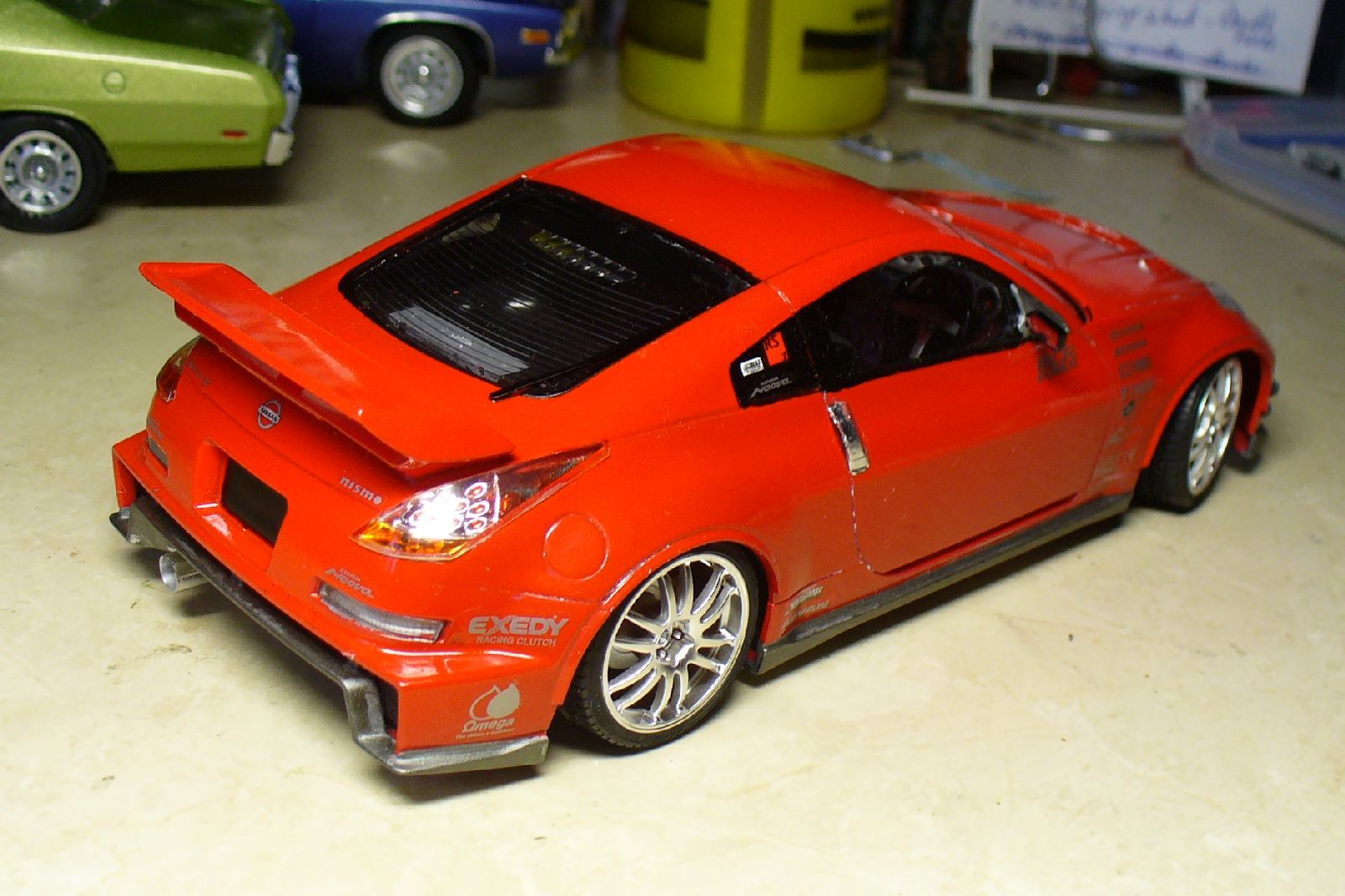
Of course various Japanese tuning firms had a go. This one from MCR (Matchless Crowd Racing!) has a smooth bodykit, huge rear spoiler, wild diffuser and taillights along with larger wheels. An Aoshima kit, they also do some other tuner 350Zs.
And yes, there was a 350Z in one/some of the Fast and the Furious movies. It’s a hideous looking thing in grey with weird graphics, and the AMT kit looks even worse. No photo of that!
Into the future…
Nissan has gone on to the 370Z and now the 400Z, but I’ll stop with one last model, a standard 370Z.

And that’s it for this week.























Thanks for an interesting history lesson, Pete. The Z Cars of my childhood were Fords, of course*, but I certainly remember these Datsun Zs in my youth. Not that I knew anyone who actually had one, but there were plenty about.
You’ve managed to cover a good deal of the history too; I didn’t realise there was one after the 2003-9 model which shows how far these sporty coupes have fallen out of fashion as much as anything.
I thought I had a set of N Gauge 240Zs which I bought about 20 years ago, but it turns out they were 240ZGs – whoops. Well one of the set came unpainted, so that’s the obvious one to rebuild.
I look forward to whatever you do next week!
* You probably know the ones I mean 😉
Thanks Bernard. In my childhood years Dad controlled the TV, and he preferred to watch the local police dramas rather than the overseas shows, but I was aware of Z-cars. Airfix did a Mark 3 in 1/32 scale, which, being an early attempt at model building, would up something of a mess. And there was a Matchbox Mark 2.
Like you, I never knew anybody with one, not in my neighbourhood, but passing through in traffic, certainly. Nice group of little ZGs you have there. Next week? Well, at the moment our esteemed editor has about ten to choose from, so it could be anything!
I grew up with Nissans (see my May 18th entry on here, “My 1995 Altima”) and only recently started to build model cars, but they’ve all been 1960’s Fords, despite the fact I didn’t grow up around them. It never occurred to me to look for model kits for cars I’ve actually owned in the past.
Chris, out of the four cars I owned in my driving years, none of them were available in kit form. Diecasts, yes, for my Mk 3 Cortina, and kits of earlier Ford Cortinas (Mk 2) and Lasers (KB), but not the generation I owned.
I’m aasuming there were no model Altimas, Maximas, or Xterras made, but they’re pretty regular vehicles. The Z31, Z32, and Z34 I’ve all owned seem to be available. The Z31 wasn’t much to look at and the Z32 may be the only one worth building, as it doesn’t make much sense to build a model of a car I still own (exception being my ’64 Comet Caliente).
Very nice Peter! When I saw the title I wondered if you would mention the 1/12 Tamiya version. I built the rally one many years ago when I was a wee tike, and I recall it was a wonderful kit. Lots of parts but typical Tamiya with everything fitting perfectly. Also interesting your comment on the lack of engines in a lot of their kits, I had not really thought about that until you mentioned it then the light-bulb went on.
All I have now for the Z car is the Maisto 1/18 240Z metal version I picked up for $5 when our local Zellers store was closing.
As always, looking forward to the next batch.
Thanks Trainman. I bought the big Tamiya one when I first started working, and was amazed at the detail they packed into it. Also amazed at what they left out – I’m sure the ZG would have come with a heater, but I had to make my own hoses. Kits do come bigger and better, but not many! I have a 1/8 scale Jaguar E type from Bandai that even has winding windows, along with working suspension and functional steering from the wheel – that would be a story in its own right!
About engines – probably because American kits traditionally provided engines (well, since about 1960) we tend to expect them, and I feel a bit short-changed when a car has an interesting engine but the kit doesn’t have it. I wouldn’t be looking for an engine in, say, a Camry (assuming anybody was mad enough to offer a kit of one!), but I absolutely would in, say, a 400Z. Or a Ferrari or Lambo, or….
We’ve still got a few goodies ahead of us.
The Datsun Zevolution! Great selection of models (and accompanying words) as always! Z32 for me – so handsome inside and out.
These are cool! The black and gold 280ZX looks like one I’ve seen in print ads with the couple that looks like they’re headed to the disco. The original Z now reminds me of Jaime Sommers after having researched the original “The Bionic Woman” on DVD.
A worthy car series / topic. Cool builds, as always.
Thanks Scott. Z32 for me as well – if I could bend to get inside these days (doubtful)! I remember when it came out thinking it was just what was needed. A shame the rest of their range was ‘patchy’ – some class-leaders, others less so.
Thanks Joseph. I remembered seeing one like that in American magazine ads, but never saw a two-toned one on the road. Did you?
I feel the original Z, coming on the heels of the 510, did a lot to build Nissan a credible sporting image, which in turn probably carried them through the lean times when their product line was underwhelming. Of course prominent product placement didn’t hurt either.
24oz? Brilliant – and wonder why we didn’t think of that in this hemisphere! We’d probably be forced to sat 0.70976.
Great theme for an article – 24oz is a real classic and a shame about Nissan’s malaise era thereafter.
Funny how often the shape of a model can be wrong – it even applies to modern ones and die-casts too. Frustrated car stylists working at model companies? It’s frustrating to us sticklers, certainly.
AMT included those wheels and Goodyears on a VW Rabbit kit too – inspired me to build mine as a GTi of course…metallic bronze as it was one of my favourite VAG colours.
I have a 1:12 275 GTB by Revell – it built up superbly, but seems more like an action-figure toy than a scale model; no inner front wings, etc. The Colombo V12 looks well, but a bit like some sort of funny car.
I like the idea of those 1/8 scale models, but anything normal is going to be about 2′ long…I remember a photo of the Heller 15 Six alongside the 1:1 version. Impressive…
Thanks Nick. Taking your points in random order…
Yes, 1/8 scale is huge. The largest model I see on display around me is 1/16, but the E-type, once built, will be about twice the size. I have no idea where I would put it!
As to your 275GTB, a quick glance online shows the Ferraristi are not too impressed with that kit, saying among other things that it’s more like 1/11 than 1/12. But it is an old kit, reboxed in the eighties, so dating back to the sixties. I’m inclined to cut them some slack for an old kit, knowing they wouldn’t do it that way nowadays.
I can remember the stir the original 240Z caused. The open 1600 and 2000 cars were more of a niche thing, nice but largely ignored by the general public, But give it a great all-independent chassis, a revvy six and a roof and people were all over it. Cut-price E-type Jaguar! It must have been quite a gamble – but it sure paid off for them.
Some shapes seem harder to capture in scale than others. There is a subtlety in play here: what’s mathematically right doesn’t always look right, and vice versa. It’s puzzling that Fujimi got the shape right on their earlier 1/20 432, but wrong on their later 240Z. Of the Japanese companies, Fujimi seems the most prone to this sort of thing.
Too bad the old z cars didn’t have plastic panels like the model cars. Their rust resistance was nil.
I’d say Tamiya makes the definitive 1/24 S30 now.