
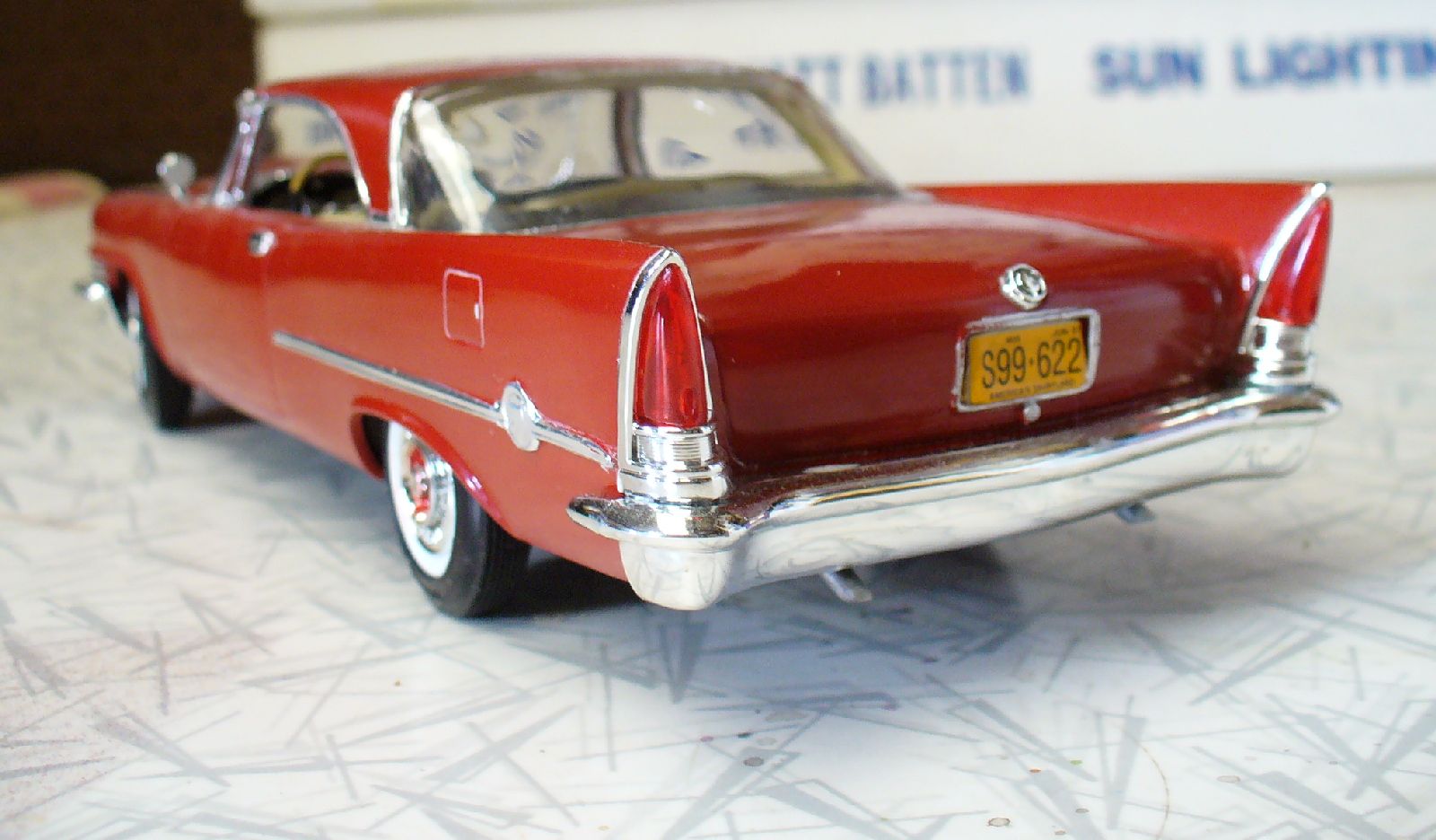
I wonder how many of you groaned at the thought of a story on mid-fifties cars? “We’ve seen all his ’56 Fords!”, you thought, “and we know he’s not over-fond of the tri-five Chevys. What else could there be?” But to no one’s surprise, the 1950s are amply covered in the model world, and there’s no way to pass up the chance to build some of the most recognizable production cars ever.
To keep this short(ish), I’ll only show one example of each most, and mention some kits in passing but without photos.
1955

Let’s start with Chrysler. This ’55 is a Moebius kit, built straight out of the box. I took a little bit of artistic licence with the colour. These only came in blue, white, or red. Photos indicated that the white was a bit on the yellow side (Daniel will doubtless provide the proper terminology for this), so I just took it a bit further in that direction, with some 1964 Ford Phoenician Yellow.

Okay, Chevy, you’re on. Back in the sixties AMT did a kit of the ’55 Nomad. Extremely well-detailed, down to an opening tailgate, this came with a range of parts for a stock build, or custom or drag versions. For this one I used a bit of everything. It was based on a magazine car, and was one of my painting experiments – involving several blue-tinted clearcoats over a bright silver base.

When going through their ‘nineties revival, AMT developed a sedan body for the Nomad kit. Instant success. From memory they had a separate version with all the stock parts from the Nomad, and a custom/street machine version with all the hot goodies. They seemed to like doing that back then – sell two separate versions rather than putting all the goodies in the one box like they used to.

Back in the sixties Monogram brought out a three-in-one kit of the ’55 Bel Air hardtop. Later Monogram teamed up with Tom Daniel for a series of hot rods and cartoon cars. This was what he came up with for their ’55 Chevy. Pure kid magnet! All the stock parts were removed from the kit at this point. It was later reissued in this form with much more basic graphics; I’d assume his contract with them was over by then.

By contrast, this is a Revell kit from the sixties. I feel they attempted to outdo the others, and while it made for a very impressive-looking kit, it had rather flimsy body structure with a lot of opening panels. The chrome side trim was all separate pieces, which saved filing it off for customs or drag cars, though the pieces were fragile. While it was a great attempt at providing show-quality detail, the panels didn’t fit well. It had lots of options for a custom or drag version, and spawned related ’56 and ’57 Chevy kits, as we’ll see. These remained in the Revell lineup until the moulds were sold to Atlantis.

Back to Monogram. They brought out this lovely new-tool ’55 Chevy convertible in the nineties just before being swallowed up by Revell. This has nothing in common with their earlier Chevy hardtop kit, being detailed right up to the best modern standards. Chassis parts in particular seem a lot more crisply moulded and precise.

For a while around 1980 AMT offered some 1/16 scale kits. These had a few customising options. I feel some of these weren’t as precise as their 1/25 scale kits, but this 1955 Thunderbird is a pretty good one.

AMT and Monogram both brought out early Corvette kits in the late seventies, Monogram a ’53 and AMT this ’55. A fairly basic kit, it doesn’t show the attention to detail of some earlier AMT kits. Yes, I know Vettes didn’t come in this colour. They didn’t come with reversed fins on the light pods either – that was an accident.
1956

1956 Ford – they’ve had their story told, so we’ll move on….

In the sixties, Revell made a two-door sedan, based on the chassis and engine tooling of their ’55 hardtop. They followed the usual (for the era) 3-in-1 path of stock, custom or drag versions. This time, Revell made the side trim all separate chrome pieces, enabling you to make a 150, a 210 or a Bel Air (well, yes, you could make a crazy combination of all three!). From the outside anyway; the interior was Bel Air. In my experience the opening panels were a bit more robust than on the ’55; maybe that was the sedan’s pillar.

Monogram brought out a lot of new products in the seventies. The kits went together very well, but unfortunately the body proportions were sometimes a bit dubious, like the roofline on this ’56 Chevy. Sometimes you had to look a while to figure out why it looked a bit funny.

Another Monogram kit from just before the Revell takeover, this was based on the chassis of the ’55 convertible we looked at before. Nearly flawless.

Monogram originally did this in the mid-seventies as part of a range of diecast metal and plastic sports cars – well, there was an XK120, and an MG TC. While I’ve never had one of those metal versions, they were all later reissued as regular plastic kits. Quite a nice well-proportioned kit.
1957

It’s hardly surprising that everybody and his dog had a go at the 1957 Chevy. Revell spun a hardtop and a Nomad off their 1955 kit’s chassis, AMT did a hardtop with a lot of custom options, MPC did an awkward-looking sedan in street machine form on a drag-inspired custom chassis, and Monogram came out with an unfortunately misshapen Nomad based on their ’56 hardtop.
Then just when you thought it was safe to go back to the hobby shop, AMT lobbed this blockbuster hardtop; a totally new kit to the best nineties standard, complete with wiring for the engine and foil for the body trim. For the gold standard of ’57 Chevy kits, there was only one colour to use…
There’s a dedicated street machine version too; I hesitate to call it a version as the chassis, rear end, and floor pan are unique to this model, as is the big-block power. I’ll be building it later this year.

Another kit from AMT’s early-sixties Golden Age, this Ford hardtop comes with opening doors and working steering, as well as being the usual (for the time) three-in-one kit with plenty of options. Just a stock build here.

Revell’s attempt at a Ford resulted in this Custom 300 sedan, on the shorter wheelbase. I felt a rather bland car needed a startling paint job – so pink and black it was. Another building version was available – a fifties police car; but we didn’t get these Fords down under, so stock it was.

Since Revell had the SWB chassis tooled, why not offer a wagon? And make it the top-line Del Rio Ranch Wagon at that. Now Revell had made a ’57 Country Squire back in the late fifties, but that kit had a multi-piece body, and was torn up pretty badly to make a faux ’57 Ranchero. So this was an all-new effort, and it showed.
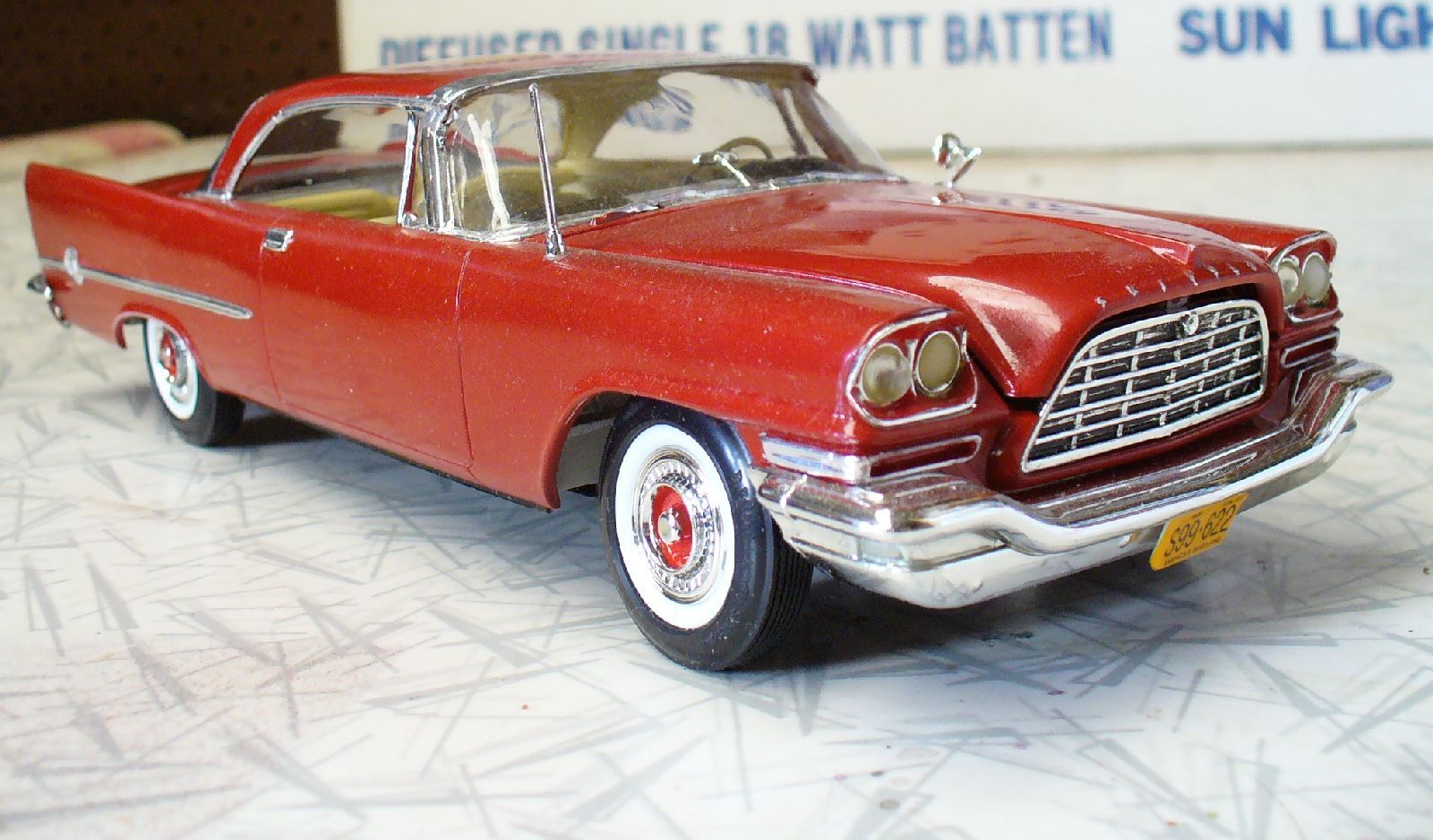
About twenty years ago AMT came out with this lovely replica of the Chrysler 300C hardtop, with magnificent chassis detail and a beautifully done Hemi. It seemed funny to have a Chrysler with a separate chassis, I’m so used to them being unitary.

AMT’s 1957 Thunderbird kit dates back to the early sixties. Ignoring the custom and drag goodies, I built this stock Bird painted in Aussie Ford Copper Bronze, with a pearl white interior.

Finishing up with a classic red and white Corvette, a seventies Monogram kit.























Keeping it shorter? The longer the better as far as I am concerned. These are a delicious treat to the eyes for a Monday morning.
Love the dog on the back shelf of the 56 Ford.
Thanks Lee. It’s not about keeping the text shorter so much as avoiding sensory overload from too many models. When looking at a show there comes a point when I just can’t take any more in. I know some guys like to choose a favourite; that’s easier with, say 15 rather than 25 to look at. If I’d shown everything in this age bracket, we’d have 13 ‘55s before I started showing ’56s or ‘57s! That’s why I try and show ones we haven’t looked at before.
Some of AMT’s early-sixties tools included those little toys for the back shelf. I seem to recall seeing them occasionally in cars here back then.
I recall building a 57 Fairlane kit in the 70s. It had the opening doors. I also built a 57 Thunderbird as well as a 58. These are nicely done, as always.
Thanks JPC. Seems I’m bringing back a few memories with today’s episode.
The TLC that’s gone into these cars is plain to see. They’re all great. But I’ve got to hand it to you; you surprised me yet again. For me, the star of the show is the Ford 300 in pink and black. It just works really well and the color-keyed wheels are a chef’s kiss. Great choice.
Y’know, as a kid I could never understand why some cars looked just so plain. No chrome, or almost no chrome; or the odd strip here or there which didn’t really look like it belonged. Couple that with a plain paint job (say a light grey) and you have one boring (if not ugly) car. As if the manufacturers were saying ‘You cheapskate!’. Punishing you for your thriftiness, because they wanted to upsell you.
But give it an interesting colour, and things can change. GIve it a high-fashion high-contrast two-tone and things change dramatically.
Another wonderful collection. I am amazed that you can recall all the details of the kits: who made it, when, how good it was, what it included or didn’t, changes between releases, etc, etc, etc.
Looking forward to the next batch.
Thanks Trainman. There are some guys with a better memory than mine for this sort of thing. I have sometimes been corrected in modelling groups, or found out later that something I had said here wasn’t quite right. But I will never knowingly spread an untruth.
Conversely I don’t tell all I know – or I would have worn out my welcome years ago! As with so much public speaking and writing, it’s a matter of what’s most likely to be interesting to the audience – or simply knowing when to stop boring.
Rich has a few more up his sleeve ready to go, and I’m working on another three.
I don’t always comment, Peter, but always check out your superb posts. My favorite here is the ’55 Chevy convertible, despite the conti spare. Great color combo and a very fine model.
Thanks Paul. Model cars and words are my two favourite playthings; here I get the chance to combine them. 🙂
I had built one ’55 convertible already when a friend gave me this kit, so I thought I’d use the parts I’d left off before, and make it a sternwheeler. Generally I prefer my cars without, as well. To eyes not brought up in the US, the conti spare is a weird look.
These are always great fun and appreciate your posting them. I’d love to see a shot or two of some engine compartments, especially those with details like wiring.
Thanks Tom, About wiring, you’d be disappointed. Generally I would use paint to accent what is there, maybe adding a few parts if something is obviously missing – washer bottle, brake booster, a larger battery; things like that. Only very rarely do I venture into wiring. That’s because of my eyesight primarily.
Sometimes I show engine compartments. But as at a car show you want to see the car with things closed to get a feel for the overall shape (or, at least, I do), so I usually show my models closed up. But here’s a sample ’56 Chevy.
The ’55 to ’57s were imo some of the best US cars ever, just the right size, height (comfortable to enter) and proportions, especially the Chevs, Fords, and Plymouths. They should have stuck to that formula. And some of the coolest designs were introduced in those years.
Beautiful models so well done. The chrome must be a real challenge given their tiny dimensions.
Randerson, I totally agree with you.
Some years ago at the Geelong Show there was a ’57 Chevy in the grand parade – and I asked myself why US car makers ever thought to go bigger then that. That package was pretty much optimal for the human body – longer is pointless, so is wider, and as for lower – well, I find it quite a challenge to enter some cars as I get older. Guess that’s in part why we see so many SUVs and corssover these days, a reaction against poor packaging.
The chrome – I find I have to be in the mood….
I had a dealer give-away plastic model of a ’57 Chrysler which my dad picked up by going into the showroom. I remember how modern it looked at the time – and how dated it looked a few years later. The model was unusual in that it had some plastic torsion bars for the front suspension – presumably to show how it worked. After a few years, the plastic weakened and the front wheels started rubbing. Unlike the real cars, there was no adjustment to restore the ride height. At a certain age (11-12 maybe?), we got a kick out of playing pretend demolition derby and destroying old models. Pretty much like the real thing. A favorite tactic was to douse the model with ligher fluid, push it down an ramp and try to crash it into another model that we’d send down a perpendicular ramp in the hopes of adding to the immolation. Had to get the timing just right. So ended the life of a lot of plastic models. Shame now. They’d be a real find today.
And that’s why those old ones are so hard to find today, and command such high prices, Rob. But seriously, old toys do get broken and thrown out; in my case it wasn’t plastic though.
I have lucid memory of Revell’s Tri-Five Chevrolet kits. For the price, they had an unusual amount of detail, though the parts did not fit together with the accuracy of a Monogram product. Unfortunately, Revell’s tires were plastic and came in two halves. Trimming the flashing off the wheels’ centerlines required a lot of patience, and if you wanted whitewalls, you had to paint them.
An issue with both kits and diecast collectibles is the glint in the headlights. The most perfect-looking headlight buckets in my book were in the AMT Edsel Pacer kit.
Those Revell Chevys were a very ambitious undertaking for the time. As you say, parts fit wasn’t always the best, and the hinges were so loose those opening panels never seemed to shut flush with the body.
Some early releases of those Revell kits came with single piece tyres; I had a ’55 Chevy with them. Much skinnier than the later two-piece ones though, probably a more accurate scale width.
The main issue I have with headlights is the ones where there’s no separate clear lens, just a chrome surface with ‘lens lines’. Or those with a peg on the back of the lens that fits into a hole in the bucket. They can be tricky to get looking right.
These are terrific! The AMT Ford with the workable steering? That was a thing? I suppose it wouldn’t be such a stretch, though, considering that many of my (pre-built) metal die-casts have the rudimentary “rack and pinion” set up with steerable wheels. The Forward Look Chrysler 300C was the perfect hook – great picture!
Thanks Joseph. Yes, poseable steering used to be a thing with AMT in the early sixties. Not for their annual kits, but for the specially detailed 3-in-1s like the ’56 Ford, ’57 Ford, (but not the ’57 Chevy!), ’58 Chevy, ’59 El Camino and doubtless some others I’ll think of after I hit Post Comment.
MPC took things to the next level with an atttempt at a working steering box – turn the steering wheel and the front wheels steered IF you got all the clearances right and didn’t break anything or get glue everywhere. Just the other week I built an old MPC ’32 Chevy, and that steering was so tricky to set up. By the late sixties they seemed to have abandoned this.
Almost every Japanese kit comes with poseable steering – comes from their origins as build-it-yourself motorised toys in the seventies.
All beautiful and show hard work and detail .
-Nate
Thanks Nate. Some of my favourites here.
Weirdest detailing I remember was on a Studebaker dragster – Chrysler Hemi (IIRC) had pistons moulded into the block & crankshaft moulded into its ladder frame.
All lost when one built it up, but fascinating.
The Japanese tended to be a tad frustrating in that department…good subframes though!
Oh yes! Was that the Revell kit? That is a strange way to split the engine! Although I never built that one, I remember encountering some of those unexpected details in some of their mid-late sixties releases. Valve detail on the bottom of cylinder heads was my favourite.
AMT also did some of this kind of thing; I remember one kit had a separate chrome crankshaft – which (as with your Stude) was invisible when completed. I’d reckon more than a few got left out for workshop dioramas.
When a Japanese kit has an engine (some Aoshima Nissans, Corolla AE86) it’s usually excellent. Some recent Hasegawa kits have part-engines (Mini, Honda N360); just what would be visible through the grille (moulded open, of course!). I’m seeing an increasing tendency to mould a model with a separate hood and maybe an engine lower – oil pan, perhaps bottom of block – moulded with the chassis plate. Sometimes the parts trees have random underhood details – horns, brake booster, etc. This provides the ideal setting for an aftermarket engine.