

Impreza WRX STi
They’ve always held a fascination for me. They’re just so different. At a time when every other Japanese small car was thoroughly old-style conventional: front-mounted inline four, driving the rear wheels through a four-speed box which might even still run a column shift (shades of the Forties!), Subaru not only threw convention out the window, they nailed the window shut, with a determined ‘And stay out!” in Japanese.

Leone 1400 GSR
That’s not to say nobody else’s engineers had any imagination in Japan. Isuzu’s Bellett ran a de Dion rear end – not exactly what you expect from a truck builder. Toyota and Nissan sixes had overhead camshafts. Nissan’s 510 came with OHC and a semi-trailing arm rear end, which was to last for the next twenty-odd years – but all of this paled into insignificance alongside the Subaru FF. A water-cooled horizontally-opposed four driving the front wheels? Where did that spring from? Previous Subarus had been 360cc rear-engined vertical-twin Keis with rather Forties styling. Now Subaru seemed to have jumped straight from Fiat 500-type engineering to Alfasud influence – except there was no Alfasud yet! How?

Subaru’s 360, near the end of production (1971).
Doubtless there’s a fascinating story behind how that came about, (maybe involving influence from the aero side of the business?), but the Subaru Star (or FF-1) turned up at various Australian motor shows for 1969. Back in those days there was no national distributor; they were handled by different companies in a few states. Some states (e.g. Victoria) had no Subaru distributor yet. I saw the details in the Motor Show Guide, and I was intrigued – like any twelve-year-old car nut would be. Knowing nothing of the 360 (abortively sold here in 1961), nor of the company, I wondered whether this would amount to anything….
But this isn’t a history of the company, but of the various Subaru model kits which have been available.

1400GSR coupe
The earliest ‘big’ (well, bigger than kei) Subaru model I have is this early-seventies Leone 1400 GSR, by the now-defunct Yamada. I don’t think it was called Leone for export. Some of Yamada’s range seems to be available nowadays through Doyusha; but this one has never reappeared to my knowledge. Yamada kits’ bodies weren’t always accurate, the bodies being stretched or shrunk to fit on a common (motorised) baseplate. Although this one looks a bit off around the headlight area, it’s not as bad as some Yamada kits. Still, for $1 at Coles, when US kits were $3.50 and up at a toy shop, I wasn’t complaining.

Next we have a box. I have the model – somewhere. I can’t find it, but this one is too important to leave out. Subaru realised that a simple power take-off from the rear of their existing transaxle could provide 4WD. Initially available as a 4WD wagon, they developed it into a ute/pickup, which remained in the range for two generations. Unusually it was the American company AMT who did this one – complete with a detailed engine, and the seats in the bed which (as far as I know) were unique to the US market.
There was a model of the eighties Leone – sort of. Nichimo produced a Leone Swingback (3 door hatch) in 1/18 scale (a scale more usually associated with diecast models). A motorised kit with minimal chassis detail, this actually had functioning 4WD via a massive Mabuchi 280 motor (more usual was the 130), a system shared with a 1/20 Toyota Hilux pickup they produced – hence the odd scale. (I don’t have a photo of the Leone – a few photos are on the net, but my computer flagged two sites as risky, and the third seemed language-restricted.)
But then the range split into three: the larger Legacy, the smaller Impreza, and the sporty Alcyone coupe. Models of the first two were widely available until about 2010, since when the only new Subaru kit has been the BRZ (sort of carrying on in spirit from the Alcyone) now in its second generation (both car and model). We’ll look at the others separately.

First-gen BRZ, from Tamiya
Legacy
The first generation of larger Subarus were done by Hasegawa as the AWD wagon, and as rally-spec sedans. I don’t have any of these.
The third generation Legacy was kitted by Fujimi, both as sedans and wagons. At this stage, Subaru’s range tended toward sportier variants and even sportier sub-variants. With no engine detail it was easy for Fujimi to update bodykit, wheels and decals to produce the appearance of the latest variation. For example…

Subaru B4.
Here we have the Subaru Legacy B4 sedan, the ultimate performance big Subaru of its time. Or was it? It gets confusing, even more if you check Thingypedia. Never mind the GT, B4 was Next Level Subaru. They got great reports in the magazines when they sold the B4 (detuned) in Australia. There was even a model called Blitzen. Oh, hang on – here’s a new ‘ultimate’ – the RSKL.

B4 RSKL.
Alphabet soup, anyone? Sounds suspiciously like someone was looking at vintage Porsche and Mercedes model types – maybe hoping something would rub off? Rally Sport Kompressor Lightweight, they reckon. Could have called it RSKK: twin turbos, of course, but only one K – Japanese understatement?
You might wonder whether the wagons had their own distinct model names – going by Fujimi’s kits, it would seem so. But no; the JDM just had fifteen different trim levels at various times during the life of this generation! This was the GT-B sport wagon, here in E-tune II form. Yes, the B does stand for Bilstein, their logo’s on the tailgate, even. No idea about the E—tune bit, though I’m sure it’s not for Economy!

Legacy GT-B E-tune II
Then there was the version with the BBS wheel option, which seemed to have its own more attractive bodykit variations as well. Or, well, perhaps Fujimi had a second go at getting the bodykit right. That wouldn’t surprise me either. They were putting out a lot of different kits at this time, and you got the impression some may have been a bit rushed.

Legacy GT-B E-tune II with BBS option
But from this point on, big Subarus were dead as far as models are concerned. Later big Subarus are a rare spot on the road down here too.
Outback? Out of luck. Strangely it seems to have never been done as a kit.
Impreza

First up, an apology. I find it hard to keep up with Subaru’s model codes (GA, GB, GD…) and nomenclature at times, and even more so where Impreza kits are concerned. All these kits are probably WRX STIs whether I call them STis or not. Is it possible to tell the difference in a model? For some generations, maybe; for others maybe not.
Once again, we open with Hasegawa. They did the WRX as both sedan and that wagonoid hatch thingy. Is the early five-door Impreza a longish hatchback or a bobtailed wagon? Either? Both? Does it matter? I’ve always loved the look of these.

Impreza WRX

Impreza WRX wagon
But before we leave this generation, there are the two-door models. Oddly enough, these came from Fujimi. And as is typical for Fujimi, they concentrated on the high-end versions. So we have this…

Impreza WRX STi
And this…

Impreza WRX Sti type22B
Now there’s a rabbit-hole of colossal proportions here, if you look into sub-types and sub-sub-types. There always seems to be with hot factory Subarus of this era. There are just so many different levels of competition-inspired variations. Suffice to say that this 22B is the ultimate performance Subaru of this generation. (Now for a real headache, try understanding the Hawkeye WRX Sti Spec C’s sub-types!).
For the next generation (GD sedan, GG wagon), there are three very distinct front ends, and we have a variety of kits from Fujimi – as well as Revell of America! Revell had a Tuner series of kits (mostly Civics and Integras), and of course the WRX fitted into this scene perfectly! So they did this marvellous fully-detailed kit of a Blobeye, complete with engine.
Blobeye? What? Regardless of Subaru’s model code, these three sub-generations are commonly referred to by headlight shape, as…

2000-02 Impreza WRX STi. Bugeye.

2002-05 Impreza WRX STi. Blobeye (well you couldn’t call it a poached egg)

2005-07 Impreza WRX STi. Hawkeye.
For the next generation, Aoshima got the nod to produce the models. Aoshima being the company they are, they not only produced a single beautifully-detailed stock version…

…but also several tuner versions. Here’s a JUN-tuned ’07 WRX STi

And here’s one from ‘ings+1’.

One more: There is a ’19 Impreza Sti ‘EJ20 Final Edition’ kit coming from Fujimi in August; curious that it didn’t come out when the car was first released.
Forester? Again, nope. I guess the offroad Subies don’t have the popularity in their home country.
Alcyone

I’ll just mention these briefly, as they’ve been covered before when we looked at coupes.
The first generation had wild Citroen-esque looks – incredibly wedgy even in a time when the wedge was king.

The beautiful second generation with those amazing fighter-plane side windows was never done as a kit, more’s the pity. It only lasted from 1991-96, but sold less than 25,000 over that time, so was not replaced. Perhaps the state of the Japanese economy had something to do with that.
But just when you were thought we were done with Subarus….
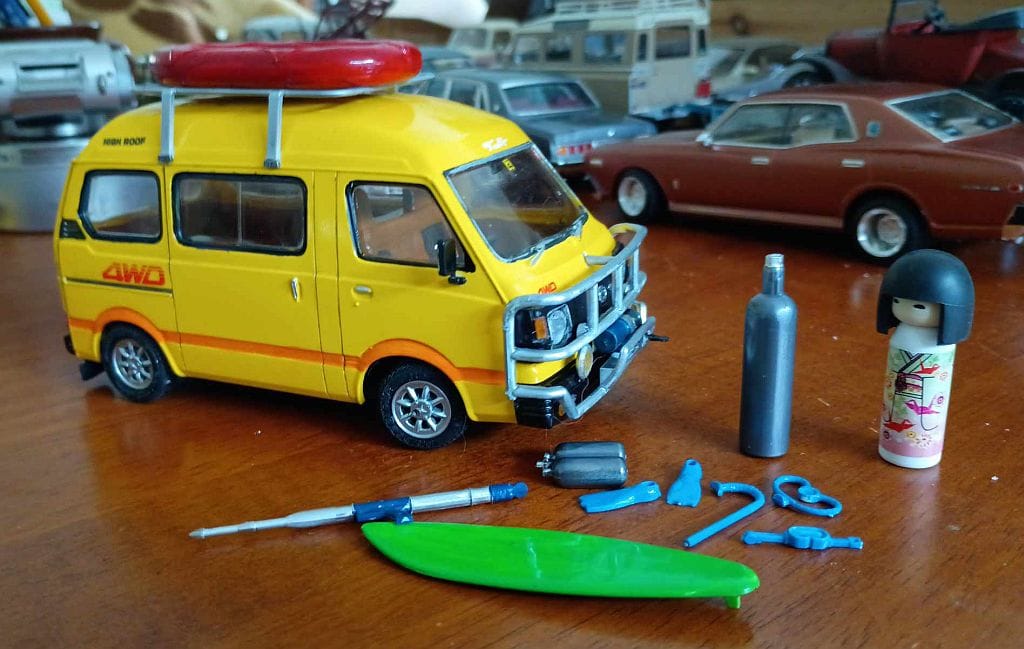
Can’t forget the little Kei van! Also with 4WD!























During my childhood Melbourne seemed lousy with early Leones including the coupe, which I vaguely recall being called Leone over here.
They did seem quite popular, perhaps the coupes and wagons more so that the sedans. As to the use of the Leone name, I’d have to check my magazine archive to be certain, though in my expeirence they went by capacity (sometimes) and trim level – 1400GSR, DL GL, GFT etc. This may be because they were the only model of Subaru sold here, and didn’t need to be distinguished from the keis.
(BTW I asked about that ’60 Ford, but my friend’s been sick)
You’re right Peter. I just remembered this living nearby for a while. No mention of Leone as badge or on stripe
…
But how about the cool “Front Wheel Drive” scripts the early ones wear (not this wagon, obviously)? Wish my writing was half as neat!
I believe the typeface is called Broughamesque
I could quite believe that! 🙂
Another cool collection Peter. I remember building that AMT Brat.
Subaru. I forget about the weirdness most days and have tuned out the boxer noise. Then I open the hood to put in windshield washer fluid and see that strange engine layout and wonder just what the heck they are thinking.
I won’t say I am convinced that they are right. But I know a 6 speed manual BRZ has caught my wife’s eye.
Thanks Jograd. My Brat’s around somewhere, but I couldn”t find it in time,
Subaru engines are so different. When I see one being torn apart on the ‘I do Cars’ youtube channel, I am amazed at the seeming complexity, and surprised they can sell the cars at a competitive price.
As a 17+ year Subaru owner (only 2, both Foresters) I enjoyed the models and the commentary. I am surprised the hot version of the Forester was never produced as a model, my 2016 XT is a pretty sporty CUV.
More good work, thanks!
Thanks Trainman. It surprised me that the Outback and Forester haven’t been done. Maybe such vehicles aren’t popular in Japan? Yet as we’ve seen, many off-roaders do have kits made of them – and some pretty unlikely subjects too.
Someone did a very small run of SVX Models, I think in 1/43 scale.
Thanks Bruce, 1/43 models aren’t my area of expertise, so I don’t keep up with what’s out there. It seems there are quite a variety of 1/43 SVX diecasts from brands such as First43 and Norev (to name just two). Hachette did it in 1/24, DNA Collectibles in 1/18 – or, at the cheaper end, Matchbox in 1/64.
Killer collection! I hope my cousin sees this post, as he’s also a Subaru fan. I’d love a diecast of an Alcyone (XT) or a BRAT.
Thanks Joseph. Some subjects I instinctively take to, other less so. For a while there in the nineties and noughties, Subaru were a hot brand.
I still had the diecast window open after Bruce’s comment above, so had a look around.
DNA Collectibles has a resin Alcyone XT in 1/18 in white or blue – but the price! Hachette has a 1/24, and there seem to be oodles of smaller ones. There seems a smaller variety of BRATs though, but they are out there. As with all online purchases though, buyer beware…