

(first posted 7/21/2018) This bus caught my eye when doing a little research on European coaches – it has an interesting look, with its low slung stance and central fog light, and as it turns out is a significant model in Mercedes long history of coach-making. It’s a MB model O 6600 H intercity bus.
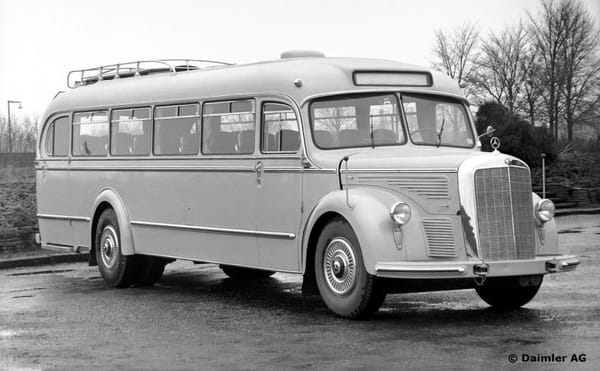

Why so significant? Mercedes buses prior to the war were all front-engined, conventional designs with a “bonnet” hood – essentially truck-based. The 6600, however, was the company’s first forward-control, rear-engined model. As I’m sure Paul could translate for us, O = Omnibus and H = heck or rear – the 6600 designates its carrying capacity in kilograms.
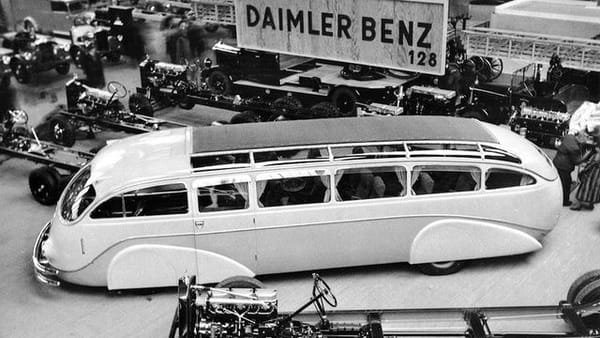
It appears MB went back and cribbed a little of the styling from its streamliner design study coach of 1935.
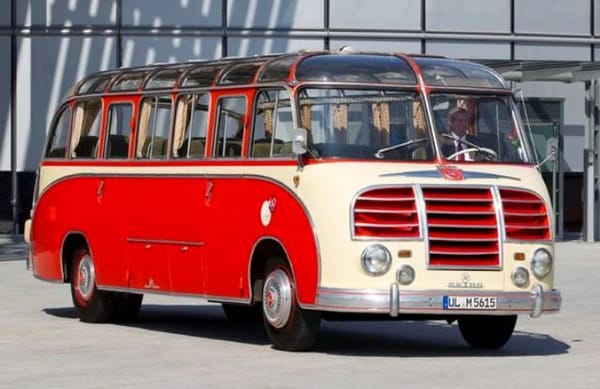

Setra S8
Mercedes was driven to produce the 6600 to match Kassborher, which had introduced its revolutionary Setra S8 model that same year. While rear-engined, the Setra also had a stressed-skin, semi-monocoque body which resulted in a much lighter (and fuel efficient) coach.

There was a front-engined conventional O 6600 built concurrently. But the “H” quickly established itself as the more popular model. The rear engine allowing for more seating, a lower coach easing passenger access, and a much quieter interior, as I’m sure those who remember riding in their old front-engined school buses can recall.


The bus was 11 meters long, with 11 seat rows, sitting 43 passengers. Engine was a transversely mounted 8.3 litre six-cylinder MB OM 315 diesel putting out 145 hp – the transmission a ZF six speed manual with an electric gear shift. The power train was mounted in a unique cradle in the rear of the bus.


The 6600 was successful and spawned both a normal diesel-engined urban transit model and a trolley coach. Interesting note – the motors and controllers for the trolley version were provided by Kiepe, which readers may remember is the same company providing motors/controllers for Dayton’s new fleet of trolleys.

Over three-thousand O 6600 H’s were produced during its ten year production run, and it saw use in both Europe and South America.

It was renamed the O 315 H in 1954 when MB went to a 3 digit naming system, though still informally referred to as the 6600.
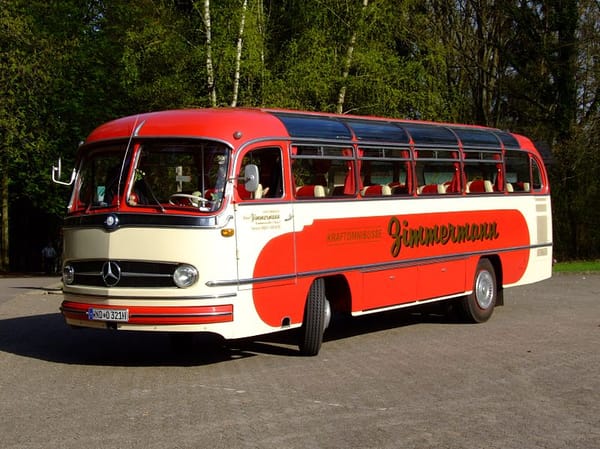
In 1954 Mercedes introduced the O 321 H, an updated coach with a semi-monocoque body. Built from 1954 to 1970 in Germany, Belgium, Brazil and Argentina, it became Mercedes most successful, best selling bus. We’ll take a look at the 321 in a future post.
Author’s Note – in writing this article I noticed this was my 100th post for CC – I’d like to thank Mr Niedermeyer and all the other editors for allowing me the privilege of contributing to this site. I can’t think of anyplace else that would be so welcoming to a guy that likes to write about buses…























Congratulations on your 100th post, Jim. And Thank You! Reading your posts here (and Paul’s, since he likes busses too) has increased my knowledge of motor coaches a hundred fold.
Jim, congratulations on your CC-jubilee! Keep them old buses and coaches coming.
Ironically, Setra was taken over by mighty Daimler in 1995. Mercedes-Benz chassis were also used by independent bus- and coach builders. A fine example is the 1963 Mercedes-Benz – Bova below (photo courtesy of Schepers Tours).
Thanks Johannes – I’ve seen pictures of some of the new MB/Setra buses – very impressive. Jim
Congrats on the 100th post!
I really enjoy reading posts about buses, locomotives and, of course, cars and trucks!
Thank you to all of the contributors for sharing their knowledge, be it in article or comments!
Congratulations on your milestone Jim, your work is one of the highlights of Paul’s site. I much appreciate the depth of research and photos you (and Paul) always feature in your posts. You’ve introduced me to many obscure manufacturers, besides doing a thorough job documenting popular models as well. Truly outstanding work!
This MB design has so much character. For me, the pronounced nose on these adds a great deal to its appeal, making the overall shape more fluid. Wish we were exposed to more European designs like this, in North America.
Slightly off-topic, not sure if you heard the announcement Jim? After October 31st this year, Greyhound Canada is completely dropping service to Northern Ontario and all of Western Canada. Dropping ridership, and difficultly competing with VIA Rail Canada (train), airlines, and others transportation services, are the main reasons cited. Greyhound Canada will now serve only Ontario and Quebec. Ironic given Greyhound has a long history in Western Canada. And more recently made inroads to Ontario.
https://www.cbc.ca/news/business/greyhound-cancellations-alberta-manitoba-saskatchewan-british-columbia-1.4739459
Thanks Daniel – I agree – wish more of the European bus manufacturers had brought their models over – and had not heard the news about Greyhound Canada – thanks for the update. Jim.
I think I enjoy reading about busses as much as you like writing about them. Thanks for 100 articles.
I would like to know more about the electric gear shift. Sounds like a good idea but I am guessing it was complex and had it’s issues.
Yes, I didn’t find much on the electric gear actuators – they seemed to be much more common in Europe than the US. As you know, almost all early US bus manufacturers used mechanical linkages to effect gear changes, and with more than 30 feet between shifter and transmission, it wasn’t very smooth. I’d assume an electric motor would be smoother – as long as they were working. JIm.
Well, be assured it’s a privilege for us to read your pieces here, Mr Brophy. Thankyou for your many efforts.
These Mercedes aren’t quite the outrageous wonder of that ’35 streamliner, but near enough to be wonderful.
Those pre-1967 VW headlights really got around, didn’t they! Even with the special bulgy-eye-sockets needed to make them work in this application.
Jim, your Bus Stop Classics is one of the best things that’s happened here at CC, at least for me. I always look forward to them, and this one today is a real gem.
I remember these well as a kid.Tourist buses would line up along the Hofburg in Innsbruck, so it was like a perpetual bus show for me. The later O321 was becoming more common by the end of the 50s, but I really liked the droopy-faced O66600Hs. These and the Setras were the most common buses that brought n tourists, as the majority of them were Germans at the time. But there were also other more exotic ones from time to time.
Here’s to 100 more, if you can dig them up!
Here’s another note of appreciation. As a child, we spent quite a bit of time in the Bavarian, Austrian, or Swiss Alps. The Post Buses were an icon at the time.
Great job Jim. Wasn’t really too interested in buses until I started reading your Bus Stop Classics, now I’m hooked. 100%.
+1
I enjoy each one of your bus features.
Ive been told there is an old ACF-Brill not too far from me, and it is for sale.
The Hall-Scott is said to still run.
If I only had a place to put it, and the time to work on its restoration, I wouldn’t have a problem dumping a large fortune into saving it for future generations to enjoy.
Fine article. However, some of these buses appear to have a thyroid problem.
Cogratulations to 100 CCs about buses. I hope another hundred will follow, your posts are one of my favourites.
But one little note. I think the O in the models name of MB buses stands for Omnibus not for the Diesel engine. In the same time the model names of the trucks began with L for Lastkraftwagen (german for truck) like in L 6600 for example
Good catch Autobahnraser – I found several sources that said it was for oelmotor but digging a little deeper I think you’re right. Jim.
Thank you Jim. You should do a book. Is CC Press a thing yet?
Congratulations and many thanks for it. Top class work for sure.
Anyone knows why Mercedes quit making bus bodies ?
They didn’t. EvoBus GmbH, a bus- and coach manufacturer, is a 100% subsidiary of Daimler AG. The company’s brand names are Mercedes-Benz and Setra.
Update: currently, Daimler Buses is the bus and coach division of Daimler Truck.
https://www.daimlertruck.com/en/company/daimler-buses
Great post, thanks!
I spent my childhood in Greece in the 70s. The 6600 looked familiarish…but not quite.
Then I saw that picture of the O 321 H, and yes THAT was what I thought of as ‘the old Mercedes bus’ as a kid.
I rode on many of these–I look forward to reading more about it!
I also rode on Setra tour buses.
My favorite bus was the what I considered the “new Mercedes bus”. They were so quiet! They had rectangular (horizontal) headlights, and the tail lamps looked like the same ones on a late 60s/early 70s Mercedes 250.
And during either during the last few months of 1976, or in the summer of 1979, an even “newer Mercedes” appeared, which looked more modern, and had tail lights that looked like they came off a mid/late 70s 450 SE Sedan.
Good post, thanks for sharing. And congrats on your 100th contribution
Congratulations on providing 100 interesting articles. My own bus experience is limited to old GM Fishbowls and the newer buses that have come along in the TTC fleet, along with International school buses when I was in high school. I always enjoy reading about the classics and about the models you don’t see here in North America, along with the always excellent photos. Keep ‘em coming!
Tengo un omnibus O321H que compre y hay que restaurarlo. Quiero hacerlo. Por ahora necesito reparar el sistema electrico de la caja de velocidades y reponer el arranque que fue robado.
De cualquier manera quisiera conseguir el manual de mantenimiento del vehiculo. No se si sera factible… ni que costo puede llegar a tener.
Mucho agradecere alguna respuesta.
Bonjour et merci pour vos renseignements très pointus
je suis propriétaire du 0321H de 1955 en alu et galva j’aurai aimé un retour sur sa potentielle valeur compte tenu des nombreuses allusions négatives que je subit
j’en suis propriétaire depuis mes 20 ans donc ça fait 27 ans que je ke fais rouler ou me suivre
Pretty good looking bus .
? Only 100 articles ? get to work lazy bones =8-) .
The amount and depth of details along with the excellent photographs makes every one of these a pleasure to read .
I have some very fond memories of riding the bus in my youth, makes these articles even nicer .
-Nate
Solenoid gearboxes! There’s really nothing new under the sun….
M-B nomenclature has always been ambiguous; it is indeed O for Omnibusse and OM for Oelmotoren.
S used to be twin-carb, before it evolved into a Klasse of its own…etc.
SL is neither Sportlich or Licht any more.
Been enjoying all the bus articles and the Benz is a beautiful bus. Have you written one on the Blue Bird bus? Spent A LOT of time riding in those as a kid, good old James Bond was our bus driver.
Im curious if that “soelinoid” shifter on the transmission used air or electric motors to move the shift linkages. Im assuming thats how it works, a motor moves the external shift linkages. Instead of the driver with a lever at the front of the bus. I know on American semi trucks they loved to use air for everything back in the day before the semi conductor was ubitiquois.