
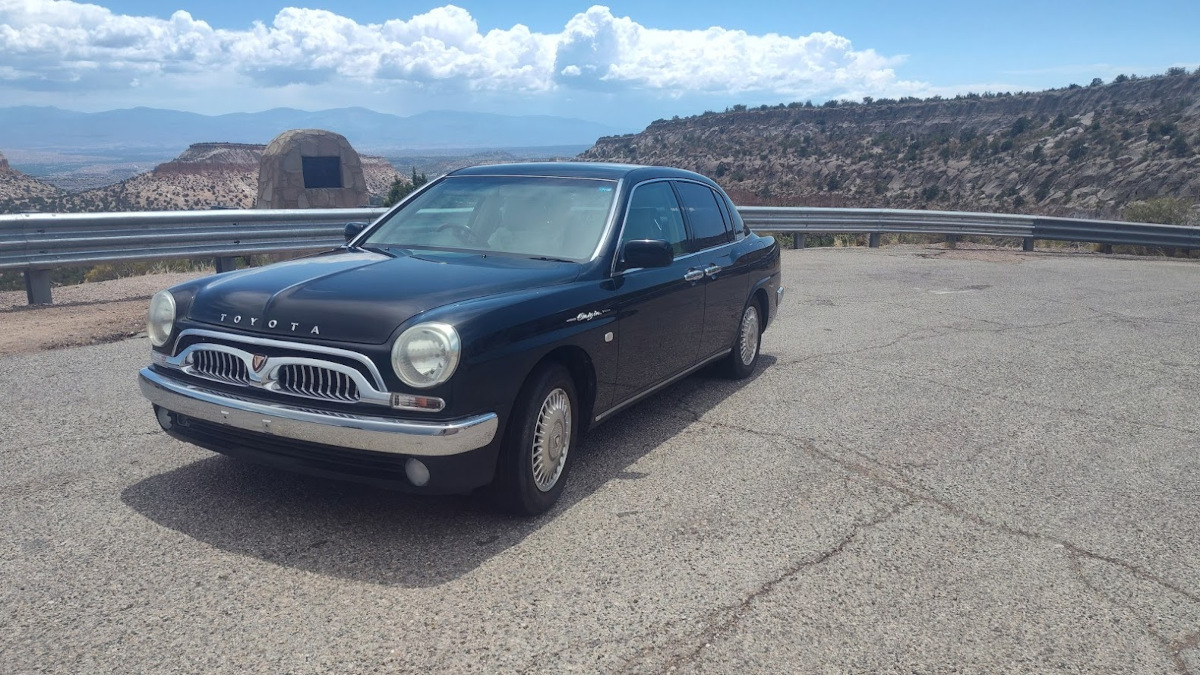
Some cars are difficult to find. Others are difficult to import. The 2001 Toyota Origin managed to be both. Toyota built just 1,073 of these peculiar little luxury sedans, none of them officially destined for America, and when I decided I wanted one in 2024, it wasn’t even legal for me to bring it home yet. What followed was a two-year wait, a pregnancy, emergency surgery, a trans-Pacific voyage, and an unexpected struggle to get the car the final few hundred miles to my front door. But after all that, I finally had a Toyota Origin sitting in my driveway—and perhaps the first one in America to have a proper story behind it.

We’d owned the Mitsuoka for about 6 months when we decided to import another JDM car. We were two for two on imports. There was nothing wrong with the Mitsuoka and the novelty had not yet worn off, but it had rough edges and there was something missing that I could not quite put my finger on. We considered a few cars, including the Toyota Will Vi and even a Century. None seemed to resonate with us, until I stumbled across the Origin.

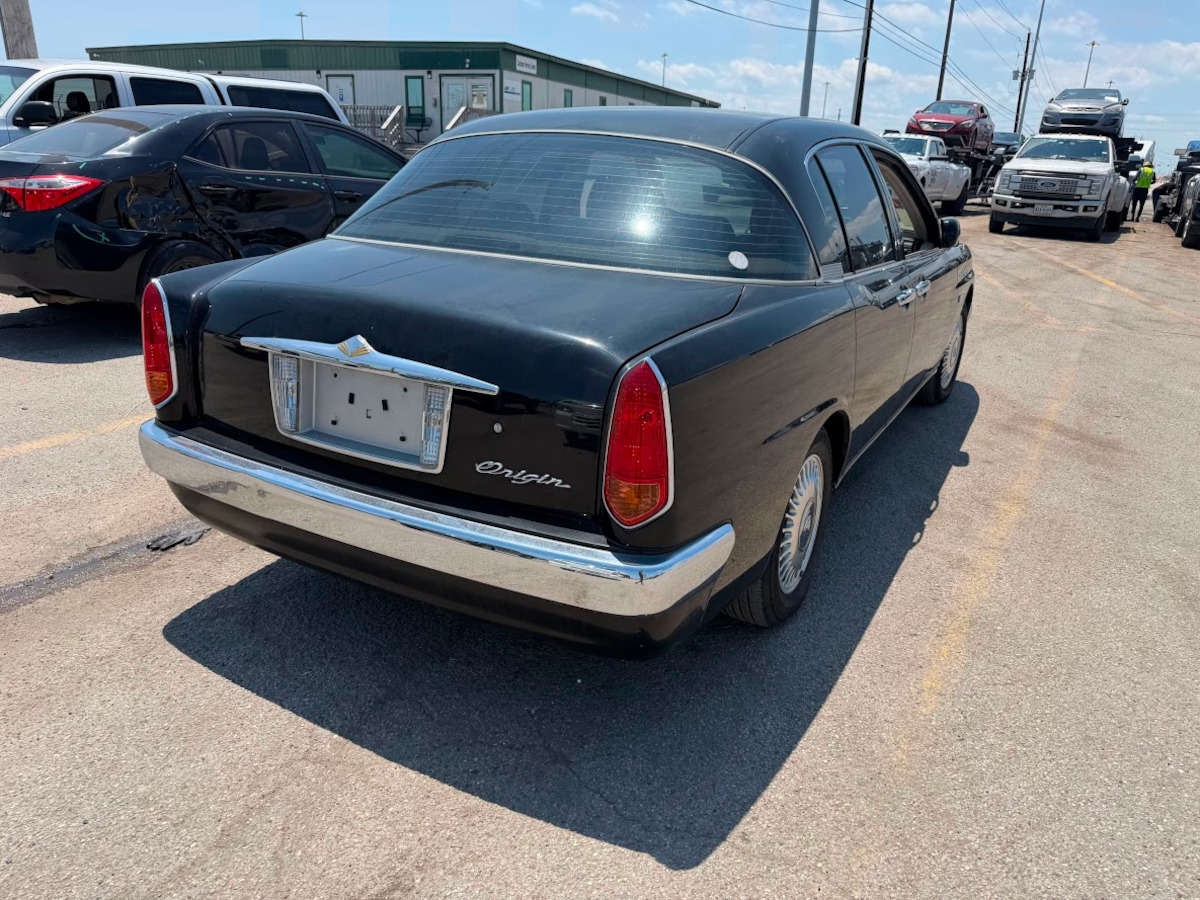
Between May 2000 and April 2001, Toyota briefly built the Origin, a commemorative limited-edition car built to celebrate a milestone that had passed two years prior (According to their press release, Toyota having built their 100-millionth car in Japan). They built 1,073 of them, each at Kanto Auto Works—the same people who were building the Rolls-Royce rivaling Century. The styling was based off the first Toyota Crown, which was the first Toyota to be sold in America, and was a total failure. Perhaps that is why the Origin was never exported here. Or perhaps it was the rear suicide doors. Or a number of other factors that stopped mattering 25 years after it was built.
Underneath the retro façade was all early 2000s Toyota. The now-famous 2JZ straight six sat under the hood, making approximately 230 horsepower and 220 ib-ft of torque. That power was sent to the rear wheels by way of a 4-speed automatic transmission. The platform shares much with the Lexus IS300/Toyota Altezza, a car which received considerable praise when new. It seemed like a genuinely good car with an interesting twist, and I got excited about it and brought it to my wife for her consideration. She loved it too, and so we set about deciding how we would go about getting it. Because it was then 2024, no Origin would be legal in the US until May 2025 at the earliest. We would have to store the car in Japan for a while, and that would be an extra expense—and an extra risk. We set about finding an example to bring in and figured out how we would manage it, and we almost gave up.
As I have said in other entries, L learned she was pregnant in early 2024. Not long into her pregnancy, in late April 2024, she came down with a case of septic arthritis in her knee. It had started as a small pain and, over the course of the day, turned into an overwhelming pain that stopped her from walking. A trip to the emergency room in Los Alamos became an ambulance ride to Santa Fe in the early morning. She needed surgery, but because she was pregnant, she could not undergo the usual anesthesia, as it might harm the baby. Fortunately, the very talented doctors managed to do without the traditional anesthesia, and 7 months later L gave birth to a very healthy and large baby boy.
However, during this time, we had started purchasing an Origin, and the whole process nearly fell apart with my attention redirected to L and her surgery. However, L was excited about the Origin and kept pushing me to get the purchase and storage agreement done. So, a few days after her surgery, we owned a 2001 Toyota Origin—built in the absolute last month of production for the model. It would not be legal to enter the country until April 2026, meaning a wait of two very long years.
This is now the third JDM car I have written up, and I have not been terribly thorough about discussing the process of owning a car that was never sold in America, and which does not have a traditional 17-digit VIN. It is at this point common knowledge that, after 25 years, you can import just about any car, regardless of whether it would have ever met American safety or emission standards. However, that does not automatically mean that you can import and register a car. Your vehicle must be legal to register in your state, and there has been much controversy in some states over attempts (some successful, some Texan) to ban kei trucks in particular. In New Mexico, JDM cars are legal so long as they meet emissions standards for the county in which they are registered. There are two categories of counties as far emissions go; those that require emissions testing, and those that are not, such as Bernalillo County.
It is therefore quite easy to register a JDM vehicle in New Mexico. Nominally, all you have to do is get it into the country, handle the import paperwork with the state, and then register it. I have always gone through the Import Guys in Washington, so I have the added step of an out-of-state title transfer. Because Japan does not use VINs—instead choosing to use chassis numbers etched onto the firewall—the state does not trust cars brought from out of state with chassis numbers. This means that you need a VIN inspection through local law enforcement to obtain a New Mexico title. Once that is done, owning it is little different from owning any other car. Insurance is a little more involved, as you need to speak to an actual person. However, it’s been my experience that most insurance companies will simply insure it as though it is any other car.
It is, however, more difficult to have maintenance done on a JDM car. Any chain store is leery of providing services for JDM cars because they do not show up on the pulldown menus for their systems. Local shops will work on them on a case-by-case basis, provided that you provide the necessary parts. Supplying parts is a little harder. Epc-data.com provides parts catalogues for a handful of manufacturers, but Subaru, Suzuki, and Mazda owners will be without a resource for parts diagrams. If you own a car that falls within epc-data.com’s catalogues, you can find whatever part you need either through Amayama, or through simply googling the parts number listed in the catalogue.
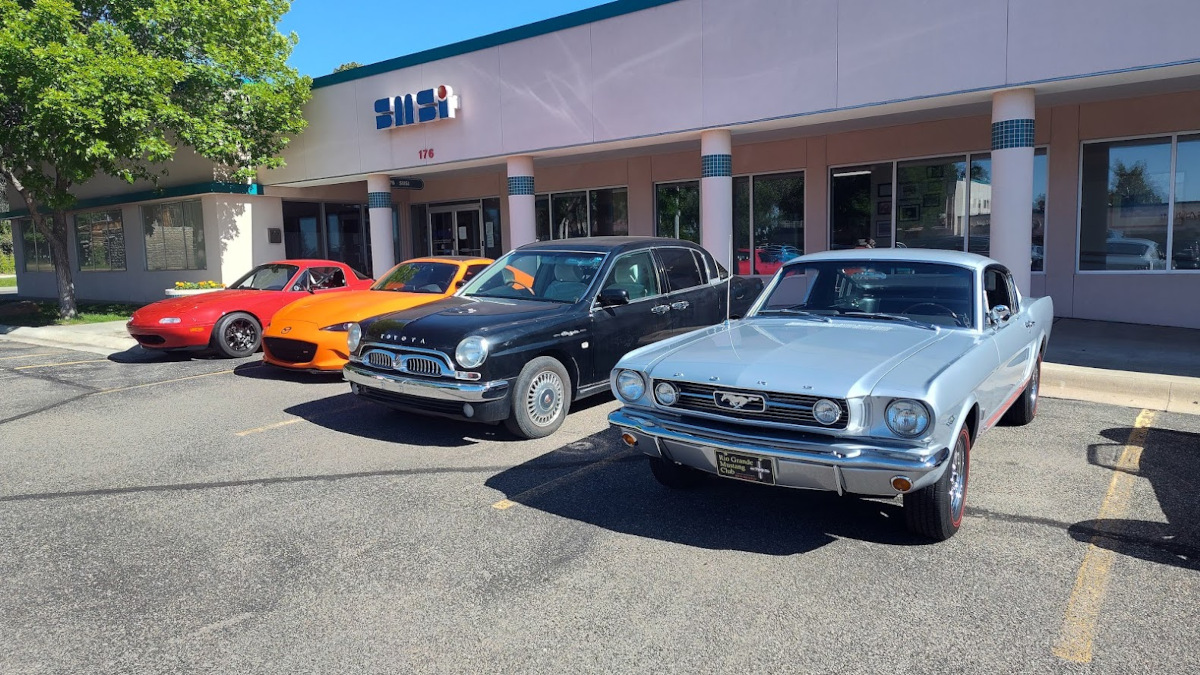
L and I were not entirely certain what we would do with the Toyota when it got here. We had a general idea that it might replace the Mitsuoka, or that we might flip it and make a quick profit off it. As the wait dragged on, and as the Mitsuoka’s shortcomings became more apparent to me, it became more likely that the Origin would become my primary car, and the Mitsuoka sold. I had become fed up with the Mitsuoka’s lack of power, lack of cruise control, and the numb steering, and I was looking forward to the IS300-based Origin’s arrival so that I would have a more substantial car.
My hope was that the Origin, which would have more creature-comforts, more power, and more refinement, would have what the Mitsuoka was missing. However, there persisted a nagging doubt in the back of my mind that I would be happier with the Origin. While it had not yet arrived, the Origin was also missing something. It would not become clear to me what until I stumbled across my next car in January 2026—four months before the Origin would even make it into the country. But more on that later.

In April 2026, my broker informed me that the Origin had been loaded onto the Hoegh Asia. I eagerly watched it cross the Pacific, through the Panama Canal and into Freeport, Texas, then arranged to have the car transported to my front door. That’s where I hit a snag.
Previously, I’d had my imports shipped to my brother in Las Cruces, both because I enjoyed visiting him and because it was convenient to Texas. But in 2025 he moved to the middle of nowhere near Grants, making Las Cruces—and especially Grants—impractical as a drop-off point. I instead arranged delivery to Los Alamos. As it turned out, nobody wanted to deliver a car there. After a week with no takers, I changed the destination to Albuquerque, where a law-school friend agreed to receive it. That did the trick: within days, I found a driver willing to make the delivery.
There are no first-hand accounts of the Toyota Origin that I could find on the English-speaking internet. As these cars were rare even in Japan, it is unlikely that more than a handful of the 1,073 that left Kanto Auto Works made their way out of Japan as well. They are an unknown quantity in the Western world. To that end, it was difficult to know what to expect from the Origin. This may very well be the first personal account of a Toyota Origin in the United States. Accordingly, I shall try to be as descriptive as possible.
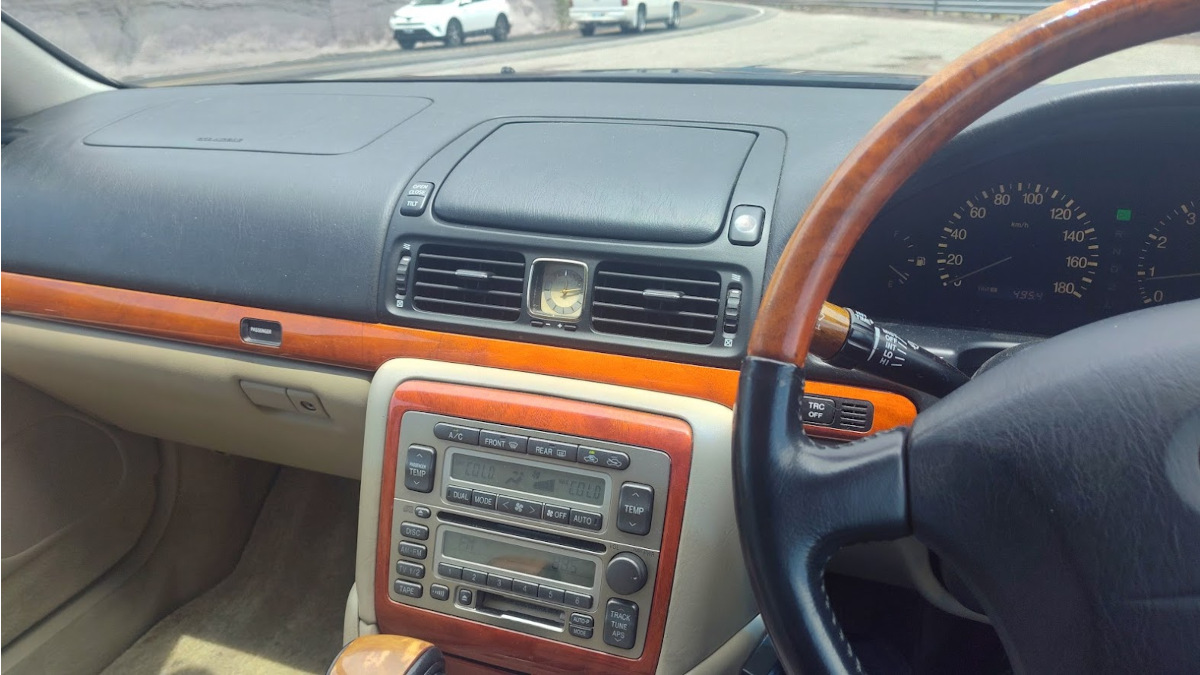
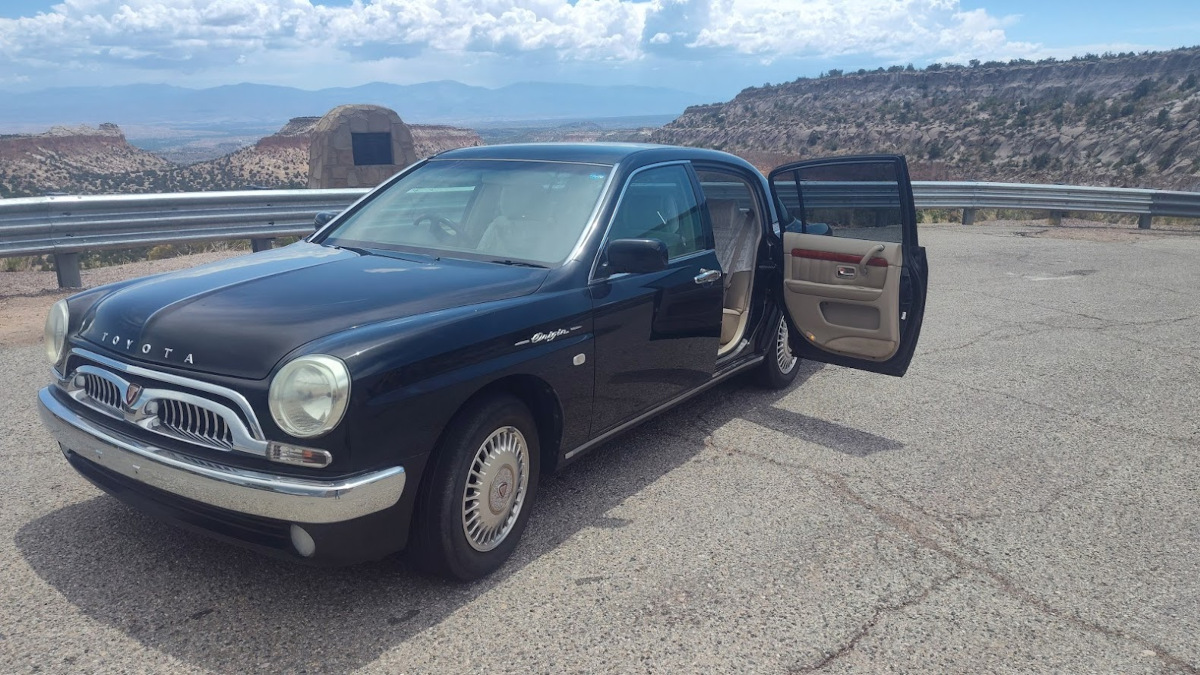
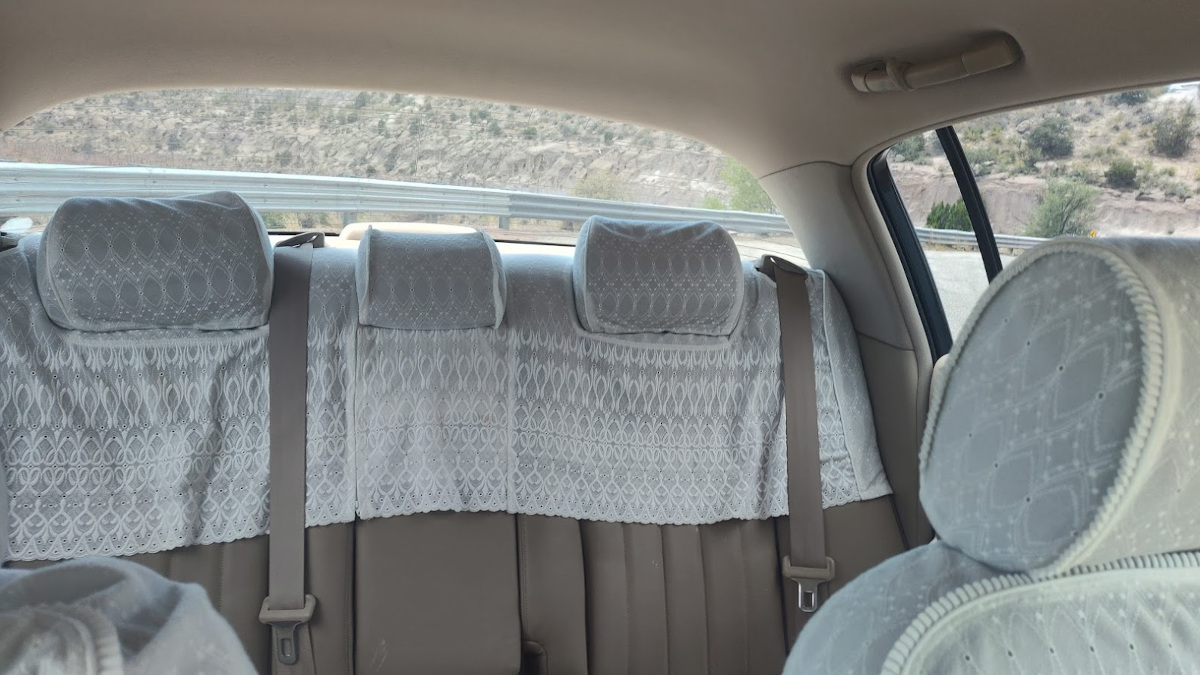
The Origin is, like the Mitsuoka Galue, a midsize sedan. However, at 68.7 inches wide, it is approximately as narrow as a BMW 3-series. This leaves plenty of legroom in the rear, but elbow and shoulder room are on-par with compacts. It is adequate in every seat except the driver’s seat. There I have found that, due to the placement of the steering wheel, my right elbow hits the driver’s door card when making left turns. The transmission tunnel also intrudes a considerable amount, and the result is that the driver’s side footwell feels quite small.
However, the interior is by no means cramped and is by all measures and metrics it is a very nice place to be. The seats are high-quality pleated leather. In fact, every material is high-quality. The carpets are thick and soft; the dashboard is made of a nice soft-touch material which has weathered the years quite well; the steering wheel is wrapped in leather and a quality red wood veneer which matches the wood trim of the rest of the car; and like that wonderful 2002 BMW X5 my father had bought twenty years prior, all the various ashtrays and moving fixtures are dampened. It is truly a world-class interior, and it felt as good, if not better, than my old E66 BMW 760li. However, its driving dynamics leave much to be desired.
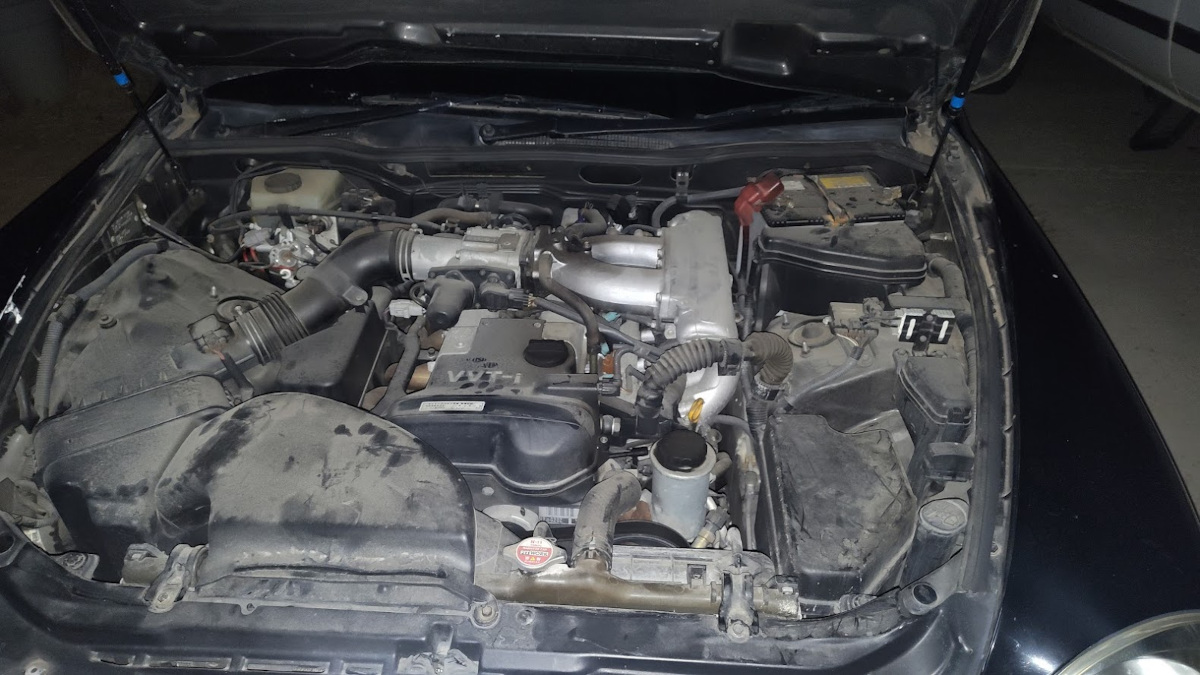
The Origin is quiet, and it is very comfortable. It rides very smoothly, and you will never arrive anywhere tired or worn out. You will, however, arrive bored. The 2JZ-GE is smooth and makes decent power; but it makes little noise and despite being nearly identical in output to the BMW M54B30, it feels less powerful. In fact, it feels less powerful than BMW’s M30B35, despite having a 22-horsepower advantage over it.
However, this is likely more a matter of perception, as the Origin is objectively not slow. It will do 0-60 in about 8 seconds, and it moves with authority. It is simply so quiet that you’ll barely notice. The transmission also does not help with the perception problem. The four-speed automatic transmission is a very smooth, very competent slushbox. While there is a sport mode for the transmission, it does little to make the transmission shift quickly or crisply. All power that is transmitted through it seems to muted, such that you do not really feel any of it except under heavy throttle. Admirable qualities for a luxury car, but hardly exciting.
The suspension also errs on the side of comfort. The steering is not totally numb, but it is not exactly communicative either. It firms up with speed, and it is nicely weighted. It does its job well, but the road-feel is quite muted, although it is head-and-shoulders above modern electric power steering. Thanks to the double wishbone suspension at all four corners, the Origin handles quite well. It corners competently and quickly, but it is also a little soft. The Origin’s float is well-controlled, but fans of the German big three will find much to complain about. The novelty of being in a right-hand drive car wears off very quickly, and you soon find yourself driving a very nice, slightly less convenient Toyota. There are worse cars, but there are also better cars. But for the novelty of its styling, the Origin is a remarkably boring car. I like it fine, but it is not really my kind of car.
Which begs the question; what is my kind of car? I have certainly run the gamut, from ridiculous kei cars to massive tanks. However, there is a pattern to my eccentricities. I have been chasing something in my purchases since the pandemic. It is not lost on me that, since I scrapped my old 735i, I have sought out three different rear-wheel drive sedans, two of which were powered by straight sixes. Indeed, when I was researching the Origin, I did not benchmark it against the GS300—the closest car to it that was sold in America—but against the BMW E39 530i. This revelation hit me one January morning as I made my way into my office, as I looked over at the local lemon lot and saw what would ultimately become my car. Munich, as it turns out, has my number. Or rather, Dingolfing does.
Related CC reading:
Curbside Classic: 2001 Toyota Origin – The Baby Century























It is a terrible thing when a car you are excited to get becomes something that doesn’t make you happy. But you got a great experience out of it (and are part of a very exclusive club!)
These cliffhangers are great. What next?
The Origin sounds like a great car for just the right kind of owner, but as something no doubt deliberately built to be as smooth and inoffensive as a vanilla sundae, that kind of owner is probably a good deal older than you. Still, what an adventurous car buyer you are. Now you know!
Incidentally, and pardon this English major, the Shakespeare quote is “uneasy lies the head that wears the crown.” For some reason you often hear “heavy lies the head” which isn’t as vivid an image. Just saying!
Nice to see another fan of the Henriad in here, rollfast! “Henry IV, Part I” is my favorite, but I like all four plays…don’t know if you’ve ever seen Orson Welles’s “Chimes at Midnight,” but it’s a good mashup of Part I and Part II.
“Heavy lies the head” could apply to Charles I after his execution.
The dynamic qualities of the Origin are exactly what I would have assumed, as its role in Japan was to be a very comfortable, quiet executive car, and very much not a sporty one. Even the base GS300 was hardly a true sports sedan; for that one had to step up to the GS430 as it had a sports-tuned suspension and improved steering response and such.
I’m not surprised that you gravitated back to BMW. These Japanese executive sedans are from a different kettle of fish.
One generally does not buy most Japanese cars for superior driving dynamics. One generally does buy a German product for that very reason, however preferably with eyes wide open for the penalties of ownership that will be imposed.
Must say the interior looks sumptuous, comfortable and of very high quality. I’ve always been wryly amused by the Japanese usage of doilies in their cars, no doubt part of their obsession with cleanliness, and one way to maintain it at a high level, but a rather odd and fussy one, it seems to me.
Nice, at least they retuned the suspension away from the bone jarring ride the Altezza has and its rare anywhere, though thats not always a good thing
“2000”, model year? Looks straight out of “1980-1”. Imagine it rode nicely.
This is from the same time period as the WiLL cars and just before Scion so Toyota was feeling experimental. Cars like the Origin and most Mitsuokas are more about look than driving dynamics so a smooth unobtrusive car was the intention
A Toyota Classic may be more engaging and retro since it’s based on a Hilux but good luck since they only made 100. I find JDM cars interesting and would love to roll up to a Jeep event in a Mitsubishi 4 door station wagon to watch the double takes. More realistically I want a Mazda Bongo Friendee, as a superior version of a VW Weekender for skiing, mountain biking and road tripping
The Japanese market has a lot more variety and playfulness than the American one. Their special editions often are actually special. I recognized the grill on this immediately but I don’t think that it or the original are attractive. The roof, rear end and interior are very nice though, and cancel out the front. I would have found this intriguing but the driving dynamics are not to my taste.
The Mitsubishi / Willys station wagon isn’t for me either, but they made a Lancer Evo wagon that I’d very much like. And I’ve wanted a Bongo Friendee for years for the name alone.
That amazing. A very rare and interesting car. Mostly all about the looks and less so the performance. Thanks for sharing your experience with such a rare beast. Perhaps you can get some doilies in a BMW?
Neat JDM, I can see why you are underwhelmed but I know there’s someone in the U.S.A. that will be over the moon to get it .
-Nate
Nice car and quite unusual, yes it will have a JDM suspension tune, they do most of their cars that way. That can be dialled out but the ride comfort gets worse
Loved this post! Maybe it’s time to start an Origin Owners Club in North America to exchange what we learn about care and maintenance. I’ve translated the Service Manual into English and would be willing to share it with other owners.
Pic of two of our three Origins attached. We love them – sporty, fast, and comfy all in a fun little wrapping.
yes we could ask questions like; where did you get the rims? not that I don’t like the original, but those definitely step the look up