
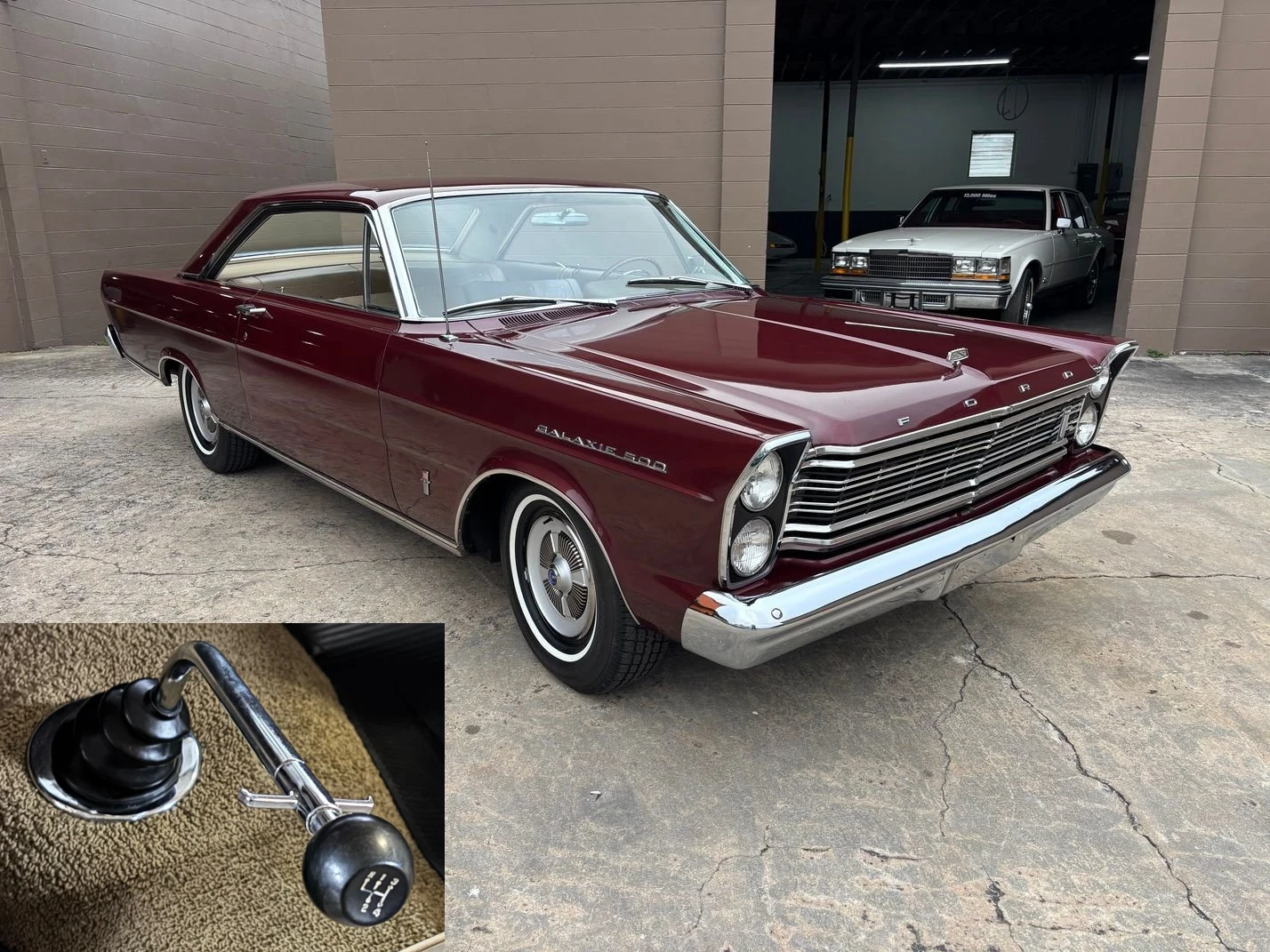
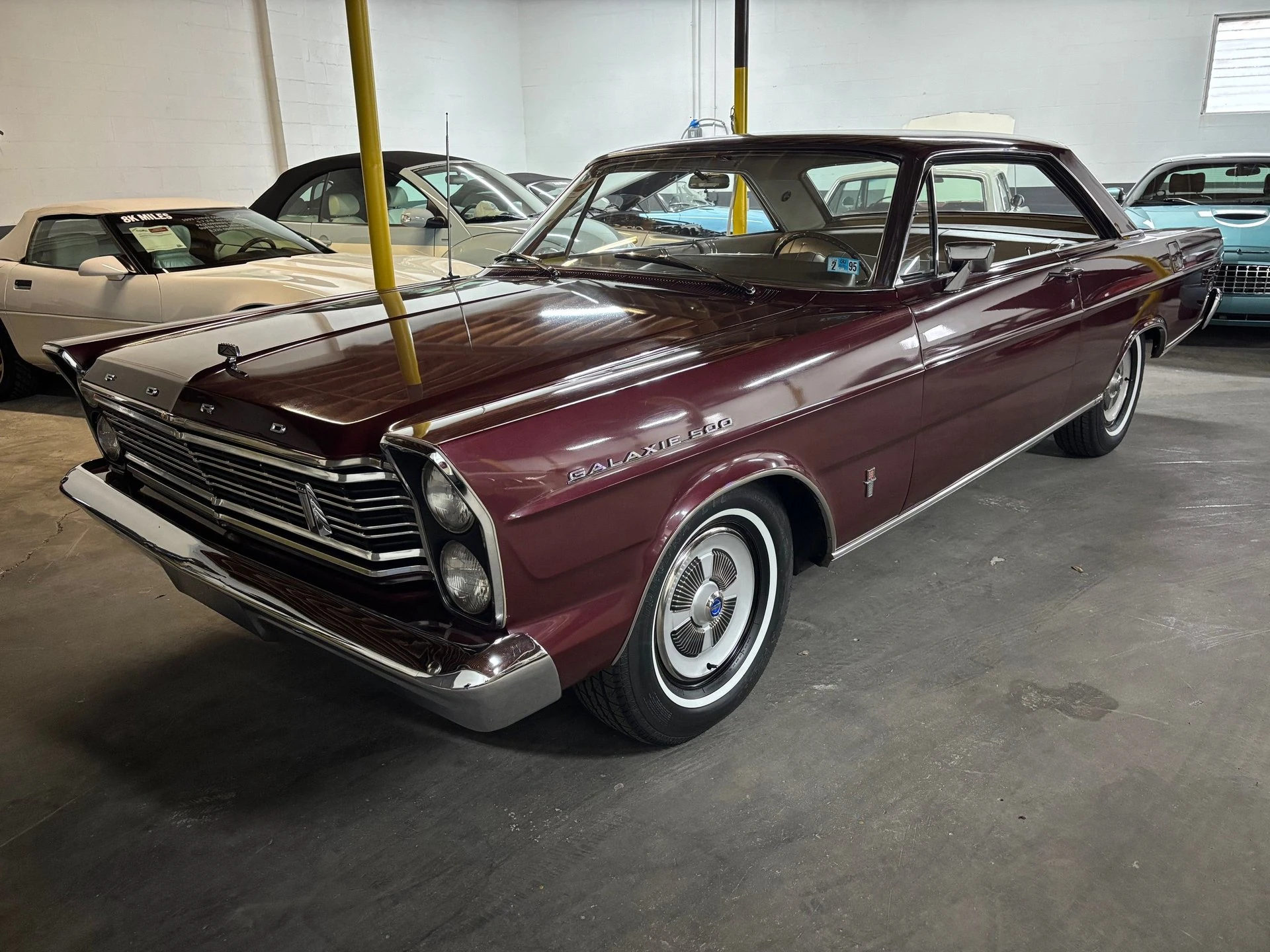
The 1965 full-size Ford was as new as it had been since 1949, with a brand-new coil spring chassis beneath its crisp new styling. While 87.8 percent of these cars were ordered with automatic, this attractive Heritage Burgundy Galaxie 500 two-door hardtop sports the Ford “Toploader” 4-speed manual transmission, behind the Z-Code Thunderbird Special 390 cid V-8.
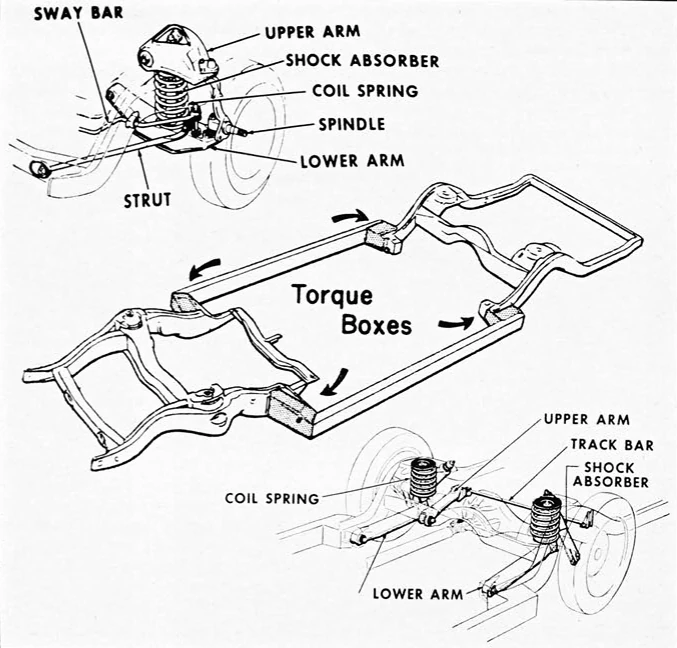
Although the big Ford news in 1965 was of course the Mustang, Ford had also totally revamped its full-size cars. They had stiffer bodies, a new perimeter frame (which was flexible on purpose to reduce vibration and harshness), and a new all-coil-spring suspension with the rear axle now located by control arms and a Panhard rod. The new models were actually lighter than before — the Galaxie 500 hardtop featured here was almost 200 lb lighter than a 1964 model with the same powertrain.
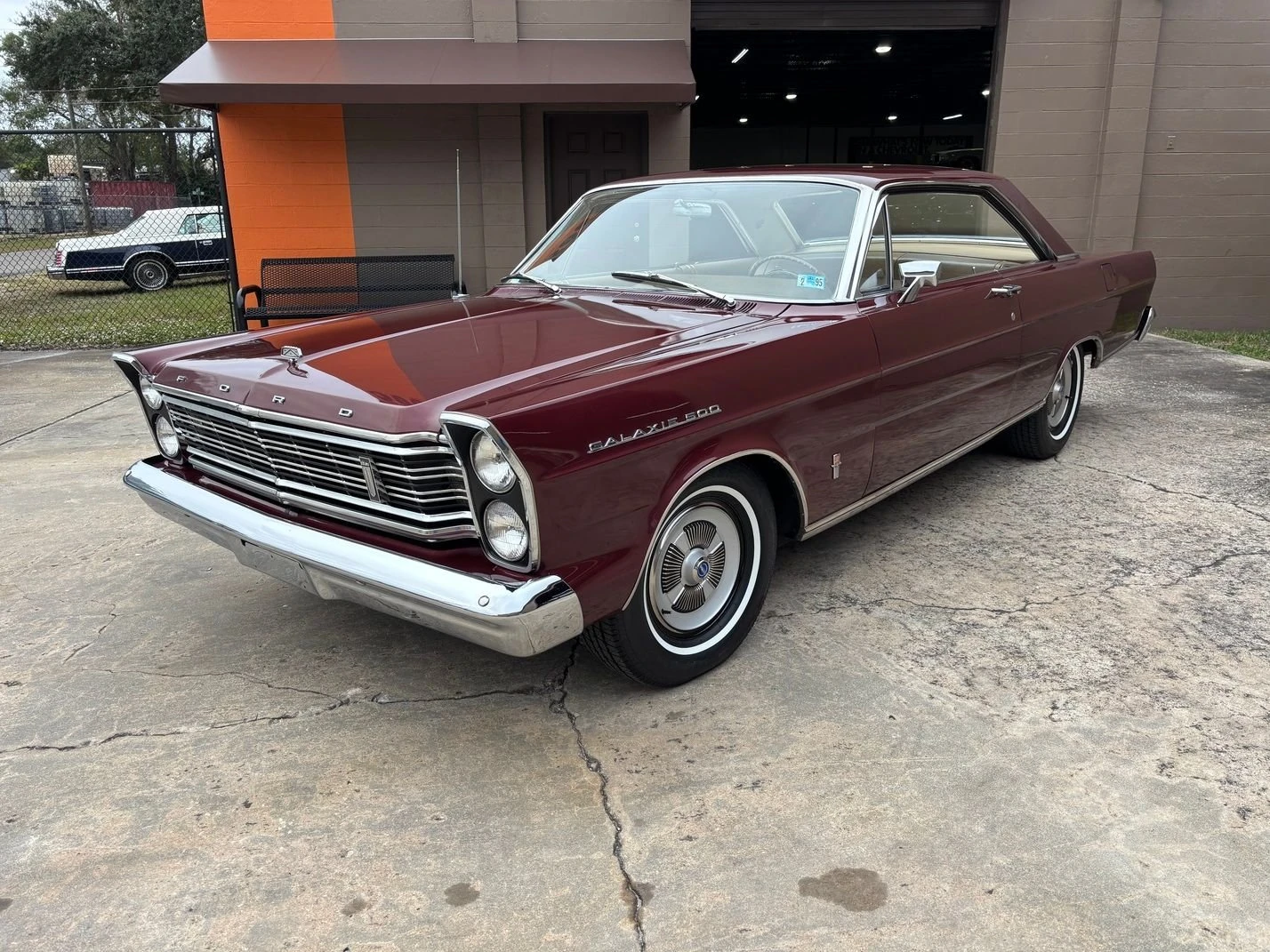
Contemporary reviewers weren’t exactly blown away by Ford’s new styling, which was angular where the latest GM full-size offerings were voluptuous. Car Life called the new Fords “severely tailored,” contending that the styling “fails to provide as much magnetic flair as is visible in some competitors.” I think it’s aged well, though, and it’s less stiff-looking than the stubbornly rectilinear 1965 C-body Chrysler cars.
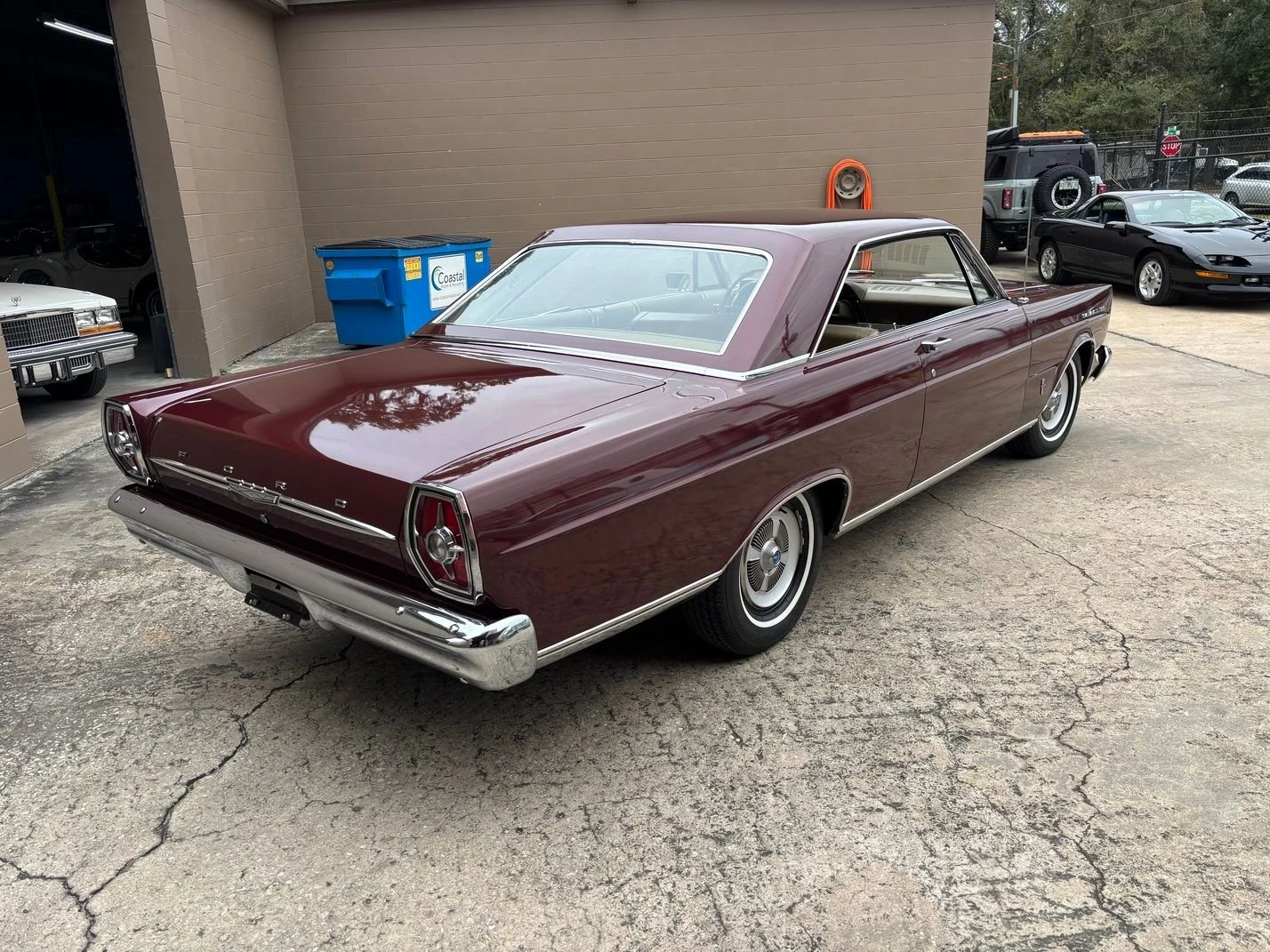
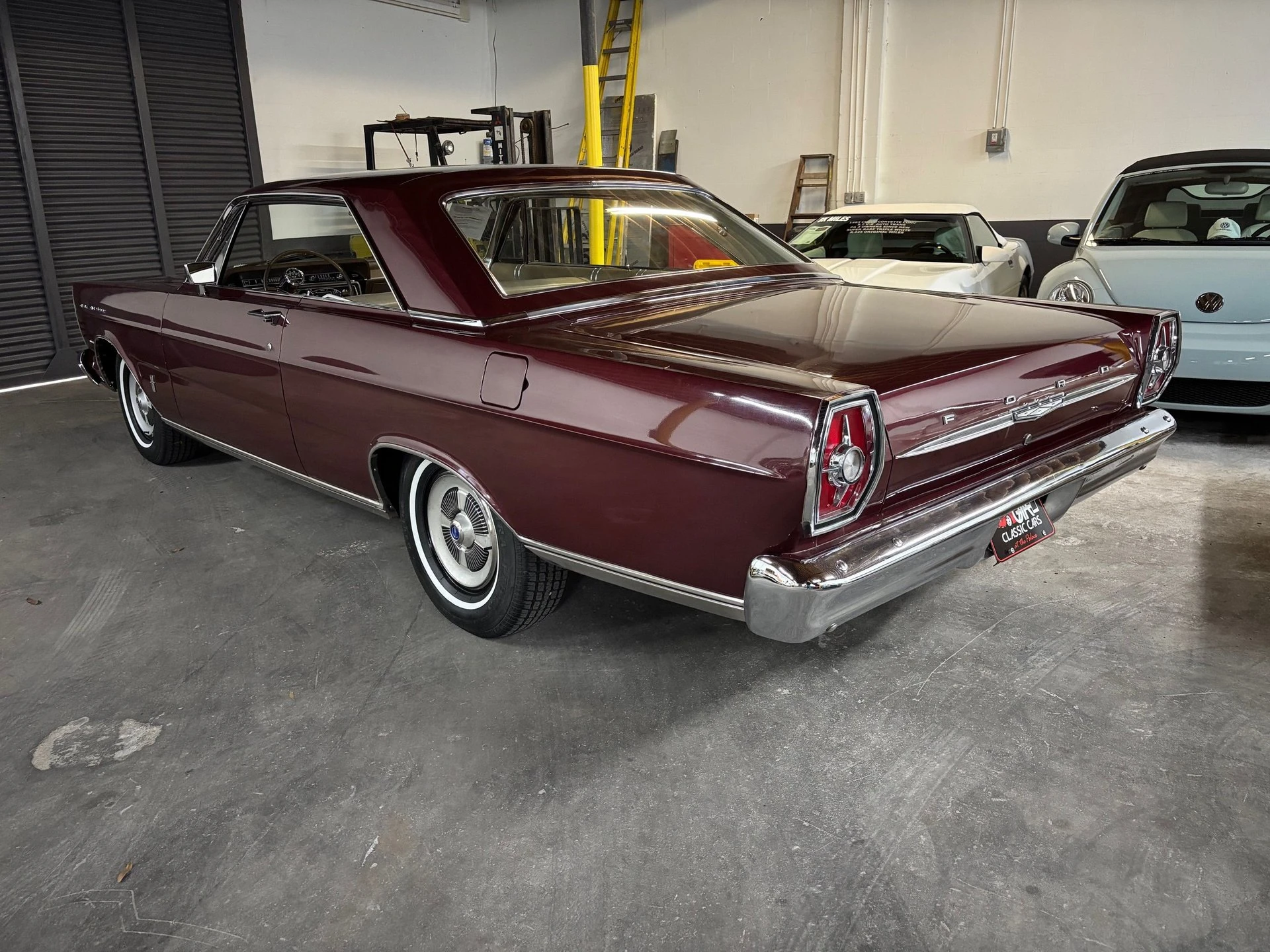
The big Ford arguably showed off best in two-door hardtop form, whose slanted roof pillars helped to avoid the angularity of the four-door models. Interestingly, while these were big cars (210 inches on a 119-inch wheelbase), they were actually several inches shorter and 4.2 inches narrower than the still-controversial 1960 Ford, and about 3 inches narrower than the ’64 Ford.
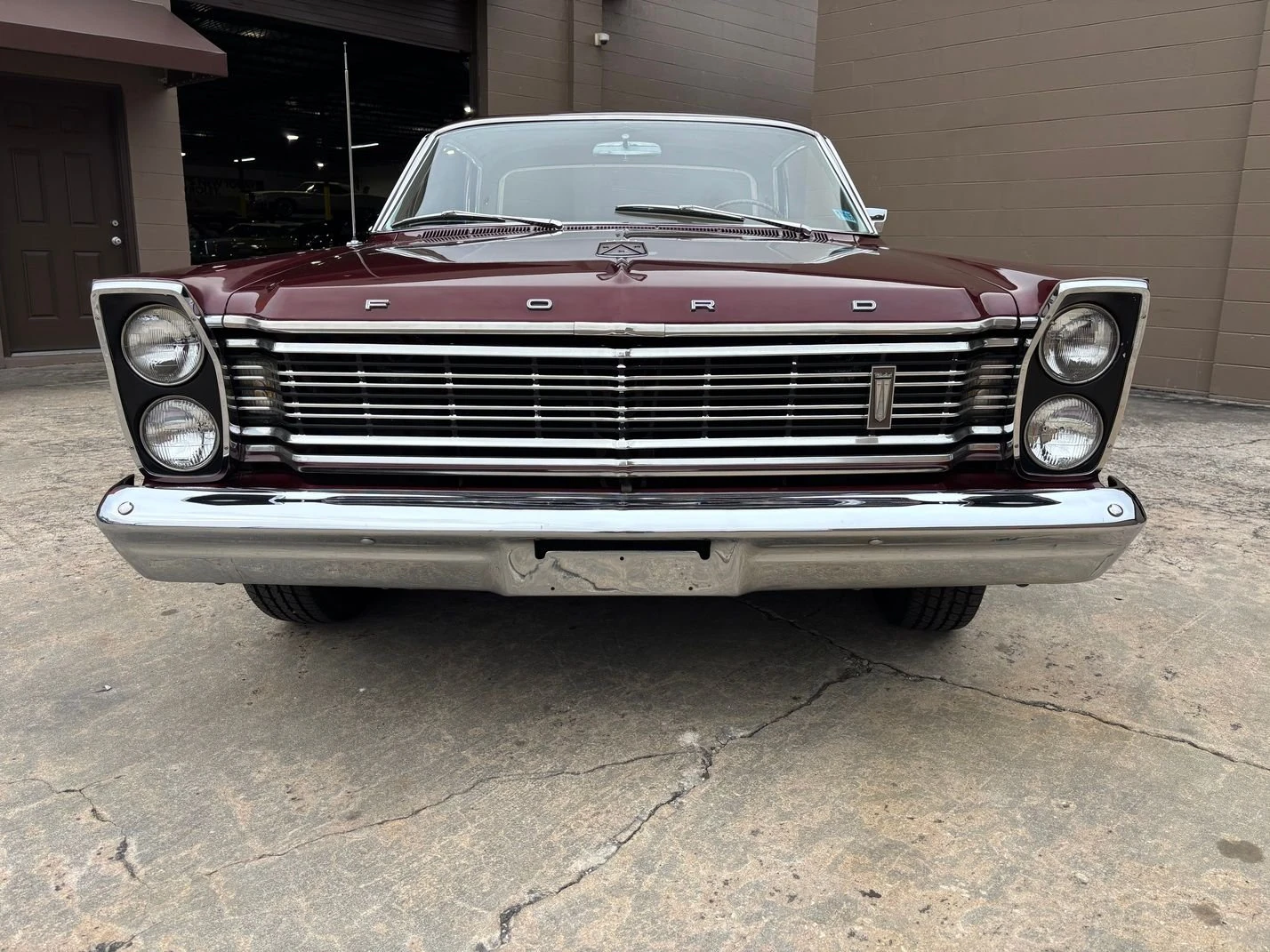
Ford built 810,198 full-size cars for 1965, a little over half of those — 420,379 cars — in the Galaxie 500 series. There was no “plain” Galaxie this year: Below this model were the stripped-down Ford Custom, which was aimed mainly at fleet buyers, and the Custom 500, which was aimed at budget-minded private customers. There were also two pricier Galaxie 500 sub-series: the Galaxie 500/XL, available only as a two-door hardtop or convertible, and the highly influential new Galaxie 500 LTD, available in two- or four-door hardtop form.
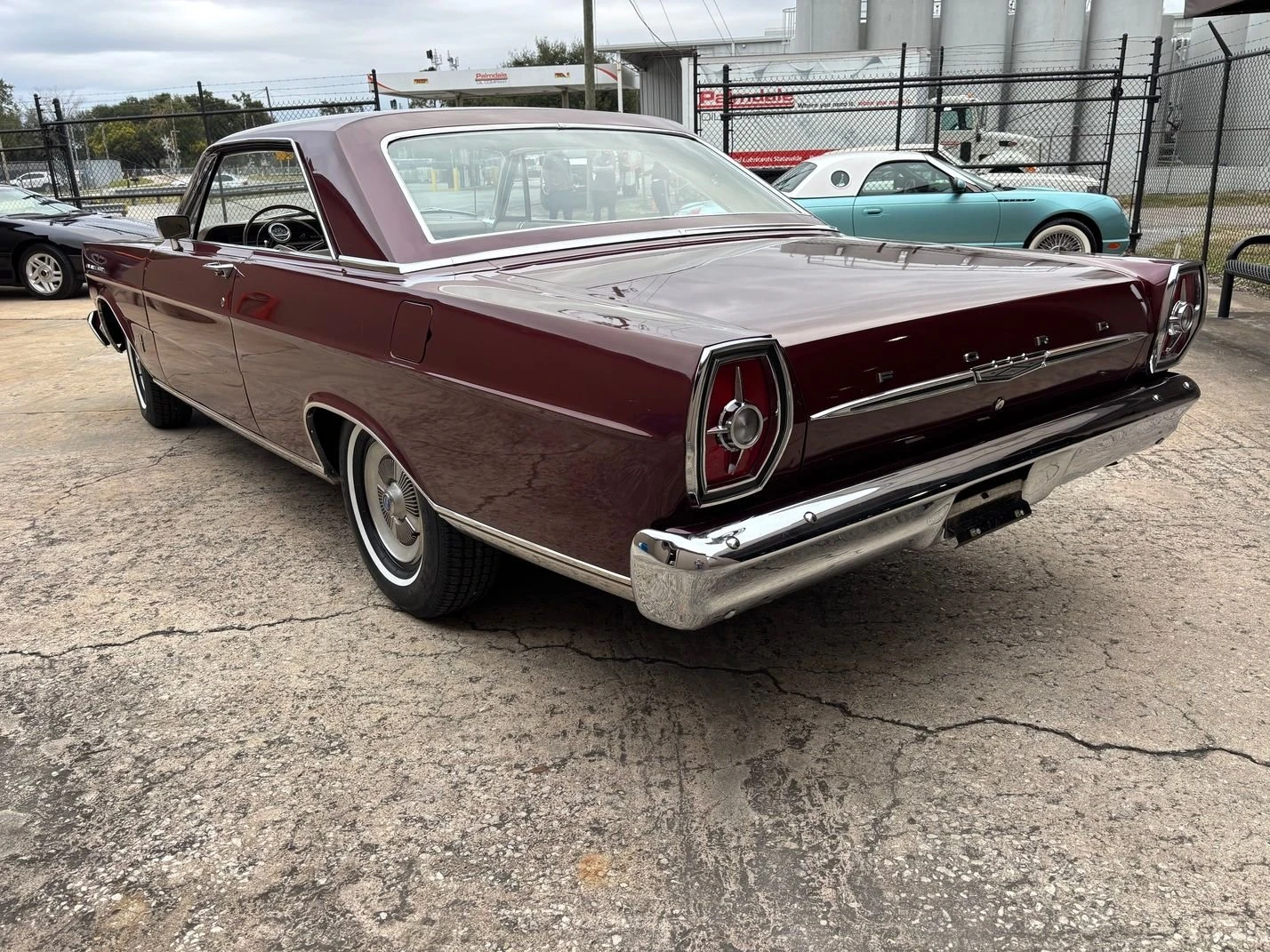
Although the Galaxie 500 four-door sedan was the most popular variant in 1965, the two-door hardtop was not far behind, with production totaling 157,284 cars, 95.5 percent of them with a V-8 engine. Because Ford now also offered the midsize Fairlane and compact Falcon, interest in stripped-down full-size sixes was rapidly diminishing. Only 12.4 percent of full-size buyers took the new 240 cid six, and only 11.3 percent of production had the standard all-synchro 3-speed manual.
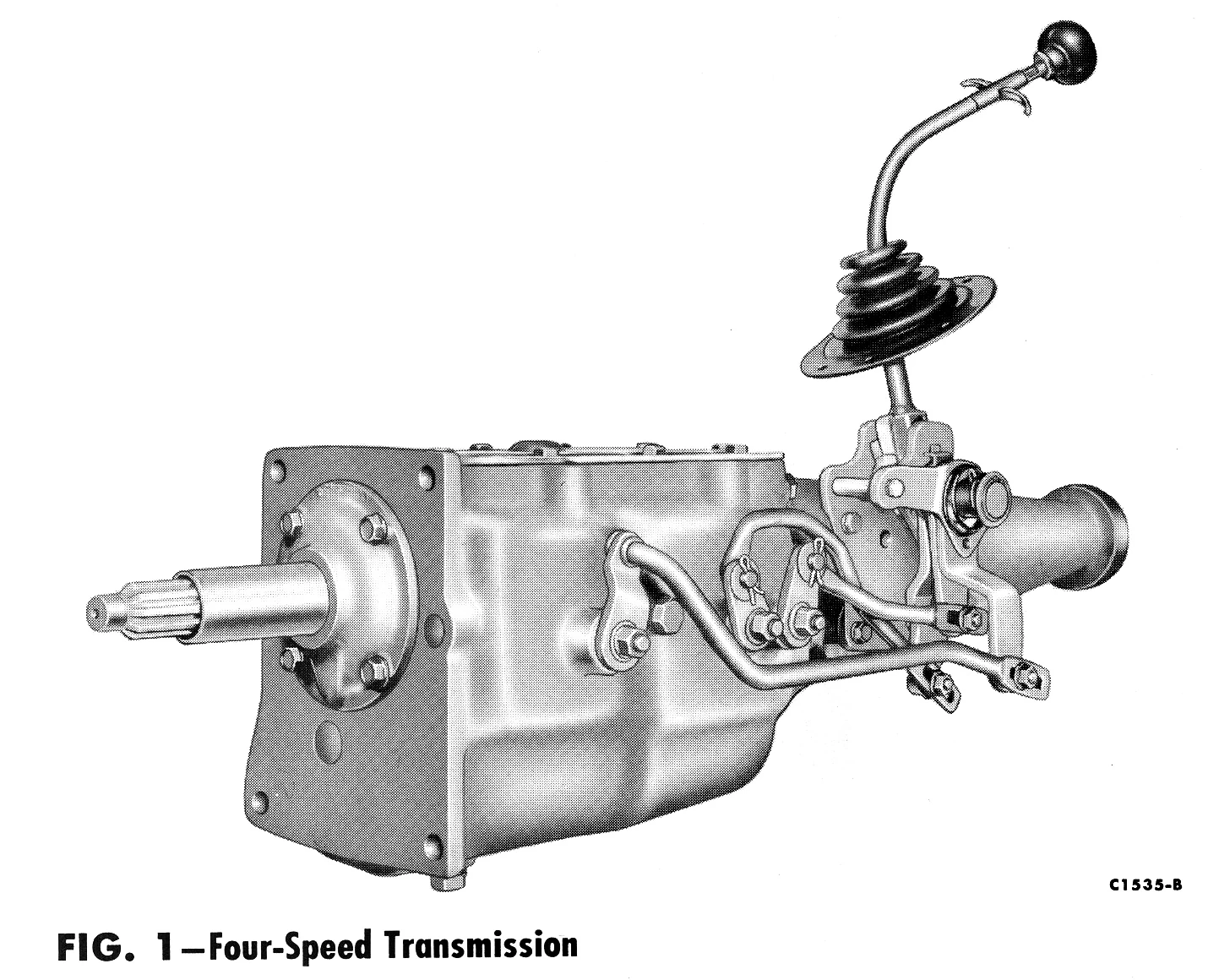
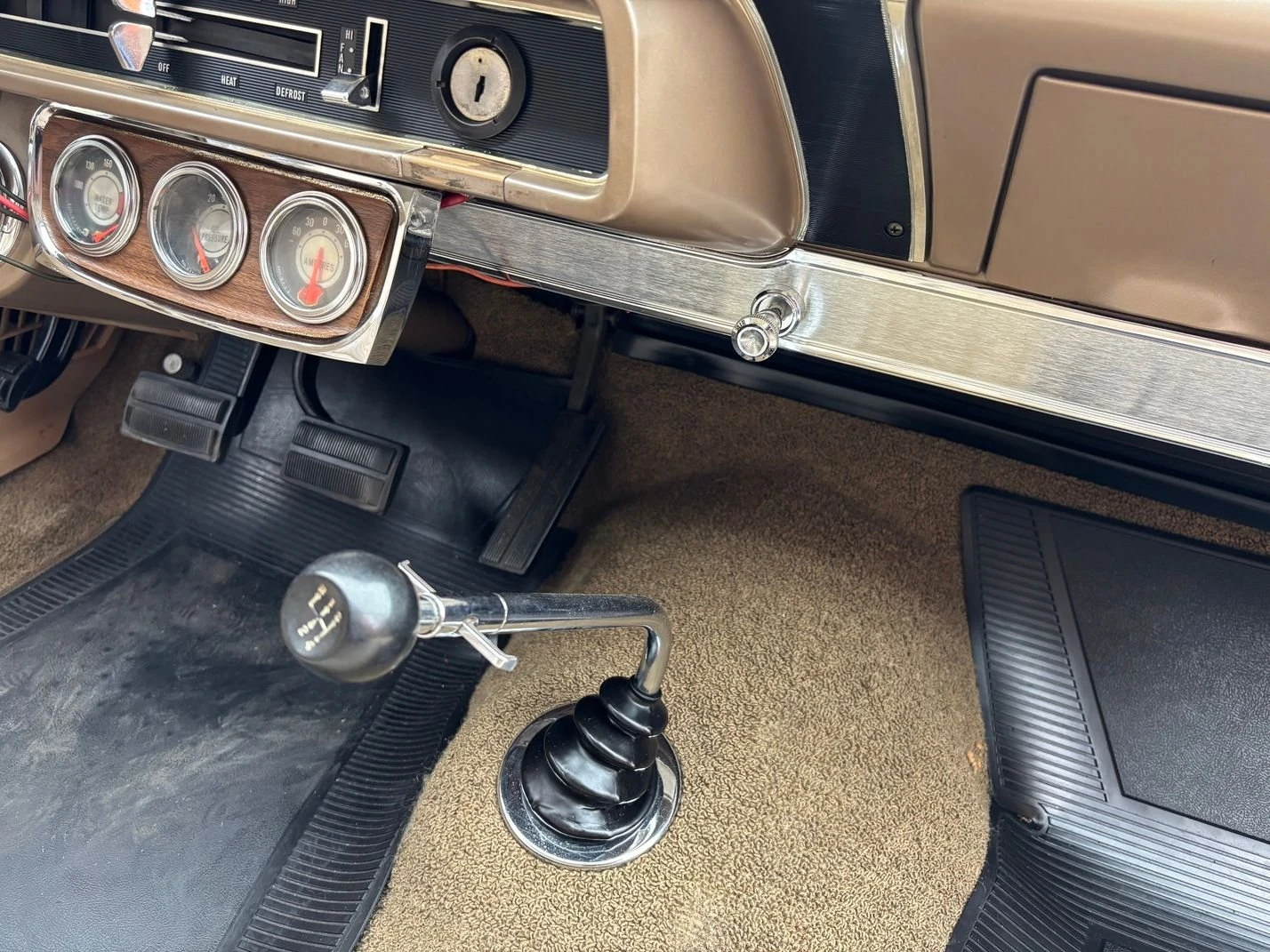
Obviously, you could still get a 4-speed manual in the full-size cars, generally for $188 extra. The gearbox was now the well-regarded Ford-designed Toploader rather than the earlier Borg-Warner T-10. Not many buyers were interested: Ford reported to Automotive Industries that just 0.9 percent of their 1965 full-size cars had the 4-speed. Given the sizable total production volume, that still worked out to be almost 7,300 cars, which was not vanishingly rare, but it was relatively uncommon.
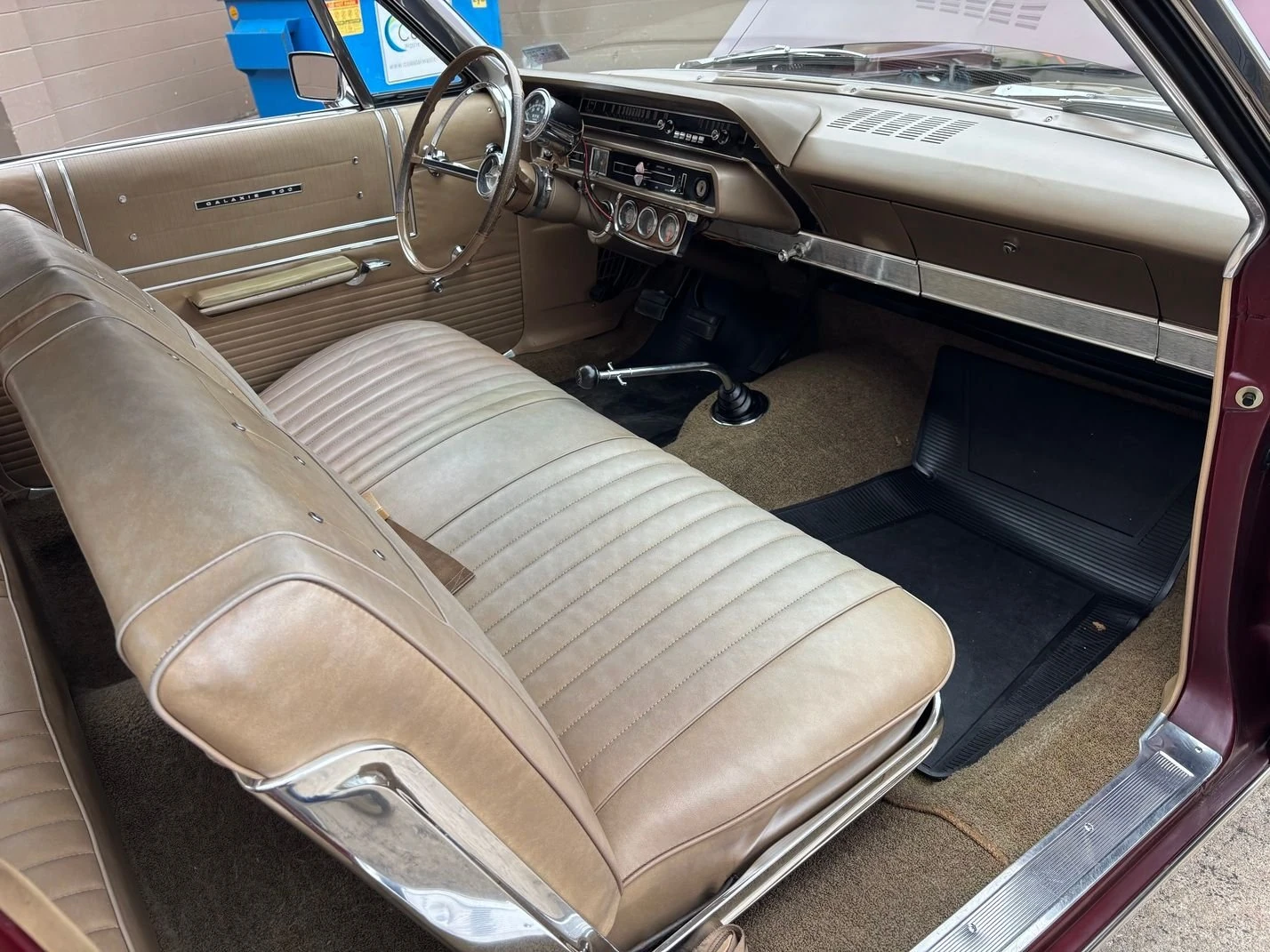
I don’t think even Ford had a breakdown of how many 4-speeds were installed in which models, but I would expect to see most of them in the Galaxie 500/XL, for two reasons: For one, the 500/XL was pitched as the sporty model, with standard bucket seats and a “command console”; for another, a 4-speed was actually a no-cost option in the 500/XL, which otherwise had standard Cruise-O-Matic. (This was also true of the LTD, but while there were some 4-speed LTDs, the archetypal LTD buyer wasn’t very interested in such things.)
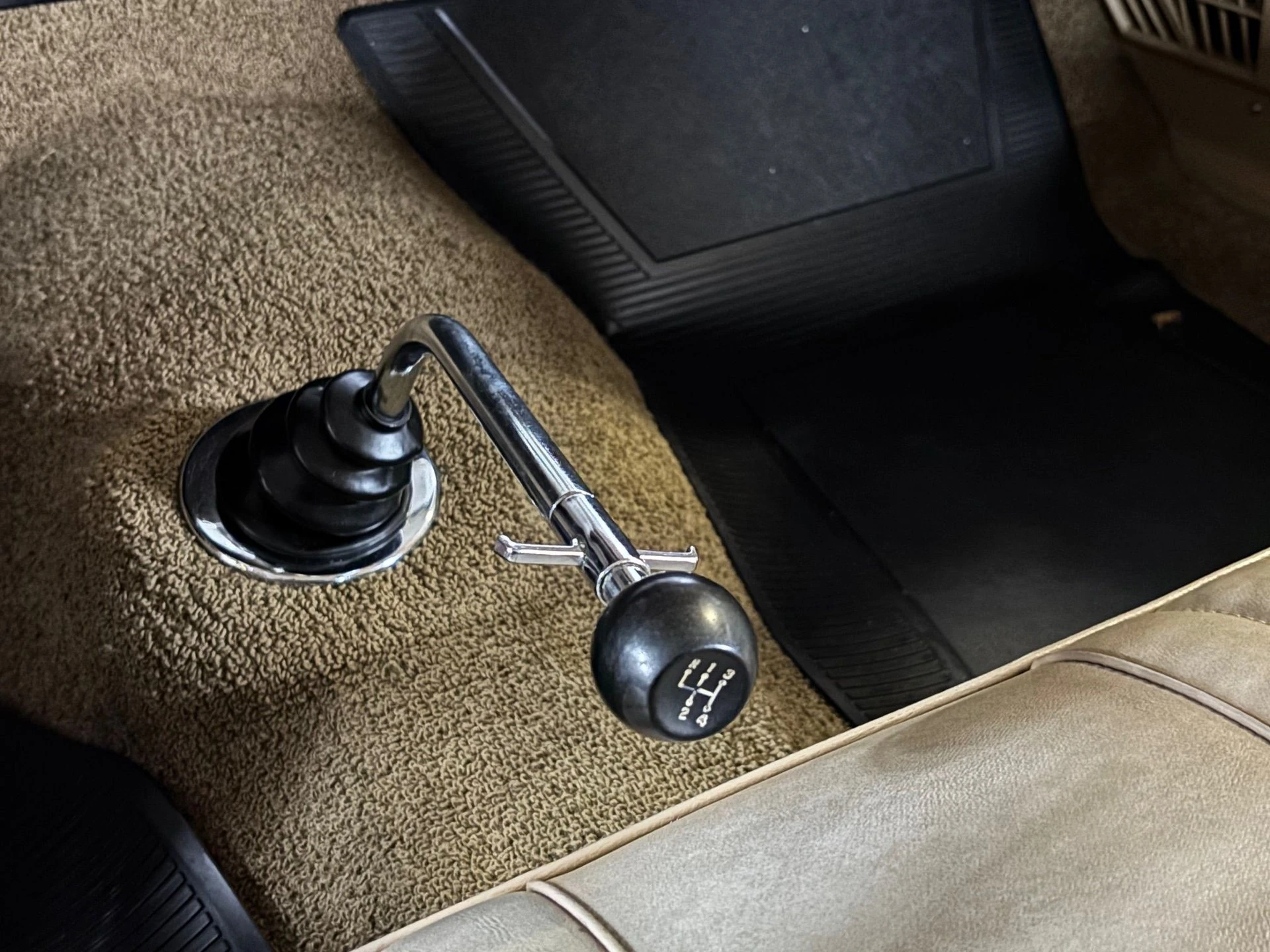
A floor-shifted manual transmission is not the obvious choice for a bench-seat car, since it makes carrying a middle passenger awkward, but some people didn’t want to pay extra for buckets. As for consoles, they may have looked cool, but they had a tendency to obstruct manual shift linkages, and created a temptation for the interior designers to put the shifter where it looked most symmetrical rather than where it might work best.
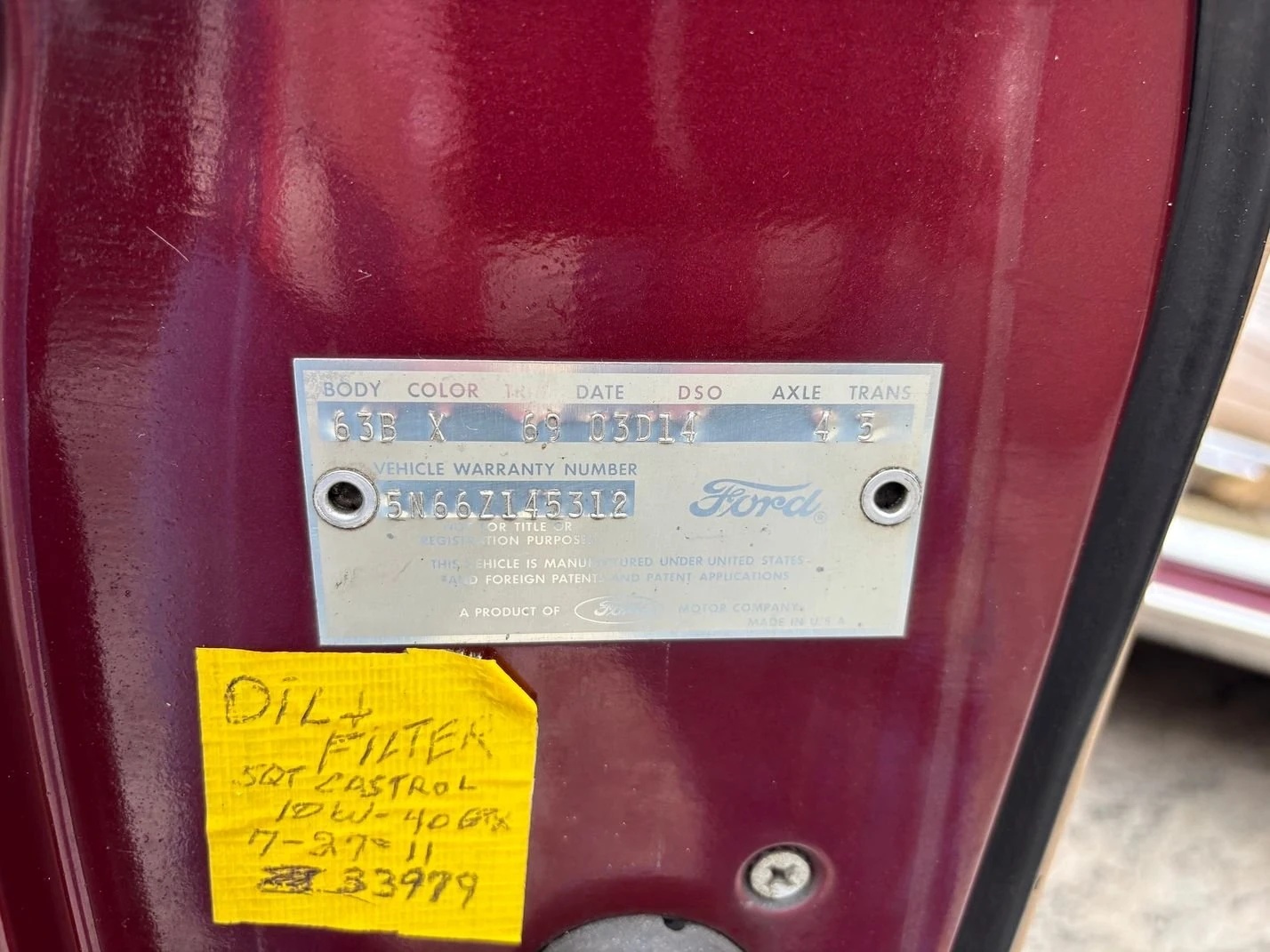
The warranty plate on this Galaxie 500 indicates that it is an original 4-speed car with the standard 3.25 axle ratio, while the “Z” in the VIN indicates that the engine is the ubiquitous four-barrel 390 cid FE engine, rated at 300 gross horsepower and 427 lb-ft of torque. Ford called this the Thunderbird Special — which was fair, since it was also the sole engine offered in the 1965 Thunderbird. It came with dual exhausts, providing a boost to its actual net horsepower.
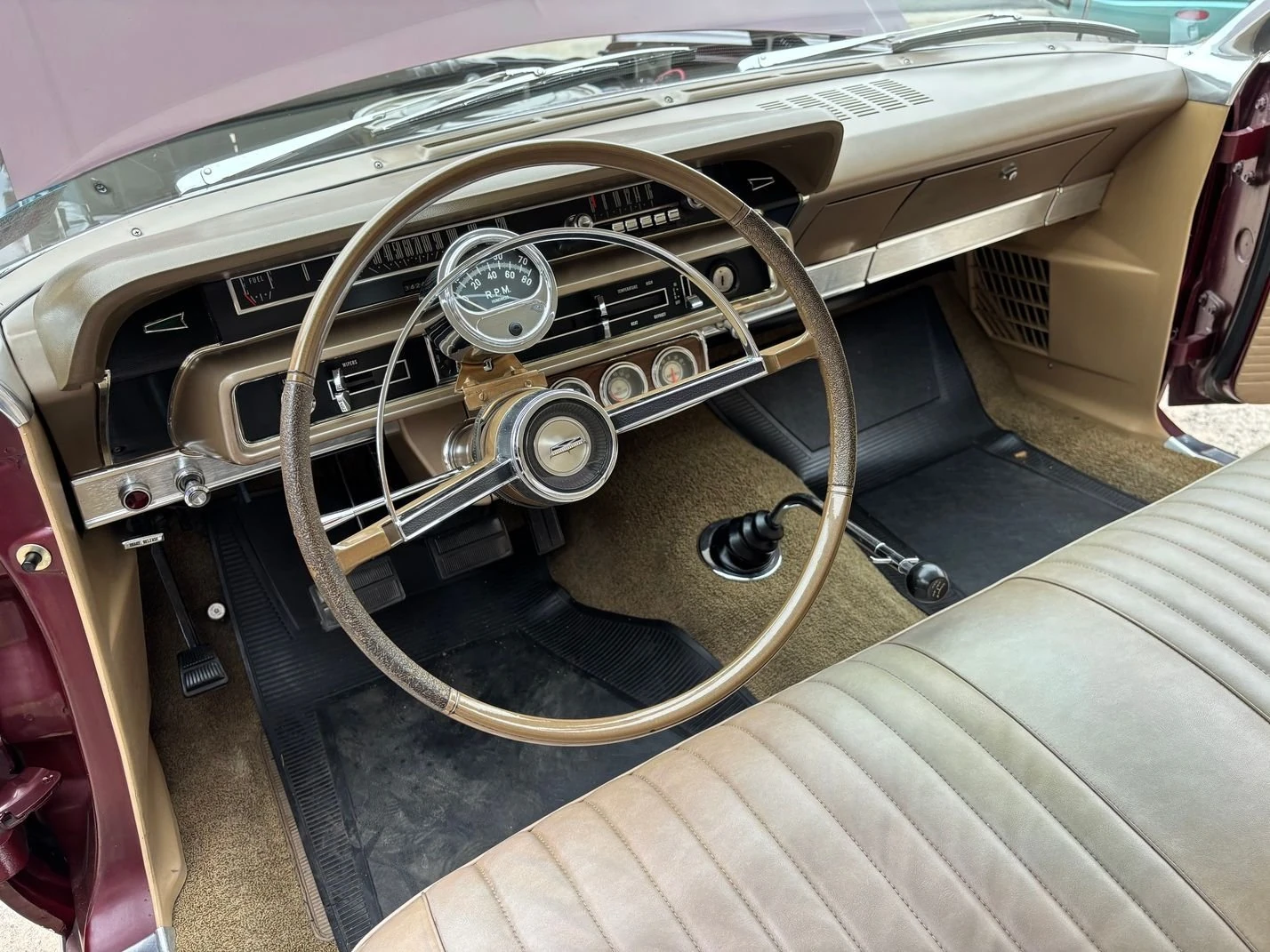
Given the rakish hardtop roof, the 4-speed, and the conspicuous array of aftermarket gauges, you might get the impression that this big-engine Galaxie 500 was some kind of muscle car. By the standards of, say, 1956, it might have been, but for 1965, it was fairly tepid. All the contemporary road tests I could find of 1965 full-size Fords with the 390 were with the 3-speed Cruise-O-Matic, usually paired with a 3.00 axle ratio. That combination was typically good for 0 to 60 mph in the mid-9s, depending on options and curb weight. Substituting the 4-speed and higher numerical 3.25 axle in a lightly optioned two-door hardtop like this might have gotten the 0–60 times down to maybe 8.8 seconds.
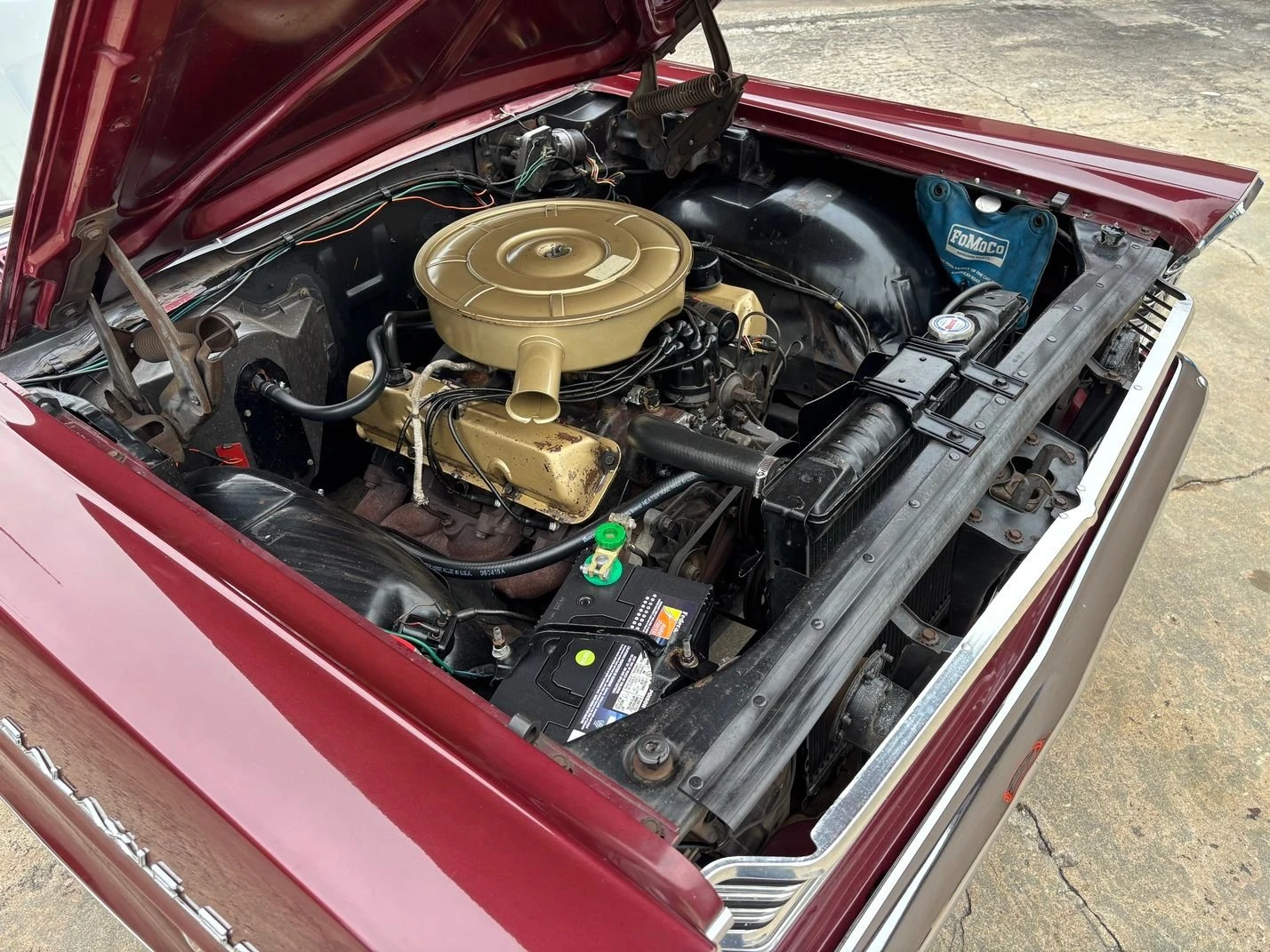
That wasn’t BAD for what was really a family car — a lot of buyers of full-size Fords and Chevrolets in this era took the 289 or 283, either of which was a good deal slower than this car. However, if you were really invested in Ford’s omnipresent “Total Performance” marketing campaign, the Z-code 390 engine was something of a letdown. It was better-suited to station wagon duty than barnstorming, and it was the most powerful engine most Ford customers could or would realistically buy.
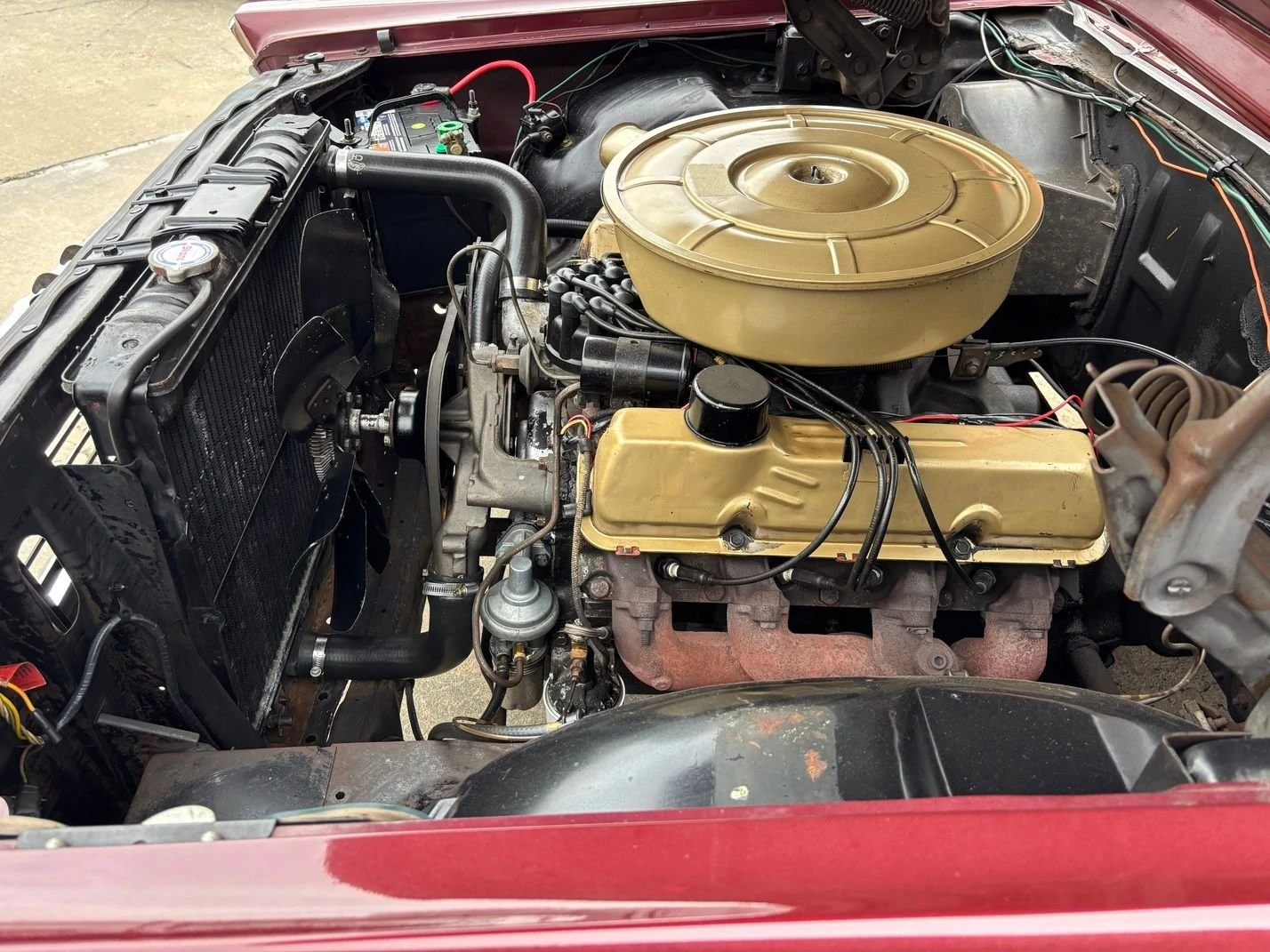
There were two other options, for the knowledgeable and persistent. There was a P-code Interceptor version of the 390, intended mostly for police customers, which had a higher-lift camshaft and solid lifters that added 30 gross hp (though no more torque). Given that its 330 hp was still 5 hp shy than the regular four-barrel, hydraulic lifter Pontiac 389, that wasn’t terribly impressive, and ordering the P-code engine required finding a salesperson who knew what it was and was willing to sell it to you. There was also the mighty R-code 427 cid engine, which boasted 425 gross hp with two four-barrel carburetors. The 427 DID make the big Ford a muscle car, but you needed lots of muscle to drive it, since it wasn’t available with power steering, power brakes, or automatic, and had a very heavy clutch. You also needed plenty of cash, since the retail price for the engine was about $571. Unsurprisingly, the 427 was rare: Ford Division installed only 327 of them in 1965, compared to more than 400,000 390s.
Not everyone cared about drag strip acceleration times, of course, but the underwhelming performance of the 390 was in some ways emblematic of the new model. The general critical consensus was that the 1965 Ford was better than its predecessor in most respects, particularly in ride quality and noise level, but, as Consumer Reports put it, the all-new big Ford showed “no groundbreaking advances.” It had okay handling, an okay ride, okay performance, okay comfort and space, and an okay but unexceptional repair record (marred by the number of early 1965 cars that Ford recalled to install reinforcing brackets for the rear control arms). As an automotive appliance (or an easy modern collector car), that was fine, but Ford had invested quite a lot of money for what what seemed like modest returns.
The real breakthrough in the 1965 full-size line was not the new body, the new chassis, or the powertrains, but the LTD, a luxury-oriented package that proved to be another Ford product planning triumph. It also marked a paradigm shift for full-size domestic models. The days when full-size members of the “Low-Priced Three” needed to try to be most things for most people were drawing to a close. The future was big, quiet, lazy, medium-priced luxury cars with automatic transmission and as many power conveniences as the budget would bear.
That made this 4-speed Galaxie 500 something of an anachronism even when it was brand new. Ford still offered a 4-speed on certain full-size models through 1969, but by the end, it was installed on a mere 0.1 percent of production. Who wanted to shift for themselves in a full-size car that would be beaten senseless by a base-engine automatic GTO in any stoplight contest? We could chide Ford for not offering more credible street performance engines in this period (the new-for-1966 Thunderbird 428 engine wasn’t really the answer either), but as far as the full-size cars went, that ship had sailed anyway. Ford had already found its road to riches, and the signs read “Ell Tee Dee.”
Related Reading
Curbside Classic: 1965 Ford Galaxie 500–A New Ford Fit for Goldilocks (by J P Cavanaugh)
Curbside Find: 1965 Ford Galaxie 500 Convertible – Straight-Laced In A Curvaceous New World (by Paul N)
1965 Ford Galaxie 500 Convertible With 240 Six – “You’ll Swear It’s A V-8” (by Aaron65)
Vintage Car Life Road Test: 1965 Ford Galaxie 500 XL 427 – This One Takes Olympic-Sized Muscles To Drive (by Paul N)
1965 Ford Galaxie 500 LTD: In Honor Of The VHS Car Commercial Compilation (by Aaron65)
Vintage Review: Car And Driver’s 1965 Ford LTD – Possibly The Best Ford Ever Built (by Rich Baron)
Curbside Classic: 1965 Ford Custom – The End Of The Stripper Tudor Era (by Paul N)























Makes for an interesting car to discuss 61 years later, but once again I am baffled as to the intentions of the person who originally bought this car.
Nothing baffling; some buyers just liked to shift for themselves, even in a full size car. I’ll suggest the profile of the original buyer: a man in his 50s who grew up with Fords, owned nothing but Ford V8s (with sticks, obviously), had (or still had) hot rods, worked on his cars, was a loyal Ford man, never cottoned to automatics (except maybe for the wife’s Falcon wagon), and was secure enough in himself that he didn’t feel the need to prove himself with a blazing fast car. Just one that had good torque and was fast enough. Who knows; maybe he even towed a hot rod behind it.
I knew many men like this back then. And given that 7,300 big ’65 Fords were built with the four speed, there were a fair number of them. And the same applies to all the other big cars ordered with four speeds back then; if you added up all of them, you’d probably come with some 30-40k of them. Is that really so baffling? And that’s just for the 4-speeds; many more were sold like this with the 3-speeds.
And as best as I can tell from the pictures, this car had neither power steering or power brakes. That just goes with the buyer profile even further.
How many hundreds of thousands of American men grew up driving Ford Ts, As, and V8s, stock or hot rods? it’s hardly surprising that several tens of thousands of them still wanted a Ford V8 with a four speed.
My father always said that I’d need to buy my own car when I reached driving age. But for some reason, he couldn’t resist buying (and giving to me) a ‘65 LTD four-door, dark green with a light green interior and vinyl top.
As I recall, it had about 70,000 miles on it and overall was in pretty good shape. I ended up trading it toward a’72 Ford Maverick in 1974.
I like the full size design for ‘65.
When I owned my 67 Galaxie 500 convertible in the late 70s, there was a lot of collector/restorer interest in early 60s Galaxies, especially the 63-63 XL. I figured that within a few years the 65-68 generation would become popular too. I’m still waiting for that trend.
I have become a fan of the 65 because of how they went all-in on angular styling (unlike Plymouth that did angular in a softer way). But I wish someone could have withheld the urge for black paint in portions of the grille and the headlight doors.
AFAIC the 1964-down are antiquated. My dad brought home a 65 4-door hardtop to replace our 64 4-door hardtop, and even as a 4 year old I was mesmerized by the silence, you couldn’t even hear the engine at idle, you sure could in the 64. I still highly favor this generation, it was the birth of the truly modern Ford. I still like them to to this day.
I think sometimes these types of cars were ordered by people who towed a boat or camper. Back then there were some who did not trust the durability of an automatic transmission and there may be some truth to that if you towed in the mountains. A trans cooler would have solved that problem.
My biggest complaint about the ’65 Ford is the test pattern deluxe hubcaps which went away for ’66.
For reasons still unknown to me,Ford offered the 330 HP 390 to retail buyers in Canada, but not the US. Here is the back page of the ’65 Canada brochure, the annotations are mine.
Compare and contrast with the US offering, btw that wasn’t the only difference in engine lineups.
Finally, the ’65 Police brochure
I have no idea what the background on this ’65 Galaxie is, but it’s been showing up at Pure Stock Muscle Car Drags for probably 20 years (I took this picture in 2009). The announcers say every year that it has an original Police Interceptor 390 with a four-speed. The owner is from Michigan, but maybe it’s a Canadian car? I have to assume that if you knew the right salesperson, as Aaron said, you could probably get one if you wanted in America, even if it wasn’t listed in the brochure.
The 330-horse 390 was listed as an option for all models in the AMA specifications, but who knows.
https://over-drive-magazine.com/wp-content/uploads/2024/08/1965-Ford-Full-Size-AMA-1-55.pdf
The 390 Interceptor was featured in the Ford High Performance Catalogue: https://oldcarbrochures.org/United%20States/Ford/1965_Ford/1965-Ford-High-Performance-Catalogue/index.html
I’m sure there were some Ford dealers who would sell you one, or perhaps even suggest it if you were interested in that sort of thing.
I think Ford’s trepidation about promoting the Interceptor engine as a regular production option in the U.S. was probably that it had solid lifters. I know GM divisions tended to be nervous about warranty coverage of solid lifter engines, probably for good reason, and selling a solid lifter engine to Joe and Jane Average who didn’t know from valve adjustments was not ideal either.
That looks like a different car to me. It is a 500/XL model, with the + emblem on the quarter panel, bucket seats, plus a different mirror on the door.
It is a different car than the featured car, Patrick. I posted it to point out that I’ve seen a car with a Police Interceptor engine and a four-speed.
Sorry, I misinterpreted “this ’65 Galaxie” to mean the featured car.
I can explain why the 289 was not available in Canada, and why the 352 was sold there in two-barrel version: the Mustang. Mustang sales were so unexpectedly hot that Ford was severely capacity constrained in building 289s. The reality is that 289s were rather rare in US market big Ford in ’65 and ’66; an overwhelmingly large percentage just came with the 352. I was very aware of this back at the time; even Custom 500s fleet cars that some neighbors drove had the 352. The 289s were prioritized to the Mustang, as well some to as Fairlane and Falcon.
So in Canada they just made a 2V version of the 352 the base V8; they might as well have done the same in the US.
Wrong-The real reason is that FoMoCo Canada had no tooling to produce the 289. This was the pre-Auto Pact era and since all Windsor small blocks were ironically cast at Cleveland until mid-1966, they would have been subject to import duty. The Windsor moniker was, BTW, applied retroactively years into the future when the Cleveland was launched.
In mid 1966, 289 production was expanded to Windsor to help satiate the demand for them.
Prior to Auto Pact, all big Fords sold in Canada were produced at Oakville. The-no-small-block policy well predated the Mustang, the 352-2V was the first V8 option starting in 1963. Mustangs with 289s were of course sold in Canada, but they were all US built and subject to duty until August of 1965, when the tariff on them was retroactively lifted. The 289 made it’s Canadian Galaxie debut in 1966. The 352-2V disappeared from the lineup, continuing on in 4V form for one more year in the US.
The differences between US and Canadian Galaxies went beyond the engines. Canada versions had a much shorter option list, with many items, notably AC, unavailable. Oakville simply wasn’t set up to do AC cars until 1968. In ’67 you could get a Ford or Mercury with AC but it had to be sourced from a US plant. Not a problem now that there were no more duties. However, Meteor customers wanting A/C were SOL until ’68, since they were all Oakville sourced. Small blocks did make it into pre-1966 Oakville-built compacts and intermediates thru a program called “Duty Remission” , since they qualified as Canadian built, unlike the Mustang. For whatever reason, this loophole was never extended to the big cars.
Small blocks did make it into pre-1966 Oakville-built compacts and intermediates thru a program called “Duty Remission” , since they qualified as Canadian built, unlike the Mustang. For whatever reason, this loophole was never extended to the big cars.
Isn’t the very likely reason Ford did import the 289 for the smaller cars but didn’t import the 289 for the big cars precisely why I said, being severely production constrained?
There was no supply constraint in 1963 and 1964, that only happened when the Mustang was launched.
Under Duty Remission, Ford Canada had to export a like amount of components to the US to get enough credit to get reciprocity. For whatever reason, this program throttled the number of engines they could import. If there was a supply issue, it was bureaucratic one, not a production one on the part of the Cleveland plant.
The irony here is that this buyer would have saved some bucks and be better served by just sticking with the excellent fully-synchronized top-loader three speed with a Hurst aftermarket floor shifter. The reality is that big lazy V8s like this 390 had no use for four speeds; it just meant more unnecessary shifting. And that meant that the time shifting probably made it no faster than the three speed, if not slower.
But the allure of that four speed shift pattern on the ball was powerful.
Torque boxes more commonly known as rust boxes. A friend had a 65 LTD about 48 years ago, the lower control arm broke away from the torque box shifting the rear end and pulling on the parking brake cable locking up the rear wheel. She had called me up and said she could backup but couldn’t go more than a foot forward. Sadly off to the junk it went, only had about 60,000 miles on it and still looked pretty good.
Sure is a handsome, car.
Yes, although as was said by others, the blackout treatment on the front grill and headlight trim to me is unnecessary. I would personally prefer the original.
An exterpt where I quoted the following: “The future was big, quiet, lazy, medium-priced luxury cars with automatic transmission and as many power conveniences as the budget would bear.”
Surely it talk of the LTD going a bit into Mercury territory but then I was also thinking of Oldsmobile who’ll strike the jackpot with, althought not as big in size like the Delta 88 and 98, with the Cutlass for the next decade.
Still, it would have been cool if the 1965 2-door hardtop also made its way to Brazil like its 4-door sedan sibling, what might have been.
You really had to be there in 1965 to grasp how much enthusiasm these big Fords made when new .
I had no idea there was ever a 4 speed, like Paul says, it would have been the typ of car I’d order .
-Nate
One thing I remember about the 65’s was the lower part of the dashboard which was angled forward giving super plentiful knee room.
The LTD, with its clever ad campaign (quieter than a Rolls-Royce) played a big part in exposing the brands in the medium price class as not being at the higher level that people had long thought. A case of cognitive dissonance….
I like this car, and it’s much as I probably would have ordered one in 65. I do take exception to Fords stacked headlights though; I think Ford was wrong to ape Pontiac’s revival of that chrome barge trend. The styling of both the earlier and later big Fords is more pleasing. I especially love the 63 Fords – timeless. But the 65-67s looked OK, especially as a fastback.
Anyway, the 390 with a 4-speed would make for an engaging, but not tiresome car. Plenty of gears to choose from, or you can just lean on the engine’s torque if you want to shift less. Given that the 65 would have the FMX transmission, and apparently the early C-6s weren’t very smooth (although very robust throughout), I think there’s a lot of argument for the stick-shift. In the big Fords, the FE was a good fit – being kind of lazy wasn’t a big deal, where they were a mixed blessing when they appeared in the Mustang. I’m kind of intrigued by the 240: it seems like a great choice for a bare-bones car (if not entirely fitting for a classier one like this). I suspect the 240 was longer-lived and definitely smoother. Not that there was any inherent problem with the 289, just the straight-six was very compelling.