
 The last picture of my Celica, taken right before I traded it in. February 1989 in Mesa, Arizona.
I knew exactly what I wanted for my first car: a used Toyota Celica. For nearly two years, I waited for the chance to own one, and in December 1982, at age 16, I finally got my 1974 Celica. It was everything I’d hoped for—at least for a while, before the purchase turned into a 100,000 mile nervous breakdown.
Honestly, there weren’t that many great choices for a high school kid in the early 1980s, especially considering I’d be paying for it myself — insurance and gas too. Much as I loved our family’s ’64 Impala — which I got to drive once I got my license — I wanted something sportier than a family sedan approaching its 20th birthday. Gas was still expensive on a part-time, minimum-wage budget, so I needed decent mileage — meaning no V8s.
Insurance for a Mustang or Camaro was completely out of reach, even with a sluggish inline-six. A Vega or Pinto was entirely out of the question. I knew they were crap. A Honda Civic or Accord wasn’t really on my radar. The first-gen Civic always looked like a roller skate to me, and even a five-year-old Accord was probably well beyond what I could afford working at the mall after school. A VW Beetle like my best friend’s ’63 was fun, but this was West Texas, and I wasn’t going to buy a car without air conditioning. Priorities, you know.
In March 1981, my older sister Susan and my Dad brought home her first car: a ’72 Toyota Celica ST. She didn’t even know how to drive a stick shift. It took a few fits and stalls — literally — but she did learn after a few days. I was still more than a year from getting my driver’s license, but this car was the one.

The Celica checked every box. Most Japanese cars from the 1970s — other than the Datsun 240Z — were kind of funky looking. Not the Celica. Clearly influenced by the ’65 Mustang, it looked like a mini pony car with a long-ish hood, short deck and a Coke-bottle beltline. It had a slick 4-speed transmission and a 1.9-liter SOHC engine with enough zip to get out of its own way. It was decent on gas. Like the original Mustang, it was well equipped inside and didn’t look or feel like a cheap econobox. And Toyota already had a reputation for reliability and durability that put Detroit’s small cars from that era to shame.
Now I just needed to find one of my own.
Once I had my driver’s license and a job in the summer of 1982, I started scanning classifieds and cruising by local lots. That’s where I spotted a red ’74 Celica at Toyota of Abilene. I wasn’t crazy about the chrome luggage rack and white vinyl top, but it had the all-important 4-speed and A/C.
I don’t recall the asking price, and I didn’t get to take it for a test drive. Instead, when it was time to leave, the Impala wouldn’t start. A few weeks later, I went past the lot on my way to work. The Celica was still there, and I looked at it rather longingly as I drove by. A few minutes later, as I was accelerating onto the freeway, the Impala stalled, and I pulled to the shoulder. Turns out the fuel pump had conked out. But it felt like the Impala disapproved of me buying a Celica. Or was jealous. Or something. Before anything more could conk out on the Impala, the Celica was gone.
In December, I found a copperish-brown ’74 Celica offered by a private seller: no vinyl top, no luggage rack, 65,000 miles, and the requisite 4-speed and A/C. The asking price was $1,300 (roughly $4,500 today). I took it for a spin after school. Everything worked — even the A/C blew cold. I told the seller my parents would be in touch to make the purchase.
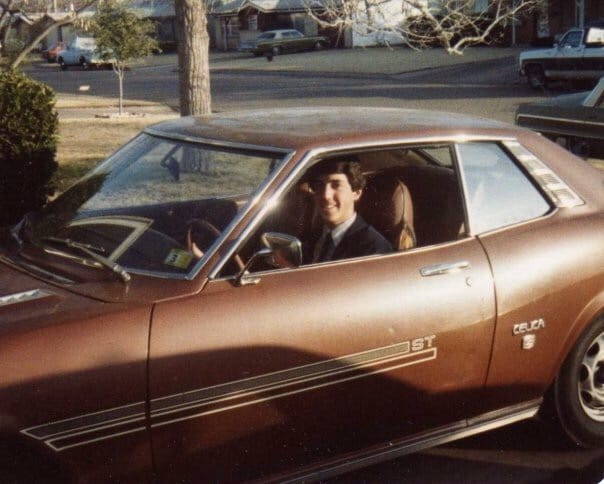
Now, it was time to get to my job at the mall. I turned the key in the Impala and held my breath. The car started. And I got to work without incident. So I figured I had permission to buy this Celica. My Dad negotiated a whole $50 off the sales price over a coin flip. Because the credit union wouldn’t write a loan to a 16-year-old, my parents took out a two-year loan for me with monthly payments of around $55. I paid it off in 18 months.
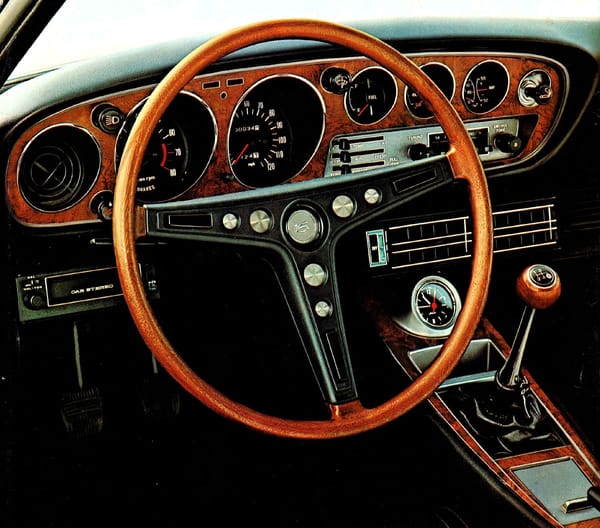
So now I had the car I had wanted for two years. And I loved it. It wasn’t a muscle car, but it was fun to drive with that slick-shifting 4-speed. It looked sharp, it was comfortable, and it had one of the best dashboards of any car I’ve owned. The full set of gauges that spread out like on the Datsun Z made up for the not-convincing-anybody fake wood.
I drove the Celica through the rest of high school and took it to college 100 miles away in San Angelo, still perfectly happy with it. But when I went back to Abilene for the summer in 1986, as the car approached 100,000 miles, it had what I can only describe as an automotive nervous breakdown.
It wouldn’t start. It stalled. It ran rough. Seemingly every week, something else would break or wear out. I was working in advertising sales for the local newspaper, driving all over town, and the Celica clearly hated the job.

Later that summer, I took a couple of days off to see a friend (the one who had the Bug) who was stationed at an Air Force base in Oklahoma. As I approached the state line, all of a sudden there was a horrible squeal from under the hood, followed by smoke. I pulled off right before crossing the Red River.
The air conditioning compressor had seized solid, and the smoke was from the belt shredding itself to bits. I was very sweaty by the time I made it to my friend’s, so when it was time to go home, I made the 180-mile trip late at night when it was at least a little cooler, and there was no sun beating down on me. Given the car’s recent track record, that was brave or stupid. Maybe both. The good news was my Dad bought a junkyard compressor, and it actually worked for the rest of the time I owned the car.
Another night nearly a year later, I barely made it home. It was another long drive, this time from Austin back to San Angelo. It was late, and I probably had another hour or more to go when I noticed the ammeter was reading negative. There was a whole lot of nothing between me and my apartment on campus, so I kept driving. The radio started acting wonky. I turned it off (and the A/C). The needle went further into negative territory. I kept driving. The lights started dimming. I kept driving.
Finally, as I approached the outskirts of town, the engine began to stumble as the ignition system starved for voltage. I coasted onto the shoulder, killed the lights and revved the engine to keep it alive. At this hour, I was the only car on the road, and soon I’d have street lighting to at least partially guide me, so I drove the rest of the way with no lights.
I have practically zero mechanical skills, but even I knew the alternator had failed. Fortunately, I had a roommate more mechanically inclined who was willing to put in a new one, and I also bought a carburetor rebuild kit in hopes of curing the chronic stumble and rough running. It didn’t help much.
Desperate, I finally took the Celica to the local Toyota dealer later that summer. About a block away, on one of the busiest streets in what constitutes rush hour in a city of 90,000 people, the Celica died again. I pushed it the rest of the way while traffic whizzed past me.
Sweaty and hopping mad when I got there, I slammed the car door. And heard the glass shatter inside. While the car was in the shop, I called my Dad: “Go to the junkyard, get a driver’s side front window, and don’t ask any questions.” He did.
I don’t remember what the dealership did. A professional carburetor rebuild maybe? Whatever it was, I left the dealership a few hundred dollars poorer, but the car did run a little better for little a while.
And it needed to. I graduated from college in December 1987 and immediately moved to Phoenix. I had visited a friend the previous spring and really liked it there. Plus, I wanted to get out of Texas and strike out on my own. Loaded up with as much of my stuff as I could fit in the trunk and the back seat (and with my Dad following with the rest of it in their ’84 Chevy Celebrity wagon), the Celica made the 887-mile trip from Abilene to Phoenix without a hitch. It was actually a pretty good highway car when it was running right.
By now, the Celica had about 125,000 miles on it. I had to replace the timing chain that spring — it was a well-known issue with the 18RC engine — and thankfully it never overheated in the brutal Arizona summer. But the engine was clearly tired. It likely needed a valve and ring job — maybe a complete engine rebuild. But that didn’t make sense on a now-14-year-old car that I was frankly tired of and tired of fixing — or paying to have someone else fix.
So once I finally found my first real professional job and got settled into my new independent life in Arizona, I started to look for a new car. Once again, I had something in mind, but I ended up having to settle for less. A lot less.
Related Reading:
Curbside Classic: 1974 Toyota Celica Coupe – Betting on The Wrong Pony
Vintage R&T Review: 1971 Toyota Celica – The Arrival Of Toyota’s Pony Car
CC Outtake: 1973 Toyota Celica ST – Welcome To The Neighborhood























Nice pick. These first iterations of the first gen look better and better as the years go on. Did those front bumper under-riders act as stand-in before proper 5mph bumpers were applied, or did the first gen escape that more complete indignity?
Unfortunately not. The ’75 had the Dreaded cow catcher bumpers.
I had a ’75 and didn’t think the bumpers looked bad at all. Better than the earlier ones.
Mine came to me used, but not running with 75K on it. Turned out to be spark plug cables. Reliability was ok, but no better. It was very tired when I sold it with 150K on it. Power was down, clutch was weak, tranny was starting to get noisy. But it was relatively clean, except for a lack of paint, ran well and the people who bought it were ecstatic, they had one that to put it mildly, was a little rough around the edges. OK, rough everywhere.
Mine did not have the legendary Toyota reliability.
A great story about an interesting, popular and apparently pretty good little car .
-Nate
I always liked these as well, I’m probably about 5 years younger than you and by the time I was looking at cars in the late 80’s the original Celica was completely gone in the rust belt areas.
Your story and timeline fit well into mine. I graduated in 1985 if that helps on the timing.
My first car was a hand-me-down 1979 Toyota Corolla Deluxe Liftback in silver with black vinyl seats. It was automatic, A/C, rear defog and an AM/FM radio with one speaker! haha. It was so basic that it never really gave any trouble till we hit the 100K mark. Then it wasn’t anything big, but just the typical little things and RUST due to living in the upper mid-west snow belt. Plus being rear drive and so light, it was awful in the snow.
So for 1985, dad and I went looking for a new car for me to drive and the family to use for shorter trips since the main car was a 1979 Cadillac Deville. We ended up ordering a 1985 Cavalier which ended up being a great little car. So much so, that my parents would often take the new Cavalier and have me drive the older Caddy. Heck, that didn’t bother me because that Caddy was a great driving car and I loved it. Plus, when we ordered the Cavalier, dad won and it had to be a 4 door sedan where I wanted the sporty 2 door RS trim. So two years later I was given permission to trade the Cavalier in and I purchased MY first new car: 1987 Cavalier Z24 coupe. That was like a dream come true. And my parents didn’t care that much because they had just picked up a brand new 1985 Buick Park Avenue that had been sitting on the dealers lot for nearly a year. So we were all happy.
A former co-worker had a 1973 Celica GT, which he kept beautifully. He drove it for years, too, eventually replacing it with Honda Accord Coupe.
The Celica was everywhere back in the day. I had two teachers who had one, and a couple of family friends. They were good cars, but in my experience Toyotas of the era packed it up right at 100,000 miles, just like the car featured here. While 100k miles is not a big deal today, it was in 1974. Stuff coming out of Detroit started to fall apart at half that mileage.
In Australia o think we always had the 5 speed as standard but only the 2T 1600 engine until 1975, then it was the 18R. I have no idea about these apparent timing chain issues.
I’ve always had problems with NipponDenso alternators. They are pieces of crap. You can’t just change out the brushes like on a normal alternator and they use a live 12v supply for who knows what reason.
Yeah, I was wondering how come the subject car only had a four speed. Bigger motor but no overdrive; I guess that was thought to correspond to American priorities. Did we ever get the 8R in anything? IIRC the 18R was the first OHC Toyota sent our way.
North American cars got a 5-speed starting in 1974 with GT trim; the 5/MT remained GT exclusive in this market for the remaining duration of the first generation’s production run while ST trim continued using the 4/MT.
Thanks. Funny how Toyota had such an extensive array of parts they could mix and match to suit different countries. We didn’t get the GT, (though a few JDM twin-cam GTs were imported ‘for evaluation’!) but our LT had the 5 speed behind the little 1600! Must’ve made sense to somebody.
In Japan, the 5-speed was available with any of the 1600 engines, not only the twin-cam 2T-G. In addition to the single-carb 2T you got in the 1600LT, there was a dual-carb 2T-B pushrod engine, which was also used in the UK 1600ST (I think originally only with the 4-speed). I think the only JDM Celica engine that wasn’t available with the 5-speed was the 1400.
Photo of the offending alternator that made my early motoring years and Toyota experiences a lot more sour than necessary. Note stupid 12v input terminal and lack of removable brushes.
I’ve always liked these but don’t recall seeing any in high school or college, when cars of its vintage were common in school parking lots. In fact, as I jog my memory, the only Toyota I recall from back then was a friend’s 1976 Corolla 4-door. It was slow and pudgy but indestructible. It’s curious I can’t remember seeing more of them. Perhaps the Georgia market was late to the Toyota party? If so, it’s certainly made up for lost time.
My dad’s break from American cars happened in 1980. His 78 Buick Electra was turned back from the lease and he test drove a new Citation. What junk! So he found a clean 1977 Corolla SR5 lift back. We lived in Fort Myers and the car was bought new up north without A/C. The Toyota dealer wanted it gone and gave him a great deal.
His job required lots of driving and he was big on maintenance. He drove it until 1984 and sold it with 290,000 miles! Sadly the man who bought it was on 95 in Palm Beach when a steel I beam came off a truck and went through the engine.
I love that you stayed with the car you wanted and didn’t stop until you found it
I’d completely forgotten how neat these were. Though I did used to laugh at the fake V8 vents in the bonnet/hood! Should have added for more and told the XJ-S to lay down & weep…
That was a warning of Toyota six sigma quality – that they all let go at 100K. The FIAT was far more alluring to me, but trouble started ~80K (mostly electrickery) and the tinworm was (like the chassis tuning) more advanced than the ‘Yoda’s.
So that’s 25% more sigmas than the FIAT. Even though 100K miles sounds poor today, where Toyota warrranty the car for a decade despite the extra rubbish they are forced to install.
I wanted a “78”! Out a my price, range. That old song “19th Nervous Breakdown” kept playing in my head after I read the headline.
An early model still puttering around my town that I spied a few months ago. I think it’s a Mk 1 liftback. Didn’t want to get too close and freak out the owner’s girlfriend/wife. You probably wouldn’t get much change out of US$25,000 if the owner put it up for sale; which is highly doubtful. Rear wheel drive Japanese cars from the 70s & 80s are treasured in this town.
I like these now but they were not on my radar then. When you bought yours, gas was expensive and used Japanese cars were $$$$. Plus, in my northern climate older ones were quite rusty.
Problems after 100k miles really was a thing back then. Certain old US cars could soldier on past that mark, but only with periodic wrenching. I had assumed Toyotas were different, but your experience says not necessarily.
I finished university in 73 and my friends and I waited a couple of years to replenish finances before getting new cars. One of my friends was enamoured with the Celica and he bought a new GT which had the 5-speed. He loved the car and it served him well. I never really liked the styling, as I felt it had too much surface embellishment.
Those Japanese cars of the ’70s would spoil you with reliability for about 100K miles, then all those well designed parts would wear out in rapid succession.