

In almost two decades of car ownership, I had owned three American cars and five “rice burners” (although we didn’t call them that until the 1980s). Then, in 1985, I bought an American-assembled Japanese model with Chevrolet badges (and a few GM touches). This last was going to become a trend, not only for me but for the nation; after the Toyonova, a US-built Camry was to follow. Here’s how that came to be.
In the mid-1980s, as Northeast Ohio went through deindustrialization, WMMS 100.7 — then quite politically incorrect — would play this ditty, “You’re Still Not Safe in a Japanese Car.”
Nonetheless, a Japanese-sourced family sedan built in America was not out of the question for us. Honda was doing quite well in the US, and I knew people who worked in their Marysville plant, which got going in 1979. Then, there was the GM-Toyota NUMMI plant, which we already owned a product of.
In June of 1989, my daughter was just two months old, and four people didn’t fit into our two compact cars very well. My wife and I were traveling to Columbus and I saw a 4-door Camry on the road. I commented at the time, I think we’ll be buying one of those. Some people had bought Taurii and were not completely happy with them, but others had great luck with them. Memories of my dad’s 1958 Dodge kept me from buying domestic Chrysler products. At that time, when buying a car, I religiously read Car and Driver and Consumer Reports for advice — a lot of times, they agreed on which were the best cars.
I had been totally self-employed since the spring, but we needed relatively fixed monthly costs. The Colt was paid for, but just that winter, I had moved from my basement into office space with two other creative types. There were business mantras about leasing, and how leasing conserved capital, etc., but I didn’t have any capital to preserve. Every spare dollar that didn’t go back into the business were spent keeping the four of us sheltered and fed.
There is a lot of talk about tariffs in 2025. We have this vague idea, as consumers addicted to cheap stuff, that we had free trade until the current occupant of the White House came along and instituted tariffs. For years, the domestic sugar market has had tariffs in place to limit foreign imports. Ronald Wilson Reagan, an ardent free trader, approved the negotiations that led to tariffs on certain types of motorcycles (to protect Harley-Davidson). His administration also instituted the voluntary import quota with the Japanese manufacturers, as this online article notes:
In 1980, Japanese automakers were trouncing Detroit’s “Big Three” in the American car market. After decades of intensive state support, Japanese firms had developed the world’s most efficient production processes and made the highest-quality cars. Without the time and resources to retool, American automakers risked bankruptcy and mass layoffs. President Ronald Reagan negotiated a quota on Japanese imports that stemmed competition for four years, bought Detroit time to retool, and spurred massive foreign investment in a new manufacturing base in the South that created hundreds of thousands of American jobs.
This is the only Toyota ad from that era that I remember.
Toyota established a plant in Georgetown, Kentucky — along the I-75 corridor, which includes, then and now, many automotive-related industries. General Motors sold Frigidaire to White Consolidated Industries, and repurposed the plant to make S-10 pickup trucks in the 1980s. A complete CC article could be written about all of the automotive businesses along this corridor, which stretches now from Chattanooga to Bay City, Michigan.

As I’ve predicted, off we went to check out the US-built Camry. The selling dealer was Geller Toyota, which was then a Toyota/Mercedes-Benz dealer. (It had been a Studebaker dealer and had picked up Mercedes-Benz when they established sales through Studebaker dealers in 1957.)
My bride test-drove an automatic, but we decided to get the 5-speed model. It had the automatic shoulder belts, which was OK; both our children were in rear car seats at the time. We decided to lease it — low monthly payments and relatively fixed costs were a priority.
The Geller Toyota salesman was young, and the sales experience was relatively painless. (I’d been through this process a lot.) He wrote up a proposal to take to his manager and asked me to sign it, affirming, “I am going to buy if this deal is approved.”
My thoughts at the time were: Do you ask the doctors/lawyers buying Benzes to sign something like that?
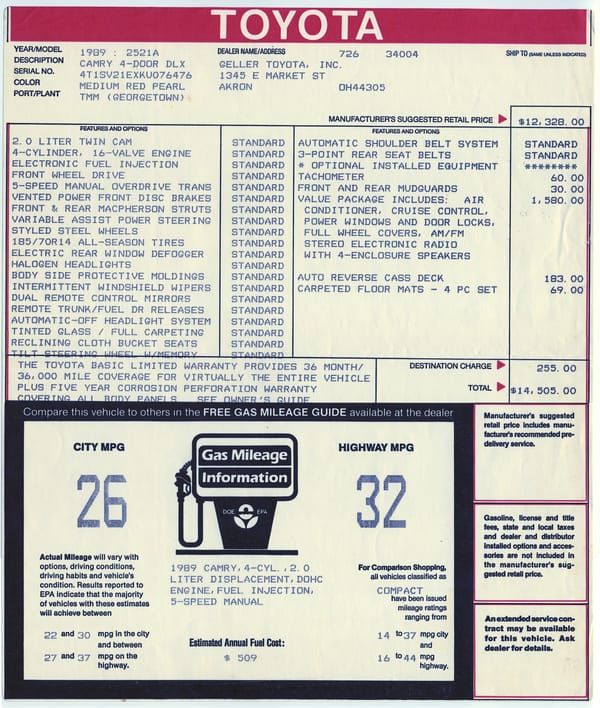
Maybe Toyota was trying to build volume at Georgetown, Kentucky, with 1989 being the second model year built there, but the lease deal for the Camry was very attractive: 15,000 miles a year, low security deposit, reasonable down payment. Getting $1,000 cash back didn’t hurt either. Back in those early days of desktop publishing, you didn’t have “software as a service,” and computers suitable for my typesetting work were routinely costing at least $2500 and up.

Car and Driver summed up the second-generation Camry like this:
In 1988, Toyota opened a new production facility in Georgetown, Kentucky, to build Camrys for the North American market. Powertrain options also expanded that year. New four-cylinder models were offered with an all-wheel-drive option called All-Trac, which used a center differential to vary torque between the front and rear axles. A 2.5-liter V-6 engine joined the order sheet, serving up 153 horsepower and 155 lb-ft of torque in both the sedan and wagon; it could be paired with either a manual or automatic transmission. Sales continued to rise, cresting the 200,000-per-year mark in the United States for the first time in 1988.
Car enthusiasts love to hate the Toyota Camry, but it was low-drama, was built well, and went where you told it to, although the steering was sort of vague. The transmission was good, and the 4-cylinder 1998cc engines were built by the millions. And it consistently got 25 MPG around town.
Curiously, there was some sort of hole left over from the steering wheel’s production process, which could be felt at the bottom of the back of the wheel. I started picking at it while driving, so that it went from pencil eraser size to bigger. I also had poked some holes in the headliner and wondered if these belonged under “normal wear and tear,” as the lease document indicated. I had no experience with car lease returns, but when a gentleman came from the Crawford Company to appraise the car, the only thing we got dinged for was that it needed tires. A great relief. One good thing about leasing is, if you hated the car after four years, you could get another one. But we liked this car, so we decided to buy it.
This was the first car we had that was an excellent cruiser to take to Flagler Beach, Florida, and back. The Medium Red Pearl color was a popular choice in these second generation Camry models, as I kept seeing apparent twins to our car, although they were different trim levels. I knew of one person who had the deluxe model (with color-coordinated bumpers) and a graphic designer who had the base model. Ours was one of the last Toyotas where the corporate logo was TOYOTA in block sans serif all capital letters.

A small, yet significant change, happened after the purchase of our Camry. According to the Toyota website:
On October 2, 1989, the new Toyota mark and logo were introduced … From then on, the new mark that symbolized the progressiveness and reliability of Toyota was to be attached to all Toyota-brand cars as an emblem.
Its design consists of three ellipses. The inner horizontal and vertical ellipses represent customers’ expectations and car manufacturer’s ideal, respectively, which are firmly interlocked to form the letter T (for Toyota). The outer ellipse signifies the global expanse of Toyota’s advanced technology and its infinite potential for growth.
So, any second generation Camry after that could be immediately identified as a 1990 or later model.

I continued to cruise the used car lots on Sunday afternoons and saw a five-speed Camry V-6 wagon for sale.
We knew many many people who drove Camrys at the time. The ’89 was the first of the three Camrys we have owned.
At the end of our ownership of the 1989 car, I totaled up the cost of owning and at trade-in time (it was starting to rust at the rear rocker panels). Other than fuel and insurance, the cost of operation was $196.77 a month over a period of eight years and eight months, and we drove it 120,524 miles. Some highlights from the service record:

We were set for the next few years — these cars were in our garage until March 1995.

At one time, Carfax gave unlimited access for a one-time monthly fee, so I looked this car up via VIN number. As of February 2000, it was still running, with 159,470 miles. It was in Kent, Washington in December 2001.
We were well-served with this Toyota, but we had a growing family and the Nova was getting cramped for us, so it was time to move on again.
Related CC Reading
Curbside Classic Review: 1990 Toyota Camry LE V6 – Dripping With Fat
CC Capsule: 1988 Toyota Camry DX – Somehow Beige Is Appropriate
Curbside Capsule: 1991 Toyota Camry All-Trac – A-Brief-Four-By-Foray























These were great cars, and there’s still a few out there. A frugal, middle aged DIYer in my subdivision still daily drives a Camry of this generation. They were reliable family cars, as this writeup attests to. I learned to drive on a Camry of the next generation, a ’93 or ’94 in champagne. It was a really easy car to drive.
I was fortunate enough to own two vehicles (both manual transmissions)in this series: a 4 door 1990 DLX with almost zero options, purchased new from Hartman Toyota in Harrisburg , PA in September 1990; and plusher 1991 DX, purchased used in 1995 in Northern Virginia.
They performed flawlessly and I wish Istill had either one, or both for that matter!
FYI a great little time capsule on what was on offer at that time can be seen in a Spring 1990 edition of Consumer Reports, in which, IIRC, the Camry was compared to the Accord, Subaru Legacy, and the Nissan Stanza.
In my experience, those are rock-solid cars that will only be killed by rust…and they do rust rather thoroughly in rust-prone areas.
That “little ditty” by Jumpin’ John Goldsmith….ewwwwww. I hated that kind of stuff back then, and it certainly hasn’t aged well since.
Please don’t think less of me, but my family loved that song when I was a kid. Part of the reason is because my dad was in a bad accident in his Subaru in 1982 – so the song was something he could relate to, and after the accident he went back to driving American cars. (The Subaru was rebuilt somehow, and became my mom’s car, which I thought was ironic since dad didn’t think it was safe.) Anyway, I remember that song on the radio back then – haven’t heard it since.
Any aversion to small cars didn’t last long, because my folks bought a Mazda 323 in 1988.
When I first met my (now) ex-wife, she was driving a 1989 Camry. It was the base car, no trim badges, which the brochure referred to as the STD (ha!) or standard model. 5-speed, no A/C, no options. She’d bought it in late 1989, when it was languishing on the lot as the 1990 models were coming in. With a stick shift and no air conditioning, it was what the dealers called either “lot poison” or “the bait and switch car”. The dealer must have wanted it off the lot, because she bought it for $9999.
Yep, that’s what I paid for mine
Then took my holiday bonus to Stereo Discounters to get a Blaupunkt “Seattle” installed!
Good to keep in mind that the original purchase of $14,500 would be roughly $39,000 in 2025.
Interestingly, an East Coast 2025 base LE FWD Camry has a MSRP of $29,495 — including the destination fee.
Aw c’mon. I realize Wicked is in a big marketing campaign now, but you were not green children.
Others can undoubtedly do a better job of color correction than my very limited laptop tech, but here is a slightly pinker
little sister.
I never thought I would own a foreign car but I inherited a 2006 Toyota in 2023 with only 32,000 miles on it. It is the best car in my fleet. Great brakes. Good radio. Lots of torque (though limited power–geared to be a city car, not a long Interstate mountain cruiser).
Partially because US manufacturers make almost no traditional sedans any more, and I do not want an SUV or mini van, if I ever need another car, Toyota will get first shot at trying to make me a buyer.
Scanning old color negatives digitally is an art. I’m still learning!
I’ve been on-again-off-again writing an article about an older relative’s 1990 Camry DX – like yours, in Medium Red Pearl. My relative (a Great Uncle) was probably the ultimate conquest buyer for Toyota – WWII vet, factory worker displaced by Japanese competition, and staunchly pro-Union… yet when he needed a new car in 1990 he bought a Camry. The fact that it was built in the US was a big factor (though at a non-union plant), but after driving the Camry and a Chevy Lumina, he said he just couldn’t justify buying the Chevy… this from a lifelong Chevy buyer.
I don’t remember the “Punch It, Margaret” ad, but honestly, I could see that ad appealing to him.
These were great cars – I drove my uncle’s car, and several others, and was always impressed. Toyota probably created a lot of loyal customers with this car.
And I love the picture of your kids with the Nova and Camry – I wish I’d thought of taking pictures like that!
As an enthusiast I considered Camrys to be the default choice if you wanted an appliance, because they rode and handled OK and the “fat” generations were as tough as a W123 if you maintained them. Unfortunately more than a few Toyotas fell victim to idiots who thought lasts forever meant you didn’t have to change the oil.
I think it was Road & Track who described the new Toyota logo as “the Pillsbury Doughboy signaling a touchdown”. For whatever reason I’ve never owned a Toyota or driven them much. So far I’ve only owned Mazdas.
In the 1990s the area Toyota dealers made the Toyotas look like Buicks by decorating them with the Gold Logo Package. You could also get a black logo package.
I got one of these (same trim, same color but with an automatic) as a rental after my 83 Colt was totaled. Our other car was an 88 Accord, so a better one on one comparison of the two Japanese heavy hitters would have been tough to find.
I found that I preferred the driving dynamics and the personality (for lack of a better term) of the Honda. Hindsight suggests that the Camry might have aged better in long-term use, but for the 7 years we had the Honda, the repair record was similar. I think that generation of Accord rusted worse.
With a V6/stick, my calculation might have been different.