

If you were a Chevrolet enthusiast in the late ’70s, daydreaming about what options you’d select to “build” the perfect big Chevy, the result would probably have been a lot like this slick low-mileage 1977 Caprice Classic sport coupe, which is equipped with the LM1 350 engine, Positraction, and the very desirable F41 sport suspension.

First the bad news: This Light Blue Metallic over Dark Blue Metallic Caprice Classic had already sold by the time I happened up on the ClassicCars.com listing. I don’t know what it ended up going for at auction, but since this is a well-equipped example of arguably the most appealing 1977 full-size Chevrolet AND it had only 15,438 miles, I’m guessing it fetched a pretty good price.

The two-tone paint job isn’t necessarily what I would have ordered — the Darth Vader menace of the black sport coupe pictured above speaks to me more — but I find the blue combo pleasing in more ways than one.

It’s taken me a long, long time to come around on the styling of the 1977–1990 Impala/Caprice, and one important reason for that is that most of the ones I’ve seen in the past 35 years have been four-doors wearing either taxi livery (and who notices a taxicab unless you’re trying to hail one?) or a police light bar. The cops around these parts used the Caprice sedan for many years, so seeing a Caprice in the rear-view mirror or pulling up alongside triggers a strong flinch reaction. (Nothing to see here, Officer.) I can’t recall knowing anyone who owned one of these cars, so the only other mental association I have is seeing them in car chases in ’80s and ’90s action movies.

But, this is a handsome car, and in two-tone blue sport coupe form, no one is likely to mistake it for a police car or a taxi. The two-tone paint also highlights the Chevrolet B-body car’s very successful adaptation of the “Sheer Look” GM introduced on the Cadillac Seville a year and a half earlier. The basic idea of the Sheer Look was that the body panels were pulled taut like canvas over a wire framework. On the Impala/Caprice, this was accentuated by the slight downward curvature of the hood and tail, adding a visual tension that keeps it from looking too boxy — a problem I think Cadillac suffered with its 1977 C-body cars.

The rounded wheel arches also keep the wheels from looking lost in their wells the way they do on the bigger C-body. This particular Caprice seems to have a curious rear-end tilt, like it’s sitting higher on the left rear wheel than the right, but that seems to be specific to this car. If it’s not an optical illusion, I wonder if it might indicate that the rear suspension needed some attention. (Fifteen thousand miles or no, this IS an almost 50-year-old car, so it might not be as limber as it once was.)

The black coupe doesn’t appear to suffer that issue.

The Chevrolet greenhouse is very interesting too, with the sloped bent-glass backlight offsetting the crisp formality of the sail panels, whose shape calls to mind the 1963 Pontiac Grand Prix. Not bad company to be in, I think, and a welcome sign that the ’70s GM Styling Staff hadn’t lost ALL its former mojo. I appreciate that this coupe doesn’t have the optional vinyl roof, which doesn’t look quite right on the coupe.

Either way, I think the Caprice Classic coupe looks miles better than the 1977 Cadillac Coupe de Ville — great going for Chevrolet, not so good for Cadillac.


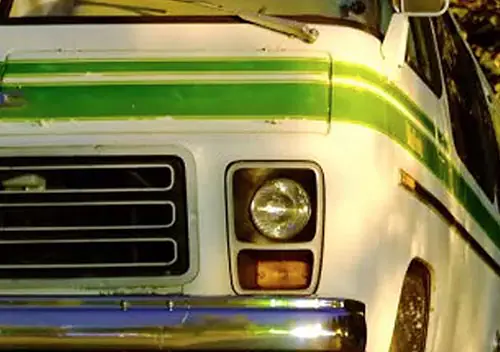
The Caprice Classic had a different grille treatment than the Impala. I think the Caprice version does look better, although I could do without the stand-up hood ornament.

My uncomfortable associations notwithstanding, I must admit the four-door version of this car also looks pretty good, in the same two-tone blue. (The one pictured above is another low-mileage car, which somehow ended up in Sweden for many years.)

From the rear three-quarter view, you can spot this coupe’s telltale rear anti-roll bar. That bar signals the presence of the optional F41 sport suspension, a $37 option that made this one of the best-handling American sedans of its time. The F41 setup was much firmer than usual, though not uncomfortable, with excellent damping and plenty of wheel travel. Car and Driver said an F41 Caprice Classic “will haul grandma and all the kids to the picnic grounds just fine—and five minutes later do an impressive job of defending the family name on a gymkhana course.” Road Test cautioned that the big Chevy was “no BMW/Mercedes killer” even with the F41 suspension, but for a big Detroit sedan, they thought it “damned impressive,” a welcome change from the wallowing barges of its time.

The blue-on-blue Caprice Classic has the optional LM1 four-barrel 350-cid V-8, with 170 hp and 270 lb-ft in 49-state cars. This was still the Malaise Era, when automakers struggled to combine emissions compliance with adequate power and fuel economy, so even an LM1 Caprice Classic was no big-block tire-smoker — this was still a 3,900 lb car, after all — but it was reasonably brisk.

Car and Driver managed to crack the 10-second mark to 60 mph with their LM1 test car, going on to an observed top speed of 114 mph. That was with the standard 2.56 axle and Positraction (which the blue car also has). The optional 3.08 would pick up the pace without costing too much extra at the pump. (The EPA combined rating for this car was 17 mpg, although the EPA ratings suggested that you might hit 20 mpg on the highway if you kept to the speed limit.)

I confess I’m still not sold on the interior of these cars. With the F41 suspension, I’d really prefer front buckets, but it doesn’t look like they were available, making this car’s 50/50 split bench the best available compromise.

The velour upholstery is probably more comfortable and less slippery than vinyl, but I don’t love the halfhearted tufted-button look.

Judge as you may, I think I prefer the lurid Dark Firethorn vinyl upholstery of the black coupe, albeit with the 50/50 split seat that the black car doesn’t have.

The listing for the blue coupe doesn’t show the dashboard, which is a bit of a disappointment in any case, with lots of cutouts that seem like they should hold gauges and don’t, although you do at least get a temperature gauge and a fuel economy gauge that I assume measures manifold vacuum. The options listing I’ve got doesn’t suggest the availability of any kind of optional gauge package, or a tachometer, although with Turbo Hydra-Matic mandatory, I guess it doesn’t really need one.

I’m the wrong generation to regard big expanses of molded woodgrain plastic as a sign of Class, but on a hot afternoon, the thought of old-school freeze-your-ears-off GM air conditioning is awfully appealing. This car also has an AM/FM radio (not much worth listening to on AM these days), plus cruise control, a boon to gas mileage and a fatigue-reducer on long freeway trips.

Older GM cars used to excel at highway cruising, loving nothing more than a long stretch of smoothly paved interstate. This Caprice Classic no doubt does too, but unlike some of the land yachts of yore, its F41 suspension can also do a bit of canyon caving without losing its cool, a very nice combination. With adequate go, not-too-gluttonous gas mileage, and decent interior space, this car had a lot to recommend it in 1977 — it might have been the best all-around car made in the U.S. back then — and it’s still pretty appealing today.
Related Reading
1977 Chevrolet Caprice Classic Landau Coupe – Bent Glass Beauty (by Tom Klockau)
Vintage Reviews: 1977 Chevrolet Caprice – A Whole New Ball Game (by GN)
Vintage Feature: 1977 Chevrolet Caprice – Motor Trend Car Of The Year (by GN)
Curbside Classic: 1977 Chevrolet Caprice Coupe – Specialty Of The House (by Joseph Dennis)
My 1977 Chevrolet Impala Coupe: It Really Was “More Like It”! (by typopete)
COAL: 1977 Chevrolet Caprice Classic – To B Or Not To B? (by Fuzzman)






Reads like there’s a bit of Opel influence in the suspension – can see a bit of it in the restrained (relatively) styling.
All it needs is those Honda CVCC heads (following GM’s insult!) and one might be able to coax a bit more power out of it and still meet emissions…
Frankly I’m shocked these broke 0-60 in less than 10 seconds. Especially with such a lazy final drive ratio. When I was in high school, that was fast car territory. I don’t even think a BMW 320i, Benz 450 SEL, or Porsche 924 did that.
Not only would they break 10 seconds in the 0-60 race, the torque of the LM1 made the cars feel punchy around town. My dad had one with the 3.08 rear end and it went quite smartly for the day.
I first saw one of these in the lobby of the GM building in New York City. Up until the early 80’s they would have samples from all divisions in the lobby. You were allowed to sit in the cars and the lobby guards were stationed at the brochure kiosk. I was allowed to take as many brochures as I could handle and my father and I would look at them on the train on the way home to Connecticut. The Holiday season was my favorite as all the cars would be either red or white. One evening my father came home and said “Son, I left my briefcase in the car could you go out and get it”. As I started out towards the driveway their sat a 1977 Caprice Classic finished in Frost Beige. I opened the door and the interior was marvelous. Leather power seats, power windows, power door locks, and a digital clock. At that moment it was the most beautiful car I had ever seen. The Caprice served us well by faithfully taking us thru New England on family vacations, serving as my test car when I got my license, and eventually when my father took me to college. While in college my father drove up in a 1986 Park Avenue. He said “Son, it’s a nice car but it’s just not the same as the Caprice”. Aaron, thanks for another great story.
I was in college when these came out and at the time I thought GM is back, these were up there with the classic full size Chevy’s from the sixties. It was also far and away the best looking of the GM crop and fully agree with your take on the Cadillac.
My dad was a died in the wool Pontiac guy and bought a ’77 Bonneville with the stupid 301 motor. I kept my mouth shut but thought he should have gotten the Caprice with a 350. The Sloan ladder was reversed in ’77.
In 77 one could still get the Pontiac 400 in full size Pontiacs. That would be the one to get.
I’ve always liked the 77-78s equipped with the F41 suspension. Great cars.
You could get voltmeter, oil pressure, and water temperature gauges on police versions of the Impala under option code 7Z4. I’m having trouble locating a photo, but memory says there was a small panel added on the lower left of the dash, below the light and wiper switches.
> The options listing I’ve got doesn’t suggest the availability of any kind of optional gauge package
The featured car actually has the optional gauge package, which adds the temperature and “econominder” gauges and a trip odometer. The standard gauges are a horizontal speedometer and fuel gauge. Analog clock standard on Caprice, rolling-drum digital clock optional; both still used mechanical movements not quartz electronic, but were still quite accurate.
This car also has the “special custom interior” which adds 50/50 split seats with dual fold down armrests (which was also available separately), thicker velour upholstery, thicker carpeting, and chrome trim around the inside door latch.
As our family was starting to grow in ’79 I bought a very low mile ’72 Skylark 4 dr from Brooks Buick in Towson. Now looking back, I should have gone across York Rd to Marsden Chevrolet and bought one of these. IMO the ’79 was the last really good one.
Yup, the 1980 cars were not nearly as good. GM cheaped them out to save money. Of course, they said it was to improve fuel economy. From 1977-1979 any Chevy made a good taxi cab. After 1980, we had two switch to Oldsmobiles. In particular, the rear brakes of the 1980 Chevrolet models were too small for the size of the car.
My Dad worked for Bethlehem Steel and they sold sheet steel to the Big 3 + 1, he told me they cut over 300 pounds out of the 1980s, and you could tell, they felt lighter and cheaper. He closed the trunk lid of his ’85 LeSabre “Collector Series” on a suitcase that was sticking up once and it bent the lid! He was swearing at GM that day! The ’77 Electra that he traded in on it was a far better and much more solid feeling car. The best ever Buick maybe.
1] it shocks my senses that the original buyer ordered all the performance bits, but picked fake wire wheel covers.
2] the bent glass rear window is a glorious feature. Shame they took it away on later 2-doors.
3] I went to HS with a guy who drove a 77-78 Impala coupe in black over red, no vinyl roof. It was probably the most barebones Impala that Chevrolet ever built. Straight 6-250, no A/C, AM radio, and pretty much nothing else.
I’ve mentioned it before but one of the engineers at our tv station was a car buff and talked his well-to-do friend to order a white Caprice sedan with all the performance and HD options that were available (and standard wheel covers) as soon as they came out in the fall of ’76. He took me and a couple of others out for a brisk ride and although I didn’t get to drive it, I was impressed and smitten. Finally a full size American car that could hold its own with the imports (except of course certain details like interior styling).
Having grown up in this era, I remember the excitement of the Bent Glass — with either Popular Science or Popular Mechanics delving in great detail into the manufacturing process. Much later, we’d all learn that GM had a failure rate on this and other glass innovations that made them untenably expensive on their end. But still, as Aaron points out: anything at the height of the Malaise to throw off spark and light.
Love these articles. Keep them coming! (Pretty sure the cruise control was a boon to mileage and comfort, not mileage and fatigue — sorry, my mother was an English teacher!)
I had always assumed that I had driven every permutation of the GM B body but this article shows that I was wrong. I have never driven any two door model of any B or C body for that matter.
These cars drove really well. Even the base suspension had a level of firmness.
A friend bought a 77 Impala coupe in 1984-85. It was in nice shape, but was north of 100k as I recall. Even at that age/miles, it was a nice car with a taut structure.
I think my biggest problem with the styling is the HUGE wheel openings. On the feature car, it seems to sit awfully high in the rear, and I would wonder if there is more to this car’s story than is in the sale listing.
I wonder if the odd stance of the featured car is due to how it’s parked. It’s straddling a fairly heavily crowned road, and that can really make a car sit funny.
My thought as well.
Back in the day, before renting a limo was a thing, there was a radio contest where our local Chevy dealer provided the use of a chauffeur-driven, fully-loaded, top-of-the-line, $10,000, two-tone Chevy Caprice Classic 4-door sedan for prom night 1977. (It was silver and light gray metallic.)
Somewhere in 1986 Imowned the twin to that car, two-tone blue with blue cloth interior.
Ended up painting it white, and I can’t remember what happened to it, weird enough.
Was not a Chevy guy but always liked these Caprice 2 drs with the bent back glass – this is a beauty. If I had one it would definitely be a 77-81 to get the TH 350 transmission rather than the later weaker TH 200R.
Why R&T has to mention isn’t a BMW/Mercedes killer is beyond me. GM never advertized it as such so why bring it up. Simply say it is one of the best handling full size cars we have ever driven.
As for the interior I would go with the vinyl. That velour looks really cheap and we know it doesn’t hold up. Fabrics used by Honda, Toyota, and Mazad in the early 90’s were bulletproof as I know well.
I had a ’77 Impala sedan, purchased used in 1985 from the original owner with over 100K miles. It was white with a light blue cloth interior (not velour like the featured Caprice). It had the 305 V8, a/c, split bench front seat, tilt wheel, and AM/FM radio. I don’t recall it having all of that plasti-wood on the dash like the Caprice. It drove smoothly and was easy to maintain. Gas mileage wasn’t great (15 mpg or so on average), and it came with water leaks around the windshield and backlight that I could never adequately patch up.
I enjoyed every Caprice I ever owned. That was a 1974 (rust took it away) 1975 (sold due to a stupid moment) two 1979’s (one parts only that gave the runner its 350-4) and an 82 coupe with the sorry 229!
The 79 and 82 had the F41 and did handle well for the car they were.
This example is really sharp with the bent rear window
I was in high school when these came out, a Detroit born GM fanboy who’s ultimate goal was to become a GM Engineer. Anyway a girl I liked uncle had a two tone tan Caprice Classic loaded up as he worked for GM. She had access to his car and so did I. I too loved these things but I have to disagree with the sentiment that it looked better than a Coupe Deville which I also got to drive. I will admit that the gulf between the two had narrowed quite a bit by 77. The new Full sized GMs I got to drive or ride in included everything except the Bonneville, Le sabre or Delta and I would have proudly owned any of them as long as it was not poverty spec. And to think today I would not consider buying or owning a GM vehicle of any type from the last 20 years. How the mighty have fallen.
Beautiful car. A 350 coupe with F41 and only 15k miles? I’d take it.
When those downsized B-bodies came out in late ’76, there were a lot of pre-downsized B-bodies on the market for pretty cheap, either on used lots or FSBO. Many people who had bought a new ’77 and didn’t like the trade-in offer they got from the dealer slapped a for for sale sign in the window of their old B-body and parked it on the street.
That’s how the 17 year old me bought my one owner ’71 Impala Sport Coupe (350) in the fall of ’76. The middle aged couple who bought it new back in ’71 had just put a new ’77 in the garage, pretty much the twin of the two tone blue coupe in the photos above, and were looking to unload their trusty ’71. I was more than happy to take it off their hands. Great car. I had it for a couple of years and drove it all over the eastern US. I still have a soft spot in my heart for those late ’60s and early ’70s and before Sport Coupes with the semi fastback rear window, before they bloated up too much in the mid ’70s right before the downsizing.
I also liked the downsized B-bodies, and only four years later a somewhat more prosperous 21 year old me bought a brand new ’81 Caprice 305. Again, a great car that I’d love to have back.
Like the blue one Not a ‘velour seats”, fan though.
Love these 2 doors.
Also, I’m on the side of the Black example looking better. Not that the 2-tone blue is bad, but I feel like EVERY one I’ve seen over the past 20-30 years was this “Lightish Blue”. (Well of course I’d still take one- 2 Dr 350 please). Guarantee it gets better gas mileage than my 2016 Jeep Wrangler.
Nice car.
I have to admit…I’d prefer a Plymouth Fury.