

We had a US-built Toyota Camry that was serving us well, but with two growing kids, having more space sounded like a good plan. In 1995, we decided to get our first minivan, a used 1991 Toyota Previa DX, a futuristic-looking “space shuttle” with a mid-mounted engine.

In the late 1980s, Toyota and Nissan vans imported from Japan started showing up in Northeast Ohio. Vehicles perfect for the crowded streets and roads of Japan didn’t quite fare as well in the wide open spaces of the USA. (For some pictures in Eugene, Oregon, of this type of van see here.) My neighbor had one of those vans, for a short period of time, either a Toyota or Nissan model. She admitted she had made a mistake — there were five in her family, and it was a rough ride with all of them aboard.
Since I had a Toyota on lease and the selling dealer had my name and address, I started getting “We want to buy your car” letters or the “Maybe for the same payment you can lease the latest and greatest.” I went to my local Toyota dealer and test-drove the new third-generation Camry (model years 1992-1996 — the car that really established Toyota’s reputation in the USA, the one that the president of Toyota said had too many parts). It felt to me just like the 1989 Camry that I had. I probably would have been OK with a Honda, but it had an interference engine, I wondered how often did those timing belts have to be changed, and the local Honda dealer was the epitome of the obnoxious car dealer ad (“Hi, I’m Joe Blowhard, come buy a car from me, you’ll get the best deal…”)
My dad passed away in April 1991. As my mother, my brother, and I reminisced through the years, we determined that my father was a “happy-go-lucky” car owner: He only had one car that he truly loved, a 1960 Cadillac he bought in 1967 as a “cream puff” from Vic Lynn “you don’t have to introduce yourself when you drive up in a Cadillac” Cadillac-Oldsmobile in Kenton, Ohio. The car had been owned by a railroader whose wife had passed, and it had just 17,000 miles after seven years. The surviving husband just drove it once a week to “blow the carbon out.”

My brother had mostly good luck with used cars, so why shouldn’t I? Toyota was getting a reputation for reliability. When you went to the Ford dealer and asked to look at the reasonably priced cars, they told you things like “need to keep the oil changed if you buy a four-cylinder.”
We, as a family, actually went to the local Ford dealer and test drove a Windstar at Christmastime 1994. The salesman even said he might dig up a giant red bow for us, if we bought the Windstar. That was a purchase I’m glad we didn’t make. A family we knew had a problematic Windstar, and I even asked them, “What dealer don’t I want to buy this car from?”
The local enclosed shopping mall, Chapel Hill Mall, still had an annual car show, so you could do a quick look at a car without the fuss of a dealership visit. My son and his friend were yelled at by the salesman on duty because they were climbing over the van seats and such. My son told me I needed to buy a car that was “Fun for kids.”
Because of my height, and because we had two growing children, I started testing cars by sitting in the back seat first. This has eliminated a lot of cars through the years (and still does). A Hyundai Sonata looked promising and the dealer was anxious for me to take a test drive, but NVH issues made me immediately turn around and drive back to the dealer without even taking it out on the Expressway.

I saw ads for the Toyota Previa, which arrived here in 1991 to replace the old Toyota Van. The Previa was quite futuristic, and a family from church had one. Car and Driver at the time gave the enthusiasts’ take, and I had learned to read between the lines about the suitability of vehicles for families. (JP Cavanaugh has published an excellent article about the pros and cons of the Previa.)
Because of the Previa’s unique design, with the engine mounted between the front seats, there was no room for a V-6, just a 2.4-liter four. Starting in 1994, there was a supercharged engine, but the S/C models were $$$$$. Was the standard Previa too slow? I decided to test drive one and see. Pulling it out of the parking space at the dealer, I immediately liked it, it felt right.

The salesman quoted me a price of $9995. He later admitted it should have been $11,995, but they honored that price. Maybe $800 was too low for the trade-in they offered on the Toyanova, which had 85,908 miles, or they were making up for the $2000 “they lost,” but the numbers were reasonable. A new 1995 Previa DX would have been over $22,000.
When I went back to the original selling dealer a few months later for service at 75,739 miles, I saw who had had the vehicle before and was told the car “hadn’t been abused.”
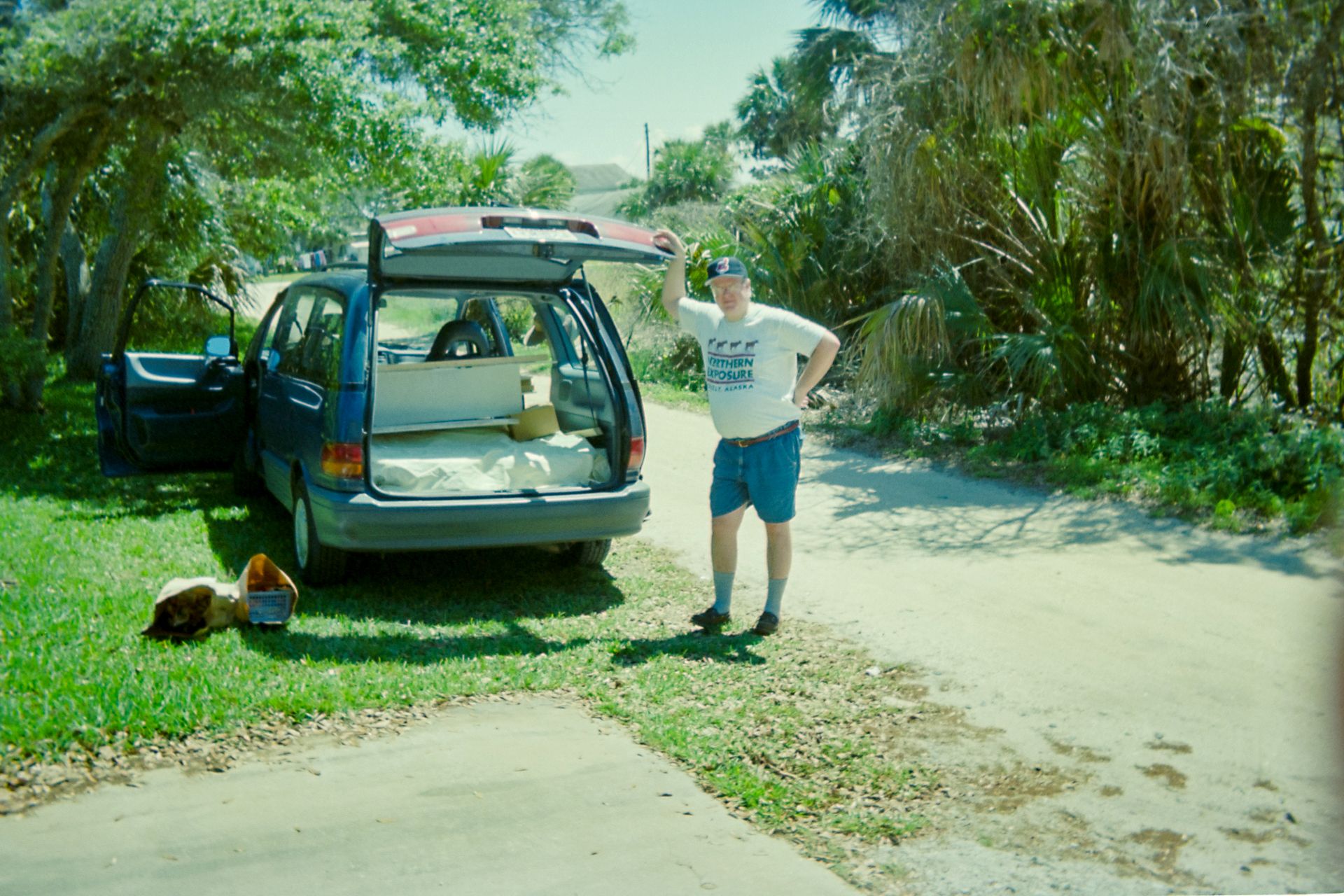
The Previa was great road trip car. We drove it to Florida several times, and my father-in-law — a WWII veteran of the Pacific Theater who always drove big Lincolns, Mercurys, or Cadillacs — was greatly impressed with it. He had built a doghouse for his daughter, then living in Orlando, and we drove over and assembled the doghouse one Florida spring day.
With a third row seat that folded up, I was able to put my bicycle in the van and ride in the early morning on the newly-commissioned Towpath Trail in what was then the Cuyahoga Valley National Recreation Area (now a National Park). We actually could put two adult bikes and two kids bikes in the back of the van. And it had a good old-fashioned passenger-side door that open and shut manually — none of the new-fangled power doors for us, no thank you.

We traveled to North Carolina for my nephew’s wedding and stayed with our friends in Durham. On Sunday morning, as we prepared to leave, I scraped something as I backed out of their narrow driveway (which conveniently had stone walls on either side). I knew something was wrong, but what could we do on a Sunday? We drove slowly until we found a Firestone Auto Care store that was open. They diagnosed something wrong with what I heard as the “cawl spring” — he meant “Coil Spring.” They couldn’t fix it, but they wired up a temporary repair for me in the best hillbilly “backyard mechanic” fashion so that we could get home and the Toyota dealer could get the part and fix it.
The Previa became my car to drive, as my bride had visibility issues with it in tight parking spaces. On one trip back from Florida, I was relegated to the far back row because of 24 hour stomach bug issues. I felt like I was the post holding the rear windshield wiper which was going left and then right, very slowly. A bizarre feeling to describe, an about the only time in my life that I have felt “carsick.”

The Previa had 69,959 miles on it when we bought it in March of 1995, we drove it until July of 1998. It had 120,287 miles on it when I traded it in in July 1998, and its trade-in value was still $4500. Other than the coil spring incident, it was a low-drama vehicle, although the 100,000-mile tuneup needed platinum spark plugs, and it made different, but not problematic, noises than a sedan. According to Carfax, it had 161,686 miles on it as of April 2004.
Toyota determined that the Previa was “too weird” for Americans and came up with the Sienna — my son and daughter-in-law currently have two. In world markets, the Previa/Estima was sold for another twenty years. I have heard it is now a “cult car” like the VW bus. Out of all the cars I have owned, this is definitely in the top five of cars I wish I still had, but we only have a two-car garage.
When we traded the Previa, the family was still growing, so what would replace the Camry in the garage? Tune in next time.























We’ve had one Previa and three Estimas – the most recent being a 2007 JDM that was very nice – Lexus-like.
Replaced the starter and the rear shocks on the Previa with about 120K on the clock. The Estimas gave us absolutely zero problems. They were just great vans.
https://www.curbsideclassic.com/blog/coal-capsule/coal-capsule-seven-toyota-vans-living-lavida-van-life/
I once considered an older used model. My custom at the time was to get my mechanic’s thoughts on the breed. “They’re great vehicles, but selfishly speaking, I hope you don’t buy it. ” He said he was down to one or two customers who had them and was waiting for the day when he wouldn’t have to deal with them because everything was so difficult to access.
Still, this was a van I probably could have loved.
And I love your house! It looks like something from my neighborhood. I still have a thing for a 50s sprawling ranch house.
Thank you for the house comment. Can’t believe we have lived there since 1984 making next year our 42nd year there. It’s Christmas’ present was new windows.
I’ll echo JPC’s comment on the house – sprawling ranchers are my favorite kinds of houses. And no place does them better than the Midwest.
My favorite kind of house: all brick, with a hip roof, on a relatively level lot. The exterior maintenance it would need that I would try to do is reachable with a short ladder.
The front of the house and one side are very reachable via ladder, the back yard slopes away very quickly from the back of the house. We are at the top of the street.
I’ve owned a ’93 Previa (NA automatic) since 2015. It’s reliable and spacious, but it guzzles gas like a V8 and it’s slow. My son loves it. He only drives it about 2000mi a year now…
Previa didnt sell well for the same reason the GM dustbuster vans didnt sell well. Too weird. Cars too weird for their time never succeed in the us fron the chrysler airflow to the pontiac aztek. Today its the Tesla cybertruck thats flopping cuz too weird.
The Previa was an excellent concept from inside out: a clever mechanical package and inspired styling. It’d go in my car museum if I had one. Thanks for posting this.
I remember the middle right seat having no foot room due to the air cleaner being there.
The panel van version was also incredibly durable.
There was an AWD Previa too.
Interesting van and the comments too .
I don’t quite Ken what happened to the coil spring ? .
Nice house, when you replaced the windows did you get double pane ? .
I have a few in my house and they’re fantastic ~ I live on a busy corner and the noise reduction was amazing, plus of course better stabilization of inside temperature .
-Nate
I believe the problem with the coil spring was when I maneuvered to back out of the driveway the suspension hit one of the side stone walls. And did get double pane windows, definitely warmer (or cooler) and less noise!
I like the Sales Order’s note of “Contingent on wife’s right to refuse deal.” I guess your wife ultimately approved it?
My minivan-owning period began in 2009, but if I had been in the market during the early 1990s, I would have likely looked at Previas. It’s one of the few older minivans that still intrigues me. Sounds like yours was a very good buy.
Nothing screams 1990s more than ribbed lower body cladding.
I strongly considered buying a used Previa in the mid-’00s. At the time I did some work involving kitchen or bathroom remodeling and needed something with decent space, but I didn’t want a big, hard-to-park truck. A minivan with the 3rd row removed or folded away gave me the room I needed to fit a cabinet or appliance in, and the ability to walk between the first row seats, or between the first row and the back of the van, was crucial. It struck me that the Previa was the exact length of a then-current Lexus RX, yet managed to fit an adult-sized third row in it that the Lexus didn’t have, and that there was as much room behind the Previa’s third row seat as there was behind the RX’s second row. Great space utilization! I still wonder how they got the engine so small it fit under the floor.
I favored the later models with the supercharged engine, AWD, and LE trim (unfortunately you couldn’t ever get the 5 speed manual on LE models and it was automatic-only by the time the forced-induction engine showed up. You could get swivel captain’s chairs in the second row instead of a bench, but those can’t be folded away or removed without tools (and I’m not sure if it leaves a floor protrusion behind if you do manage to remove them). The split 3rd row that folded up against the side panels was a best foldaway 3rd row arrangement until fold-into-the-floor designs became available.
The dashboard is well suited for updating with modern tech; there’s a double-DIN cutout for infotainment plus a large flat area above it for mounting additional screens, and both areas are easily reached.
Again its poor crash test result should be vital issue when we pick a Previa. I am not an automotive structural engineer, but my instinct is mid engine design plays a role for its front section weakness. Frankly as a current owner of Tesla Model Y Juniper, I also concern its crash rating being Tesla has no major engine component in the front section either.
Never a big fan of the Previa, mostly because I was tasked with selling them back in 1991. They were not inexpensive and I lost many sales to the Chrysler Plymouth dealer down the street from us as Voyagers could be had relatively inexpensively compared to a Previa.
A quick Ooogle search told me there was about a $1000 base price difference between the Voyager ($13,300) and the Previa ($14,400), but there were some discounts that were available on the Plymouth and our dealership was highly reluctant to take any money off of the Previa. So, we had a nice fleet of them fairly welded to the sales floor. To be honest the ones we had on the lot were all fairly well optioned and the strippo Voyager could get out the door very affordably.
I found the Previas to be nicely outfitted, but underpowered. We never had a manual one, so I have no idea how they were. I never thought the foldup third row seats attached to the side of the interior were a particularly good idea. I guess it was somewhat better than having to unbolt and store them, but the space savings wasn’t really that great, IMO. In the end, Toyota decided to join the herd and came up with their own Voyager clone.
The base price of a 1991 Previa DX was $14,398, but that was with manual transmission, which would probably have been REALLY welded to the dealership floor. With automatic, the Previa DX was $15,148, compared to $13,215 for the most basic four-cylinder Voyager automatic. (There had been a manual transmission on the Caravan/Voyager before, but it was dropped after 1990.)
You’ve got to hand it to Toyota for how well the Previa was designed considering its obvious limitations (engine compartment & front crash structure to name a few) compared to more “conventional”, front-engine US minivans. Oddly enough, the side view looks an awful lot like the Ford Aerostar if you made all of THAT van’s edges more curved than angular. It’s almost as if Toyota looked to it for inspiration when building the replacement for the outgoing ’80s van (TownAce/MasterAce Surf) in the North American market.
The right move was made with the Sienna taking the Previa’s place in 1998, and it has been one of America’s best-selling minivans ever since, right up to the present day.