

Our 2013 Ford Escape SEL EcoBoost arrived at exactly the right time in our lives. It was quick, comfortable, practical, and handled everything we threw at it, from road trips and Costco runs to Oregon winters. Sure, it had a few quirks along the way, but after four years and roughly 50,000 miles, it had earned its place as one of the most useful vehicles we’d ever owned. Then a positive pregnancy test changed everything—not because the Escape had failed us, but because my priorities suddenly changed overnight.

To get today’s chapter going, by the summer of 2017, it had become clear that our time with the Mercury Mariner Hybrid was coming to an end. The final straw had been a warning related to the hybrid braking system, which the local Ford dealer diagnosed as a likely failure of a control module. The repair estimate was around $4,500—an amount that simply didn’t make sense on an older vehicle with existing rust concerns.
Oddly enough, I didn’t feel burned by the experience.
The rust issue had certainly been frustrating, but that wasn’t really the Mariner’s fault. The vehicle had spent much of its life in the Chicago area before finding its way to Oregon, and it arrived carrying the scars of years of Midwest winters. Aside from the rust and the hybrid brake issue, the Mariner had been everything I wanted it to be. Courtney loved the higher seating position, the cargo room, and especially Ford’s brilliant keypad entry system. I loved the hybrid drivetrain, the practicality, and the styling. The hybrid SUV concept fits our lives perfectly.
Naturally, my first instinct was to buy another one.
I had also become attached to the idea of staying within the Ford family. One of the things I appreciated most about owning the Mariner was the convenience of having a local dealership that could service it. Tillamook has exactly one new-car dealership: Ford. Every other brand meant a trip over the Coast Range to Portland whenever something more complicated than an oil change was needed.
My first choice was a 2010 Mercury Mariner Hybrid or a 2010-2012 Escape Hybrid. The 2008 Mariner I had owned was still closely related to the original 2005 Escape Hybrid. For 2009, Ford made major updates to the hybrid system, including a larger 2.5-liter Atkinson-cycle engine, revised electronics, Microsoft Sync, and a number of drivetrain refinements. By 2010, Ford had another year to polish the package, and many hybrid enthusiasts considered the 2010-2012 models to be the sweet spot of the entire Escape Hybrid run.
Unfortunately, good examples proved surprisingly difficult to find. That disappointment finally pushed me to broaden my search.
The third-generation Escape wasn’t my favorite stylistically. I still preferred the boxier look of the older Escapes and Mariners. The newer Escape looked more like a tall hatchback than an SUV. Still, I had to admit Ford had packed a lot of technology into the redesign.
The third-generation Escape was offered with three engine choices: a naturally aspirated 2.5-liter four-cylinder, a 1.6-liter EcoBoost, and the larger 2.0-liter EcoBoost. Initially, I thought I would be perfectly happy with the smaller turbo engine because of its fuel economy advantage. However, after spending far too much time reading owner forums, I became convinced that the 2.0 was the engine to have. The 1.6 had developed a reputation for some reliability issues, while owners generally seemed much happier with the larger engine.
Before long, a nearly perfect example appeared right here in Tillamook.
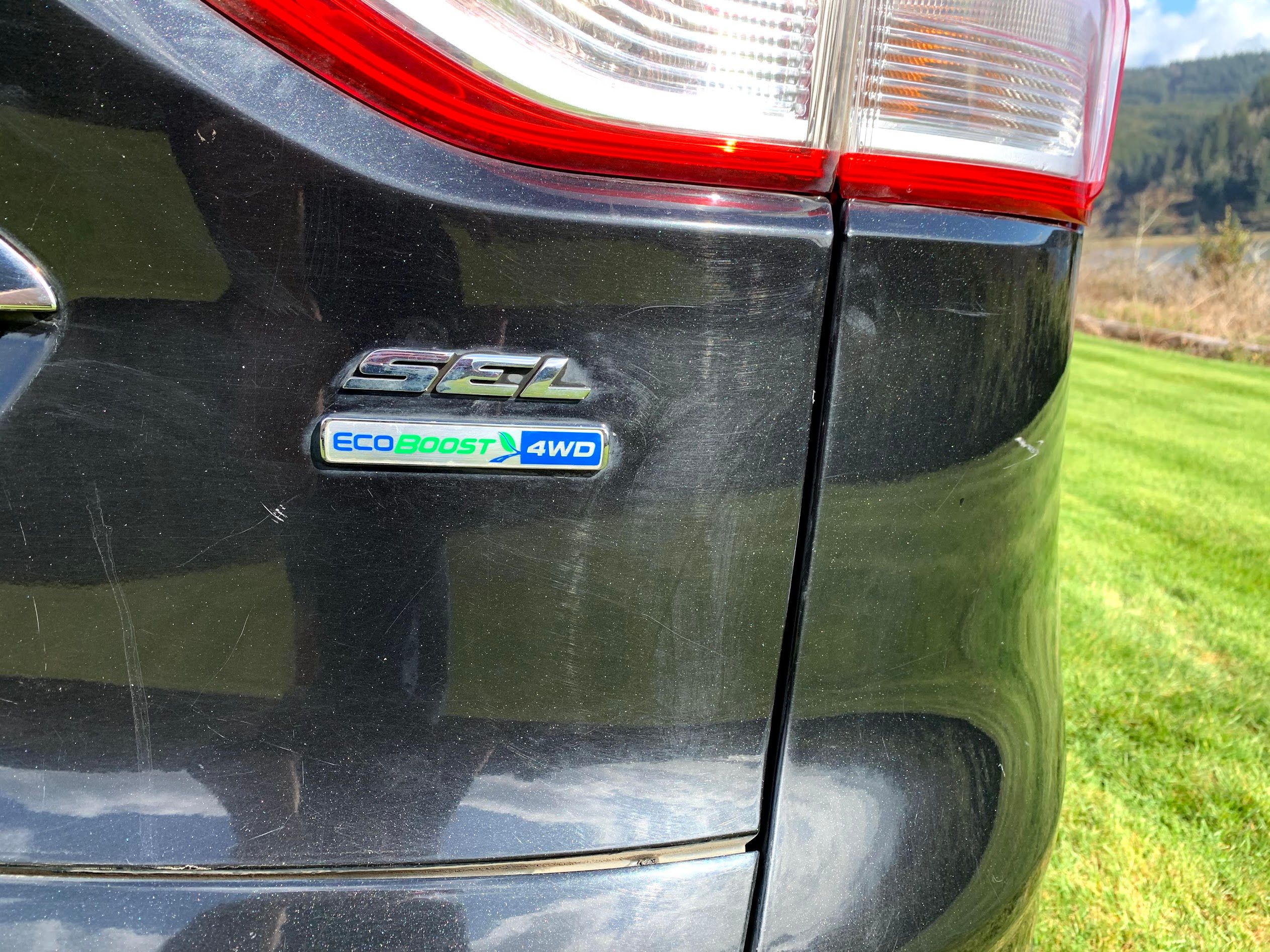
It was a 2013 Ford Escape SEL AWD equipped with the 2.0-liter EcoBoost. The SEL trim only existed for the first model year of the redesigned Escape, slotting nicely between the more basic SE and the fully loaded Titanium. It struck me as the sweet spot of the lineup. This particular Escape had heated leather seats, the upgraded MyFord Touch infotainment system, and one feature that Courtney was especially excited about: the panoramic sunroof.
We went and test drove it, and the difference between the Escape and the old Mariner was immediately obvious. The handling was dramatically sportier, and the power from the 2.0-liter EcoBoost was intoxicating. The first time I really put my foot into it, I yelled, “EcoBOOST!” as the Escape lunged forward. For reasons I can’t fully explain, that became my tradition anytime I passed another vehicle, much to Courtney’s annoyance.
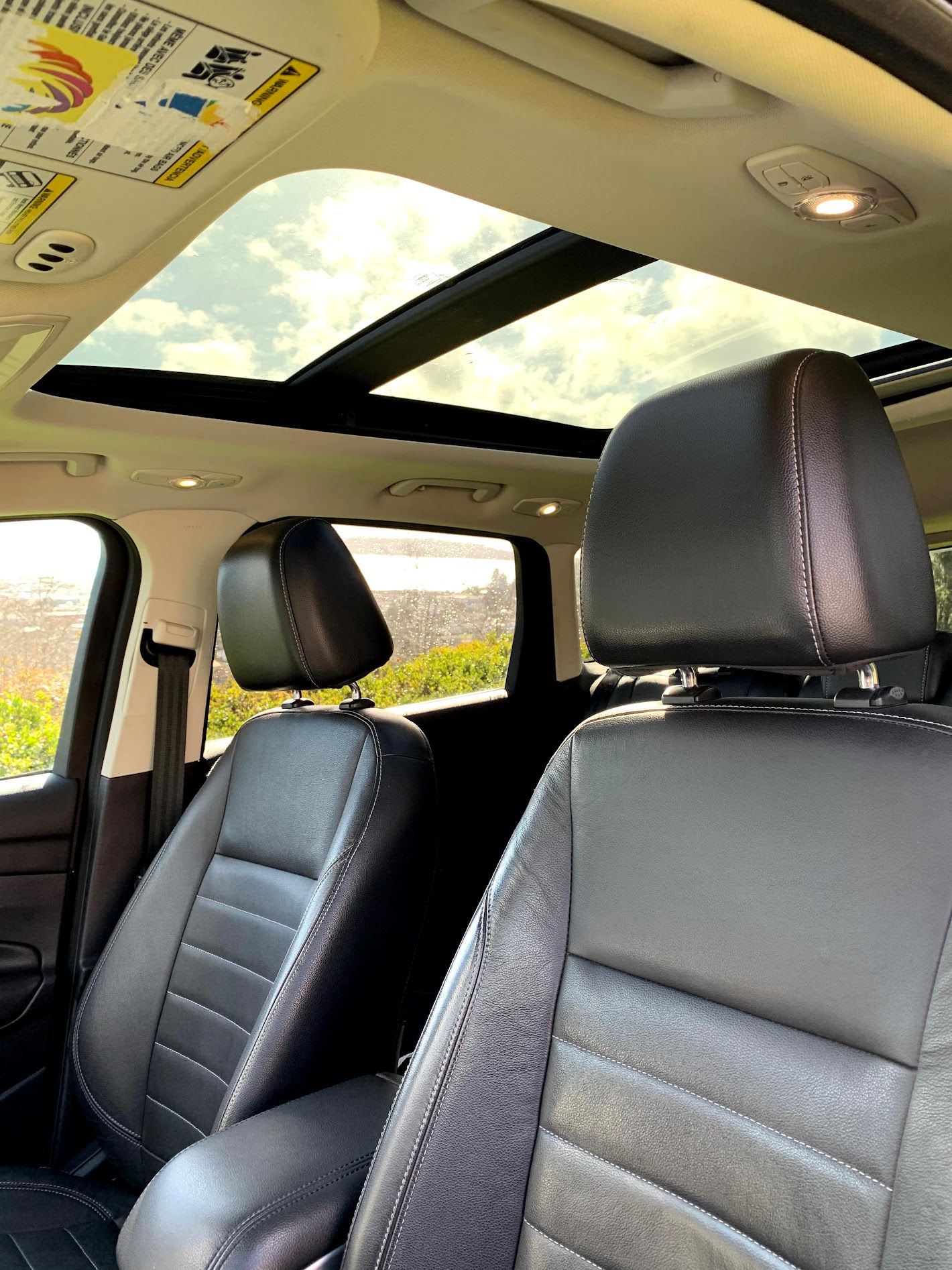
The interior felt like it came from a completely different era than the Mariner. Even with the black interior, it felt brighter, more modern, and much more upscale. The panoramic roof transformed the cabin, and both of us loved it.
Still, I had learned a lesson from the Mariner. Before buying it, I paid the local Ford dealer to perform a pre-purchase inspection. They went through the vehicle from top to bottom and gave it a clean bill of health. That was all the encouragement I needed.
We bought the Escape for around $12,000 with roughly 80,000 miles on it. The Mariner sold shortly afterward to someone upgrading from an early-1990s Toyota 4Runner. I was completely honest about the rust repair and the one-time hybrid warning. To my surprise, neither issue seemed to bother them very much. Financially, the Mariner wasn’t one of my better automotive decisions. Between the rust repair, depreciation, and short ownership period, we lost a fair amount of money. But such is life. We moved on.
The Escape settled into life as Courtney’s daily driver and our primary out-of-town vehicle, while the little Spark EV continued serving as my perfect commuting buddy. The combination worked wonderfully. The Escape handled road trips, Costco runs, and winter weather, while the Spark quietly racked up miles running between schools and computer service calls.
Not long after buying the Escape, I added a backup camera using a module that integrated into the factory Sync 2 system. Surprisingly, the SEL trim didn’t include one from the factory. The installation was straightforward and immediately worthwhile.

The Escape wasn’t without faults, though. While it never actually stranded us anywhere, it wasn’t quite as reliable as I had hoped. Nothing catastrophic ever failed, but every few months, there seemed to be another minor issue. A sensor would fail. A wheel bearing would start making noise. Some EVAP-related component went bad and made the vehicle annoyingly difficult to start after filling the fuel tank. Thankfully, the local Ford service department was excellent to work with, and most repairs were only a couple hundred dollars.
Fuel economy was respectable, though nowhere near what the Mariner Hybrid had achieved. The Escape traded efficiency for performance, and there was no denying that the 2.0-liter EcoBoost made the vehicle feel much quicker and more modern than the old hybrid SUV.
If there was one area where the Escape showed its age, it was the infotainment system. As many owners have reported over the years, MyFord Touch was not Microsoft’s finest effort. It looked futuristic in 2013, but in practice it could be laggy, occasionally lock up, and generally felt slower than it should have. I performed a software update not long after buying the Escape, which helped somewhat, but it never transformed the system into something I would call great. Around the same time, the Escape developed a strange quirk where a random bonging sound would occasionally come through the speakers for no apparent reason. The dealer couldn’t figure out what was causing it, and eventually we simply learned to live with it.
A couple of years into ownership, I discovered that owners had figured out how to retrofit Sync 3 into older Escapes using factory Ford parts from newer vehicles. Naturally, I became obsessed. After a lot of research, I found a screen and APIM from a wrecked 2017 Escape on eBay for around $500. The installation wasn’t exactly plug-and-play, but it was well within the capabilities of a computer technician.
The difference was incredible. Sync 3 was dramatically faster, cleaner, and more polished than MyFord Touch had ever been. It added Apple CarPlay support, responded instantly, and looked completely factory because, technically, it was. Best of all, the mysterious bonging disappeared. Whether it had been caused by the original APIM or some buried software issue, I never figured out. All I knew was that after the upgrade, the Escape stopped making strange noises and became a much nicer place to spend time.

The other transformative upgrade was a set of Continental tires. The cheap all-seasons installed by the previous owner were so noisy that the studded snow tires we bought later were actually quieter. Replacing them cost roughly $1,000, but the improvement in ride quality and noise levels was immediate and remains one of the best automotive upgrades I’ve ever made.
In June of 2018, Courtney and I took one of my favorite road trips. We pointed the Escape south and spent over a week working our way down the Pacific Coast. We drove through the Redwoods, spent a couple of nights in San Francisco, toured the Winchester Mystery House, and enjoyed countless scenic stops along the way.

For this lifelong Apple fanboy, however, the highlight of the entire trip was visiting the Apple Park Visitor Center in Cupertino. Apple had recently opened its new headquarters, and after years of following the company, finally getting to visit felt a little bit like a pilgrimage.
The Escape was an outstanding road-trip companion. Between the comfortable seats, panoramic roof, strong air conditioning, and surprisingly punchy turbocharged engine, it was exactly the kind of vehicle you wanted for a long adventure. And every time I accelerated hard to merge, pass, or climb a hill, I still found myself announcing “EcoBOOST!” much to Courtney’s annoyance.
We ended up keeping the Escape for more than four years and putting roughly 50,000 miles on it, which was a record for me at the time. For all of its occasional quirks and repair bills, it had served us well. It had hauled us on road trips, survived Oregon winters, carried countless Costco runs, and generally fit our lives exactly the way we needed it to.
Then, in October of 2020, everything changed.
After years of struggling to conceive, Courtney and I found out we were expecting our first child. We were absolutely over the moon. Like many couples who go through infertility, there comes a point where you start wondering if it is ever actually going to happen. Then suddenly, after years of hoping, planning, praying, and waiting, there was a positive pregnancy test sitting in front of us. The future we had wanted for so long was finally becoming real.
Naturally, my brain immediately turned to cars.
The Escape was a perfectly reasonable family vehicle. It had good crash-test ratings, plenty of room for a family of three, modern technology, all-wheel drive, and it had been serving us well for years. Rationally speaking, there was absolutely no reason we needed to replace it. But rationality has never been the primary driver behind many of my automotive decisions.
By this point the Escape was approaching 130,000 miles and still had a tendency to need the occasional repair. Nothing major, but enough little things that I was always slightly aware of them. More importantly, I found myself looking at the vehicle differently. Good safety ratings were one thing. But now there was going to be a tiny human riding in the back seat.
I had fully entered New Dad Mode.
Suddenly, “good” wasn’t good enough anymore. Our child was going to ride in the safest vehicle I could reasonably put them in. The Escape had been a great vehicle, but in my mind I had already started looking at what came next.
It was time to invest in a German tank.
Eventually.
You’ll have to wait a couple of weeks to hear that story. While Courtney was perfectly content to keep driving the Escape, I wasn’t quite done shuffling cars around on my side of the driveway. Before the German tank arrives, there are still a couple more automotive adventures to cover.























I love reading about your car and your career and family adventures in the beautiful Pacific Northwest. I think I have lost count of how many cars you’ve had so far. I did a little math and over 46 years of driving, I have had 6 cars plus a pleasure car (MB 560 sl). That’s almost 8 years per car, skewed because I had two 3 year leases on Nissan Leafs. (I understand why you like the little electric/hybrids.) Otherwise it would be ten years per car. I’ve only actually purchased one brand new car (2004 CTS-V!) Is it your commute, or your changing car needs, or the seaside environment, or a little boredom that has influenced you to keep changing your fleet? I forgot if you ever had a Subaru up there. Most of the COALs have owned a LOT of cars. I get how once you get used to a manufacturer, it can be hard to switch. Looking forward to reading about the baby vehicle. I crammed my kid into the back seat of a 3 series convertible until he was five. Well, our other car was a GMC Safari van that we bought for towing and camp. (Good thing we weren’t looking at crash test footage because You Tube didn’t exist then.). Car shopping has changed a lot!
Thanks Lori! I’ve had a ton of fun walking back through memory lane. I have indeed had a lot of cars. I’d say boredom has been the primary factor between switching cars…. so many cars, so little time! There have been times when a life change forced my hand, but usually it was just being ready for the next thing.
I just saw a Spark parked near my mom’s house. That is one tiny car! It must be like the Honda Fit in terms of swallowing cargo.
Hello Tyler, nice write up. I am posting about the camera you installed. We just purchased a used 2013 Ford Escape SEL with SYNCH 2 but it came with no back up camera, i see in your post that you installed one. Can you point to the exact camera you got? We need to install a back up camera that shows on the ford 2 synch, we do not want aftermarket screens. Just a back up camera that shows on the OEM screen. Please help. Thanks
I think I have had more vehicles than you have had years driving, even though I tend to keep the ones I like for a long time – 27 years being my longest ownership period and one at present I’ve had for about 20…
Maybe there should be an organization for Autoholics Anoymous? I’ll bet a fair fwe CCers would join:
“Hi, I’m Huey and I’m an autoholic…”
In addition to retrofitting infotainment systems from later years of the same car, there are several companies (mostly ones I’ve never heard of) selling infotainment upgrades to specific cars, often sold on eBay and Amazon. There are lots of cars made in the ’00s and ’10s that had decent-sized center screens used only for backup cameras and long-obsolete navigation, sometimes radio or HVAC functions. The replacement hardware completely maintains the factory appearance but adds modern features like CarPlay/AAuto smartphone integration,, modern Bluetooth implementations, high-res OLED replacement screens, and the like. They only cost a few hundred dollars, though you’ll need to install it or pay a car-stereo place to do it for you.
That IIHS crash test of the GM Astro/Safari vans (now on Youtube) is one of the scariest things I’ve seen. What a complete structural collapse – at first the airbag looks like it will protect the driver, then the seatback breaks loose and rams into the wheel, and the footwells get crushed too.
I or my gf wasn’t infertile in my ’20s but faced another somewhat related issue – genetics so awful I was reluctant to pass them on to another generation; I didn’t want to put in the effort to raise a kid who had a good chance of not living to be 18, or maybe 50 but with major issues along the way. We would probably go the donor route, or could adopt. Neither wound up happening as we parted ways before it came to that. I wound up becoming infertile anyway by about 40, but by then I had already decided against having kids. They would remind me too much of when I was a kid myself.
I’ve used those kits in two different cars, including the German tank. They are super helpful.
I understand the fear of passing on bad genetics. I have something called Poland-Moebius syndrome. Poland-Moebius syndrome is a rare congenital condition characterized by the co-occurrence of Moebius syndrome (cranial nerve palsies affecting facial expression and eye movement) and Poland syndrome (underdeveloped chest muscles and hand/limb deformities on one side of the body). While I live a full and wonderful life, and these differences haven’t stopped me from achieving everything I want in life, they weren’t necessarily something I would want to burden another child with. Thankfully, both of my kids are as perfect as can be.
What was Ford thinking using Microsoft for the initial MyFordTouch – could you imagine if our cars were running on Microsoft? Random stopping out of the middle of nowhere – CRASH CRASH CRASH.
One of the reasons I have a Mazda – I’m one of the few who doesn’t want to deal with a touchscreen while driving.
Cindy and I had an 11 Escape. It was a decent low mileage used car for us and living in Florida, rust wasn’t an issue. Our model had the 2.5 which was really peppy and was great both in town and in the highway. One day her and her mom drove from Palm Bay to Orlando. They had just made it back when the car wouldn’t run past idle. I had it towed into Ford where the circuit panel for the fuel injection was found to have corrosion. It was still under the 5/60 power train warranty and was fixed.
To the day 12 months later, while I was driving, I’d pulled into traffic when it dropped to idle. Once again it was towed to Ford and they replaced the same piece. However, when I went to pick it up, my sales adviser told me that strict orders were sent by Ford that “this is the last repair under warranty whether the 5/60 is in date or not.”
So I took the keys and walked over to the showroom. My father in law was looking at a17 Escape Titanium but I was intrigued by the C-Max hybrid. All that’s what we bought. We drove it 4 or 5 years and other than a set of tires and one 12v battery, it never failed. My father in law did take the Escape and once the recall for oil and water mixing came up, it went away.
I’m enjoying your journey through life. At 63, I enjoy hearing how others navigate. Recently I became very smart car wise: we had a 17 Ford Explorer that was only for me to use in town. But when the mechanic heard a few noises and told me about the 3.5 tear down to replace the water pump and many other things, I’d had enough.
So I told my wife I’m looking for something used that is simple. We bought a low mileage Subaru Outback (2013 with only 90k). No infotainment, no cylinder deactivating, and it uses a key! Getting old is tough enough!!
I don’t understand how a manufacturer can tell you they will no longer fix a warranty item when a car is still under warranty and there is agreement that either the part is defective or the repair wasn’t performed properly. That’s the entire point of a warranty. At best I would think they would send you some sort of official notice that you could then share with your lawyer rather than just having a service advisor relay a message resulting in you buying a different vehicle, hopefully from somewhere else.
You seem to have the absolute worst luck with vehicles of anyone I have ever encountered. Perhaps even more than everyone else combined! 🙂
Best of luck with the Subaru! (Don’t neglect the CVT if it’s the 4 cylinder version).
We’ve had our share of issues! But we’ve also had some really durable vehicles as well, like our C-Max and all 3 of our Buick Park Avenues. And our Geo Prizm was bullet proof until being rear ended!
Thanks for the advice on the Sub. It’ll be going into my mechanic for an oil change, CVT fluid change and probably plugs. It was really well loved and garage kept.
Your initial intuition about the 1.6L EcoBoost may have been right. My 2016 Transit Connect has that engine and routinely gets 30 mpg or better on the highway with it, as long as I stay out of “Boost” mode. It currently has 98k miles (bought it 2 years ago) and has had no issues with the engine or transmission yet. But for your situation the larger 2.0 was probably the best choice; for my vehicle it wasn’t even an option. Both engines are still potent off the line though!
I never saw that good a mileage out of ours. Maybe 24mpg or so on trips, closer to 20 around town. But it’s true what they say about that engine… you can have either Eco or Boost. I usually chose boost.
I agree that tires can make or break a vehicle. I put Michelin Defenders on all of my “good” cars, I don’t bother on my old fishing car, it gets Sailun Touring since it only goes 1500 miles a year. A nice set of matched tires can even make a tired old vehilce seem better than it is.
My wife had almost the exact same car as you – a 2017 Escape with the 2.0L EcoBoost. I didn’t drive it much as it was a lease vehicle and strictly her commuter car, but I remember that Turbo 2.0 being very peppy (but I never shouted “EcoBoost” LOL). The start-stop was very annoying though. I reached for the defeat switch many times. Her Escape was a reliable car and pleasant to drive, and I enjoyed the times I got to take it for a spin.
All those early ECOBOOST engines were Mazda engines, LOL
Hello Tyler, nice write up. I am posting about the camera you installed. We just purchased a used 2013 Ford Escape SEL with SYNCH 2 but it came with no back up camera, i see in your post that you installed one. Can you point to the exact camera you got? We need to install a back up camera that shows on the ford 2 synch, we do not want aftermarket screens. Just a back up camera that shows on the OEM screen. Please help. Thanks