
Like many of us, my dad was a big part of my early COAL history. If you’ve read any of my previous entries, particularly the pieces on my LTD II and the two-parter on my 280ZX, you’ll recall that Dad taught me everything from basic maintenance to extensive bodywork and mechanical repair. Through those automotive experiences, he also taught me numerous life lessons, and instilled in me the confidence to try my hand at new skills and not be fearful of a few failures along the way. We lost my Dad this summer, and to mark what would have been his 86th birthday on November 22, I’d like to share with you a few of his many COALs.
As a little background and context, my parents were both born in Dublin, Ireland, and Dad’s early work experience was at the Standard-Triumph plant in Kimmage, where they assembled CKD kits shipped over from Coventry. He had the opportunity to drive countless cars and trucks in his time there, but his personal vehicles while in Ireland were primarily small-displacement British motorcycles. My parents immigrated to the Northeast when they were in their early 20s. Dad arrived first in 1962, while leaving Mom in Ireland for several months while he got established. Within a few weeks, he found a job as a service technician with National Cash Register (NCR), where he would work until they offered him early retirement nearly 40 years later. As a field tech, he covered a large territory in North Jersey, and needed a car suited to those roads and freeways.

Dad’s first car in America was a 1958 Plymouth Fury in red and white, nearly identical to the one made famous in Stephen King’s Christine. That car was five years old when he purchased it, and the tin worm had already started to set in. By my calculation, he drove the car for between 2 and 3 years. When it was time to replace it, a co-worker practically begged Dad to sell it to him, even though he didn’t want to because of extensive rust in the rockers. Dad shared that, a few weeks later, the coworker came into the shop pale-faced and shaken. Apparently, he was rounding a corner on his way to work when the last welds broke free, liberating the body from the frame and shifting it several inches toward the outside of the turn.

The Fury was replaced by a white 1960 Pontiac Bonneville coupe, which would have been his daily driver when my two brothers were born in ’64 and ’65, just 14 months apart. Yep, Irish Twins. He didn’t share many stories of that particular car, but I do know that it was good to him, and he followed it with another Pontiac.

In 1968 he purchased his first new car, a 1968 Pontiac Catalina sedan, in blue. Not long after getting the car, he broke down and was stopped alongside the road. He walked away from the car to call for help from a nearby phonebooth, when a drunk driver plowed into it from behind, driving the trunk up into the back seat. The car was rebuilt, but he said it was never the same. One morning, as Mom opened the door to the garage, she was overwhelmed by the stench and fumes of gasoline. It seems the body shop had pulled the gas tank back into shape instead of replacing it, and it had ruptured and flooded the garage with a full tank of leaded. It’s a good thing Mom didn’t flip the light switch. Dad did continue to drive the car for several years, and it brought me home from the hospital in early 1973. I do have memories of the Catalina, although only of it parked in a non-ambulatory state at the side of the house.

While Dad had taken a shine to big American cars, he also maintained an affinity for British motorcycles. During this same mid-‘60s to mid-‘70s period, he owned two Nortons – first a 750 Atlas and then a 750 Commando. He loved to tell of the time he was riding the Atlas with a group of friends from our home in New Jersey to motorcycle races in the Poconos. A rider in their group went down and caused Dad to have to drop the Norton, breaking his right arm and right leg in the process. His friends put him back on the bike and tied his barely-useful right hand to the throttle, and they continued on to the races. Recall that on those old British bikes, the brake pedal was on the right side of gearbox. This meant that he could effectively shift and work the throttle with his left limbs, but was completely unable to brake either wheel. His friends solved this by getting out in front of him and waiting for him while he downshifted to a crawl, and then catching him and the bike before he hit something or fell over. They proceeded to sit in the sun and drink beer all day at the track, then put him back on the bike and ride to the hospital so he could get the limbs set and cast.

In 1975 or so, Dad replaced the Catalina with a ’71 Buick Estate Wagon, which was the first car I remember spending a lot of miles in. It was metallic green and sported the de rigueur Di-Noc woodgrain, Buick’s stout 455, air-leveling suspension, rear-facing back seat, and the GM clamshell tailgate. This was our family truckster for the back half of the ‘70’s, and moved with us from New Jersey to Seattle in 1979. Dad often referred to this as being the best car he ever owned. I remember our uncle visiting from England and being amazed by it. The highlight of his trip was cruising that massive 9-passenger wagon effortlessly up and down Interstate 5.

By the time we got to Seattle, rust and wear were taking a toll on the Buick, and Dad needed something a little more economical for his long days on the road. One afternoon he came home in a 1967 Datsun 520 pickup, taking the 90-degree turn into our neighborhood so fast that he drifted and skipped through the intersection. It seems that when he tried to slow for the turn, the brake pedal went to the floor, an intermittent issue that neither he nor my brothers were ever able to resolve.

That Datsun was a beater in the truest and coolest sense, and it was a tough little brute. Prior to Dad buying it, it had served for over a decade at the docks, pushing stalled cars off the auto ferries. Over the years it had received countless sheet metal rust repairs, and it was about a dozen shades of rattle-can red. If you dared to lift the floor mat on the passenger side, you could see the road passing beneath you. The Datsun was a bulletproof runner, but it barely seated two-and-a-half people across its bench seat, so Dad would have to borrow my brother’s car – an ultra-rare 1967 AMC Marlin 343 – when he needed extra passenger space or something a little more socially acceptable.
After maybe a year of this arrangement, my brother totaled his Marlin, effectively leaving us without a family vehicle. The Datsun was handed down to my brother, and Dad brought home the coolest car that I remember from my childhood – an almost-new, 1980 Mustang Ghia Turbo notchback with a 4 speed. That car was stunning in a metallic copper, and I recall the neighbors coming out to see it when he took us on its inaugural drive. Unfortunately for Dad, Mom never liked the Mustang. She would panic whenever the turbo light came on, fearful that the engine would burn up. When my brother got married in 1984, the Mustang went with him to his Air Force station in California. Dad got a brand-new company car, a dull as dishwater Pontiac 2000 Sunbird Wagon, which he drove until he got a transfer from Seattle back east to PA in 1985 (mom also never liked Seattle). There he would be taking a role in their refurb shop and would no longer be working on the road.

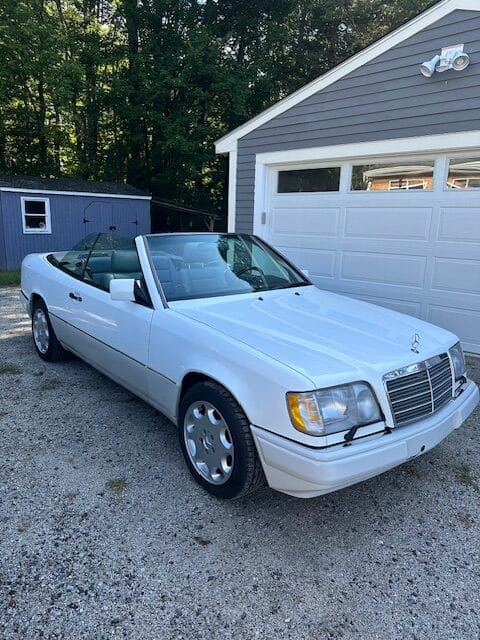
When we settled into our new home in Bethlehem, PA, Dad bought a 1982 Cutlass Supreme with the miserable 267 V8. That car never ran quite right, and Dad was always fiddling under the hood. Regardless, he drove it for almost 10 years. In 1994, he finally replaced it with a ’92 Buick Park Avenue, a car he truly loved. Sometime in I believe 1999, Dad was finally in a place where he felt comfortable buying a new car, and he bought the first of two successive Honda Odysseys that he drove for the next 20 years. During that time, he also had a string of fun second cars. First a 1972 Triumph TR6, followed by a 1992 Jaguar XJS Convertible, and then his final love, a 1995 Mercedes E320 Cabriolet.
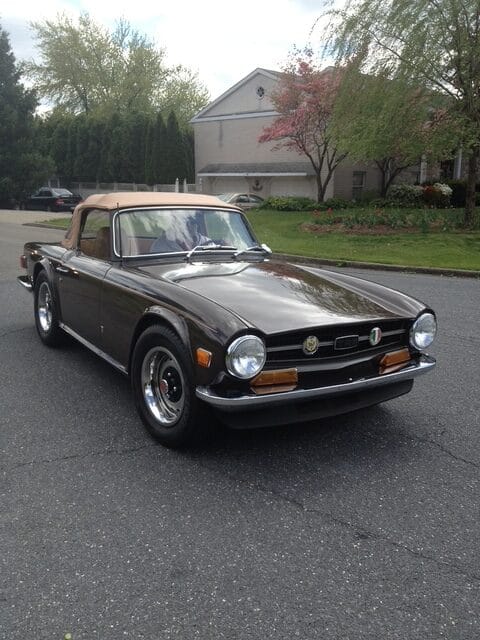
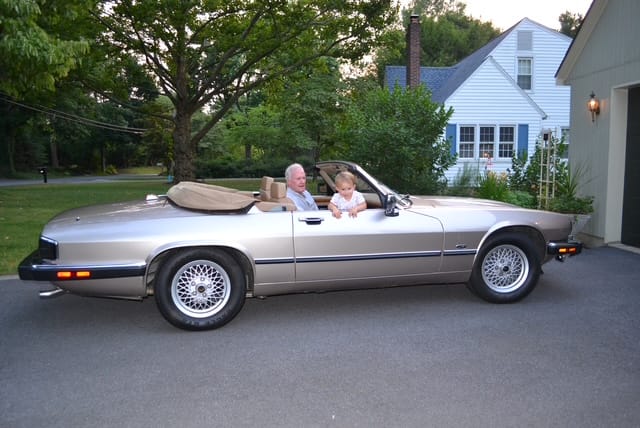
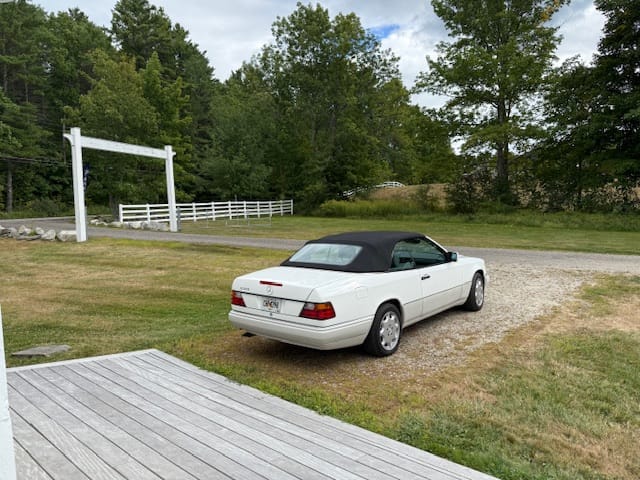
Dad bought the Merc about a year after Mom died in 2020, and it ended up being his daily driver and his hobby for his final years. Unfortunately, he also had a couple of accidents in that car. The second one, in January of this year, signaled that it was time to hang up the keys. The damage was severe enough that it was in the shop for six months, and Dad passed a few weeks before it was completed. After Dad’s passing, my middle brother’s son asked him what was going to happen to the car, noting that he really liked it. A few weeks later, I picked up the car from the body shop and drove it from my home near Atlanta to meet my brother in DC. There, after an evening of laughs and toasting our dearly departed father, he took the keys and continued on to his home in Maine. Two weeks later, on the eve of his son’s wedding, he surprised him with a completely unexpected gift – Dad’s beloved Mercedes.




That 71 Buick wagon had three rows of forward facing seats. No rear facing seats in that car.
Thanks Rick. The memory from my 7-year-old brain stands corrected, although I do recall riding in something with the rear facing seat in that era.
Great story! Field service technicians are unsung heroes of business operations. Fond memories of operating state-of-the-art NCR cash registers in 1971. Every night they were cleared by the crew and the punched tape from each were sent to company HQ for data analysis and such.
So true. Dad came here with just the equivalent of an 8th grade education, but his natural mechanical inclination allowed him to be a top student in NCR’s tech school. That continued as the technology advanced through electromechanical and onto computer platforms. In more recent years, I’ve learned that dad had a reputation as being the best in his region. I was told he could fix anything, and he’d be the guy they’d call in when all others were unable to solve the issue.
Brian, thanks for sharing memories of your dad and his cars. He sounds like a great guy and an enthusiast in the most basic sense of the word. The story about how his Mercedes was passed down is an excellent ending to the story.
I love that 1971 Buick! I so seldom see the wagon version of the 71 Buicks…what with the flow-through ventilation vents. I had the same in my 1971 LeSabre, but would have much rather had a wagon. Too bad about the rust, already visible in your photo. Rust like that on a 9 year old car (rust is what killed my 71 about 4 years after your 1980 photo). Amazing to think that was the norm back then.
Thank you Jeff. These pics reminded me that it really was quite normal to see cars with fist-size holes in their lowers in the salt states of the midwest and northeast. When we moved to Seattle we were shocked by how many 15-20yo cars were still daily drivers that would have been reduced to dust in New Jersey.
Brian, great story! It’s so nice to read the life stories of people through their cars. And your nephew getting his grandpa’s car, which probably was more a symbol than a machine, made me smile.
Great write-up of a fascinating personal history. Some interesting cars in there. Lost my dad, jeez, 15 years ago now. Still miss him.
A terrific tribute to your father, who was very obviously a dyed-in-the-Irish-wool car guy. What an eclectic series of cars, and bikes. Speaking of, that bike trip story is one that would be increasingly hard to believe in more recent times. Wow.
And what a great final car, and a fitting way to pass it on. Thanks for this great read.
Dyed-in-the-Irish-wool for sure. When he bought the TR6 it had the little Union Jack logos on the rear fenders. They didn’t last long.
Funnily enough, my TR6 owning friend in the UK was reprimanded by the police and told to take these off his car.
Why?
Some terrific stories here – thanks for putting all this together. Seems like every one of your dad’s cars had a few moments of drama.
Your mom panicking when the turbo light came on is hilarious. That said, having had two turbocharged cars, I’m glad not to have to worry about turbo issues any longer.
Those Mercedes convertibles were wonderful. I recall the father of a good friend of mine had one in the 1990s, and I got to drive it once – amazingly impressive. Great choice for a fun second car.
Great stories about your father, and great cars too. He really ran the gamut of interesting vehicles.
There are several parallels to my family, my parents had a 1957 Plymouth followed by a 1960 Pontiac.
Despite my own father’s interest in cars he never did indulge himself with an interesting vehicle. Perhaps my misadventures with sports cars and motorcycles were a deterrent.
He’s now 87 and the other week I suggested that he could trade out his Ford Escape for something smaller and easier to park. I gave him a few suggestions, since he could afford almost anything. My main suggestion was a Honda Fit, he thought the Ferrari 599 was a bit over the top but the 2008 Porsche Carrera 4 also looked good for going to the grocery store.
A great share down your memory lane. Thanks.
Speaking of memory lane…those open bay barracks. Ugh.
Nice story Brian. That’s an interesting run of cars. I spent a lot of time at one of my jobs in a Datsun 620. Hilariously small but certainly could work.
Brian, a wonderful story about your family, your Dad, and the history of the family cars. The Jag & Mercedes would be really nice to have today. My Mom passed in the mid-80s & Dad passed in the mid-90s. We were mostly estranged for nearly 20 years, cordial but little communication as I always lived far away from where my parents retired. I did get close to my father the two years before his death and I am thankful for that. I have one older brother and we were never close. In the early 1970s he moved Australia, disappeared for 13 years. When I found out my parents were spending a great deal of money to track him down I got pissed. I called the State Dept. & and the FBI, reported a missing citizen abroad. Within 24-hours my brother called me and said “what’s up mate”. What’s “UP” is call your damn parents. Obviously I could write the book on dysfunctional families but most of my memories are good. Extensive travel in the States & abroad, excellent paid education, Dad always made sure I had beautiful cars. Dad was an Air Force lifter and didn’t talk about it. We moved so often and as hard as I have tried to piece together my Dads career, and places we lived, over the decades the US government still calls that info classified. So I have scattered childhood memories and big gaps in my family history. Add to that, two devastating fires, late 1950s & early 1970s, wiped out most all the family photographs. Brian, you are so fortunate to have a record of your family history. Please pass it down to your children and their children.
I certainly will. Your story would make quite a write up.
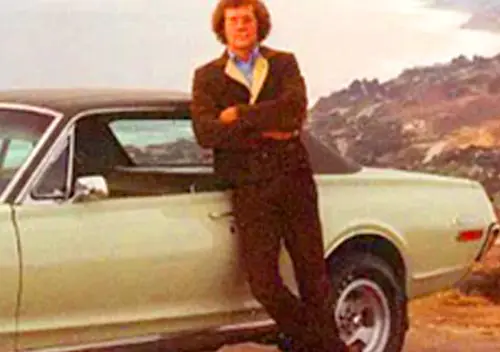
Another great entry, Brian. I really hope this gets rerun for Father’s Day at some point, maybe even next year. I hope it’s okay to offer my condolences here. This painted a great portrait of both of you parents, especially your dad. I had several random thoughts as I read this. I love the ’80 Mustang Turbo notchback, and that’s a great picture. It’s a shame about that ’58 Fury, but having grown up in a family where we had owned a ’77 Volaré, I’m aware of how quickly some Chrysler products – and cars in general before a certain point – had been prone to rust.
I’d be curious to compare notes with you as being a first-gen U.S. kid (for me on just one side) and what that was like for you. Again, a topic / tangent for another day / place / etc. I always saw it as a plus and not a minus.
Looking forward to your next entry!
I would love to make that happen. And thanks for your encouraging comments on my posts.
Wonderful recollection Brian. Dad had great taste. The Commando is an Interstate and your Mom’s pose on the Atlas calls to mind ads of the time…..she could have been a Norton girl!
Also, what’s parked next to the Mustang? Looks like a Rover…
Yep. Rover 2000. My brother’s cars could be another post unto themselves.
Right off the bat I am confused. Dad started as a field technician, with NCR, in 1962 but in 1963 he is in a US Army uniform?
In those days when men got their green card they had to immediately register for the draft. 6 months almost to the day after arriving he was called up into the Army reserves. He went to Fort Knox and drove tanks. What people often don’t believe is that immigrants would serve on a green card. He and my mom became citizens in 2002, after 9/11.
I loved this story, it’s a little like meeting your dad through his vehicles. Several of these are cars I experienced as a kid, in one way or another. I’m glad he got to feed his automotive passions in the last years. My family connections to Ireland are a couple of generations farther removed, but I’ll raise a glass of Guinness to himself.
He’d have been happy to cheers back at yourself. I appreciate all of the encouragement JP.
Thank you for explaining this! I was wondering about that photo of your dad in U.S. uniform.
I’m going to have to look into this further, since I wonder why this didn’t happen to my dad. He would have gotten his green card right around 1961.
Then again, he’d already spent time driving tanks in the Chinese Nationalist Air Force (yeah, he drove tanks in the air force), and nearly got thrown out for destroying some farmer’s paddy and scaring the water buffalo, given his (apparently) exceedingly poor tank-driving skills. Perhaps his reputation followed him to the new country.
I remember hearing stories of guys who emigrated from Germany and then being sent back there within a year in uniform.
Wonderful tale! Your dad (and family) had very eclectic motoring tastes. That MB 124 cabrio is a nice keeper – IIRC there is a large vibration damper in the trunk to keep it feeling solid sans roof. A colleague here picked up a mint facelift XJS cabrio like your dad’s with the straight 6 recently – lovely car!
Seems like your father had “a long life, well lived”…
That he did, Huey, and worked his ass off along the way.
I enjoyed reading your story. Thank you for sharing!
Godspeed to your pops. He sounds like one good, tough, cool and interesting dude.