

During the 1950s Chrysler Corp. was unique in offering engines with no less than four distinct types of cylinder heads: hemisphere, polysphere, wedge and flathead. But the really crazy and bewildering part was that Chrysler built no less than 25 different displacement V8 engines for their 1953-1960 cars: 241, 260, 270, 276, 277, 291, 301, 301, 303, 313, 315, 318, 325, 326, 330, 331, 341, 345, 350, 354, 361, 383, 383, 392 and 413 cubic inches. (yes, there were two distinct 301s and 383s). These were all part of five unique engine families, many of which were available in either hemi or poly head versions. And there were some flathead sixes too, of course.
A lot of us gearheads knew all the engines in GM and Ford cars by heart back then but did anyone ever keep all these Chrysler V8s straight? I’m going to try to make that a bit easier here.

1955 was a very big year at Chrysler, with a complete makeover dubbed “The Forward Look”. These were the first cars styled under Virgil Exner’s term as head of styling at Chrysler, and they did what they were supposed to do: propel Chrysler out of the dowdy, short and plump era that had hurt its image, market share and profits.
The Forward Look was more than just new styling: it was also a major trendsetter towards bigger, wider and lower cars to come, especially at Chrysler in 1957. The 1955 Dodge grew a whopping 16″ from 1954, to 212″. And it gained a couple of inches in width and lost a couple in height. The ’55 Plymouth, at 204″, was also the longest in its price class.

Despite their looks, the ’57 Mopars weren’t actually any longer than the ’55-’56 cars, just lower (by 2.5″) and wider (by 3″). That really hurt their space utilization, as the ’57s still sat on a rather primitive ladder-style frame (essentially the same design as the previous years) that cut into legroom and headroom, more so than GM’s X Frame and Fords “cowbell” frame. It really helps explains why Chrysler went to unitized construction in 1960, as it lowered the floor by a couple of inches, making a significantly more commodious interior.

Although Exner was the overall styling head and responsible for the general direction and basic body shape of the ’55s, the specific styling aspects of the Dodge are credited to Maury Baldwin. But the front end does have a certain Exneresque vibe to it.
The Forward Look propelled Dodge sales forward too, up from 154k to 277k in 1955, keeping in mind that ’55 was an explosive year for car sales. That amounted to a 3.6% market share, not enough to pull it out of the #8 spot it had in 1954.

I’m not really too wild about the front end and especially the trim on the hood; the ’55 Plymouth with its hooded headlights and clean hood seems decidedly more advanced and cleaner in those regards.

Let’s not forget that completely misguided and embarrassing attempt by Dodge’s utterly mad men to create a version specifically for women. Full story here.

The Dodge (top) had a 120″ wheelbase compared to the Plymouth’s 115″. And it’s quite obvious where that was added, in the rear. At least Dodge gave the four door sedan longer rear doors so that there wasn’t that awkward filler area in those cases where this wasn’t done, like the Bonneville at Pontiac in the ’60s. The Plymouth’s wheelbase and overall proportions look more organic and better balanced; the Dodge has a Studebaker vibe to that set-back rear wheel. These endless stretching of wheelbases at the front or rear by American manufacturers were mostly design failures.
The only apparent difference in their body center sections is that the Dodge rear door opening is larger and shaped differently.

Here’s the two door sedans, just because. The Dodge is at the top. They obviously share the same side glass, front and rear. The Plymouth in both cases looks like an update on the Dodge styling, especially at the front and rear.

The exception to the rear door issue was the wagon, where Dodge (above) used the same rear doors as the Plymouth wagon, and has that dead area ahead of the wheels. Since the Dodge and Plymouth used the same wagon body shell, the Plymouth is extra long, at 208″, and the Dodge’s length of 214.9″ is all just in extra front and rear overhang.

Here’s a shot of a ’55 Dodge interior, but not from our featured car. I rather liked Chrysler dash boards of this vintage, with a fairly clean and solid look. The dash-mounted chromed shifter handle for the two-speed Powerflite automatic transmission is just to the right of the steering column.
Now we get to the tricky part, keeping all those early Chrysler V8 engines apart, especially since several of them were made in both hemi and poly (polyspherical combustion chamber) versions.

I’ve arranged them here, by their bore center spacing, from smallest (top) to largest. During the years 1956 – 1958, there were four completely distinct V8 families being built, with no basic parts interchanges and no ability to be built on the same transfer lines due to different bore centers. And during those years, three of these were made in both hemi and poly versions, for a total of seven primary variants. Yet all the hemis and polys physically looked essentially the same with similar internal architecture except for being scaled down to varying degrees from the original Chrysler hemi. Wild. Crazy, actually.
There was a bit of overlap between the divisions before the A Series engine arrived at Plymouth first, in 1956. In 1955, Plymouth, lacking its own V8, used the Dodge V8, in 241 and 259 CID sizes and only in poly (“Hy-Fire”) form. And in 1956, Plymouth still used the Dodge 270 V8, along with the new A Series 277 and 303. Also, DeSoto used the Dodge 325 poly in 1957 in addition to its 341 hemis. And of course the B came in two versions, low deck and raised deck (RB), and the 383 was made in both of those versions. And don’t even start on the differences in the Canadian versions; that gets really complicated. Got all that?
Oh, and of course the venerable old 230 cubic inch flathead six, making 123 hp, was also still available. Hemi, poly, or flat head; your choice of cylinder heads.

1955 was the first year for the polys, which were created because the hemis were expensive to build, heavy and not all that efficient. The polysphere (sort of a cross between a hemi and wedge) was created to supposedly still have some of the hemi’s advantages, be cheaper to build, and still use the hemi’s two different angles pushrods without significant changes. But then the polys weren’t so hot in any of those qualities either, as even the Chrysler engineers soon came to admit: “the performance improved by getting rid of the silly polysphere”. So next they adopted the GM solution of wedge heads for the new 1958 B series engines. The A Series poly (318) soldiered on until it too got the wedge heads (1964 for the 273; 1967 for the 318) and became the LA (“Light A”), which was lighter, cheaper, more powerful and efficient.

The top engines in the 1955 Dodge were the 270 CID Super Red Ram (hemi) V8, which was rated at 183 hp with a two barrel carb. A power pack option with four barrel carb and dual exhaust made 193 hp. This Dodge hemi was commonly known as the “baby hemi”, the smallest of the three hemi families back then.

The poly version (“Red Ram”) had the same 270 cubic inch block. In fact, the only real difference was in the heads and manifolds, which could be swapped, if one felt so inclined. It was rated at 175 hp, with a two barrel carb. Our featured Coronet has V8 identification, and given that the Coronet was the low trim Dodge, most likely it’s this poly 270 engine under the hood.

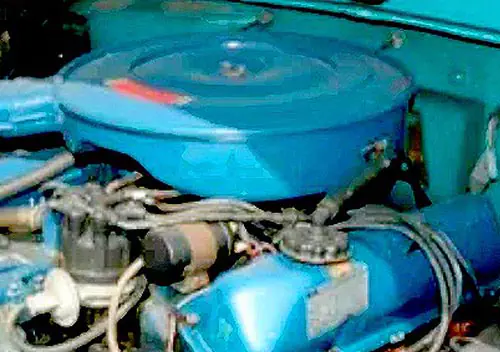
As a frame of reference, here’s an A Series 318 poly, to show some of the more obvious external differences.

And for good measure, here’s a Chrysler 301 poly, which shows distinct features too. So now if someone says “poly” you can ask them which of the three they’re referring to.

Back to our featured car: This venerable and original Coronet has been places, as these vintage stickers attest. These used to be a big thing back in the day, and some cars had prodigious numbers of them.

So we’ve come to the end of my ’55 Dodge story. New let’s got out paper and pencil for a quiz on those engines. Starting with perhaps the trickiest one: Which engine did the 1959 Dodge Coronet use?
CC reader Jonathan F. sent me the pictures of this original ’55 Coronet, which got me going here. Note: this is a revised and updated version of an older post.









And people think Ford engines are confusing… 🙂
This was nuts. Much like GM with it’s transmissions in the 50s-early 60s.
’59 Coronet base engine: flathead 6, optional: 326 poly “A” V8, a 1 year only engine (going by memory here, all my brochures are packed for the move out to CO). The new “B” wedge engine was also optional.
A good safe money-maker is to bet a GM guy that Mopar ever made a 350, they’ll invariably swear they didn’t, but it was a 1 yr only in ’58 DeSoto Firesweep and Dodge, the earliest first year “B” wedge V8 that became the long running 361 and 383. My ’58 Firesweep had one. My ’58 Firedome coupe had a 361 as did my ’59 Firedome sedan. My Grandpa’s ’57 Coronet coupe had a 325 poly.
Everyone of course loves the “hemis” (Mopar actually called them the “Double Rocker” V8) but the “B” had a stronger crankshaft and was more efficient. Copying GM here paid off.
one last comment: the RB 383 was ’59/60 only, using the 440 block with a smaller bore, due to high demand and not enough production capacity for 383 engines. The “low deck” 383 was made up to ’71? when the low compression 400 smog-compliant engine was introduced.
Learned all this stuff due to 20 years of hanging out way too much at http://www.forwardlook.net
The 350 was also available as an option across the full-line of 1958 Plymouths as the ‘Golden Commando’, too.
And, yeah, it’s interesting that Chrysler downplayed the ‘hemi’ description in their ad copy for those first generation engines. That didn’t really begin in earnest until the new 1964 version.
Took me a bit to get into the story as I was stuck on the first Dodge car ad. That woman had four kids? Well we know she didn’t but the premise…
Chrysler had a generally common engine architecture. What made it so complicated was that each division started out building its own version of the common architecture. Up to the introduction of the wedge, differences could be divided into head style. It was either poly or hemi. Basic blocks were the same architecture, but with differing dimensions depending on which division was using the engine. With the late ’50s switch from hemi to wedge, Chrysler engines evolved into 2 basic families. The 318 poly which hung on into the mid ’60s was the last hold over of the 1st generation of V8.
This transition gave Chrysler a much more rational V8 engine family. I don’t pretend to know the whys of engineering and manufacturing decisions made in the late ’40s/early 50s. There must have been some original logic that convinced management separate V8s for each division was a smart business move. Fixation of competitors on the GM divisional model may have played a role in the original decision. Whatever the original reason, the concept was died at Chrysler by the late 50s. The concept of separate divisional engines would linger at GM for another 20+ years, but eventually economics killed it there as well.
If you ask me,Chrysler should have spent the money they blew on tooling up for 25 different V8s on getting Torqueflite into production earlier than mid-1956 and having it be Imperial-only for several months…
Or at least the Powerflite before 1954. A Chrysler Corp. floor salesman must have had to do some smooth talking to explain why none of the cars had automatic transmissions when all the competition did. Sorry, the semi automatic with all it’s variations, despite it’s reliability had to be a hard sell. This, probably as much as the “conservative” styling had a lot to do with the sales slump in the early to mid ’50’s.
Good point and what if Chrysler haven’t gone with push buttons transmissions? Could they have attracted more customers from GM, Ford, Studebaker-Packard, AMC(Nash-Hudson)? And what if Chrysler have gone with the hardtop right from the start and going further than just the proposed Town & Country giving one version to Dodge, DeSoto and Plymouth around 1946/1947? https://www.curbsideclassic.com/curbside-classics-american/curbside-classic-1946-chrysler-town-and-country-sedan-a-slave-to-fashion-and-varnish/
It definitely didn’t help the semi-auto’s case that it looked just like a three-speed-on the column, complete with clutch pedal, until someone uninitiated in the ways of Mopar tried to put it into what they thought was first gear!
I think Chryco was the first to collapse the divisions fully into being marketing operations only with all design including brand differentiation being done at the corporate level. I’d want to say that it was at the same time as DeSoto’s demise and the dealer reorg into Dodge and Chrysler-Plymouth channels, but then I remember there were still separate division studios as late as the Duster program.
Pretty nice survivor .
I think these were designed to look best on two ot three tone paint jobs .
I never knew they had so many different V8 engines ! .
-Nate
318 poly 2bbl had the same gross hp rating, 230, as the LA wedge, for what that is worth. I remember the weight of the 318 poly was up there with a Cadillac V-8.
“Aircraft type” open chamber heads with big valves only worked best at wide open throttle. Due to lack of “quench” compression had to be lowered to avoid detonation with pump gas and a single spark plug.
“Hey… That thaing got a Poly?”
(Yea, doesn’t have the same ring.)
Excellent article. Thank you. These are the cars I remember in my Dad’s dealership when I was growing up.