
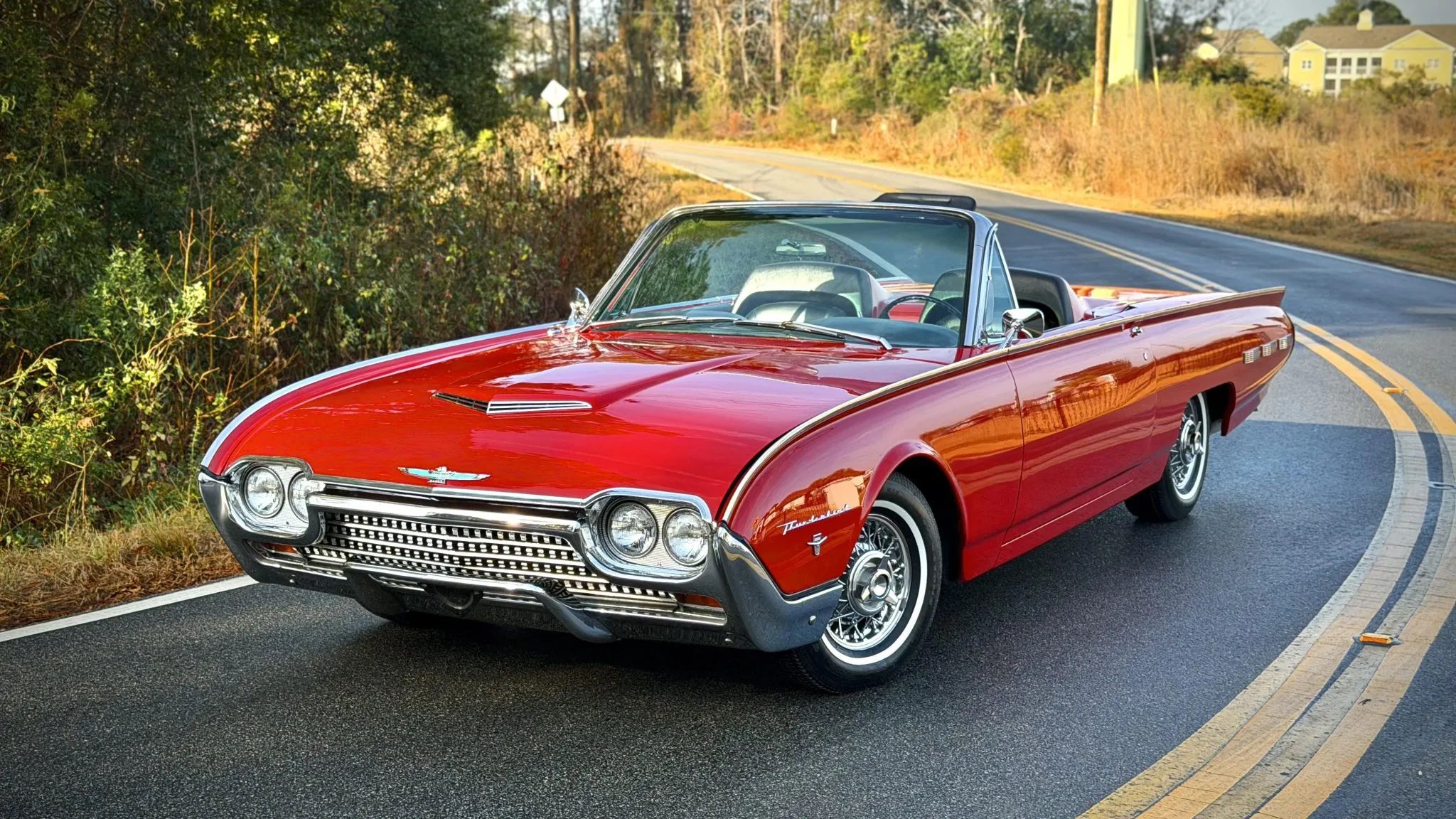
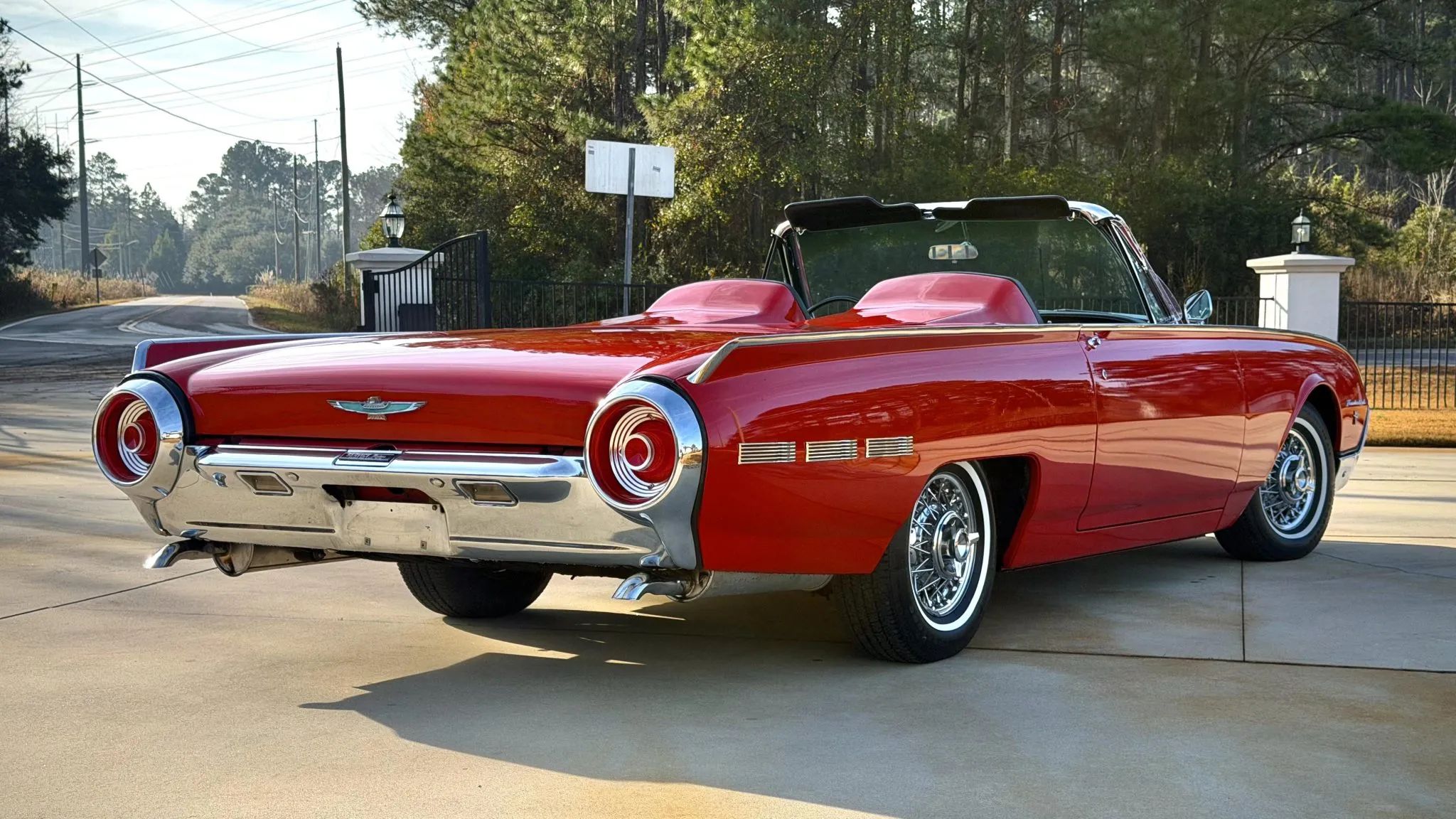
The two-seat “Baby Bird” set a styling tone that was difficult for subsequent Ford Thunderbirds to equal, but is it possible that this specific 1962 Rangoon Red Sports Roadster, which was designed to bring back that two-seater magic, outdid the original?
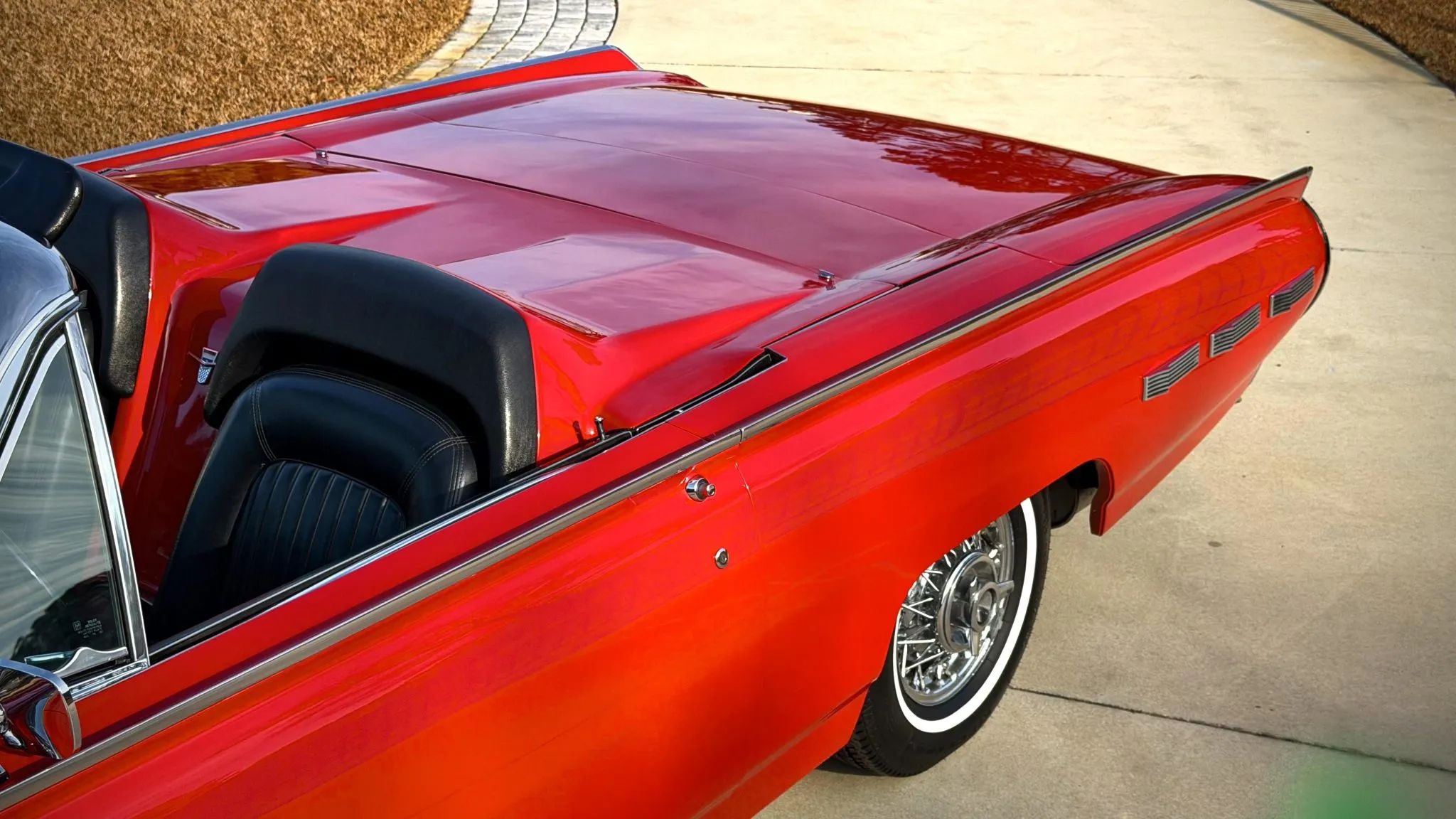
As the owner of a 1963 T-Bird Hardtop, I’m already a fan of the “Bullet Bird,” which rolled off the line in Wixom, Michigan, alongside Lincoln Continentals of the same vintage. Every model from 1961 to 1963 was a high point in the pantheon of Ford personal luxury cars, but somehow, adding a fiberglass tonneau cover, removing the fender skirts, and bolting on a set of genuine Kelsey-Hayes wire wheels elevated the T-Bird’s show-car styling into something even more special.
On paper, the Sports Roadster made no sense. The rear deck was far too long to make the car look like a viable two-seater, and the rear seat remained hidden beneath the tonneau cover, so nothing was really changed. Nobody was mistaking the Sports Roadster for a sports car.
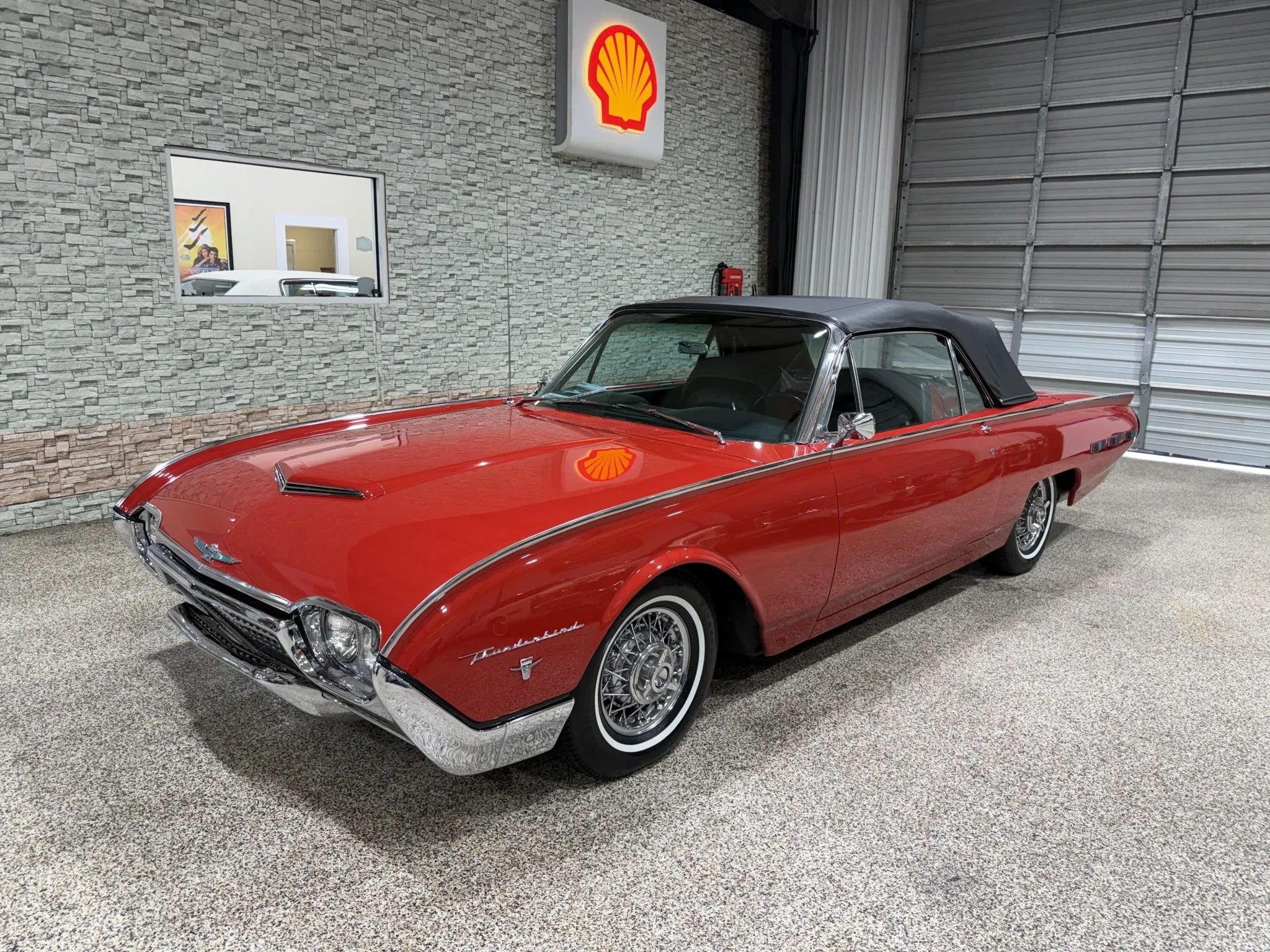
And when the top was raised, the Sports Roadster looked like any other Thunderbird Convertible, aside from the fact that the wheels were a lot fancier and the fender skirts were missing, an omission that some fans see as a detriment to the Bullet Bird’s smooth styling.
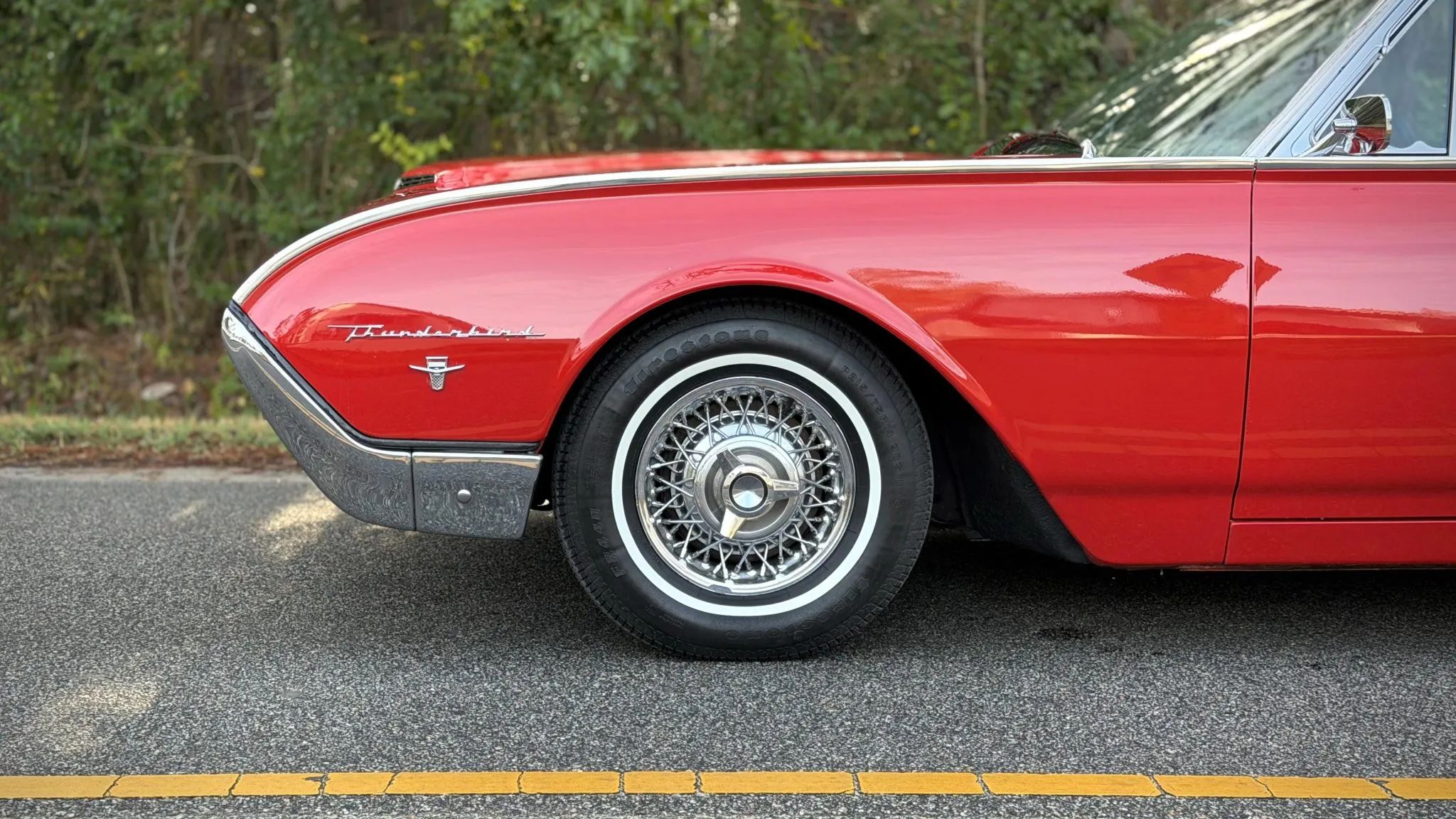
On the outside, the only other difference between a Sports Roadster and a standard Convertible was the little badge beneath the “Thunderbird” emblem on the front fender. And speaking of the wheels, they caused a big headache for Ford.
According to squarebirds.org:
The wire wheels were also associated with service problems and bad publicity from the very beginning, with complaints from customers about flat tires on their Roadsters due to slow air leaks. It wasn’t good for public relations to have new Roadsters sitting in driveways with flat tires. To make it worse, several reports of wheel failure cropped up. One of the cars affected was Elvis Presley’s Thunderbird Sports Roadster, which was one of the first Sports Roadsters built. Mr. Presley was at the peak of his popularity during this time…Presley was on a drive in his new Sports Roadster when one of the wheels collapsed, apparently while turning at a good rate of speed. This incident made the national headlines, and sent engineers at Ford and Kelsey-Hayes back to the drawing board to refigure wheel load and tolerance. It was determined that the spokes on the forty-eight spoke wheels were slightly undersize at 1/4 inch, and that the diameter of the spokes would need to be increased to 5/16 of an inch to allow for proper safety margins. Ford immediately recalled the wheels, fitting Sports Roadsters in the field with standard wheels and wheel covers until the new Kelsey-Hayes Wire Wheels could be manufactured and installed.
Squarebirds.org continues:
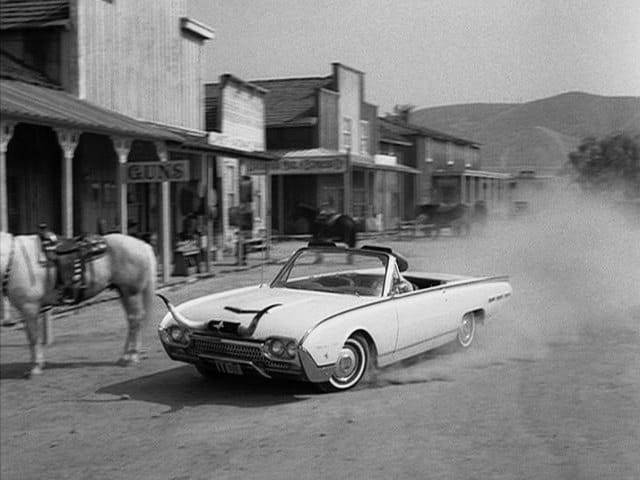
This is proven by an episode on The Twilight Zone, titled “Showdown with Rance McGrew,” which had an original air date of February 2, 1962. This episode was filmed and copyrighted in 1961, and featured one of the first Corinthian White 1962 Thunderbird Sports Roadsters built, complete with all of the Roadster accouterments–with the exception of the wire wheels. Standard wheels and full wheel covers were provided. Apparently, this episode was filmed during the wire wheel recall period. In addition, the wire wheels were not capable of holding air, which meant inner tubes were required on the wire wheels. Tubeless tires had been around for awhile at this point, so this “technology” seemed to be a step backwards. To prevent heat buildup between the tube and the tire, thousands of tiny holes were punctured through the sidewalls of tires fitted to these wheels, and the notation “Tubeless” was ground off in an attempt to prevent the use of “non-ventilated” tires.
In the still image from that episode pictured above, only two things identify that car as a Sports Roadster, the fender emblem and the lack of rear fender skirts.
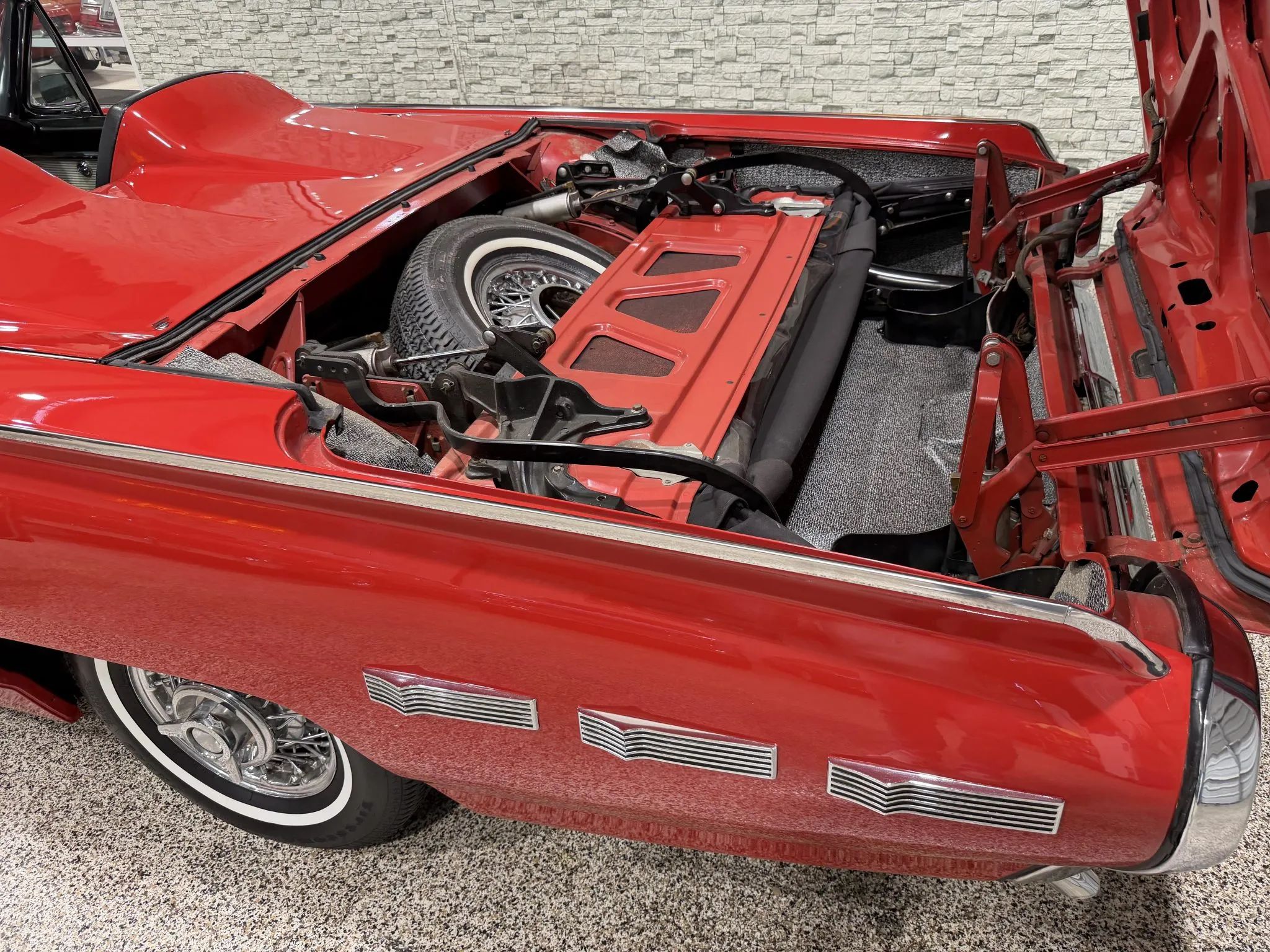
Wheels aside, the Sports Roadster was just as impractical as any Thunderbird Convertible, with a complicated top mechanism that folded the top (and its hard boot) straight into the shallow trunk, leaving even less cargo capacity than the car had with the top up. While one might argue that nobody was loading up their Sports Roadster with the whole family and the dog for a three-week vacation, the lack of trunk room with the top down might have swayed some buyers to cross shop other luxury convertibles.
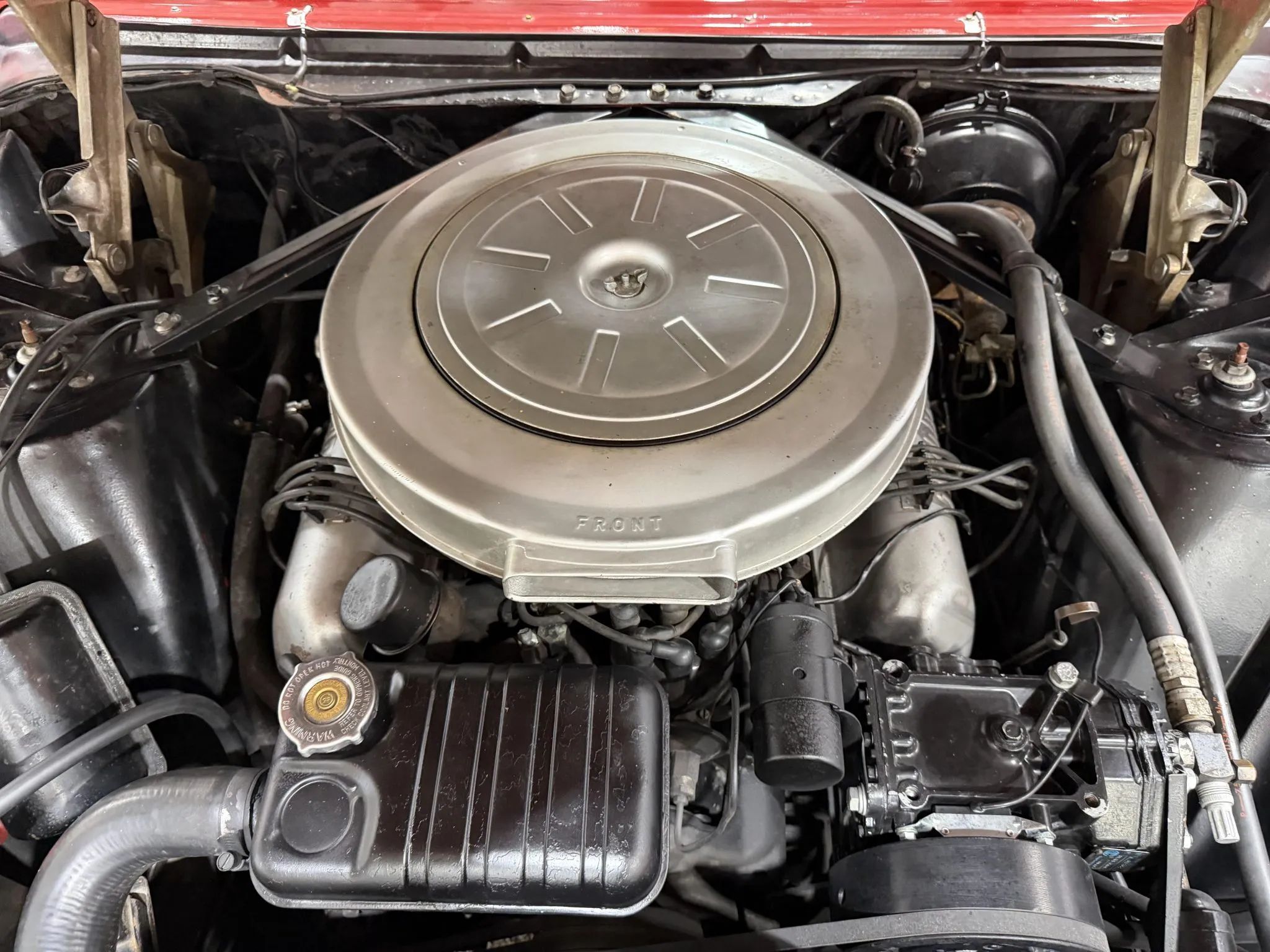
The engine put no additional “sport” into the Sports Roadster either; the standard Z-Code 390 four-barrel produced the same 300 horsepower and 427 lb.-ft. of torque as it did in your neighbor’s Thunderbird Hardtop. An M-Code 340-horsepower 390 with three two-barrel carburetors was available as an option on all Thunderbirds, not just Sports Roadsters, but only 145 were sold (and 120 were unsurprisingly found under the hood of Sports Roadsters).
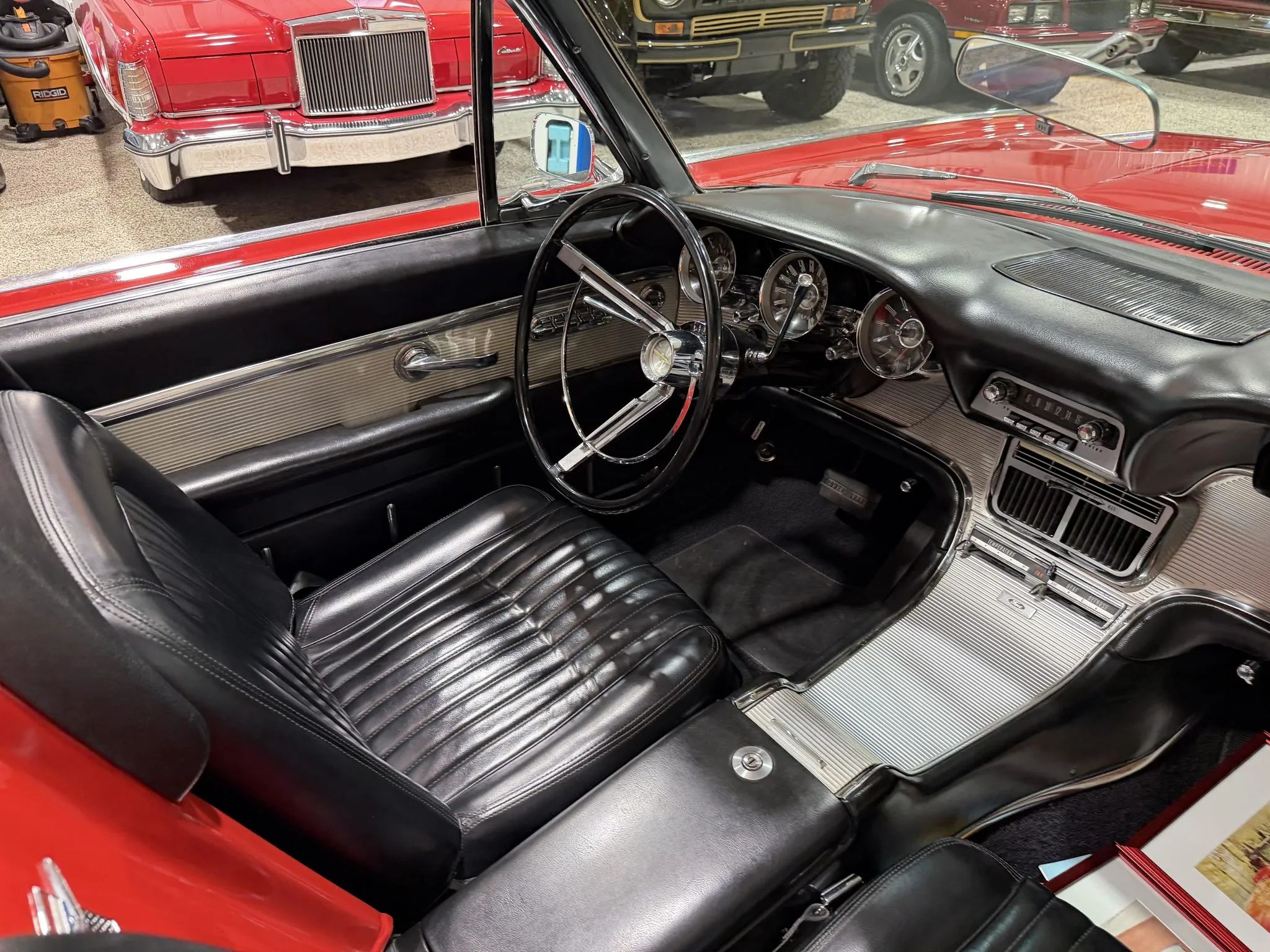
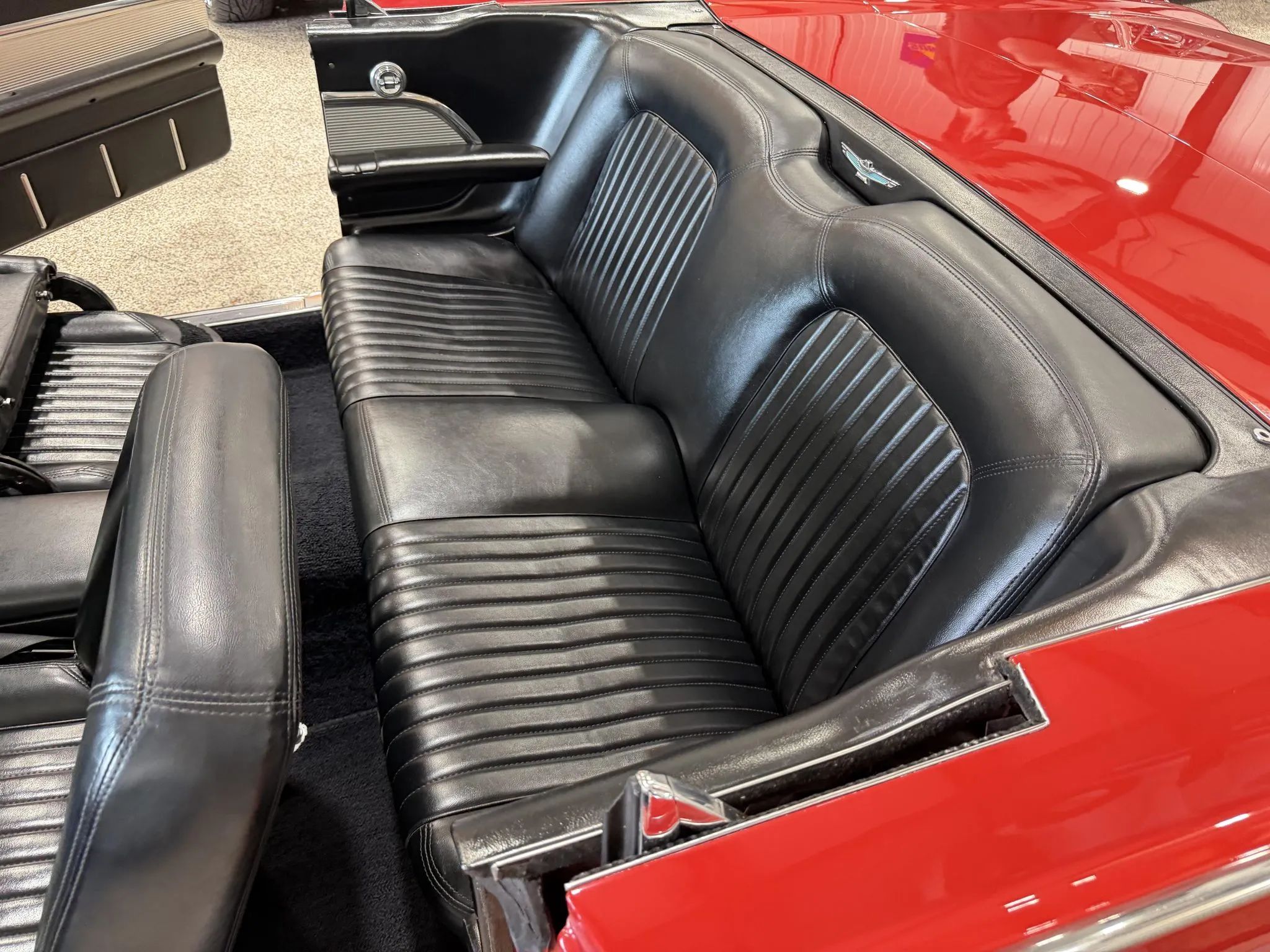
Aside from the tonneau cover, which did add a feeling of two-seater snugness, the only difference between a Sports Roadster’s interior and a Convertible’s interior was a grab bar mounted to the dashboard beneath the dash pad (which is in excellent condition on this example). In every other way, the regular T-Bird’s beautiful interior carried over, and this example has air conditioning, which was not always a given with a T-Bird Convertible.
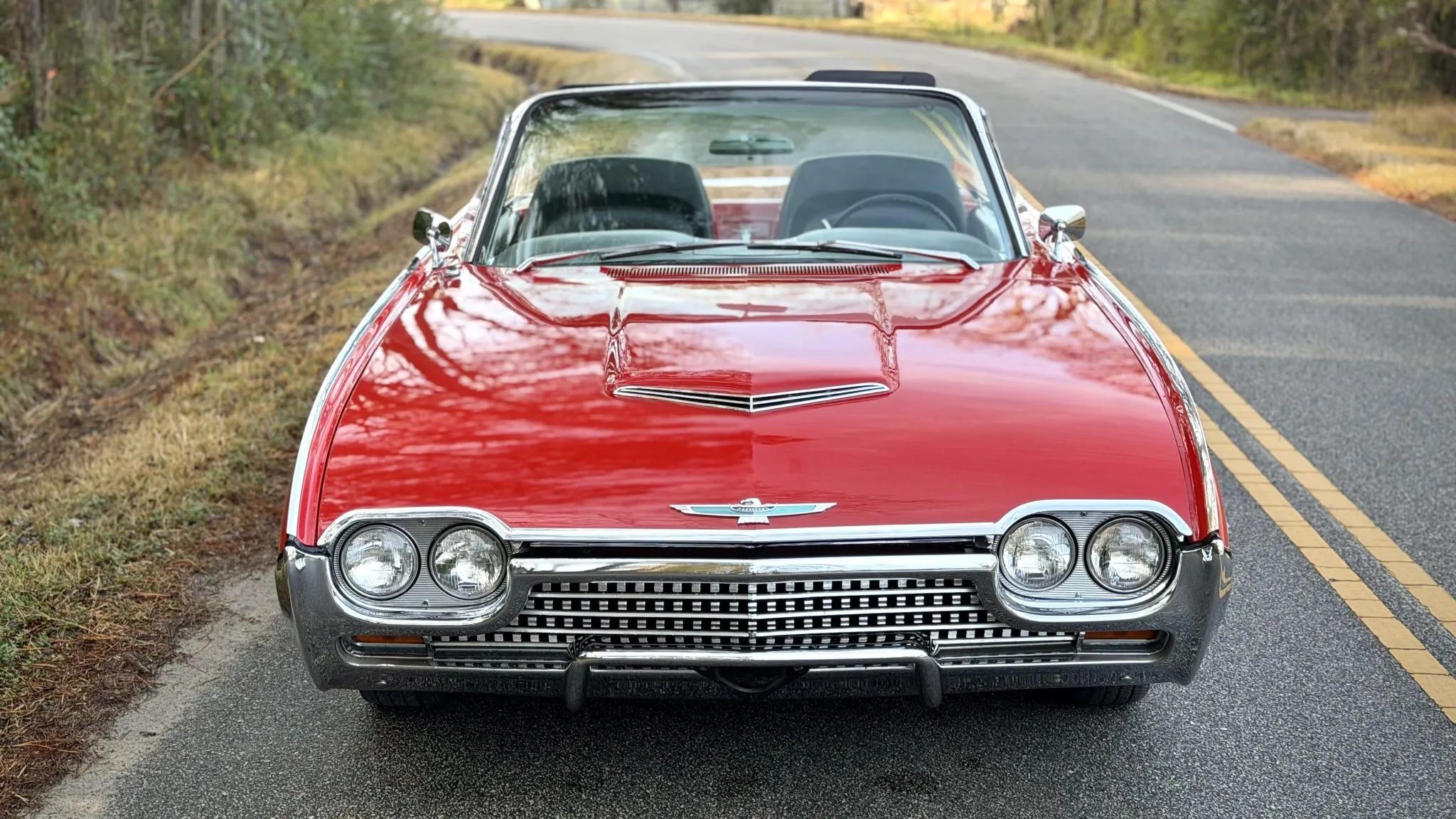
Factor in the staggering price difference between the Sports Roadster and the similar convertible ($5,439 vs. $4,788), and it’s easy to see why the Sports Roadster was a slow seller. Only 1,427 were sold compared to a total of 8,457 Convertibles, and even fewer found homes in 1963 before the model was dropped.
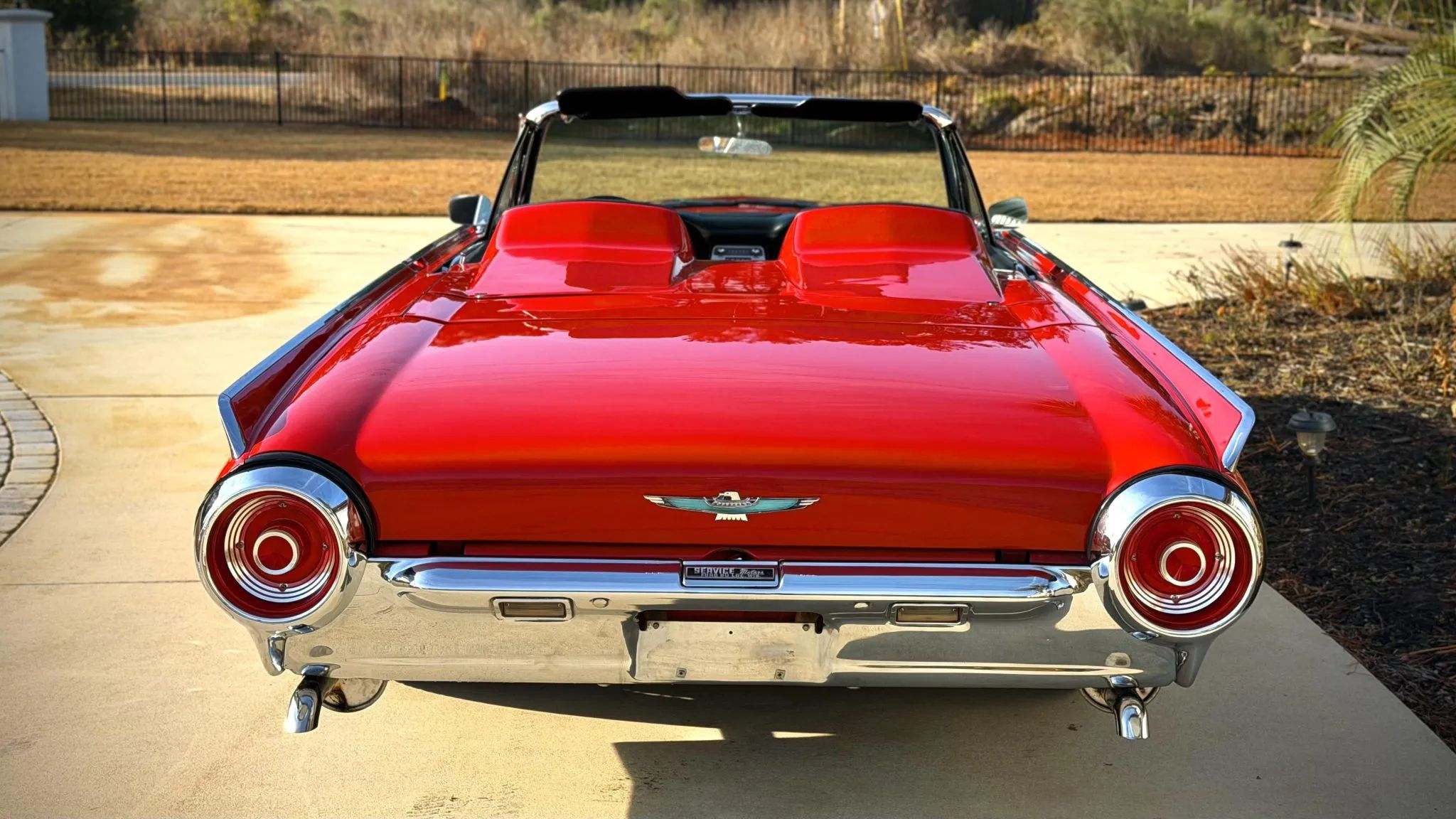
But none of that matters today, because those few Sports Roadsters that did sell command quite a premium over almost any other Thunderbird, and that’s almost certainly due to their dramatic looks and relative rarity. This example sold for an admittedly higher-than-average $70,000 on Bring a Trailer in February 2026, and while it’s very nice, I’d classify it as a good driver rather than a show car. Because of its desirability, it’s important to be diligent in your research when buying a Sports Roadster.
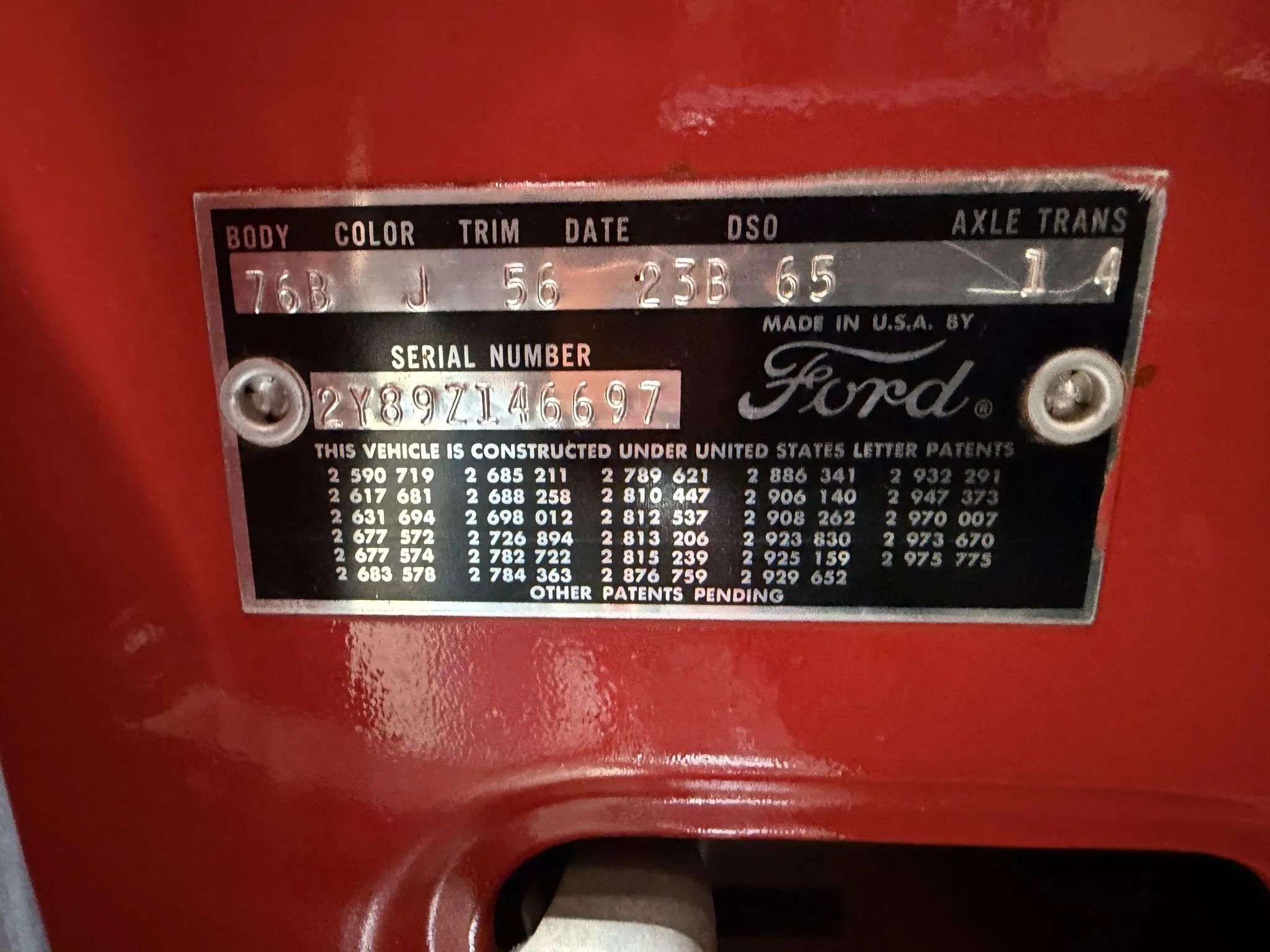
While the Sports Roadster got its own “76B” body code fairly early in the 1962 model run, some very early examples still had the “76A” body code of the regular Thunderbird Convertible. Since it’s fairly easy to recreate a Sports Roadster from a Convertible, anyone should demand a paper trail before paying a premium, especially if the car has the “76A” body code and is being presented as an early Sports Roadster.
The market seems to have spoken, and while certain 1957 Thunderbirds with rare engine codes sell for more money than Sports Roadsters, few if any other T-Birds do. Mechanically, there is no difference between this racy ragtop and my plain old ’63, so we have to assume that Ford’s stylists got the most bang for their buck. By adding a little fiberglass and a set of troublesome wheels, they created a classic, a car that I think tops the list of a long line of fantastic-looking T-Birds.
Related Reading
CC Cinema: 1962 Lincoln Continental and Ford Thunderbird Wixom Assembly Line (by Tom Halter)
CC Capsule: 1962 Ford Thunderbird – Let’s Talk About the Sports Roadster (by JP Cavanaugh)























I might agree with you – If not for seemingly every owner of a 1961-63 Thunderbird convertible having paid for the reproduction tonneau and wire wheels (and painting it red). There was a time (though that time may have passed) when every Thunderbird convertible of this generation you might see at a show would present as a SR, whether it had been built that way or not. I got to where I would gush all over a non-SR convertible, but would walk right past one with the SR pieces.
I am trying to take a fresh look, and I can see the attraction. Though I am one of those people who thinks this body needs fender skirts to look right. One bit of trivia I recall is that the skirts had to come off of SR cars because the original wire wheels would not clear them.
I have always wondered how effective the air conditioning was in these, with the only outlets for cold air being in the middle of the dash. I would think that it would be a trick to get decent air distribution with that setup, but then I have never ridden in one to actually experience it.
You’re right on the wheels, JP. The skirts wouldn’t clear the knock-off caps.
I wish I could discuss the air conditioning, but I’ve never bothered getting the unit in my car working; it’s needs pretty much everything and I just wouldn’t bother using it all that often.
My (actually wife’s) 61 Coupe is a non A/C car.
I am building the 390 right now and I was going to put some retro-fit A/C in it; but my wife doesn’t use the a/c in her daily driver 90% of the time. Why bother?
I’ve been surprised lately at the number of people who seem downright hostile about cars without air conditioning. A quick stroll through the comment section at Bring a Trailer, etc. makes you wonder how people have the bandwidth to care so much, but I also understand that many climates are much harsher than mine in the summer.
March was a record-breaker for Tucson. For the first time on record, we broke 100 degrees in March. April so far feels more like May. I don’t think it’s an exaggeration to say that we use car air-conditioning from March into November. For most of us in the southwestern deserts, a car without A/C is a dealbreaker. I too have wondered how well the A/C in the center of the dash on ’58-’66 Thunderbirds worked.
I vividly remember seeing my first SR,a red one parked with the top down at a little church for Sunday mass at Stony Brook, NY, a tony little Hamlet on Long Island, where we were staying with a distant relative in the summer of 1964. No, there were none in Iowa City. And yes, I was duly impressed.
I’ve never had a car with vintage wire wheels, so it never occurred to me that many of those wheels weren’t airtight and had to be used with inner tube-type tires. More recent wire wheels have spokes that don’t poke through the wheels allowing air out of tubeless tires.
Yes, the SR is in contention for best-looking T-Bird ever, although a few others are in contention.
Didn’t know there was an automotive recall that was set off by Elvis.
I don’t know if the proportions of this TBird, with the tonneau installed, influenced the ASC McLaren Mustang designers, but the TBird got it so right, and the 25 year newer car got it so wrong. I liked these when I was six years old and it still looks perfect to me. Though I’d prefer white to red.
CC Effect that there’s an ASC McLaren Mustang also posted today? 🙂
My parents had many old National Geographic magazines and, unlike most children with National Geographic, I would peruse the car ads. This one was my favorite:
Not true. My mom picked up a stack of 1950s era National Geographic magazines at a rummage sale and I only looked at the car ads. Well except for the photos of topless Polynesian women.
I love it, Adam! I have that exact ad hanging on the wall of my car room right now.
We had a bunch of “Life”, and “Look” magazines. I liked the car ads as well. The “VW” ones, so, so plain, always interested me.
In 1964 the tonneau and wire wheels were available as options rather than a separate model. I did see a ’64 T-Bird so equipped at a car show about 20 years ago.
Yes, and for a while, replica tonneau covers were very popular with Flair Bird owners, so it was common to see ’64, ’65, and even the occasional ’66 T-Bird with a tonneau and sometimes also wire wheels (albeit bigger ones with clearance for disc brakes).
Well, I learned something today. Back when I was a 23 year old kid in 1983 with a new Aero Bird, I went to a cruise in with some friends, and a guy with a beautiful light blue metallic ‘66 Flair Bird encouraged me to park in the space next to him. When I got out and looked at his car, he had the tonneau cover in place on his car.
I thought that it was an option you could get, but didn’t realize it was its own model for the ‘62 & ‘63 Bullet Birds. I thought that it was its own model all the way thru ‘66 when the convertible itself was discontinued.
Anyway, it was the first one that I ever saw.
I loved the look of these! I owned a ’62 hardtop in Chestnut Beige Metallic from around ’87-’98.
I never heard about the wire wheel recall, and I definitely never heard the story of poking thousands of holes in tire sidewalls to relieve heat. I worked in a tire shop in my high school days circa ’72-’73 and we routinely put tubes in tubeless tires, by customer demand, to seal leaking/rusted rims. And this was in the tire capital of the world!
These are very beautiful cars. I remember the first time I saw a T-Bird with the tonneau cover, I was utterly gob smacked! Even though it was really big, it seemed to suit the lines of car. The overall styling is, in my opinion, the best of any T-Bird ever made.
Wire wheels are a complete headache. Yes, they look cool, but try cleaning them. The spokes routinely get loose and have to be tightened by hand, laboriously spoke by spoke. Owners would get a bill for this and proceed to be shocked, angry and reticent all at the same time.
To my eyes the ’57 was the prettiest T-Bird ever, and one of the cars on my bucket list (Citroen CX is another one) though I like all the 2 seaters and ’60 to ’64.
Anyone else remember Fred MacMurray driving a new ’57 into a tar pit in an I Love Lucy episode?? I was shocked and traumatized!
I remember that Fred MacMurray scene. It was in Episode 3 of the Lucy-Desi Comedy Hour (post-I Love Lucy). As a kid I too was traumatized to see beautiful cars like the 57 Bird in danger of damage. Only car nuts can understand…
AARON65, excellent abbreviated review on the 1962 T-Bird SR. Anyone who has read my comments on this site know I am a T-Bird fan. My Mom bought a new 1960 Bird convertible, Dad bought a new 1963 Bird hardtop (at my pre-teenage rant), a 1966 Bird Town Landau (I didn’t have to rant). The 1963 became mine in 1967 and the 1966 was mine late 1969. Currently I have a 1966 Bird convertible.
I think the Bullet Birds are the best of the best regarding T-Bird body styles. Agree, if you are in the market for a 1962-63 SR, check the VIN #, and there are T-Bird Clubs and Registries to confirm originality.
There was a comment about the AC on these cars. My 1963 had AC, worked beautiful as well as the AC on my current 1966 convertible. Even without the AC on, vents on these cars helped to cool the interior airflow.
The skirts on 1955-66 Birds were optional, call fender shields. My 1963 came loaded with options including the fender shields. However, when my parents gave me their 1963, I removed the skirts & optional deluxe hubcaps and replaced the hubcaps with wire wheel hubcaps from a 60s Oldsmobile. As a teenager thought my Bird looked more sporty. Regarding my 1966 Bird convertible, it was factory ordered without the optional fender shields, but otherwise loaded with options including AC. Only on the 1966 Birds there was SS trim around the front and rear wheel wells. With skirts the SS trim was on the bottom of the skirts, without skirts the SS trim was on the open rear wheel well. On my 1966 Bird I decided to put correct only 1966 skirts on my car, but retain the correct factory SS trim if I want to remove the skirts.
As a side note: Judging T-Birds it is acceptable to have wire wheels, but only 1962-63 T-Bird Sport Roadsters came from the factory with true wire wheels.
A period pic of my 1963 T-Bird in Miami with Oldsmobile wire hubcaps. Heritage Burgundy with Peal White interior:
Thanks, Alfred. Regarding the fender skirts vs. no fender skirts debate, I don’t have a really strong opinion. I think your hardtop looks great without them, and I think mine looks great with them. I feel the same way about the two-seaters.
With or without the skirts this Bird is a beautiful, timeless design. Altho from what I’ve read: it’s mechanicals and construction don’t seem to match the superaltive styling.
Maybe I’m a wee bit biased because as a 16 year old I got to drive one thanks to it’s gracious owner. I can’t remember if it was a ’62 ot ’63, or? but-OH WOW-getting to drive a NEW THUNDERBIRD, even tho it was a short drive under the owner’s watchful eyes..just OH WOW!! Given my father’s car was a bare bones, ’60 Chevy Biscayne 6, 3 on the tree, 4 door sedan……..uh, yea. I’ll never forget that short drive in that POWERFUL Bird! :):) DFO
One of my favorite car reviews of all time was of this very model – a 62 Rangoon Red Sports Roadster – in the September 1962 issue of Motor Trend which I still have, though it is falling apart. As a 12-year old I was totally in love with this car. The reviewers considered it a beautiful, prestige car despite its faults:
“Who cares if the car has a large price tag, is grossly overweight, offers less than average performance (even with 300 hp), will consistently deliver horrible gas mileage, at times handles like a land-locked whale and suffers from an almost complete lack of usable storage space?….In spite of what we consider to be faults, we wouldn’t have the T-Bird any other way – it’s the only car around that can make even the lowest peon (like a road tester) look like a million bucks behind its steering wheel.”
BTW, this car is from Competition Cars in Myrtle Beach and their YouTube channel is a lot of fun and undersubscribed IMHO. A lot of focus on originality, something many CCers appreciate.
I have that road test in a compilation of T-Bird road tests, and I still think about that review when I drive my ’63. I agree with everything they said, but I will also add to its flaws that it is one of the most unpleasant cars to work on I’ve ever seen. Still, I feel pretty prestigious behind the wheel. 🙂
Best-looking Thunderbird? By several miles!
This is what I think of when I hear the word Thunderbird. I would have been five when this came out.
Big enough to carry four (two with the cover in place), no needless bulk, and some of Ford’s best styling ever.
Later Birds got less sporty-looking, more formal, and finally devolved to being just plain old two-doors, all gorped up with brougham gunk. Until they finally tried to return to the T-bird’s roots in ’83 – but it still didn’t have the look, the proportions of old.
I’ve got a red ’62 somewhere, can’t find the photos just now.
Now THAT is a sweet model, Peter. These look good in white, too.
Indeed! It would seem that The Stig also approves.
I see the attractiveness of these and why they were so admired. I’ve always been more of a 66 TBird guy with the linear taillights and the more upright grille. The front of these ’62s was a bit too droopy to my eyes.
I didn’t like these when new, after I passed 50Y.O. I began to see their beauty .
SO BIG ! .
I like cars to fit like a pair of gloves, be they sporting or not .
Only those who regularly worked on these years of Fords will understand why they’re so hated .
I love this one, everything is *perfect* but still not a car I’d buy .
The AC thing depends where you live and how fat you are (ahem) I now have working AC in almost all of my cars as I like to drive way out in the Desert .
-Nate
I agree that the ’62 is a beautiful ‘Bird, but my love (LUST!) is for the ’66 with tonneau and fender shields!! 🙂
“George’s, snooty sister, “Deidre” drove one in a “Hazel”, episode. ((circa “63”)). Was actually one of the better written episodes. Good story line, quite comedic.