

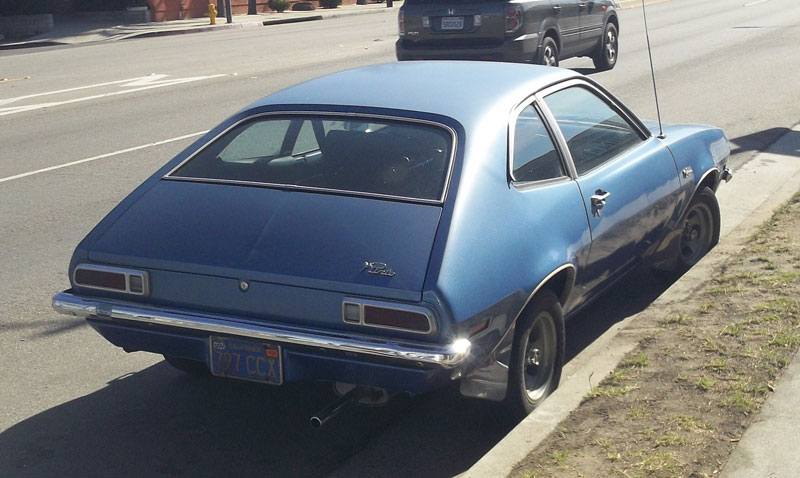
There it sits, the Mighty Blue Pinto. I drove a medium blue ’72 Pinto Runabout (hatchback) back in high school, and still recall it with fondness. When Dad went car shopping for a third car, he looked for one critical factor- Overall length. Dad already owned a Toyota Corolla, and calculated he could park two cars on one side of our exceptionally deep garage, IF he kept the second car’s overall length below 165″. This led to some very interesting conversations with used car salesman, and resulted in the purchase of the blue Runabout (and yes, per Dad’s plan, both cars fit in the garage ).
While the Mighty Blue Pinto met Dad’s single requirement, it also came with a 2.0 liter 4 cylinder, 4 speed manual, and 3.82 rear axle ratio. As I subsequently discovered, this combination added up to the most potent Pinto ever produced.
I understand that my take on the Pinto does not match the normal view of this car, but understand I’m talking about a very specific powertrain, installed into a car without the additional mass present in later model Pintos.
Having said all that, let’s check out this Curbside Classic before we continue my trip down memory lane. Based on the visual cues (primarily the bumpers), this car is a 1971 or ’72. Since it’s a sedan, it includes a real package shelf for 6 X 9 speakers behind the rear seats (something the Skinner hatchback lacked). Looking inside, an automatic transmission lever identifies the engine as a 2.0 liter OHC four- The base 1.6 pushrod motor only mated to a four speed manual transmission. The wheels mimic genuine Ford wheels that first appeared on the 1974 Mustang II, so they aren’t original equipment. Still, overall this Pinto appears quite stock.
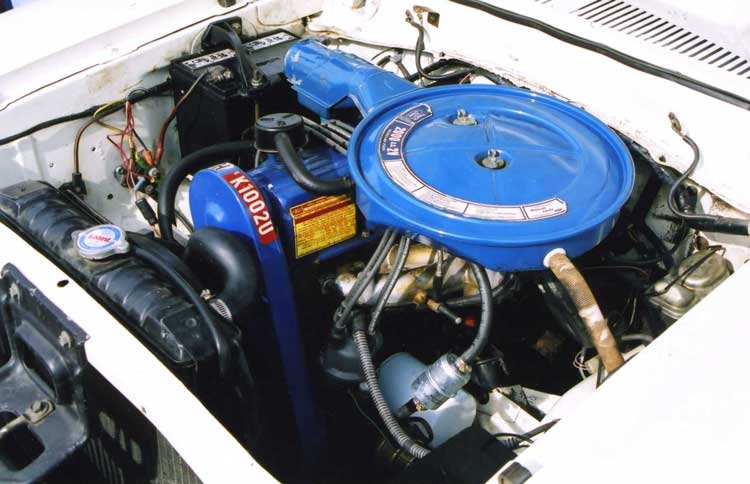
As I said, the 2.0 liter OHC four is the desirable Pinto engine, but only if it’s mated to the four speed manual. German designed and built, the engine provided a good power to weight ratio, smooth power delivery, and a fat torque band. Also offered in the imported Capri, this engine lived in the US market for a brief four years, and is relatively unknown among US car enthusiasts. Regular readers may recall that Paul Niedermeyer wrote about driving new OHC Pintos in his biographical series, and praised the motor when matched to a four speed manual- At least as compared to the other new cars available at the Ford dealership.
Perhaps most surprising, Car and Driver had this to say about driving a Pinto (from a 1971 long term road test):
“The Pinto is exceptionally satisfying, even amusing, as a city traffic car. It’s highly maneuverable, visibility is extremely good in every direction except toward the rear corners, and it has the sharp-edged, go-stop-turn feel of a sports car. With this in mind, there are two bargains on the Pinto’s option list: the 2.0-liter engine for $50, and the disc brakes, which will set you back $32. Without those two extras the Pinto is just another low-dollar transit capsule—with them it’s a real urban flogger’s car. The “big” engine is relatively smooth and quiet and very powerful. It also revs like a dentist’s drill. The 4-speed transmission which backs it up is right for the task with short, quick throws and a solid, stubby lever.”
Surprised? Having lived with one for four years, I know the 2.0 Pinto delivered, at least when compared to the contemporary competition.

Looking into the interior of this Pinto I once again see very familiar territory. This car shares the same base vinyl interior of my Dad’s car, complete with a painted metal dash below the safety padding. Ford offered interior upgrades (things like cloth seating surfaces, “plusher” steering wheels and plastic wood grain accents), but this one left the factory with the cheapest skinny spoke steering wheel, and large expanses of vinyl on the door panels. I’m surprised to see a club mounted on the steering wheel- Nowadays the only cars more theft proof than a Pinto are a Vega or Gremlin from the same era (V-8 Gremlins excepted, of course). I once left the keys hanging in the trunk lock of a Pinto parked on the curb in downtown Denver. Five hours later, the keys were where I left them, hanging in plain sight.

Here’s a shot of an interior taken from the internet. It better highlights that cheap steering wheel and broad expanses of painted metal dash. This minimalist approach to overall vehicle design led to a light weight car, which also helped deliver class leading performance.

I do see a couple of features in this final shot that my Pinto lacked. The brightwork around the windows and wheel arches are optional upgrades, making this Pinto even more desirable. Speaking of desirable, sharp eyed readers may have noticed this car wears a “For Sale” sign. Am I tempted to buy it and relive my youth? Let me answer that by making three critical points:
1) It’s an automatic. I’ve got no interest in an automatic with only three gears, nor any slush box mated to an engine displacing less than 3.0 liters.
2) It’s forty years old. I said the Pinto performed well compared to the competition from its day. Now? Not so much.
3) The asking price is $5,000. That’s about $4,000 more than I’m willing to pay.
However, if my glowing description of this fine machine has interested any readers, I’d be happy to swing by and jot down the phone number for you. Christmas is just around the corner!
A Final Note- Starting in 1974, Ford installed the 2.3 liter “Lima” four in the Pinto. While there are structural similarities between it and the 2.0 liter, they have completely different characters. In the grand tradition of seventies era emissions, the Lima engine was down on horsepower, had a lower redline, and lousy Noise, Vibration and Harshness (NVH) brought on by an additional 300 ccs of displacement. The Lima motor went on to entwine itself deeply into Ford’s (American) history, but you will not see me extolling the performance virtues of a Lima equipped Pinto. I would, however, still extol its reliability and toughness. D/S
Note: a rerun of an older post.























I had an Aunt who bought one of the first Mustangs, then when I was a little kid she drove a yellow Pinto. Yes I have actually ridden in one, and it made Dad’s Zephyr wagon seem like a Continental LOL
I don’t doubt the one described was sprightly, but to be fair being the quickest Pinto is a bit like being the smartest kid on the shortest bus 🙂
The 2.0L motor may have made for the quickest Pinto, at least until the emission controls began to sap more power from the engine as the decade of the ’70’s proceeded, but the 2.3L offers more retrofit options. The same 2.3L “Lima” engine that was in the Pinto became the power plant of choice in the SVO Mustang and T-Bird Turbo Coupe, when it was upgraded with turbocharging. The addition of the turbo included significant internal upgrades, including oil jets under the pistons, a forged crank, an oil cooler and electronic fuel injection (EFI). I can’t recall if balance shafts were added at the same time to quell the Noise, Vibration and Harshness (NVH) of the “Lima” engine, but it wouldn’t surprise me if that were the case.
3.82 axle, no overdrive, and tiny 13″ tires. Must have been a real screamer on the highway.
My ’72 dark green Pinto wagon had the 2.0 w/ auto was used for commuting from out in the country into a bad part of Baltimore City to spare our ’73 Plymouth Suburban wagon (400 V8) and save on gas . With good radials and rack and pinion and with very balanced weight it was very tossable and fun, at least once up to speed. Did yeoman duty for several years and with a primer gray r quarter and dull paint it was left alone, even when the barbed wire computer center parking lot was full and it was parked on the street where passed out winos or dopers lay on the stoops. Sadly totaled by an inattentive driver while I was stopped for a turning bus. RIP lil’ wagon, you were fun.
My father had a 71 2.0 with a 4 spd. I was really good with carbs back then so I reworked his. I also learned from my mechanics teacher to advance the overhead cam 2 degrees and also advanced the ignition timing a few degrees. Made all tbe difference in the world. Dad never once asked what all I did after telling him just the timing belt needed replacing.
I second all your comments in the article Dave. I had a ’73 Pinto with the 2.0 and 4spd. It was my first car and I loved it. Excellent engine, the only things I did to it in a year and a half and almost 40k miles were a timing belt and a coil. I echo the fact that it was a REAL dog with the auto but not the 4spd.
When our daughter went to RRadford University, she needed a car she could afford to drive. A friend at work had a 1975 Pinto Pony MPG. It was an interesting car, Ford had managed to get it 49 state certified without a catalytic converter and then used some old tricks for decent performance and fuel economy. Exhaust was pretty free flowing especially without having a catalytic converter. She drove that car for probably 5 years, till the useless jerk she was living with parked it in the back yard when the exhaust system needed replacing. By the time she asked me to see if I could fix the exhaust, the floor was rusted out.
The fastest street Pinto would be more like my brother’s 1971 hatchback. Within 6 months of getting it in October 1971, upon turning 16, he had removed the 2.0 and turned it into a 11.0:1 compression monster complete with induction and exhaust changes. Throw on some 14″ tires with mags by June 1972 in time to move north. Him and I had a summer job out in the Sacramento Delta region at a tomato canning plant in Thorton. You drive along Highway 12 which is on top of a levee which means water one side and a downhill embankment on the other side and he is passing slower cars twice a week. My fingerprints are probably still embedded in the arm rest. Car could easily hit 100 mph quickly but in a car that light, compared to my 67 Parklane, the comparison stops there. He joined the Navy in 76 and moved onto F-4 Phantoms and F-14 Tomcats before ending up at United retiring as Chief Mechanic. The Pinto disappear in 76 and today has a warehouse filled with motorcycles, some he bought, and many others just given to him and I am not talking 350cc here.
Yeah, I’ve long heard that was the Pinto engine to have. Never driven one, but I have driven the 2300 and those things are dogs. Moderate torque, didn’t like to rev and little HP. Even with a 4 speed, but the auto was much worse.
So, perhaps a low bar, but the best is the best. But all that was common knowledge back in the 70s and I’m not even a Ford or domestic car guy, and I knew it!
The faster Pinto is the 1.6 engine, with a 4 speed. Back in 71 ,mechanics from Ford dealership got 117 mph from one lol
Mid 1970s, first job after I graduated with a degree in Interior Design. I took the first job offered at a department store in Roanoke VA., interior design services. I was only going to be there for 12-months, then move to Houston. Twelve months in Roanoke and I did move to Houston. All was not wasted, I met a mentor that changed my life.
At Roanoke, I was given a company car, a new Pinto. That car was such a slug. Going up any hills I had to floor it, it was so underpowered.
I remember watching the guys racing in the GTP class at Summit Point – you never really look at Pintos the same way after!
Dave, that may actually be a 1973 Pinto. I took delivery of one in that color with the 2.0 and a stick, with a white interior, in March of ’73 and my license plate was 673 BIA. California issued the plates sequentially.
The ’73’s front bumper stuck out further; it was a 2.5 mph bumper. This doesn’t have that.
Remember the Pangra ? Pangra” most commonly refers to a 1970s American kit car based on the Ford Pinto. Developed by Jack Stratton of Huntington Ford in California (1972–1973), it was designed as a high-performance, turbocharged, Pantera-inspired alternative to the standard Pinto. It could reach 175 horsepower with a 2.0L turbo engine.
I went for a test drive!
My father never said much, but one expression I remember was “ Damning with faint praise”. It came to mind when I read the title of this piece. There is not a lot of competition for “the fastest Pinto”.
A good review of an interesting economy car .
I remember Pintos when first released, I thought them “right sized” but nothing more, I wasn’t aware of this slightly larger engine option .
Agreed, it’s over priced but it’s also a rarity these days .
I remember twenty year old Pintos still on the original clutch, Ford could get it right when they wanted to .
-Nate
High school for me was in the San Fernando Valley in Southern California. Every Friday, word would go around where the street races would be at midnight. The locations varied, since LAPD didn’t appreciate our fun. One Friday, a guy showed up with a ’72 Pinto that he wedged a 289 in. It was lowered and rumbled up to the line. When the flag dropped, he smoked a stock ’82 Corvette off the line. It was something to see.
It might also be a ’73, I had a ’73 and had the exact same bumpers with the 2.0 and 4spd. Loved that car, only things I replaced on it were a coil and timing belt. Oh, and by the way, the 2.3 Lima was not an enlarged 2.0. Different (but similar) engine.