

(first posted 8/21/2018) America’s love affair with pickups is hardly new. Sure, it took a while for them to become the perennial best sellers, but ever since the mid 50s, there were signs of a budding crush developing. Ford’s Ranchero was one little but key aphrodisiac in that first process. It took a while for it and its cross-town rival El Camino to find their ultimate market niche, but by then their days were effectively numbered because big pickups had become fully civilized and gone mainstream. Whatever role the American utes had in their fairly brief lifespan was soon played out.
The Falcon version of the Ranchero was particularly interesting, as it also lowered the financial bar, and as such it can be seen as the precursor to the huge mini-truck mania that swept the land a decade or so after it arrived in 1960. And of course it’s the hippest of the bunch.

Ford pioneered the segment in the modern era with its 1957 Ranchero, based on the full-sized Ford; the two door Ranch Wagon more specifically, with which it shared a good deal of its body panels. Going back a few decades, pickups were all based more heavily on the sedan counterparts, but in the 1930s most of them started to diverge with unique bodies and chassis, although there were a few exceptions like the Hudson and the Studebaker Champ.
I’ve covered the ’57 Ranchero here, and titled it “America’s First Respectable Truck”, as real pickups were still widely considered to be the rough and ready work tools of certain professions.

The first shot at respectability for real pickups was the 1955 Chevrolet Cameo Carrier, conceived by Chuck Jordan. It was created by adding sleek fiberglass panels to the universally-used step-side bed of the times, along with a sleek new rear end and bumper, a very nicely trimmed cab interior and some other touches to turn it into something rather different. Sales in 1955 (5,000) were somewhat encouraging given its considerable price premium, but already in its second year, they started to fizzle out.

One can’t help but wonder why they didn’t just use their new 1955 Nomad wagon for the Cameo, or the proto-El Camino. I rather suspect it would have made a much bigger splash and a more enduring one. This one is of course a custom conversion.

Dodge countered two years later with its 1957 Sweptline, which was of course a Cameo Carrier imitation, but by then that approach was passé.
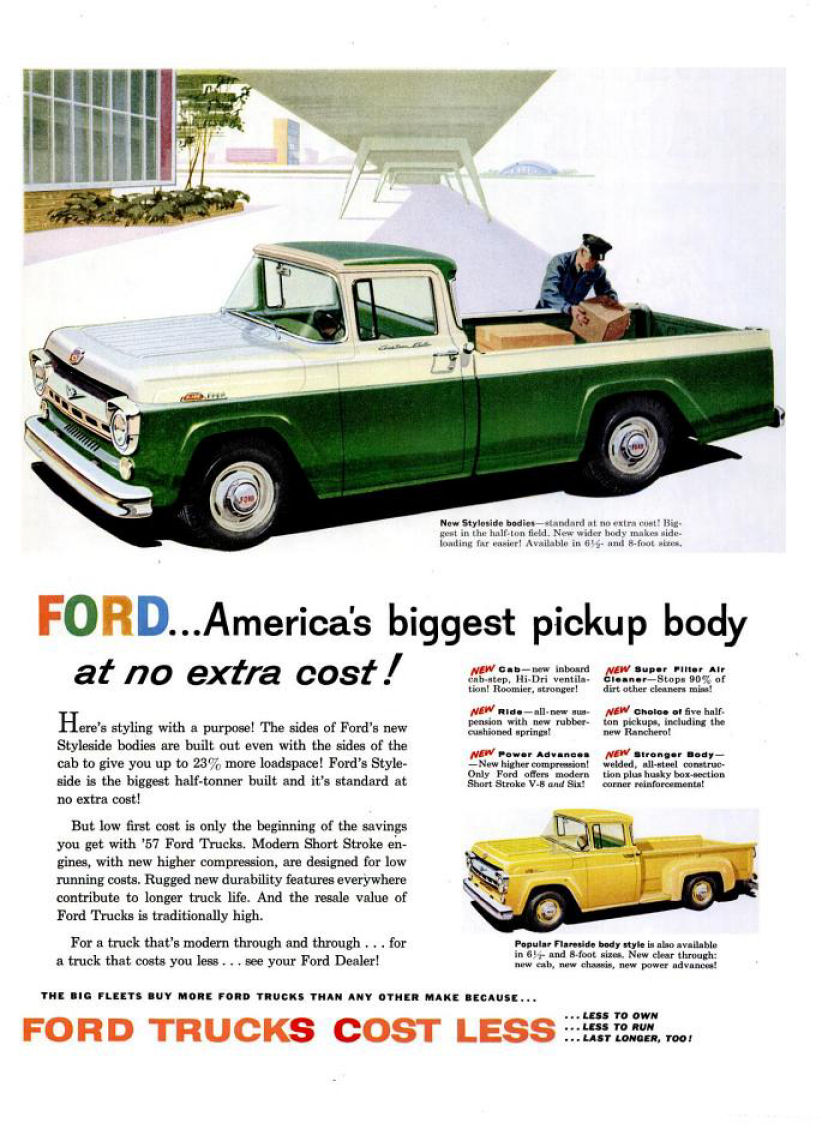
In 1957, Ford showed the way forward with its new Styleside beds, which were the real thing, not just a stepside with plastic falsies. This was a key step in making the every-day pickup look more stylish, and Chevrolet quickly followed in 1958 with its Fleetside bed.

The 1957-1959 Ranchero was decidedly a niche or lifestyle vehicle, and as such, its sales were modest at best. And then in 1959, Chevrolet jumped in with its wild bat-winged El Camino. That only diluted that narrow slice of the market further. Good thing that Ford had already decided to move the Ranchero to the Falcon platform. In any case, the El Camino was a two-year wonder in its first iteration, killed by weak sales and the fact that there was no more two door wagon or sedan delivery in 1961 with which to share tooling. And in 1961, the Corvair Rampside and pickup offered something a bit different, compact and efficient as a complement to the regular pickup trucks.

Of course Ford too fielded a Falcon-based Econoline van and pickup, so Ford was really covering all the bases starting in 1961. But the pickup version didn’t last very long either.

With the Falcon Ranchero, there was now a new emphasis on low price and economical operating costs. Here was America’s lowest-priced pickup, and one that was advertised to get up to 30mpg. Probably cruising at a steady 50 or so might actually yield that number, but the point was made. It all played into the zeitgeist that propelled compacts and low-cost cars into the spotlight, a combination of a reaction to the giant finned barges of the mid-late 50s and a double-dip recession in ’58 and ’61.

The Falcon was also ideal, as it did include a two-door wagon in the lineup, upon which to base both the Ranchero and Sedan Delivery. This means the investment to tool these was not exactly huge. And sales did perk up, as its low cost and efficiency spoke to a segment of buyers looking for a little hauler.

This ’61 Ranchero is very much in sync with the times. Old falcons are cool, so an old Falcon Ranchero ups the ante considerably.

The purple wheels and green hubcaps are the frosting on this tidbit. I don’t know what’s under the hood, but I rather suspect it’s a genuine Falcon six, as these are not cool once they’ve been hot rodded. It may well not be the original standard 144 or the optional 170 version, but a 200 or 250 would make a nice motor in one of these, given how light they are (ca. 2500lbs).

The original bench seat has been tossed in favor of some much more comfortable buckets, and a homemade wooden box does duty as a center console. The floor mounted Hurst shifter raises the question as to what it’s attached to. I’m guessing it’s the original three-speed, or a later fully synchronized version, or possibly a four speed. The 8 ball doesn’t exactly tell us much.

The bed is on its way to looking like the bed in my F100.

The Ranchero was of course restyled in the boxy mode for 1964-1965, and was the beneficiary of the excellent 289 V8 in ’65.

A ’64 Ranchero became famous after it hauled off the compacted remains of a 5000lb Lincoln Continental in the movie “Goldfinger” without breaking a sweat, or spring.

The 1966-1967 Ranchero is a curious beast, as it sported a Falcon front end in ’66.

But the El Camino, which had reappeared in 1964 as a Chevelle offshoot, quickly redefined the genre. Now it increasingly about sporty styling and performance, and when the ’66 El Camino was offered with an optional 396 V8, the gloves had come off. These trucks were now quickly becoming two-passenger muscle coupes with a bed out back for a large cooler full of beer.

Ford responded by swapping out front end clips on the Ranchero, thus elevating it to Fairlane status.

The Ranchero continued to track the evolution of Ford’s intermediate cars, through the Fairlane, Torino and even the LTD II, ending in 1979 with that car’s oversize front end. That has earned it the dubious moniker “center cab” in my book. Quite the contrast from the little Falcon it started out as.

The later Rancheros have their fans, but I’m afraid I’m with the Eugene contingent that considers this one the best of them all. And I felt that way about them before I moved here. I’ve been a fan since I first saw one in 1961.























Nice ute, Strange that the first American Ford ute was the 57 Ranchero and Ford Australia who had been building sedan based utes since forever didnt have that model, they were still stamping out the 55 Mainline utility albeit with Meteor grille. I hope it has a 250 cu in it if it ever gets loaded up, those 144s didnt have much in the way of hp.
GMH didnt do the 55-57 Chev utes either and just built their Holden brand utes and upmarket Vauxhall utes. wonder why?
The US 57 Ford was a major change from 52–56. Australian manufacturing of US 57 Ford style vehicles would have required more than new external panels.
GM didn’t build Chevrolets in Australia. Ford and Chrysler built big US style cars in Australia before the Falcon and Valiant.
In Australia, GM certainly built plenty of Chevs here from Canadian CKD boxes (British Empire tariff-related stuff as to why Canada was the source) until the late ’60’s.
This one looks an awful lot like a ’61 Ranchero that I helped to overhaul back in ’92. It ended up in Seattle soon thereafter, so a later trip to Eugene wouldn’t be unlikely. The transmission was shot so it would have been replaced for sure.
Now that’s a proper pick-up and it’s got to be easier to load than one of the modern, jacked up jobs.
In the 60s, pickup advertising stressed low load height.
In the 2000s, they stressed the built-in extendable step in the tailgate. ‘Cause what you really want to do while carrying 90 lbs of something is climb a rickety staircase when you can’t see your feet.
+1!
Given how early sixties Falcons are a preferred vehicle choice of trendy, minimalist hipsters, it makes perfect sense that Falcon Rancheros would also be valued as hipster-mobiles.
As an aside, I rather like that ’57 Dodge Sweptline, mainly due to the very nice rear platform in front of the rear bumper to access the contents of the pickup bed. OTOH, I guess it wouldn’t be so great to get to the cargo from the rear while standing on the ground..
Minimalist is the right word, for sure. I wonder what it was that first triggered the youthful hipsters to gravitate towards early sixties Falcons? I’m neither youthful nor trendy and so I have no idea.
————
The chartreuse-painted hubcaps and purple wheels on the ’61 Ranchero pictured make me think the owner was using LSD and then decided to do his “thing” with the wheels and ‘caps. I still like it even though I don’t understand what kind of ‘look’ the Ranchero’s owner was going for.
I don’t like those bucket seats. I noted in the article Paul felt the buckets were “much more comfortable”. I wouldn’t ever swap out the bench seats in my ’64 for buckets. My bench seat is quite comfy. That’s one of the many things I like about the car. I’ve ridden in a ’65 Mustang with bucket seats. I’ll take my benches, thank you.
The first standard truck with a full width flush fender pickup box was the 1957 Ford Styleside, not the Chevy Fleetside.
You beat me to it.
Oops; it was getting late last night and I was rushing…. I’ll have to fix that.
Like (a lot), but prefer that blue ’79.
As long as you can haul a motorcycle in the back of one, it’s perfect for me. I have never needed bigger.
It has a cousin even hipper, if you’ll drive upside down and steering from the right.
The 1960 Aus version of this is a more stylish looker, and an unusual example of expedience improving the breed. The two door wasn’t sold here, and doors are a very pricey panel. So the shorter doors had to come from a sedan. This moved the bed forward some, and helped the rear-dragging issues that this long-arsed US design would’ve had on the plentiful dirt roads hereabouts. The door also meant a steeper dipping style curve in it’s upper half, which continues as a stylish swage to the rear lights: the US line here is all but horizontal to the end, for a frumpier effect. Finally, the shorter door allowed for the insertion of a much wider B-pillar panel, leaning forward eagerly at it’s rear edge in profile, and stamped with speedy effects on it. The overall effect is to make the cabin look somehow lower than it’s Dearborn counterpart. The shorter rear was then used, for expedience, on the wagons, which look better for it too.
What I don’t know is if this resulted in a shorter cabin than the Dearborn one, though from the interior photos here, I suspect so. Interesting, as Australians were once (supposedly) known for long legs, probably only in comparison to English kids stunted by weather and poverty when Australia was booming 100 years ago. As the old colonialists disdainful ditty had it:
Aussie born, and Aussie bred.
Long in the legs
But thick in the head.
(Could some local kindly insert a photo, profile perhaps, of an XK ute here? I can’t. Bryce? Don?).
I’m Scottish, so my legs are probably shorter than yours.
I agree, I prefer the Aussie ute.
More like it.
Lovely, thankyou tonito. (Oddly, my closest friends here are all Scots, and wonderful mad bastards they are. Cheers!)
I don’t think there would be much difference in seating room, the Ranchero has the spare wheel located behind the seat. So there would be some storage space behind the seat as well, more like the AU-onwards utes.
A shot of the spare tyre, from https://www.garagekeptmotors.com/vehicles/251/1962-ford-ranchero
Great article. As an aside, the 1966 Ranchero used this interesting one-year-only taillight design, also shared with the Falcon wagon. The back-up light is located right below the red dot.
I have always liked Rancheros and kick myself for not showing an interest in the sweet, double red, 66 that my once landlord owned. That one was equipped with the 289 and automatic transmission that made it a great alternative to a Mustang.
After 66s, my other favorite Ranchero is the 57. You can keep any example, for the most part, that was built in 1960-63.
What a great find curbside. Love the overall look, although I’m not sure about the purple wheels and green hubcaps. But then again, I’m not that hip 🙂
I immediately got on Craigslist looking for a broughamy Grand Marquis to fit with Fisher Price coloured cop rims and hubcaps.
Am I cool now or something?
It’s good to see one of these still out and about. There is something refreshing about seeing any Falcon or Falcon based vehicle.
If you’re ever in the Thomaston/Zebulon, GA area look me up, Mr. Shafer. I live in between those 2 towns. You will be undoubtedly refreshed to see the ’64 and what’s left of its turquoise paint still existing in a driveable state. Cheapo Falcon turns heads wherever it goes.
The older I get, the more perfect I find the styling job on the 60-63 Falcon. The look works just as well on the pickup. I would happily find some garage space for one.
Would this also be the first American pickup of unit body construction?
I had never before paid attention to the Falcon-to-Fairlane switch in the middle of the 66-67 styling cycle. I would have sworn that the switch came a year sooner. The Ford folks disguised that jump really well.
JPC:
I wish someone had noted your question about the unibody pickups. I don’t have the knowledge other folks here have but if I were to guess I would say that at least 1 other American car manufacturer and probably an independent brand had a unibody before the 57 Ranchero came along. I believe Powell beat Ford by building a unibody truck from 1954 to 56….but there may be others. Hudson?
Powells were built on older Plymouth frames.
The Hudsons had frames, as they were before the Step-down series.
The Crosley had a frame.
So yes, the Ranchero was the first unibody pickup in the US, certainly from a mass producer.
You may have misunderstood my question. The 57 Ranchero is not a “unibody” (except in the sloppy use of the term as it has been applied to the 61-63 Ford Styleside). I am talking about actual unit construction – as in not built on a separate frame, so like the Nash Airflyte or the 1960 Mopar standard sedans. The Falcon was Ford’s first unibody pickup I can think of – at least I presume that the Falcon Ranchero was not built on a separate frame. If it was, this would have been the only Falcon built that way.
The Powell was (as I understand it, and I am far from an expert) built on recycled Plymouth frames. Hudson pickups were discontinued after the 1947 models so they were gone by the time Hudson entered their unit construction years. I have seen a picture or two of Hudson pickups based on the 1948+ stepdown design, but I think those were all homebuilt jobs.
The VW pickup (not often seen in the US due to the chicken tax) was probably a unibody, but until the one Chrysler built from the Omni/Horizon, I can’t think of any earlier than the Falcon.
[edit – I see PN got here first]
The Falcon would have been Ford US first unitary effort at a pickup though Ford AU had been building Ford Zephyr utes without a seperate chassis for several years, they did however feature a double skinned floor and were immensely strong.
Agreed about the 1960 Falcon’s styling. What’s interesting is that it was decidedly different that the general styling theme that came to dominate Ford styling, starting with the 1960 Comet, which was of course a well-disguised Falcon.
There were clearly two schools of thought at Ford styling at the time, and the Falcon’s approach quickly lost out, but it was very appropriate for the job at hand. It certainly made the Valiant look mighty odd and challenging in comparison.
The original Falcon has quite a few lines borrowed from the 60 standard Ford’s, look at the sculpting at the leading edges of the front fenders in particular, it was a pretty straight up junior design (though its smaller proportions and details work much better on it IMO). So I don’t think it was two different schools of thought at Ford design so much as the big Ford’s were on an annual styling cycles and the Falcon being a low profit entry model would go through 1963 with the same basic 60 themes.
I’m quite aware of that. I was referring to its contrast to the ’60 Comet, which was highly predictive of where Ford styling was going. Presumably the Comet was styled later than the Falcon.
Going to cover this in-depth at some point. Note how the Falcon side-sculpting changed to the bulletbird nose profile for the 62/63…
Here’s my Ranchero story: when I was a kid, I came *this* close to convincing Dad to buy a Ranchero. I grew up near the ocean in the Cape Canaveral area of Florida. In late 1968, my parents were looking to buy a new second car, and Dad was leaning towards something Ford-ish. As a 14-year-old nascent gearhead, I set upon a campaign to sell Dad into buying a new 1969 Ranchero. I showed him pictures and even bicycled to the nearby Ford dealer to pick up a brochure. Getting a diver’s license wasn’t too far away for me and I was secretly harboring visions of driving to the beach hauling my friends, surfboards, kegs of beer, and the family Airedale terrier. Dad was surprisingly interested (I have no idea how Mom felt about the idea), and we went to the Ford dealer to see what they had. Unfortunately, the only Ranchero in stock was a strippo maroon base model, complete with three-on-the-tree, no options, and dog-dish hubcaps on blackwall tires. It was too bare for Dad, and he ended up buying a Fairlane wagon instead. I still like the ’66-’71 Rancheros. Make mine a ’67 500 or XL model with a 289, 4-speed, and A/C please.
Ford styling had a problem with ungainly body proportions in the ’70s. That “center cab” ’79 Ranchero looks anencephalic, poor thing.
Shit, does it ever! (Admittedly, I did have to look up that word).
I’ve always had a love/hate feeling about the Ranchero and El Camino.
While it would be cool to own one, the question “Why?” keeps popping up on my mind.
These, while attractive – sort of – depends on paint and trim – I never felt compelled to reach out and look to own one.
Funny, both vehicles get renewed interest from time to time, but like their real-life sales, it is short -lived.
If you don’t need to carry more than one passenger, and frequently carry dirty things, they’re awesome.
The key is to recognize that they aren’t sedans, they’re coupes. Play cars with slightly more utility than a traditional sports car, but still a niche vehicle.
Never been much of a pickup man but I’ve always loved a good ute. Truck practicality, car driving experience… What’s not to love?
Those ’67 Fairlane Rancheros though… Ugh. The ugliest year of the Ranchero nameplate by far.
Really? I rather like it, and reckon here that a Fairlane ute – “For The Successful Grazier” – might just have sold in profitable numbers. And if not to the landed gentry, then to successful horsey types, surely.
Ofcourse, horses for courses, and all that.
Or in this case, horse owners and horse-course owners. (Or even, the bet-winning hoarse horse-owning horse-course owners. Too much?)
Certainly to the types who did the round of the various agricultural shows back in the day.
Agree 100% – always loved the 1st gen Falcons in all their variations. Years later the Dodge Rampage and VW Pickup tried the compact pickup genre again to some degree of success.
For those with more modest budgets, Hemmings had an article recently on upcoming 2019 Matchbox die-casts which includes what appears to be a ’61 Ranchero. The detailing looks quite nice. Hot Wheels have done various generations of Rancheros, but this is the first 1st-gen Falcon die-cast I’ve ever seen.
Tonyola, I still live in the Cape Canaveral area. When is the last time you were in the area?
My brother and his family live in Titusville right on the Indian River. I last visited them about two years ago.
If we ever get compact pickups again (not necessarily compact pickup trucks, just pickups), they’ll almost certainly be based on compact car platforms.
If its primary duty and configuration is for hauling things rather than people it’s a truck. Regardless of whether it conforms to arbitrary distinctions placing more weight on how it’s constructed than how it functions.
I’ve always liked Rancheros and early Falcons, and have a connection to them both. In the fall of 1956, we got a 1957 Del Rio Ranch Wagon, whose body was the basis of the 1957 Ranchero. We also had two new Falcons, one in 1960 and one in 1963, the last year of the original design. I learned to drive a stick-shift in 1964 with the 1963 Falcon (which had what was thought at the time to be a Galaxie/Thunerbird roofline!). The family construction company also had a 1958 Chevy long-bed Fleetside pickup, which my Mom often drove, to the amazement of my school chums. I once wondered what would have happened if Mercury had attached a first-generation Comet front clip to a ’60/’63 Ranchero body, for a more upscale ute. I even had a Western-themed name picked out for it: Comanchero! That wouldn’t be too P.C. today, but then, we do still have Jeep Cherokees.
The Australian XP model Falcon used that Mercury front clip
Though it had the Dodge Sweptline I wonder why Chrysler never built an “el Camino” or a “Ranchero.” I know they had a pickup version of the A 100 van similar to Ford’s Econoline but not a passenger car-based pickup. Perhaps someone who is facile with Photoshop can (or has) create(d) a Valiant- or Belvedere-based pickup. It would be interesting to see.
From what I know of Lynn Townsend, he was not about to chase niche segments. Ford and Chevy had proved that there was no real volume there so the numbers Chrysler could have expected were likely pretty dismal. Chrysler even killed the A body station wagons after 1966.
No, Lynn Townsend never would have went for a Mopar version of the Ranchero/El Camino. But it is interesting to ponder. A Plymouth Ranchero based on, say, a ’66-’67 Belvedere or even earlier (post-1962) Valiant probably would have been okay.
But I can’t really envision one on the 1968 or later cars. I mean, imagine a Road Runner Ranchero. In my mind, it just doesn’t work. But a Charger Ranchero might have been kind of cool.
I was at the Orillia, Ontario Classic Car Show this past weekend and shot this very nice looking ’62 Ranchero.
“Load capacity is more than enough for most pickup hauls”–yeah, as true in 2018 as it was in 1960:
I’d forgotten that the large 170 six didn’t show up until the 1961 model year:
High Performance Six! “Look at us, we now have an optional high performance six as big as the standard engines on the Valiant and Lark! 🙂
What a hoot that ad is. I suppose compared to the ‘144’ the ‘170’ is kinda, sorta ‘high performance’ . . . 😀
From now on I’ll have to remember to refer to my ‘170’-equipped Falcon as a high-performance machine, even with its 2-speed Ford-o-Matic. I’d never thought of Cheapo Falcon that way. Until now!
That floor shifter looks like a Hurst Indy conversion kit which replaces the three-in-the-tree column shift, the socket of which, is still visible on the column. I did the same conversion on my 1980 F100. The bench seat probably had to go because it gets in the way of the shifter.
Fun ad from the ’57’s debut:
>>A ’64 Ranchero became famous after it hauled off the compacted remains of a 5000lb Lincoln Continental in the movie “Goldfinger” without breaking a sweat, or spring.<<
LOL – the Falcon Ranchero was incapable of doing that, or anything close to that, in real life.
The script called for the Ranchero to transport the remains of a compacted Lincoln Continental containing $1 Million in gold bullion along with the corpse of the late Mr. Solo from the scrapyard back to Goldfinger’s compound. Unfortunately, the maximum payload of the 1964 Ranchero was only 800 lbs (363 kg).
On the other hand, a 1964 Continental weighed in at 5,200 lbs (2,359 kg), and the gold (at 1964 pricing) would have added an additional 1,954 lbs (886 kg) for a total of 7,154 lbs (3,245 kg), nearly nine times the load capacity of the Ranchero.
https://autouniversum.wordpress.com/2015/07/08/the-cars-of-james-bond-ford-falcon-ranchero/
And one for ’60 targeting the farm folks:
If you look past my cousin’s new 1969 SS 396 in the foreground, just behind is my Dad’s 1960 Ranchero, white on red with whitewall tires, three-speed manual and the standard 144. He bought this one for a couple hundred bucks (rust taking over) around that time – from a co-worker who needed quick cash. It was a handy hauler and I thought it was cool even then, especially compared to the other stodgier Falcon models.
These Rancheros were uncommon at that time and must be quite rare today – even in SoCal I haven’t seen one in a long time and the last was a less attractive later model (I’m with JPC: the earlier models with simple straightforward styling are the most attractive).
While I don’t mind the later incarnations of the Ranchero, which appeal to my muscle car fandom, the problem with them is they may as well be full size pickups, the dimensions and economy is pretty much the same, but visibility is worse, and they still don’t look as good as the car body they’re based on. Values on ElCaminos and Fairlane/Torino based Rancheros are quite low for classic “muscle car” bodystyles, and should be right up my alley as someone who adores 60s-70s design, but with a low budget for entry, yet for the number of opportunities that have come my way, I never even considered actually buying one.
I have to agree that the small and earliest Falcon Rancheros are perfection of the concept, and I’d legitimately love to find one as a neat old parts hauler. I absolutely wouldn’t paint my hub caps and trim rings such lurid colors, so I guess that disqualifies me from being hip, but I certainly do appreciate it for the right reasons.
If it wasn’t for the Chicken Tax, I think Ford could be building a swell mini-pickup on the Transit Connect platform.
Who would buy a new Connect pickup in the US? It would be about as cool looking as a Cushman scooter, so private buyers wouldn’t want it as a daily driver. Businesses hauling stuff that size would want covered cargo space. The US isn’t Europe or Asia where there are very old cities that are too tight for an F150.
The Connect is designed around tiny wheels to keep the nose compact and maximize rear floor space, so there’s no way to keep a pickup version from looking like a golf cart. Even if gas prices go up, it will still look just as dorky and be just as unattractive to folks who buy trucks for style.
Looks like a clown car. Which works for me, because I love clown cars…
I know this is well after SVB’s comment but it is interesting that now a few years later a pickup based on Ford’s small car platform, as was the Transit Connect, is a surprise hit. I see them used by gov’t fleets, businesses of many types and the general public.
Roofer friend had a ’63 260 automatic version, we up graded it from it’s 2 speed to a 3 speed C4. Would love to own that truck today. Even in 80’s SoCal they were very rare.
The spiritual successor? Campbell River, BC, August 21 2018
+1 Maybe the owner of that Ranchero and the owner of this truck are psychically connected!
My dad had the 1960ish Falcon Ranchero without seatbelts, and with the steel dash. Once he had to do an emergency stop and I banged my throat on that steel dash. It was scary because I was not able to speak for about 3 minutes.
A 250 6 in one of those goes real well a mate had one years ago and did just that, unfortunately the extra power and speed showed up the suspension and brake shortcomings they steer like a dog on lino and dont stop at all, and the roof will not support the whole ute.
It is interesting that since this article was originally published Ford got back into the lowest priced, most fuel efficient pickup business once again with the Maverick. I don’t understand why they didn’t call it Ranchero instead of Maverick.
The low price and available high fuel economy is certainly a big part of the Maverick’s appeal just like it was for the Falcon based Ranchero. Of course I think the back seat and doors are another big reason it seems to be relatively more popular than any generation of Ranchero.
Nobody cares what the lowest priced pickup is today. They care about what the most expensive pickup is and how close they can come to buying one reguarless of the actual need to own one, All the while bitching about how bad the economy sucks.
The Maverick’s sales numbers say that there are at least a few people who do care about price and fuel economy in today’s world.
Pretty neat, I appreciate all the detailed information and pictures .
I think the two Aussi Falcon Utes look the best .
I remember these being incredibly popular when new, ten years later they were still wheezing and rattling along at work or play .
In Alhambra, Ca. there was a plumbing outfit that had an entire fleet of mostly derelict early Falcon Rancheros in the 1970’s .
When new I thought all early Falcons screamed ! CHEAP ! but now I rather like the conservative lines .
I had a ’57 Ranchero, it was beautiful but also a big heavy beast in spite of the Mercury V8 (? 412 ?) with a honking big four barrel carby and dual point Mallory (? SP ?) distributor .
-Nate
Several comments about the Maverick pickup already. As cars and pickups have moved to being primarily four door vehicles, the Maverick is really the Falcon Ranchero’s successor. What’s interesting to me about the Maverick is the number that I’m starting to see in fleet livery. Everything from small local businesses to national chains and government/public utility use. As such, it’s also a successor to the Ford Ranger which was also so popular in this role (my city has quite a few Rangers in their fleet still). I suspect the Maverick will be around for a long time.
I see them in use by a lot of businesses and gov’t agencies in my area. In fact my brother bought one for his small business. The local O’reilly’s got one shortly after they came out. It replaced the last of their small Rangers. Their current line up is S, M and L or Maverick, Frontier and Ranger. I fully expect them to keep buying the Mavericks as long as they are available and they live up to their low TCO promise over the long run.