
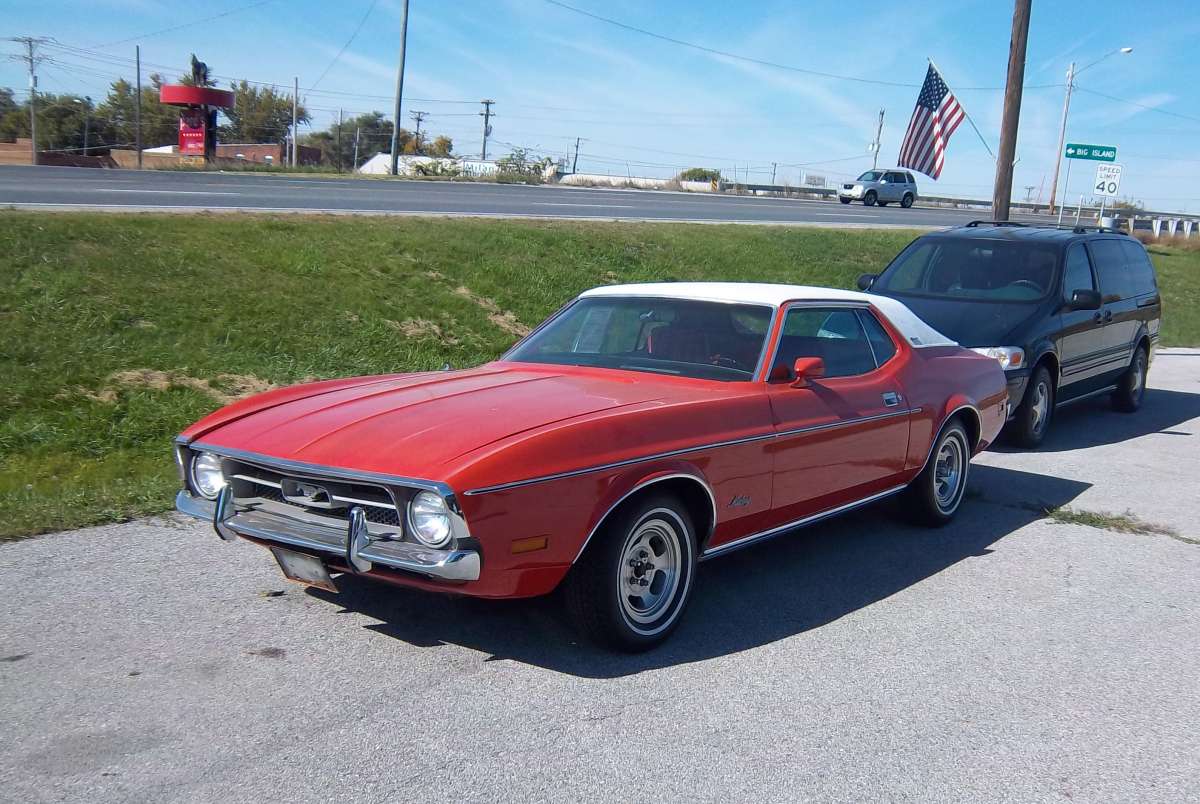
(first posted 10/31/2012) A while back, jpcavanaugh told us about a Ford product that didn’t get any respect. Here’s another one: The “fat” 1971-73 Mustang. And while the Boss 351 and Mach 1 fastbacks may get a little love, the flying-buttress hardtop, in Grandé trim no less, may well be at the bottom of a Mustang lover’s list. To appreciate these Brougham Mustangs, you have to view them not as hot-blooded tarmac terrors, but instead as junior Thunderbirds.

The Mustang: All things to all people, or almost. From the first, it could be equipped as anything from a plain-Jane secretary sportster to a thoroughbred V8 sprinter, and it branched out even further throughout the ’60s. The 1967-68s got a bigger engine bay to accommodate big-block power; then, in 1969, the Mustang grew longer and added a Brougham model, the Grandé. And while all 1969 Mustangs appeared, well, grande, they were in fact only 3.8 inches longer than the ’68 models and rode the same 108″ wheelbase.

In a sense, the Grandé was the Mustang aping the Cougar for a change. Instead of flashing scoops, spoilers and stripes, the Grandé was rather elegant, with its subtle metallic colors, notchback roofline, vinyl roof, full wheel covers and suitably plush interior. The Grandé was priced about $200 above the plain Mustang hardtop.

Poor Mercury: Always living in the shadow of more salable Fords, and now that they did come up with a winning formula, the Mustang cheerfully copies it! Is it just me, or does the ’69 Grandé look like a knockoff of the Cougar, right down to the plush seats, roof line and chrome trim? Yes, I know they were corporate cousins, but maybe FoMoCo could have let the Cougar keep the Brougham pony car market to itself. Throw Mercury a frickin’ bone!

OK, sorry about that, but Mercury’s slide into irrelevance still chafes. Back on topic: The ’69 Grandé sold 22,182 copies, not bad for a first-year model. And just as the 1965 LTD was a simple re-trim of the more common Galaxie 500, I’m sure Ford made good money on every one. So naturally, the Grandé returned for ’70. Despite a new vinyl canopy-roof option, sales nosedived to 13,581. Perhaps that was due to the availability of more tantalizing Mustangs like the Boss 302 (my favorite Mustang), Boss 429 and Mach 1. Nineteen seventy was the last really big year for muscle, so maybe Mustang buyers wanted one last taste of it before the pony’s slide into Broughamified personal luxury.

Things changed drastically for ’71, at least appearance-wise. The “classic” Mustang look had been replaced with a billiard table-size hood, sheer, scoopless sides, and “flying buttress” C-pillars on the hardtop. Yes, the ’71s were longer, lower and wider than any previous Mustang, but as with the ’69 model, the look was in large part an optical illusion; versus their predecessors, they had a wheelbase only one inch longer, and sported a mere 1/10th-inch more in overall length.

Here’s an interior shot from the brochure. At least in this case, Ford was now pitching the Grandé as a “Ford Cougar,” or even a more affordable Thunderbird. Note the particularly campy ad copy. I’d never before seen the term “sparkles like champagne” used to describe a brown interior. Oh, those wacky ’70s Ford marketeers…

As expected, the hardtop, fastback and convertible all returned for ’71. Sadly, the legendary Boss 302 and Boss 429 had been dropped, although a new Boss 351 fastback offered partial compensation. In terms of power, everything from a 145-hp, 250 cu in six to a Ram Air, Super Cobra Jet 429 with 375 oh-so-understated horses was available. Six-cylinder Grandés started at $3,117, and V8s at $3,212.

While most of the V8s probably were the “cooking” 210-hp 302, theoretically a buyer could have ordered up the 285-hp, four-barrel Cleveland 351, the 370-hp CJ 429, or even the 375-hp SCJ with Ram Air. I recall seeing an SCJ-equipped Grandé in a recent issue of Hemmings Muscle Machines, but I believe it was a 1969 or ’70. Still, a handful of ’71 Grandés may have gotten out the door with this configuration. Our featured Calypso Coral Grandé most likely has either a 240-hp two-barrel 302 or 351 underhood.

You’d think Ford would have consulted a Spanish-to-English dictionary before bestowing “Grandé” nomenclature on these plush mini-T-Birds; in Spanish, “Grandé” means “large”, not “great” or “grand.” How deliciously ironic.

Here we see the flying-buttress C-pillars and recessed backlight. Since ex-GM executive Bunkie Knudsen arrived at FoMoCo as the ’71 Mustang was being pinned down, I think it’s a safe bet that he remembered the similar treatment used on the ’66-’67 GM A-body hardtop coupes. Bunkie’s mark can also be seen on the GM-ified 1970-71 Thunderbird and 1972-76 Continental Mark IV.

As you can see, the interior was just as orange–excuse me, Calypso Coral–as the exterior. Although this is a snooty Grandé, it still shares a plain ol’ two-spoke Ford steering wheel with Galaxies, Pintos and F-100 pickups. The optional three-spoke, rim-blow steering wheel was much cooler looking.

And here’s the back seat. The upholstery is just as plush, but that vacu-formed armrest/quarter panel looks decidedly non-Grandé.

Automatic, tape player, sport mirrors…but no power windows? And although it looks cool, I’m not sure why the clock was placed so far out of the driver’s line of sight. I can just picture it: “Hey Bob, what time is it?” “Well, it’s quarter to….AAAUGH! (CRASH). Not exactly a Ford Better Idea, eh?

Clock of doom notwithstanding, I was drawn to the orange and black interior…now this I like! No wimpy, apologetic gray or beige interior here. And how very appropriate, since today is Halloween. But is this Grandé a trick or a treat?

Well, keep in mind the Muscle Car Fallacy, to wit: Many, nay, most pony cars in the ’60s and early ’70s were not hot rods. Sure, high-test variants were available, but they were certainly in the minority. Most Chevelles were not SS396s, most Camaros were not Z/28s, and most Mustangs were not GTs, Boss 302s or Boss 429s. Thanks to well-off Boomers and a surfeit of repro parts, Sadie the Secretary’s powder-blue 250-cube six-cylinder Mustang is today a bright red SCJ Mustang. Taken in its proper 1965-71 context, the Grandé was not all that unusual. And besides, what’s wrong with a little comfort?

With that in mind, the Grande was actually a nice, plush boulevardier; broughamy, but sporty too. No, it wasn’t a classic ’65 Mustang, but still was a perfectly nice car in early ’70s America. To my eyes, this Mustang has some style–and clearly remains a Mustang with the characteristic long hood and short deck. The lines are clean and trim, at least when compared with the gun-slit windowed, used-bar-of-soap mid-sizers on the road today. I’m not ashamed to say that I like it.

Grandés received all the usual Mustang features, plus bright pedal pads, Deluxe cloth-and-vinyl, high-back buckets, Deluxe instrument panel and steering wheel, electric clock, special door panels with integral door pulls and armrests, dual paint accent stripes, color-keyed sport mirrors, bright rocker and wheel lip moldings, vinyl roof and more. In addition to the previously mentioned range of available V8s, options included Cruise-O-Matic transmission, power front disc/rear drum brakes, power steering, power windows (although only 1.9% of Mustangs got ’em) and a rear window defogger.

I found our featured Grandé sitting at a used car lot about 10 minutes before I spotted the Euclid dump truck. Most of the cars were the expected late ’90s/early ’00s fare, but this one stood out despite its slightly down-at-the-heels appearance and one flat shoe. Of course, I had to investigate.

I really liked the orange/white/black color combination, and the slotted mags and whitewalls just looked right. I have no idea what they were asking for it (or if it even runs), but this car has style–a trait sorely lacking in most of today’s cars. Why can’t we at least get bright interior and exterior colors on 2012 models? Yes, I know certain sporty models come with them, but what if I want a 2013 Impala or Camry sedan in red with a red leather interior?

Annual Grandé sales for the 1971-73 period were 17,406, 18,045 and 25,274, respectively, a telling sign of the advancement of the Great Brougham Epoch. And while both the Grandé and the zaftig Mustang would go away after ’73, the Brougham Mustang would carry on in Bristol fashion through the early Fox-body years, albeit as a Ghia, not a Grandé.

The Grandé, like all the other Mustangs, got a minor face lift for ’73, as vertical parking lights moved up into the grille and a body-colored bumper replaced the previous chromed version. As you can see in this vintage ad, Ford was now trumpeting comfort and handling, not quarter-mile drama; rising insurance costs had seen to that. After ’73, the Grandé and the convertible were dropped; eventually, the convertible would return, but the Grandé would not.

Yes, the Grandé was a kind of odd offshoot of the classic pony car, but one that would look pretty good to Mustang fanciers once they got a gander at what Ford was passing off as a 1974 Mustang: The Super Pinto, AKA Mustang II! The Brougham Mustang was now the Brougham Pinto, as least in Ghia notchback form. But that’s another CC for another time.
























An associate – rather a friends of a few of my buddies back in the mid-1970’s drove one of these Mustangs. Don’t recall the year, but it was HUGE! It was red, but no vinyl top. Of course it was a gas hog, but weren’t most cars at the time?
There’s nothing really to recommend this to me – not now, nor back in the day, roll-down back windows, notwithstanding!
This one is in nice shape, however, and for that reason, believe it or not, I like it! I’d even like to take it for a spin to remember what these cars felt like on the road.
As for the vacuum-formed rear interior panel, it goes to show, in coupes, how things have changed – car makers knew few would ever ride back there, so this was a trend, along with fixed glass, too, I suppose.
It’s still a very nice car.
Coincidentally saw one of these just yesterday. It was a faded blue with a patina that would indicate daily driver status. I was stopped at a light and it crossed my path turning left and I was a bit awstruck by the length of the hood, and the body lean. The front left wheel was about to pop right off. Cars of that era seem grossly huge now.
Salient point on the translation of grande meaning large and not grand.
Excellent write up.
But it isn’t that large by today’s standards it just has presence. Overall outside dimensions are smaller than a recent Accord.
As I posted in this article http://www.curbsideclassic.com/blog/cc-outtake/cc-outtake-convertible-weather-in-march/
Length
2010 Accord 194″
1971 Mustang 190″
Height
2010 Accord 58″
1971 Mustang 50″
And it’s not really heavy either compared to modern cars
Weight
2010 Accord 3186-3536lbs
1971 Mustang 2,907-3,261lbs
I’d wager the Accord has a fair bit more of that size devoted to passenger space than the Mustang does.
Cars in all segments have progressively become larger. But then again, so have the people buying them.
Certainly the Accord has more back seat room, but that was not the point. I was responding to the “Cars of that era seem grossly huge now.” comment and pointing out that it is just because they have style and presence lacking in modern cars not that, in the case of the Mustang, it is actually that large.
Well, I have to say that I have gotten roomier as I have gotten older, too.
My first car, the 1970 Impala two door, was svelte:
216″ long
80″ wide
3,992 curb weight
1,800 cubic foot trunk
two people could really ride comfortably in it.
What makes this car look HUGE is the low height and that long hood. That sets the proportions that are so 1970’s.
And let us remember that the Honduh Accord is one bloated product now – it is a far cry from the efficient and svelte product it used to be; and now the new ugly as sin Civic is over a foot LONGER than the original Accord! Honduhs need to be put on a diet!
What, no shots under the hood? Well I wouldn’t want the current owner PO’d at you. My high school beater ’71 Custom 500 had a 351W 2bbl, so at least I’m familiar if it’s a 351W. I’m sure the dual exhaust sings really well.
Is that Vampire Bill, with his 1970’s wife, looking unhappy that she talked him into the 1974 Pin-tang Ghia?
It is weird that the name of this model was Grandé. The accents on letters in Spanish mark the stress of the word, so Grandé is pronounced gran-DEH instead of grande GRAN-deh. However, I have to say that grande, despite meaning “large” it also can be used properly to refer to certain “grandeur”.
The accent issue is also the thing that makes the Chrysler Cordoba sound different than the city of Córdoba
Once this said for the sake of linguistic correctness, I guess the marketing thing was just the same as naming a two-door model a Tudor.
I’ve always found the Tudor/Fordor thing more than a little twee.
It was late in 1972, and being newly graduated and employed, I wanted a new car to replace my old, dowdy Chevy II. I really wanted a Camaro or Firebird, but a UAW strike at this time made them impossible to get at this time and there was even talk of discontinuing the brands. So off to the local Ford dealer, where I really liked these Mustangs. But it was a chance visit to the sign of the cat where I fell in love. The Cougar XR-7 with that great dash and all those guages had me hooked. Even came with leather. Ordered one in dark green with white vinyl roof and styled steel “road wheels”, which I have never seen on another one. The 351 Cleveland was no burner, but reliable. Pretty trouble free for 5 years and 100,000 miles.
For those who dislike the ’71 – ’73 versions, just look at what replaced them. The 1974 Cougar/Montego barge and the Pintoesque Mustang II. The less said about those the better.
Ooh, I’d like to see a pic of that Cougar — heavy love on that dark green/white color combination.
I do get a little tired of the “bargelike” ’71-’73 Mustang hatred — these cars weren’t all that large. I always thought they were attractve in both Grande & Sportsroof bodystyles.
I got the opportunity to drive a friend’s ’73 351 CJ Sportsroof several years ago — The car was dark green & it had the 4-speed manual. I’m 5’11” but felt like a midget. Visibility was severely limited in the rear obviously, but the tip of the dashboard seemed like it was at eye-level, limiting front visibility as well.
The black base interior made me feel like I was in a cave & I wonder how short people could live with one of these on a day-to-day basis.
They sure are pretty on the outside though. I’d probably want a Grande or convertible with white interior.
CPJ, How about a convertible? This one is local……..looks great! I haven’t seen it in person though.
http://sandiego.craigslist.org/esd/cto/3368702170.html
Ahh! Those are the wheels! Exact color combination too. The thing that really didn’t excite me was the pea green color of the interior that mine had. As I recall saddle was also a choice and I hemmed and hawed between the two before settling on the green. Didn’t detract too much from that great interior though with leather seats, full guages including tach (rare for “73), rim blow steering wheel, courtesy lights everywhere.
The write-up makes me reconsider my thoughts concerning this kind of lost generation of Mustangs. You’re right, it’s really not a bad looking car, and it does make sense given the conditions at the time of its sale. It does make me wonder, however, why Gran Turismo 5 would use a version of this Mustang in the game when there are so many more viable alternatives for a racing game. A comfortable boulevardier with a vinyl top should not be doing hot laps, even imaginary hot laps, at Laguna Seca. An earlier Boss or GT would be a better choice. Still, I agree it’s not a terrible car, and probably is overlooked a bit. I reserve the right to overlook it again in the future.
Looks quite comparable to my 74 Firebird Esprit, in spirit and execution.
All that vinyl goodness and the lack of rear seat room also look quite similar.
Ahh, the age of the “luxury” pony car.
For comparison sake…
Jimmy Rockford, is that you?????
and…
lastly…
Drool — This gorgeous custom interior was essentially unchanged until 1978. Those horsecollar seats are so comfortable. The base Firebird interior was much less inviting.
Never seen one in gold/white before. I like it!
I like the color, I like the “sugar scoop” rear aspect, I love slot mags with whitewalls. I actually could see myself enjoying this thing.
Also, despite the appalling sexism of the ad, I admit to a guilty crush on bookish beauty “Carol Edmundston” with her gold ’70.
In the late 60’s Mercury ads proclaimed their cars “The Man’s Car”
Partly in response to the fact that a large number of buyers were women! Cougars were, and are, very stylish and that appealed to women (and men who valued taste!)
So what do you do with a car that is almost too pretty? Make an Eliminator and go drag racing of course.
There was also a brochure for the performance Dodges in ’69 or so, called “The Man’s Guide to Supercars.” And a really snazzy one for the ’66 Imp called “A Man Meets his Match,” featuring a Bond-esque mystery man and his exciting jet-set life, decorated with sexy women and at least four different Imperials. Where do I sign up?
http://imperialclub.com/Yr/1966/66Match/index.htm
The more I think about it, “Carol” is a form of progress. “Dudes, buy this car to pick up chicks” is about the oldest pitch in the book. “Hey gals, buy this car to pick up guys” wasn’t something you would have seen in the 50s!
The 1971-73 Mustang represents what post-war Detroit most longed to produce — Bulgemobiles. The first rule of American automakers: Even if their product started out as a clean and efficient design, eventually it would morph into a fat, overpowered, poorly assembled gas hog.
What’s tragic — and hilarious — is that Detroit’s “bigger, glitzier, more powerful” tendencies often did not result in better sales. One can point to numerous examples of where the opposite occurred. Consider pony cars: As they got bigger their sales tanked. Meanwhile, sales of entry-level compact coupes such as the Plymouth Duster soared.
Whichever automaker bucked this trend in pony cars could have been quite successful in the early-70s. Alas, herd instinct prevailed. That’s particularly unfortunate with AMC’s Javelin, whose first generation had an unusually clean and space-efficient design. If they had given the 1971 a hatchback variant instead of a bloated reskinning, AMC might have actually made money on its hugely expensive pony car gamble.
From day one, these Mustangs got no respect. Current Mustang is bigger and heavier than the 71, and sells in about the same numbers.
Yes I remember very well how disappointed I was looking over the new 71 Mustangs at the downtown Ford dealership. The showroom was very crowed as this was a Saturday and negative comments about the fastback were coming from every direction.
A highschool friend had a bronze ’73 Mach 1 fastback with a 302 in very similar condition to this car, his older brother had a blue ’68 Mustang with a 428 SCJ. Older brother wraps the ’68 around a tree. They transplant the SCJ and four speed into the Mach. It woke it up a little bit! That was the school’s hot car my senior year. I never got to ride in it but I heard stories…
BTW, they took the 302 and c-4 tranny and put it in their PInto wagon.
I do not hate these. However, I do not love them either. To me, their biggest problems are the same problems they shared with virtually everything FoMoCo built from around 70-71 to about 73-74. The were way too big outside for the usable room you got, their quality was not good, they were rusters extrordinaire, and good but not great performers/handlers. GM was building better cars, and Chrysler was building more exciting cars. I can’t wait for PN to weigh in on these, as he surely drove quite a few of them during his stint at the Ford dealer. I know what he will say, but it is always so fun to read. 🙂
However, Ford was setting the Broughamliness trend for the entire industry with these. Every one of this generation from Dearborn came across (when new) as substantial, solid, and very well trimmed. Unfortunately, they often did not age well.
It is surprising to me that these are only marginally bigger than all prior Mustangs. The visual aspect of the styling really made these thins look huge. It does look to me that they were wider.
You are, as usual, spot on, JP. These cars were bad in just about every way one can imagine. It’s no wonder the US makers just kicked in the teeth right after the first oil crisis when mainstream consumers found out for the first time that there were efficient alternatives that didn’t fall apart the minute the pathetic one year warranty expired. Heck, most never made it that far.
My family made loads of money on crap like this. They needed loads of service, too, like three or four times a year and there was never a service trip on a 1970’s Ford that didn’t result in a really good up-sell as there was no doubt something else was wrong. Commonly, water pumps, alternators, batteries, brakes, master cylinders, leaky radiators and their perpetually bad front ends. They were by far the worst of the American stuff of the time although that isn’t saying much.
Ford. Fix or Repair Daily, at least in this era.
Seems to me ALL cars of the early/mid 70s were that way. My dad had a 74 Grand Torino Elite Brougham. Actually I don’t remember it ever having any problems. Hell even the tires were relatively long lasting radials.
It’s no secret that most dealerships made as much or more money from the service department. “Up-selling” usually just for profit was the norm…..and a huge rip off.
Canucklehead just has a selective memory. I remember replacing a lot more water pumps, and alternators on imports from that era than those from the big three despite there being far fewer on the road. Now of course once you’ve replaced that water pump, alternator or master cylinder with the lowest bidder rebuilt unit then certainly you could expect to see that vehicle back for yet another in a year or two.
Case in point is one of my Scout IIs that I purchased from the original owner. He included a large file with darn near every dime he spent on the truck going back to having it undercoated at the local service station within days of taking delivery. The original water pump lasted until the early 80;s when it was replaced with a rebuilt unit. From then on there was a bill for another rebuilt water pump every year or two. I put a new one on from a reputable supplier and haven’t touched it in 15 years.
A friend of mine spent extra for the lifetime waranty on a rebuilt water pump on his Firebird and low and behold he had to keep replacing it every year or two. The last time it decided to start pouring out the coolant as he was on his way to my house. I said sure you can get another rebuilt unit but do you really want to replace it again in another year or two. He decided that I was right and I called up my supplier ordered up a new unit and low and behold he did not have to replace it again in the subsequent 10 or so years he owned it.
Good points, Eric. In our taxi cabs, we learned about rebuilds the same way. We always replaced with OEM factory parts but from reputable manufacturers like Moog because their stuff was actually better than the GM factory stuff.
Any yes, the early Japanese stuff, especially Nisssn, was nothing to write home about with reliability. The cars were, however, dirt cheap thanks the the Y360 exchange rate which allowed the Japanese makers to make a killing starting about 1973 or so. By that point Toyotas, especially, were really good cars for the money, way better than anything from Detroit.
(Coming in the house to put a BandAid on)…I said much of it here: http://www.thetruthaboutcars.com/2009/11/curbside-classic-1973-ford-mustang-mach-1/
And what more to add? You’ve said it pretty well. I hated these, from the first moment I set eyes on it. It ruined the last vestige of warm feelings about the Mustang, which was getting a bit lukewarm already.
That was then. Now? Amusing artifact, and a prelude of Ford’s decade of Deadly Sins.
It’s true that it wasn’t all that big; but sit in one, and you might as well be driving an armored car with gunslits for windows, The feeling it created getting into it transcends any discussion of its relative length to modern cars.
But the feeling of driving an armored car with gunslits for windows does make it ripe for comparing it to modern cars since that seems to be the way the market is going.
Especially a new Camaro, ironically.
If there was ever a modern car comparable to these mustangs, the new Camaro is it. gigantic looking, no interior room and no visibility.
‘como se dice ‘Brougham”…..
No se, pero si es Feo!
too bad its so ugly as the car is in wonderful condition :/
I rode in a 1971 version of this that a friend had; I didn’t care for the high belt line – I felt like i was sitting way down inside it. And what I saw of its handling and performance didn’t endear it to me either.
New Mustangs are taller and heavier than these but don’t seem that way from inside when you’re driving. I wonder why that is…probably in my case because I’m comparing it with the 1999 and 2009 Accords I’m accustomed to rather than any early-generation Mustang rides which happened a long time ago.
If this were a Sportsroof I’d be asking for directions to it’s location.
The Notchback 71-73 cars just don’t do it for me in any way.
“The Notchback 69-73 cars just don’t do it for me in any way.”
I feel much the same way
Color me weird, but I liked those Mustangs. More than the Pinto-Too models, anyway. Odd taste for me, since I hold affection for the Pinto also. Just not a Pinto pretending to be a Mustang.
Anyway…although 1964-66 Mustangs appear regularly, and I pass TWO 1968s on my way to work (both of them basket-cases for sale)…I haven’t seen one of these in over thirty years. It never got the love; not sure why.
From my viewpoint, it was actually a logical, if not as it turned out correct, evolution of the Mustang. The Twentysomethings who bought one in 1964 were getting older and, one hoped, more prosperous; the Mustang grew with them. No need to move to a T-Bird, or (Gawd forbid) a Monte or a Grand Prix.
I wouldn’t reject this era as a choice for a hobbyhorse car….certainly an engine upgrade, a FI 302; but the basic chassis still looks good.
The 1970 Boss 302 and 429 didn’t outsell the Grandé — the Boss 302 accounted for something like 6,300 cars, while the Boss 429 sold fewer than 500, since it was really just an homologation special to allow Ford to run the engine in NASCAR. The Mach 1 sold better than the Grandé, but only a smidgen better than the plain fastback, which was nearly $400 cheaper.
I think a major reason the Grandé did progressively better while the Mach 1 declined was insurance. With some insurance companies, I think just buying a Mach 1 — even with the base engine — triggered the (punitive) performance car surcharges.
Another thing in the Grande’s favor was female buyers. I would wager that not many women bought Mach Is. The Grande’, however, was the Mustang I thought I could talk my mother into in 1972. She was half interested until she saw how small it was inside and chose a Cutlass Supreme instead. Hindsight says it was a good choice.
Agreed on that – FoMoCo’s of that era were tinworm magnets.
68 BEAST yellow all restored must go *400+hp) see my add
Which is why people bought 429CJ Montegos instead of Cyclones. 455 T-37 Le Mans instead of GTOs……even 340 Duster/Demons instead of Road Runners or Chargers.
That worked for awhile! Insurance companies caught on eventually.
A friend of mine went to buy a ’69 Camaro new and found that his insurance company would impose a massive surcharge just for having a four-speed, regardless of engine. He ended up special ordering a 350 with heavy-duty three-speed instead.
When one of these was new (a 1971 owned by a friend of a parent) I had a good look at it. The rear seat is really a lot more inadequate than the photo here suggests. If you wanted a somewhat more inhabitable rear seat, Ford offered the Cougar hardtop and convertible with a few inches more wheelbase.
(So in those days, 1967-73, there were two lines of cars, the full-size and the Mustang/Cougar, that rode different wheelbases depending on whether they were Fords or Mercurys. Would Mercury have been better able to remain distinctive, and to have survived, if it had maintained this?)
The Longer wheelbase for the Mercury spanned much longer than just the 67-73. Heck even the lowly Comet had more wheelbase than the Falcon.
Personally I do thing that a little more wheelbase could have saved Mercury. Particularly if they had done in on the stillborn version of the Focus. The could have billed it as the “big small car”. The Milan, Mariner and Mountaineer were still selling pretty well and the Grand Marquis continued on for the 2011 model year even though Mercury was pronounced dead in 2010. They also went and made an L version of the Crown Vic for Taxi use and I think they should have offered it on retail and fleet spec Grand Marquis too, heck I would have just dropped the short version of the Merc but then of course it would have been longer than the short Town Car.
“Well, keep in mind the Muscle Car Fallacy, to wit: Many, nay, most pony cars in the ’60s and early ’70s were not hot rods. Sure, high-test variants were available, but they were certainly in the minority. Most Chevelles were not SS396s, most Camaros were not Z/28s, and most Mustangs were not GTs, Boss 302s or Boss 429s…”
Totally 100% true! Most Boomers just wanted a nice looking coupe, and some power when buying a brand new car. Hence the huge boom of Personal-Lux 2 doors. Young car buffs today think in the 60’s “everyone drove a Muscle Car”.
It was used coupes that got ‘hopped up’ by teens, 20somethings for fun. One reason muscle cars died, was high insurance costs and teens/parents couldn’t afford them. So, they bough used 57 Chevys, Chevelles, Novas, LeMans or Torinos and added go-fast parts.
I was wondering if you were going to show the Mini-me Mustang II at the end.
The Mustang Grande looks great compared to what followed.
I don’t know also, how to say Brougham in Spanish, but I sure can tell you that to cover the roofs with vinyl, full and canopies like those in the ads above was a very common practice in México in those days even though they were not part of the car’s package; those were aftermarket items for the one who liked them and was a heavy trend in this country. Also those flying buttresses were found mainly in the 2-door Dodge Dart (1970-1976), which made these models very attractive, as you can see. That said, the Mustang was a favorite among young drivers, they were women-magnets and parents of their drivers were most of the time worried about the whereabouts of their offspring, due to the fresh and impressive image of the car. Oh, what a time! And yes, GrAnde, instead of GrandE should have been the right spelling for the name, but of course, with no accent whatsoever.
I have always liked the 71-73 Mustangs, but mainly the Sport Roofs. Yeah, not the best Mustang ever (and the 1970+ GM’s were better style), but they have their appeal if you can appreicate 1970’s styling. Sure no Boss 429 or 302 for these years, but the Boss 351 ran quicker than the small block and as good or better than the 429. 1971 was the only year the Cleveland got to run fully untapped in these Mustangs and they were as quick as most serious Big Block muscle cars. In 1972 the HO versions was good for it’s day, but not compared to the 1971. The Grande and formal tops were not my cup of tea, but I don’t dislike them. They are a good representation of the trends and tastes of that time.
A lot of people dislike these cars, but I think this mainly had to do with styling. Quality was really not much different than the late 60’s Mustangs, neither was space usage. Handling if anything was the same or generally better (at least Ford FINALLY update the steering box to a integral power steering, and HI-PO models had a quick Saginaw box). Performance was comparable. Sure they looked big, but compated to todays bloated Mustangs, they aren’t so bad. And they are MUCH better than the Pinto-based ones that followed.
I really like this car. True, I wouldn’t have called it a Mustang. I don’t like making every name so wide as to be generic.
But I have always wanted a fast, good handling luxury car with a long hood and a short trunk. In a lot of ways, this fits the bill.
I just don’t know if the handling was decent or not. In a way, my 2011 Mustang is like this – power everything, leather seats, very comfortable, handles well and is fun to drive.
In general, I vehemently hate the ’71-’73 Mustangs… but I like this particular one!
I had a friend who had a ’69 Mustang Grande as his first car when we were in high school. It was dark green with a black vinyl top, caramel colored interior and 351/automatic. I was super impressed by this car back then (2001) – it was comfortable, quiet, handled well for a 32 year old car and it was drop-dead gorgeous. The car had a “light restoration” done before he bought it (about $3,500 if I remember correctly!!) but it was kept all original looking – down to the factory wheel covers and standard exhaust. He used it as a daily driver for several years and still has it, though he moved somewhere non-car friendly and it now sits in the driveway at his parents’ house. Ever since I got behind the wheel of that one, I’ve always had a soft spot for the Grandé Mustangos.
The interior actually looks kinda ridiculous to me, with a black dash, console, seatbelts, and carpet, but red seats and door panels. Was this a “made on Friday” job or was that really the actual color scheme?
I’d certainly drive it. Just as it sits, but with a new set of hooves. It’s beautiful. A Grande with a 429 and a manual would be such a cool car, like the old LTDs with the 427/4 speed combo.
The Mustang II wasn’t a bad car – as long as it had a V8 in it. That little 302 really woke the car up.
I owned a 71 Mustang “Coupe” that came from the Factory with the “M” Code 351C 4bbl rated at 285 hp, the C6, and the big rear end.
White with black on red interior.
The car was original down to the last detail. I purchase off of ebay for $2200, got the Marti Report which showed on 666 ever left the factory in this configuration…..and struggled to sell it for what I had in it.
I think these cars are aging well, and can be had for a relatively reasonable price compared to other cars of the era……they just have NO FOLLOWING and they just have not held any value.
Pics can be seen on Photobucket under “randy911”.
Nice car, 285 horsepower, ran great, worth almost nothing.
I have a 72 Grande and its a really nice car. Enjoy cruising in it as there are so few on the road and get many a thumbs up. Riding in it is like riding in a boat. would have loved to have picked up a 67-68 Mustang but we work with what we are dealt. At least it’s considered a first generation Mustang.
I think that comparing these to the current Camaro is correct. Big (appearing) on the outside overstyled; and cramped and ugly interior on the inside. But I still like them especially the sportroofs the coupes have more balanced proportions. The concept of the plushcoupe always resonates for me. I rode motorcycles for 35 years and when I parked the bike I was looking for something with a little more comfort. I could always jump on the bike for my speed fix. I bought a new Cougar in 84 and thoughtl that it was a great roadcar. ( I had wanted a T Bird but my wife loved the formal roof of the Cougar). My last broghammy coupe was my 97 Acura CL. Plush. When I bought my 07 Mustang I told the salesman that they should revive the Grande. He didn’t know what I was talking about.
I was never a big fan of the 1971-73 coupes and convertibles but always loved the fastback models (especially the Mach 1’s), the coupes looked too Torinoesque for my liking.
You’ve done a great work with your blog, keep it up.
Excellent post! Keep up the great work.
Sheeze, talk about BIG. That Stang could almost be a
Torino JR! lol
This article really demonstrates how models have replaced brands, and why maintaining a stable of brands no longer makes sense for most manufacturers.
Back in the day, there were no models – you just bought a Ford. If you wanted a nicer Ford, you got a Mercury. If you wanted the nicest Ford, you got a Lincoln.
Nowadays, you get a Ford Fusion. If you want a nicer one, you get a Fusion Titanium. If you want the nicest one, you get a Fusion Platinum. Luxury is dead.
But an MKZ is still better appointed than any of its Ford cousins.
I’ve always thought that this car in this guise speaks volumes for the validity and viability of the Mustang II. I’d venture a guess that interior space (back seat particularly) didn’t suffer too tremendously in the II vs this one. I wonder if even trunk space was sacrificed by more than 20% or so, as I’ve seen the trunks of these cars, and despite outward appearances they’re pretty tight. I’ve commented before that I’m a bit of a Mustang II fan, so my opinions might be a bit biased, but having ridden in a couple of these (and believe me, the desire to drive one never struck me), they just seemed like big rattly behemoths. The seating position, sightlines and general ergonomics just couldn’t have seemed more “off”.
All of that said, for anyone who ever criticized the Mustang II, you’ve just got to admit that for a “personal 2+2” type vehicle it really was head and shoulders better than its predecessor. Although one the my biggest criticisms of Fords of this era in general is the bulbous hood and front fender design. These, the II’s that followed, the Torino, etc. all seem to suffer from a forward view that feels like you’re viewing the world through the eyes of some fire-breathing creature with a bad case of the mumps. Or is it just me?
The Mustang blowfish 71, I just love this one, however it really looks kinda awkward for a sleek and young muscle car. Ford should have released it as a coupé between Mustang and Torino.
Overall the timing may have not been right for “Grande”, But in concept, they did see a market and later it came with the 1977 Thunderbird.
The wave that bought the ‘re-sized” ’77 Thunderbird were Baby Boomers who had settled into their careers and finally had some pocket money. The same group who bought the original Mustang. Again, Ford was in the right place at the right time.
However, I still have a soft spot for the ’71 thru ’73 Mustangs, especially the fastback versions. Still looks good to this day.
Not being loved means those remain a viable entry muscle cars for those who do not have unlimited funds, and being, well, Mustangs, they enjoy a vast aftermarket suppliers net which means you can practically make them into anything you like.
I’ve always loved the 71-73’s……and have never understood the dislike and hate for them, because they still have the classic Mustang cues, just in a slightly different configuration. I guess that the declining power levels and some truly annoying traits of these cars (huge blind spot; very high dashboard that makes visibility a problem for some drivers) had sealed their fate somewhat, but on a purely visual level, I think that they look great.
In this article, you raise a really good point of the Mustang taking over the Cougar’s territory…..I had never thought of that before. The first Cougar had really done a great job of establishing the “gentleman’s Mustang” niche, and it really did look like an upscale Mustang. One can imagine the Mercury division being irate over this, but I wonder if it wasn’t well known within the Ford/ Mercury/ Lincoln ranks that as the Thunderbird became more luxury oriented in the late 60’s (more like a Lincoln), that the Cougar was to follow the T-Bird’s lead and start being based on the T-Bird platform, rather than the Mustang platform. This could make for a great CC article……why, exactly, did the Cougar become platform mates with the T-Bird, instead?
it is the ridiculously long nose that I find so comically silly. There must be 36 inches from the the water pump to the front bumper…enough room in front of the engine to smuggle an immigrant or two at least!
I love this generation (much more than the original Stang actually), a neighbor owns a Mach 1. Glorious car, love seeing it every day.
The 71 Mustang doesn’t have flying buttresses, except when the name is misappropriated in the world of the car. community. In architecture, a flying buttress is an angled support strut, like a pole. A solid support like the Mustang roof is just a buttress.
The rear of the Maserati Merak has flying buttresses on the roof.
However it’s described (‘tunnel-back window’ is common), the ’71-’73 Mustang Grandé rear window styling doesn’t really work. It looks like whomever styled the similar 1969-70 full-size Ford/Mercury hardtops (which didn’t look all that great, either) tried to awkwardly adapt it to the much smaller (compared to the big cars) Mustang. GM and Chrysler, to their credit, did a much better job of tunnel-back rear window styling, only using it on the intermediates, Corvette, and Charger.
Ford’s efforts on tunnel-back seem to most closely mimic the originator of the styling feature found on the final 1964 Ferrari GTO. And, honestly, although it’s not as bad as the Mustang, it doesn’t look all that great on the Ferrari, either, with the earlier GTO styling looking a whole lot better. Probably the best adaptation of the style was on the 1968-77 Corvette where they got the proportions ‘just right’.
Ironically, the same styling feature on the same years’ Cougar isn’t that bad. It seems to fit better with the Cougar’s softer, more rounded, longer hind quarters. The Mustang’s truncated rear deck pretty much does it in.
Amazing how the proportions of the two competitors are so closely aligned:
Used to hate it. Now I like it. Maybe I want it. Maybe I do.