
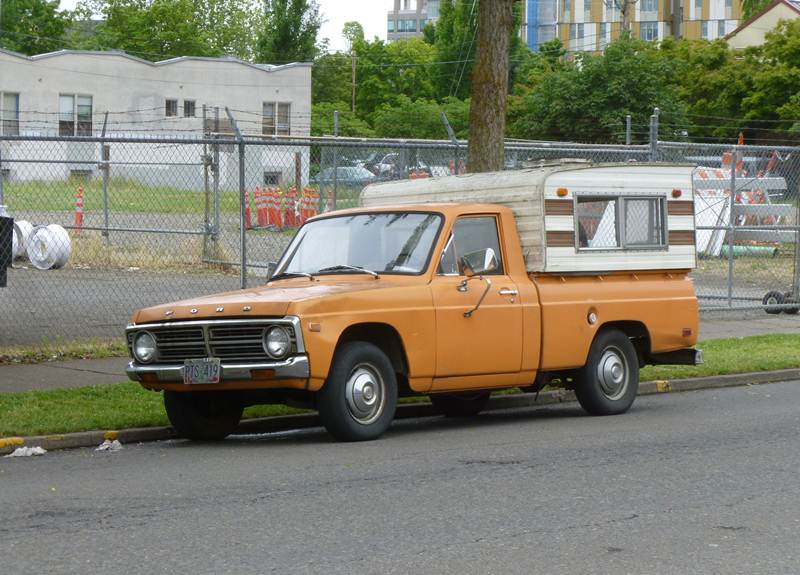
(first posted 7/18/2012) Really old Toyota pickups are as common here as …back-yard chickens. In fact, they’ve become an icon of the whole genre, and it’s a status symbol to have an ancient Hi-Lux in your driveway, even if it’s only used twice a year to haul some compost for the garden or a batch of fresh chicken litter. It’s a bit like keeping back-yard chickens around after they’ve stopped laying eggs; in fact, there are now “retirement homes” for unproductive cluckers.
Now the Toyotas have earned their seemingly infinite low-stress retirement, but the question is: what if I can’t find a suitably-old Hi-Lux? Am I going to be a social outcast? No, the answer is to dig up an old Ford Courier. Given how many there are still around, and the rude health they seem to enjoy, the question is only: were the Mazda-built Couriers any less durable than the Toyotas?

Its common knowledge that Ford Couriers were built by Mazda, essentially the B-Series with a Ford F100 mini-me grille, and a few other changes. And the Mazda’s will get their own due respect here in good time. But just to establish the pedigree, here’s proof that Mazda had some experience building pickups before they got the Ford job. The B-Series goes back to 1961, and the family resemblance is fairly obvious.
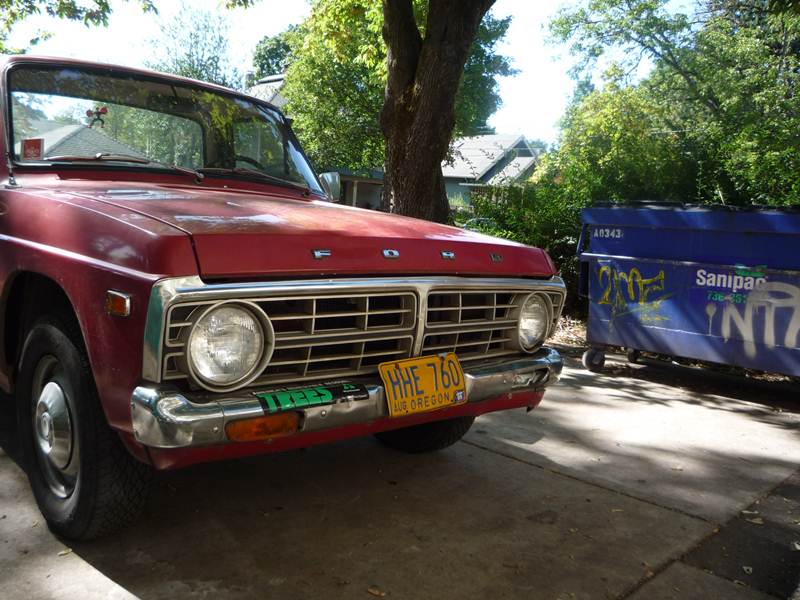
Under the hood of these old Couriers beat an engine that I have a bit of experience with, and lots of respect for.
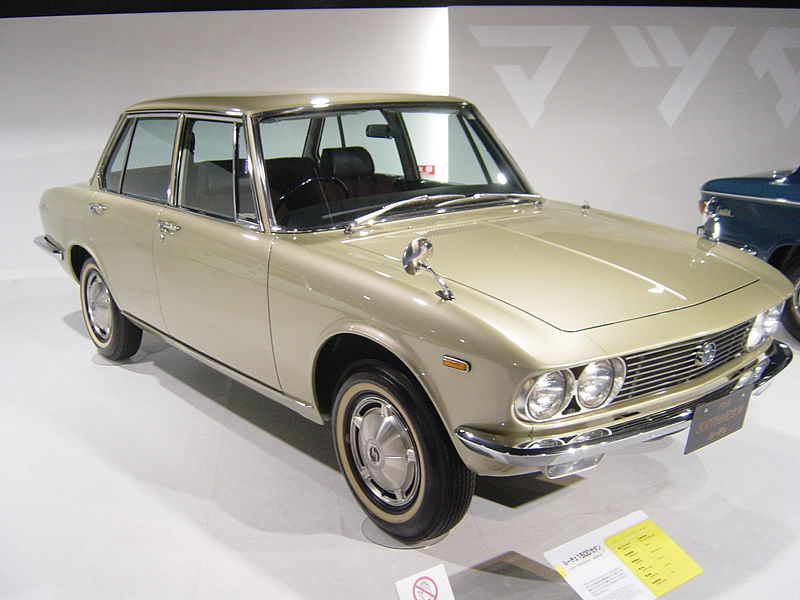
The classic Mazda SOHC four dates back to the 1966 Luce, Mazda’s first foray into the world of modern sedans, and styled by Bertone. Its a car I’ve liked since first seeing one in Vienna in 1969. With a different grille, it could well be an Alfa, or at least a Fiat. The 1500 cc four had “square” bore and stroke of 78 mm each.

That turned out to be a bit small, and it was soon stroked to 1600 cc, then 1800 cc, by which time it was swinging a healthy 94 mm (3.7″) stroke. That’s getting into big-block V8 territory. The 1800 cc engine is what this generation B1800s and the Courier had, and a tough and torquey little mill it was.
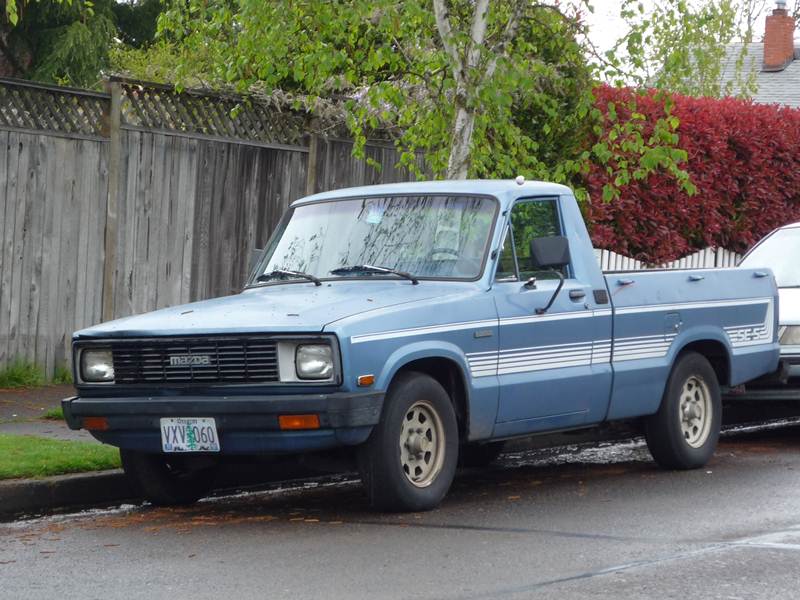
And just because we’re talking about it, the next gen Courier (1977) and Mazda B2000 got a 2 liter version of that motor, with the stroke taken all the way to 98 mm (3.86″). Grunt power from idle on, and nothing past 5000 rpm, unless it was hopped up. 72 (net) hp was its rating, less than the 74 hp the 1800 garnered, but but it felt like more, down low. But we’re not talking about those gen2 trucks, of which some of the later Couriers also had Ford’s Lima 2.3 L four installed: a preview of coming Ranger attractions.
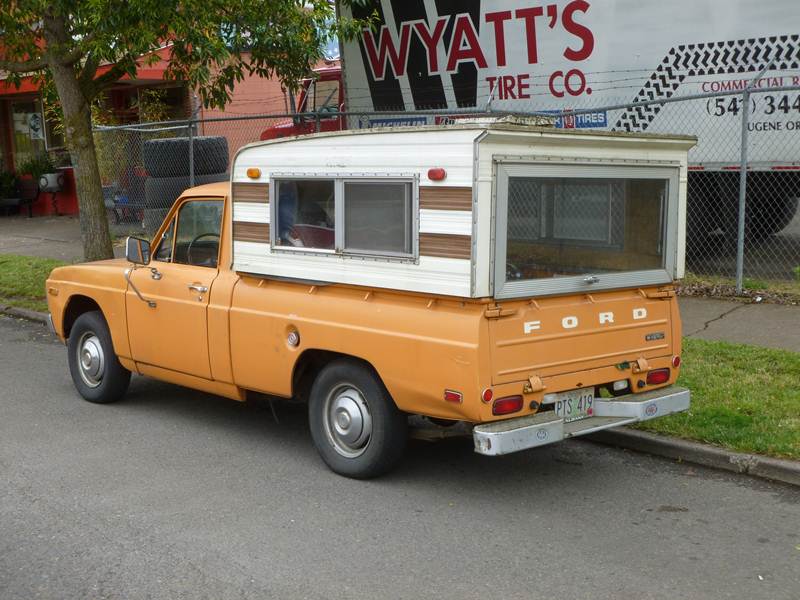
No, let’s stick to the first gen, which ran from 1971 through 1976. And even in those years, there were some differences. The biggest being a couple of inches of precious length added to the cab, behind the rear window.

You can see that, right? I do, it really jumps out at me. That happened in 1976, in anticipation of the slightly more revised gen2, which got a new front end to go with the longer cab.

Well, it’s hardly a mega-cab, but every inch counts in these old-school Japanese trucks. I find them visually appealing, but unbearably cramped, which is why I’m not fully accepted into Eugene’s social elite, even though I do have the chickens (and a Subaru). Oh well. Big, old Ford trucks are a bit “north of the river”, if not even “east of the river”. Ask me if I care. Actually, it’s not totally true; the kids in my neighborhood love my truck. Young women, especially: “cool truck, man!” If I were single, and could only keep one of my vehicles, I know which one it would be.

As nice of shape as all old Couriers here inevitably are, the roof of this shell is showing the effects of thirty-five years of Oregon rainy winters. Time to re-roof. Or put a blue tarp on it, the budget solution to Oregon’s leaky roofs. Blue roofs are a common sight here, come late winter.

Just for the hell of it, let’s see what’s inside there. Golf clubs? Diet Cola? Jeez; someone’s not on the program. “Don’t you love the planet, man?”

The way to tell the vintage of these old Couriers, other than the ’76 cab stretch, is to check out their tailgate lettering. The 1972’s have “FORD COURIER” in big letters. The 1973’s spelled out “COURIER” in big letters, with a smaller “Ford” on the upper left. Starting with 1974, it changed to a big “FORD” and a small “Courier” on the lower right. The marketing executives at Ford had to justify their big salaries somehow.

That makes both the red and this green ones either ’74s or ’75s. Who needs VIN numbers? Who cares?
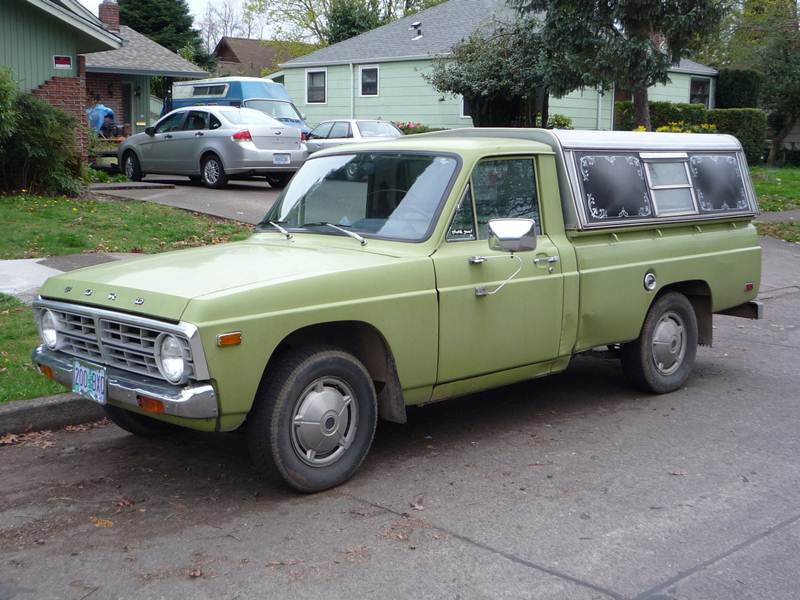
I know you do, otherwise you wouldn’t still be reading along. You’re going to get a degree in Courierology by the time I’m done. Which I am. Ready for the final?
























These have been gone here in Indiana for 25 years. Which is a shame.
Ain’t that the truth I’ve search high and low nothing within 500 miles of Indy
Here in salty Atlantic Canada, I have NEVER seen one of these trucks. I see 1st gen Rangers all the time, and 1970s F-Series, but no Couriers. I’m starting to wonder if they even sold them here.
The first time encountered one was as a plastic model kit (a former hobby) in the early 1990s. I had no idea what it was even then, but I had to buy it.
As an aside, there is a Chevy LUV for sale on Kijiji that says it’s the only one in Atlantic Canada. I wonder if they were sold here too?
The Courier was sold in Canada, the LUV wasn’t.
Any idea why the LUV wasn’t sold in Canada? Just as in the U.S., I would think that if Ford and the Japanese brands had small pickups available, Chevrolet would want to have one, too.
When I discovered these I really wanted one, as I was stuck with my 1976 ¾ ton Chevy pickup and its 13.5 mpg drain on my wallet.
Previously, a friend bought a 1976 Toyota SR5 pickup and he was getting 28 mpg out of it. Awesome! I thought, as gas was 50 cents a gallon and more at the time. I even drove one, but when I saw the Ford, I liked the lines of the vehicle much better.
All in all, I kept my truck as I had higher aspirations on my mind, like engagement and ealry preparations for eventual marriage in 1977.
Still, all these years later, I still have a fondness for the Ford Courier, even if they all dissolved over the years.
I bought a brand new 76 courier when I graduated from high school. I fell out of love in a real short time.The little truck looked great. The problem was , had no power and no fuel economy.It went back to the dealer several times,but I was lucky to get 15 mpg! Then there was the lack of room and comfort.I traded my dad for his 70 f 100. years later I was in a local shop where a mechanic was overhauling the same year truck, he commented that he had never seen such an engine. It wasnt designed for power or fuel economy.
Most of the Japanese car / truck engines we were spoon fed were not tuned for fuel economy or power. They were tuned for forklift use, among other industrial uses.
Frankly, that’s a rather silly thing to say, and hardly the truth. These engines were designed first to be used in cars and light trucks; some were modified for forklift use later. Not the Mazda, as far as I know.
AFAIK the Japanese OEMs who make both cars/light trucks (Toyota, Nissan& Mitsubishi) and industrial lift trucks use an old(er) car engine re-purposed and tuned for propane. The Toyota forklifts are just as tough and long lived as their cars and pickups.
So are the Nissan forklifts, we had a whole fleet of them, when I worked at Ocean Spray back in ’98 and ’06.
We used to do donuts when the bigwigs, weren’t around. Lol
Here is one for sale in Columbus, Ohio. Listed in Nov. 9, local paper, ThisWeek Rocky Fork Enterprise
RARE & UNUSUAL FIND
1976 Ford Courier
Very good condition!
All original low miles, 5 speed manual, 20,500 miles, senior
1 owner $3600 firm.
614-477-1288
Thanx Karen ;
No link or photos ? .
That sounds rather $pendy to me @ $3,600.00 but they’re mighty thin on the ground these days .
-Nate
I’m out. I never spend more than $1000 on ANY car. And it has to be damn nice for that! Right now I drive a $900 79 Thunderbird owned since April 02 and have had zero breakdowns. Im always amazed what some people think 40 year old vehicles are worth. Glad I bought all 18 of mine between 83 and 04. Most expensive was $1200 ( 71 mint condition 4Dr Maverick at the local chevy dealer in 1988) and cheapest were free, 74 Montego in family since new and grandma’s 74 Impala.
i have a 78 and it runs strong and nice but the wiring is pretty frustrating to work on.
My first vehicle after graduating collegr was 1976 courier. Baby blue, loved it!
almost all the small japanese pickups from this era have long since rusted away on the east coast. i miss them.
That ’66 Luce is a beauty! Too bad about the sideview mirrors though…yuk.
(do you think they’re remotely adjusted?)
There is/was a Japanese law that the mirrors had to be visible through the wiped portion of the windshield. I don’t know how to explain fender-mounted mirrors in other countries however!
In 1966, I sincerely doubt it. Once they got to the 70s and 80s and the gadget fascination of a more affluent population, quite possibly.
The real beauty, for my money, was the Luce R130 coupe, also styled by Bertone, with a pronounced resemblance to the second-generation Corvair.
Love the styling of those Luces too – we got them new, but they were rare and it’s been a while since I saw once. Mirrors are probably not electric given its age; plus they look way too slender. But on many later Japanese domestic market cars (of which NZ is full of used examples), the ‘hockey stick’ mirrors are electrically adjustable just like door mounted ones. My ’92 C33 Nissan Laurel had hockey sticks on the wings, they were electric. They proved to have their uses too as they were absolutely superb for towing a trailer! I think they look cool on old Japanese classics now too. My JDM Nissan brochure collection shows they were optional right into the late 90s – including on the JDM version of the Infiniti Q45.
I once read that the Luce was originally intended by Bertone to be a proposal for the Alfa-Romeo 1750 sedan, but Alfa ended up passing it over for a homegrown-styled version and Mazda scooped the design.
Hey, don’t knock those fender mirrors, they were made to eliminate blind spots.
I thought that was all fake, till I looked into the ones mounted on my 83 Corolla… You actually see a lot further rearward with them.
Just don’t bump them, because they are a PITA to adjust them correctly again. 😉
Hopefully when we talk about the Mazda B-series, we get into the “pickup with pickup,” the Mazda REPU (Rotary-Engine Pick-Up)
Very nice blast from the past, Paul.
When growing up, we had a neighbor with a white ’72 Olds Delta 88 and a white ’75 F-150. Suddenly one day, out of the blue, there were 8 tiny little Ford Couriers parked in a row out in their yard. All of them were white. It almost appeared like this was the consequence from a rendevous between the Olds and the F-150; however, their son had gone to an auction and purchased them. They sold seven of them but kept #8 for many years.
“I find them visually appealing, but unbearably cramped…”
Sums up my feelings about a lot of tasty little cars. Love the styling of just about every Japanese ride from the ’70s, but I doubt my legs and back would let me sit in one for long.
There are advantages to being 5’7″. Fitting in small cars is one of them. I’ve never found a car so cramped I didn’t think I could drive it.
I like that the tire tracks on the truck’s graphics in the last picture follows the silhouette of the Courier.
Also, the Luce made me think of a series I Lancia Fulvia more than anything:
Thanks for pointing the tire tracks out. That makes an already good photo one of my all-time favorites. it’s perfect!
Good call on the Fulvia – in fact if Lancia had used the Fulvia coupe’s front clip on the sedan model, it would look exactly like that Mazda Luce.
The grille of the Luce R130 Rotary Coupe, also by Bertone, did use a very similar treatment. Recycling, you know.
A friend in Hobart Tas had several of these he was doing up nice looking cars and well made.
I remember when these started to show up, and recall the magazines testing these and the LUVs. Both were sold in northeastern Indiana in the 70s, but the Courier seemed to outsell the LUV by quite a bit back then. But as noted by everyone else here, they all eventually dissolved. A shame, because I always really liked these for some reason. Now you give me reasons to like them beyond just their looks.
I just so happened to watch an old Hawaii Five O episode last night. I think it was from 1972? or so. The bad guy drove a beautiful bright yellow Mazda truck that was absolutely brand new. Much like the Courier here.
i rented one at u -haul to move some furniture .it had a small enclosed box that extended over the cab ,it was a stick shift .my wife and i are tall ,i don’t remember it bieng cramped.. i think it was about 1985 or’86.thats the also the last time i drove a stick
” in Portland there are now “retirement homes” for unproductive cluckers.”
A stewpot.
We have as a nation reached a point of unparalleled wealth when our citizenry will pay room and board to care for old chickens instead of eating them.
Ghod, I love the back-to-the-earth-liberal mindset. They know how to play at being farmers . . . . . .
That “retirement home” isn’t in Portland, Paul, that’s just the dateline. It’s actually in Scio, down in the Willamette Valley farmland. In fact it looks closer to Eugene than Portland.
When a chicken becomes a pet instead of a roaster, things change. Ever read Charlotte’s Web? Dogs are food animals in some places.
How about acre-sized perfectly fed and groomed lawns? Those suburbanites, they know how to play at being country gentlemen……
By the way, nice article! Those great little trucks keep marching, as long as the rust bug stays away.
Thanks; fixed it. We wouldn’t want to reinforce any Portlandia stereotypes 🙂
I like my old chickens as soup, but to each their own. I hear dogs are delicious, and have been tempted to turn a few noisy ones into a meal….
Please, no more political comments or this place will quickly become like TTAC.
I agree…Let’s drop the subject! Cars, not chickens, please….
Portlandia is close enough to home to be hilarious. Carrie Brownstein lives in our neighborhood, I’ve seen her at my local coffee joint.
Lily made chicken enchiladas last night, delicious. Oops, I said “chicken”!
Chicken enchiladas? WAS THE CHICKEN LOCAL?!
I could barely get through that episode! To close to home.
As local as we are.
http://www.youtube.com/watch?v=l2LBICPEK6w
“I’m so weird with that gas pedal, the thing just moves the whole vehicle forward and…”
Here in Lefty Vancouver, our property taxes also support a home for unwanted chickens. Utter nonsense.
A recent study here shows that back yard chicken coops last an average of five months until their latte-sipping owners find a new fad to tie them down.
Wouldn’t it be great if we could all decide how our tax dollars were spent?
And all backyard chicken coop owners are latte sippers too? Interesting.
Funny, I was just thinking how I enjoy seeing “conservative” types indulging in whatever pursuits that bring them happiness, while not passing judgement.
That will be the end of this comment thread…..thank you!
Thank you.
Thank You, Paul
I came here for cars not chicken talk. Some of you need to go back on your ADHD meds.
Focus people!
Friends of ours have a different method of disposal for old hens, put them outside the coop and let the raccoon and coyotes take care of it. The problem? A couple where to smart to be caught and eventually died of old age.
Oh, no, here in Portland chickens have feelings too…
There are even a couple of these kicking around here. The engine is the same as the one in my old 808 Coupe although the 74 and 75s would have the 1.8L version. My 1.6L revved not too bad but seems every one I saw was a bit smokey and could do with some new valve stem seals.
All the couriers must have gone to Oregon, as the only one that I can remember seeing in the Seattle area has been in a junk yard. Other then Toyota’s I’ve noticed a fair number of LUV’s and Datsuns from the era.
I enjoyed this piece and added some nice photos to my collection. I admire these little trucks and wish I had one.
See my post above dated today, there is one for sale in Columbus, Ohio.
Had 2 of these back in the the day. Great torque and pretty economical. Head gaskets went like popcorn at less than 100,000 which was the weakness compared to the Toyota. Old Rangers are the most elderly small truck where I’m at now.
Here in Massachusetts, I remember seeing Couriers around back in the ’70s and ’80s, but they are all but extinct today. Before reading Paul’s article I knew absolutely nothing about different styling generations or how to tell different years apart. I just knew that they were badge-engineered Mazdas that Ford sold for about a decade before introducing the domestic Ranger.
Any Japanese pickup from the ’70s is a rare sight here; on those occasions when you do come across one, it will most likely be either a Toyota or a LUV.
Just last week, I saw two different LUVs around the city where I live, on two consecutive days. One was parked in a driveway, with a For Sale sign which identified it as a 1979. It was black and looked like it may have been mildly customized; the front bumper was missing. I saw the other one in traffic. No idea of the year, but it was dark blue and looked to be stock and in nice shape. No recent Courier sightings, though….
You have a better chance at seeing a Snuffleupagus chatting with a Dodo, than to see a Ford Courier driven around in Massachusetts, or even Rhode Island. 😉
They were pre-galvanized steel in cars. I think Audi started it, American cars caught on in a couple years, and Japanese cars were the last to do it.
Road salt is a terrible thing.
There are still a few kicking around up here I saw one a few weeks ago. They were good little trucks and were the longest lasting of the early 70’s mini trucks around here. The LUV seemed to rust at a higher rate and for what ever reason the first Toyotas were never popular and the Datsuns while moderately popular seemed to disappear pretty early on too.
Oh, my goodness, the Magic Truck. Friends of mine had the green one with the cap (did they all come with the cap standard?) in the late seventies. He was an artist, she a fellow psychology intern. I was just starting to work on stuff, so I was able to help them get it running well enough until they could have a burned valve diagnosed and get it running right (they were artists, not machine heads, god love them). After which we took it one early morning in October on a magical trip out Route 9, from Worcester to Pittsfield, where the husband had some of his paintings in a show. Oh, what a colorful ride through the Berkshires-just a perfect day. Capped off when we passed that Saab mechanic with the “Troll Crossing” sign up the road from his shop near Amherst. The Magic Truck was slow, cramped, noisy and incredibly stiff riding by American standards, but the perfect vehicle that day.
One of these was my first vehicle. (By the way, the roof extension was a mid-year ’76 change. Mine was a ’76 but did not have the extended roof!) I got it with 60k on the clock, drove it to 110k or so. Great vehicle to learn to drive a manual. (Dad picked me up at my work with it, and said, “Here, drive it home”. His knuckles must have been white, but he never flinched…) It never stranded me, but boy it is true that they don’t make them like they used to:
It was pretty rusty (Philly area), and it wandered a bit (ok, a lot!) on the highway (though that got better when I replaced the bias tires with radials and discovered that the previous owner had 2 different sized tires on the front (!) )
But most of the problems were with the carb. An emissions control solenoid failed one summer halfway to WV, so it would backfire VERY loudly on deceleration.(That may have contributed to the loss of the gasket between the headers and the exhaust pipe. I never could one to last after that. IIRC one of the studs was shot?) The carb would freeze up if it was fairly cold and humid (i.e., snowstorm), but if you waited at idle for a few minutes it would be ok again. And it always started, even at 10-20 below, parked outside with no heater. I finally had the carb rebuilt at 100k or so as it was running too rich, but it never was quite right again. It sat for a year outside before I sold it, but it still started right up.
The early versions had a heated intake system to prevent the carb icing problem. The issue was that instead of a thermostatic vacuum controlled system like used on most cars of the time it was fully manual. On the snorkel there was a lever and some writing indicating a summer and a winter position.
Hmm. If mine had it I sure didn’t know about it, but it did have a manual choke so it might have been there. Honestly, it wasn’t a really frequent problem even though it spent a winter in extreme northern NY (Potsdam, to be exact) where the temps were often below zero. Once on a very cold night (15 below?), and once when it was high 20s and snowing. Had my roommate’s fiancee in the car that time, which made it rather more uncomfortable/ embarrassing.
These light pickups are popular EV conversions. Light weight, plenty of room in the bed for batteries, and the load capacity to carry even lead-acids without chassis modifications. Here’s a ’76 Courier from the EV Album.
Every third kid in my high school had one of these…new…back in the day. Great little trucks.
Well that looks like the truck I had in Guam. Hard to imagine how it could have been better. Open booted window from cab to camper. Could have stood to have less rust. The prior owner was a scuba diver and threw his tanks in the bed. That led to a batch of salt water and neglect led to a rusted out bed.
Guam’s humidity, rain, warmth and salt air are bad enough without adding sea water to the bed. When I lived there, we’d hose off all our gear first if we could. If we couldn’t we’d put the stuff in large plastic containers so we wouldn’t allow salt water to drip down under the trunk lining/truck bed.
Saw many an old truck in Guam (and here in Hawaii) where the bed was Swiss cheese and the roof seams/rain gutter are completely rusted through.
Didja know there was a 1956 Ford Courier? I didn’t until I went looking in the Wikipedia to learn more about that Mazda engine.
The Courier name lasted until 1960 on Ford’s sedan delivery. The name didn’t make the move to the Falcon body,
…and a Triumph Herald Courier as well…
By the way, “To circumvent the 25% Chicken tax on light trucks, Couriers (as with Chevrolet LUV’s) were imported in “cab chassis” configurations, which included the entire light truck, less the cargo box or truck bed and were only subject to a 4% tariff. Subsequently, a truck bed would be attached to the chassis and the vehicle could be sold as a light truck.”
Oops, I said “chicken” again.
Ford certainly liked to recycle old names for their new trucks. The Ranger and Explorer both being trim levels in the F series. They even got in on it over at Mercury with their mini-vans the Villager and Monterey.
Also for most of those trucks that were imported as incomplete vehicles it was the bed, that was made in the US, that seemed to rust first and worse than the cab.
And there was an Edsel Ranger too!
I had a Courier and that’s why I never take it seriously when people say they want “small” trucks like that again. They were too small.
I think people want Ranger sized small trucks again. I have a 2010 Ranger and I’m 6’0″. Good room.
The size of the truck needn’t have any relation to the room allowed in the cab.
Japanese pickups were cramped, because the typical Japanese was and is much smaller than the average American male. Those trucks were mostly designed for their domestic market and imported here as an afterthought.
I had a Datsun King Cab…fine truck, except for its susceptibility to rust. And, plenty of room inside. I also borrowed a 1995 Ford F-100 for an afternoon…that was a standard cab; and I just plain DID NOT FIT.
I would like to see smaller trucks available, too…and of course we will; CAFE will supply that.
My avatar was a ’74 Courier. Loved that truck. Don’t recall if the Rube Goldberg air cleaner assembly had a summer or winter position as it was soon discarded in favor of a Weiand air cleaner to fit over the idle adjustment blocked-off Hitachi carb.
Eventually put white RV spoke wheels with Remington RWL 70 series tires and a “turbo” exhaust (where I exploded two mufflers due to the backfire issues). Pretty sharp truck; played and worked hard. Kept it five years and 80K miles (bought with 21K on the clock).
Took it with me the first time I moved to Hawaii. Started to rust from the roof on down and the weather stripping started to go which made the carpet moist and mildewy. (Central Oahu by the Ko’olau range – rainy). Made numerous nighttime excursions through cane fields getting airborne on occasion. Sold it to buy my very first brand new car, a 1980 Toyota Tercel 2 door base model sedan. Four speed, rubber floor mats, fixed rear windows. No a/c. 42mpg vs. 25-28 for my Courier (which DEFINITELY) needed a five speed. Early ’76’s did have the flat rear cab as did my ’74 – the mid year “B” trucks came out with that slight extension. Only the Mazda “B” stuck with the 1600 through ’76; Couriers had the 1800. Archaic in it’s day as I remember non-self-adjustable drums all around and the manual choke.
I still miss that truck.
As you all may know I have owned a couple of Couriers. One a first gen, the next an 80’s one. Both tough as nails and good little trucks. Personally, I think they might be better than the Toyota’s (I’ve owned those too).
We had Couriers at work. 1973 and 1982 models. Automatic and 4 speeds. They all were great. I drove mostly the earlier models and they were fun, nimble and reliable.
The later Rangers they got after that were pretty good, too.
I have an S10 now, and some day when it’s time to move on I want another small truck.
Chevrolet Montana? Or perhaps better yet, Fiat Strada?
Fiat Strada? Isn’t that a car?
We had Mazda b series utes on the NZED when I worked there they all got driven hard but took it without complaint. Rare now the termites feasted on these things.
I don’t recall seeing these early models over here, it looks like the Japanese pickups from Ford/Mazda & Mitsubishi arrived around 1978-80. Prior to that we got the Toyota Stout and Isuzu Wasp, a pickup with Bellet front-half sheetmetal, that eventually evolved into the Colorado. Oh and the Datsun 1000/1200 pickups.
The calls for the return of small pickups poses an interesting problem – to build them as per these vehicles is likely not economic nor necessary – these things would have a higher load capacity than a current base half-ton pickup. The Fiat Strada or a chopped-roof Transit Connect is probably the best form factor, to pick up on available passenger car drivelines, plus the lower load bed possible would be incredibly useful.
It seems that logic evaporates from some discussions on compact pickups, eg I caught a recent discussion where the following was raised as a problem “by the time you buy a V6 4×4 Ranger you can get an F150 for less!” Well yes, but not a 4×4 F150, so does that matter? In any case, keep it simple to keep it cheap.
Logic evaporates whenever there’s any discussion of smaller vehicles. I’ve yet to see a small car thread which doesn’t have somewhere in the first ten comments some variation of “yes, but you could [should] get [this other vehicle] instead which is bigger”. There’s a lot of people who just cannot grasp that not everybody thinks bigger = better. The small cars that I want, I don’t want in spite of them being small. I want them BECAUSE they’re small.
By the same token, when I say I want a small work truck, I’m told to just get a stripper F-150 for the same money. I don’t want a stripper F-150. They’re no smaller than the F-350 I have now, and I need something smaller because there are places I have to go where it just doesn’t fit. If I could afford to buy new I’d swoon for a pickup Transit Connect. Since I buy on the cheap, I’m probably going to get a small 4-door SUV (Sidekick, Rodeo, Pathfinder, etc) and strip out the back seats.
Good points. If often surprised people when I tell them I love small cars, because today’s are so good and have few compromises like small cars once had. I get plenty of weird looks from my wealthy clients.
Agreed. There is more to life than retail price — part of the reason small pickups survive in the U.S. despite their near-extinction here is that there are plenty of conditions and roads/streets for which a U.S.-style full-size truck is just too unwieldy, too expensive to run, or both.
I miss the compact pick-up truck of 30 years ago. For some people they may have been too small for comfort, and the seats themselves weren’t very comfortable, but I found the cab roomy enough to work with. I also like how basic these trucks were by comparison to today’s trucks.
I remember my uncle had one of these 1st-gen Couriers (in the ubiquitous mustard yellow) that my cousins and I decked out in tin cans, shaving cream, and streamers on his wedding day. That was a sweet, sweet ride to drive away from a wedding reception in! He eventually replaced it with a brand-spanking-new ’82 Subaru Brat, a vehicle which thoroughly impressed the hell out of a 7-year-old me with it’s rearward-facing death seats.
Slightly related, around that same era, my dad owned a 1974 Mazda Rotary Pickup for about a year. He wound up trading it in for a pop-top VW camper van, as I had started swim team, and we needed a vehicle to travel around Oregon and California to swim meets in. I remember thinking that the Mazda was pretty sporty for a small pickup (especially since it replaced his wheezy old ’68 Datsun pickup, which was showing its age).
I found out much later how rare those Rotary Pickups really were (I believe only about 15,000 of them were produced). If you can find one of those tooling around Eugene– and I bet you probably can– it would make for an excellent CC.
Looking back, I realize that I would kill for just about any of these vehicles that we had in my family when I was a kid (especially dad’s 1978 Porsche 924, but that’s another story for another day). It’s too bad they all ultimately got upgraded to Caravans and Explorers!
I’m prejudiced because I had a Ford Courier. I will say that Couriers and it’s Mazda B series that begat the Courier were THE toughest small trucks!! A little slower than the Toyotas and Datsuns, maybe, but more rugged – certainly more so than Mitsubishis, although the Isuzu-built Chevy LUVs gave all of it’s Japanese competition a run for it’s money.
Very few small trucks of this vintage around here in Hawaii unless they’re meticulously restored examples. I did see a late 70s LUV in Pearl City still running about . . . VERY rusty . . . but OK enough to pass Hawaii Safety Check.
First experience with small trucks was my Scoutmaster, Deke Kitchen, driving a friend and I home from a camporee. He had a blue ’71 Lil Hustler (Datsun trucks as they were marketed then).
First Couriers I saw were ’72s . . . . . they were pretty popular in Northern California in the day. Mine was a ’74. Would have to adjust the valves every 20K or so; brake adjustments frequently (non-self adjusting drums on all four wheels).
True Courier story. I used to like to take every vehicle I ever owned up through 1987 through the Oakville Grade. Connects Oakville (Napa County) with Glen Ellen (Sonoma County). Up/down through the mountains, twisty and windy. Scrub Oaks, poison oak, mansinita trees, skunks, deer, wild turkeys and rattlesnakes . . . . typical Northern California hill terrain. Kept on the tail of a Porsche 911 on the downhill grade going into Sonoma County! Said Porsche couldn’t shake me . . . but then came the straightaway . . . . 68 net hp of Mazda smog-control choked power . . . need I say more. By Highway 12, the Porsche was but a memory . . . .
it IS true . . . it takes more skill to drive a slow vehicle fast .
My father had a ’75 or so El Camino that my uncle talked him out of. He replaced it with a ’76 Courier, baby blue as I recall. Dad soon painted it a nice dark blue and added a rollbar which really made it look sporty (well, kinda). I would always ride along in the middle of the seat (I was only 5 or 6 when he got it) and would shift the transmission for him (with Dad working the clutch, naturally). My father beat that little thing to death. In those oil crisis days he bought a woodstove and would load that thing with an unbelievable amount of wood, pretty much even with the roof. I remember riding with him this one day, he drove it straight through a corn field at about 30 mph. Had to remove the grille to get rid of all the stalks!
Somebody told him the engine would be shot by 50k. Sure enough, it started using more oil than gas. He managed to trade it in on a ’75 Dodge D100; lucky for Dad they didn’t test drive the “mosquito sprayer” but just took his word for it that it was in good shape. He did get a nasty phone call later, though! I haven’t seen another one in many years-rust here in MD got ’em, I guess.
Interesting to read that several folks had backfiring issues. There was a small hill just prior to our house and every time, I mean EVERY time we would drive down that hill my father would switch off the ignition, let it coast, then switch it back on and POW! POW! POW! In case you didn’t know, it was on purpose-Dad has always been a cool guy to be around!
My 1974 ford courier just seized up on me. I would love to restore her but I cant afford to. If there is any way to part her out that would be cool. Does any one know where I could part her out? Please help…….Julz
Try looking at “Ford Courier Collectors” web site
I got my 75 courier from my grandfather in 08 for graduating high school and I never want to sell it. I just love this little truck. So much character in every line. Arizona truck, rust and bondo free!! Always getting comments and lookers. Grill is off a 76. Odometer says 75,000 but there is no way she hasn’t rolled over at least once
I have a 77 2.3 l courier I purchased for $800 in running condition. I’ve replaced the entire couch system and rebuilt the top end. I bought it wit 72,000 miles on in and it now has around 93,000. about $1200 total in the truck. I am only 26 so I love the attention I get from the older generation and kids lol. I would also like more info about it if possible. my email contact is [email protected] if anyone has some feed back. I’m currently tinkering with the carb. I have hesitation at low rpms buy once I hit top end it does fine.
What was the first year truck that came with a catalytic converter?
Thanks..
I really, really like that 66 Luce. I’ve never seen it before. That thing is a beauty.
i uploaded some pix of a green example that i see around my neighborhood to the cohort a while back.
https://flic.kr/p/nbPNnx
Just saw one of these beauties while camping on savory island bc.. First time I have ever seen one..Way up the coast on an island with no paved roads! 🙂 immediately looked them up when I got back and it lead me here .. Thanks for the read! 🙂
I’m on the hunt now
I saw a white courier for sale a few years back on a used car lot. They wanted 5500 for it. Never see them anymore.
Great article. I’ve just rescued a Baja racing Ford courier that has never been registered to the street. Won some races in AZ and CA. Always loved couriers, and now have a fun one to restore. Not very stock, but maybe I’ll find one somewhere I can use as the “example” and put this puzzle back together.
Ford stylists did a nice job giving its grill a resemblance to the ’73 F-series.
Ironic how things went full circle when the Courier’s domestic replacement, the Ranger, became the Mazda B3000.
Current Ranger and Mazda BT50 are the same vehicle.
The B 1800 was an improvement over the B1600 in that it had extra room in the cab and the awful 4 speed tree shift was gone.
This gets confusing.
In North America:
–From 1972 to 1982, Ford and Mazda both sold small pickups of Mazda origin. Ford’s was called the Courier.
–From 1983 to 1993, Ford and Mazda each sold their own unrelated small pickups. The North American domestic-built small pickup that Ford introduced in 1983 was called the Ranger.
–From 1994 to 2009, Ford and Mazda both sold small pickups of North American Ford origin. Ford’s version continued to be called the Ranger. Mazda stopped selling pickups in North America after 2009, and Ford stopped selling the Ranger after 2011.
In other markets:
–Starting in 1972, Ford and Mazda both sold small pickups of Mazda origin. Ford’s was called the Courier. All of this continued to be true in these markets even after the North American Ranger was introduced in 1983 (the North American Ranger was not sold in other markets).
–Starting in the late 1990s, Ford began phasing out the Courier name and branding its small pickups as the Ranger in non-North American markets. They continued to be based off a Mazda design, which also continued to be sold by Mazda in these markets. This is all still true today.
Note that for a time during the 1990s/2000s, Ford and Mazda shared a common design everywhere, and used the same model names everywhere, but the trucks sold in North America vs. other markets were different. In North America they were of a North American Ford design that was not sold in other markets. In other markets they were of a Mazda design that was not sold in North America.
I remember the Ford Courier. Although no one in my family had one, I’ve known people who had them, and thought they were awesome trucks.
Don’t recall ever seeing a first gen courier, seen some second gens, but not for many years.
True , great little trucklets that worked very hard indeed .
I drove one of those first generation ones with the big sticker in the back window ” FORDS NEW 180 c.C. IMPORT ” .
Mustard yellow of course .
The back firing was caused by a bad ” gulp valve ” , V-8’s had them back then too .
-Nate
Was it a 1972 Ford courier?
Yes Eric it was .
It was even the lovely mustard yellow paint same as the one heading this article .
I nearly wore the paint through polishing it .
A cheap truck yes but very good indeed .
-Nate
The orange (or is it called yellow?) one best represents the type. I bet 75% of them were that color.
I have seen they occasional second generation Courier in my part of the world.
First generation nope, long since rusted away. Although some makes of other Japanese mini trucks still drive the streets here. They look awful but obviously the power trains are very durable.
I bought a 72 as a guide to restore my 72 desert racing courier and ended up driving “the guide” daily. Very handy and gets 26mpg. Happens to look awesome too!
Were do you get parts
The City of Santa Rosa, CA bought those Ford Couriers for utility use in the mid-1970s. They even got them in the same orange as the featured truck. Tough as nails, they stood up to all that we city employees could dish out, and came back for more. I was in Public Works for two years, maintaining the parking garages and associated properties. Tne Courier never let me down.
@ G.Poon ;
So did The City of Los Angeles , most (? all ?) had automatics and they were hated by the troops but were unkillable .
I was 6’1″ back then , luckily I only have a 34″ inseam so the leg room wasn’t any problem .
I liked my Datsun PL620 Mini Pickup more but the Courier was _far_ sturdier .
-Nate
-Nate
The California 68 net horsepower with a stick meant lots of high-rpm driving between the gears for any real semblance of speed (the Mazda engine could take it, though); the automatics however, sapped just about all power out of those engines. I loved my Courier! Great gas mileage (up to 28mpg) . . . rugged. Brought it to Hawaii from California in 1980. Rust started to get it along with the door rubber rotted letting lots of rain inside the cab. Still ran great when I sold it September of 1980.
That’s what I miss about compact trucks of old, they’re rugged. For the most part, they provide all the power needed for the job at hand. My dad had a 1978 Toyota Hilux SR5 pickup truck. It had a 20R 2.2 litre 4 cylinder engine. It delivered 95 bhp and 122 lbs.-ft. It had a 5spd. manual shifting transmission. The seats themselves weren’t very comfortable, but the cab was big enough to fit me comfortably. It may not seem like much by today’s standards. But for a “compact” truck, it was perfect. I miss driving it.
That camper shell is no problem to fix. Go to a box hardware store and buy 5 gallons of Snow Roof. You paint on a new foam-like white roof that hardens. Contractors use it on mobile homes. It is a little pricey. It is sold as Cool Seal in the South.
I cant agree that Couriers were bad on fuel or gutless. For what they were designed to do they were great. Ive owned several over the 29 years ive been driving. My first car was a perfect 76 I bought for $300 in 1986 . It belonged to a elderly neighbor who stopped driving a few years prior . It had a whopping 12,XXX original miles and still sported the original tires and brakes . I drove it for 9 years and it finally died when i was hit by a speeding teen . It was still running well with 234,XXX miles . Got great fuel economy if not wound up to 65. At 55 it purred. I then built a 74 with a 5.0 HO and 5 speed out of a 91 mustang. Spooky quick and left many of unsuspecting go fast guys in their high dollar hot rods in my rear view mirror . I loved the look on their face after the mauling by the little white hubcapped truck lit them up and put them out lol
I just want to know if there is any real Mazda b2000first generation pick up 1961 to 1964 left.Can not find a nother one now were.can anybody maybe help me The first generation b2000 was build in Hiroshima Japan.If got areal real one ,is there another one.Thanks
I miss this one! 76 new courier with Sundance (San Diego Ca) conversion. It was a real head turner and performed above expectations off road. I wish I still had it in the garage!
Is there any way to find out if by chance this vehicle is still around somewhere? I got rid of all the papers/documents years ago through one of various moves around the country so I have no info Togo on (sadly). I would give anything to buy it back if it exists! Probably a real “pipe dream”. !!!
I’m in the middle of a project on my 73 courier and I didnt measure this before because i didn’t have a need for it but can anyone tell me the front and rear wheel track measurements for it.. I can’t find it anywhere online.
HI there .
I have a 1977 ford courier orange , and it’s not that bad . Aside from the tapping noise on the valves it’s a pretty decent truck . I cannot seem to find any links or websites that can help me out in understanding under the hood . It’s a 1.8l 4 speed no muffler just cat. And as I checked the valve head ,(cause I did the gasket ) I saw there were 2 cams. One int and one exh and that’s where my logic scrambles cause I’m not sure what kind of ohv it has . I must need the book , and I’m going to get it later today . Long story short here’s my gal with the neighbors ford ranger .
Another one , didn’t know why it didn’t post the second pic .
I love all these people who love thier Couriers.
Mine is bright orange, so everyone sees her coming; and rusted out and beat up, so everyone gives me lots of space on the road. That makes her the Lucky Truck.
She needs a fan shroud, and so far I have not found one. Any help would be appreciated.
She is a 1978 with a 1.8 engine. Email me, [email protected].
Those Mazda pickups followed a slightly different engine evolution here, the posted pickup is what we called a B1600 with 1600cc OHC engine it replaced the previous B1500 with 1500cc OHV engine and a touch more room inside, we had both as workshop runabouts and power and legroom were noticeably better in the OHC ute, later the B1500 disappeared and a B1800 replaced it complete with floorshift and bigger engine and much more room inside,
B1600 engines ate timing chains at a rapid rate other than that they seemed like really good engines rust is what has killed off most of these utes here and it doesnt matter which brand of Japanese pickup you bought the bodywork on all of them just evaporated.
More than 20 years ago, a neighbor’s friend would stop by with an early ’80s Courier. But underhood resided what looked like a 2.3 Ford Pinto motor, with a Japanese carburetor and alternator. At the time, I drove an ’87 Isuzu P’up – for me a great little pickup, which some here have compared to the Courier. By sometime in the ’90s, Mazda’s small truck became a rebadged Ford Ranger and Isuzu’s became a rebadged Chevy S-10.
Happy Motoring, Mark
Recently posted on RCR
Where the hell did they find one with an un warped/cracked dashboard ?! .
-Nate
You can buy dash covers that adhere to the original and make it look new.
The love for these deathtraps, or more precisely, leg trap trucks astounds me. The Courier, and LUV both were just trash. A woman I worked with had her foot almost amputated in what would have been a nothing wreck in a car or full sized pickup, but in that Courier, it was pretty bad. All that kept her foot attached was the achillies tendon and the artery to her foot. The firewall collapsed when she was hit by a ’79 or ’80 Cutlass at like 30MPH. She had to endure a number of surgeries to reattach and try to make her foot functional. She finally got to a slight limp after about 10 years and 8 or 9 operations. Sadly, she just recently passed away after a month long battle with Covid at ’79.
The LUV wasn’t any better, IMO, a friend of a friend’s little brother was riding in the passenger seat of his totally rotted out LUV when it was hit by a VW Passat about 1982. He barely survived, and has never looked the same since that wreck. The only reason he wasn’t trapped in it was the door and cab were so rotten his brother was able to pull the door off of it. The frame was nearly as rotted out as the bed and cab were on that POS. I understand people wanting a little truck, I guess (not for me, but..) but not one of these tin boxes.
Because they were very economical, reliable, and probably not much more unsafe than a typical small ’60s or ’70s import car. Today’s Toyota Tacoma is almost as large as a full-size American pickup from the early ’70s.
I drove an ’87 Isuzu Pickup from 1990 to 2014, and compared to a typical ’90s automobile, I knew it was a tin box when I bought it to replace a trouble-prone old Audi wagon that I couldn’t get parts for anymore. Fortunately, the Isuzu wasn’t a rusty wreck. Over the years, I only had one minor fender-bender in it, and it was the most reliable motor vehicle I’ve ever owned. Sometimes your make your choices and take your chances!
Happy Motoring, Mark
What Mark said ~ in the early 1970’s when the Ford Courier was released it was only marginally more unsafe than any full size 1/2 ton pickup .
I was there and worked with and on plenty of both, servicing then and scrapping them when they got smashed .
I know modern cars are better safety wise but at the time these were the right vehicle and tough as nails if you could stand the cramped quarters .
They’re only gone because of rust, the few that remain are still running well .
I don’t like the modern ‘gun slit’ pony cars but that doesn’t make them “trash” , just not what I like or want .
-Nate
My current cargo hauler, and replacement for the Isuzu, is a ’96 standard-cab 4-cylinder Tacoma. I really would’ve p referred a wagon – something like a Camry or Volvo 240 – for the safety, ride, etc like a regular car. But the US market has been forcibly steered to trucks and SUVs. So wagon choices here are slim – pretty much limited to a handful of expensive European money-pits, or the AWD Subaru. Overall, my Tacoma is safer than the Isuzu, with at least a driver’s airbag. But it sits taller than the torsion-sprung Isuzu. So the Tacoma’s ride & handling are not as good and the hard plastic Tacoma dash might be a more serious issue in a crash than the padded dash in my Isuzu. I do have a ’96 Camry sedan and ’98 Altima when I want safer, more comfortable transport.
Happy Motoring, Mark