

Which is more universally and instantly recognizable: A VW Beetle or a Jeep CJ? Hard to say; they’re both iconic. But unlike the Beetle, whose body shape (except for windows and a few other details) did not change from 1938 to 2003, the Jeep CJ did go through a number of distinct evolutions from its original military MB predecessor in 1941 to the end of the line in 1986. The CJ-5 was the most important and long-lived (1955-1983) of those evolutions, as it ushered in the rounded front body style that still informs the current JL Wrangler. As such, the CJ-5 might be better compared with the Porsche 911, in terms of a continuous evolution of their respective initial design elements.
The transition from the flat-fender MB and CJ-2/3 to the rounded CJ-5 was a bit convoluted, with some curious twists, bumps and turns, one of them called CJ-4. But then the Jeep was tailor made for that.

We’re not going to review the birth of the legendary WW2 MB Jeep here as we’ve already done that. Suffice it to say that it wasn’t exactly “styled” in the usual sense: form followed function here more than just about any other car.

Technically, there was a CJ-1 (“CJ” stands for Civilian Jeep), a slightly modified MB designed as an experimental prototype for civilian agricultural use and built in 1944, as that was considered the likely market for the Jeep after the war. But none still exist and there’s little documentation.
This ad from 1945 (before the war ended) clearly intimates what Willys-Overland saw as the greatest potential for the Jeep in the post war era, as an agricultural quasi-tractor. Of course it was also foreseen in other off-road roles, but recreational use was not yet on the list.

The next step in its evolution was the CJ2, also built in 1944-1945 and dubbed the “AgriJeep”, as it too was designed primarily for agricultural use. It was essentially an MB stripped of all military gear, with a lower (higher numerical) 5.38:1 axle gear ratio, a PTO, a drawbar and other items useful in its intended role, including tractor-tread tires. There were a number of minor body changes too. Some 40-45 were built, and a few have survived including this restored one (CJ2-09).

Here’s another ad from 1945, where a Jeep “invades” a Midwest farm and takes on multiple roles in the fields as well as on the road. Presumably this refers to the 40-50 “AgriJeeps” that were built and tested on farms. But the reality was that the Jeep did not have the ability to get adequate draw (depth) pulling plows. It really takes a tractor to do that. The Jeeps career as a true agricultural machine turned out to be largely illusory.

In 1945 the definitive civilian Jeep, the CJ-2A, went into production. Although it was very heavily based on the MB, there were numerous differences, one key visual one being a change in the grille from 9 openings to 7, which has become a trademarked feature of all Jeeps since. The legendary 134 cubic inch “Go Devil” side valve four rated at 60 hp powered it as it had the MB. That engine first saw the light of day all the way back in 1926 in the Willys Whippet.

In a nod to civilian use, the three-speed Borg-Warner T-90 transmission had a column shifter. Only a singe driver’s seat was standard. 214,760 Jeep CJ-2As were built from 1945 to 1949.

The CJ-3A took over from the CJ-2A in 1949. The most obvious difference is in the one-piece windshield and its construction. There were other small differences such as a modified rear wheel well to allow the driver’s seat to be moved back a bit. But largely it was still very much like the MB Jeep, at least in its basic shape and proportions, but it would be the last of that family.

The 2WD Dispatcher DJ-3A continued to be built until 1964 based on the CJ3A body, including in this Surrey version.

Although Willys Chief Engineer Barney Roos had done a remarkable job improving Willys’ ancient flathead four, boosting its power substantially to 60 hp for the MB Jeep, it was deemed a bit lacking in the larger and heavier post-war Willys Station Wagon and truck. So Roos went at it again, giving the “Go Devil” a new F-head cylinder head as well as a new name: Hurricane. The change to overhead intake valves allowed a very large 2″ intake valve thus improving the breathing of the little long-stroke four (the exhaust valve stayed the same, 1.47″). Compression was raised to 7.4:1, power increased from 60 to 75 hp (@4000 rpm), and torque was up from 105 to 114 lb.ft. (@2000 rpm)

The first big change in the CJ’s looks came in 1953 when its flat hood was raised quite considerably in the CJ-3B to make room for the taller Hurricane engine. Somewhat curiously, the CJ-3B was built alongside the CJ-5 all the way to 1964, and military versions for exports were built until 1968.

The tall-hood CJ-3B was the basis for the license built Mahindra and Mitsubishi Jeeps, which was built with its distinctive front end all the way through 1998. This is a 1990’s Mitsubishi Jeep turbo-diesel that was imported to the US by an acquaintance in Port Orford, here next to my friend Allen’s CJ3A.

Common knowledge says the CJ-5 then appeared in 1955, two years after the boxy CJ-3B and featuring the more modern and distinctive rounded hood and fenders. But in a curious twist to the CJ story, the rounded taller hood to clear the Hurricane engine was already seen back in 1951, on the one and only stillborn CJ-4M (above).

There’s also photos of it in military garb, dubbed M-38E1. I’m not sure if there was more than one prototype or if it was de-militarized, but in any case, the CJ-4M was a half step towards the definitive CJ-5, having a similar rounded front end to clear the taller engine and and the front end and fenders were full width, not needing to flare out to meet the body tub as in the earlier CJ’s. But the rest of the body tub from about midway from the side openings was essentially unchanged
One (or the only) CJ-4 has survived, having been sold to Willys suspension engineer Miguel Ordorica. He talked the company into selling him a civilian model in 1955 for a mere $300, taking his unique Jeep to his property in Toledo, Ohio, he used it for hauling logs, plowing snow, and generally making itself useful. It last surfaced with a new owner in 1997.

It seems rather odd that Willys would create this new rounded front in 1951 for the CJ-4 to clear the taller engine, yet then in 1953 it came out with the rather retrograde CJ-3B. The CJ-3B was kept in production alongside the CJ-5, priced in 1955 a bit lower at $1411 compared to $1475. The 72 hp rating was for a version with a slightly lower 6.9:1 compression rating.

There’s a fairly good explanation. In 1953, the same year the CJ-3B arrived the military got the new M38-A1 with quite a few significant changes, including a one inch longer wheelbase (now 81″) , a heavier frame, longer rear leaf springs and a longer body at the rear to accommodate those longer springs as well as to increase rear cargo and/or seating room. The body tub was now also full width at the area under the cowl.
And of course the front end and the rest of the body now had the definitive styling and features that would be seen in the civilian CJ-5. But that would have to wait two more years. Why? Supposedly the military had first dibs on the improved Jeep, and this was during the Korean conflict. Willys still depended heavily on military contracts, and it’s probably fairly safe to assume that much or a significant portion of the M38-A1’s development and tooling costs were rolled into their military contract.
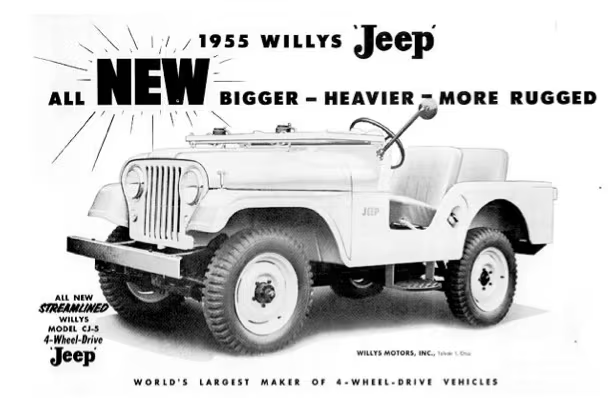
In 1955 the “All New Streamlined” Willys CJ-5 arrived. It was a bit bigger, mostly in some 5″ of extra length at the rear. And the full-width body created a bit more room for the front passengers and their feet.

This makes driving the CJ-5 a bit easier to drive when wearing big boots or such; the CJ2-3 is really quite tight in that regard. And there was even a glove box now. But mechanically there was no real difference between the CJ-3B and the CJ-5; all the usual classic early Jeep CJ components: the tough Hurricane four, a B/W T-90 three-speed transmission, a Dana 18 two-speed transfer case, Dana 25 or 27 front axles, a Dana 44 rear axle and 6.00 x 16 tires.

This immaculately restored CJ-5 was sitting right in front of us, at the local Friendly Food Court. It must have pulled in to park while we were ordering, so I missed the driver and didn’t have the chance to ask him what year it is.

Given that it’s still got the Willys (pronounced Willis) markings, it’s a 1964 or earlier. Starting in 1965, Jeeps were officially now from Kaiser-Jeep and labeled as such.

Standard 15″ wheels and tires replaced these 16 inchers in mid-1963, so that narrows it down just a wee bit more, although the 16″ wheels were optional through 1971. These are ND (military style) tires, which were also standard through 1963 (based on ad pictures), so that’s not going to help us narrow down the model year for this Jeep. There were apparently very few changes during these Willys years (1955-1963).

So unless the owner sees this post on the web and chimes in, the exact year of this CJ-5 will have to remain a mystery.

The front seat is the optional 2/3 – 1/3 spilt bench. Given the narrowness of the CJ and the three levers protruding from the floor, it’s a bit hard to imagine anyone riding in that middle position. But things were different back then, and folks were generally narrower. Still…
The rear seat is a good place to get some wind in one’s hair.

I haven’t encountered a restored early CJ-5 before, so it was fun having this one drop in for dinner entertainment.
I’d happily drive off in this Jeep. And I’m even good with the Hurricane four; it’s quite adequate for the back roads and off-road driving I’m likely to subject it to.

It reminds me of the red four-cylinder TJ Wrangler we rented in Silverton, CO some years back. It was a chilly mid-October morning as we headed off on the Colorado Alpine Loop, but as the sun hit we stopped and put the top down. Here we are crossing Engineer Pass (el. 12,800′). The 2.5 four in the TJ was perfectly adequate for the job.

Time to say goodbye to the face that’s become iconic.
Related CC reading:
Curbside Classic: 1945 Willys Jeep MB – The Icon Of Freedom by P.N.
Curbside Classic: 1947 Willys-Overland CJ-2A by M. Butts
Curbside Classic: 1948 Willys Jeep CJ2A – In The Beginning by J.P. Cavanaugh
Curbside Classic: Kaiser Jeep CJ-5 – Transcendent Independent by R. Kim
The History of The Curious F-Head Engine by P.N.























Column change on a Jeep, nope never seen that but Ive kinda worked out which model was parked dead where I was living in Tassie it had valve problems and was hard to get parts for and not a go devil so must have been the hurricane, A lot of the body was flay galvo sheet so which model has been hard to work out, but CJ3B looks just like it, Cool.
Mitsubishi built a good Jeep the powertrain was in other of their vehicles to.
It was one-year-only, 1946. I’d guess it never existed in right-hand-drive and Jeep didn’t even consider doing RHD until many years later since the first Mahindra Jeeps made in India for that country were nonetheless LHD.
I remember being disappointed in the looks of the cJ-7 when it came out. Whether it was because the CJ-5’s lines were inherently right or (more likely) because of familiarity, I came to love the CJ-5 even more.
A cousin bought a new one, probably 1976, a well-dressed one with the 304 V8. It remains the ultimate Jeep in my mind.
My 56 Jeep died in 1973 for lack of a replacement head. Parts for the F head engine were scarce and pre internet searches for rare parts were difficult. Now 50 years later they aren’t even available on the internet.
I noticed in yesterday’s Wagoneer post that ‘Jeep’ was written in single quotes in the ads. In the early CJ ads shown here, both single and double quotes, as in “Jeep”, are used rather randomly. As a punctuation nerd I got curious and looked at some moreJeep ads. At some point during the AMC era the quotes disappeared completely, then ®️ for Registered Trademark appeared. It’s used pretty diligently, now often combined with Brand as Jeep ®️ Brand or Jeep ®️ Vehicles. Like the vehicles themselves, vehicle naming and legal protection is more complex now. In fact, the only non Grand Cherokee Jeep that I’ve driven was a recent plugin hybrid 4xE Wrangler … a far cry from these simple CJ’s. But still fun.
I’m curious as to why the quote marks were used so long too. I know Ford and American Bantam (who also built WW2 jeeps) didn’t want Willys to be able to trademark the “Jeep” name and turn it into a brand, which Willys set out to do even before the war ended. But neither Ford nor anyone else called the vehicles they produced in the postwar ’40s “Jeeps”, so Willys was able to register Jeep as a trademark in 1950.
Similar situation with “Suburban”, which was long a generic term for a station-wagon body on a truck frame, or occasionally even on a car frame or unibody. When Plymouth discontinued their last Suburban wagon in 1977, only General Motors was left building Suburbans, and after nobody else called their vehicles that for the next ten years GM was able to trademark Suburban for themselves.
The Jeep history on the current Jeep website ( https://www.jeep.com/history/1940s.html#quad ) has everything going back to the first jeep prototypes in 1940 as “Jeep® Brand 4x4s” which is simply wrong.
Well, when Willys-Overland filed their original application for trademark registration in February 1943, they declared, “The trade-mark was first used about November 20, 1940, and first used in commerce among the several States which may be lawfully regulated by Congress on February 5, 1943.”
Did all CJs have tailgates?
Yes, that was one of the key changes to from the MB.
Thats pretty cool that it survived well enough to be restored. Are jeeps as rust prone as old Detriot convertibles?? And do they have companies making new “tubs” or bodies? I know 1960s Camaros and Mustangs have complete reproduction bodies you can buy.
As for the diesel Mitsubishi jeep, that must be miserable with all the engine noise in an open top car. Its not like they could stuff a ton of sound deadening in there and make it tolarable like an old Mercedes diesel sedan
It wasn’t loud at all, like pretty much all modern automotive diesels. A nice little bit of grumble but pleasant. Have you been around modern diesels?
Yes there are a number of companies that make basically every part for early jeeps. I have seen a number get new tubs frames and more swapped in at a frame repair shop near my house. In pre-internet/early internet days there was a guy named Ivan who locally stocked all the body parts and advertised them in local papers with the tagline Ivans got it.
Lately I’ve been seeing a lot of modern Wranglers sporting the Willys trim package. I’d thought that Kaiser bought the “Jeep” name from Willys, but it appears they bought the entire Willys-Overland company and got the “Willys” name as well, and it must have gotten transferred to AMC, then Chrysler, then FCA, and now to Stellantis.
So was Willys of Brazil a different company?
Not originally. Willys-Overland do Brasil was simply the local subsidiary.
In 1967, it was purchased by Ford, leading to an interesting mix of Ford and Willys products going forward. It got even more interesting when the operation merged with Volkswagen in 1987, only to split up again in 1994.
One Willys product that got a new life in Brazil was the Aero-Willys sedan. Introduced in the US in the mid-1950’s, it had the same problem as other independents, being a well-engineered smaller car that could not be priced competitively with the basic full-size cars from the Big Three.
The tooling was sent down to Brazil where it remained in production through the 1960’s and even had a modern restyling.
Technically speaking, Kaiser Motors merged with Willys-Overland in 1953 — it was a whole saga, described at length in Richard M. Langworth’s Kaiser-Frazer: The Last Onslaught on Detroit.
Interestingly, the Jeep mark is still owned by FCA. Stellantis owns FCA, but I guess its various property is still held by FCA US LLC.
A nice and fairly comprehensive article .
The restored red one is glorious .
I briefly worked for Milne Bros. JEEP in the parts department in 1976 and we sold quite a few F Head parts, cylinder heads included .
We’d even get requests for transfer cases for older JEEPS, apparently they’d develop cracks and the old guys could still be used .
-Nate
“The restored red one is glorious.”
Absolutely. Came to say this. ^^^
I have a 2016 Wrangler “JKU” (4 dr). It’s nice, and ya get the “offroad, fun, wind in the hair experience’, but it’s definitely just not the same as the CJ.
The 150HP 304V8 in a CJ5 or CJ7 was cool back in the day…
The 500HP 392 Hemi V8 in a Rubicon 392 JK is kinda cool too!
500 hp in a Jeep is suicide. If not for you, it is for your young driving age kids.
Strange comment.
500HP from any vehicle is common these days. It’s not even that much these days.
So many older Jeeps have been converted to aftermarket V8 power over the years. Aftermarket companies have offered V8 conversions kits for years.
I recommend to take a Rubicon 392 for a test drive! It is a total brute.
The US$100k+ price tag is a problem though.
Are you smoking crack? Seriously?
“Ploughing” ? “Willis”?
“Given that it’s still got the Willys (pronounced Willis) markings, it’s a 1964 or earlier. Starting in 1965, Jeeps were officially now from Kaiser-Jeep and labeled as such.”
This has me scratching my head a bit. I’ve always known the CJ-5 my family had until the early 2000s to be a 1959 model, but the tailgate says “Jeep” instead of “Willys” and in the font that was used in the 60s & 70s. This must mean 1 of 2 things: either the Jeep is actually a 60s/70s model, or the tailgate isn’t original to this model (though the color is close to correct and matches the rest of the vehicle in every other way). I DO know it was a 4-cylinder model however. I otherwise don’t know much more about it as I was no more than 10 years old at the time it was sold.
Here’s the only other photo I can find of it for the time being. Besides the labeling on the tailgate, the CJ-5 pretty much looked the same in the early 70s as it did in the 50s. And I assume both tailgate styles weren’t offered concurrently before 1964.
UPDATE: I just asked my dad about it. It IS a ’59–the tailgate was sourced from a later model & painted to match the rest of the body. A remarkably good job to say the least! 🙂