
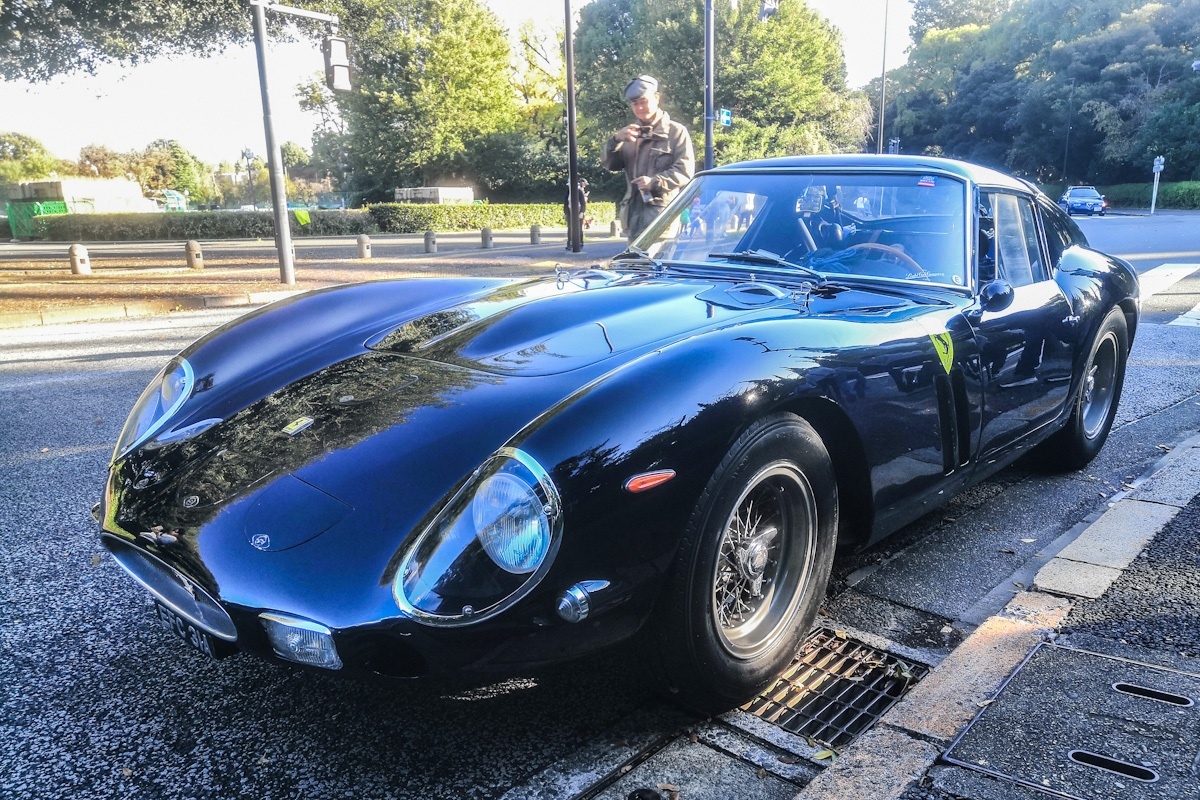
Although they are objectively beautiful, rare and very fast, I’m totally out of my depth when it comes to older Ferraris. Especially the 250 – there were just too many of those to keep track. This looked like one, and a pretty exclusive one at that. The big question being: real or replica?

I’ll answer that straight away: it’s a genuine GTO. A very well-known and thoroughly documented one, too. Ferrari 250 GTOs were more meant for the track than the street, though they are road-legal.

This one must have had a special dispensation to be able to putter about Tokyo with its British plates on. But then, if you’re able to afford care like these, I’m sure you can come to some sort of an arrangement, no matter where you are.

This particular car is known, like all GTOs, by its engine number. Let’s meet and greet 4219, then. Said engine is a race-spec 2953cc all-alloy V12 fed by six Weber carbs, producing 296hp. The chassis is (of course) tubular and the back end is still a live axle setup – this was perhaps the last truly competitive racing car that featured the traditional front-engined / non-IRS layout.

And it certainly was a highly competitive racing car in its day. Here’s what our priceless prancing horse looked like originally, finished in Cina Rosso red with a blue interior. It was ordered by tobacco heiress and NART racing driver Mamie Reynolds, who took delivery of it in Florida in February 1963. It won at Daytona a few days later, driven by Pedro Rodriguez.

A couple of months later, 4219 was purchased by Californian Buick and Ferrari dealer Bev Spencer, repainted white and raced at Laguna Seca, where it finished second. Spencer’s financial means were not infinite though, so it was re-sold later that same year for $14,000 – just $4000 less than it had cost new.

Here’s the ad, as published in Road & Track in December 1963. The car was sold a few weeks later, staying in California but switching to the dark blue paint that it still wears now. In 1993, 4219 was sold to present owner and UK-based Ferrari collector Brandon Wang, who has managed to keep in intact and unrestored ever since.

Mr Wang bought this rare machine for $3.2 million back in 1993 – a tidy sum, to be sure. But given that one 1993 dollar is roughly worth two present-day ones, it was still a bargain. If the last couple of GTO sales are anything to go by, should 4219 go back on the market, it would presently fetch between $50-70 million, especially since it was raced, never restored and 100% legit.

Short of finding something that won Le Mans or the Indy 500, I doubt I’ll be able to score anything more exclusive than this. And those racers probably won’t have as nice an interior as this Ferrari, nor will they be worth anywhere near as much.

Putting aside its astronomical price, which I was unaware of when I took the pictures, it’s undeniable that the GTO’s muscular, yet sensuous curves are a work of art. It’s all in the name of aerodynamics, as worked out by Bizzarrini and the coachbuilder Scaglietti, but the shape of this thing was amazing to see in the metal.

And I must say the dark blue paint really compliments it very well – much better than the white it briefly wore. I can’t say that it really stirs anything in me, though. Now that I realize how much it’s worth and all that, so sure, it’s like I met a major film star, but not one whose movies ever made my top 100. So long then, 4219. You’ll always remain a 4-digit number worth an eight-digit sum. A car for math nerds or for dyed-in-the-wool Ferrari tifosi.























I saw one of these at a Cincinnati area cruise-in a couple of decades ago. It was owned by the guy who started Cincinnati Microwave (Valentine was his name), the creator of the original Passport radar detector.
When I walked up to it, my first thought was it had to be a nice copy, but when I saw the engine, began realizing it was the real thing. I couldn’t believe someone would drive one on the street to a local car show, given the value, not to mention how few would recognize it for what it was.
As one might imagine, someone close to the owner (probably the guy who drove it to the show) was nearby and confirmed it was real. Talked with him for a few moments but don’t remember him saying anything particularly noteworthy.
I also recall reading a story that these cars weren’t anything all that special versus Ferraris of the period, and recreating one wouldn’t be all that hard. Of course, the provenance wouldn’t be there, either, since the VIN wouldn’t jibe with an actual production GTO; it would just be a rebodied Ferrari 250.
Looks a lot like an XK-E except for the top…
The Subaru I’m driving right now is also blue, was also never restored, has three syllables, and I certainly have tried to race it on American soil too. Yet it’s somehow worth a bit less than this. And also less than even Bev Spencer’s asking price was. I suppose it is true that “The rich, they are different from you and me.” It’s a harsh world; the struggle is real, folks.
Dark blue tends to suit Ferraris quite well, certainly better than the orange and white this one was previously and in many cases better than the ubiquitous red. Green (very green) might be a more appropriate color for this one, but perhaps too on the nose, eh?
“I doubt I’ll be able to score anything more exclusive than this.” – Don’t sell yourself short, I’m convinced there must be some even more exclusive baubles tucked away in one of those Tokyo back alleys you skulk around in. You’ll turn up at least one within the next six months!
Really though, one might find/see another GTO somewhere or other but it won’t be as accessible to the hoi polloi as this one is on Gingko Street, perhaps the ne plus ultra of car spotting spots anywhere in the world. A(nother) most excellent find!
I have seen a handful of genuine 250 GTO’s, but I’ve never seen a Mitsuoka, so exclusive is all relative. I don’t remember the Ferrari dealer on Gearyin San Francisco being associated with Buick, but I recall peering out the car window whenever we drove by, hoping to get a glimpse of a Ferrari behind the showroom windows. Maybe I even saw this one 60+ years ago. Note: Geary’s “auto row” is not what it was.
I can’t say that it really stirs anything in me, though.
You’ve just made history, as the first automotive writer to say that about the GTO. It’s a wee bit surprising, but then I’d rather read that frank admission than another breathless and bloviating essay on the GTO.
Raced at Laguna Seca. That would have been the original Grand Prix Circuit. I wonder what time? Apparently not in the books. The circuit today is much more challenging. The fellow I know who took his Porsche 911 GT4RS down there did his laps in 1:43. Slow. He has an app that shows how you did around the entire course and where you let off on the gas. Laguna Seca is classified F1A Grade 2 being slightly narrower than a Grade 1 circuit. Nonetheless, he told me someone flew in a Formula 1 Ferrari with a professional driver who went around the track in 1:08. From what I can find that would be the third fastest all time unofficial lap record on the new circuit
Nit picking here, but if the Porsche was a GT4 it was a Cayman and mid-engined. A 911 would be a GT3 or GT2…
This car certainly embodies the beauty of the hand built GT/racing vehicle. I would guess that any car enthusiast who saw this car and was smitten by it, spent many, many, years of their lives looking for something that could excite them even a bit like this Ferrari, but was obtainable. Corvettes, Shelby Mustangs, Cobras and even Datsun Zs have probably satisfied that craving for many. There were kits to convert your early Datsun Z into a Ferrari look-a-like. I saw one once at a Datsun show, and to my untrained eyes, it looked like a passable copy. The desire to own a curvaceous Italian super car has been the inspiration to hack up many a Pontiac Fiero and re-body it in fiberglass in the hopes of catching some of that Ferrari spirit. I could say that this Ferrari is probably a terrible car to drive on the street, noisy, hard riding, liable to suffer grievous damage in a minor collision, and uncomfortable, lacking even a/c. That may all be true, but maybe it’s just an example of sour grapes on my part. In my more mature stage of life, I’ve quit pining for things that I’ll never have, and focus my enjoyment and gratitude for the things that I do have.
What a find for a street side car show/drive in – something that could be the centre piece for any prestige or top end concours event.
Hats off to Mr Wang for letting mere mortals get that close.
Perhaps the most expensive car ever on CC, and without a barrier!
Fun NY think. I saw 250 Ferrari in about 1976, stop buy it the price was do able. The sales laugh at me when ask if he took trade ins, the TR6 was in his league I guess. Life could of been different at I own that 250.
What an absolutely gorgeous vehicle! The look, the sound, the performance, the head turning lines. I’d love to see, better yet, experience one.
I could see the original Bond, James Bond driving one of these only if he had never sat in a DB5.
Oh yeah, it’s my favorite kind of vehicle…owned by someone else!
Those curves are so alluring. I would sell it tomorrow since auction prices are astronomical then pickup a few new toys to fill the void. So many other fun things to do with that pile of cash.
I will take mine in white with the stripes, thank you.
It’s an almost comically-unlikely find, at the curb, something akin to seeing an old master hanging at the kid’s godawful school art day. (Though I do spy a Bugatti loitering behind, so I suspect it’s a rather special curb, but that is to digress). I salute you, Prof.
But I’m with you – doesn’t stir much in me either. Doubtless it sounds like the trumpets of heaven and drives equally (for its time), but it isn’t a pretty thing. And it helps not that the valuation represents an obscenity: whether art or objects, by this level the market is only ever about vainglorious possession, a clinging to immortality that won’t ever come.
My goodness what a find! The price numbers broke my brain a bit, hats off to the owner for actually driving the thing.
I saw 2 of these at the HI$$TORICAL Races at Elkhart Lake, Road America many years ago. Both were immaculate and both RACED, as they were designed to do. IIRC, one, back then, had recently $old for $39 million-in Japan?….a World Record at the time.
They did SOUND GR8 racing, too!
Certainly worth far, FAR in exce$$ of my beloved ’56 Chevy!! 🙂 DFO
I’ve been near GTOs a number of times and they make me go weak at the knees! The ’64 version is more extreme, but not as pretty as this one. The color is also lovely and seeing how original it looks I am in lust with it. Forget the value (which is almost off putting) and, as Clarkson would say, “just look at it!” Curves combined with tautness and that functional Kamm tail.
Tatra, if you had heard it run, your loins may well have been stirred. I have a recording of Nick Mason’s very well known (British plate # 250GTO) being driven and the sounds in the cabin are intoxicatingly multilayered – truly a symphony orchestra of mechanical, induction and exhaust sounds.
I’m getting a bit hot and sweaty just thinking about it….
“clinging to immortality that won’t ever come.” Funny Justy, you hit the nail on the head. Yes, the rich certainly do live different but even with a bank account that wouldn’t wince at paying a high six figure accident deductible how much fun would one truly have driving such a sensitive investment? Not much I think. Prices fetched for such rare pistonic pleasure pods appear limitless.
My Dad drilled in the Ferrari GTO being the most beautiful Ferrari ever into me as a lad (even though I still favor the Daytona and 308 GTB secretly), and where it’s one of those cars that is so obscenely valuable where I may as well be dreaming to go to space, it’s influence in (somewhat) more down to earth cars I am aspirationally interested in is right there; The side louvers in 66 and 68-69 Corvettes, the fastback profile of 65-68 Mustangs, the fuel filler of 68-70 Dodge Chargers, and of course the coke bottle shape that literally shaped the late 60s-early 70s. I now know there were many influences in that period of car design, but the Ferrari GTO single handedly contains the best of them.
You’ve put the GTO into proper context. It was not ever designed to be “beautiful”; it was an uncompromised racing GT racing car, in the classic “form follows function” mode. There are many Ferraris that are more “beautiful” in the classic sense, but the way the automotive world works, successful racers tend to be extremely influential. The GTO stands as the most influential of its time, as were cars like the Mercedes SSK/SSKL in its time.
Looks a lot like an XK-E… except for the top… which I wouldn’t want, anyway…
Actually there weren’t too many to keep track