

The Rootes Group was one of the earliest practicioners of badge engineering. Long before the 1982 GM A-body quartet came into being–going back to the mid-1930s, in fact–Rootes was keeping busy with variations on a theme, a practice that by the 1950s had become a long-established Rootes tradition. Take today’s CC: The “Series” 1955-67 Sunbeam Rapier. This car, the most sporting of the “Audax” series of cars built by Rootes, shared just about everything (except minor trim and interior fillips and, in some cases, engines) with the bread-and-butter Hillman Minx and medium-priced Singer Gazelle.
 image: sunbeam.org.uk
Sunbeam originally was an independent company dating from 1877, when John Marsten started a bicycle company called the Sunbeamland Cycle Factory; as you might have guessed, the bicycles were called Sunbeams. The first Sunbeam automobile was offered in 1901, although several prototypes had been built before then. During WWI Sunbeam built trucks, ambulances and motorcycles. During the 1920s they merged with the French firm Darracq, thus gaining the Talbot marque at the same time; by then, Sunbeam had become known as a maker of very high-quality autos. Despite this, the company went into receivership in 1935, and was purchased by the Rootes Group.
 image: autogush.com
Following the acquisition, Sunbeams became derivatives of the Rootes Group’s Hillman and Humber models, but still were quite attractive cars. In 1948, the Sunbeam-Talbot 80 and 90 were introduced. These cars were quite streamlined in spite of their carryover chassis and drivetrains. The S-T 90s, including this white convertible, used an OHV version of Humber’s two-liter engine.
 image: autogush.com
The 80s used the Hillman Minx’s 1,185cc, 80-hp mill, which really wasn’t enough engine for the car; it was gone after 1950. The Humber-engined 90 carried on, as did the sportier 1953-55 Alpine roadster.

The Sunbeam-Talbot 90 lived on in subsequent Mk II and Mk IIa versions until 1954, when it became the Sunbeam Mk III. It also got a larger grille, side “portholes” and a bump up to 80 horsepower. The final cars were built in 1957, not long after the introduction of the new Sunbeam Rapier coupe and convertible.
 image: lov2xlr8.no
While not the first Audax model released, the Hillman Minx was the bread-and-butter version. Available in sedan, station wagon (or Estate, in its home market) and convertible body styles, it looked a great deal like the 1953 Studebaker, with its low hood line, shallow grille and unadorned flanks–especially without a two-tone exterior.
 image: britbox.com
Next up the Audax chain was the Singer Gazelle. If the Minx was a Chevrolet, the Singer was more of a Pontiac or Oldsmobile. Like the Minx, the model lineup consisted of sedan, estate and convertible versions. The Gazelle sported a bit more chrome, a more prominent grille and available two-toning.

But what about the Sunbeam? Actually, the Sunbeam Rapier was the first Audax to be released. Introduced in 1955, it was positioned above both the Hillman and the Singer, available exclusively as a two-door hardtop. It wore much more elaborate two-toning than the other Audax models, and featured deluxe trim throughout. Boasting a 96″ wheelbase and 160″ overall length, it used a higher-compression, 62.5 horsepower version of the Minx’s 1390cc inline four.
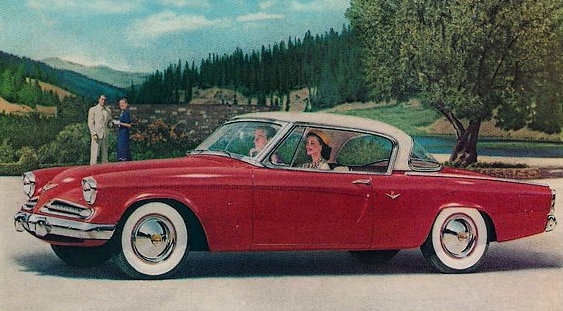
If the Series I Rapier looks like a stubby Studebaker, the resemblance is strictly intentional. Raymond Loewy Associates consulted with Rootes on the Audax cars, and several styling cues, notably the reverse-curve roofline and wraparound backlight, were very familiar. Production totaled 7,477 between 1955 and early 1958.
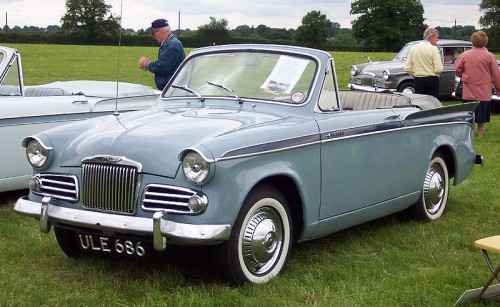
The Series II debuted in February 1958, with a new convertible model joining the hardtop. The Series II reintroduced the traditional Sunbeam radiator grille, albeit with side grilles to fill in the largely carryover front sheetmetal. Two-toning was no longer available, but the new spear-like side trim could contain a contrasting color. The biggest sheetmetal change involved the addition of fins, which made the Loewy-designed Sunbeam look even more Studebaker- (and especially Hawk-) like. The column shift of the Series I was replaced with a floor-mounted unit. It mated to a larger, 1494cc engine good for 73 hp @ 5200 rpm.

The Series III came along in late 1959. Differences were largely confined to minor trim shuffling, but narrower A-pillars allowed more glass area in front. More noticeable was the updated interior, which now featured a wooden dashboard and carpeting in place of last year’s rubber mats. Under the hood, a new cylinder head and crankshaft provided an additional five horsepower.

Outside, the 1961 Rapier Series IIIa was largely the same, but under the hood was an 80.25-hp, 1592cc engine with modified water and oil pumps. This was also the last call for the convertible, which was discontinued in mid-1963.

Interestingly, the Series II, III and IIIa largely mirrored the newly befinned 1956-58 Golden Hawks, right down to the tall central grille flanked by mini-grilles. I guess Loewy liked variations on a theme.

The Rapier was also a popular rally car. In the Fifties and early Sixties, Rootes Group used Rapiers as works rally cars; this surviving works car can be found on sunbeamalpine.org. A Rapier driven by Peter Harper finished fifth in the 1958 Monte Carlo Rally.
 image: humberholman.com
The 1964 Rapier was supposed to have been an all-new car. Although it had been designed and approved for production, Rootes had a last-minute change of heart and decided to update the IIIa instead. The would-be Rapier became the 1964 Humber Sceptre, which is pictured above.

The Series IV was facelifted with a new hood, rectangular parking lamps and more angular side grilles. The Rapier’s headlight trim, borrowed from the Alpine roadster, was chromed, not painted as on the Alpine. New bumpers were fitted as well.

The unique stainless steel wheel trims of earlier Rapiers were gone; now the Rapier shared 13-inch wheels and hubcaps with most other Rootes Group cars. The Series IV engine was unchanged except for the substitution of a single two-barrel Solex carburetor for last year’s dual Zeniths. It now produced 84 hp and 91 lb-ft of torque.

The revised instrument panel was still basically a slab of wood. The glovebox was moved up, which allowed space for the new open storage bins flanking the radio. The steering wheel was shared with the Alpine and Tiger roadsters. New seats and an adjustable steering column rounded out the changes.

Speaking of roadsters, the Alpine and Tiger had by now become the preferred Sunbeam rally cars, thus providing one more reason for the Rapier’s demise in the near future. After selling a record 17,354 Series IIIa Rapiers, Sunbeam began slowing production with the Series IV.

In late 1964, time was just about up for the Audax Rapier, although it did receive a new, all-synchromesh transmission along with the rest of the Rootes lineup. The last of 9,700 Series IVs came off the line in 1965–but would you believe the 1955 bodyshell still had one more surprise in store?
 image: motorpix.com
The car that originally was going to bow out in 1963 returned one last time as the 1965 Series V. It still sported those Hawk-like fins and grille, but under the hood lived a 1,725 cc four. The ultimate Audax Rapier now had a top speed of 95 mph and a 0-60 time of 14.1 seconds. In a concession to modernity, the polarity was changed to negative earth and the antiquated dynamo was replaced with an alternator. Despite all the worthwhile improvements, the V didn’t sell well. It is the rarest version, with only 3,759 made. The final Vs were built in 1967, right around the time Chrysler purchased Rootes.

After the “Series” Rapiers were discontinued in 1967, a new, modern fastback Rapier was introduced the same year. The new Rapier shared its platform (and most of its sheetmetal) with the redesigned Hillman Hunter sedan. A less deluxe Alpine fastback joined the Rapier in 1970. Both of these Barracuda-like Sunbeams continued until the 1976 model year, after which the Rapier would be gone for good. The Sunbeam name itself would not last much longer.
Special thanks to Bryce, who found our featured car at an auction and shared the photos on the Cohort. Nice find!
























Nice write-up on these cars, Tom. There were a surprising number of Hillmans around in the early sixties; they sold fairly well in the US during the Great Import Boom. But not the Sunbeams, at least not to my memory. Hard to imagine anyone still buying a Rapier in 1967! Even in England.
As a kid, I would have been very happy to know that Loewy had a hand in the Audax cars. It would have solved a long-running mystery then. I just assumed they were copying.
What is interesting to me is that while Loewy considered the standard 53 Studebakers (not the Starliner) to be tall and stubby botch jobs, their general proportions seem to appear on the Rootes cars as well, even with Loewy’s input. However, this is probably unavoidable given the Rootes cars’ small size and the need to accommodate passengers.
Here are the cars I was thinking of.
The Roots cars look better to me than the 1953-55 Studebaker sedans. Oddly enough, that’s because the Roots’ design was much more understated. The front end was squared off rather than pointed, and the profile was boxy rather than tear-dropped.
That also had the happy result of better rear-seat headroom and trunk space. The Studebaker, in contrast, was a failed family car — which is why it received a major restyling in 1956 to give it a squarer look (and better trunk space).
Another lesson in English car history. These are really nice. I don’t recall ever seeing any in the STL area, just the usual MGs, Triumphs, Healeys, Mercedes, VWs, Fiats et al.
That hardtop and especially convertibles are super-cute! I see the styling relationship to American cars. They remind me of Studebakers as well as Ramblers.
The turquoise 1964 Humber Sceptre shown certainly had a grille reminiscent of the 1964/65 Barracuda.
Thanks for all these pictures and for walking us through the twisted path of British badge engineering.
Carrying on the Rootes/Studebaker connection, I found the fins added to the Rapier strikingly like the Hawk’s fins, which made me want to compare the two directly from behind. Interesting difference, sensible English, wild American.
This photo from Belgian Rootes club shows off the fins a little more than the top picture. Golden Hawk from Wikipedia.
Facepalm on the clue it was cropped off one of my shots and I drive the 4door version oh well, nice cars but greatly overpriced now I am upgrading my Minx to semi Rapier performance levels just using a pick and mix of the Hillman parts book. The Hunter used a similar cylinder head to the Rapier and can be retrofitted to any Minx engine and gives an instant hp gain.
The Rapier was one of the cars I didn’t consider too, they are pretty rare but there are a few around.
Years ago I had a ride in a Hillman Husky that had been converted to full Alpine running gear (easy as they share the same platform), the idea was that it would cruise just off the cam for good fuel economy, but have excellent performance. Unfortunately the guy who built it died a couple of years ago.
Something about these kind of British cars just annoys me! The guppy nosed Studebaker front just about cuts it but those fins in the mid ’60s- what were they doing? It would be like trying to introduce a car with 2002 styling now. The conservatism of the British public really is embarrassing at times!
As for the later ‘Barracuda’ styled rapier, what a dog! Somehow you feel patronised by such cars. That you didnt DESERVE a modern sports car that handled and drove properly. At least the Hunter,despite being dull was at least a practical, reliable and unpretentious car that could be trusted.
Keep in mind just how much America was ahead of the rest of world when it came to automobile styling back then. Any European that was only five years behind the Americans were considered completely up to date.
Ease up, the fins were introduced in 1958, and hung around at least partly because the cars were sold in small numbers that wouldn’t pay for a re-tool. They certainly weren’t on their own in that respect (keeping fins), as even in the US there were still small fins on a few cars. On the other hand, the fins (that were different) were taken off the sedans in 1961 or so, the sedan also had a major restyle in 1964 which the Rapier coupe didn’t.
In 1964-65 Rootes was being bought up by Chrysler, and it wasn’t because they had more money than they knew what to do with.
The conservatism of the British
publicmotor manufacturers really is embarrassing at times!There. Fixed it for you. And since they’re all now long defunct it should cease to be a source of embarrassment. 😉
The memories one keeps: Back in the summer of 1962, my father came home for lunch from the dealership and, as was his usual, came driving the oddest used car he had on the lot. Such was keeping his son amused at the time (and it was appreciated). This time he showed up with a 1957 Hillman Minx. While I’d usually just poke in, around and under the car while dad was eating, this time he took some extra time off and took me for a ride in it. And to this day that car has really stuck with me.
Anytime I think of British saloon (non-Jaguar), that Hillman comes to mind. About the only thing he brought home that fascinated me as much was a Renault Dauphine, which I remember because I actually got to drive it.
Back in the 50s and early 60s the Rapier was the sexiest mid size car you could buy in Britain. When they put the fins on it was the icing on the cake. The contemporary Minx and Gazelle models were face-lifted to a more radical degree than the Rapier. Note that before the Rapier ever appeared there was a two-door hardtop version of the previous Minx ( which must have had Loewy input ) called the Hillman Minx Californian.
Loewy’s imput can be seen in the 49/50 minx which looks like a 49 Studebaker its interesting to see the various models compared but Rootes cars outsold Studes hands down in this part of the world they were ruggedly made extremely durable and as reliable as anything else bear in mind Hillman held the import crown in the US in the 50s lost to VW mid decade. Of course in NZ there was an extra step in the lineup between the Minx and Singer was the Humber 80 with slightly different trim to the Minx it was a method of doubling the import quota.
Sorry if some of you guys like these cars but it seems to me that while the rest of Europe was forging ahead with new ideas, Rootes in particular was cribbing ideas from US cars that were already out of date.
By the close of the ’50s European car makers thankfully turned their attention towards Italy for design cues.
That kind of styling just doesn’t translate into small cars. Other examples are the Ford Anglia and mk1 Cortina. On large cars like the Fintail, Zodiac and Supersnipes it works better.
Worth remembering also that Ford of Great Britain continued to sell the Anglia – reversed rear window and fins – into 1968. It was a market best-seller throughout its life.
Great article Tom, I didn’t know the pre-Rootes Sunbeam history – and I always wondered why Chrysler used the Talbot badge here from the late 70s when it phased out the Hillman (etc) name. Interesting that Rootes allowed Sunbeam unique styling differentiation from the other Audax cars – I’d always wondered why the ’64 Humber Sceptre had similarly unique styling differences (rear end/roof/windscreen) from its stablemates, but now I know it was meant to be a Sunbeam it all makes sense.
I always found the Rootes badge engineering fascinating, and have a growing appreciation for the Audax series – cheers for fuelling that appreciation!
It’s probably worth mentioning that the Humber Sceptre was based on the Hillman Super Minx, which was intended to be the Series 4 Minx until they decided that it was sufficiently larger that they could sell both, and thus the Minx skipped the series 4 and came out with the Series 5 and 6, together with the Rapier Series 5.
There was also a coupe version, the Sunbeam Venezia, with a body by Touring of Milan.
Yes, I knew the Sceptre was based on the Super Minx, but was always intrigued at the amount of different sheet metal it had. Had never heard of the Venezia though, so looking forward to researching that! 🙂
One reason Rootes may have stuck with the AUDAX for the Rapier as it was meant to be a sports coupe the audax has far superior roadholding than the later Super Minx the audax Husky/Cob van was converted into the Sunbeam Alpine sports car and retrofitted with Ford V8 motors by Carroll Shelby certainly a wide variety of cars from one set of DNA