
Dad only ever owned one car—or, more accurately, half a share in a “sit-up-and-beg” Ford Popular with his brother, my uncle. Yet among his belongings in his desk were two car leaflets: one for a Bond 875 three-wheeler, the other for “A New Kind of Viva,” a fold-out brochure introducing the third-generation Vauxhall Viva in 1971. This was Vauxhall’s bread-and-butter family car, a straightforward offering. The Viva would go on to serve British motorists until 1979, but Dad never bought one. He stuck to his pedal bike, despite having a driving licence and occasionally hiring a car for family holidays. So there’s a certain irony in finding a beautifully restored, basic 1974 Viva today—a reminder of the kind of everyday family transport that once filled Britain’s roads, and that now survives only thanks to the dedication of enthusiasts.

The Viva’s story was covered by Roger Carr a while back. For the uninitiated, it was Vauxhall’s mainstream family car, introduced in 1963 and remaining in production until 1979. It was GM’s British answer to Ford’s offerings, first the Anglia and later the Escort. As Carr’s article explains, the Viva also played a part in Vauxhall’s gradual convergence with Opel. The original HA was developed alongside the Opel Kadett A, setting a pattern that continued with Vauxhall’s future products.
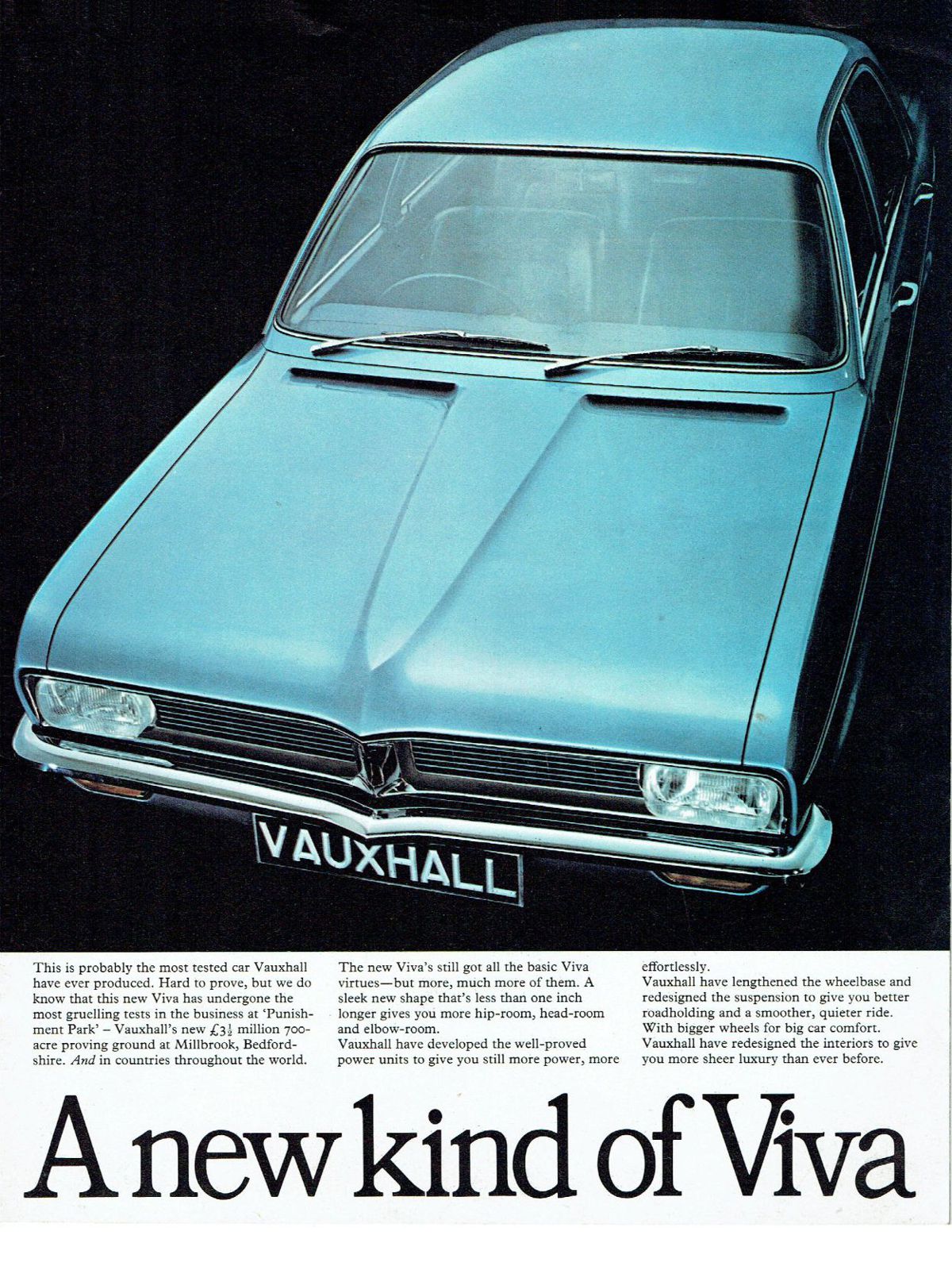
Essentially, the HC Viva was a refined and slightly enlarged version of the HB, introduced in October 1970. Its wheelbase grew by 1¼ inches, overall width increased by 1¾ inches (with the front track widening by an inch and the rear by half an inch), and overall length gained another half-inch. In two-door form, the HC weighed around 60 pounds more than its predecessor, an increase of roughly three percent. For its first year, it retained the HB’s 1,159-cc engine, producing 49.6 net bhp, but the extra weight dulled performance: 0–60 mph took around 20 seconds, half a second longer than before. In August 1971, the engine was enlarged to 1,256 cc, raising output to 52.8 net bhp and bringing the 0–60 mph time back down to around 18 seconds.
The Viva’s basic OHV engine dated back to the original HA of 1963, when it displaced 1,056 cc. Apart from the engine and gearbox, little carried over from the HA to the HB, making that transition a substantial redesign. The move from HB to HC, by contrast, was a more evolutionary step. The HA and HB each had relatively short production runs of three and four years, respectively, while the HC soldiered on until the summer of 1979, with few significant changes after 1974. Plans for a larger, Cortina-sized successor, the HD, were abandoned in 1972, paving the way for the Cavalier, based on the Opel Ascona B. The Viva remained positioned above the Kadett-derived Chevette and below the Cavalier, and the HC was the last passenger car created with dedicated, independent Vauxhall design and engineering input, excluding Bedford commercial vehicles.
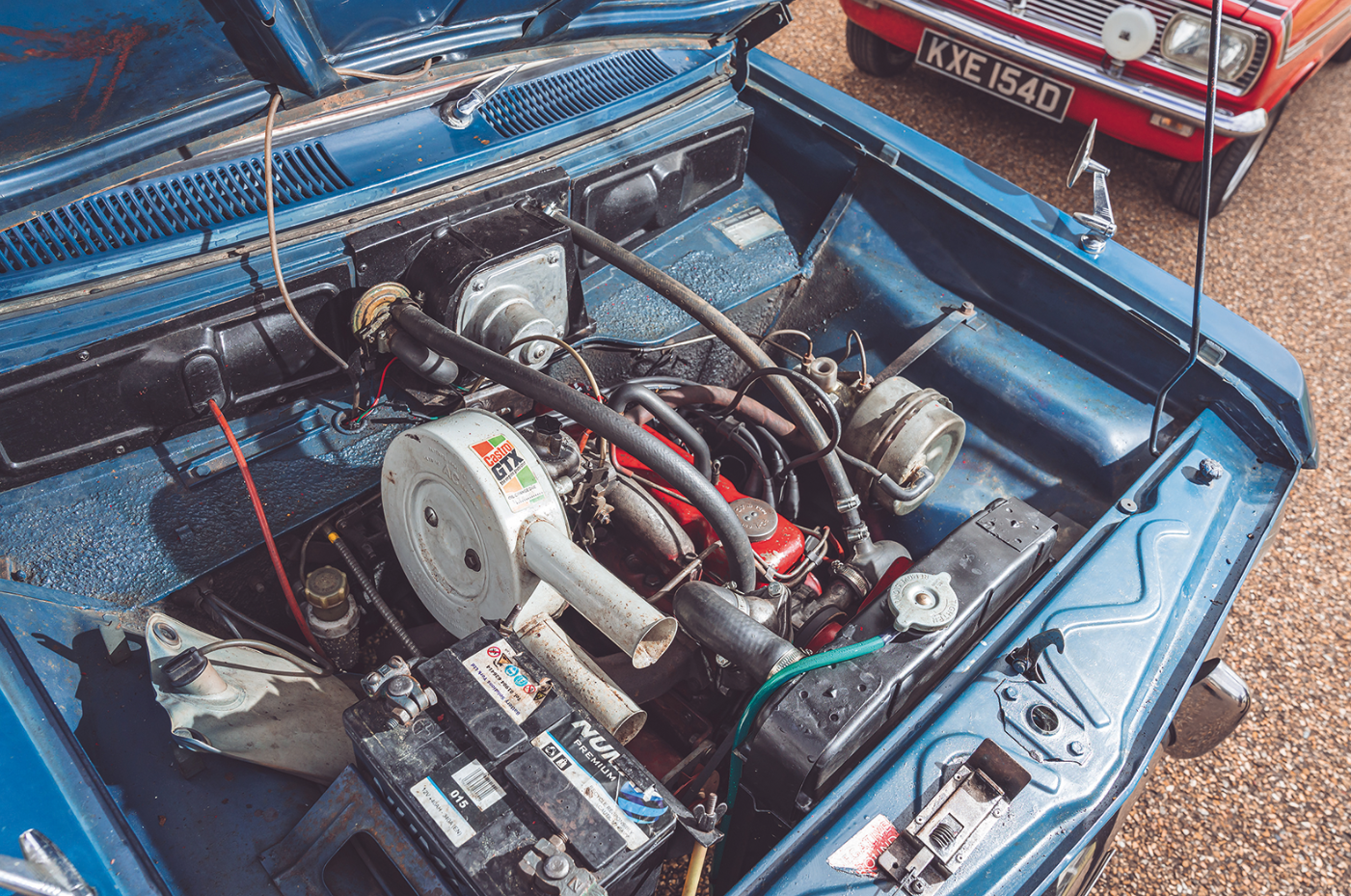
The 1056cc grew to 1256cc for 1971, and was the standard for 1974. The engine and 4-speed synchromesh gearbox may get you from 0-60 in 18·1 seconds, the dual-circuit brakes are servo assisted, 8½” discs up front, 8” drums at the rear. There’s rack and pinion steering with 3·16 turns lock to lock, while suspension is SLA independent up front and live axle on four coil sprung, trailing arm links at the rear. An 8 gallon (10 US gallon) fuel tank, which at 33·5 mpg (26·8 US gallons) at a constant 56 mph theoretically gives something like a 250 mile range.
The HC Viva offered a range of engines beyond its basic four-cylinder. More powerful options included a 1,599-cc “Slant Four” rated at about 81 bhp, later enlarged to 1,759 cc and around 78 bhp. The range even extended to a 2,279-cc, 110-bhp version, though from 1973 the larger-engined models were rebadged as the Vauxhall Magnum. The HC proved a success, with more than 640,000 Vivas built by the time it ceased production in 1979.
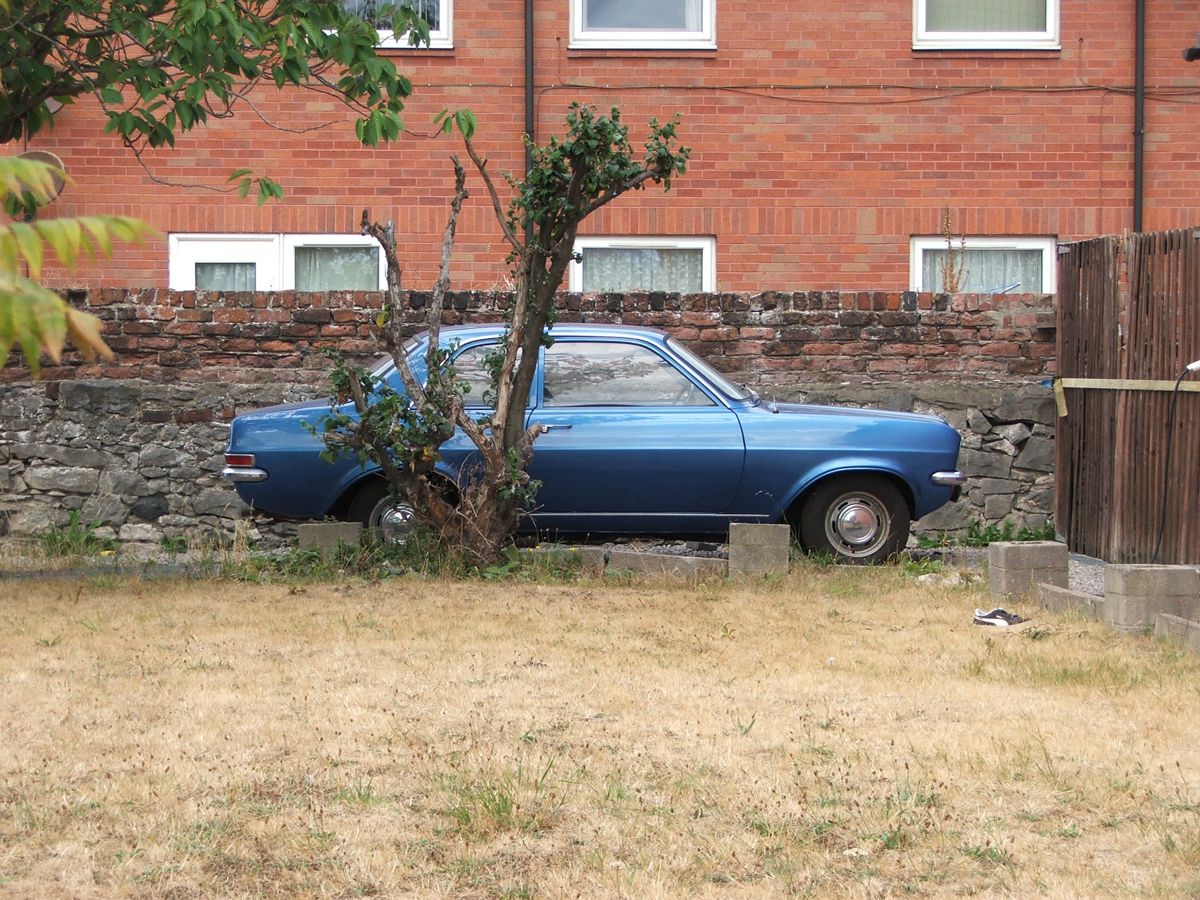
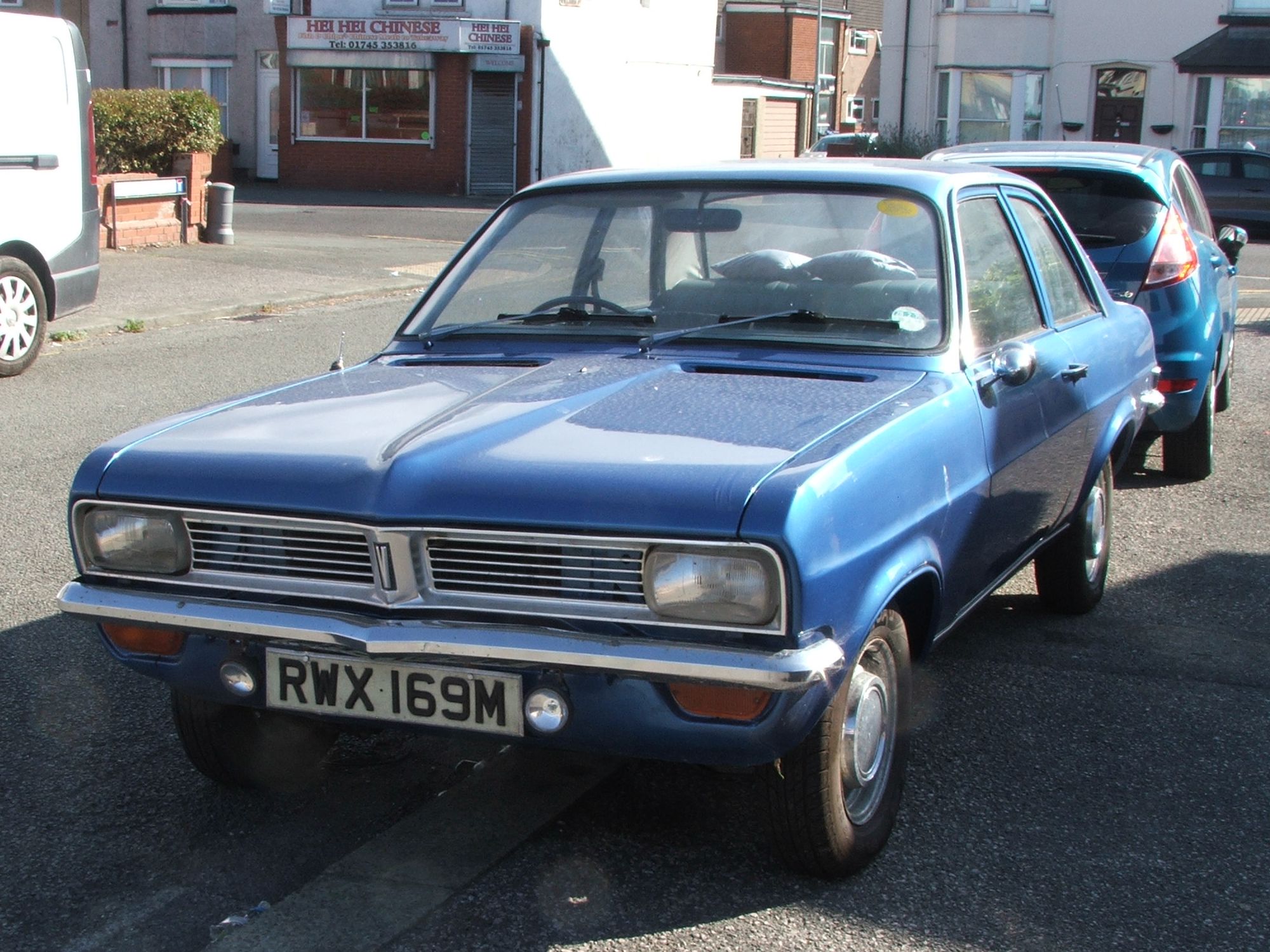
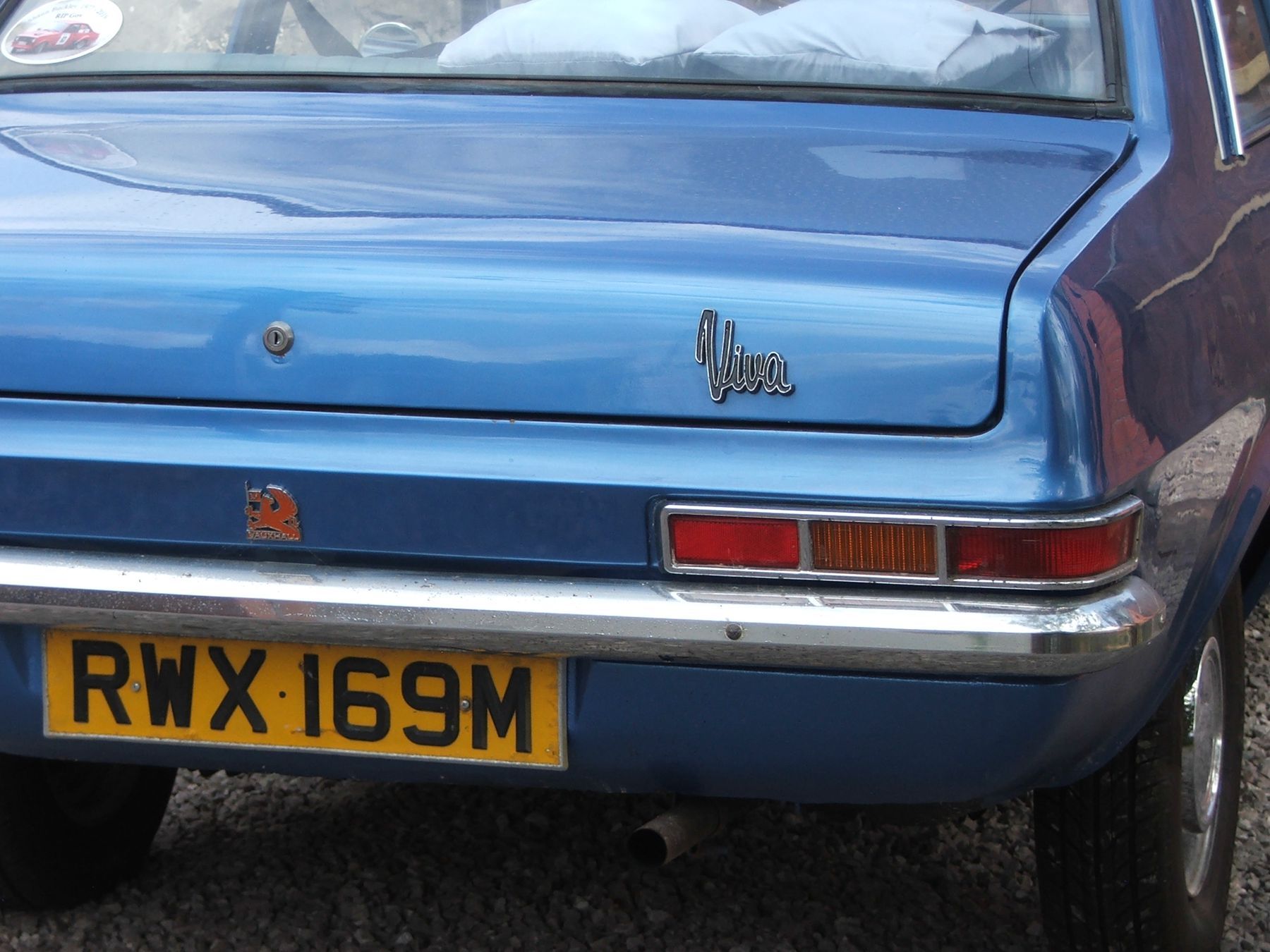
I spotted this blue beauty a couple of weeks before I took the first photos, so I noted the registration. RWX 169 M, first registered in West Riding (Yorkshire) in March 1974. It wasn’t visible the next week, but a week later it was parked off-road, so I was able to get some pictures of the side and rear.
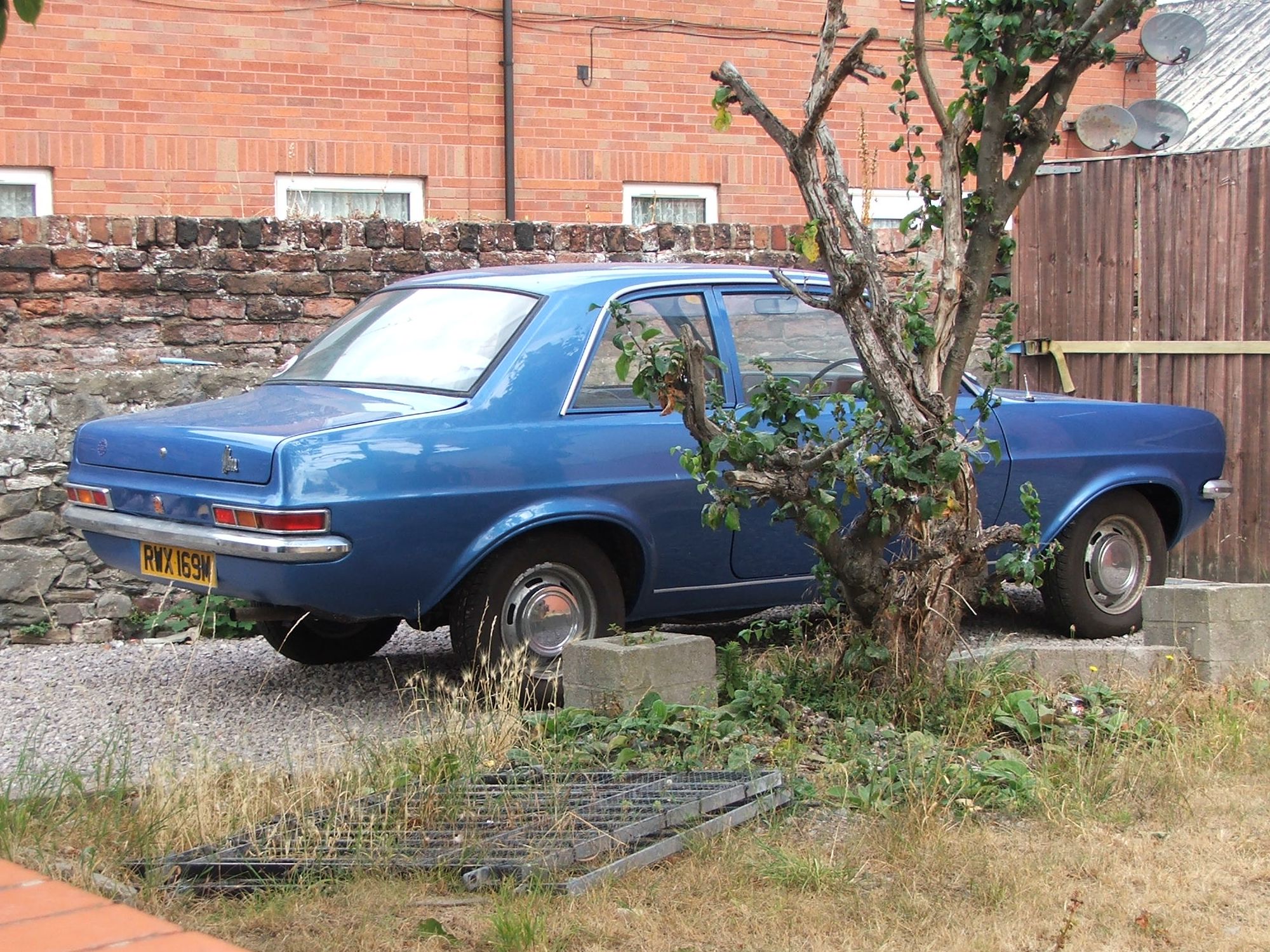
At first, I thought this was a Viva deluxe 2-door in Riviera Blue Starfire. The colour seemed appropriate for deluxe, but it was missing the waist pin striping, so likely repainted. Badging & wheels (6 hole), are correct for ’74 model year, with the Griffin badge between the lights replacing the VAUXHALL lettering previously used. Looking closer, it appeared to have only a driver’s side sun visor. That would make it a Standard (base) model Viva, only available with 2 doors, repainted to a period correct (but not trim level correct) colour. The (Viking) blue interior on a Standard model had either Glacier Blue (similar to Humbrol 47 Sea Blue) or Monaco White (both solid colours) outside. The same interior colour was available on deluxe and SL models in Riviera Blue Starfire.
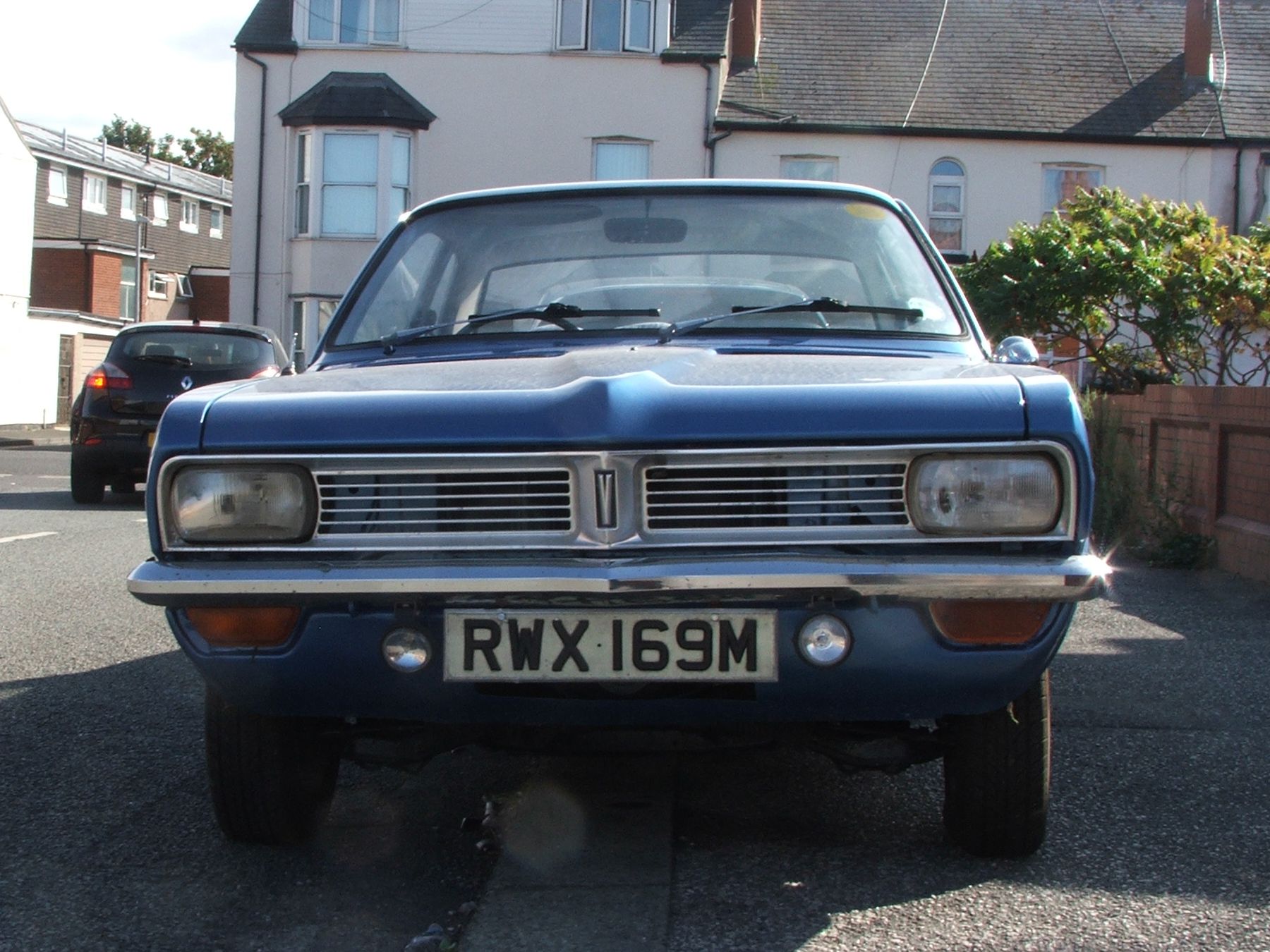
Another week later and this time it was on the road, so a shot of the front was possible. This time the owner was also there, so I asked permission to photograph it, to which he readily agreed. He even said I could open the door to get an interior shot. Apparently, the car had been in storage for 5 years, hence a little dusty, but he’d restored it very thoroughly after it had sat in a field for 28 years (yes, it was a big job; he showed me the photos).
The bonnet was pretty flat, though the strong, Pontiac inspired central ‘nose’ flared out to the ventilation intakes at its rear. The paint was actually a Ford colour; an error by the supplier, but at a price that was too good to ignore.
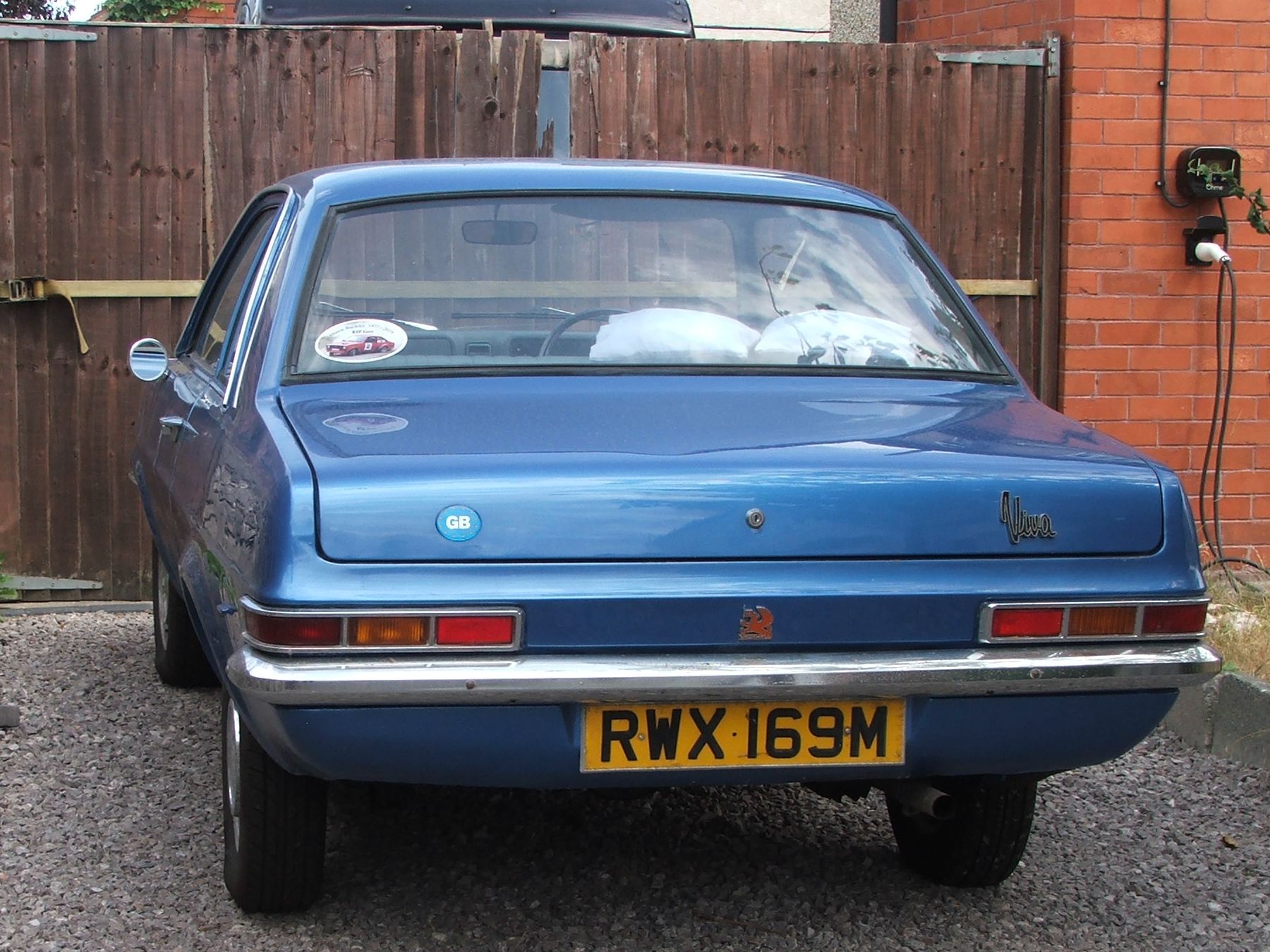
At the back, the rear edge of the boot lid stopped at the window, with no infill panel between. Unlike some early ‘70s saloon designs, the top surface of the boot didn’t look droopy, creating a classic, three box outline made all the cleaner by the lack of vent windows. The styling has a definite emphasis on the horizontal: the strong crease line at the waist, the thin, three part wrap-round taillights, the wide grille and close-fitting, chrome bumpers front and rear.
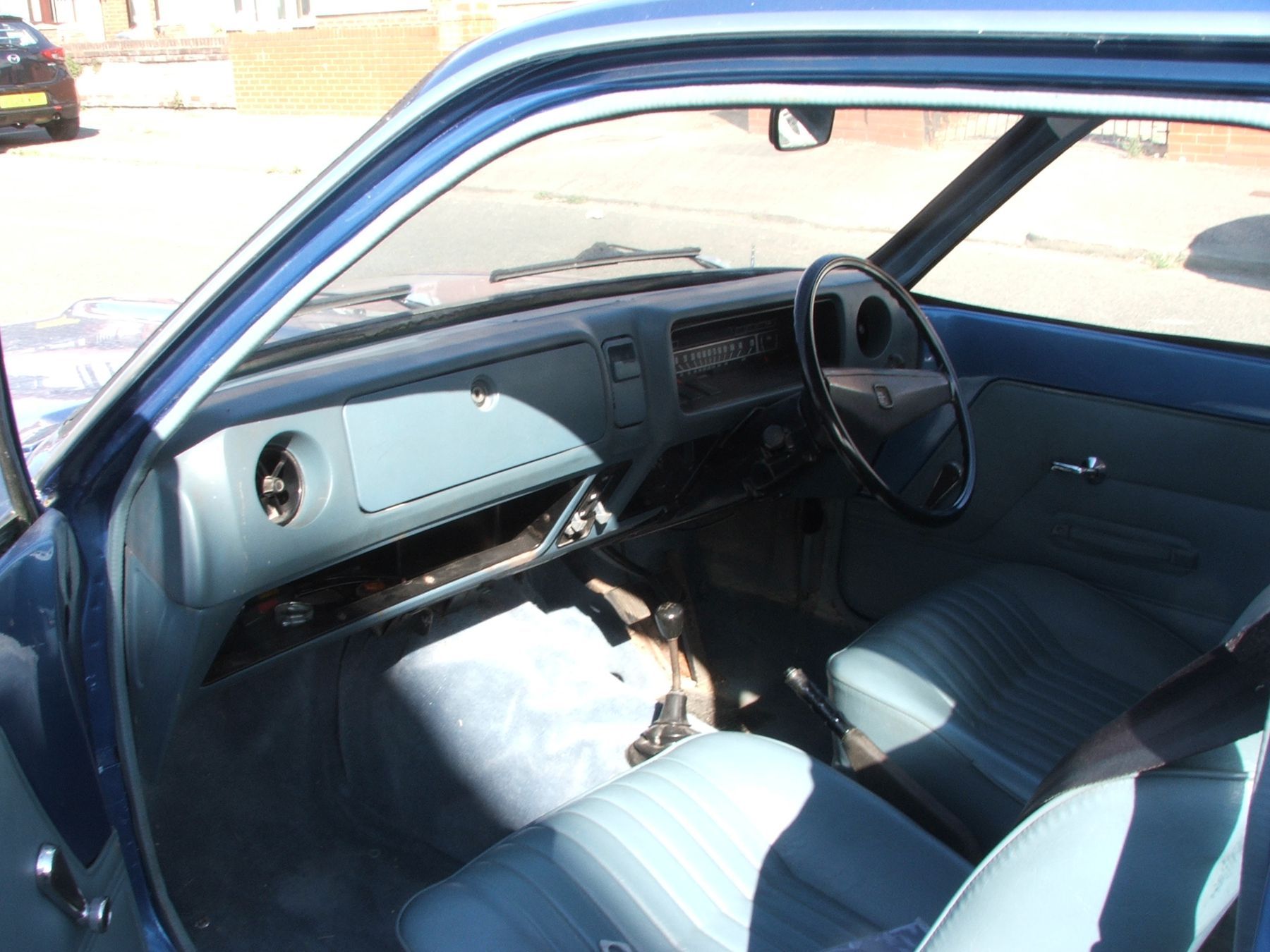
So, what did £1148.33 (including £88.33 car tax) buy you in 1974? Instruments are basic: a strip-style speedo (though don’t expect to get to the 110 mph mark), fuel level & temperature gauges, all recessed in an impact absorbing dash moulding, through-flow ventilation and heater with booster fan, reclining front seats with seat belts (none in the back), padded steering wheel on an impact absorbing column, two-speed wipers and electric screen wash, single padded sun-visor on the driver’s side, rubber floor mats, 20 cubic feet of luggage in the boot, choice of four solid colours.
What makes this car so surprising is that it is the basic model, bottom of the range, the type that would have gone to the crusher in the ‘80s, yet by luck, and determination by its restorer, it is still around to give a taste of basic family motoring in Britain half a century ago. Even if Dad never did buy into that kind of thing.
Related CC reading:
1971 (Vauxhall) Firenza – Viva Canada (by Perry Shoar)
Carshow Classic: 1964 Vauxhall Viva HA Saloon – Viva Vauxhall? (by Roger Carr)























Of course Australia’s General Motors Holden (GMH) offered a Vauxhall Viva as its small car offering until 1966. From 1967 the GMH continued to assemble a British Vauxhall Viva but it left GMH assembly lines badged as a Holden Torana.
Over many models, GMH’s Holden Torana went through massive redevelopment that included high powered 6 Cylinder and V8 engines. Today GMH’s Torana is a highly regarded car particularly the XU1 variant. The first edition Holden Torana was offered in three trim levels and apart from have front door vent windows looked a lot like the Vauxhall Viva featured here.
Great article covering an interesting car.
Good write up on a car that was everywhere when I was growing up, and the archetypal ‘banger’ when I started driving. Just one small point though: the basic Viva’s engine was OHV, not OHC.
Yes, mea culpa. Slight mis-type on my original script C instead of V, subsequently expanded in edit.
Nice to see, they used to be everywhere in the 70s, haven’t seen one for years. My dad had one, dark green, reg number YCE580T, so a 1978 model. I suppose even at the time it was basic but it did the job.
A nice tidy looking little car .
I’d be interested in reading about how it was to drive and maintain .
-Nate
What an unusual find, even more so for being kerbside in 2026. Any Viva, from 1963 on, is a rarity even at a car show so a kerbside find is truly rare. Good to hear that its being looked after carefully by an enthusiast too.
Dad never had a Viva or indeed a Vauxhall but my uncle worked for Vauxhall-Bedford in Luton and got a staff car, often a Viva, occasionally a Victor, every year and always kept another Vauxhall (Velox, Victor, Viva, Firenza, Chevette, Cavalier, Astra) in the household as well. All in all, he was driving Vauxhalls for probably 60 years.
I remember 2 HC series cars specifically – one was a 1.8 litre Viva automatic, chosen after a brief sojourn to north America and an automatic hire car of some (GM) sort and an early Firenza Coupe in 1256 form in refrigerator white which my aunt enjoyed for several years, even if it was like well glazed Mexican prison cell inside
Great find on a car that I have never seen in the flesh that I can remember. Some interesting styling details on an otherwise clean design.
I can’t unsee the bonnet with the mid 60’s Pontiac vibe which I do like.