
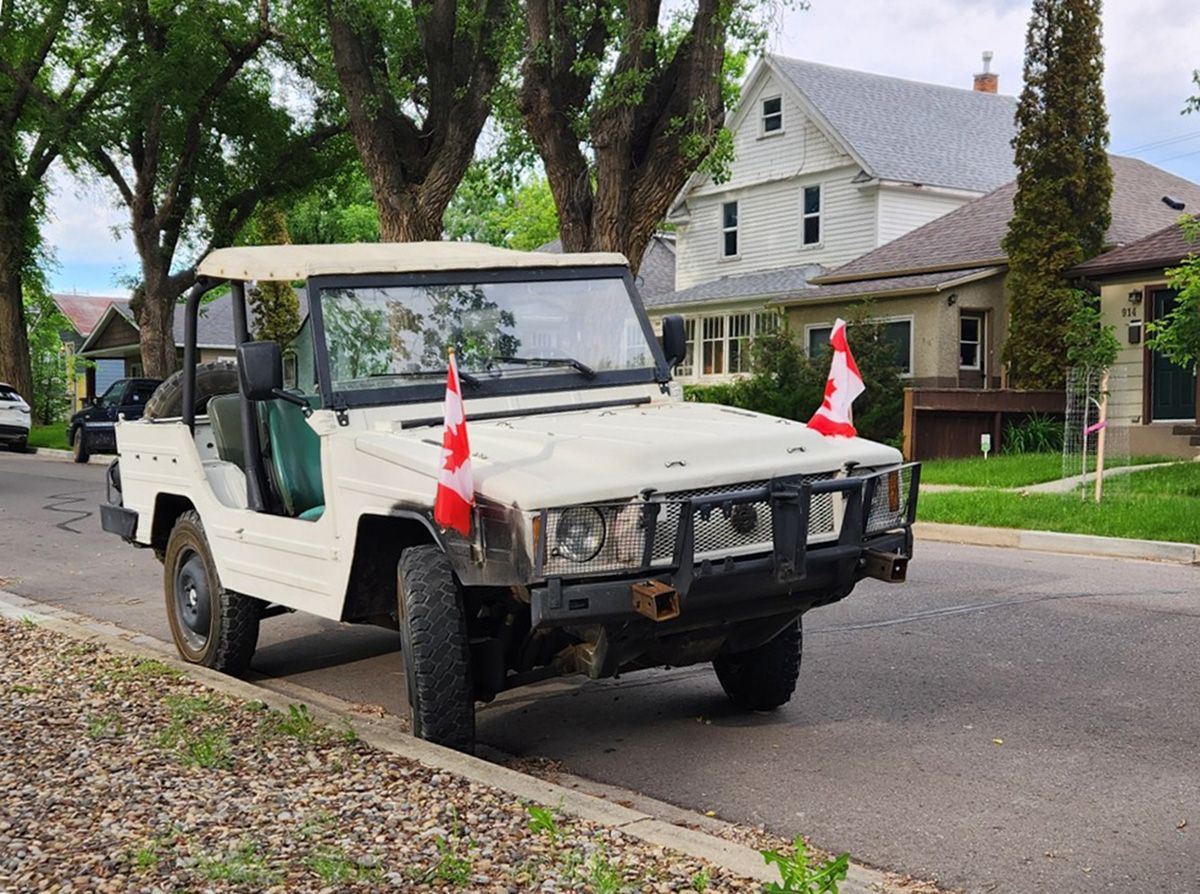
For Canada Day on July 1, I thought we would take a look at a rarely seen Canadian variant of the Volkswagen Type 183 Iltis: the Bombardier Iltis. Also known simply as the Type 183, the Iltis was developed by Audi for military use in what was then West Germany. Bombardier later built the vehicle under license in Quebec, Canada, for the Canadian military, although a few have since found their way into private hands.

These vehicles were originally painted green, but this example wears the white finish commonly associated with United Nations duty. It retains the skinny Südrad 16-inch wheels, along with a full-size spare mounted at the rear. The Iltis came with a more robust top that covered the rear compartment and included fabric doors, but this example wears a bikini-style top instead. From the side, the very short 2,017 mm, or 79.4-inch, wheelbase is especially apparent. Even with fully independent suspension all around, it probably delivers a fairly rough ride.

This example shows the more typical paint and roof configuration.

The Iltis, the German word for polecat, was developed as a replacement for the aging Volkswagen Type 181, whose civilian version was sold as the Thing in Canada and the United States. West Germany needed an agile, compact, and capable small military vehicle. The recently consolidated Audi had access to the out-of-production DKW Munga, which was thoroughly overhauled to form the basis of Volkswagen’s proposal.

Gone was the front-wheel-drive DKW two-stroke engine, replaced by a 1.7L four-stroke Volkswagen engine and a four-wheel-drive system. Although the Iltis does not have a true low range, its five-speed manual transmission includes a gear labelled “G,” indicating very steep gearing. That gear gave the vehicle impressive hill-climbing ability, but limited top speed to 20 km/h, or 12.4 mph, when engaged. Front and rear differentials can also be locked to improve off-road capability, aided by approach angles of 41 degrees at the front and 32.5 degrees at the rear.

Power came from a water-cooled, Volkswagen-sourced 1.7L engine producing 75 PS, or 55 kW, with an 8.2:1 compression ratio.

The design of the four-wheel-drive system later helped provide the foundation for Audi’s famous Quattro system, which debuted in 1980.

Volkswagen offered a civilian version of the Iltis in Germany, but sales were weak. To bolster interest, Audi prepared the model for the 1980 Dakar Rally. Despite taking first, second, fourth, and ninth places, sales remained sluggish, with only 453 examples finding non-military buyers.

This Iltis was produced under licence by Bombardier Inc. in Valcourt, Quebec, from 1984 until 1986. Bombardier is well known for snowmachines, snowmobiles, jets, trains, and other vehicles. Still in Canada, the company is perhaps also known for its long-standing relationship with government support, due in no small part to its location in Quebec. Interestingly, Bombardier-produced Iltis vehicles were also sold to Belgium, but at a much lower price than the Canadian military paid. Despite the model’s lack of civilian success in Germany, a Canadian civilian version was planned; however, it never materialized, likely because of the relatively high cost.

The very basic interior still wears its original green paint. The distinctive four-spoke Volkswagen steering wheel, familiar from the Thing (Type 181) and Super Beetle, carries a Bombardier logo. Behind it is a full complement of VDO gauges. The front seats were sourced from the Volkswagen Passat and are likely more comfortable than what you would find in the average military vehicle.

Dual batteries provide a 24v electrical system and are located under the very basic folding rear seats.

The hood is secured by dual rubber latches, and beneath the bumper the Iltis has lifting eyes, as it was designed to be carried by helicopter. The fabric doors, missing on this example, were designed to be secured to the hood when not in use. Like a Jeep, the front windshield can be folded flat.

I like to feature a Canadian vehicle on July 1, and this one feels especially patriotic with its owner-added Canadian flags. It is not often that we get to see a new, previously unfeatured vehicle on the site, but the Bombardier Iltis certainly qualifies. It is also a bit of a rarity, with only about 2,500 made, and they are sadly prone to undercarriage rot. Fewer than 10,000 Volkswagen and Bombardier Iltis vehicles were produced in total. A few, like this one, have retired from military service to begin a quieter civilian life.























That is a fantastic find David. Bombardier is a most unfortunate name for a peace-time business, I see it around Melbourne on larger travel machines. Maybe they should take a lesson from the Rapeseed Association of Canada.
It is named after the company founder and inventor of the snowmobile, Joseph-Armand Bombardier.
hehehe I’ve been thinking along the same lines with Grenadier, which was apparently named after a pub. And the name rapeseed was derived from the latin ‘rapum’ meaning turnip.
Thanks – I’ve also considered Bombardier an unusual name, but never looked up its origins.
Meanwhile, I’d assumed that “Iltis” was, in fact, someone’s name… but in reading this, I learned its a polecat. Given Bombardier’s snow vehicle roots, I see the connection.
Here’s to Canada, a beacon of hope, and a reminder to the rest of us the continent’s called North America. Happy Canada Day.
And why shouldn’t you have an oddball VW, made locally? Even if I can only think of Bombardier as makers of the trams I ride on, or as makers of planes.
I’ve speculated before that that DKW/Audi FWD layout must be one of the auto world’s longest-lasting sunk-cost oddities. By this I mean that having the engine plonked halfway to the car in front is maybe ok for a flat twin, or four, but once it’s a tall old OHC inline watercooled job, it’s starting to test physics, and this is the inheritance of the Auto Union combine. Here, it does make for a very Streisand-esque frontal protuberance, and an altogether ungainly insect.
All that said, Audi has made it work, up to and including a 6 litre iron-block V12 diesel hanging right out there in the old Q7…
Hehe, not just “made it work”, back with the Sport Quattro they doubled down on it by actually chopping 12.6″ out of the body, leaving the front overhang even more out there and making it only a foot longer overall than the Iltis itself. Of course the radiators were moved to the trunk etc and plenty of other weight re-distributing occurred but visually it certainly is striking…
The curious serendipity of the acquisition of Auto Union by VW was of course that VW used the same drive line layout, just in reverse. And VW had already developed a 4WD version of their drive train during WW2, used in the Schwimmwagen and the Beetle Kommandeurswagen. So VW pioneered this configuration for 4WD application, to which it lent itself so readily, by just extending the main shaft of the transmission past the end of its case.
Thanks for this great article David! I had no idea these Bombardiers existed. There was a time in Germany you could find an Iltis here and there, possibly this was the times when they were decommissioned from the german army. The Munga was also 4WD, with the same configuration as the Iltis (engine in front of the front axle).
A number of Bombardier Iltis vehicles are currently being offered on “Kleinanzeigen”*—albeit by private sellers. Prices vary widely, ranging from approximately €8,000 to well over €20,000.
* = lit.: “small advertisements” / A nationwide online marketplace for private-to-private sales.
Great story! There is one of these in my town in southern Ontario, but I did not know they were built by Bombardier. The local example is still in military colors with the full soft top and fabric doors.
Bombardier also supplied Iltis vehicles to the Belgian Army. Some of these were fitted with turbodiesel engines at the VW plant in Brussels.
A wonderful Canada Day treat! I’m always torn between these and the VW 181. I think if I had to choose, I’d take the VW although the Iltis is obviously more capable in serious off-road conditions.
Et cela vaut toujours beaucoup d’$$$$$. https://www.facebook.com/commerce/listing/848028938357335/?media_id=4&ref=share_attachment
Tech spec : https://museebombardier.com/artefacts/automobile-tout-terrain-iltis/
Does anyone know what frequencies the Canadian military used? I’m wondering what wavelength the rear whip antenna supports. https://www.facebook.com/photo/?fbid=26811873781806924&set=pcb.3360282047484653
Great find Dave ! Is the Iltis located in Lethbridge ? It would be great if the the owner could bring it to the Vintage Sports Car Club of |Calgary’s European Classic Car Meet Saturday July 18 at Stanley Park in Calgary. It’s a big show, I’ll be there with my Fiat X1/9. This year the featured marque is Mercedes-Benz, in honour of the company’s 100 year anniversary.
I will see if I can connect with him. That show is one of my favourites. I have never managed to enter a car of my own it though. One day.
*Very* cool limited production 4X4 ! .
HAPPY CANADA DAY ! .
-Nate