

The name Haynes, of John Haynes CBE, Haynes manuals and Haynes publishing probably needs little introduction to a CC audience. The manuals have sold over 200 million copies; the publicly traded business was recently bought out for over £114 million.

Haynes published his first manual in 1956, a home made manual for an Austin 7 Special; the first Haynes manual as we now know them was published in 1966 for an Austin “Frogeye” (or Bugeye) Sprite. The list that followed is almost endless, and includes the Chilton manuals published in the US. Growing up, I was always intrigued why they were the only books wrapped in plastic wrap in the bookshop, but now I understand.

In 1979, Haynes Publishing was floated on the London stock exchange, and eventually included not only the Chilton but the Clymer manuals in its portfolio, as well as a significant activities in digital spheres including extensive software and data solutions around vehicle maintenance.
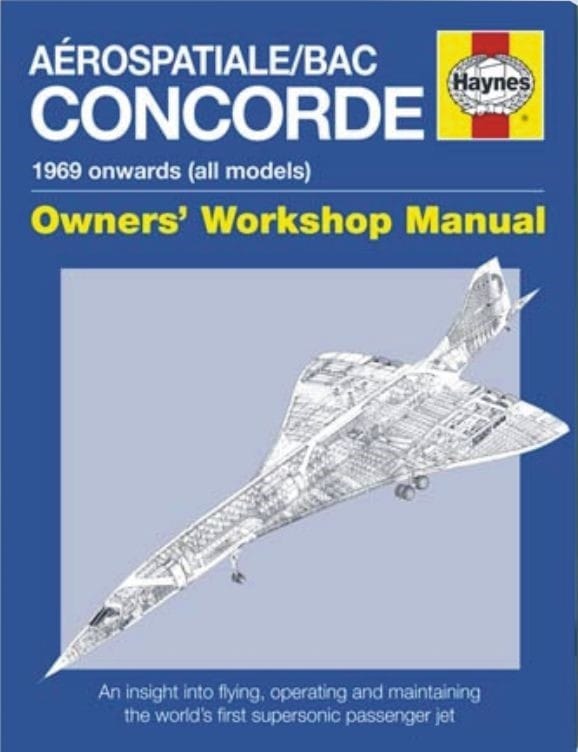
Haynes himself died in 2019 but his name lives on, even if the demand for manuals is reducing with more reliable, durable and complex cars and modern digital methods of presentation. The range has been widened – after all, some things will always need repairing, properly.

Haynes was also an inveterate car collector, amassing a collection that forms the core of the Haynes International Motor Museum, in essentially rural Sparkford in south west England. Sounded like a good day out for a COVID imposed staycation.

Where to start? With the British cars? How about an Austin Allegro in a typical early 1970s BL colour?

And the Allegro’s predecessor – the BMC ADO16 , seen here as a Vanden Plas Princess. All the wood and leather you could ask for in a small package.

Earlier Austins were there too – a 1957 A35 and 1954 A40, being photo bombed by a 1960 Austin Metropolitan.

And here’s the Metropolitan, showing a sort of style and colour 1950s Britain craved for, alongside an Austin Atlantic, which it seemed we didn’t.

Or perhaps you’d prefer a Morris Minor – here in 1955 Tourer form, with the same A series engine as the A35.

The Minor’s big brother was the Oxford and the six cylinder Isis, which formed the basis the Wolseley 6/80.

The museum has a special display dedicated to Morris, mocking up an interwar Morris Garages workshop, which among others featured this splendid 1938 Morris Eight.

But perhaps the Morris highlight was this 1917 Morris Cowley “Bullnose” – Morris’s first volume car, built when his was just one of many dozens of ambitious but struggling manufacturers.

Also nominally Morris based was this 1992 Hindustan Ambassador, dating from a time when some entrepreneurial soul thought they’d do business in the UK, under a retro theme.

Other British manufacturers were represented too – a 1964 Audax range Singer Gazelle from Rootes, the smart man’s Hillman Minx.

The last large Humber, the 1967 Hawk, looking very dated against the Ford Zodiac on the value front and the Rover and Triumph 2000 on a style basis. Next along is a Arrow range Humber Sceptre, the smart man’s Hillman Hunter or Sunbeam Arrow.

And completing the Arrow range the Sunbeam Rapier (or Alpine GT), looking very striking in Rootes’ Tartan red.

A Vauxhall Cresta (PA series) and matching Victor F series show perhaps peak American influence in Luton.

Quick reminders that fashionable does not mean the same as elegant or timeless.

British Fords are there of course; a Consul Mk2, 1961, with its younger brother a 1965 Cortina MK1 with an early Capri in the background.

With the Anglia, this was close to the full British Ford range in the early 1960s

A 1959 Popular, a derivative of the pre-war Ford Y Type that endured to 1962, a 1955 Anglia and 1966 Anglia 105E show a progression of the small Ford over 20 or more years.

A 1960 Standard Vanguard Phase 3 and a 1958 Standard 10, my father’s first car.

A Triumph Dolomite Sprint, with a very novel 16V single OHC head and serious Alfa/BMW/Ford RS2000 baiting potential, a Triumph Stag and a Triumph 2000 Mk2, looking like a brochure line up for the mid 1970s

Here’s the 2000 saloon alongside an early Rover 75 (P4 series) saloon, with the distinctive Cyclops central headlamp, and an early Rover 2000 (P6) in the background.

Here’s the P6 again – a 1966 2000. It’s displayed closely next the Vanden Plas Princess.

Very close indeed! Not sure how they’re done that!
Like many museums, the display is divided into sections. These F1 cars are in the display dedicated to Sir Frank Williams and his F1 team, often cited as the British enthusiasts’ favourite.

Nigel Mansell’s “Red 5”, painted so Murray Walker could spot it more easily. World Champion in 1992.

And Damon Hill in 1996

And the more recent Martini livery, perhaps the one of the most famous and recognisable liveries in motorsport.
Back to mere mortal cars….

A DAF 44, from 1971 with the Variomatic CVT transmission.
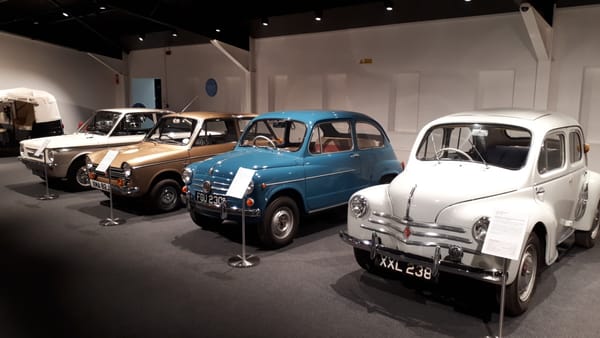
A 1967 Hillman Imp Californian, a 1971 Honda N600, a 1965 Fiat 600D and a 1959 Renault 4CV.
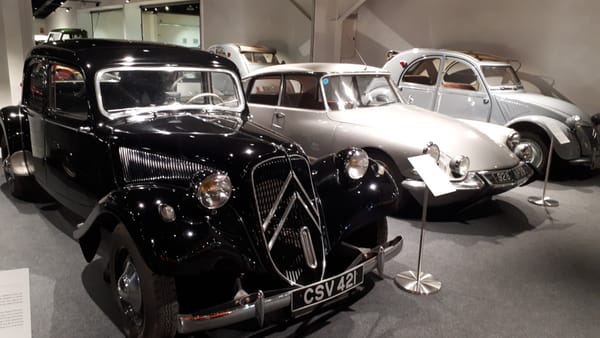
A Citroen 2CV, ID and Traction Avant – all worth museum space on their own but as a threesome…


Pages: 1 2





















WOW! What a collection and history of this gent’s manuals as an enterprise.
Thanks for posting! Good photos that capture the feel. Having lived for two partial years in the UK in 1960 and 1964, my memories of the common British cars of the late fifties and early sixties are very strong, even though I was young. At the time I liked the Vauxhalls and Ford Consuls/Zephyrs/Zodiacs, perhaps because they reminded me of home, and found most of the older BMC and Rootes stuff to just look old. The front wheel drive BMC cars, and the Imp, were by contrast, unlike anything we had in the US. No Allegro’s then yet 😀.
Nice to have a place that has a representative collection of so many of the more popular pedestrian British offerings. Those are the cars that people actually owned and drove. Not just the Minis and MGs.
Parking those two cars that close together, and then one unexpected flat tire will create a messy situation and the likely need for repairs and partial repaints of two cars. So unnecessary.
Just needs one more… The Droogie mobile, aka Durango 95, M-505 Adams Brothers Probe 16.
Looks like a great museum. Thanks for sharing. I do like that Rover 3500 wagon and think it could have been viable were it to have been made.
I think it looks great, and I don’t see how it could not have been a success. Very reminiscent of a big Australian estate car of the era, maybe a Ford XE?
In my visit to that museum, I came across this sign that you may have noticed. Right next to that 64 Chevy is a 79 Ford Wagon. Sort of tongue in cheek, this is the sign posted in front of the Ford.
I had enough trouble navigating the narrow lanes (including the A303) of Somerset in my smallish rental car. Driving on the left hand side of the road, sitting on the right hand side of the car, but not for the first time. Not for the feint of heart I say ole’ chap!
A great museum to visit, probably a couple hours drive west of London as I recall. I was on my way to the town next to the River Yeo.
If folks in that museum consider the 79 Country Squire “enormous”, I wonder what word would have been used to describe a 1975-78 version? Or a fuselage Town & Country? “Gargantuan”? “Stupendous”? “Thumping”? “Mahoosive”? (I looked that last one up). Or maybe just “Prodigious”.
The A303 is quite road, with a history worthy of a CC post all of its own. From Neolithic origins, to the Romans, medieval England and now the route to the south west for holidays for many of us…..and right past Stonehenge as well…parts of it are dual carriageway now.
This is a really great museum! I always seeing Rootes cars on display. And I believe the 55 Anglia shown is the same series as the one my parents bought in the US in 1959 or 1960. That was such an odd choice for them, and it was not remembered fondly. But then it wasn’t really designed for the midwestern US with its growing network of interstate highways.
Those sidevalve 100Es were at home in built up areas where there is a low speed limit but useless on the open road, I have several Haynes workshop manuals but not for anything I currently own,
One little thing the Morris six was the stablemate of the Wolseley 6/80 and shared body and OHC powertrain the Isis didnt appear untill the series 2 Oxford hit the market and used the C series 6 cylinder shared with a A90 six Westminster.
So many great cars ! .
My ex wife worked as a temp for Haynes in Glendale, Ca. for a short time (maybe the U.S. printer ?) and told them I was a mechanic, they sent her home with bunches of free H.B.O.L.’s, none for the oldies I love .
Haynes
Book
Of
Lies
For the incredible amount of mistakes and wrong specs.
Better than Clymer but not by much .
-Nate
You said it (H.B.O.L.) more concisely than I said it.
Oh, so that’s why those two brands are equally useless! I didn’t know.
…and more reliable sources of accurate information on how to fix cars of whatever make, model, and age.
I’m not sorry for being a sourpuss on this. It really bothers me when people get wealthy by making the world worse with crappy products. Haynes/Chilton manuals, Microsoft Windows/Office/etc, and other suchlike.
Nice collection of cars. Haynes didn’t deserve to be able to collect them.