
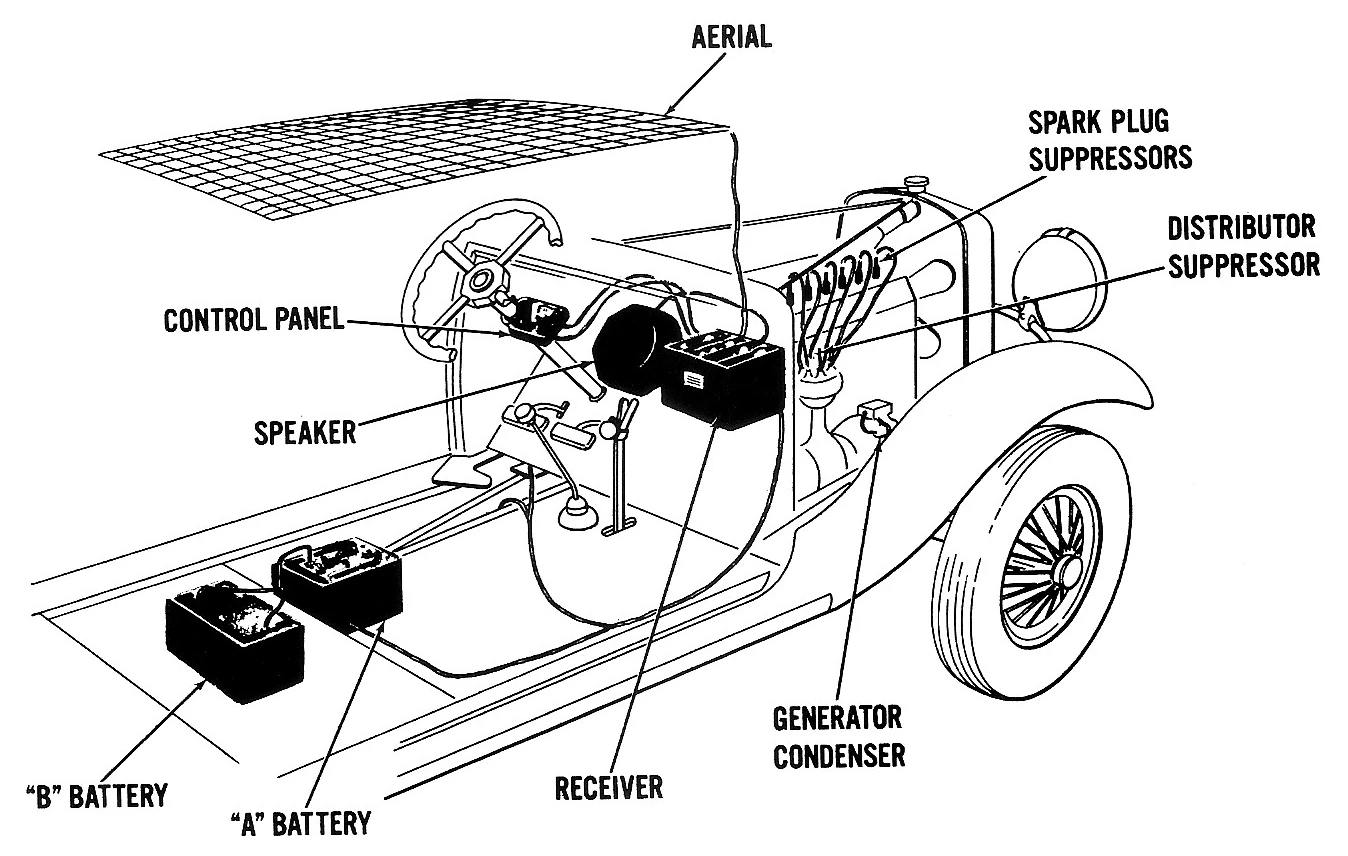
2026 marks roughly 100 years of a feature most of us have long taken for granted: the car radio. This 1972 article from the long-defunct Special Interest Autos magazine explores the early days of automobile radios — beginning when just installing a radio might mean “literally tearing a car apart.” We offer the article here with some corrections, and an answer to the question, “Who was the first automaker to offer a radio option?”
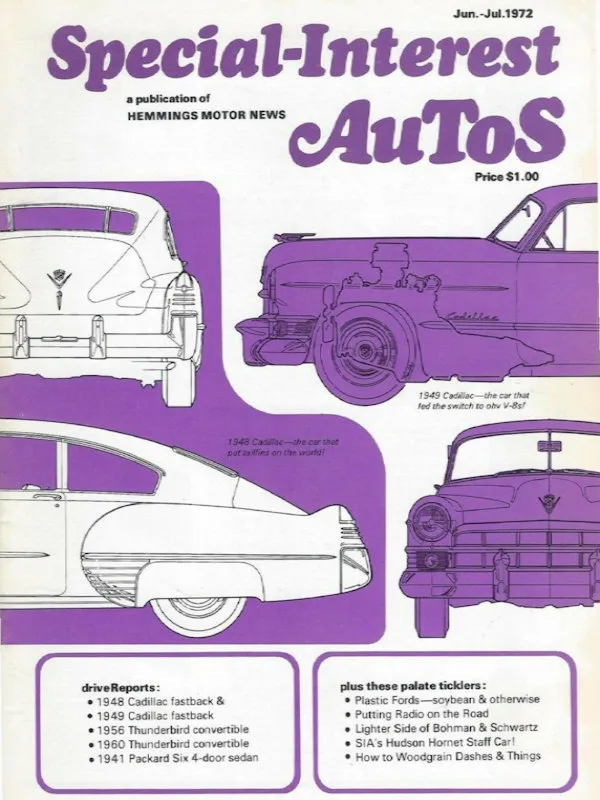
This article by Robert J. Gottlieb originally appeared in Special Interest Autos No. 11 (June—July 1972). It’s an interesting and useful overview — useful enough that several other sources (including a 1985 SAE paper and a 1998 book on auto electronics) have incorporated it more or less verbatim. However, I did find a number of errors that I want to point out along the way, for the record.
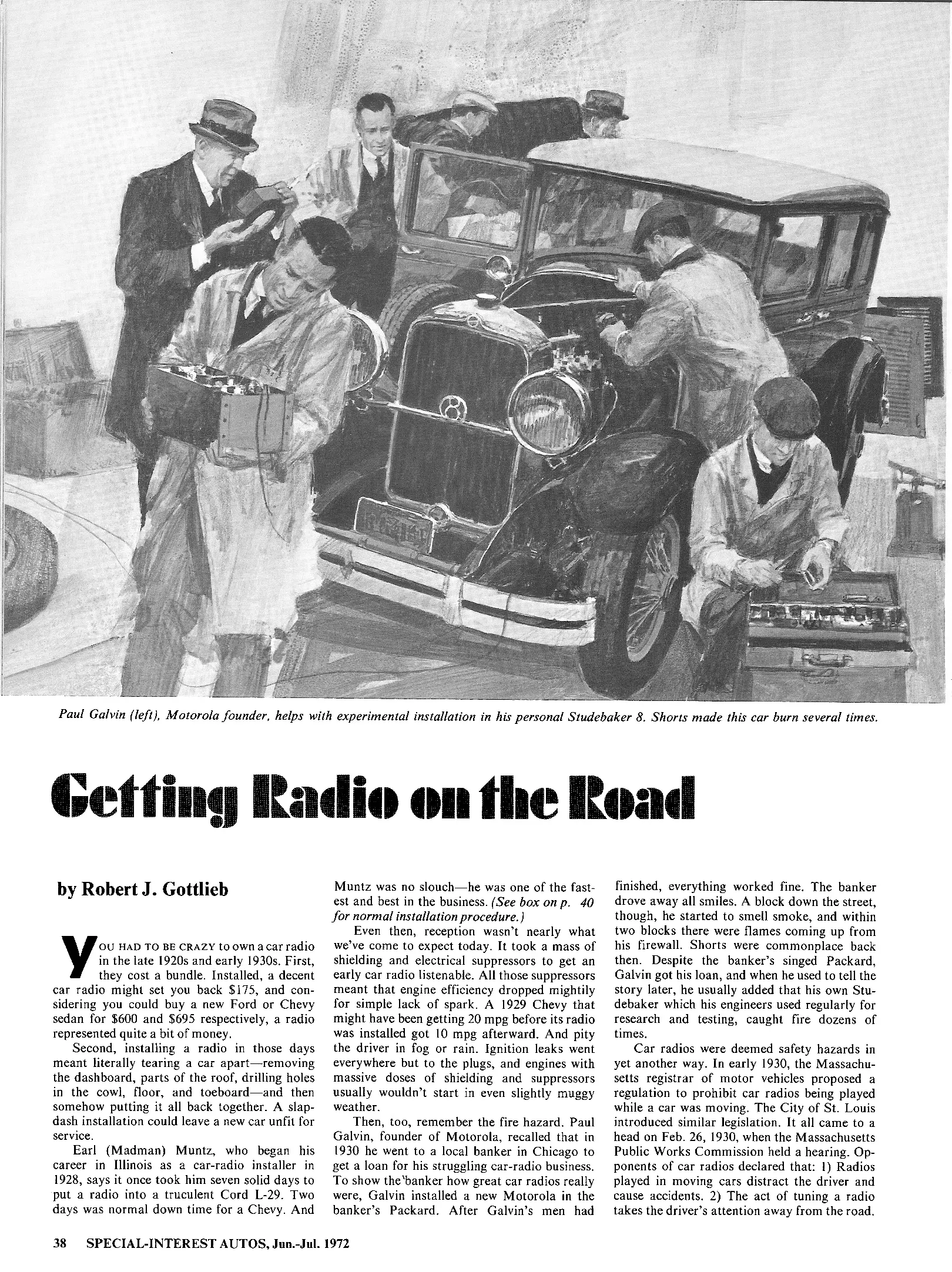
Gottlieb begins:
YOU HAD TO BE CRAZY to own a car radio in the late 1920s and early 1930s. First, they cost a bundle. Installed, a decent car radio might set you back $175, and considering you could buy a new Ford or Chevy sedan for $600 and $695 respectively, a radio represented quite a bit of money. Second, installing a radio in those days meant literally tearing a car apart—removing the dashboard, parts of the roof, drilling holes in the cowl, floor, and toeboard—and then somehow putting it all back together. A slapdash installation could leave a new car unfit for service.
[Famed car dealer] Earl (Madman) Muntz, who began his career in Illinois as a car-radio installer in 1928, says it once took him seven solid days to put a radio into a truculent Cord L-29. Two days was normal down time for a Chevy. And Muntz was no slouch — he was one of the fastest and best in the business. (See box on p. 40 for normal installation procedure.)
Even then, reception wasn’t nearly what we’ve come to expect today. It took a mass of shielding and electrical suppressors to get an early car radio listenable. All those suppressors meant that engine efficiency dropped mightily for simple lack of spark. A 1929 Chevy that might have been getting 20 mpg before its radio was installed got 10 mpg afterward. And pity the driver in fog or rain. Ignition leaks went everywhere but to the plugs, and engines with massive doses of shielding and suppressors usually wouldn’t start in even slightly muggy weather.
Then, too, remember the fire hazard. Paul Galvin, founder of Motorola, recalled that in 1930 he went to a local banker in Chicago to get a loan for his struggling car-radio business. To show the banker how great car radios really were, Galvin installed a new Motorola in the banker’s Packard. After Galvin’s men had finished, everything worked fine. The banker drove away all smiles. A block down the street, though, he started to smell smoke, and within two blocks there were flames coming up from his firewall. Shorts were commonplace back then. Despite the banker’s singed Packard, Galvin got his loan, and when he used to tell the story later, he usually added that his own Studebaker which his engineers used regularly for research and testing, caught fire dozens of times.
Gottlieb probably got the latter anecdote from Harry Mark Petrakis’s 1965 Galvin bio, The Founder’s Touch: The Life of Paul Galvin of Motorola. I’ve noticed that some people online have claimed that Paul Galvin originated car radios, which is wrong. According to The Founder’s Touch, Galvin didn’t get into automobile radios until after the October 1929 stock market crash, by which time others had been selling them for several years.
Car radios were deemed safety hazards in yet another way. In early 1930, the Massachusetts registrar of motor vehicles proposed a regulation to prohibit car radios being played while a car was moving. The City of St. Louis introduced similar legislation. It all came to a head on Feb. 26, 1930, when the Massachusetts Public Works Commission held a hearing. Opponents of car radios declared that: 1) Radios played in moving cars distract the driver and cause accidents. 2) The act of tuning a radio takes the driver’s attention away from the road. 3) Music lulls drivers to sleep. 4) Radios distract drivers of other cars as “attractive nuisances.”
The Radio Manufacturers Assn., set up largely to fight just such regulation, argued that Massachusetts was not only dead wrong on each point but that radios actually prevent accidents by keeping drivers awake and relieving road monotony. Some 200 people attended the hearing, and only five were volubly anti-radio, so the Massachusetts proposal died.
The proposed 1930 Massachusetts law was reported in the radio and automotive trade journals of the time, but the proposed St. Louis ordinance was actually more than five years later, in the fall of 1935. The trade journal Radio Today reported in November 1935 that the St. Louis proposal had just been introduced, adding, “No city or state has yet passed any measure banning auto radio.” (The St. Louis ordinance died aborning as well.)
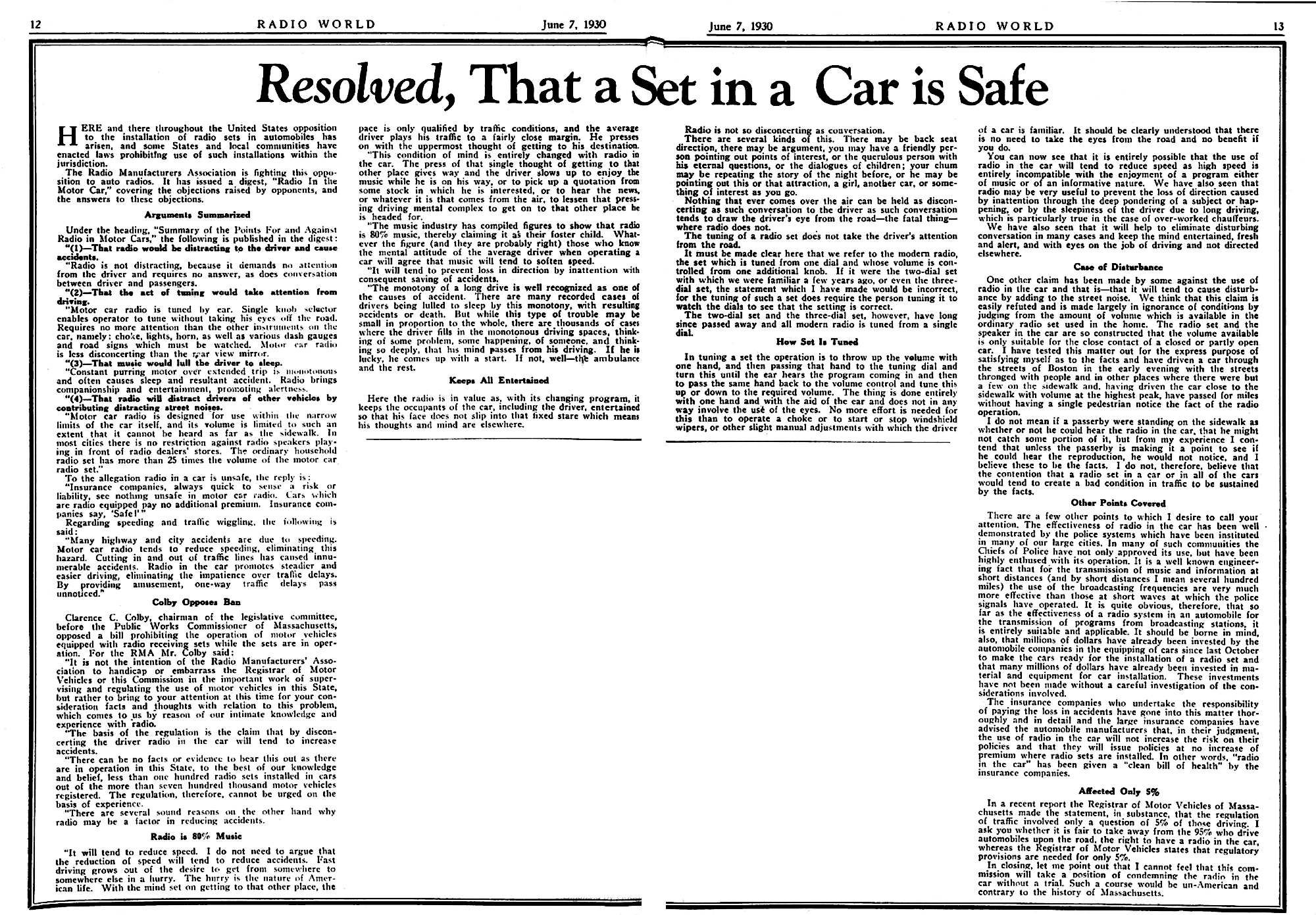
In June 1930, the journal Radio World ran this entertaining statement from the Radio Manufacturers Association in defense of the car radio. It refuted the points raised in Massachusetts, insisting, “Radio is not so disconcerting as conversation,” and even suggested “that it is entirely possible that the use of radio in the car will tend to reduce speed as high speed is entirely incompatible with the enjoyment of a program either of music or of an informative nature.”
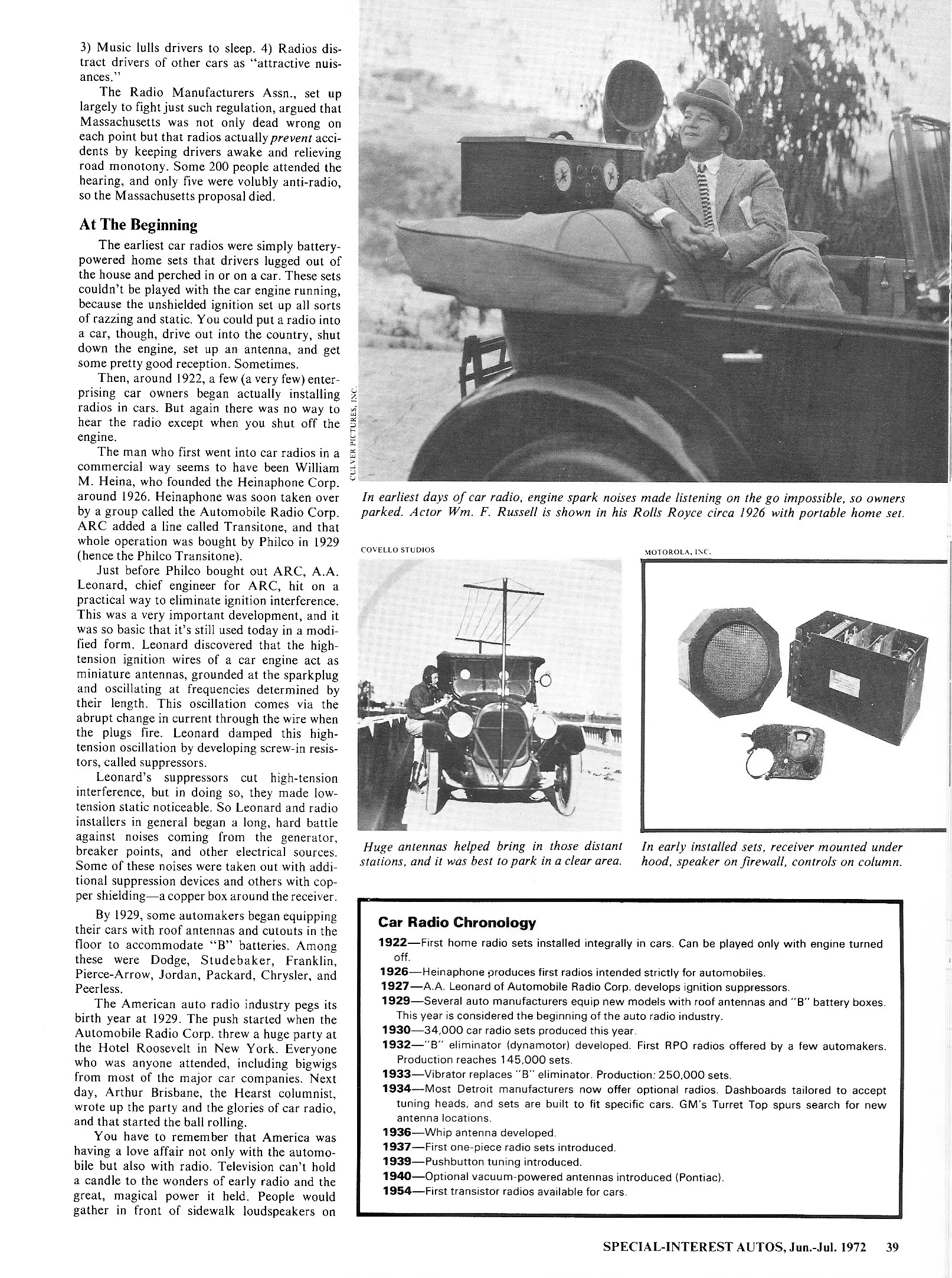
The gentleman in the photo at the above right is silent film star William Russell (1884–1929), sitting in what I think is an American Rolls-Royce. Gottlieb’s text continues:
At The Beginning
The earliest car radios were simply battery-powered home sets that drivers lugged out of the house and perched in or on a car. These sets couldn’t be played with the car engine running, because the unshielded ignition set up all sorts of razzing and static. You could put a radio into a car, though, drive out into the country, shut down the engine, set up an antenna, and get some pretty good reception. Sometimes.Then, around 1922, a few (a very few) enterprising car owners began actually installing radios in cars. But again there was no way to hear the radio except when you shut off the engine.
In the early to mid-1920s, home radio sets were generally battery-powered; it wasn’t until later in the decade that most home radios could run on AC current. Paul Galvin’s first radio-related venture, circa 1926, was a “battery replacer” for home sets.
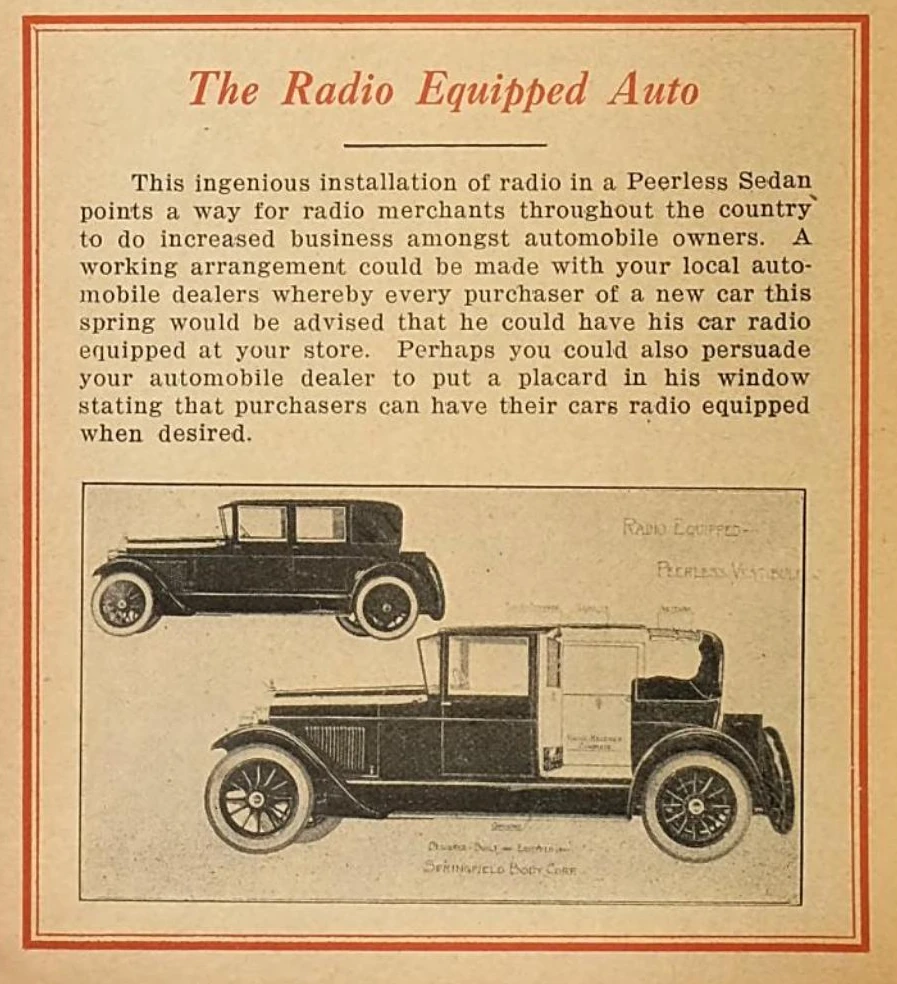
An important milestone Gottlieb didn’t mention was that car radios were offered as standard equipment on certain 1924 Peerless models with bodies by Springfield Body Corp. These models were first shown at the New York Automobile Salon in November 1923. So, if anyone is wondering, “What was the first automobile manufacturer to offer a radio as factory equipment?” the answer is “Peerless.”
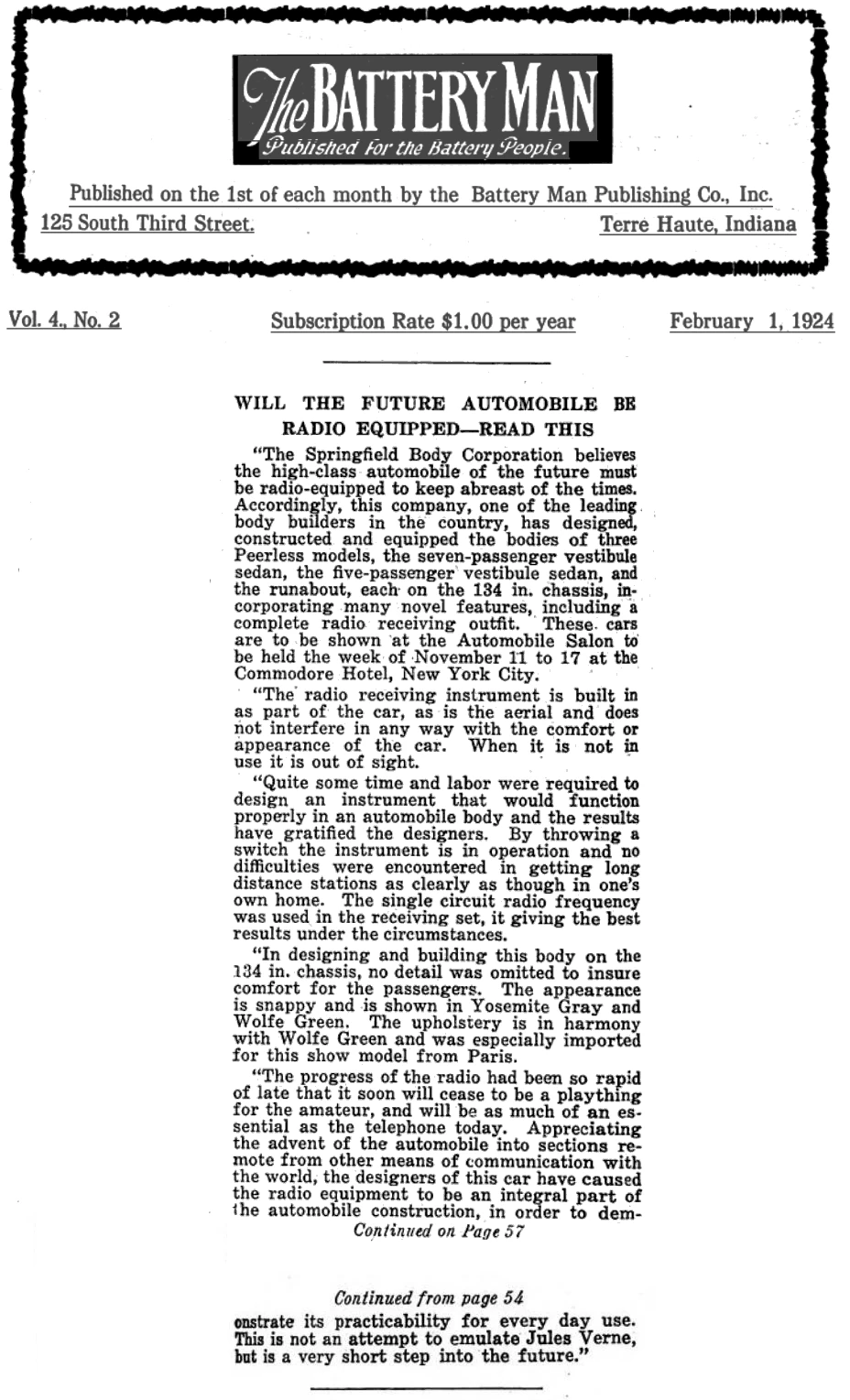
As the above item from the February 1, 1924 issue of the industry trade journal Battery Man explains, the radio-equipped Peerless cars were the runabout, the five-passenger vestibule sedan, and the seven-passenger vestibule sedan. “This is not an attempt to emulate Jules Verne, but is a very short step into the future,” the journal reported. However, production of these cars was limited, and radios weren’t offered on 1924 Peerless models with bodies by other coachbuilders.
Gottlieb continues:
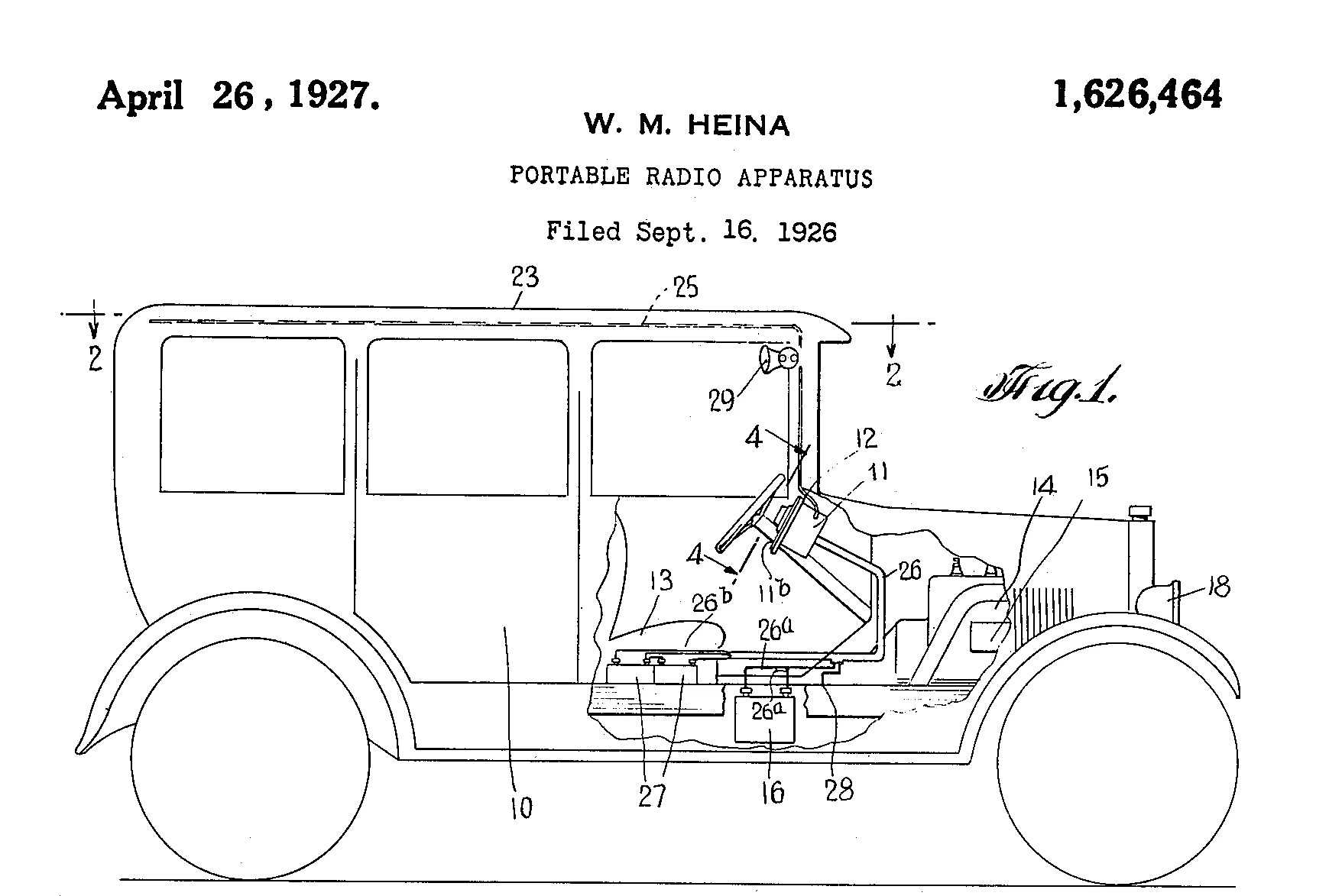
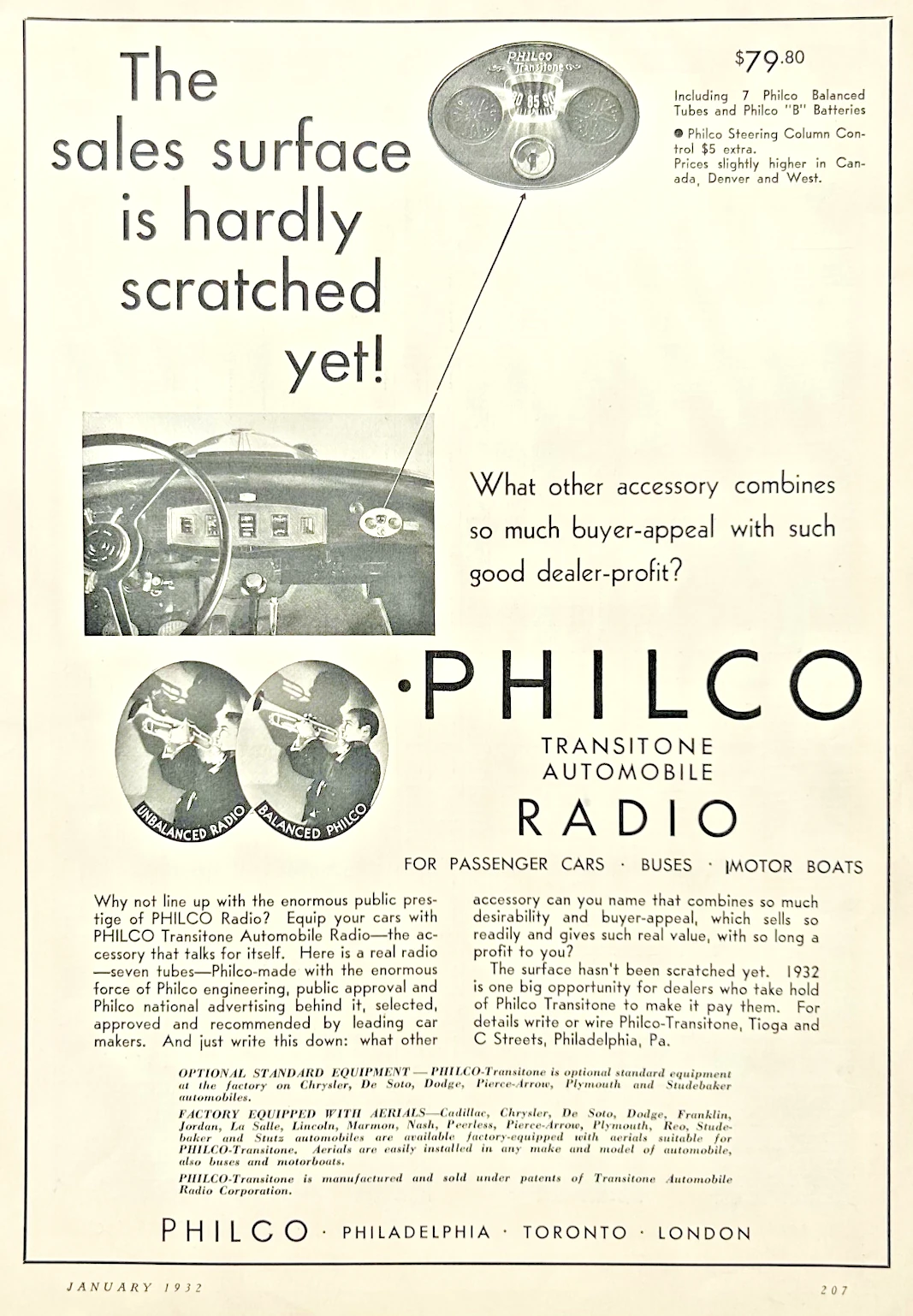
The man who first went into car radios in a commercial way seems to have been William M. Heina, who founded the Heinaphone Corp, around 1926. Heinaphone was soon taken over by a group called the Automobile Radio Corp. ARC added a line called Transitone, and that whole operation was bought by Philco in 1929 (hence the Philco Transitone).
Heina applied for a patent on his car radio design in September 1926, just a little over 100 years ago. He didn’t claim that it was the first car radio, just that his design would “afford a high degree of efficiency in operation without marring the appearance of the car or interfering with the ease and convenience of manipulating the various car mechanisms and devices.”
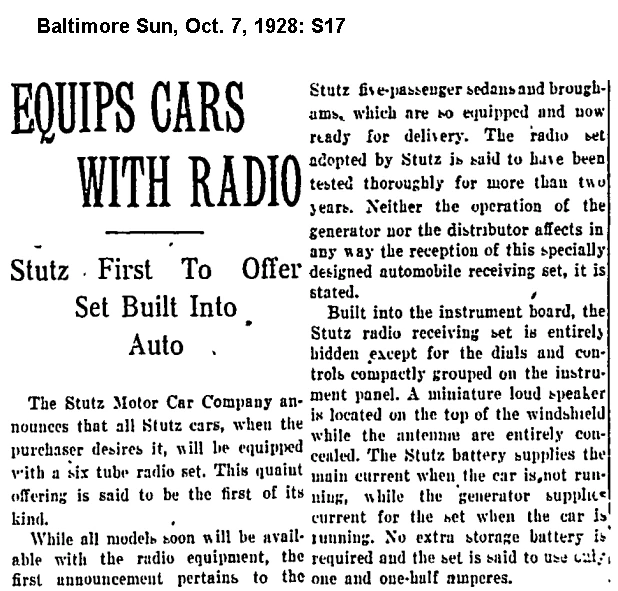
Heinaphone’s first deal with an automaker came in October 1928, when they contracted to install radios on Stutz five-passenger sedans and broughams. (The above clipping doesn’t identify Heinaphone as the installer, but the January 1930 issue of Radio did.) Stutz believed this was a first, but they were incorrect, as I noted above — Peerless had beaten them to it by almost five years.
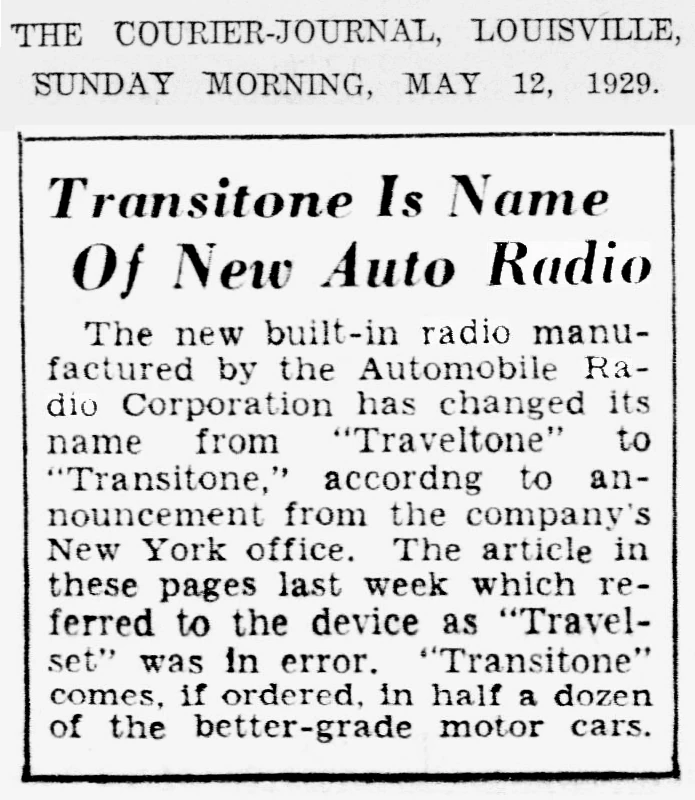
When Automobile Radio Corporation (ARC) absorbed Heinaphone, around April 1929, they initially announced that the new name of the Queens, New York factory and its car radio would be “Traveltone,” and that name appears in a number of contemporary press articles. However, they quickly settled on the “Transitone” name instead, perhaps to avoid some trademark conflict, leading to some hasty corrections like the one above. Transitone Automobile Radio Corporation made a deal with Philco in July 1930 (not 1929) for Philco to manufacture Transitone radios — the first Philco automobile sets. Philco then announced in January 1931 that Transitone was becoming a Philco division.
Gottlieb goes on:
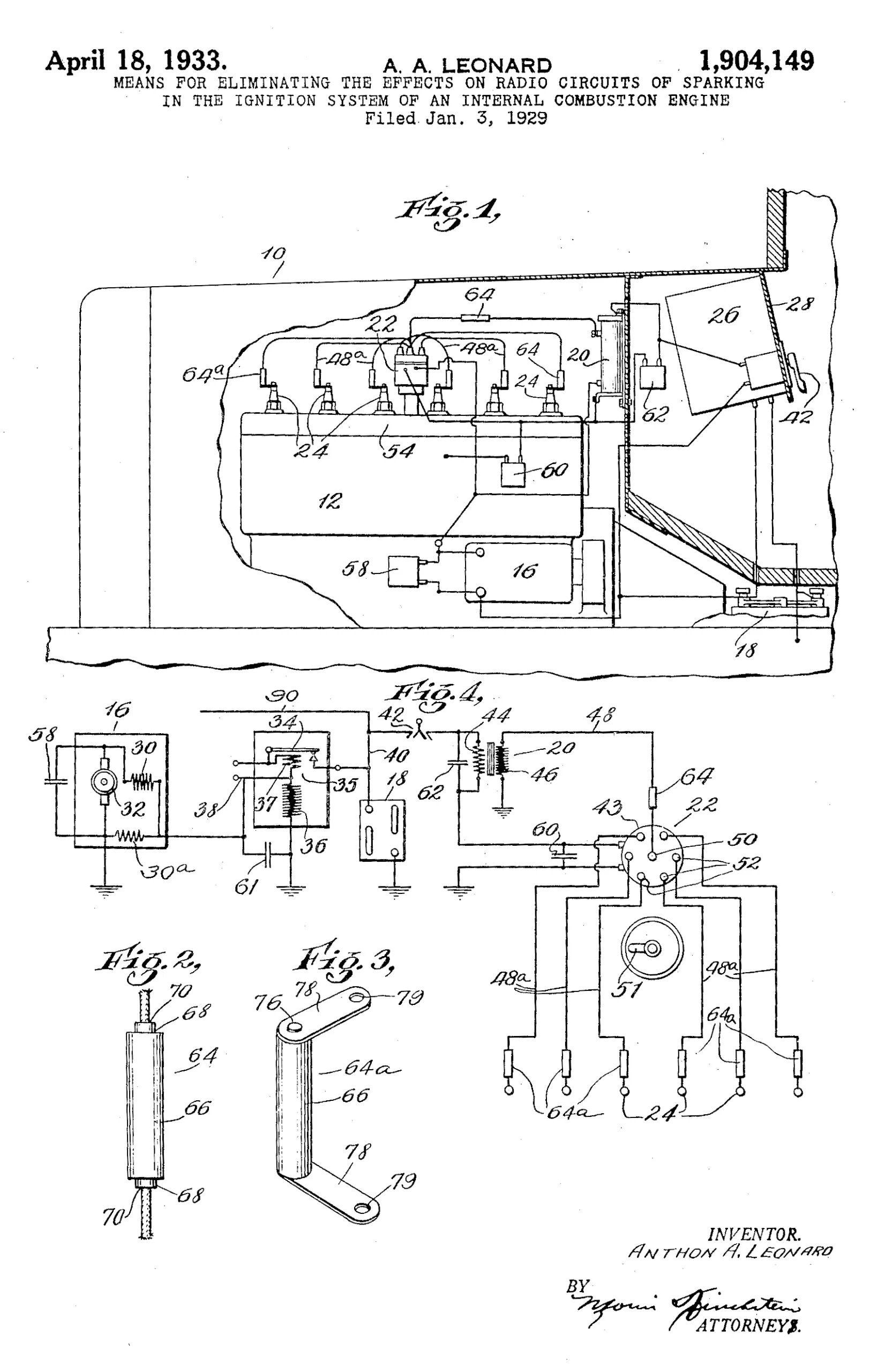
Just before Philco bought out ARC, A. A. Leonard, chief engineer for ARC, hit on a practical way to eliminate ignition interference. This was a very important development, and it was so basic that it’s still used today in a modified form. Leonard discovered that the high-tension ignition wires of a car engine act as miniature antennas, grounded at the sparkplug and oscillating at frequencies determined by their length. This oscillation comes via the abrupt change in current through the wire when the plugs fire. Leonard damped this high-tension oscillation by developing screw-in resistors, called suppressors.
Leonard’s suppressors cut high-tension interference, but in doing so, they made low-tension static noticeable. So Leonard and radio installers in general began a long, hard battle against noises coming from the generator, breaker points, and other electrical sources. Some of these noises were taken out with additional suppression devices and others with copper shielding—a copper box around the receiver.
Leonard’s patent (US1904149, above) was filed in January 1929, although it wasn’t granted until April 1933.
Back to Gottlieb:
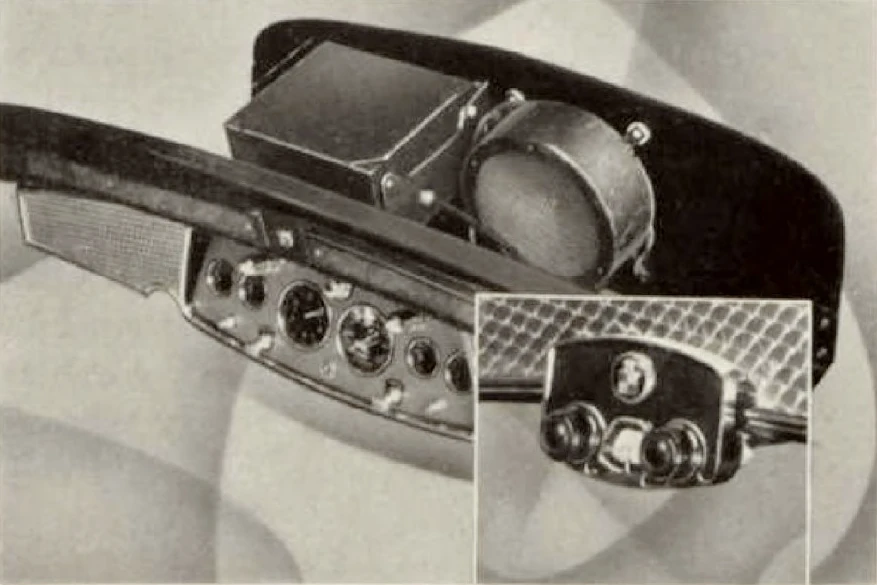
By 1929, some automakers began equipping their cars with roof antennas and cutouts in the floor to accommodate “B” batteries. Among these were Dodge, Studebaker, Franklin, Pierce-Arrow, Jordan, Packard, Chrysler, and Peerless.
From 1929, all closed-body Cadillac and LaSalle cars also included what the 1931 accessories booklet called “a skillfully concealed aerial and a place on the cowl for the set and speaker,” although prices for the radio installation were still available only “on application.” (The January 1930 issue of Radio estimated the installed price as $150 to $185.)
Gottlieb continued:
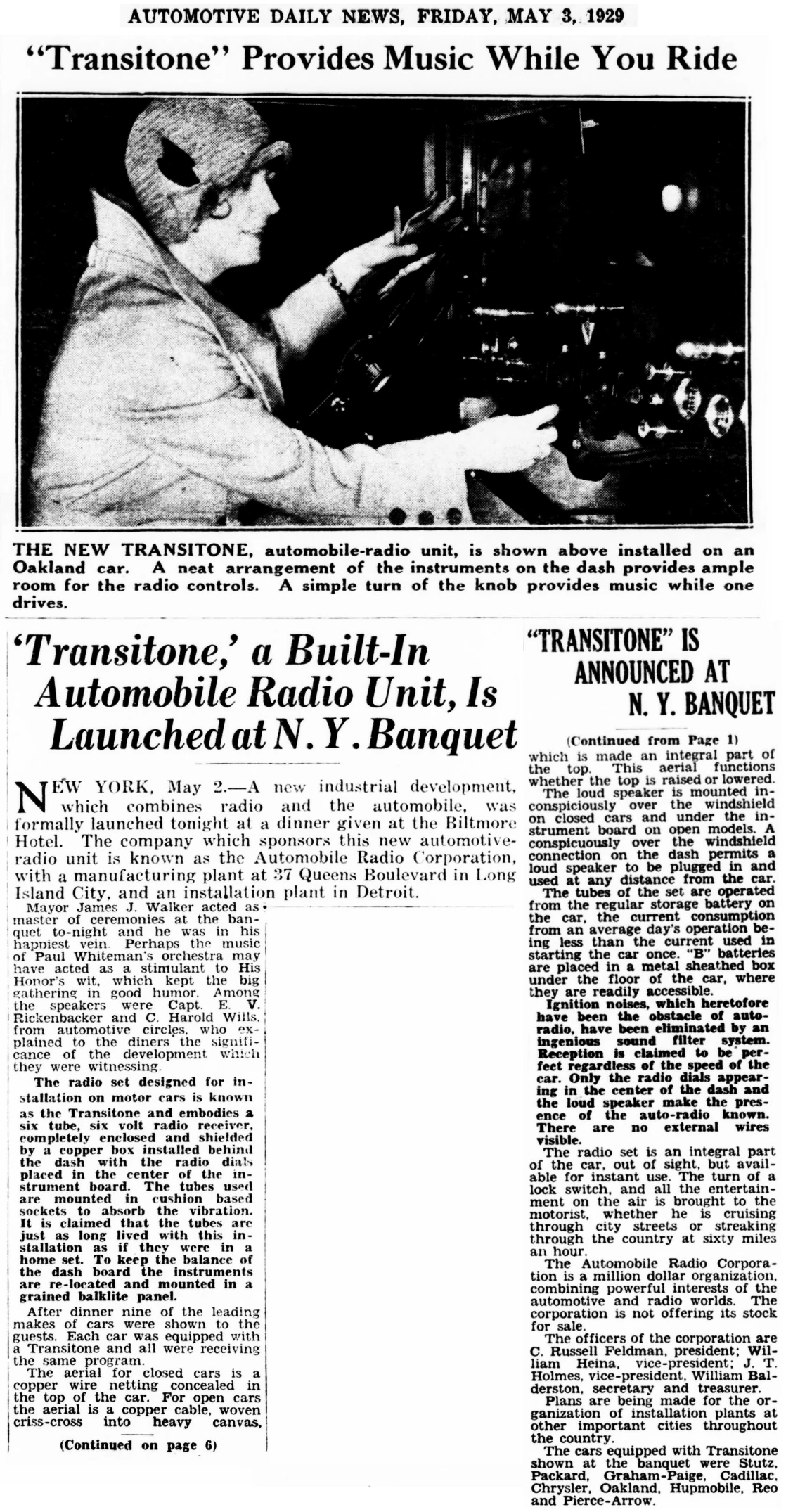
The American auto radio industry pegs its birth year at 1929. The push started when the Automobile Radio Corp, threw a huge party at the Hotel Roosevelt in New York. Everyone who was anyone attended, including bigwigs from most of the major car companies. Next day, Arthur Brisbane, the Hearst columnist, wrote up the party and the glories of car radio, and that started the ball rolling.
As the above clipping from the May 3, 1929 Automotive Daily News explains, the event Gottlieb is describing was a banquet to announce the Transitone radio. It was held at the Biltmore Hotel, not the Hotel Roosevelt — which threw me off in looking for contemporary coverage — but it was a big to-do, featuring New York’s Mayor Jimmy Walker, Paul Whiteman and his orchestra, Eddie Rickenbacker, and columnist Arthur Brisbane (who was a speaker, not a guest). The radio, installed in cars from Stutz, Packard, Graham-Paige, Cadillac, Chrysler, Oakland, Hupmobile, Reo, and Pierce-Arrow, was demonstrated to about 400 guests from the radio and auto industries. So, while this event wasn’t the beginning of car radio, it did serve to put it on the map.
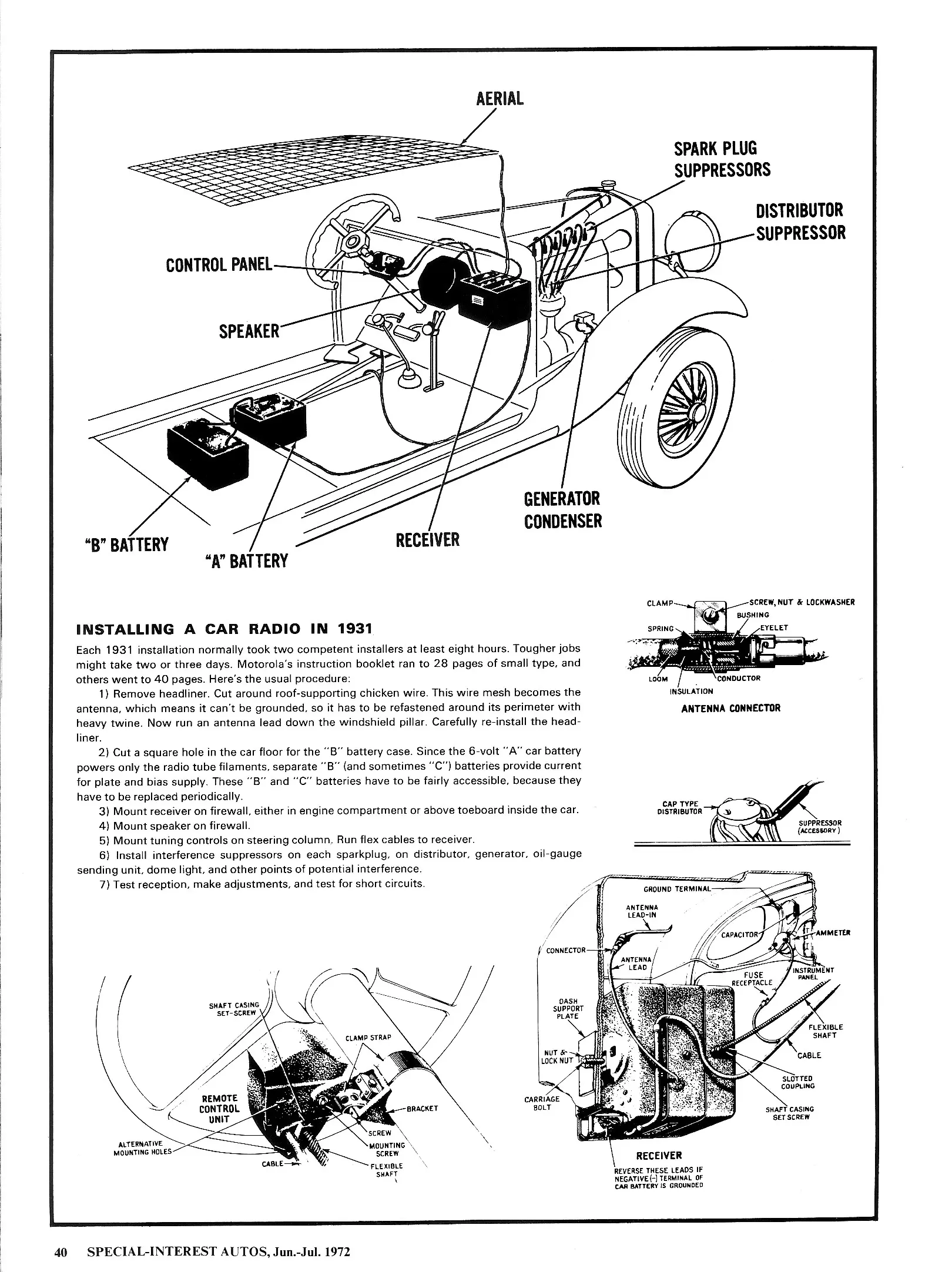
As the above text explains, “Each 1931 installation normally took two competent installers at least eight hours. Tougher jobs might take two or three days. Motorola’s instruction booklet ran to 28 pages of small type, and others went to 40 pages.” Installation could also be a messy process, especially on a car that didn’t already have a roof aerial.
I’ll skip over Gottlieb’s paean to the Golden Age of Radio (some of which is anachronistic anyway, referring to shows not broadcast until a decade or so later) and pick up in the third paragraph:
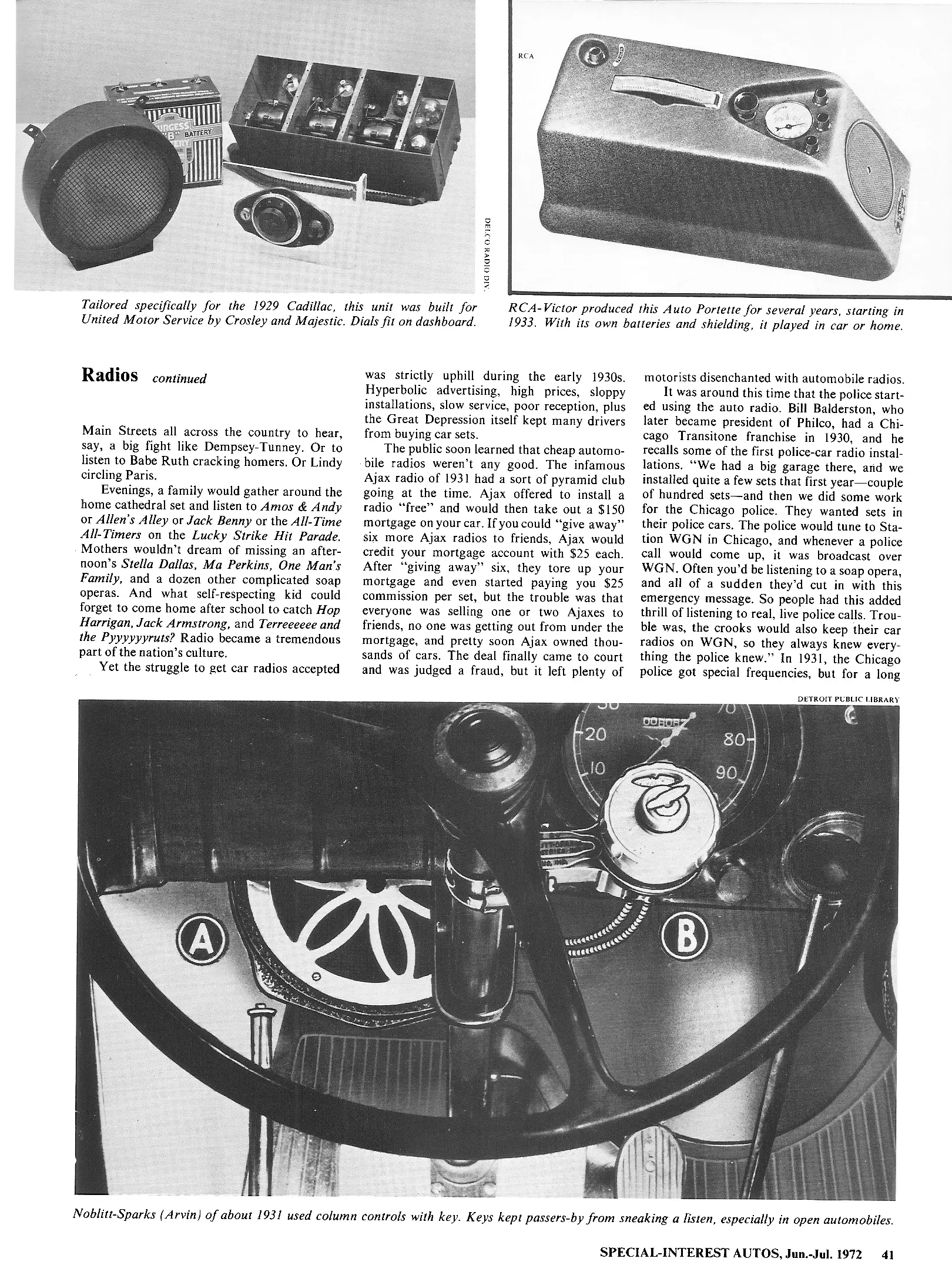
Yet the struggle to get car radios accepted was strictly uphill during the early 1930s. Hyperbolic advertising, high prices, sloppy installations, slow service, poor reception, plus the Great Depression itself kept many drivers from buying car sets.
The public soon learned that cheap automobile radios weren’t any good. The infamous Ajax radio of 1931 had a sort of pyramid club going at the time. Ajax offered to install a radio “free” and would then take out a $150 mortgage on your car. If you could “give away” six more Ajax radios to friends, Ajax would credit your mortgage account with $25 each. After “giving away” six, they tore up your mortgage and even started paying you $25 commission per set, but the trouble was that everyone was selling one or two Ajaxes to friends, no one was getting out from under the mortgage, and pretty soon Ajax owned thousands of cars. The deal finally came to court and was judged a fraud, but it left plenty of motorists disenchanted with automobile radios.
This interesting anecdote turned out to be unverifiable. While it certainly sounds like a Depression-era pyramid scheme, considerable searching failed to turn up ANY references to it other than this article and a couple of later sources that were very clearly drawing on this article. There were some radio companies called Ajax in the ’20s and ’30s, but I spent too much time digging through ProQuest Historical Newspapers, Google Books, and the Internet Archive, and I found nothing talking about either a pyramid scheme like Gottlieb describes or a fraud trial (which is something I think would have caught the attention of the auto industry and radio trade publications). Does that mean it didn’t happen? Not necessarily, but I think there’s a good chance that if it did, it was either at a different time, involved a company with a different name, or both — so take that one with a grain of salt.
In any event, Gottlieb’s claim that there was an uphill battle to get car radios accepted in the early 1930s is not supported by the numbers. On the following page, Gottlieb cites 1933 U.S. car radio set sales of 250,000 units. In the January 4, 1934 issue of Printers’ Ink, Radio Retailing market analysis manager Arthur P. Hirose quoted total car radio sales of 143,000 in 1932 and about 700,000 in 1933 — up from only 34,500 in 1930. Growth like that certainly didn’t suggest any great public reluctance about auto radio!
Gottlieb goes on:
It was around this time that the police started using the auto radio. Bill Balderston, who later became president of Philco, had a Chicago Transitone franchise in 1930, and he recalls some of the first police-car radio installations. “We had a big garage there, and we installed quite a few sets that first year—couple of hundred sets—and then we did some work for the Chicago police. They wanted sets in their police cars. The police would tune to Station WGN in Chicago, and whenever a police call would come up, it was broadcast over WGN. Often you’d be listening to a soap opera, and all of a sudden they’d cut in with this emergency message. So people had this added thrill of listening to real, live police calls. Trouble was, the crooks would also keep their car radios on WGN, so they always knew everything the police knew.” In 1931, the Chicago police got special frequencies, but for a long time they had only one-way communication.
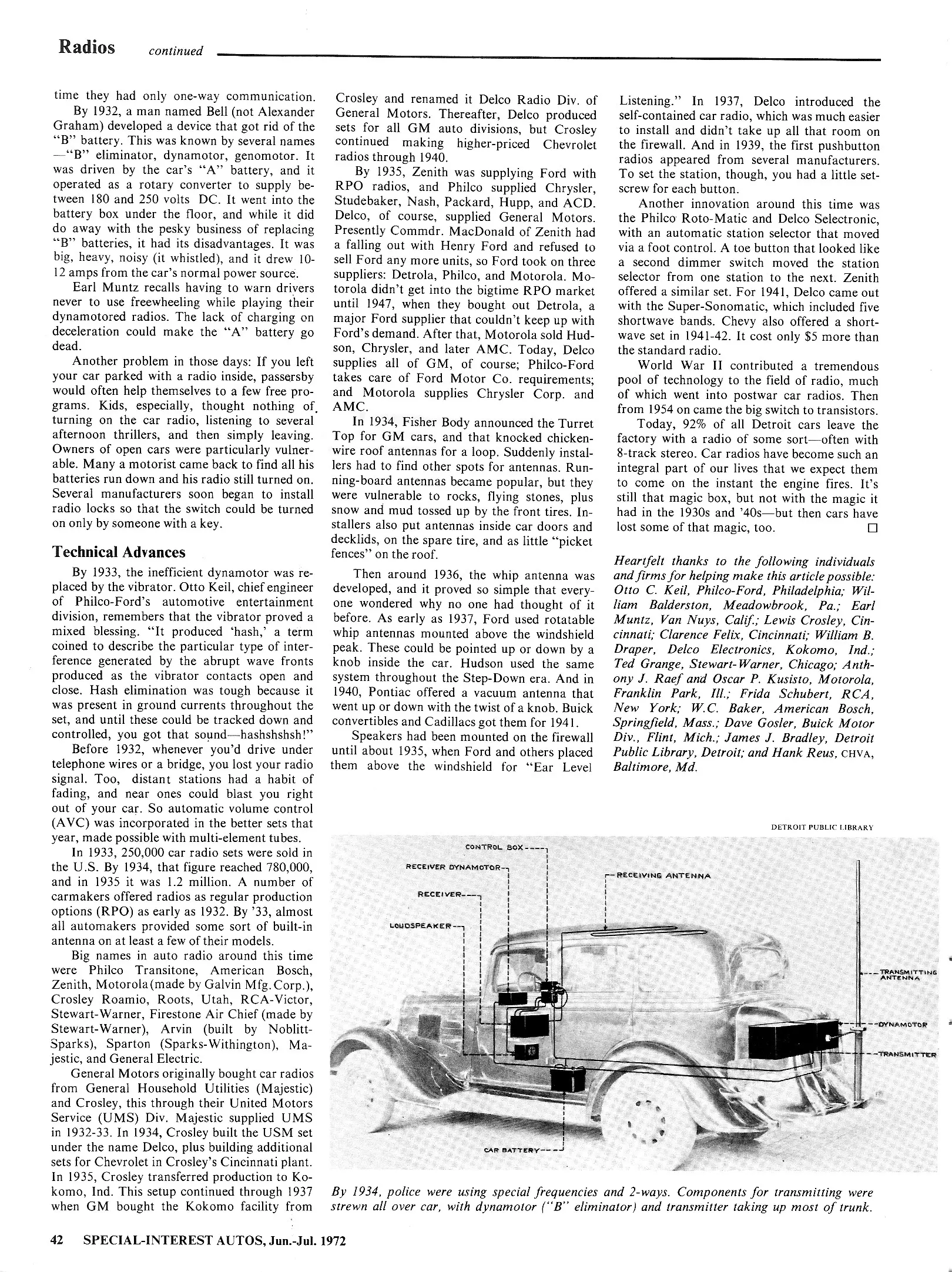
The photo in the lower right, showing a police car with a 2-way radio, unfortunately wouldn’t reproduce well. Such police radio installations were first adopted in service in 1933–1934, but there had been experimental installations going back to about 1924.
Gottlieb then stumbles a bit factually:
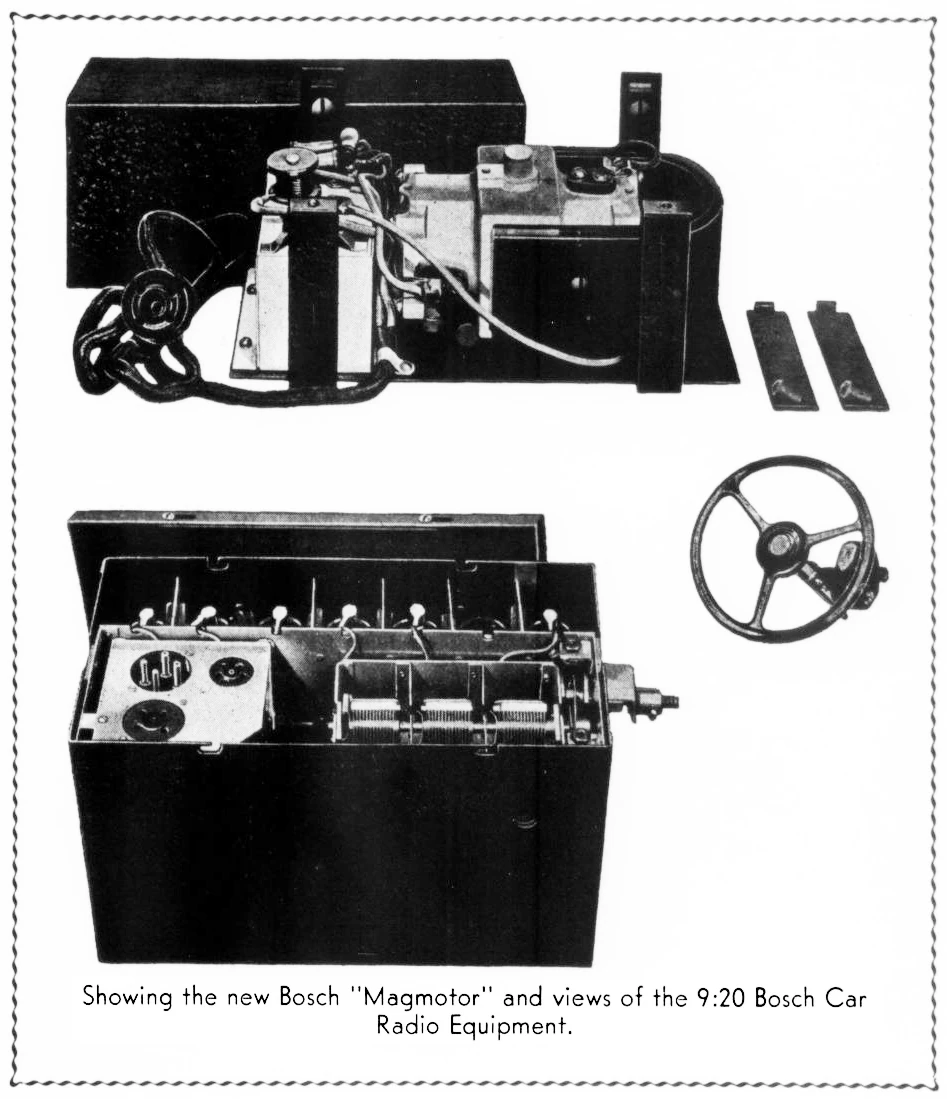
By 1932, a man named Bell (not Alexander Graham) developed a device that got rid of the “B” battery. This was known by several names—“B” eliminator, dynamotor, genomotor. It was driven by the car’s “A” battery, and it operated as a rotary converter to supply between 180 and 250 volts DC. It went into the battery box under the floor, and while it did do away with the pesky business of replacing “B” batteries, it had its disadvantages. It was big, heavy, noisy (it whistled), and it drew 10-12 amps from the car’s normal power source.
The above passage is another one that has gotten repeated in various other sources, which is unfortunate because Gottlieb was rather sloppy with it. An item in the March 1932 issue of Electronics describes no fewer than ELEVEN battery eliminator devices for car radios, of at least five distinct types, that were either already on or about to go on the market.
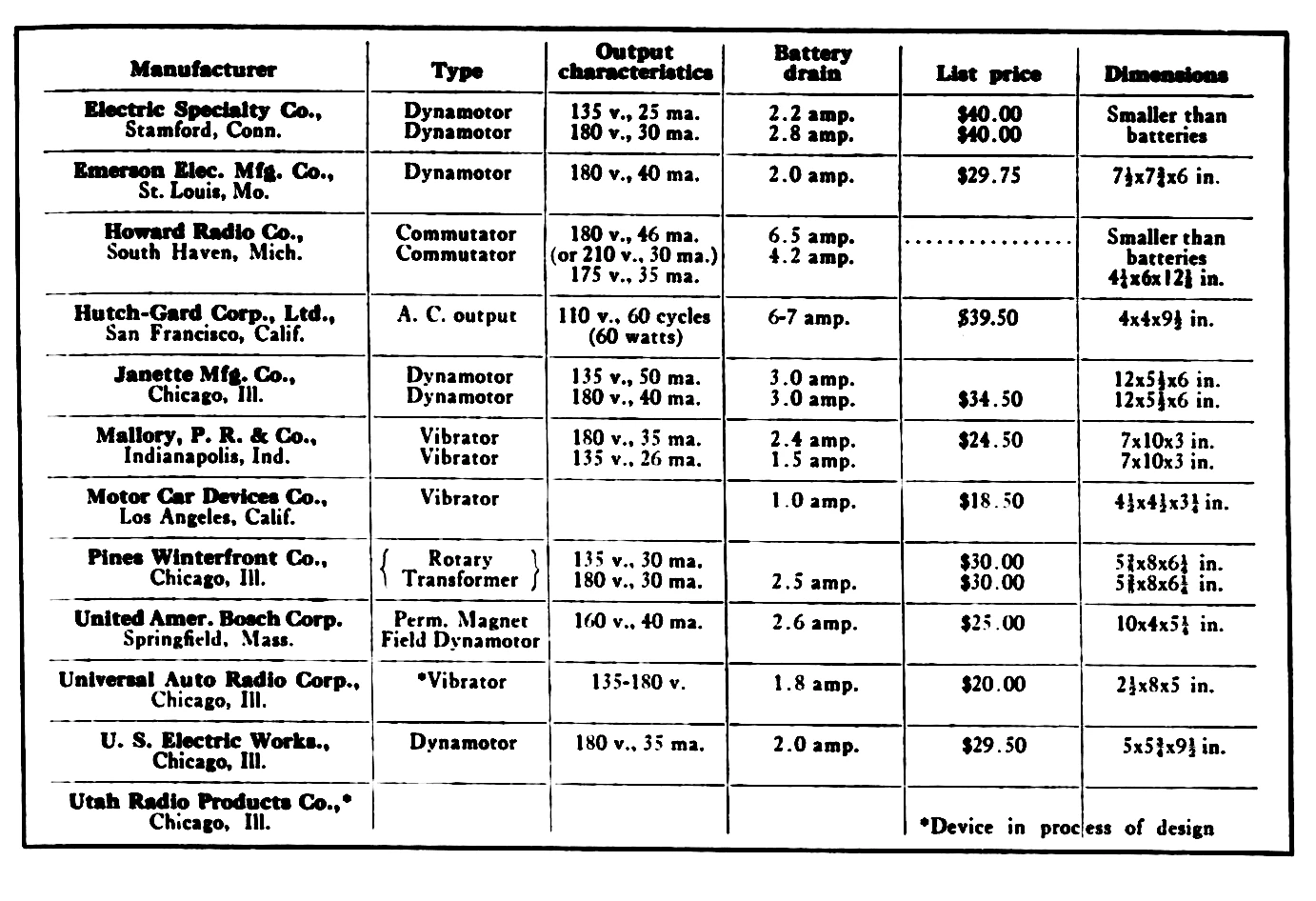
This table from that Elecronics article shows a breakdown. Note that the claimed battery drain figures ranged from 1.0 to 7 amps, not the “10–12 amps” Gottlieb quotes. (By 1937, when nearly all new car radios incorporated such devices, Consumer Reports found that the average battery drain was “from 4.5 to 9.2 amperes in late models, which, to be sure, still puts a load on the battery that will shorten its life.”) Whether any of these battery replacers were indeed designed by “a man named Bell” is unclear; I didn’t find any relevant patents under that name.
Back to Gottlieb:
Earl Muntz recalls having to warn drivers never to use freewheeling while playing their dynamotored radios. The lack of charging on deceleration could make the “A” battery go dead.
Another problem in those days: If you left your car parked with a radio inside, passersby would often help themselves to a few free programs. Kids, especially, thought nothing of turning on the car radio, listening to several afternoon thrillers, and then simply leaving. Owners of open cars were particularly vulnerable. Many a motorist came back to find all his batteries run down and his radio still turned on. Several manufacturers soon began to install radio locks so that the switch could be turned on only by someone with a key.
The latter was eventually superseded by wiring the radio through the ignition switch, although the battle to keep passersby from tampering with (or, more likely, stealing) car radios raged on.
 Gottlieb continues:
Technical Advances
By 1933, the inefficient dynamotor was replaced by the vibrator. Otto Keil, [later] chief engineer of Philco-Ford’s automotive entertainment division, remembers that the vibrator proved a mixed blessing. “It produced ‘hash,’ a term coined to describe the particular type of interference generated by the abrupt wave fronts produced as the vibrator contacts open and close. Hash elimination was tough because it was present in ground currents throughout the set, and until these could be tracked down and controlled, you got that sound — hashshshsh!”Before 1932, whenever you’d drive under telephone wires or a bridge, you lost your radio signal. Too, distant stations had a habit of fading, and near ones could blast you right out of your car. So automatic volume control (AVC) was incorporated in the better sets that year, made possible with multi-element tubes.
In 1933, 250,000 car radio sets were sold in the U.S. By 1934, that figure reached 780,000, and in 1935 it was 1.2 million. A number of carmakers offered radios as regular production options (RPO) as early as 1932. By ’33, almost all automakers provided some sort of built-in antenna on at least a few of their models.
As I noted above, Printers’ Ink in 1934 cited a MUCH higher sales figure for 1933, 700,000 sets. The March 1934 issue of the journal Electronics put total 1933 sales of car radios even higher: 724,000 units, with an aggregate retail value of $28.6 million (a relative worth of about $1.9 billion in 2025 dollars). Keep in mind that this was in the midst of the Great Depression, when money was very tight for most people.
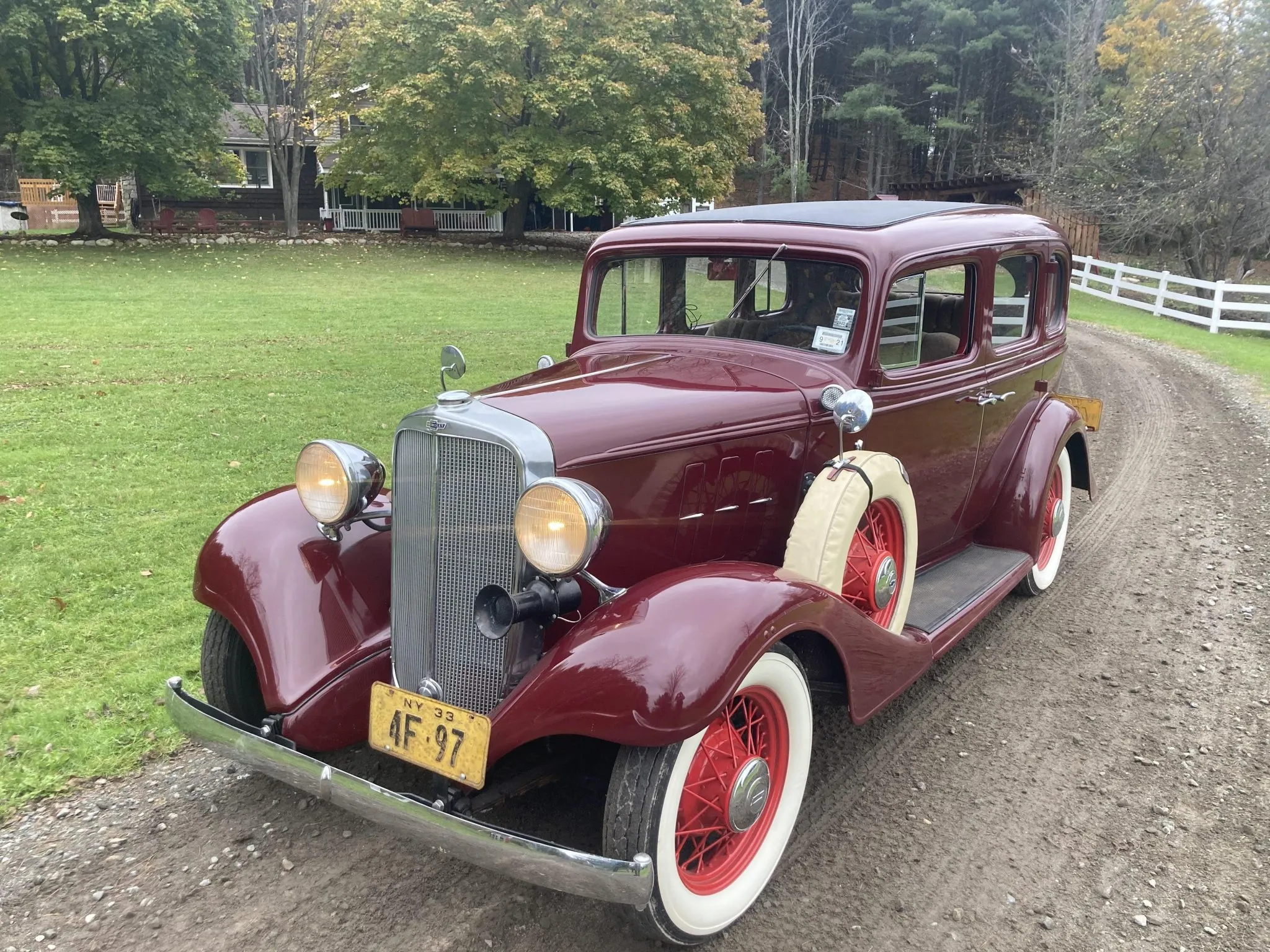
According to a 1933 SAE Journal overview of notable engineering features of the 1933 cars, all U.S. closed-body cars were designed for radio installation, incorporating a built-in roof aerial. Automakers also made ignition system changes to try to reduce radio interference.
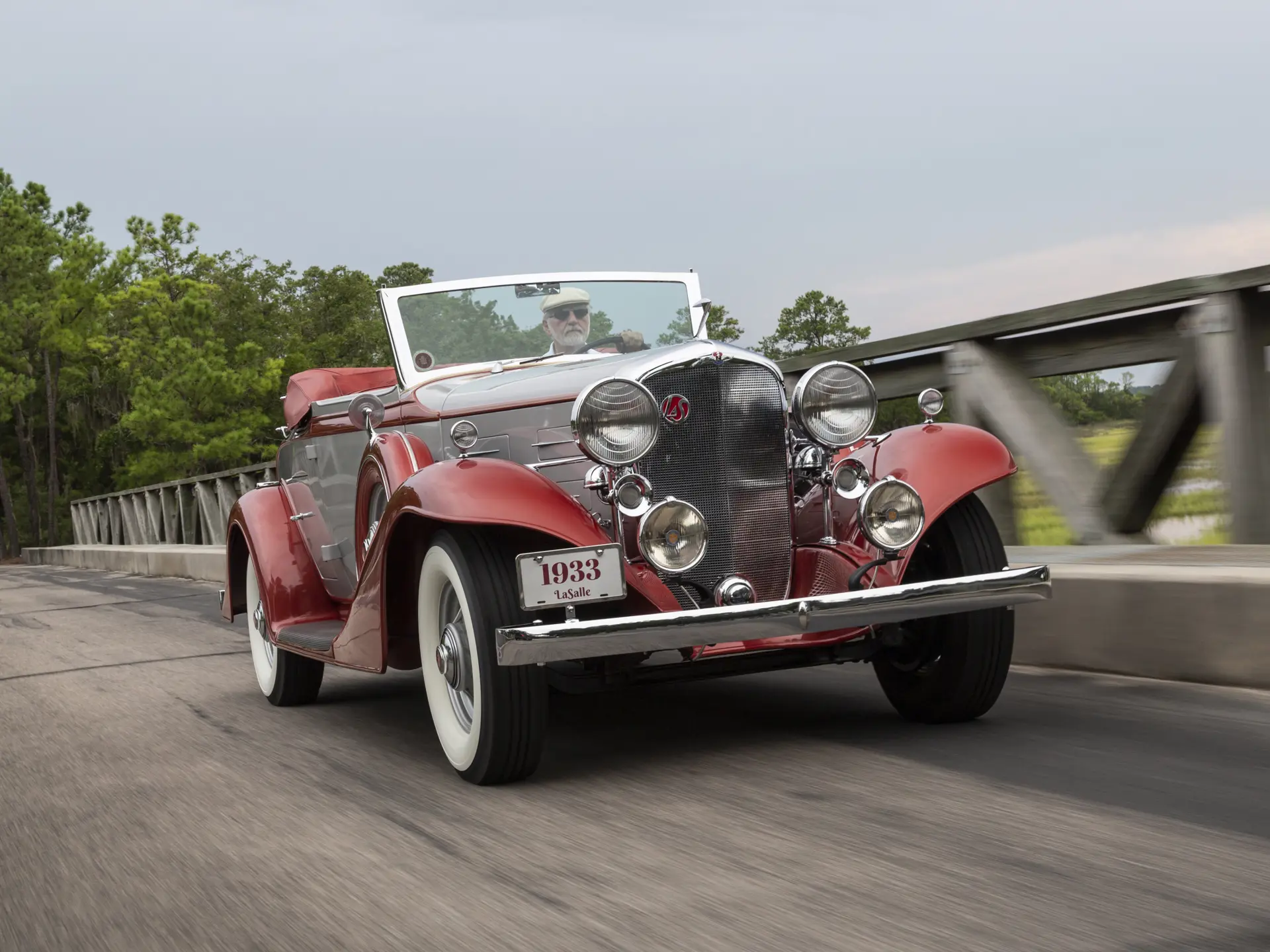
1933 was the first year that Cadillac offered a factory radio option for Cadillac and LaSalle cars, with an as-installed retail price of $89.50 (including a very healthy $25 retail markup for the dealer!).
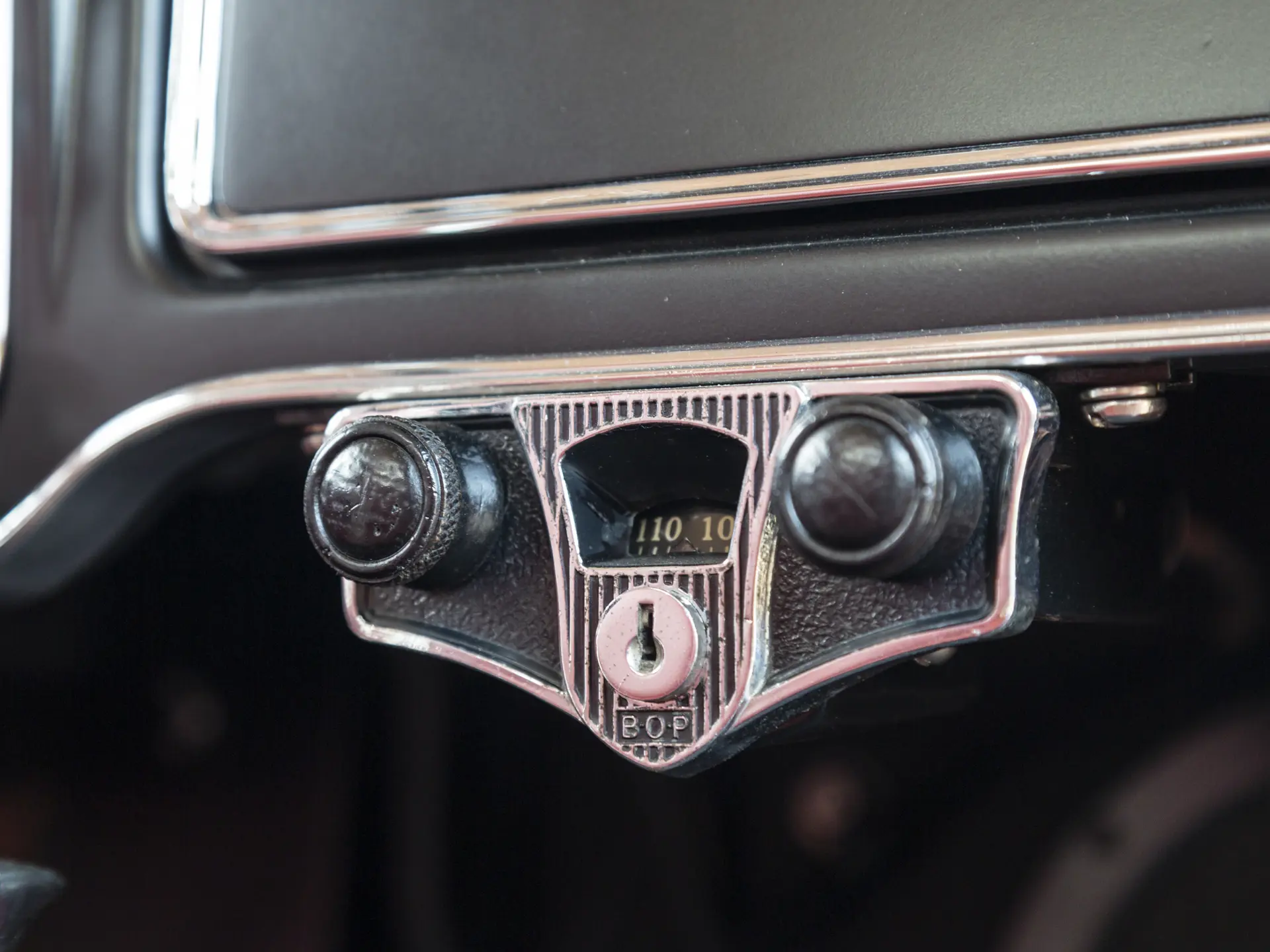
That was still a lot of money in 1933 (a relative worth of almost $6,000 in 2025 dollars), but it was about half what a radio installation had cost just three years earlier.
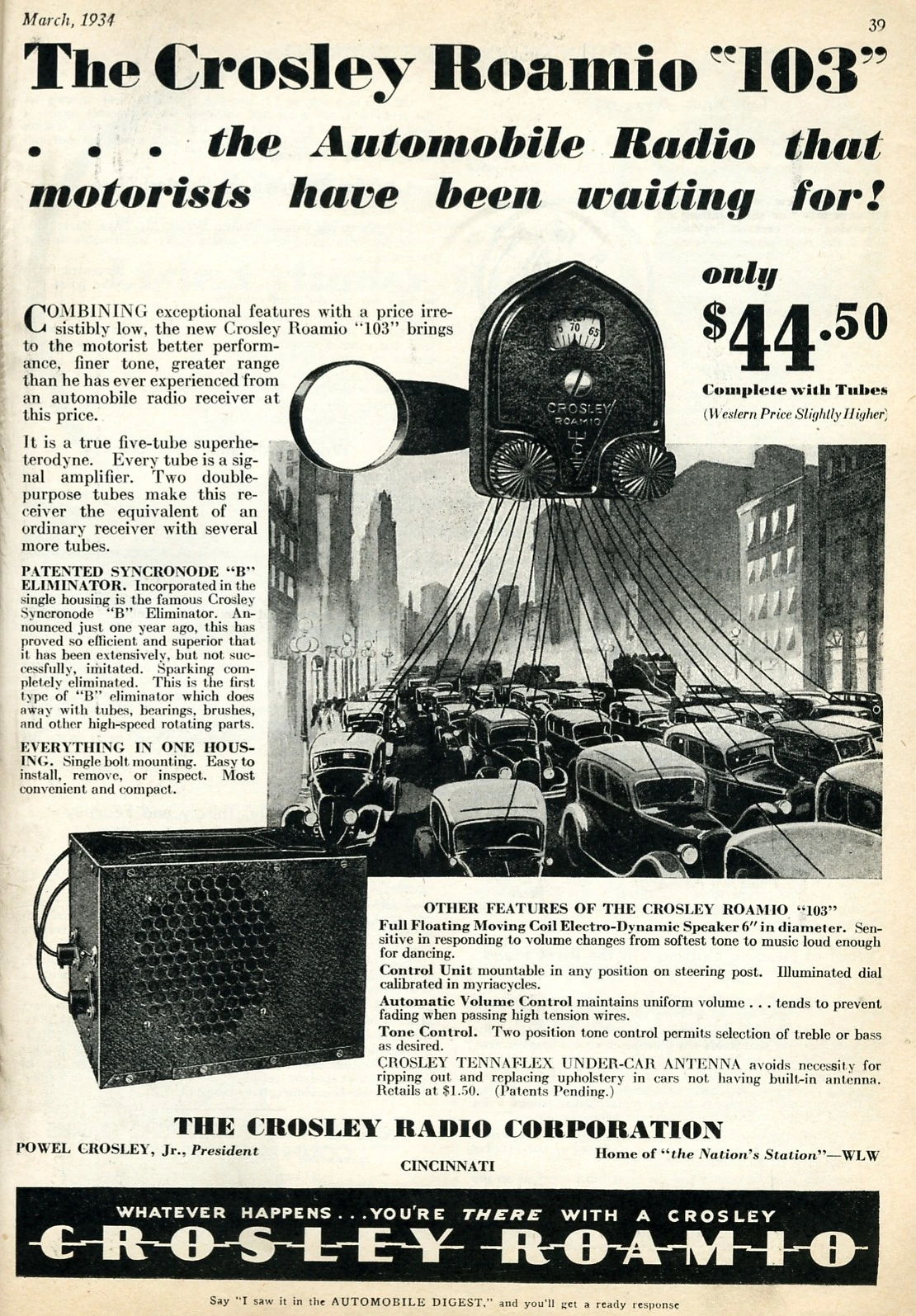
Gottlieb goes on:
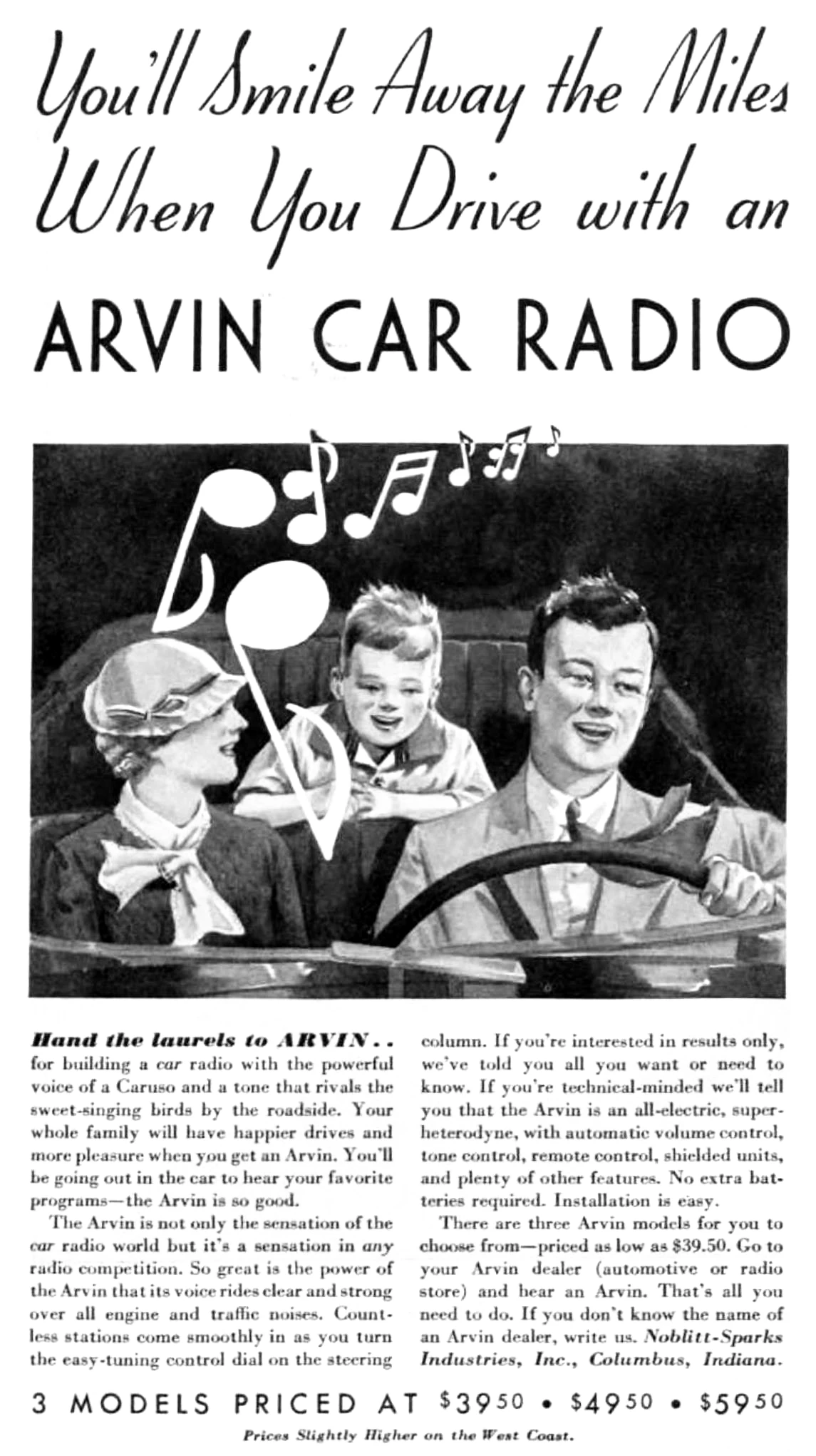
Big names in auto radio around this time were Philco Transitone, American Bosch, Zenith, Motorola (made by Galvin Mfg. Corp.), Crosley Roamio, Roots, Utah, RCA-Victor, Stewart-Warner, Firestone Air Chief (made by Stewart-Warner), Arvin (built by Noblitt-Sparks), Sparton (Sparks-Withington), Majestic, and General Electric.
General Motors originally bought car radios from General Household Utilities (Majestic) and Crosley, this through their United Motors Service (UMS) Div. Majestic supplied UMS in 1932-33. In 1934, Crosley built the USM set under the name Delco, plus building additional sets for Chevrolet in Crosley’s Cincinnati plant. In 1935, Crosley transferred production to Kokomo, Ind. This setup continued through 1937 when GM bought the Kokomo facility from Crosley and renamed it Delco Radio Div. of General Motors. Thereafter, Delco produced sets for all GM auto divisions, but Crosley continued making higher-priced Chevrolet radios through 1940.
The last part gets a little confusing: GM first incorporated Delco Radio in February 1930, not 1937; it was an associate company of the General Motors Radio Corporation, which was originally co-owned by RCA and made household radios. Delco made a five-tube automotive radio that was handled by GM’s United Motors Service Division. However, RCA pulled out of GM Radio Corporation in 1932, and General Motors liquidated that business line in 1933. Delco-branded radios were still built after that, either by Crosley or by Delco Appliance Corp. in Rochester, New York. In April 1936, GM bought Crosley’s Kokomo plant, as Gottlieb says, and organized a NEW Delco Radio Division, now a subsidiary of Delco-Remy.
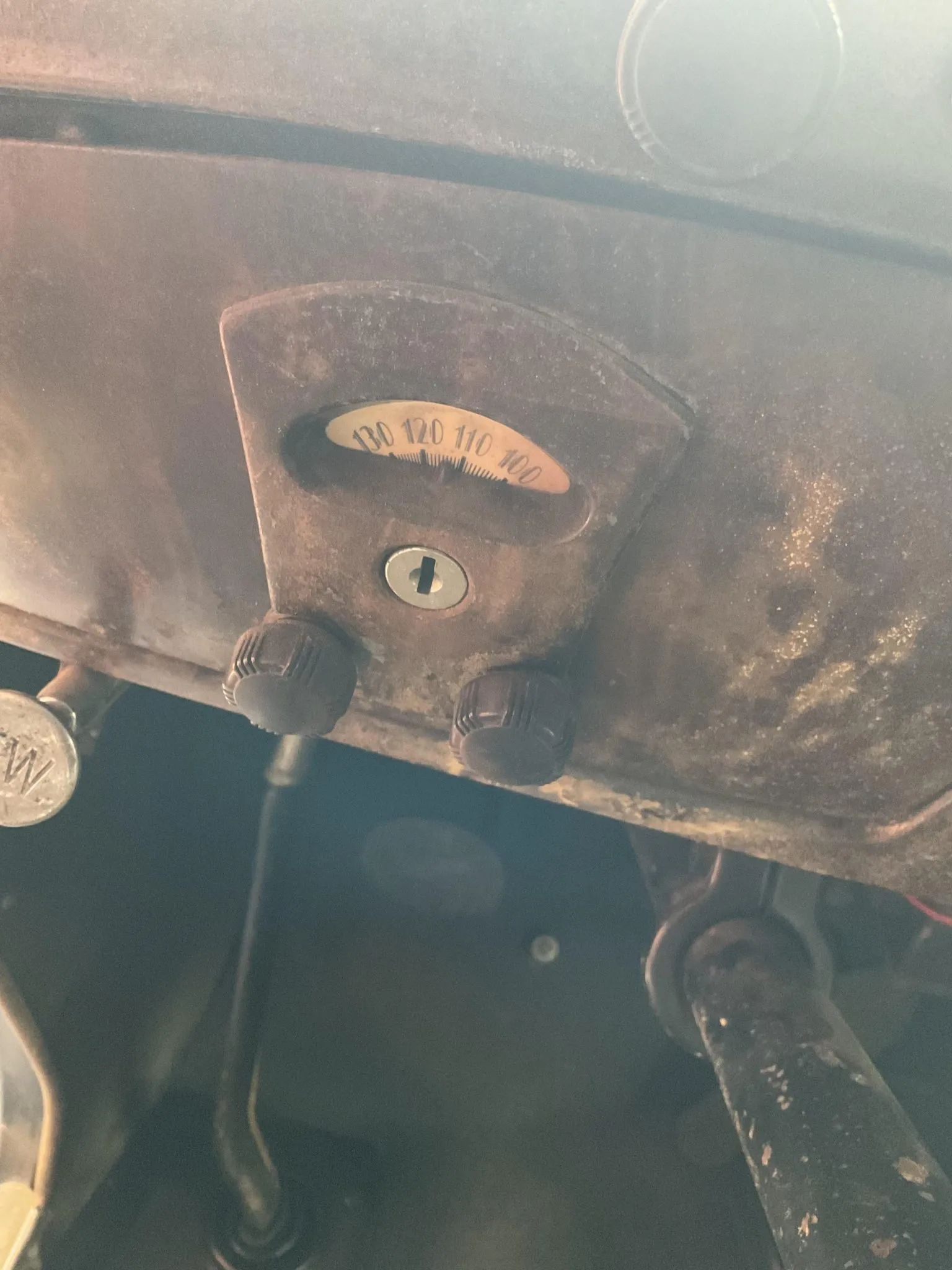
Gottlieb continues:
By 1935, Zenith was supplying Ford with RPO radios, and Philco supplied Chrysler, Studebaker, Nash, Packard, Hupp, and ACD. Delco, of course, supplied General Motors. Presently Commdr. MacDonald of Zenith had a falling out with Henry Ford and refused to sell Ford any more units, so Ford took on three suppliers: Detrola, Philco, and Motorola. Motorola didn’t get into the bigtime RPO market until 1947, when they bought out Detrola, a major Ford supplier that couldn’t keep up with Ford’s demand. After that, Motorola sold Hudson, Chrysler, and later AMC. Today, Delco supplies all of GM, of course; Philco-Ford takes care of Ford Motor Co. requirements; and Motorola supplies Chrysler Corp, and AMC.
The founder of Zenith Radio Corporation was Eugene F. McDonald (not MacDonald). He was called “The Commander” because he was a U.S. Naval Reserve Forces lieutenant commander from 1919 to 1939. Motorola bought the car radio division of International Detrola Corporation in September 1948, not 1947. Paul Galvin said the deal would allow Motorola to sell directly to OEMs for the first time.
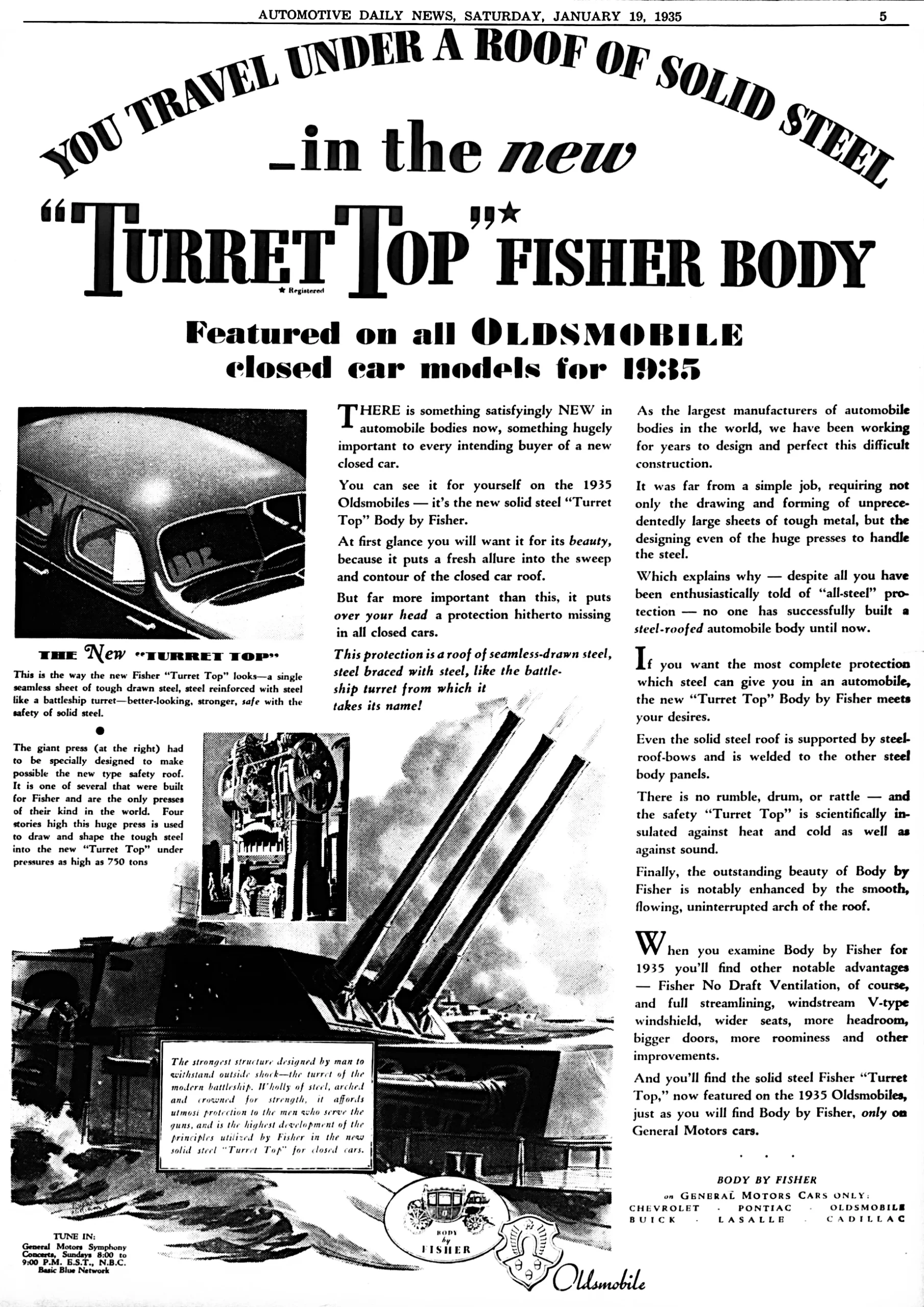
Gottliebe again:
In 1934, Fisher Body announced the Turret Top for GM cars, and that knocked chicken-wire roof antennas for a loop. Suddenly installers had to find other spots for antennas. Running-board antennas became popular, but they were vulnerable to rocks, flying stones, plus snow and mud tossed up by the front tires. Installers also put antennas inside car doors and decklids, on the spare tire, and as little “picket fences” on the roof.
Then around 1936, the whip antenna was developed, and it proved so simple that everyone wondered why no one had thought of it before. As early as 1937, Ford used rotatable whip antennas mounted above the windshield peak. These could be pointed up or down by a knob inside the car. Hudson used the same system throughout the Step-Down era. And in 1940, Pontiac offered a vacuum antenna that went up or down with the twist of a knob. Buick convertibles and Cadillacs got them for 1941.
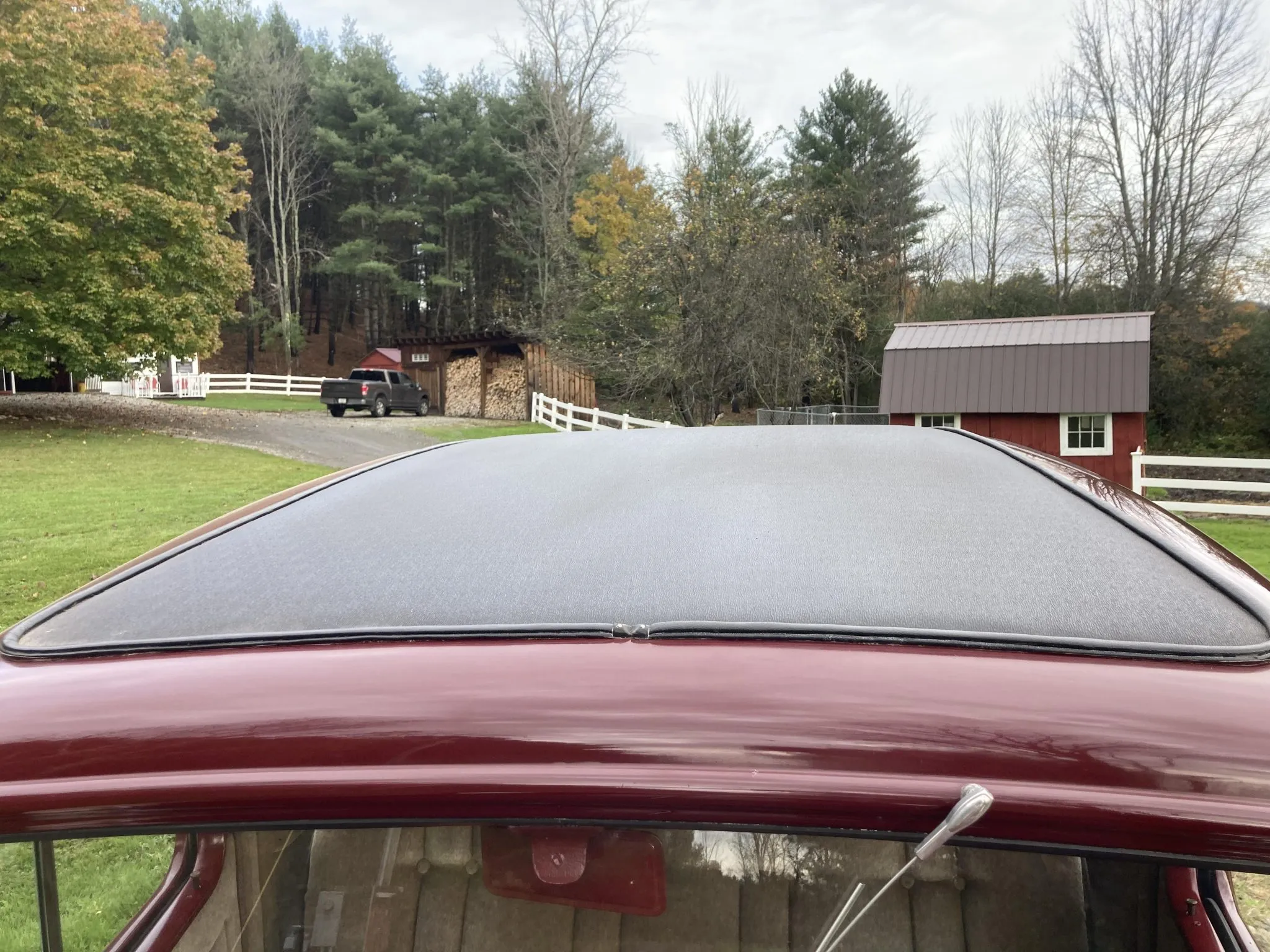
The “Unisteel Turret Top” body was introduced on many (not all) 1935 GM models. Previously, the body structures of many cars had used steel panels over a wooden framework, typically with a section of canvas or leatherette rather than metal covering the center section of the roof, to prevent annoying drumming. The Turret Top bodies had a steel roof structure with felt and cork insulation instead. As Gottlieb notes, that made the previous roof aerials impractical, but putting the antenna under the car was no better. In addition to the problems he describes, Consumer Reports warned that an under-car radio antenna also “picks up wheel static readily, signals poorly.”
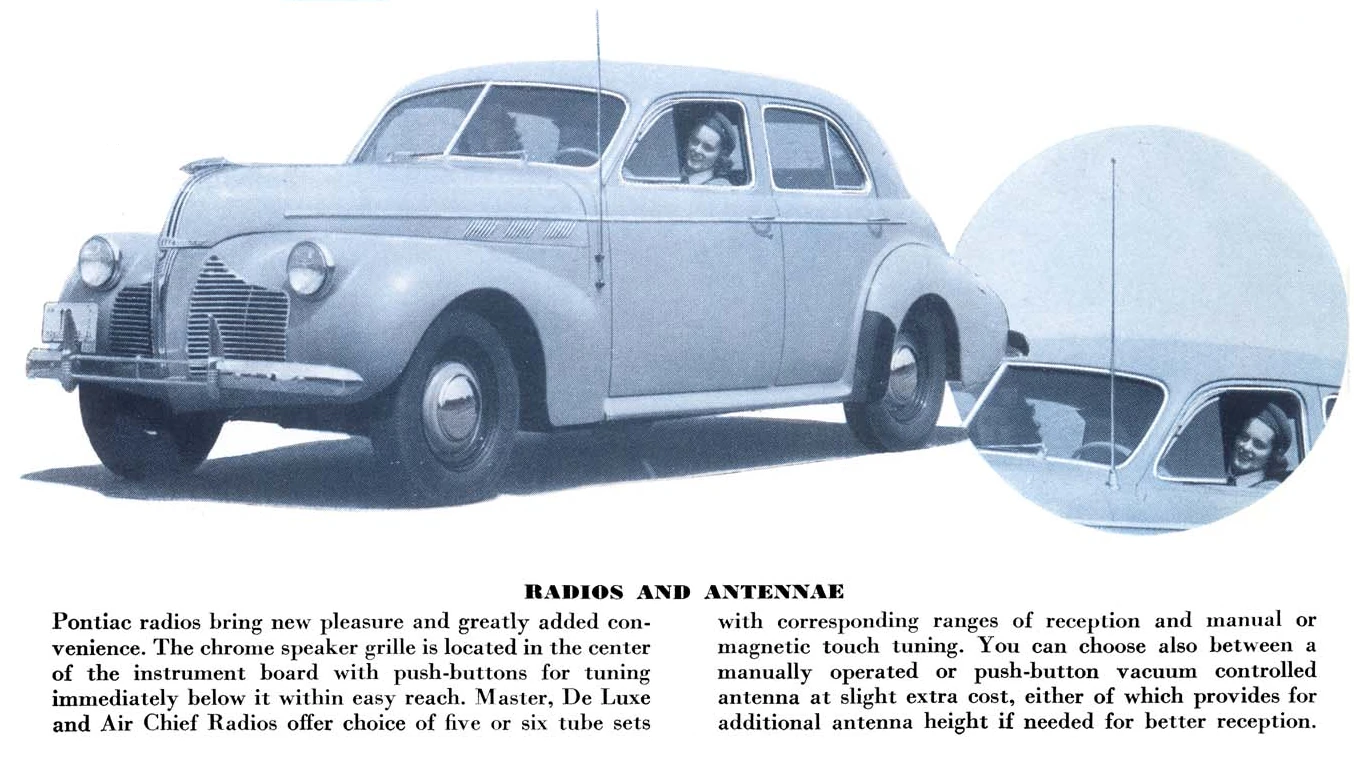
Development of the vertical rod-type antenna for car radios seems to have happened very quickly in mid-1936. The trade journal Radio Today didn’t associate it with any particular manufacturer — their observation was that its popularity seemed to be regional until automakers began adopting it for their 1937 models. There were several kinds, which in that era were commonly known as either “fish-pole” or “buggy whip” antennas. (The difference was fairly self-explanatory). The above brochure illustration shows the manually extended and vacuum-operated retractable antennas offered on the 1940 Pontiac line.
Back to Gottlieb:
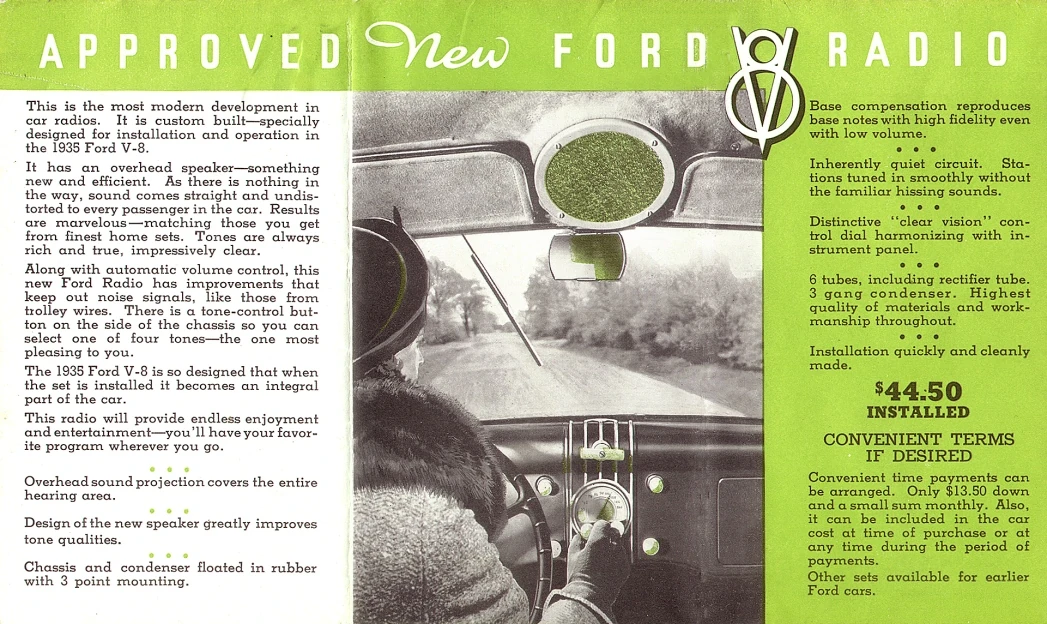
Speakers had been mounted on the firewall until about 1935, when Ford and others placed them above the windshield for “Ear Level Listening.” In 1937, Delco introduced the self-contained car radio, which was much easier to install and didn’t take up all that room on the firewall. And in 1939, the first pushbutton radios appeared from several manufacturers. To set the station, though, you had a little set-screw for each button.
Another innovation around this time was the Philco Roto-Matic and Delco Selectronic, with an automatic station selector that moved via a foot control. A toe button that looked like a second dimmer switch moved the station selector from one station to the next. Zenith offered a similar set. For 1941, Delco came out with the Super-Sonomatic, which included five shortwave bands. Chevy also offered a shortwave set in 1941-42. It cost only $5 more than the standard radio.
Overhead speaker mounting (the 1935 Ford version is shown above) doesn’t seem to have caught on in any sustained way. By the late 1930s, the integral dashboard speaker grille was far more common, sometimes supplemented with a rear speaker in the back seat (still a separate extra-cost option into the 1970s).
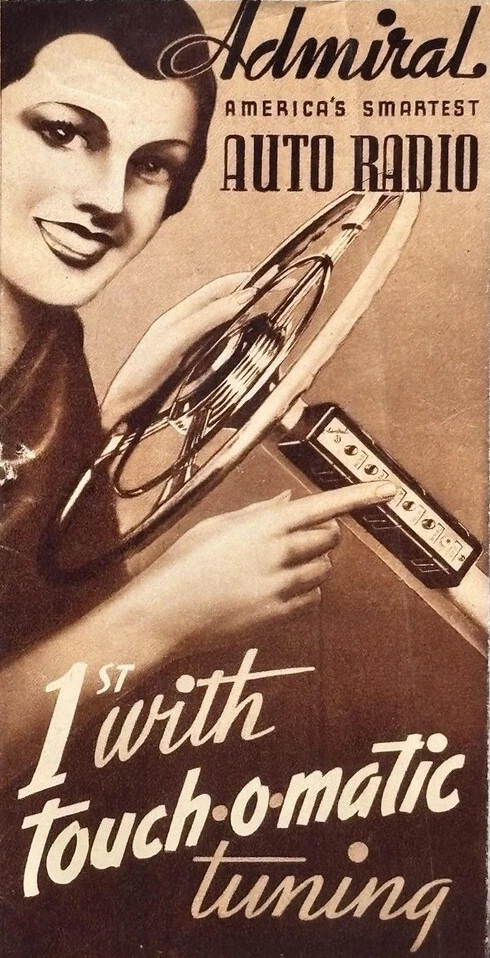
Both automatic frequency control and pushbutton control were introduced in 1937. Some Motorola Golden Voice radios even incorporated buttons that were color-coded for different radio networks. “A red pushbutton identifies the NBC network, green for Columbia and yellow for the Mutual system,” explained an item in the April 1938 Radio News. “An electric motor drives the variable condenser when a button is depressed and contact made.”
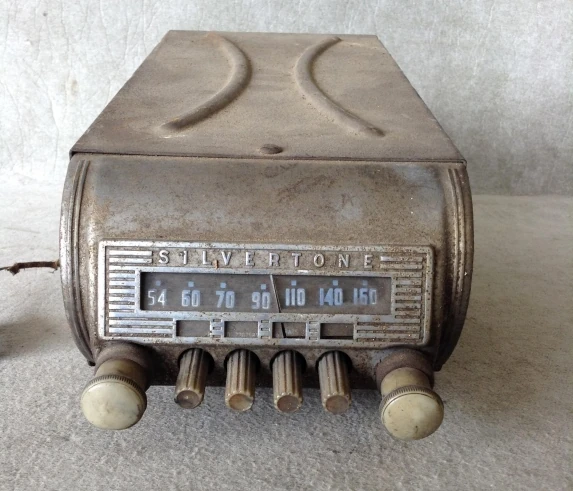
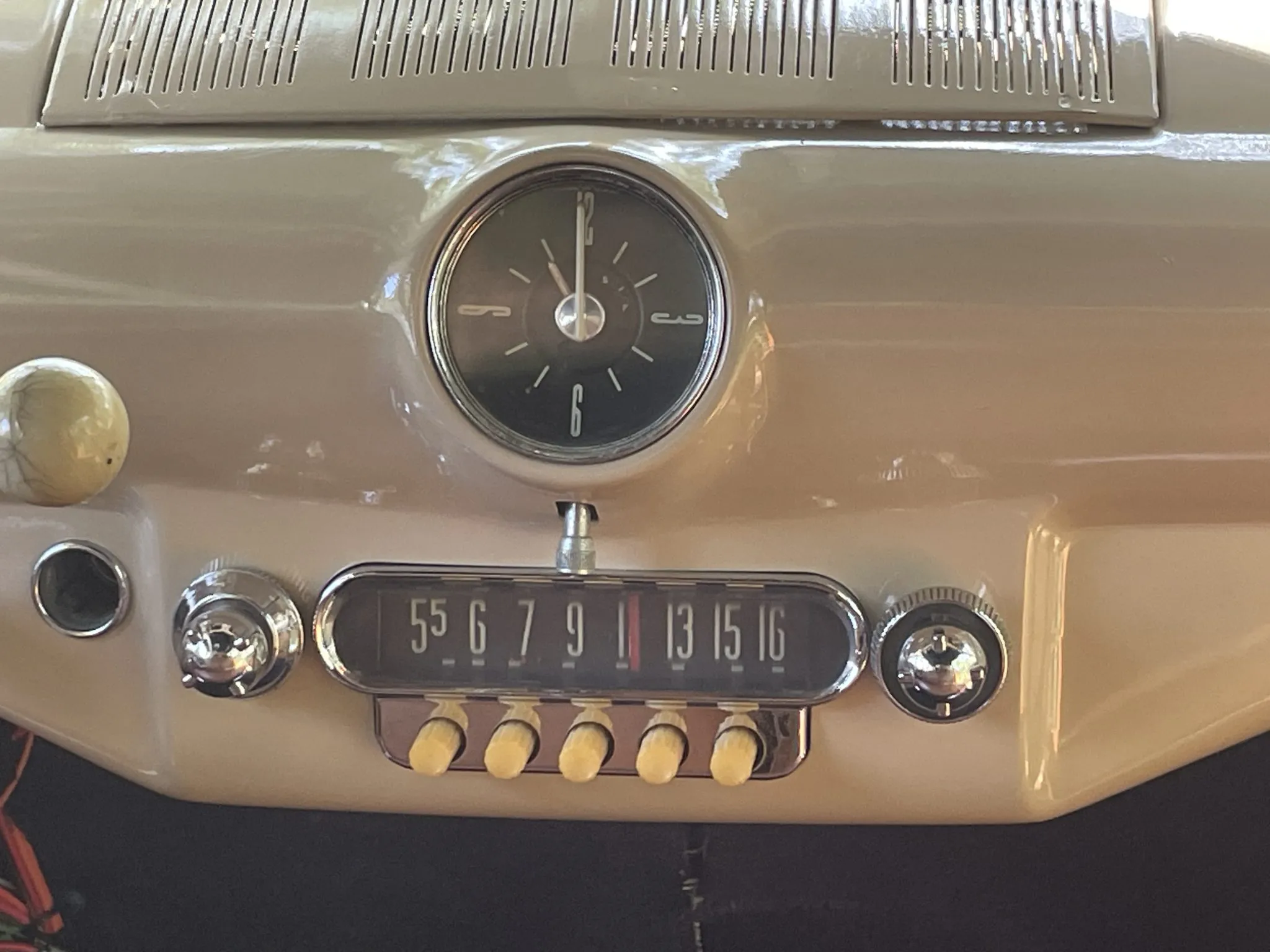
This was part of a larger industry push to sell pushbutton controls for various kinds of radios, including both home and car sets. The September 1939 Consumer Reports noted:
The same three types of push-button tuning available in home radios are also available in automobile radios. They are:
- An arrangement in which a cam or lever, operated by the push-button, moves the tuning mechanism;
- an arrangement in which the conventional tuning mechanism is driven by an electric motor;
- an arrangement whereby a separate set of two or more screws is adjusted for each station, with the push-buttons controlling switches which select the different combinations. (In some designs, such as the Philco Model 937, the controlling switches are operated by a remote control motor.)
Pragmatic Consumer Reports reviewers naturally favored the first type, which they called “rugged and relatively fool-proof.”
Gottlieb concludes:
World War II contributed a tremendous pool of technology to the field of radio, much of which went into postwar car radios. Then from 1954 on came the big switch to transistors.
Today, 92% of all Detroit cars leave the factory with a radio of some sort — often with 8-track stereo. Car radios have become such an integral part of our lives that we expect them to come on the instant the engine fires. It’s still that magic box, but not with the magic it had in the 1930s and ’40s — but then cars have lost some of that magic, too.
What about overseas? Gottlieb doesn’t discuss that, but Blaupunkt (originally a trademark of Ideal Radiotelefon- & Apparatefabrik GmbH) introduced what they claimed was the first German car radio at the 1932 Berlin show. In 1933, Crossley Motors in Manchester, England became the first British automaker to offer a car radio as a factory option, priced at around £35 (roughly $175 to $180 at the contemporary exchange rate). A 1985 paper by Clem Rowan and Carlos Altgelt of Ford Motor Company noted that one reason car radio was a little slower to catch on in Europe in the 1930s was that many countries (including the UK) required a separate radio license for an auto set, adding to the cost of ownership beyond the initial price.
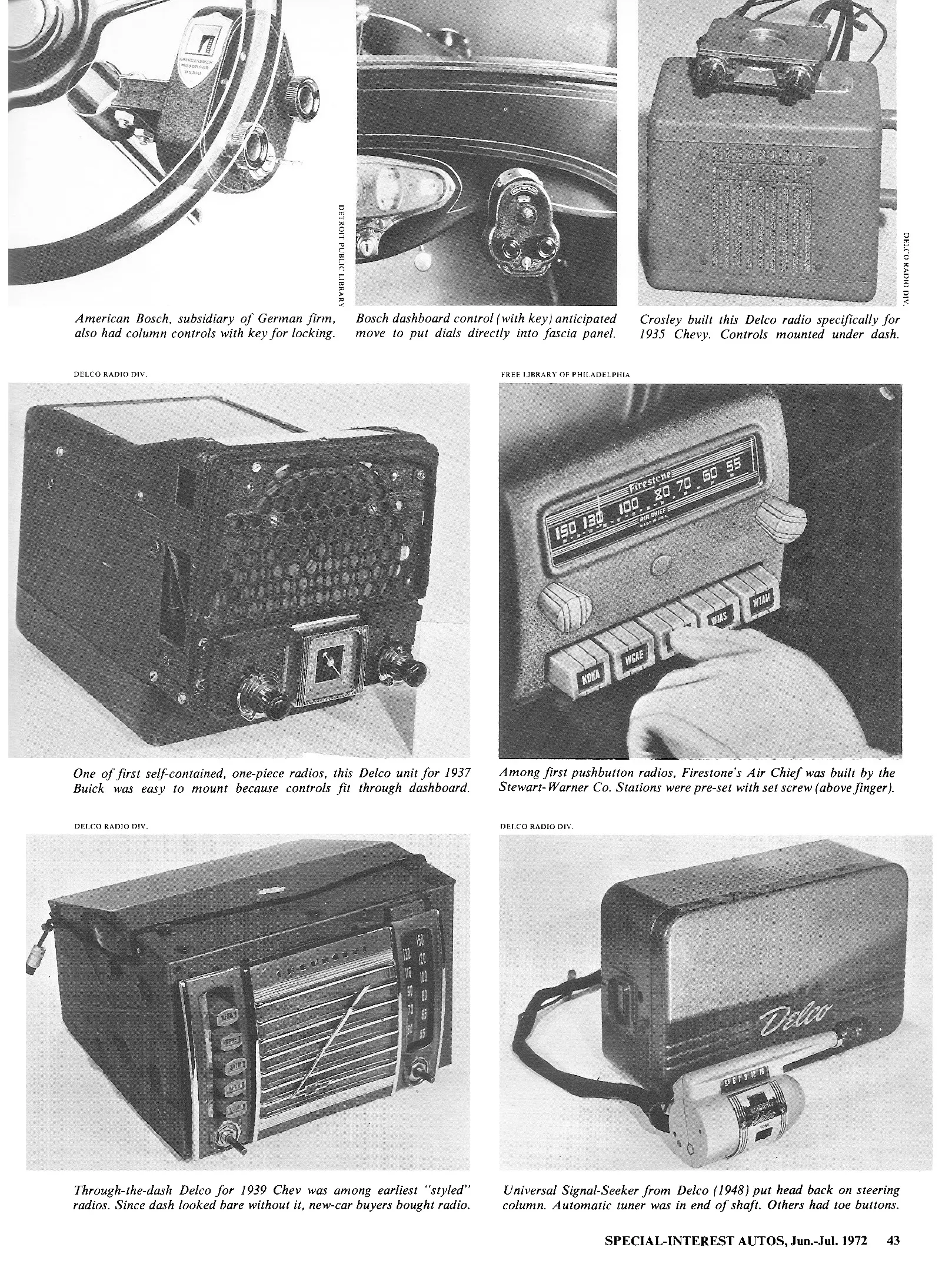
Except for the two photos at the upper left (which are of early American Bosch sets) and the center right (which is a Firestone Air Chief), all of the radios on the above page are from Delco: a Crosley-built Chevrolet unit (upper right), a 1937 Buick set (center left), a 1939 Chevrolet Master 85 set (bottom left) and a postwar Delco Universal Signal-Seeker (bottom right).
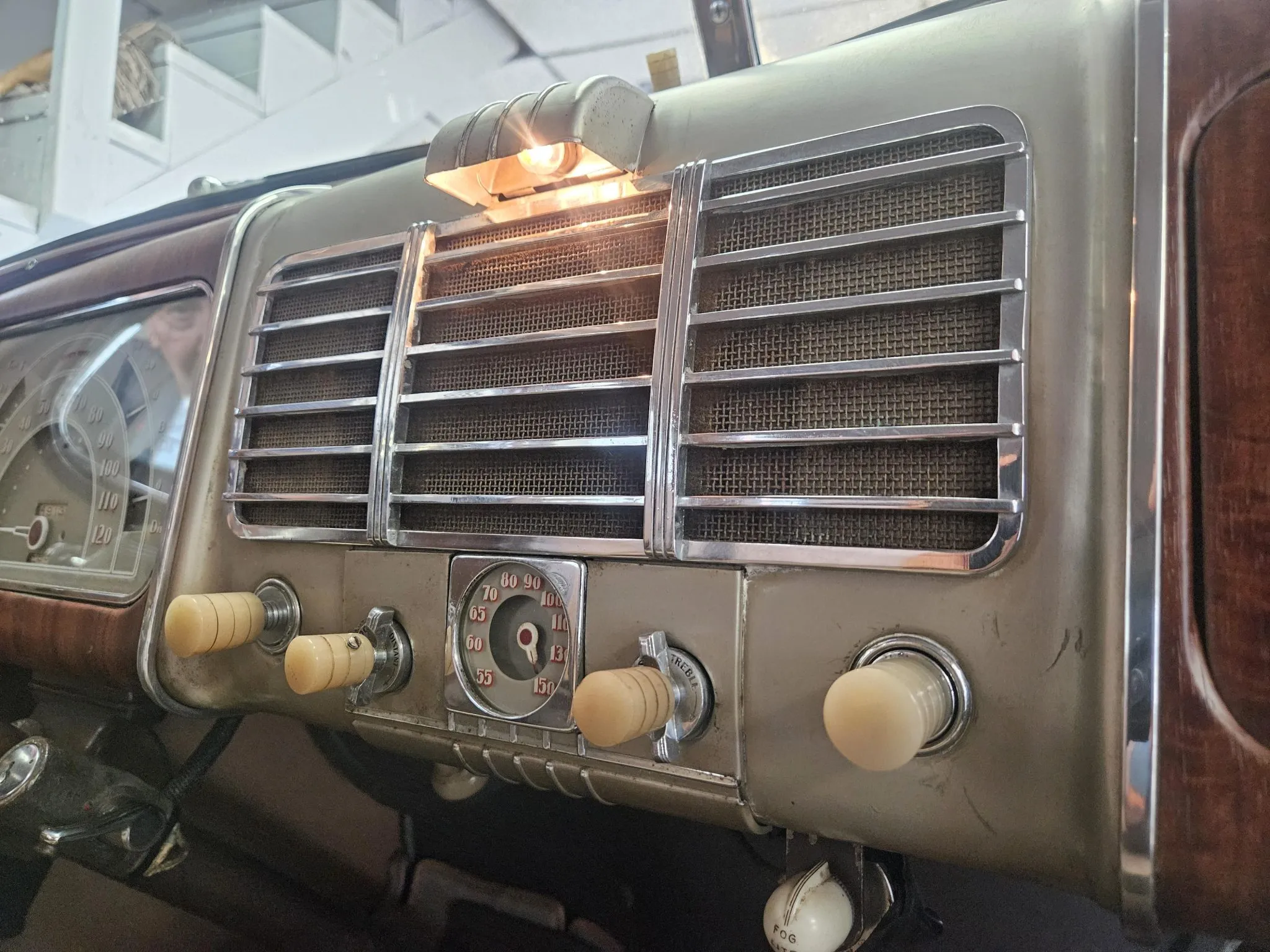
As a postscript, while researching this post, I found a nifty tool to consume your day if you like old radios. Retro Radio Shop has a set of online tools to help you identify specific car radio models, either by automaker, by brand, by model number, or by image.
Related Reading
1956 Delco Station-Seeking Radio Ads: “Touch The Wonder Bar, Dilworth” (by me)
The Delco-GM/Bose Sound System: GM’s Greatest Hit Of The 1980s (by Eric703)








Thank you Aaron, another excellent, very informative article.
Of course, all of these radios tuned the AM band, which was the only band for which there were commercial broadcasts in the era. In an ironic twist, modern manufacturers of EV are eliminating AM receivers from their vehicles because there is too much EMI and RFI emanating from EV drivetrains to make AM radio listenable.
The FCC first authorized commercial FM broadcasts in May 1940, right towards the end of the period Gottlieb was talking about. A number of factors ended up kneecapping the growth of FM in the early 1940s, so it didn’t really take off for another 20 years.
The Rivian R2 electric SUV has neither AM nor FM tuners. Streaming radio (two different apps) is included but of course requires a) cell service and b) for my favorite local station to be available on those apps, which it is not. And of course the upcoming Slate EV will have no “infotainment” from the factory, relying on the user’s cell phone. There is some talk about requiring manufacturers to provide true AM on all vehicles for emergency information. My 2004 Subaru Forester included the “cold weather package” with heated seats, heating wires in the front windshield to defrost the parked wires … and an AM/FM/cassette/CD changer which also included the weather band. It was handy a few times.
Eighty million AM listeners to 4,300 AM stations can’t be ignored; the AM Radio for Every Vehicle Act easily passed the U.S. House of Representatives with wide bipartisan support, and it’s expected to pass the U.S. Senate and the president when the new Congress is seated. If so, Ford, BMW, Tesla, Mazda, Rivian and Volkswagen will have to fall into line again with full-service radios.
I guess this is another example of how out of touch I am with the modern world. I listen mostly to FM when I drive; I rarely stream from my phone, maybe the occasional podcast. One or two local FM music stations, plus NPR. If I’m out of my home area I listen to my thoughts. On the other hand, I don’t think I’ve listened to AM for decades.
>> On the other hand, I don’t think I’ve listened to AM for decades.
AM has larger reception area and Congress wants to keep it as a method for broadcasting emergency information in case of war, weather or civil disturbance. You may have seen the little triangles on older radios that indicated the emergency broadcast frequencies.
I’ve gradually stopped listening to radio stations over the past two decades or so, just because the ads and other yapping is so annoying. All I want is to listen to music, so these days, I have music on a USB stick that I can listen to instead. But recently we bought a 1990s pickup that only has an AM/FM radio, so I figured I’d give the radio a try again. Well, I still can’t stand it (except for when I want to listen to classical music in the morning – we still have a local station that plays good classical music). While driving the truck, I mostly “listen to my thoughts,” as you wrote!
AM? I haven’t listened to it in years, but my wife listens to AM a lot because she listens to religious programming. She was glad that the gov’t passed that bill preserving AM car radios.
The funny thing about that is that the only two brand-new cars I ever bought didn’t have AM radios, nor any radio at all. But for some reason they want to make radios mandatory now. I can’t believe my cars were somehow unsafe without radios.
What a great topic for a CC article and something that’s taken for granted as the mundane car radio. What isn’t addressed, though, is when car radios made the great leap forward to transisters. I was quite surprised that the early radio manufacturers were able to downsize what I always thought were huge home vacuum tube home sets to something that would fit into the cars of the times. What a revelation it must have been when relatively affordable car radios, either as RPOs or aftermarket, became available to purchasers of domestic autos.
And, has been pointed out, the vehicle information/entertainment (“infotainment’) industry always seems to be in a state of flux, albeit a slow moving one, with the latest controversy being the bit of requiring AM in all new vehicles. I’m unsure of how wise that idea is and, frankly, would think that just having a quickly tunable weather band is a much better idea.
OTOH, I guess out in extreme rural areas, there are still plenty of people that rely on AM not only for weather, but actually use it for things like talk-radio. The hip and tech savvy use podcasts for that (like my BiL), instead.
Be that as it may, it’s fascinating how far things have come in, say, the last half century, to the extent that even the most basic of vehicles have radio sets with exponentally more reception power and features than that of the sixties/seventies space programs.
For example, I’m very ‘frugal’ (to use a polite word) and detest streaming subscription services, mainly like Sirius/XM, but am still able to connect to free services (albeit with occasional commercials) like Calm Radio via my smartphone.
In short, car radios have come a very long way in a relatively short period of time.
This is a wonderful and well-researched article on a subject that I probably would never have thought to delve into. I enjoyed it immensely.
I read this part: “Car radios were deemed safety hazards in yet another way. In early 1930, the Massachusetts registrar of motor vehicles proposed a regulation to prohibit car radios being played while a car was moving. The City of St. Louis introduced similar legislation. It all came to a head on Feb. 26, 1930, when the Massachusetts Public Works Commission held a hearing. Opponents of car radios declared that: 1) Radios played in moving cars distract the driver and cause accidents. 2) The act of tuning a radio takes the driver’s attention away from the road. 3) Music lulls drivers to sleep. 4) Radios distract drivers of other cars as “attractive nuisances.”
And then I though to myself: Look how far we have gone backwards. Today, even the cheapest vehicle is loaded with tons of screens and distractions. Just think how these people back then would react if they were to be put in a modern car today?
I’m not saying we should ban radios or go back to what they had then. But I do feel things have gotten out of hand now.
Love this article! Fine job, Aaron! For a short period of my work career, I worked for the Blaupunkt Division of Robert Bosch GmbH (Gesellschaft mit bestimte Haltung). I prepresented Blaupunkt throughout New England. I called on distributors and jobbers as well repair stations. At the time, I was fluent in German. Thus, when the “Rundschreiben” or circular letters arrived in America, the office in Woodbury, Long Island, NY photocopied the data and sent it to me. I read it, translated it and gave the information to the clientele including car dealers. Interestingly, in the early 1970’s European cars would have either positive or negative ground and therefore we had many suppression packages. Unlike American automobiles, suppression was not standard even in a car without a radio. One major suppression item in American autos was the use of spark plug wires. Blaupunkt also lays claim to the first signal-seeking radio. As for its name, Blaupunkt means “Blue Point.” It refers to the color of the spark emitted in the early days by radios which in German are called “Rundfunk Gerat” which means radial spark apparatus. I probably had the only International Travelall in the U.S. equipped with a Blaupunkt AM/FM Stereo radio and a Bosch power antenna!
Before 1932, whenever you’d drive under telephone wires or a bridge, you lost your radio signal.
I definitely have memories of momentarily losing AM reception when going under bridges as recently as the 1960s. Under telephone wires, no problem.
Great article – thanks for all the research! It’s amazing to read about the early histories of products that we now take for granted. I never would have imagined car radios to have been such a hassle to install. Taking 8 hours for two installers – wow!
Regarding the early perceptions that radios distracted drivers, I do remember (when I was a kid) some older drivers refusing to play the radio for that reason. More recently, I had a co-worker who told me that her dad refused to play the radio or even to talk while driving. All family car rides had to be done in silence. Consequently, she grew up to despise driving!
Fascinating too about the “Ajax” story. After reading this, I was curious, and did some digging too, and found nothing about any radio company taking out chattel mortgages, or for that matter, any radio company named Ajax that was big enough to be considered “infamous.” Definitely curious.
Fine comprehensive article.
Dodge had factory optional radios in 1929, thus probably the other Chrysler makes as well. This is a ’29 Senior Six. The speaker is above the windshield, and the two tuning dials indicate it was TRF, not superhet.
I had these parts once, found them in an old chickenshed and didn’t know they were part of a car radio. The speaker worked.
Thanks Aaron entertaining and enlightening.