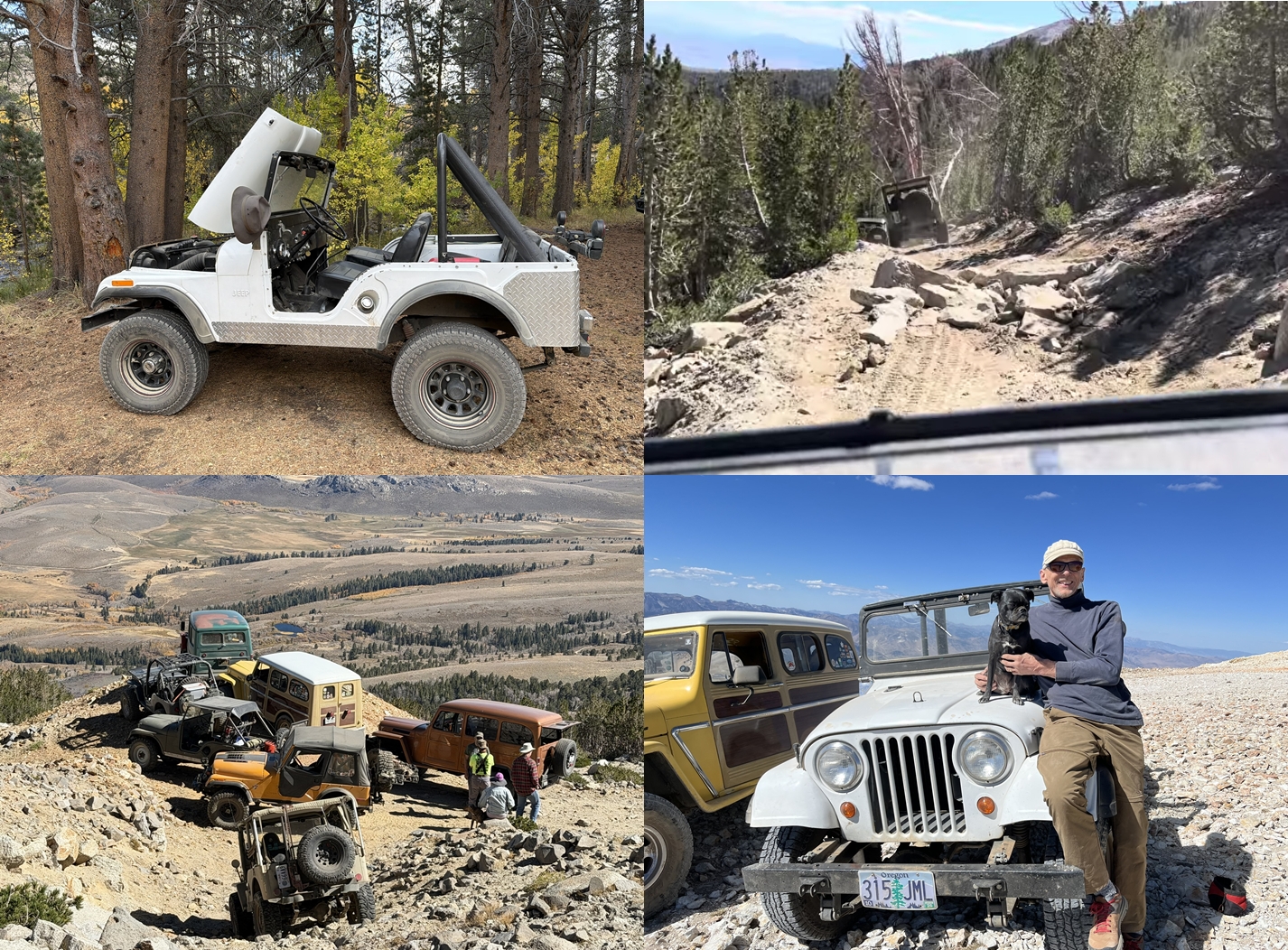
My week of Jeeping in the high Eastern Sierra with other Old Willys Forum members was absolutely splendid; I will treasure the memories of superb scenery, challenging rocks, steep climbs and new friendships made. But there were a couple of lows, both of which were failures of plastic engine parts, one on my van and one on the Jeep, an aftermarket accessory part as there’s no original plastic engine parts on a Willys Hurricane four.
That van issue almost kept me from getting to the event and the Jeep issue kept me from driving it on one of the days. But with a little help from my friends, both were fixed in camp and the Jeep took me to new heights, including to the summit of Mt. Patterson. And my Jeep wasn’t the only one that had mechanical issues.
Part 1, Buying and preparing my new Jeep is here.
Saturday, October 3
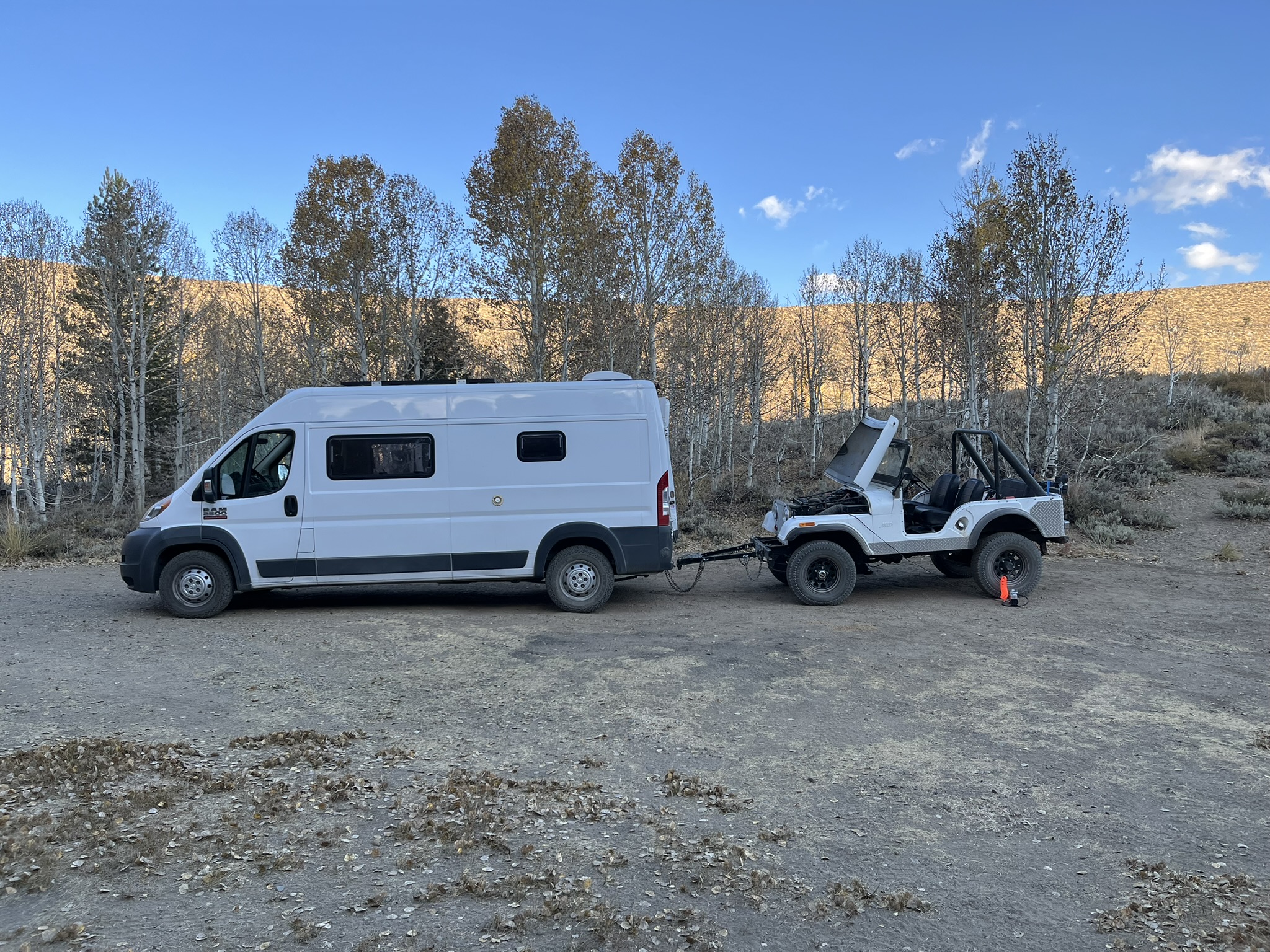
I had a long drive, some 550 miles to the Green Creek area above Bridgeport, CA. flat-towing the Jeep behind my 2017 Ram Promaster van. There’s a number of grades along the way, which consisted almost totally of two lane highways in mostly remote areas. The Jeep made itself felt behind the van, with its Pentastar 3.6 V6, especially on some of the steeper and longer grades. But it was cool and I was surprised to hear both electric cooling fans kick sooner and for longer than I would expect. Hmm.
Then coming up a grade outside of Reno, NV, a warning on the dash “Rapid High Coolant Temperature Increase” (or something like that) appeared along with the red warning light and the gauge pointing skyward. That’s never happened before. It was near the crest of the grade so I assumed it was just…the grade and the weight of the Jeep. The temperature dropped rapidly as soon as I headed down. And it did that a second time. And the third time, not far from Bridgeport, it did it on a flat, so I pulled over on the shoulder, as denial was no longer a sufficient excuse to have done so sooner.
I popped the hood and the coolant reservoir was empty. I looked under the engine and saw a steady trickle of coolant. Yikes! I sure hope I didn’t warp a cylinder head, which happens all too easily on these modern aluminum engines. Fortunately I have a 30 gallon fresh water tank in the van, so I slaked its (prodigious) thirst and drove on to Bridgeport, where I jacked up the right front corner at a gas station in the now-dark, removed the (plastic) shroud under the engine and peered up at the source of the trickle: the thermostat housing. Why would that fail? (more on that later).
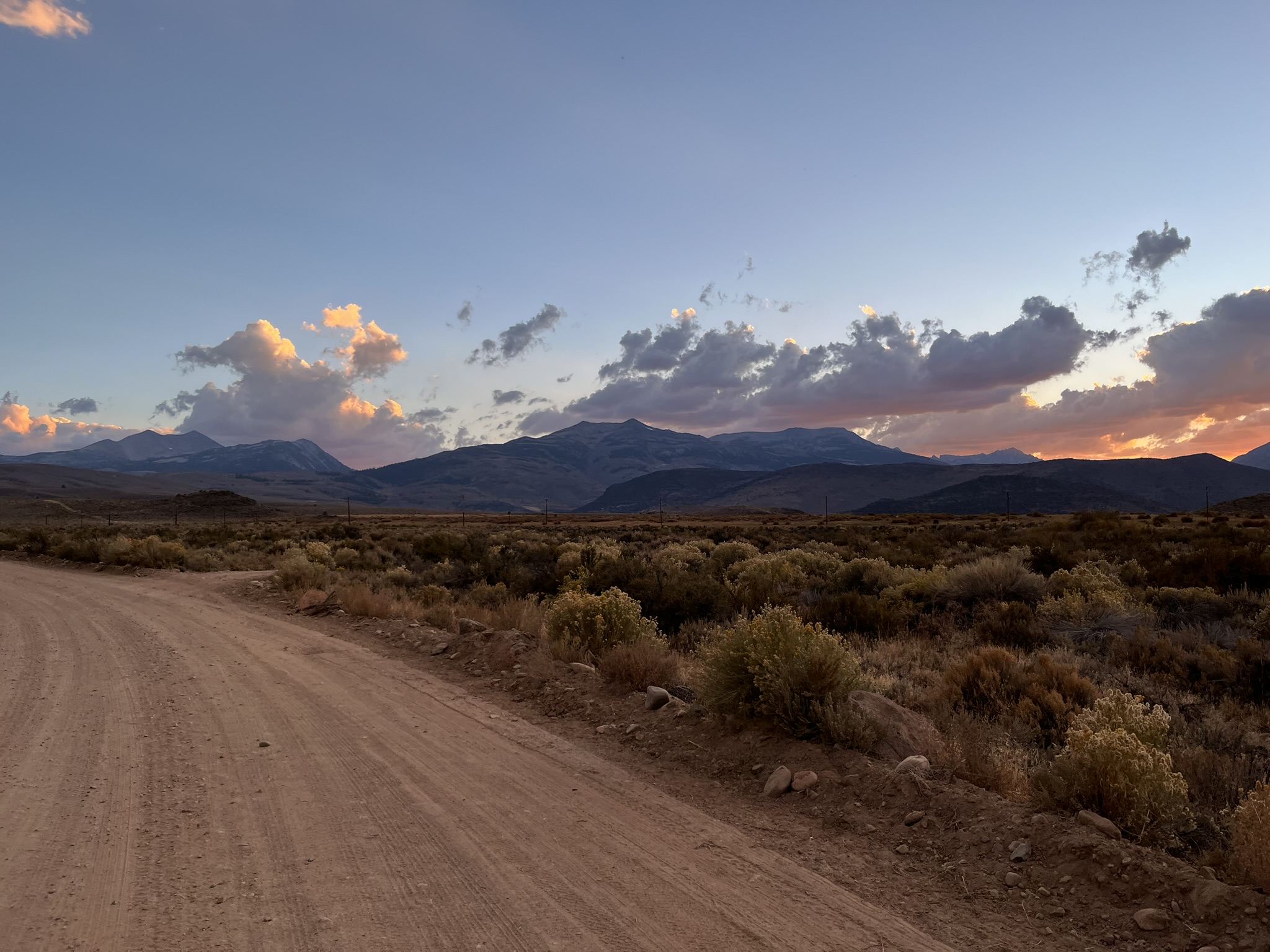
I filled ‘er up again and with fingers crossed, headed a few miles past Bridgeport and up the fairly steep and badly washboarded gravel road to where the campsites are. I had some 1500’ in elevation to gain and I was very nervous about it overheating again.
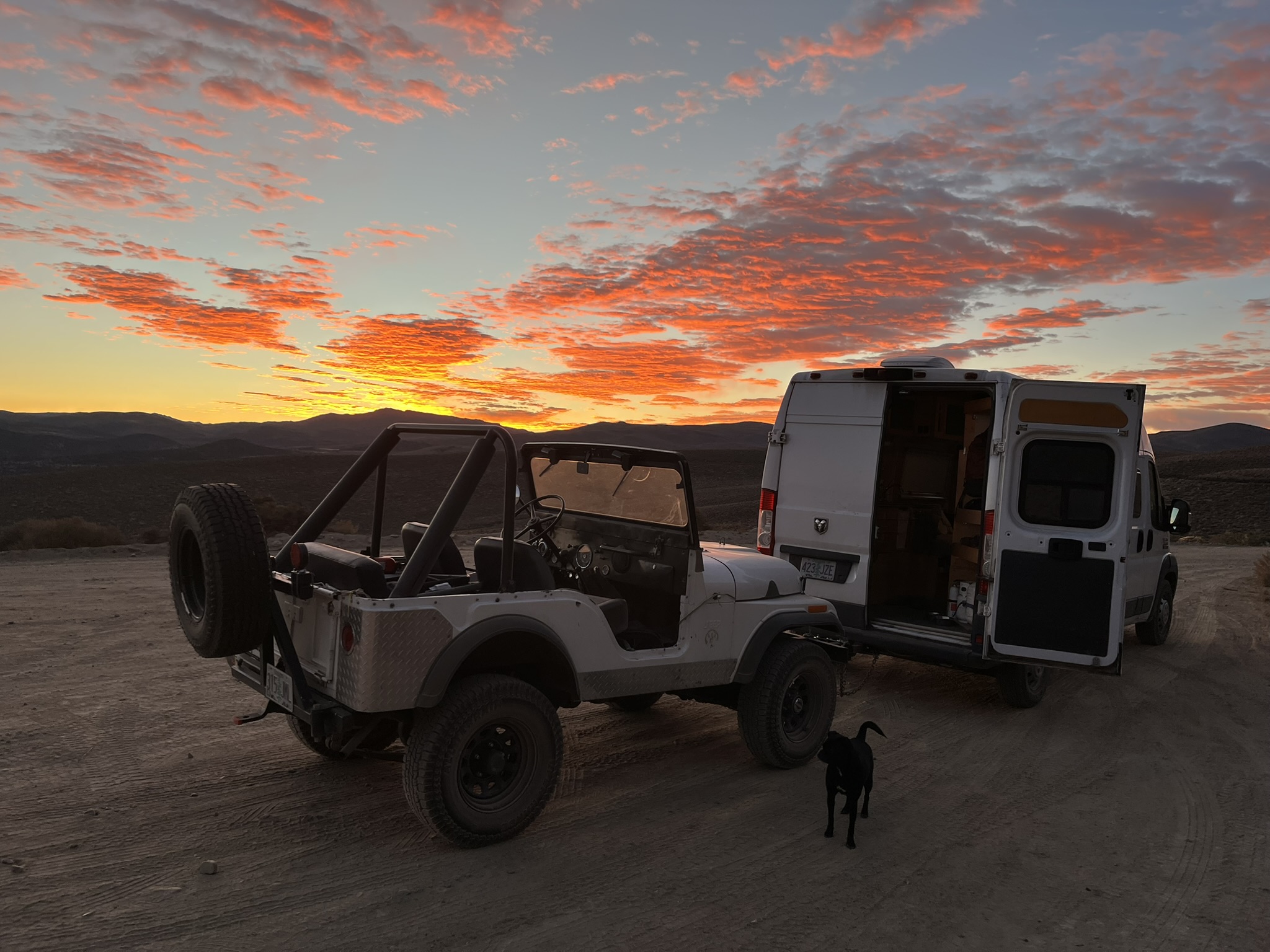
I was also nervous about pulling into one of the little spur roads that lead to the numerous dispersed primitive campsites and then needing to back out if it was occupied. So when I came to an intersection with a wide flat spot, I pulled over and called it a night. The next morning this colorful sunrise greeted Wanda and I as we tumbled out of the van.
Sunday, Oct. 4
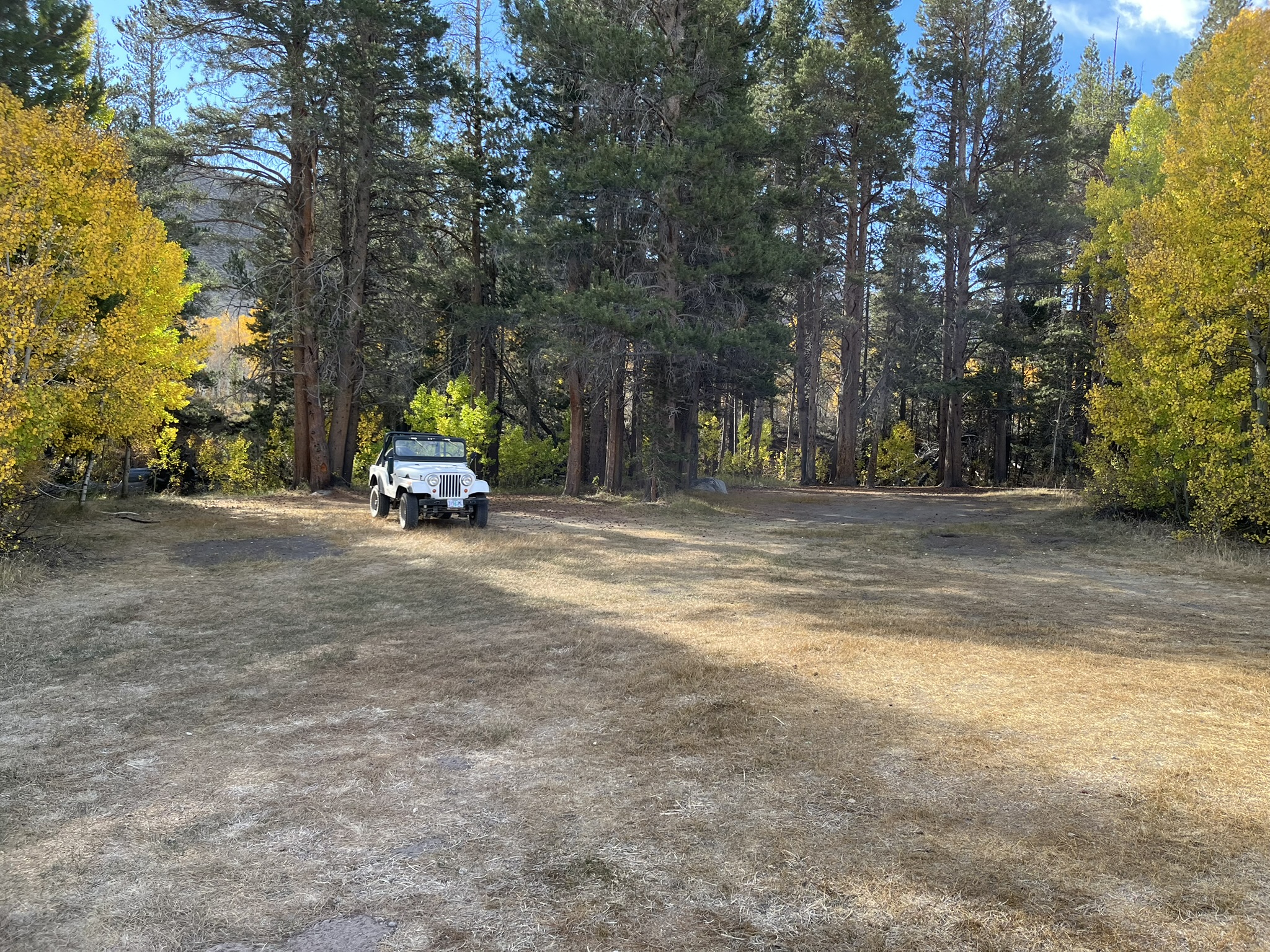
After breakfast I unhooked the Jeep and drove up the road a couple of miles scouting various campsites. When I came to this one, I knew it was it, as it was plenty big for the five of us in the group that had chosen to camp up here rather than stay in town. Wanda and I walked the 2.5 miles back to the van, filled up the water again, and drove it here to camp.
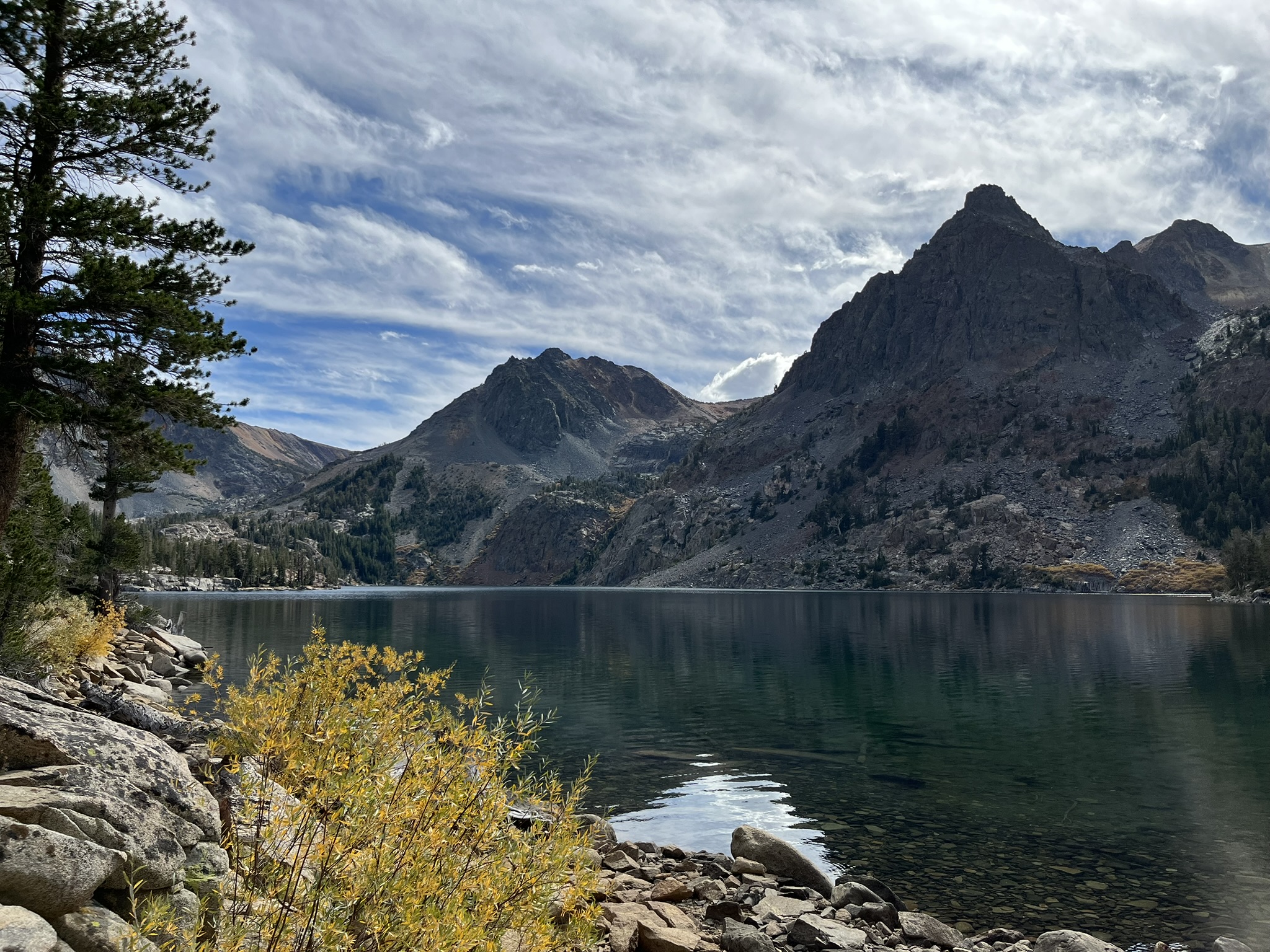
After lunch Wanda and I drove the Jeep up to the end of the road to the Green Lakes trailhead and campground and did a splendid 8-9 mile hike up to Green and East Lake (above) in the Hoover National Wilderness. I had hoped to get up to Summit Lake and Summit Pass, and look down into Yosemite NP, but the late start made that unfeasible.
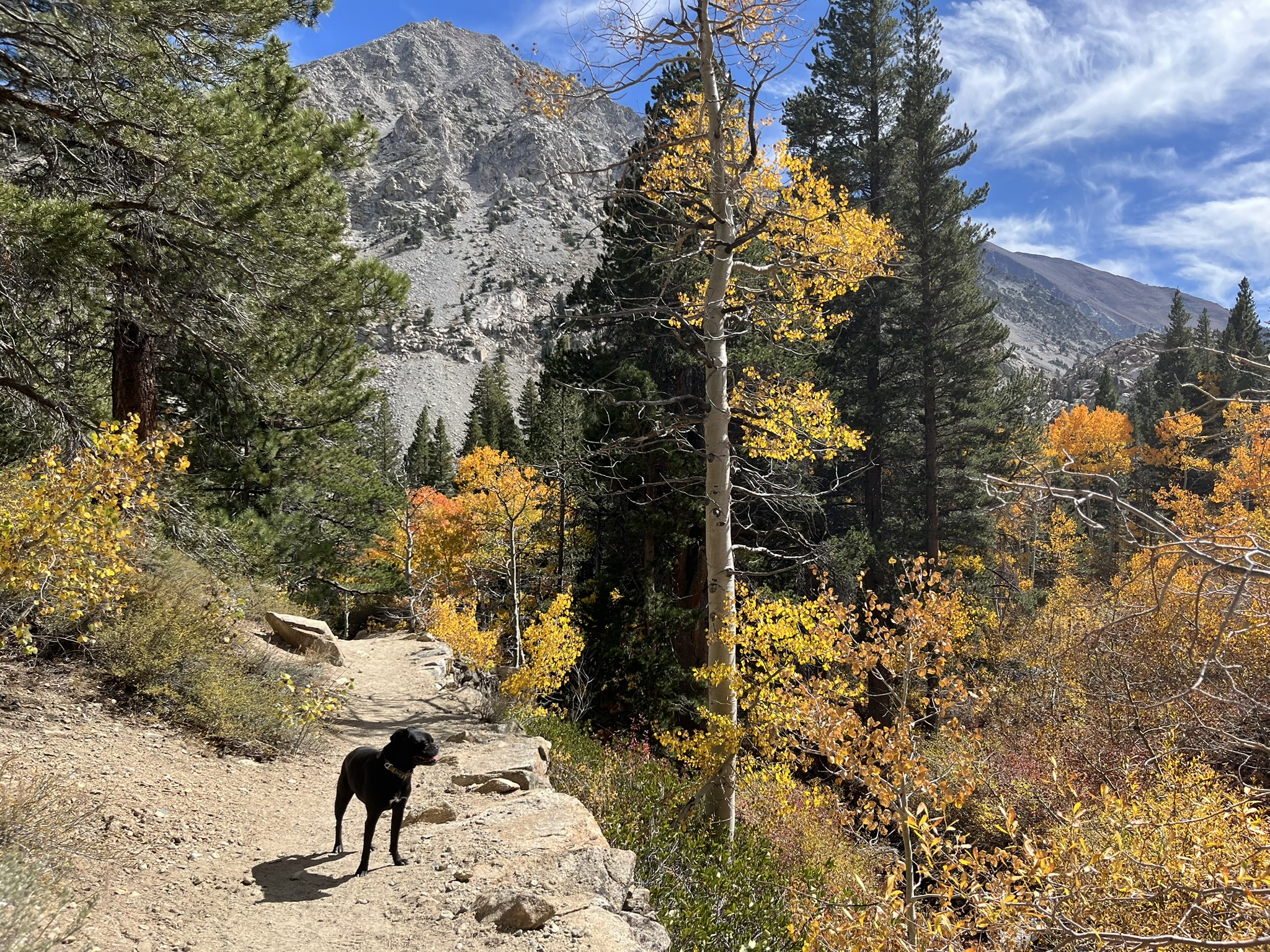
It would be the last chance to really stretch our legs for a while. Yes, the fall colors (mostly aspens) were in full glory.
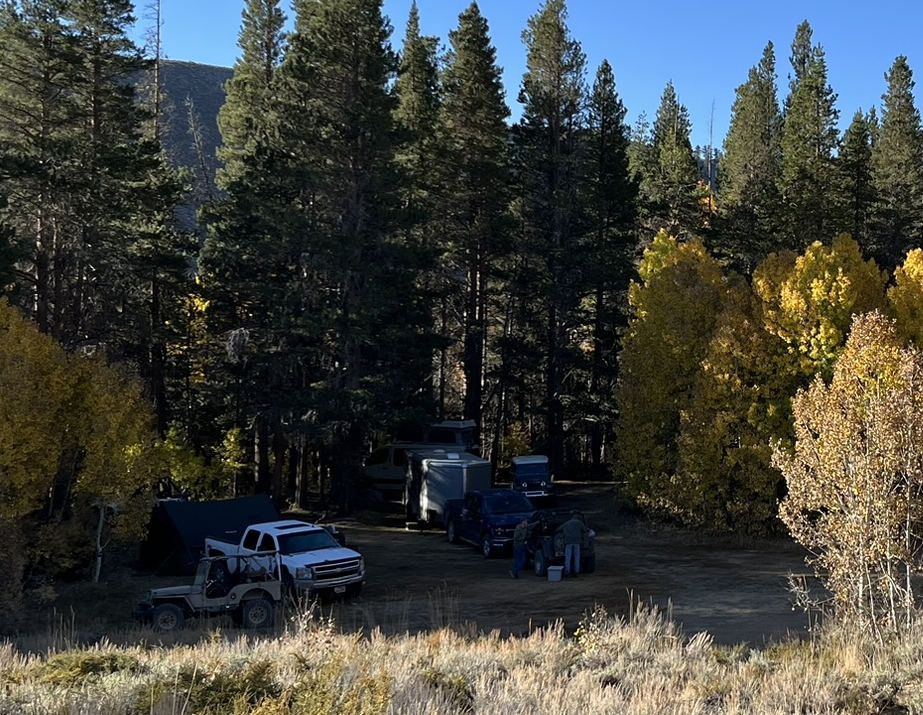
Later on Sunday, the other three camping participants showed; my friend Alan from Port Orford with his heavily-modified Buick V6-powered flat fender, Richard, also with a heavily-modified flat fender (4.3 L Chevy V6 among other changes) and Bob, with his ’62 Willys wagon with a Chevy 350 V8 under the hood.
I jacked up the van again to confirm my earlier diagnosis, and found out that these Pentastar thermostat housings are plastic and…are pretty notorious for cracking and leaking. It’s not unlike that other infamous Pentastar plastic piece, the oil cooler/filter housing. CC’s Jim Klein wrote up the definitive non-video post (as per a Google search) on replacing that here.
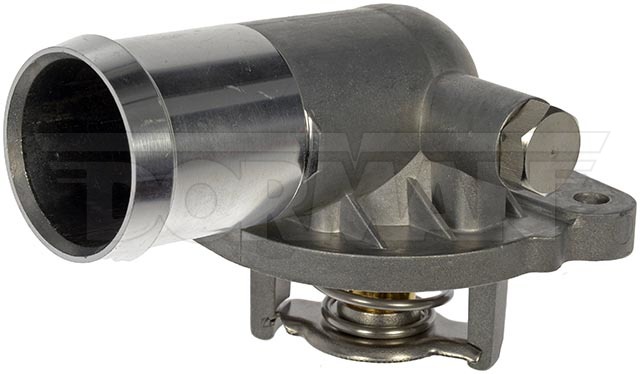
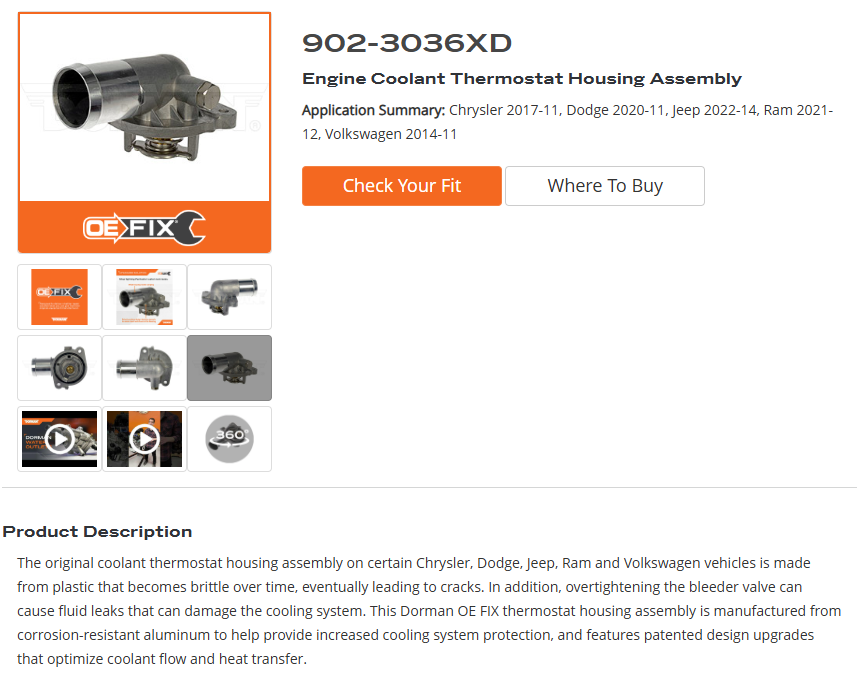
And just like with that oil filter housing, Dorman makes an all-metal replacement for the thermostat too. Dimitry (“dman”) was planning to join me on Monday to ride along, so he volunteered to pick one up along with some coolant.
Monday, Oct. 5
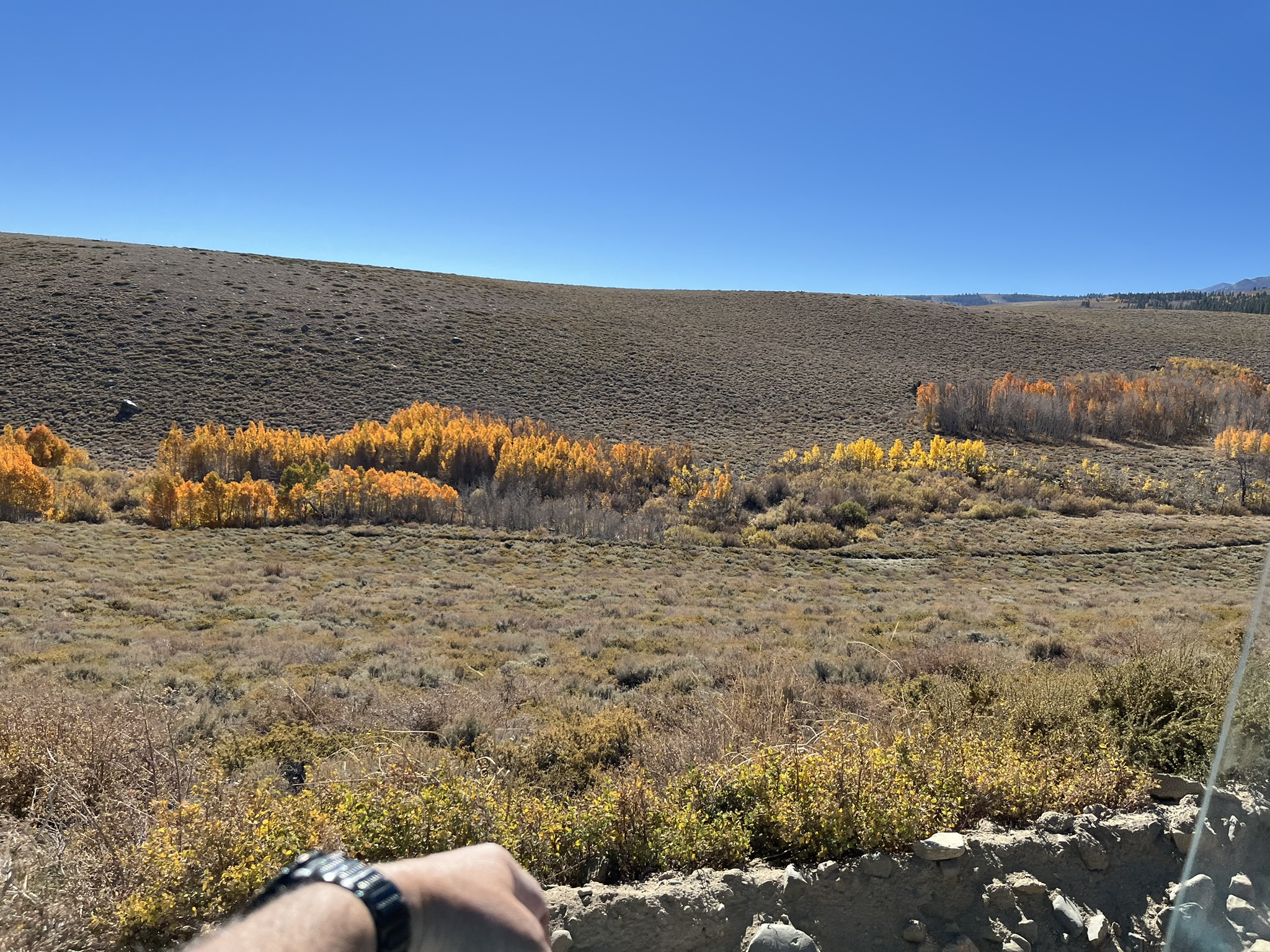
On Monday morning the three of us (Alan, Richard and I) decided to take our Jeeps out for a little shakedown trip up into the hills above Dunderberg Meadow Road. It was a perfect crisp fall morning as we headed up. We took some little tracks that branched off and had a great drive, including a few mildly challenging sections.
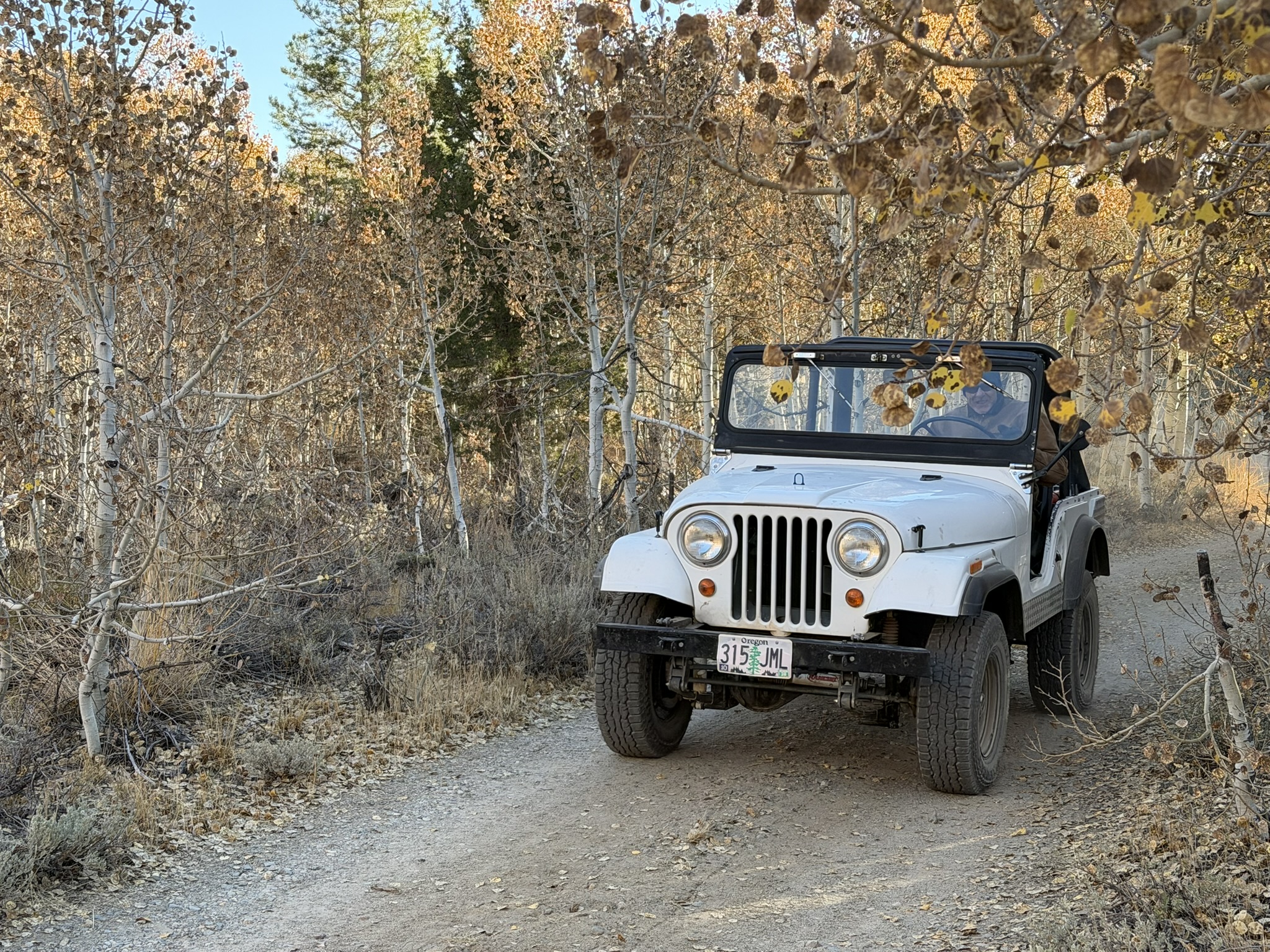
I was in bliss, what with the scenery and finally driving my Jeep up in the mountains. It purred along flawlessly and my confidence in managing the three longer group drives to come went up very substantially.
That afternoon Dimitry showed up with the part for the van and with a bit of help from Bob, we replaced the obnoxiously awkward-to-reach thermostat housing. Oddly, I could not see any signs of a crack in the old one, but it sure was leaking. The new one was tested and all was good. I was really stoked about the big drive up to Kavanagh Ridge the next morning.
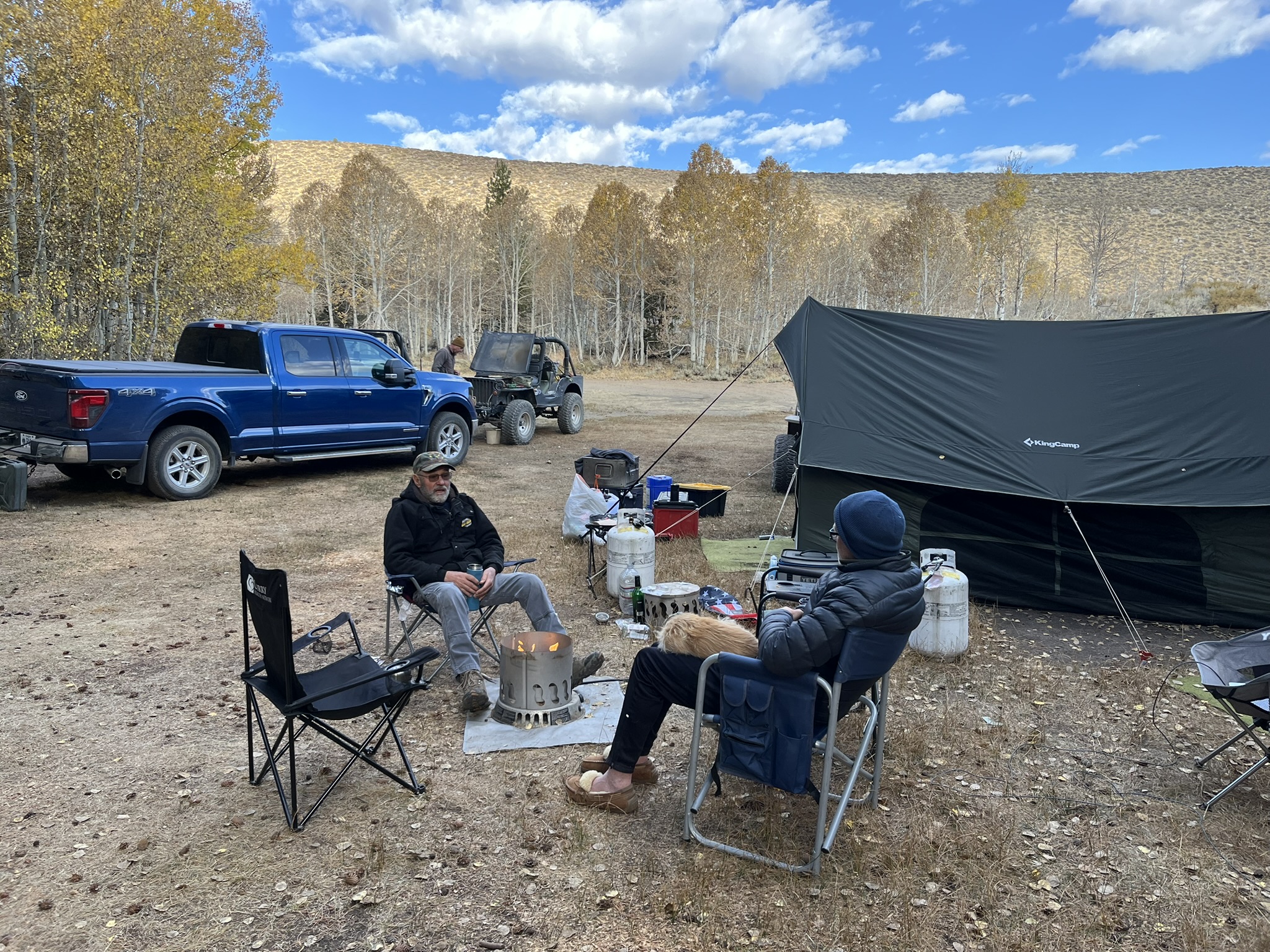
We spent the evening (and morning) hours around the propane “campfire” (real fires are not permitted) eating, chatting and imbibing from the collection of Rich’s most excellent Scotch.
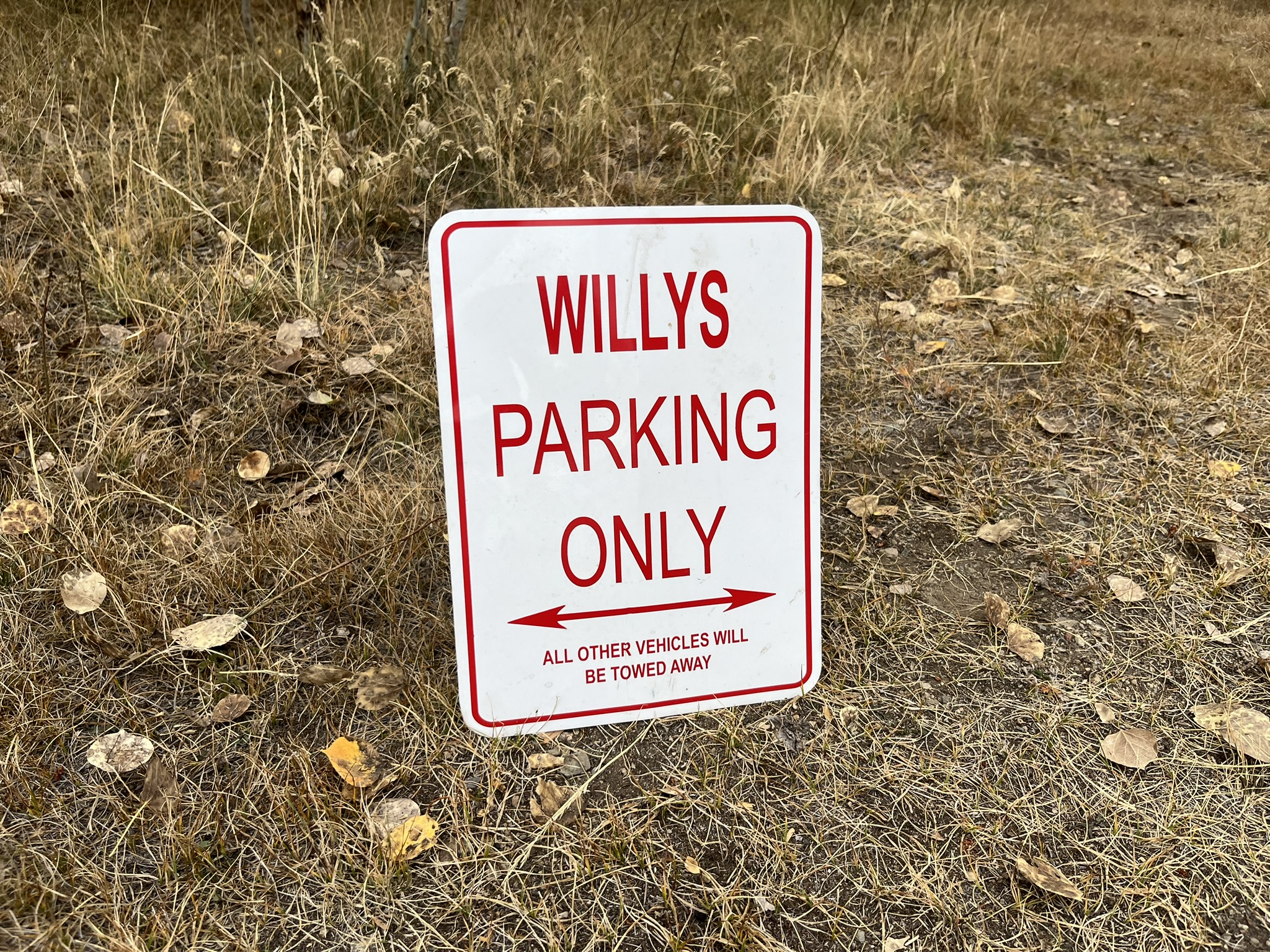
Tuesday, Oct. 5: Kavanaugh Ridge – Disaster or Divine Intervention?
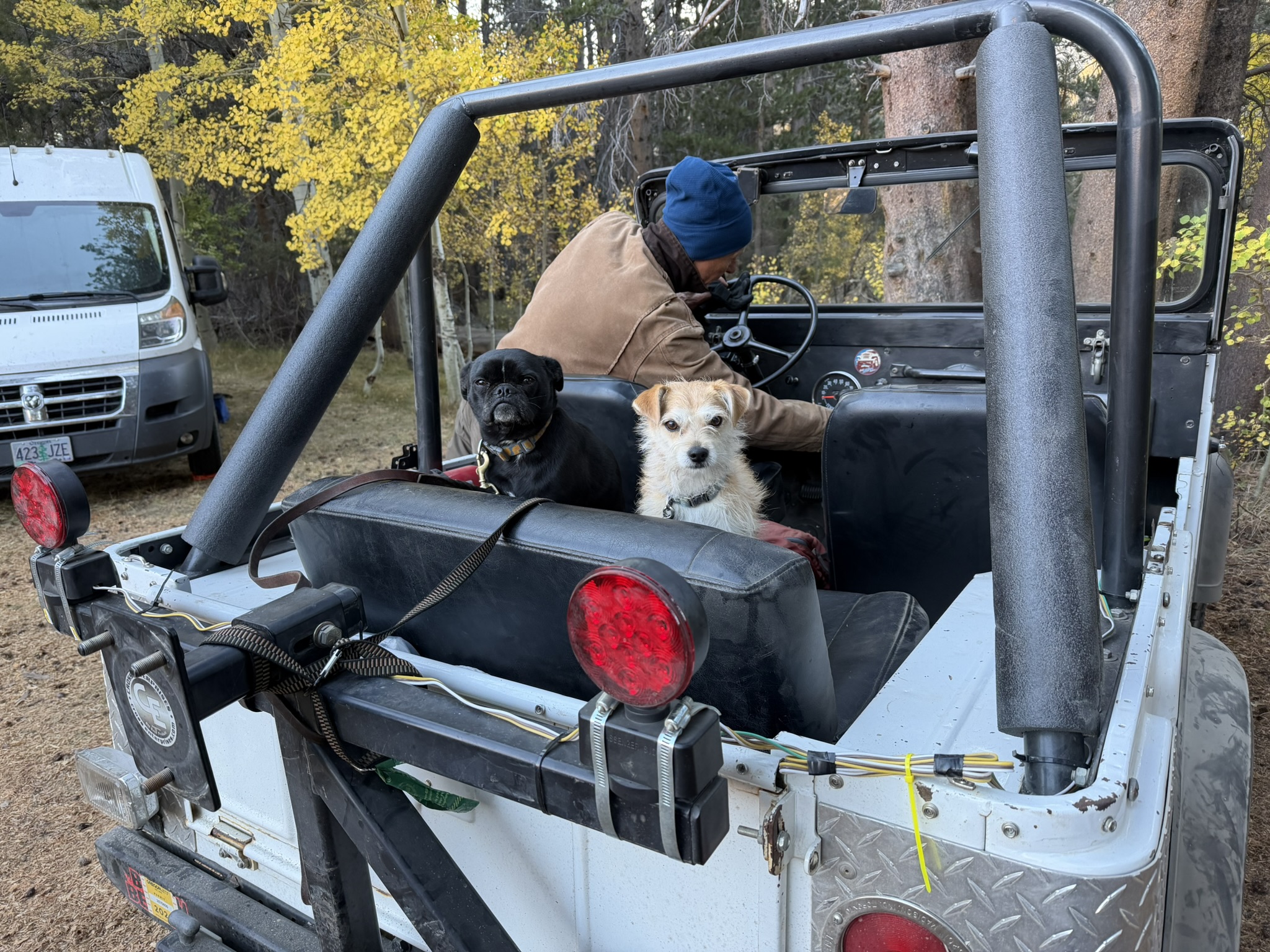
I woke very early, excited to hit the trails up to Kavanaugh Ridge. We were supposed to meet the other participants at that road junction where I spent the first night at 8:30 AM. I packed my lunch and strapped the dogs in the back seat (that’s Dimitry’s dog Riley with Wanda), started ‘er up to warm it up, and then turned it around and drove about 20 or 30 yards to where Dimitry was camped. Bob was there too, and he pointed to under my Jeep and said: Uh-oh. You’re leaking oil!
I turned off the engine, hopped out and saw a pretty good sized puddle of dino blood on the dirt road. What the?!? I pulled off into a little spur and slid under it to see where it was coming from: the oil pressure gauge sending unit for the aftermarket oil pressure gauge.
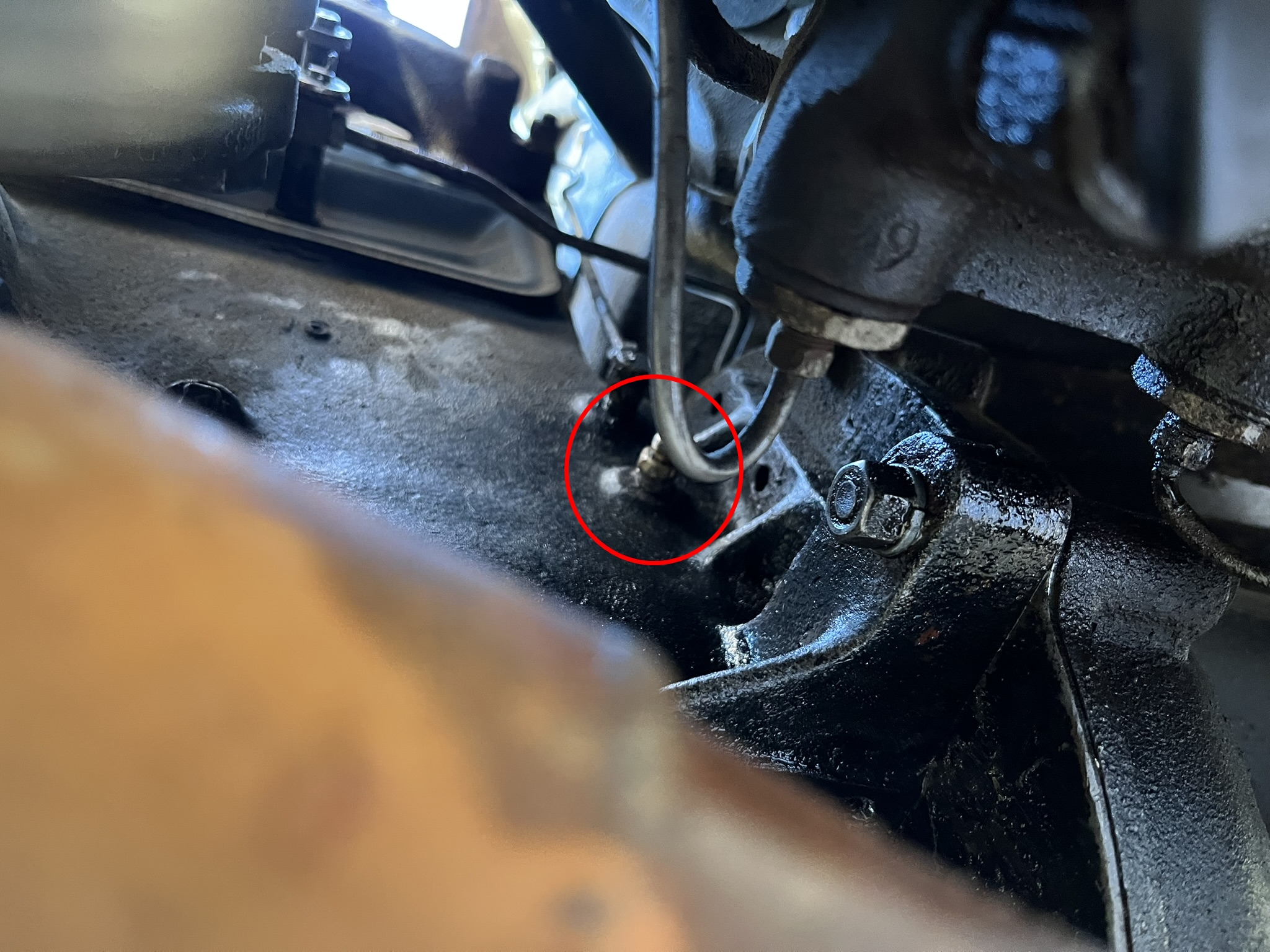
Or more specifically, from the 1/8″ nylon tubing that sends the oil to the gauge, which had been torn just past the compression coupling where it goes into the sending unit, down at the rear of the block and very close to both the steering gear and the exhaust pipe (the sending unit is behind the brake line in the red circle). The steering gear had obviously been rubbing against it at full lock since it was installed, and picked this very moment to finally break.
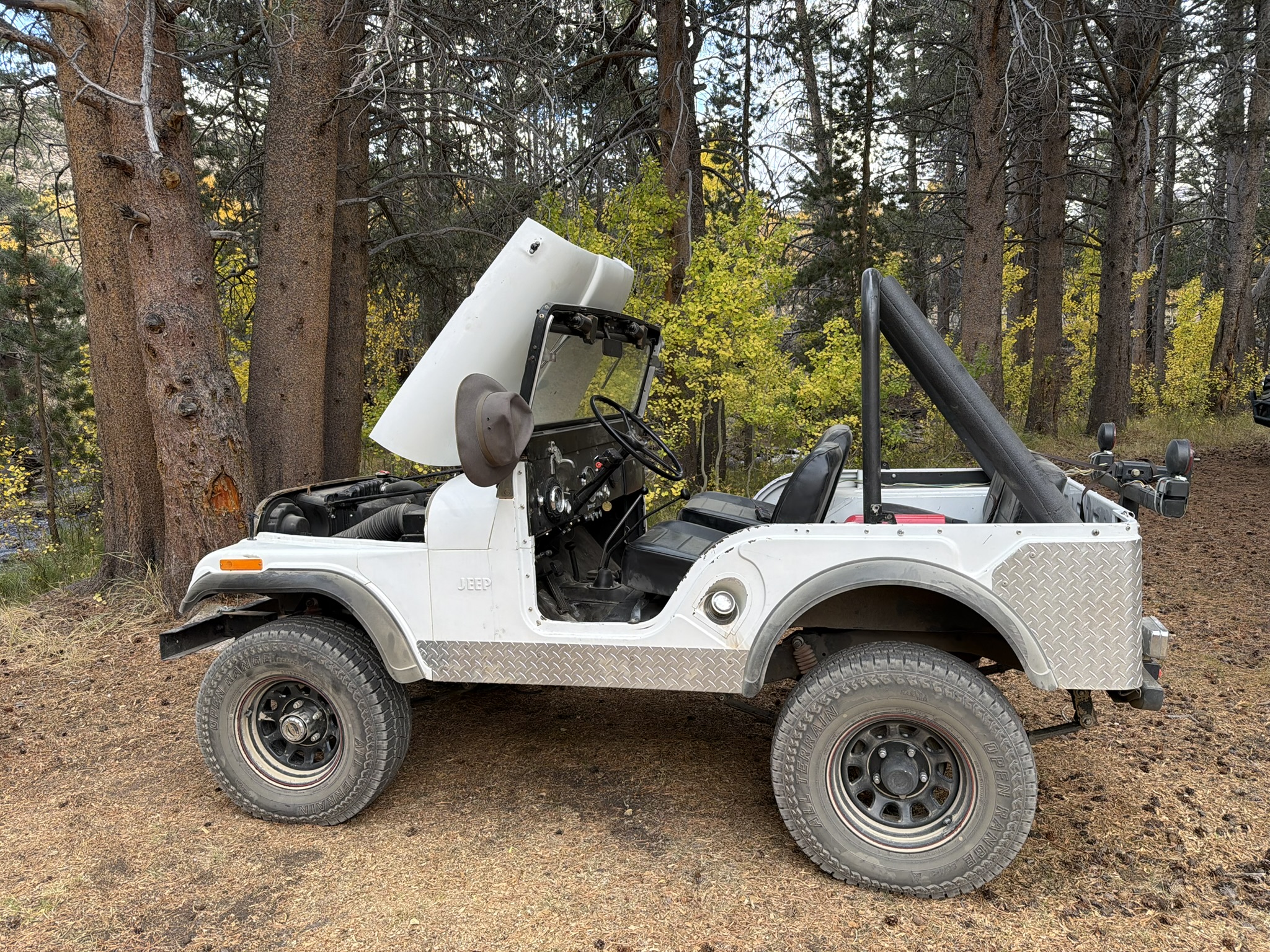
I was in an absolute tizzy; I couldn’t believe this was happening. I grabbed a wrench and started trying to undo it, without think of what I was actually going to do even if I could get it off. The open end wrench rounded off the soft brass edges, so that was a lost cause anyway, although I did manage to burn my hand pretty nastily on the hot exhaust pipe.
Everyone else had taken off for the meeting point. I was utterly distraught. I put a bandage on my hand and we drove in Dimitry’s Tacoma to the rendezvous point just in case they were late.
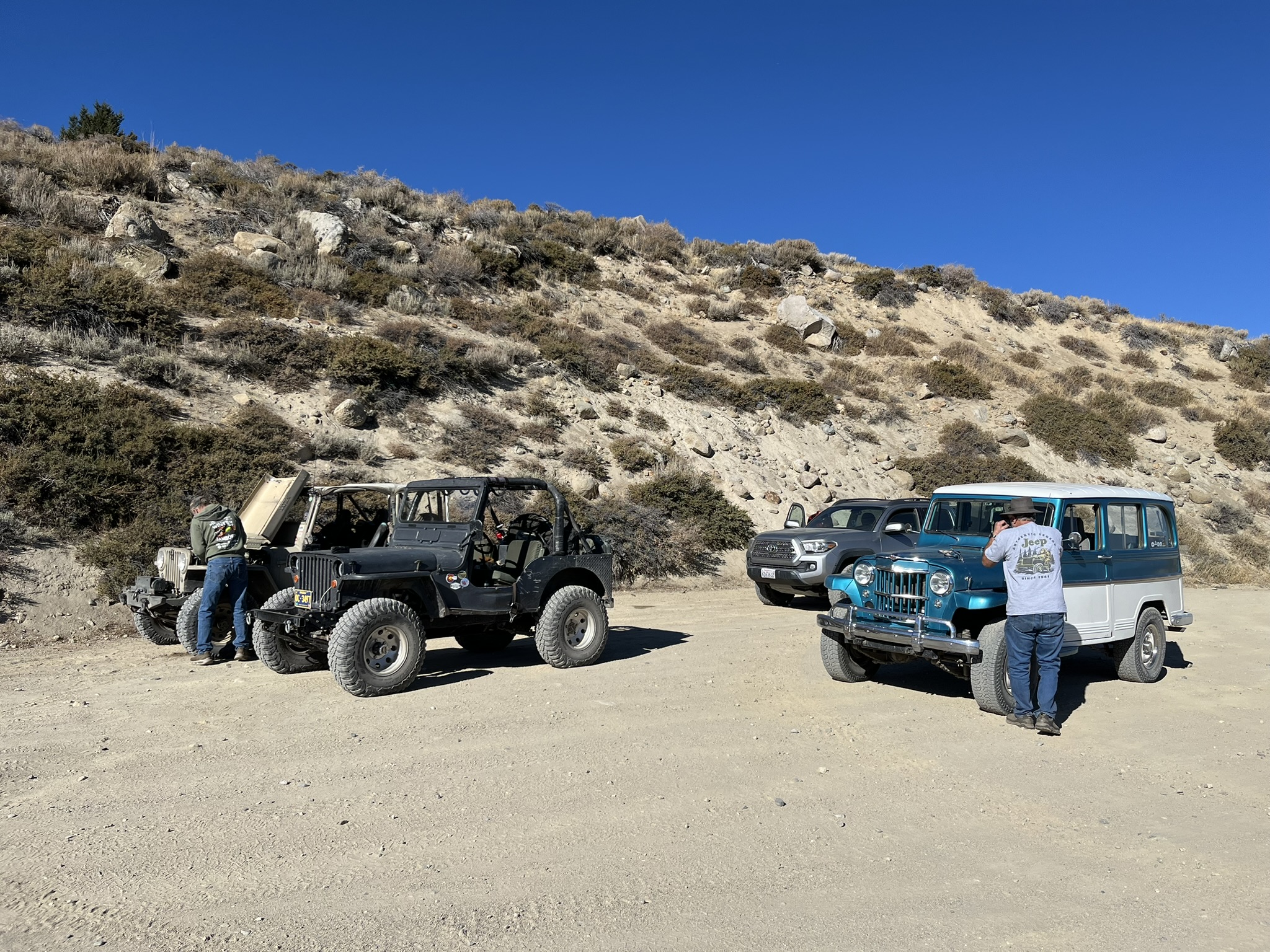
The others coming from town hadn’t even shown up yet, so at least I was going to be able to ride along. I hopped into Bob’s ’62 Willys Wagon as I have an affinity to them.
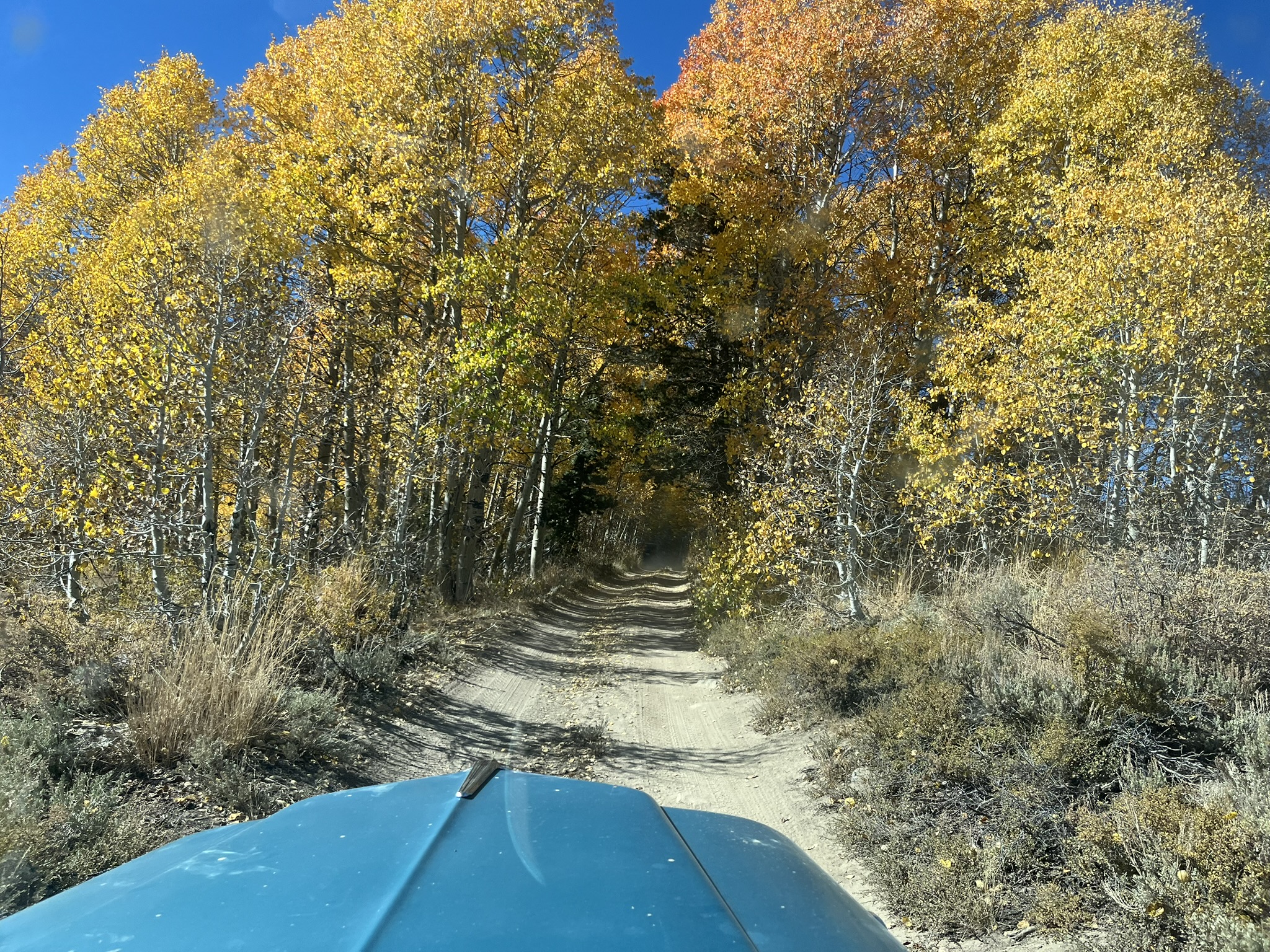
We headed up into the hills again, through more aspen glens.
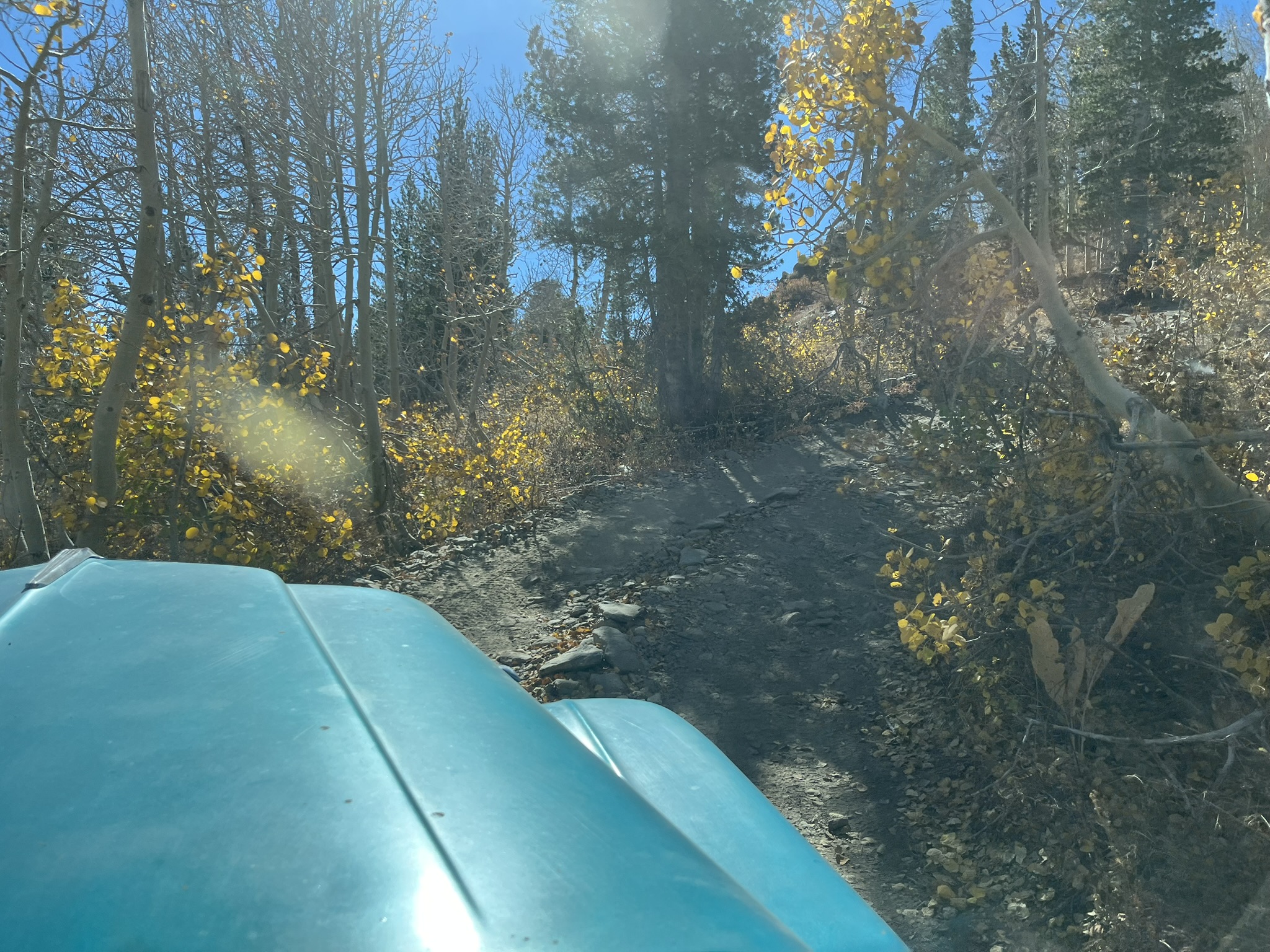
The road got steeper and the curves tighter. The Chevy V8 under the hood grumbled as Bob found the best line through the tight curves. This wagon originally had the OHC Toronado six that has been a bit of an obsession of mine, but there aren’t many still at work in these wagons.
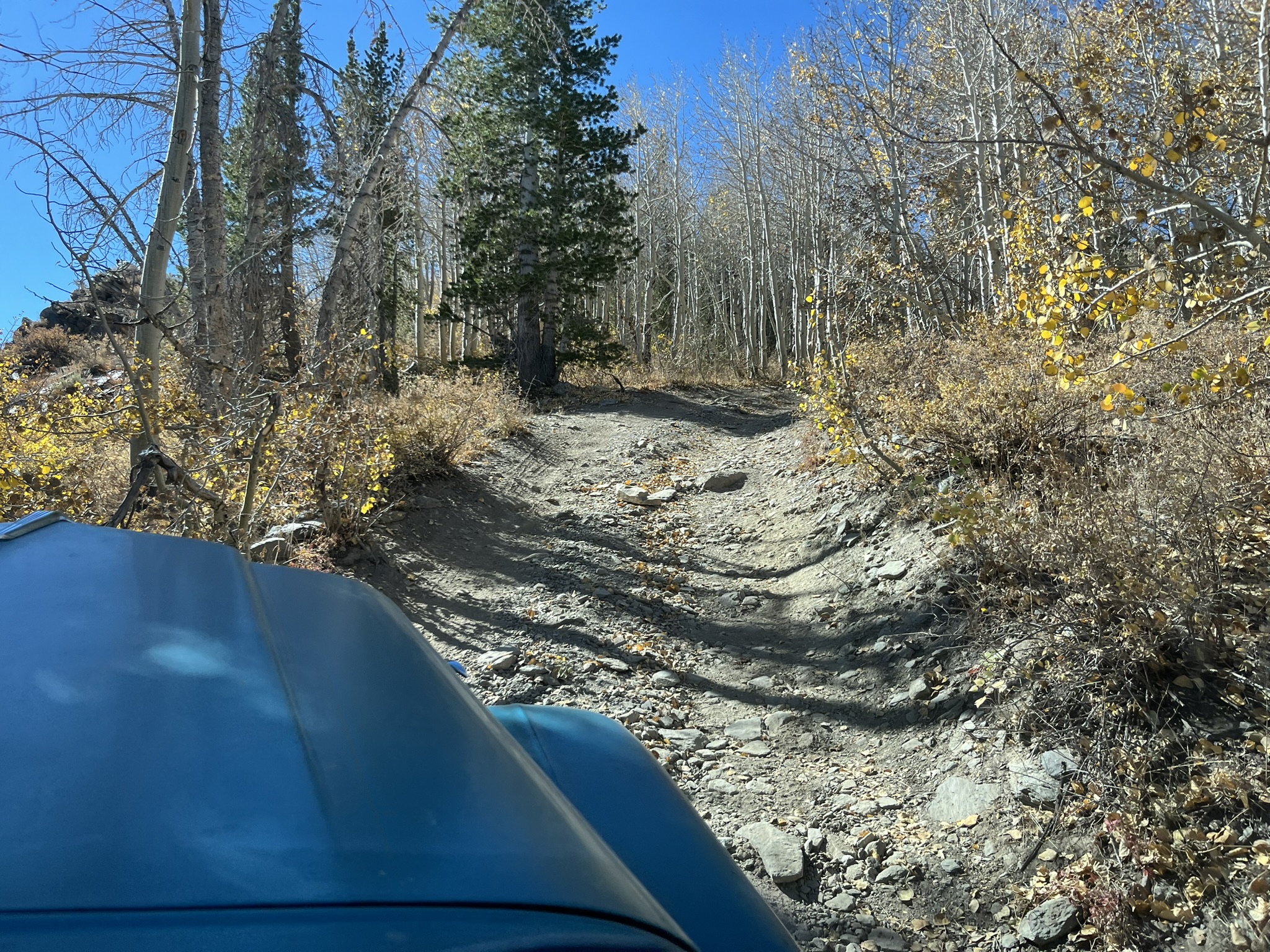
Many of the aspens had already shed their leaves as we got into higher elevations.
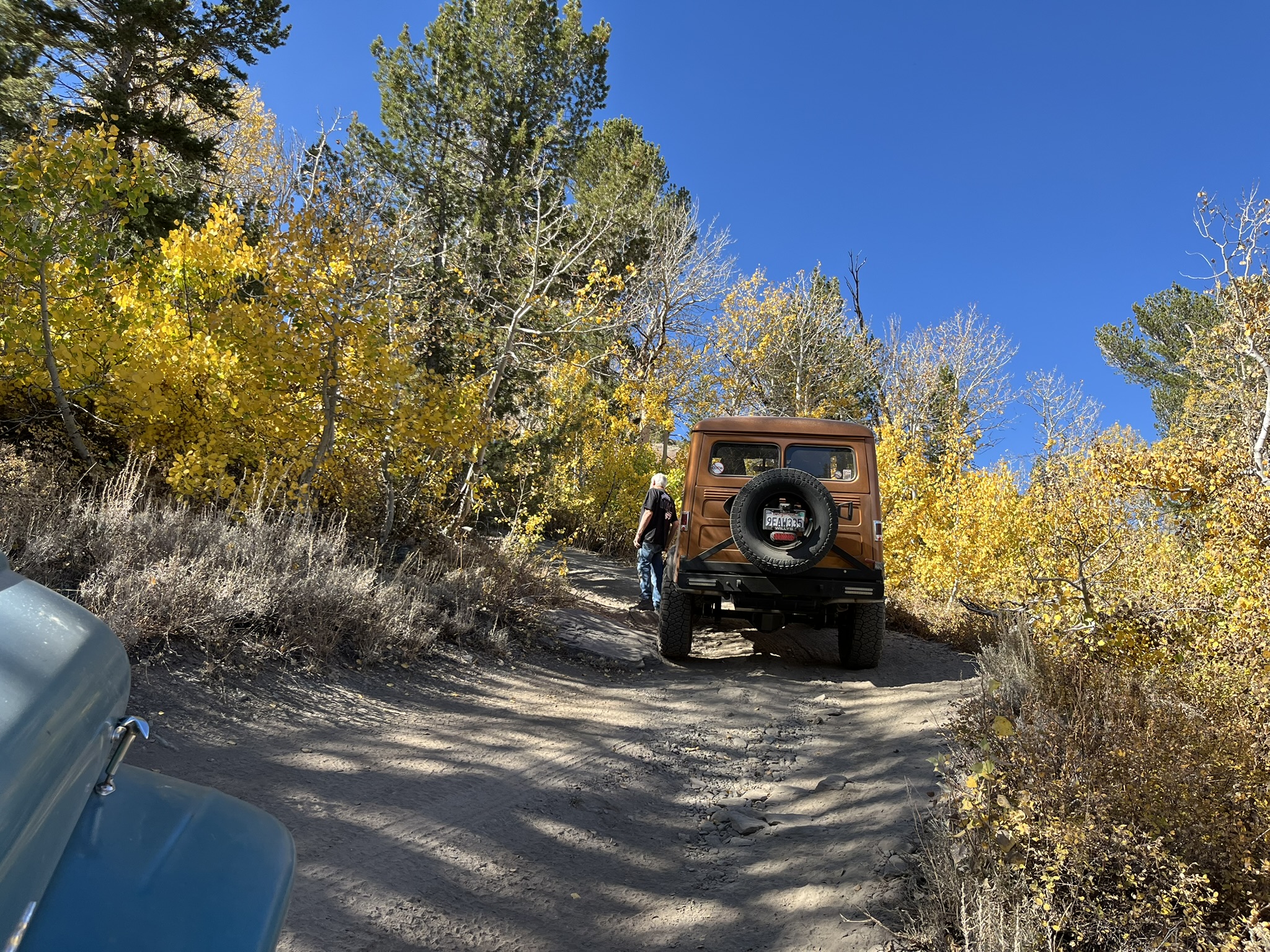
We had to stop while someone in a wagon further up had some difficulty managing one of those narrow steep tight curves between the trees.
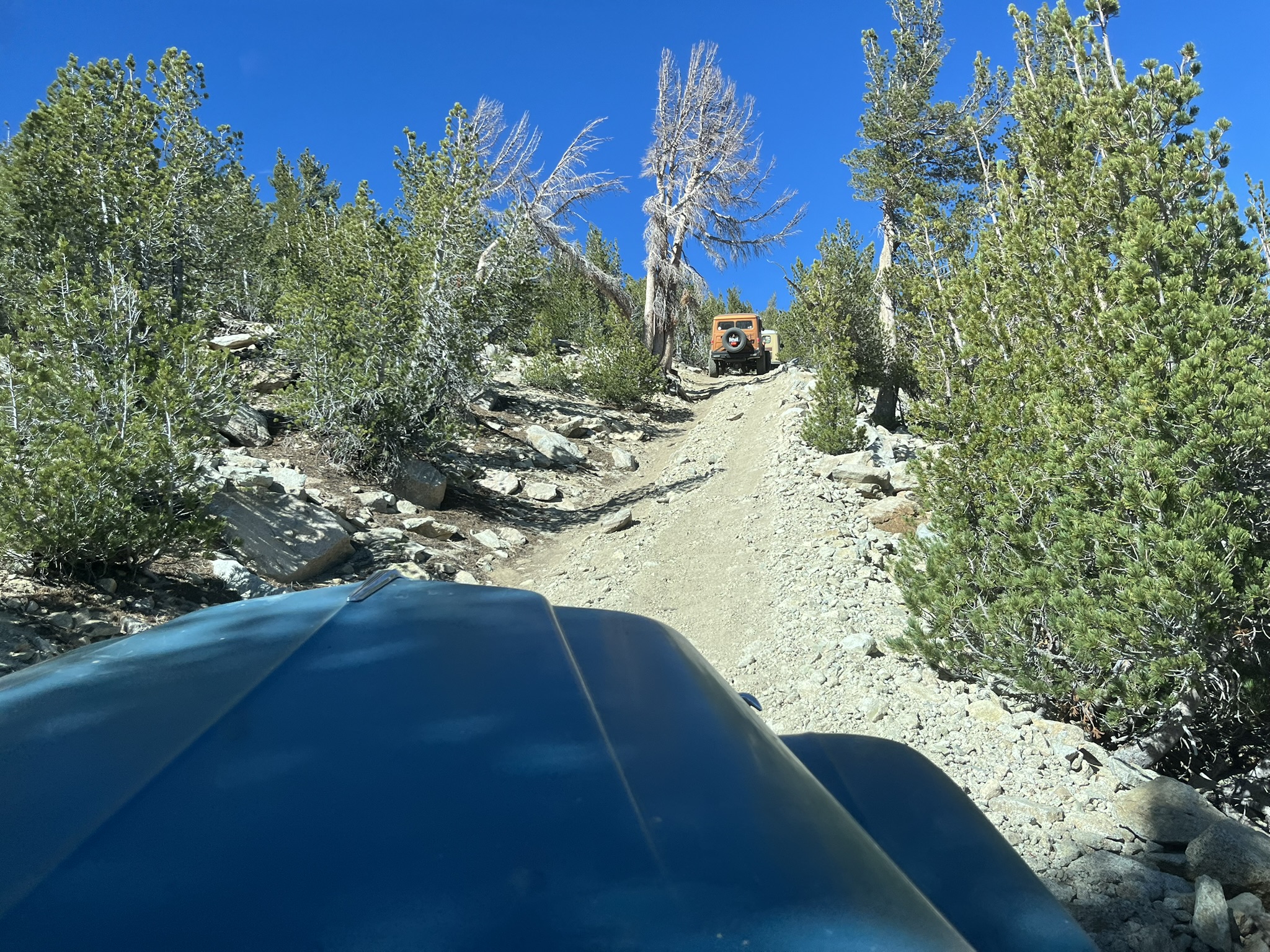
Somewhere along the route to Kavanaugh Ridge, our fearless leader Kurt decided to take a spur off to the right. This route, up to an old mine site, quickly became much more rocky, narrow and steep. iPhone photos never properly capture the steepness of the terrain ahead, due to their lenses.
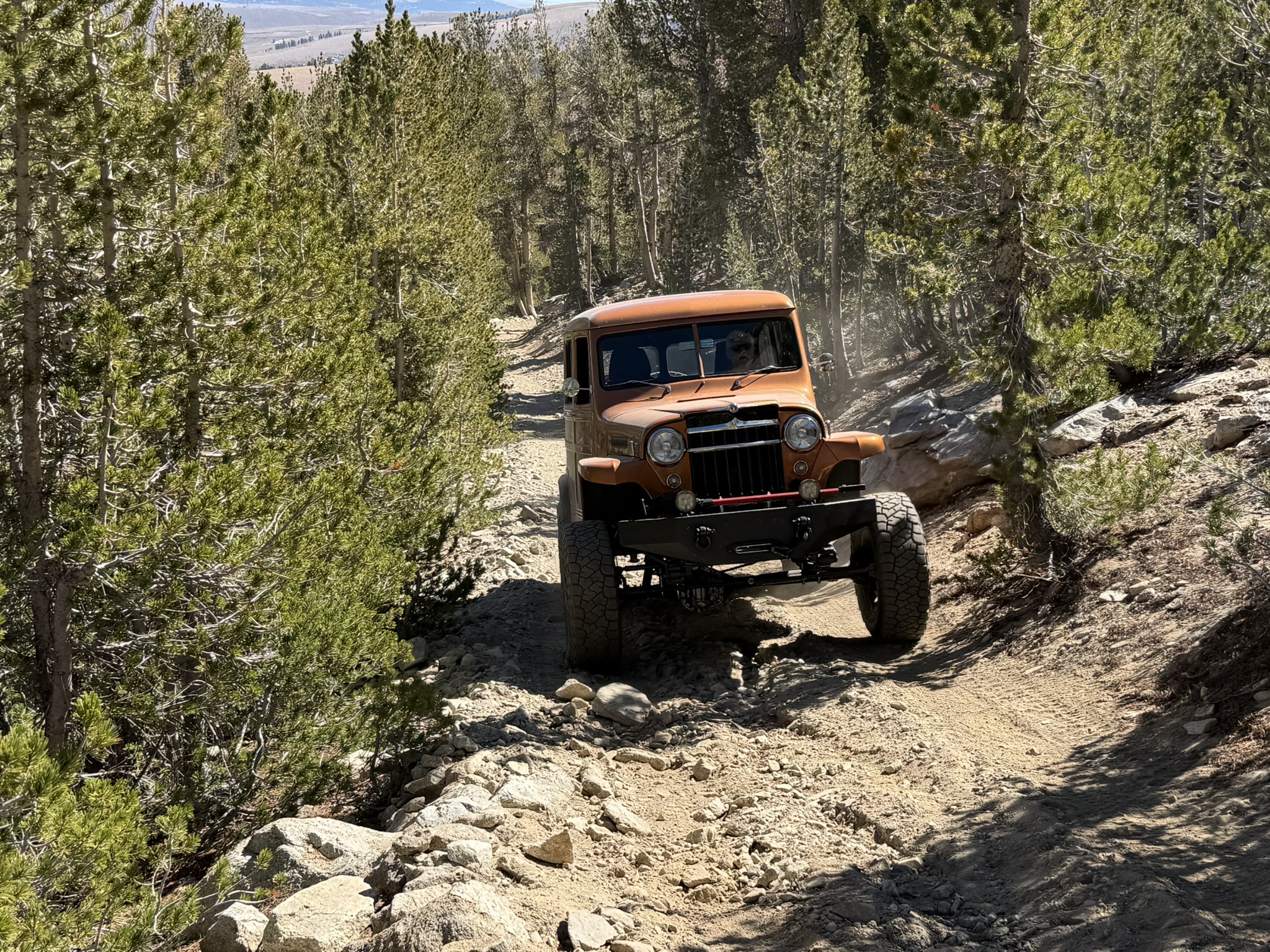
And the rocks became more frequent and bigger, although not so bad here. Also, the drop off on the valley side was very steep and far.
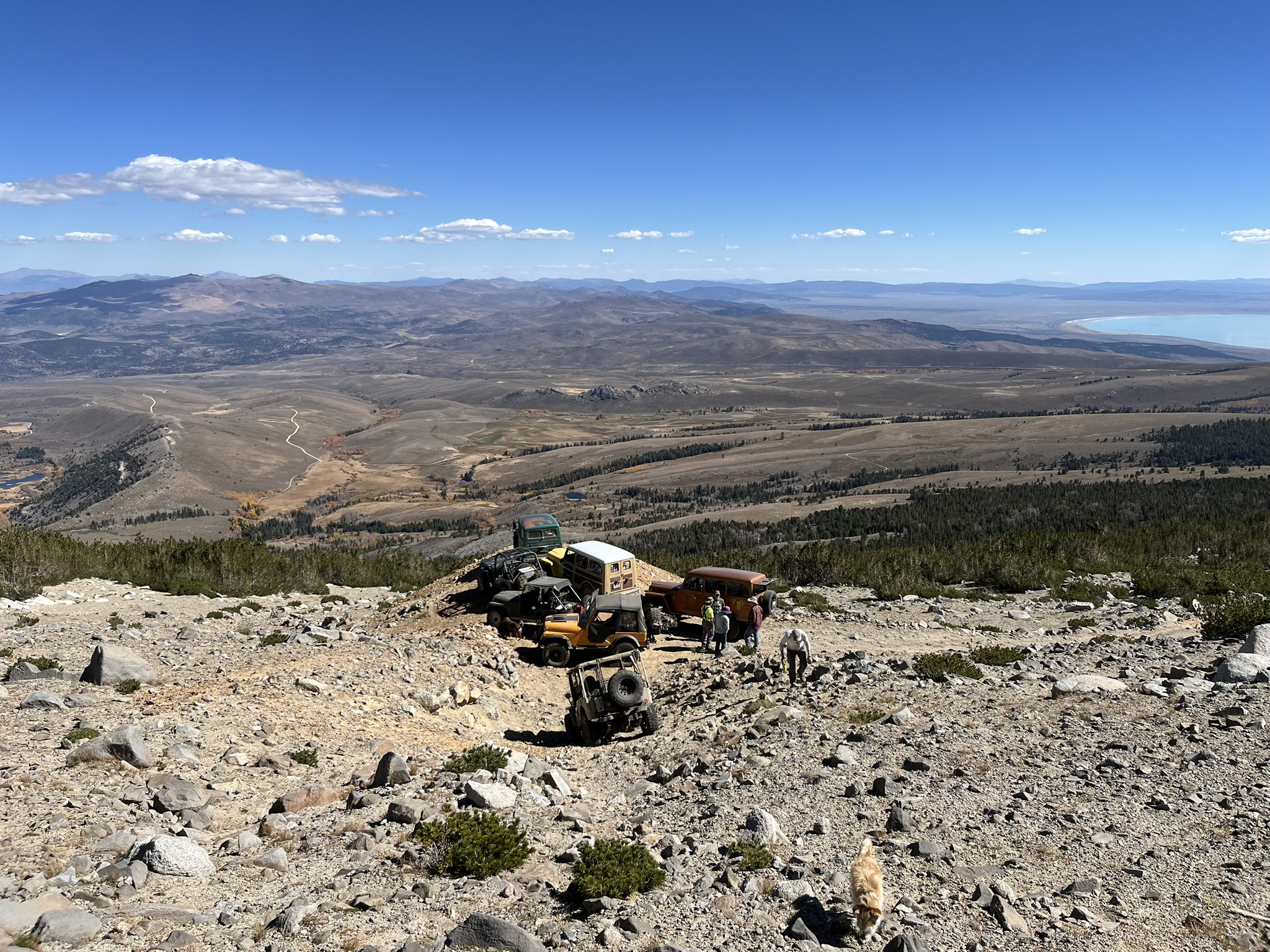
Bob decided to pull off a bit before the top, as he was having some issues with his steering (Pitman arm). The rest of us made up to the end, and managed to all park there.
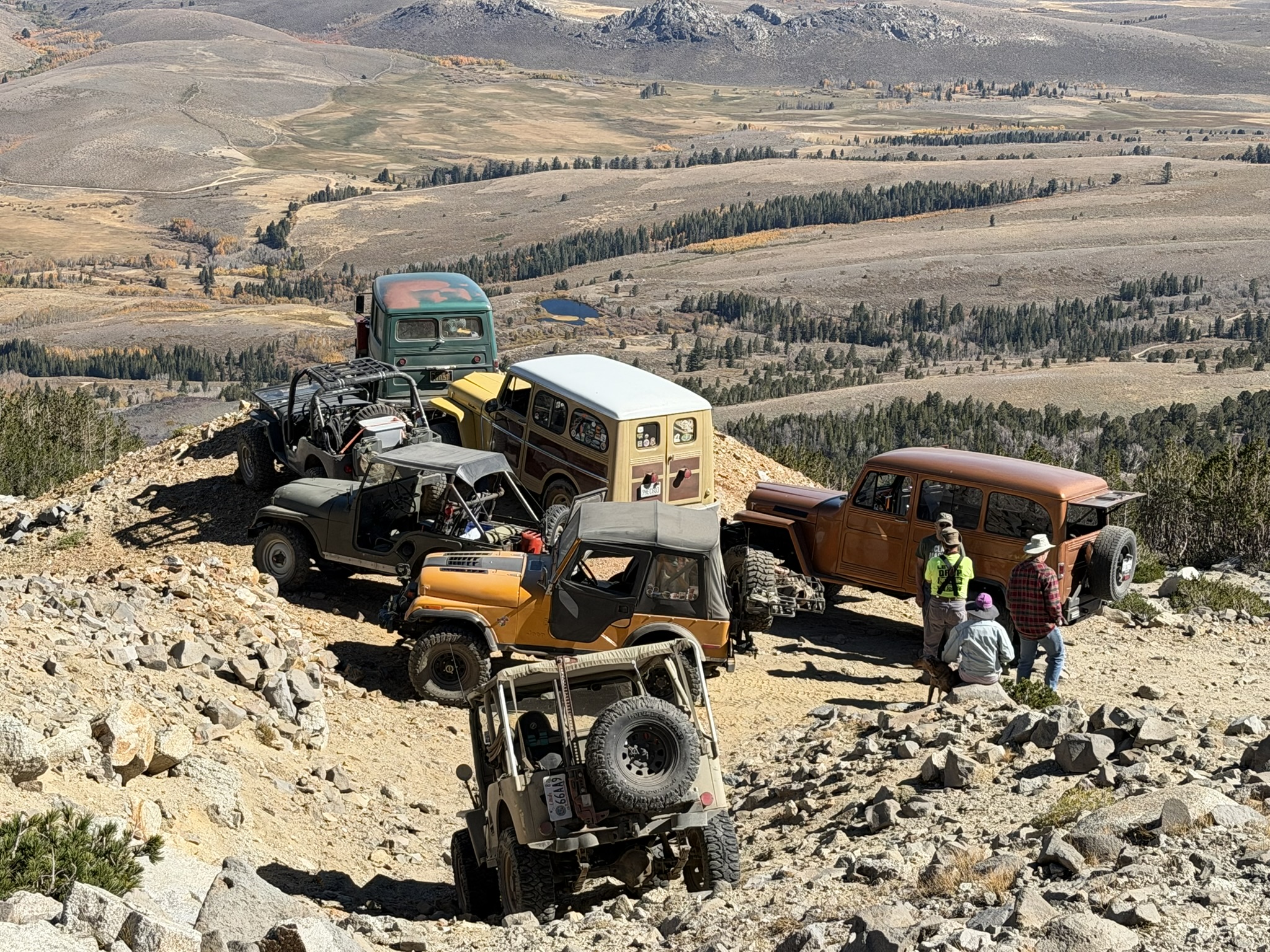
Here’s a closer range shot.
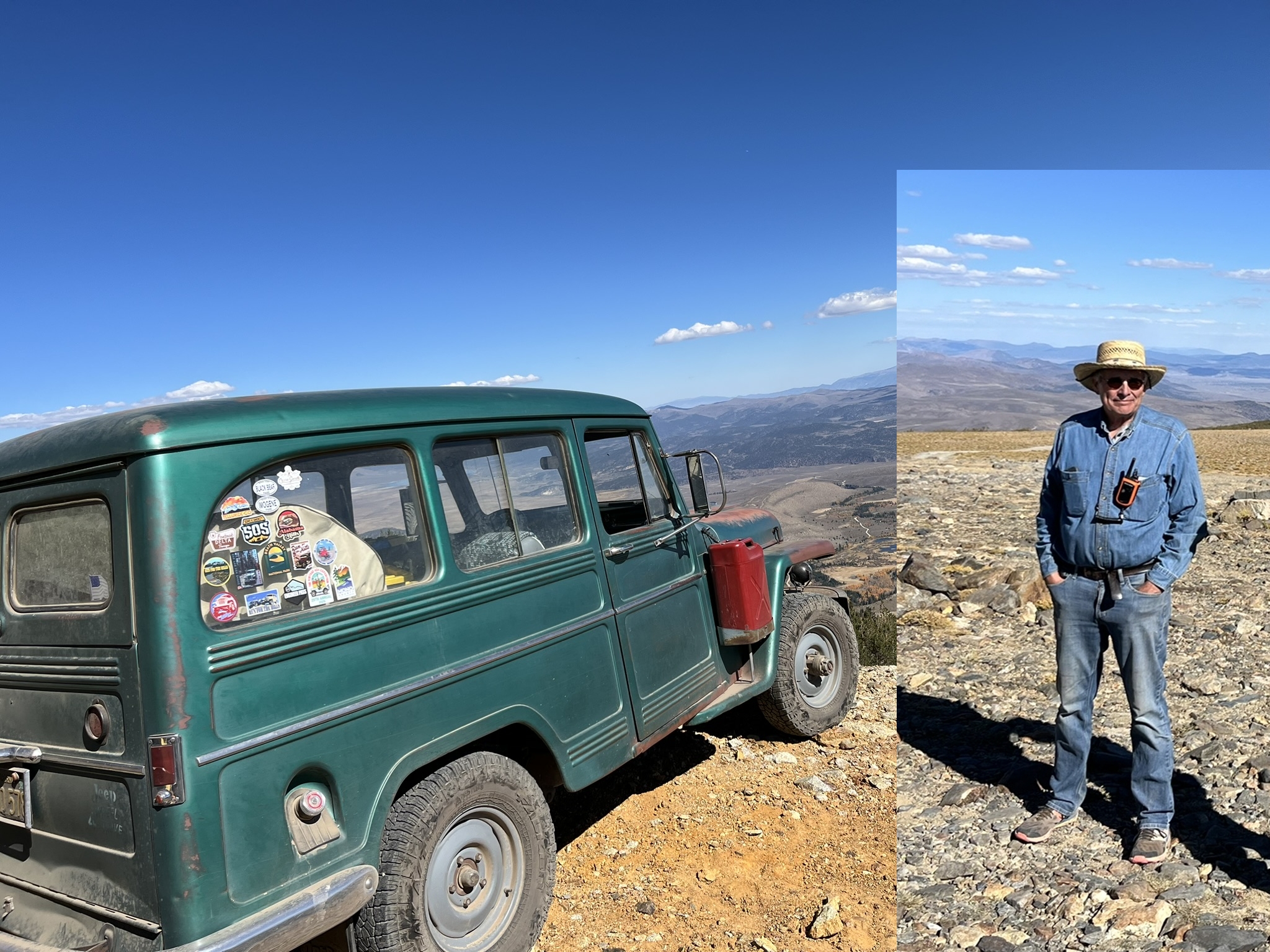
This is Kurt, who organized this whole trip, and his totally-stock 1957 Willys Wagon, with the venerable 226 “Super Hurricane” flathead six that he’s had for 34 years. Kurt is always utterly calm and collected, but he is known for his fearless (and superb) driving. That wagon is my favorite of the group by a healthy margin and I’d ride with (or follow, if I could) Kurt anywhere.
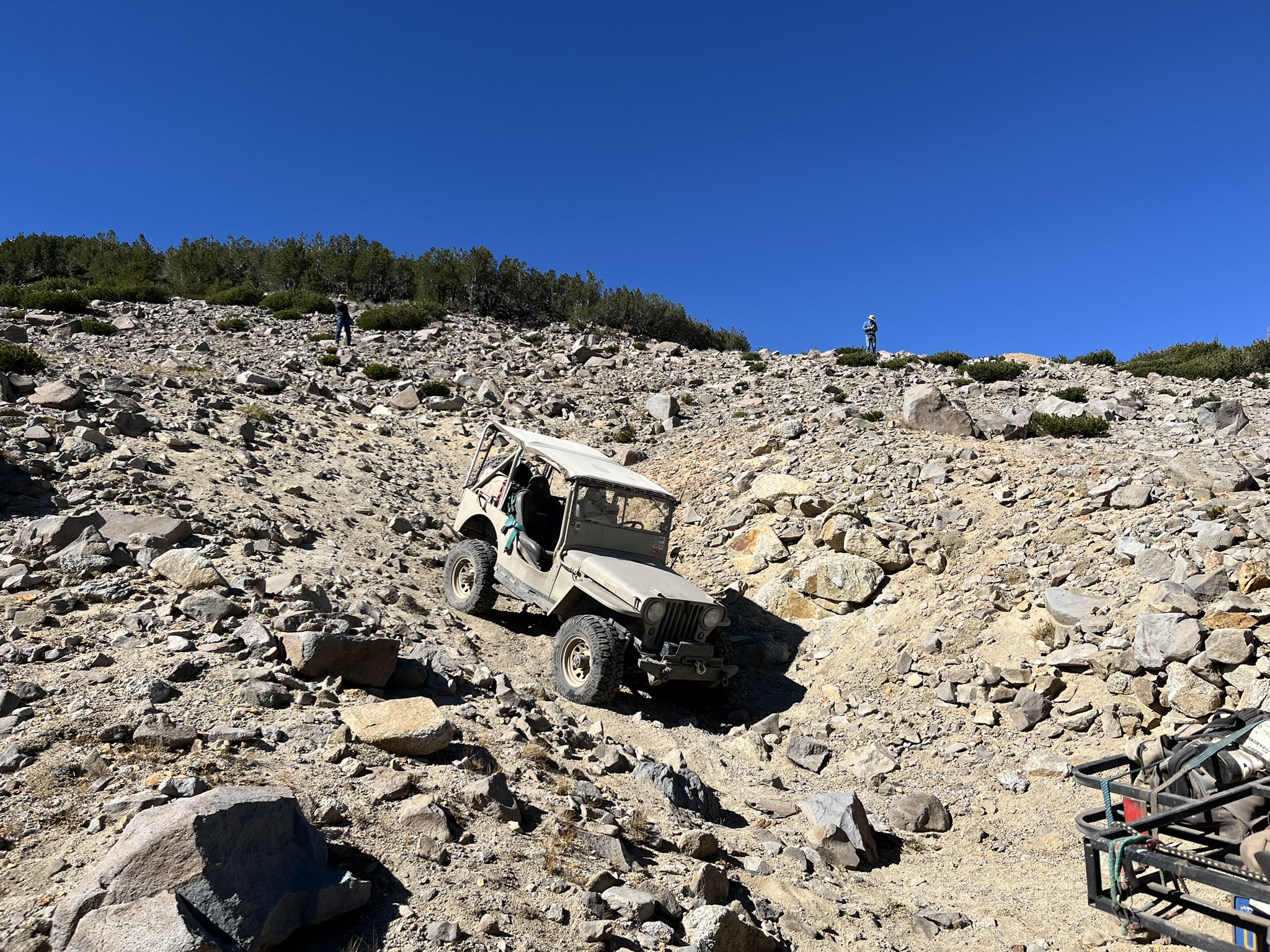
Some of us climbed up (on foot) to get a better view. Rich took the hard parking spot.
I hopped into Alan’s Jeep for the ride down, and his folded windshield made it easier to get some good shots and videos. This one better shows some of the rocks on the roads. To tell the truth, when I saw some of the sections of this stretch, I was a bit relieved not to have been driving my Jeep, as I hadn’t yet clambered over boulders like this. But I would do it now, as my confidence and experience have significantly improved. According to others in this group, this road had sections that would be Class 6 (“Very rocky and rough trail; This is the most difficult trail that should be attempted with a stock full-sized 4×4”) in the common 10 point trail rating system
But what I was really thankful about was that my oil leak happened right there in camp and not here. That would have been a bummer. Alan told me that breakdowns obviously can happen on difficult stretches. The disabled vehicle is strapped between two others, one ahead to pull, the other behind to act as a brake, to the extent necessary.
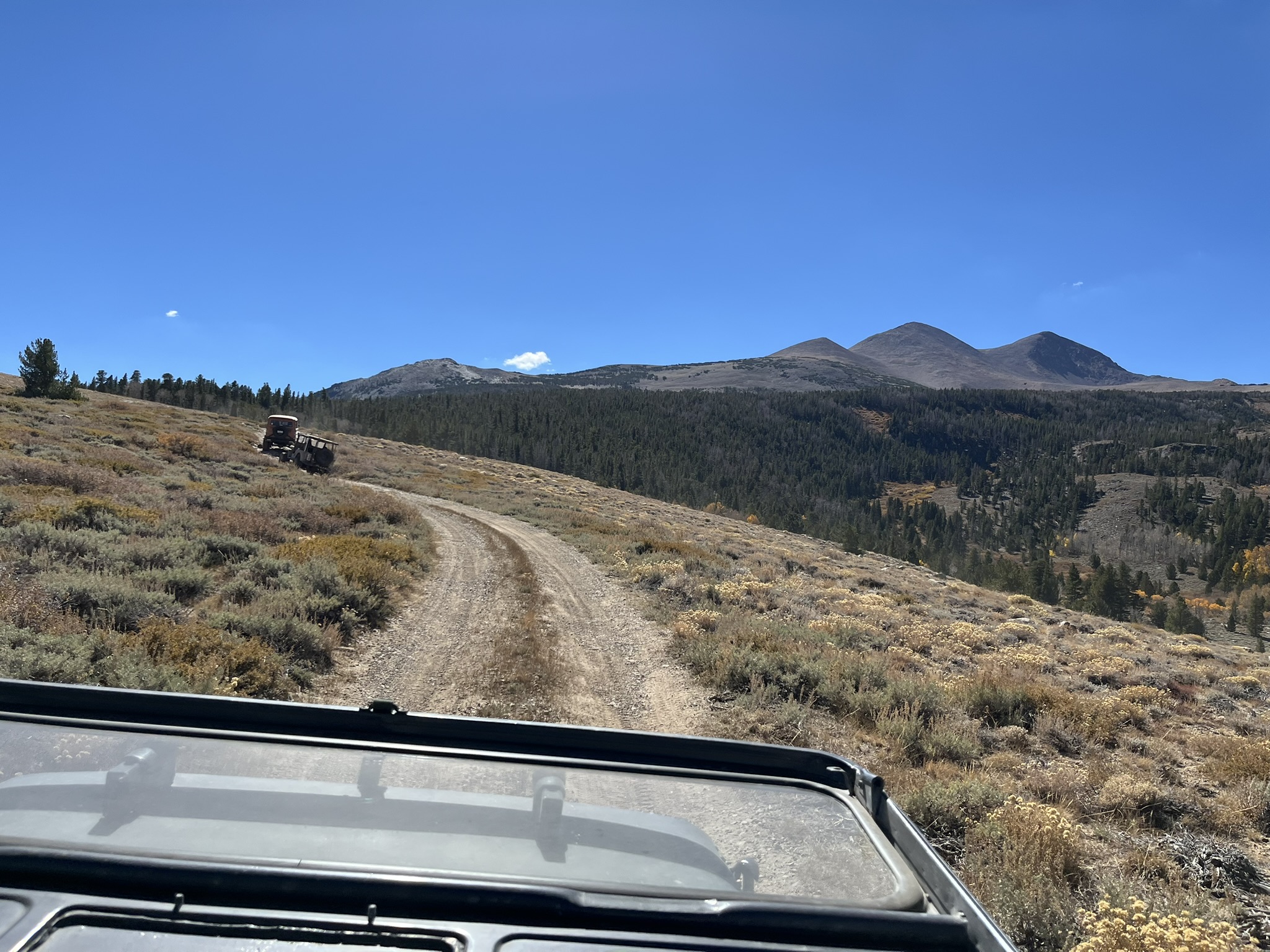
We got back on the road to Kavanaugh Ridge and worked our way up.
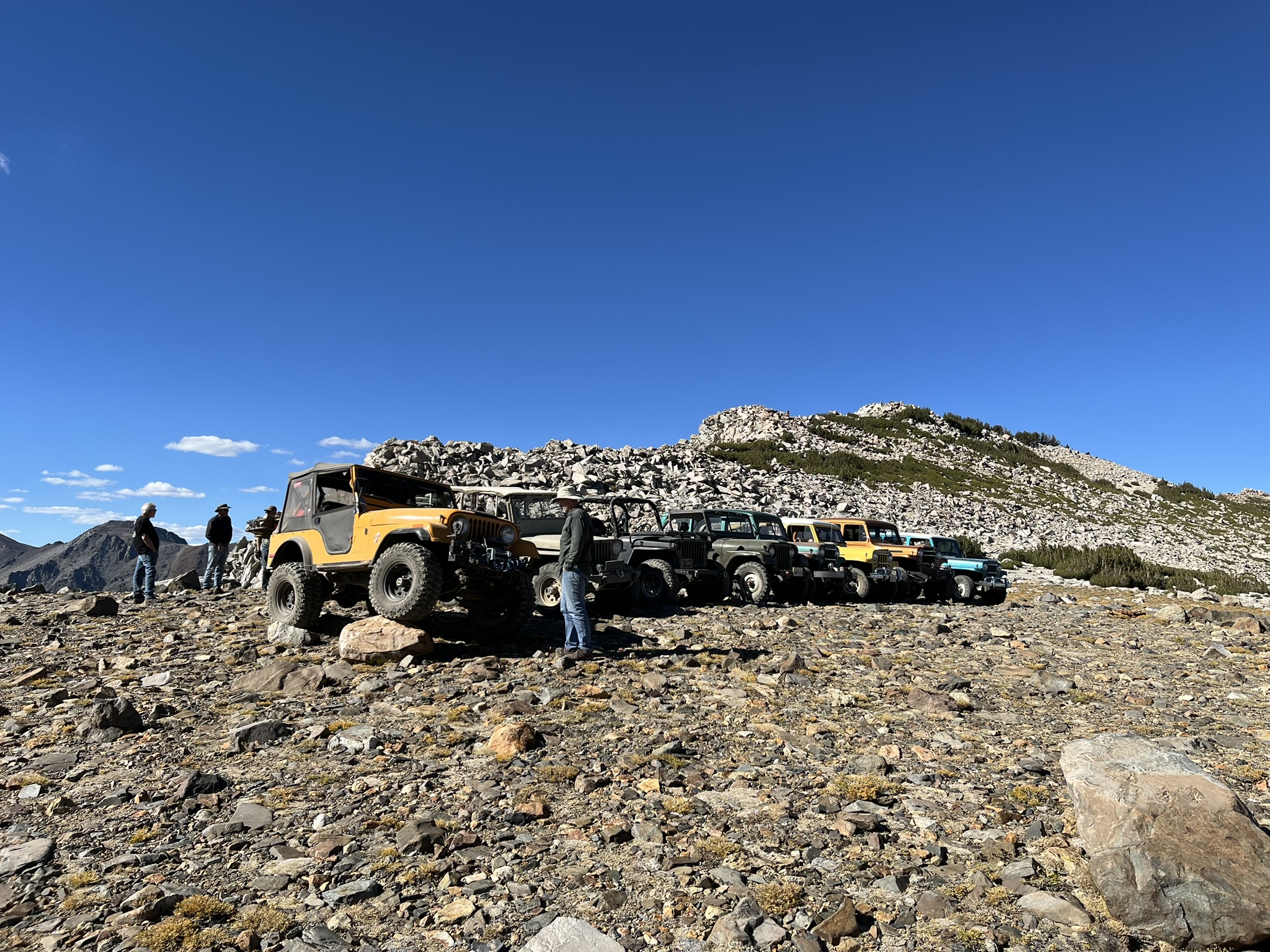
At the top we lined up for the obligatory group shot.
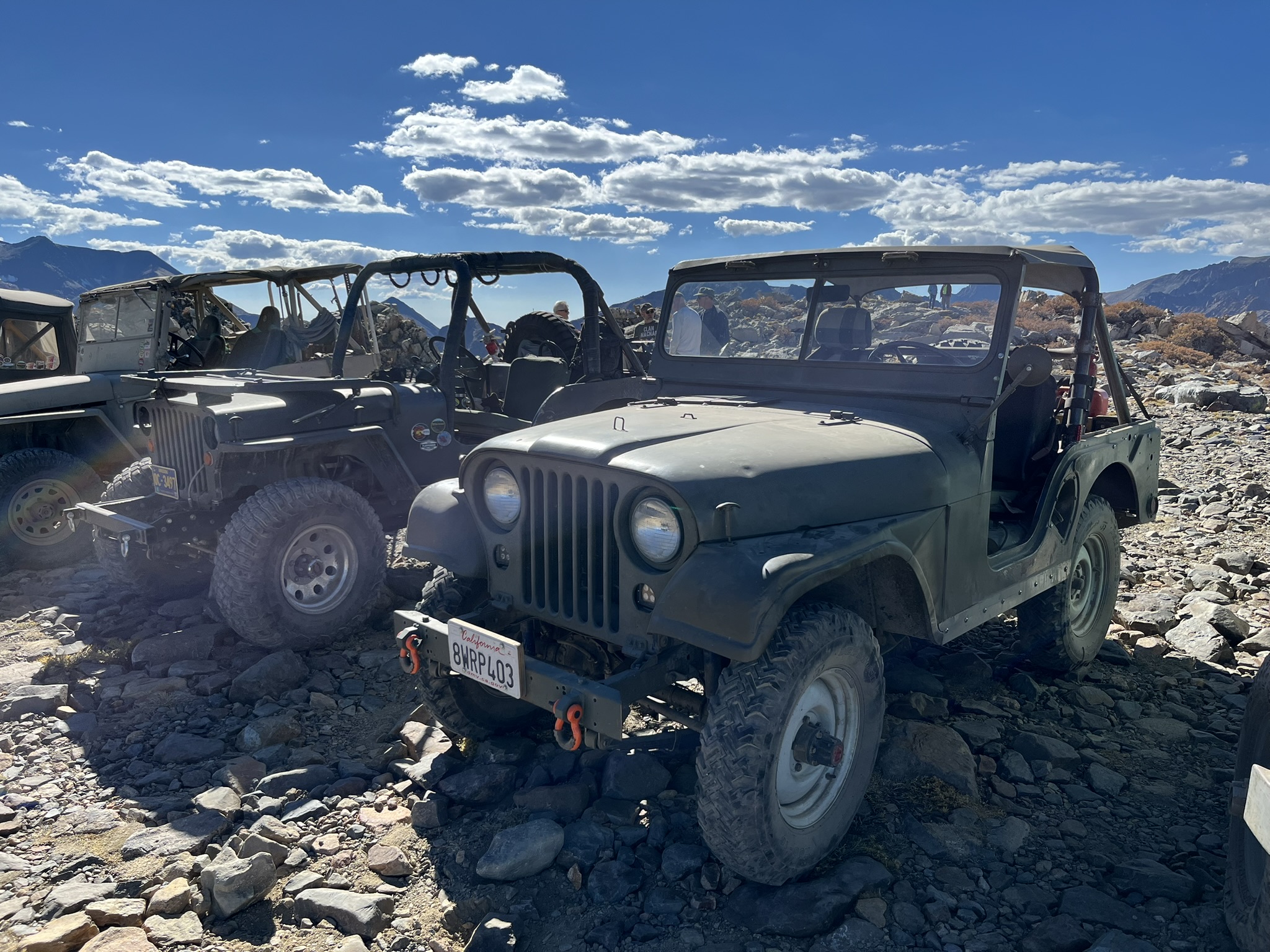
Eric drives this 1950’s M38, the military version that first came out in 1953, two years ahead of the JC-5. It’s generally similar, but of course has all sorts of unique equipment and elements of military Jeeps. He invited me to ride with him part of the way down. Due to the springs it has and/or the old bias ply 16″ tires, it rode significantly more brittle than the others (and mine). A bit of a tooth rattler. He may also not have aired his tires down as much; Alan runs as little as 5-7 lbs the big 33″ tire in his Jeep next to it. It rather floats over the rocks.
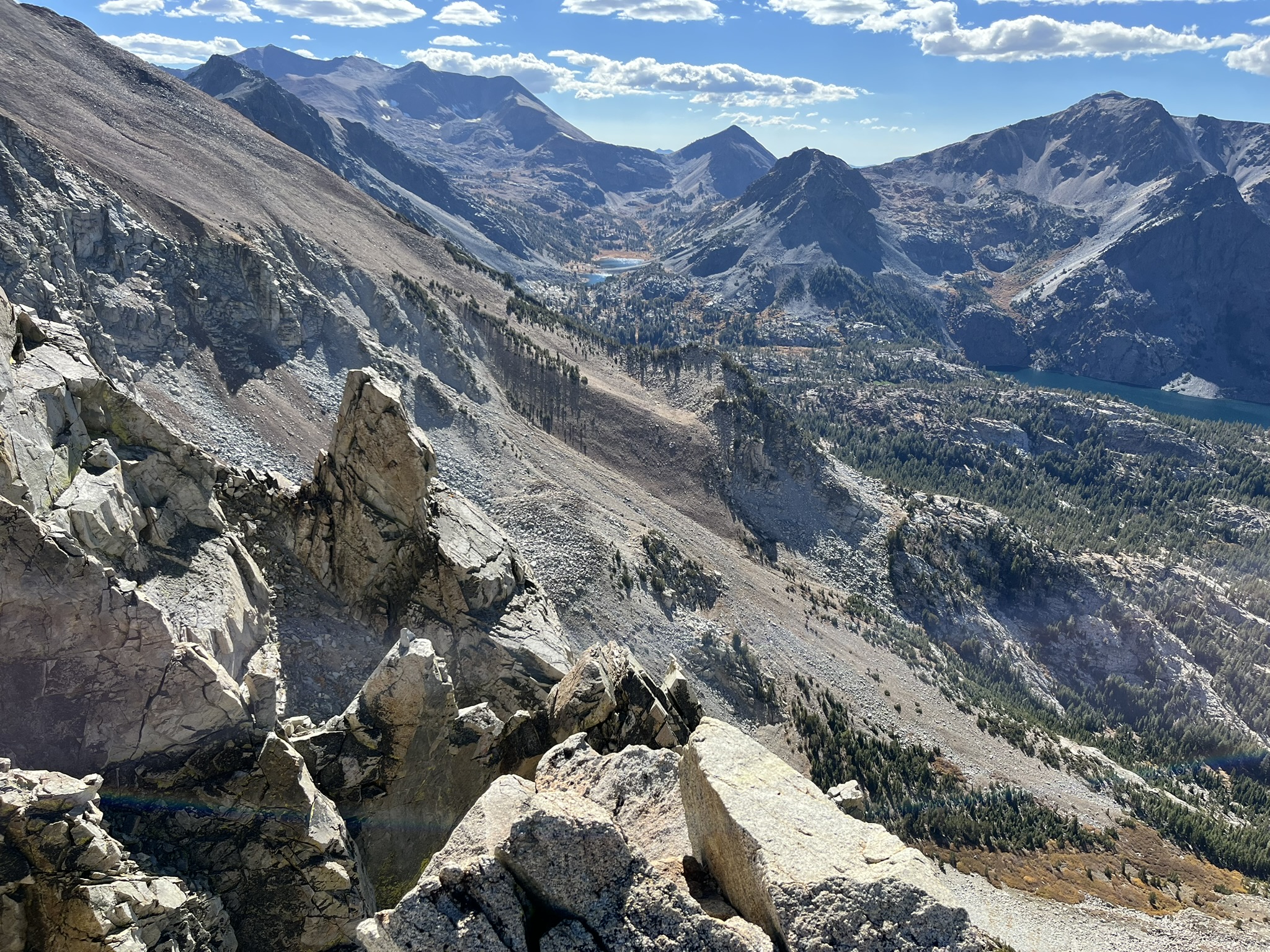
The backside of Kavanaugh Ridge drops off dramatically into the Hoover Wilderness. Those are Upper and Lower Hoover Lake, and Yosemite is just over the pass there.
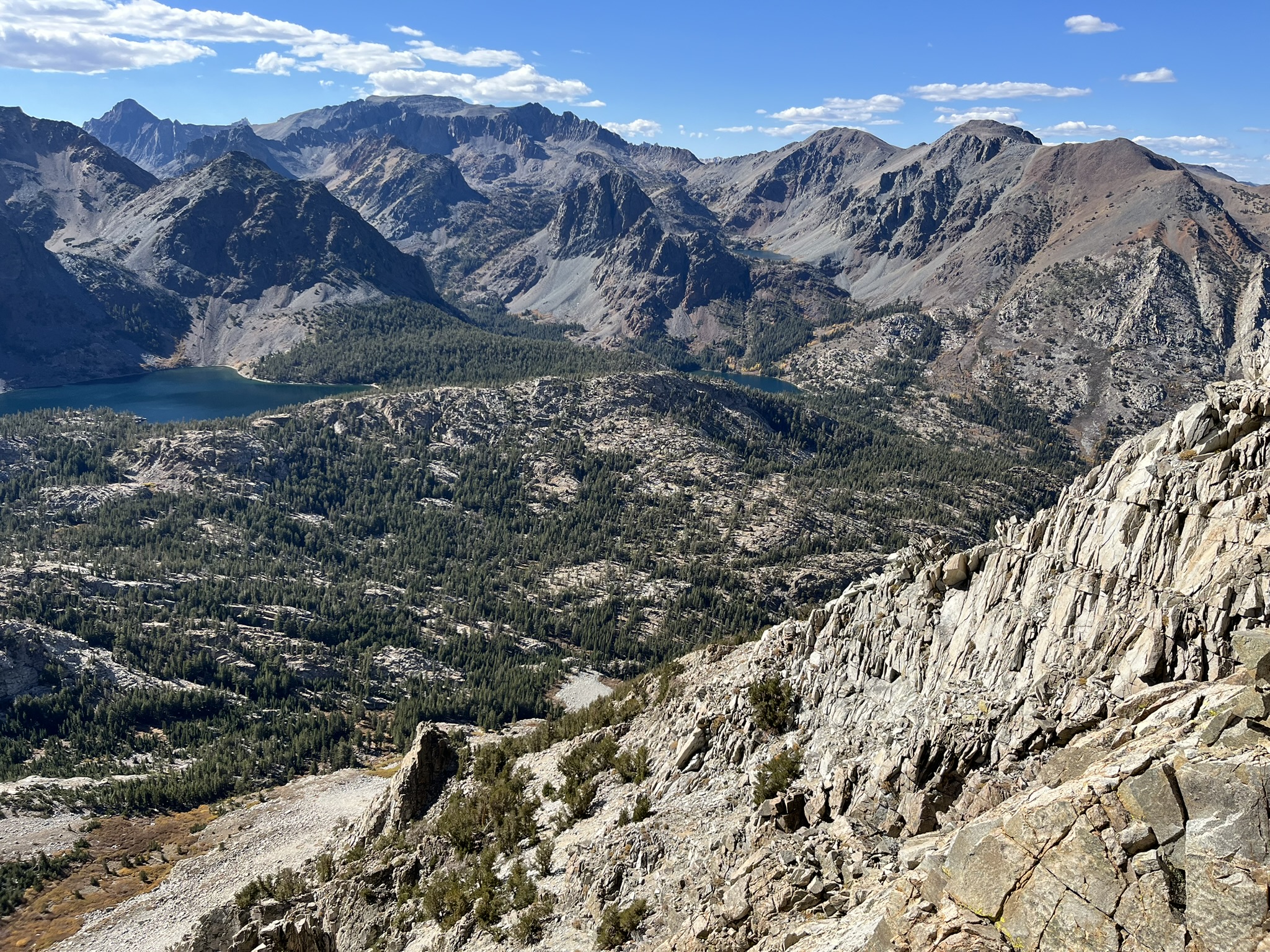
That’s Green (left) and East Lake, the one I had hiked to on Sunday.
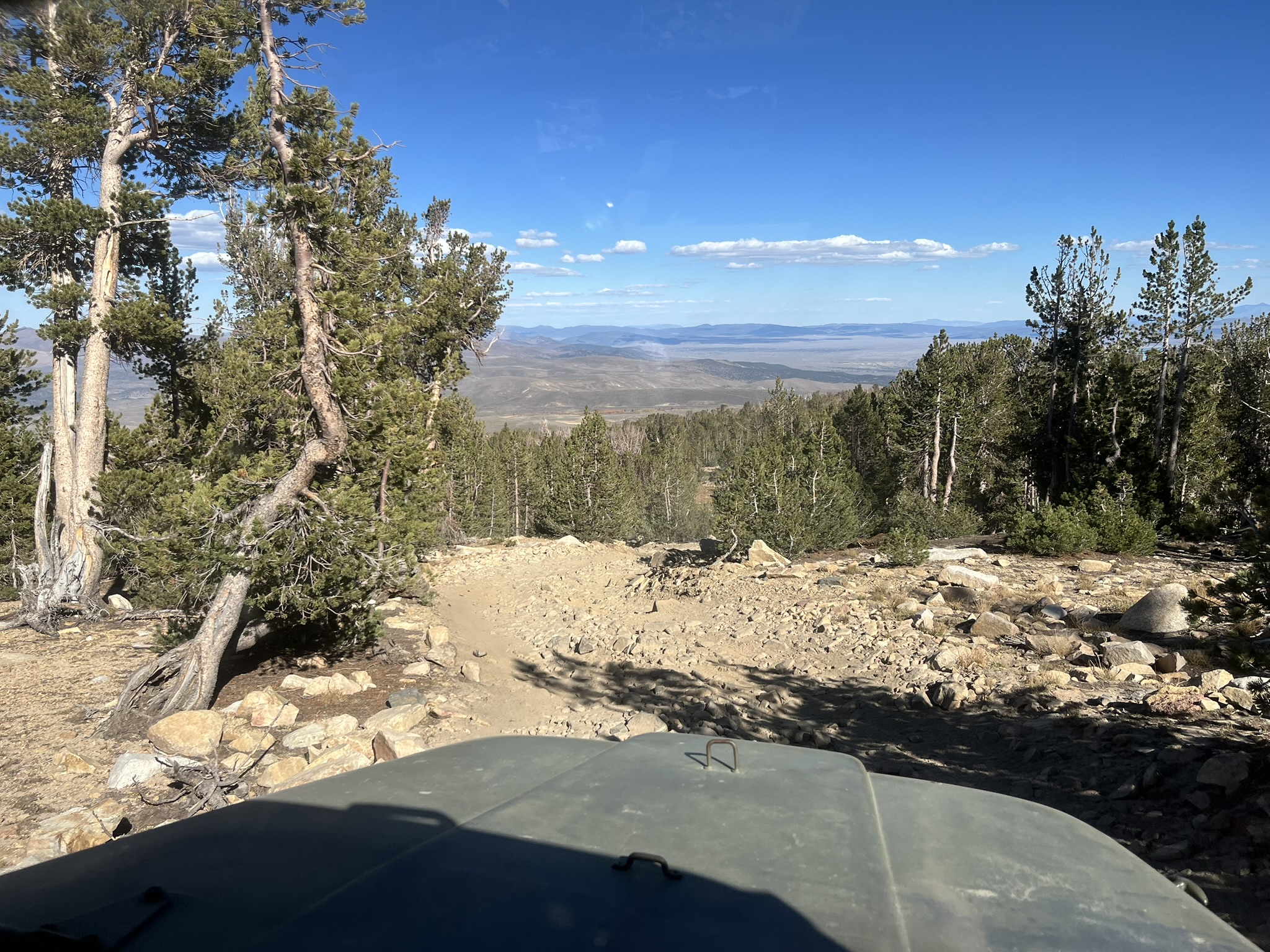
The descent was uneventful; Eric is a very good driver and his M38 and its F134 engine made familiar sounds.
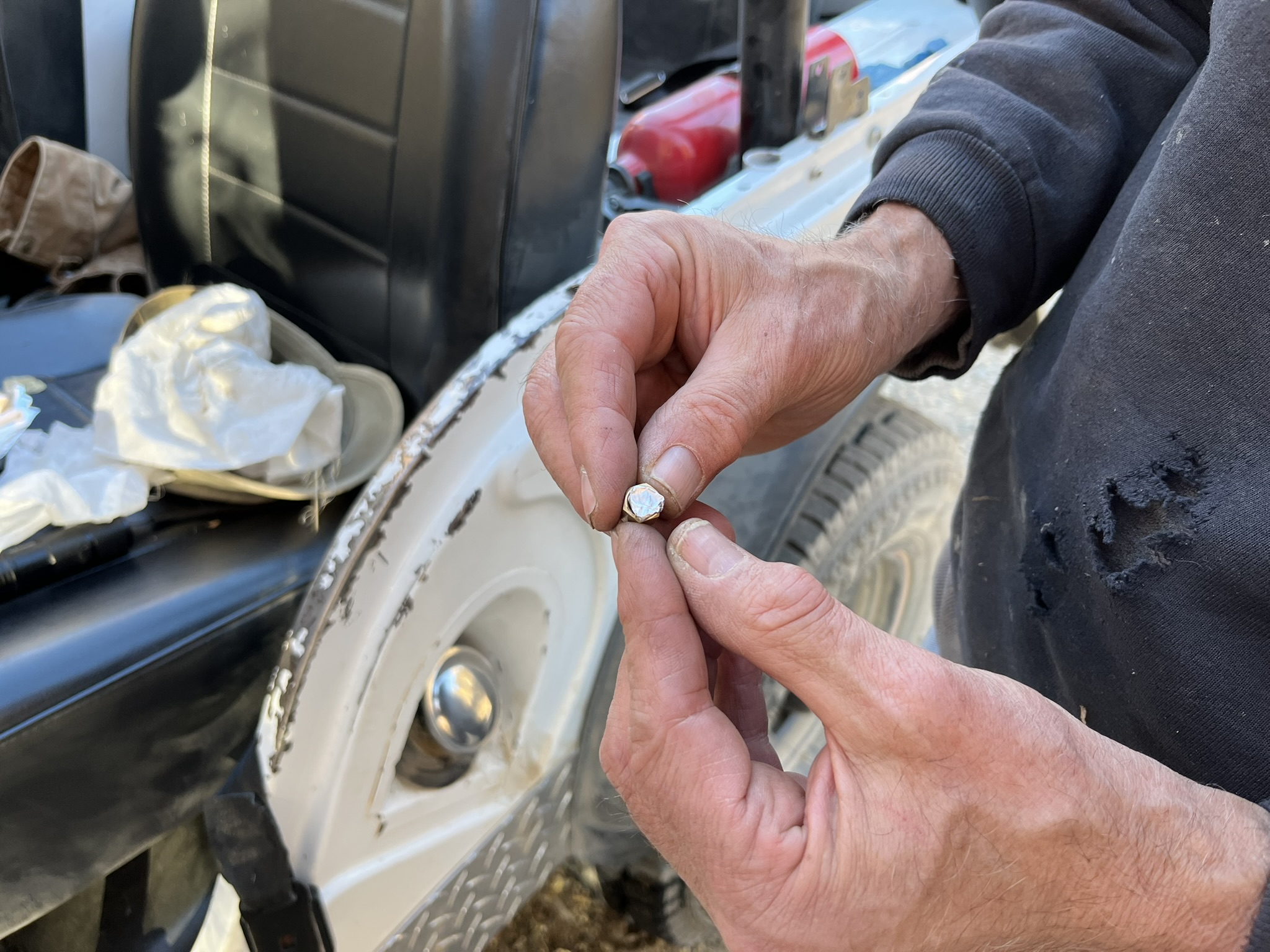
Back at camp we had a group discussion as to the best fix for my Jeep. Kurt had given me a Zerk fitting that had the same thread, but we wondered if the oil might be pushed past the ball valve. Anyway, it was a moot point as I had bunged up the brass sending unit with that open wrench. Alan came up with the idea to put a ball of fine foil into the compression fitting, to block the oil there. That started to make sense, and it worked perfectly. Not a drop got past. Whew!
I was more than ready to get behind the wheel again.
Wednesday, Oct. 7: Lee Vining Ridgeline and Log Cabin Mine
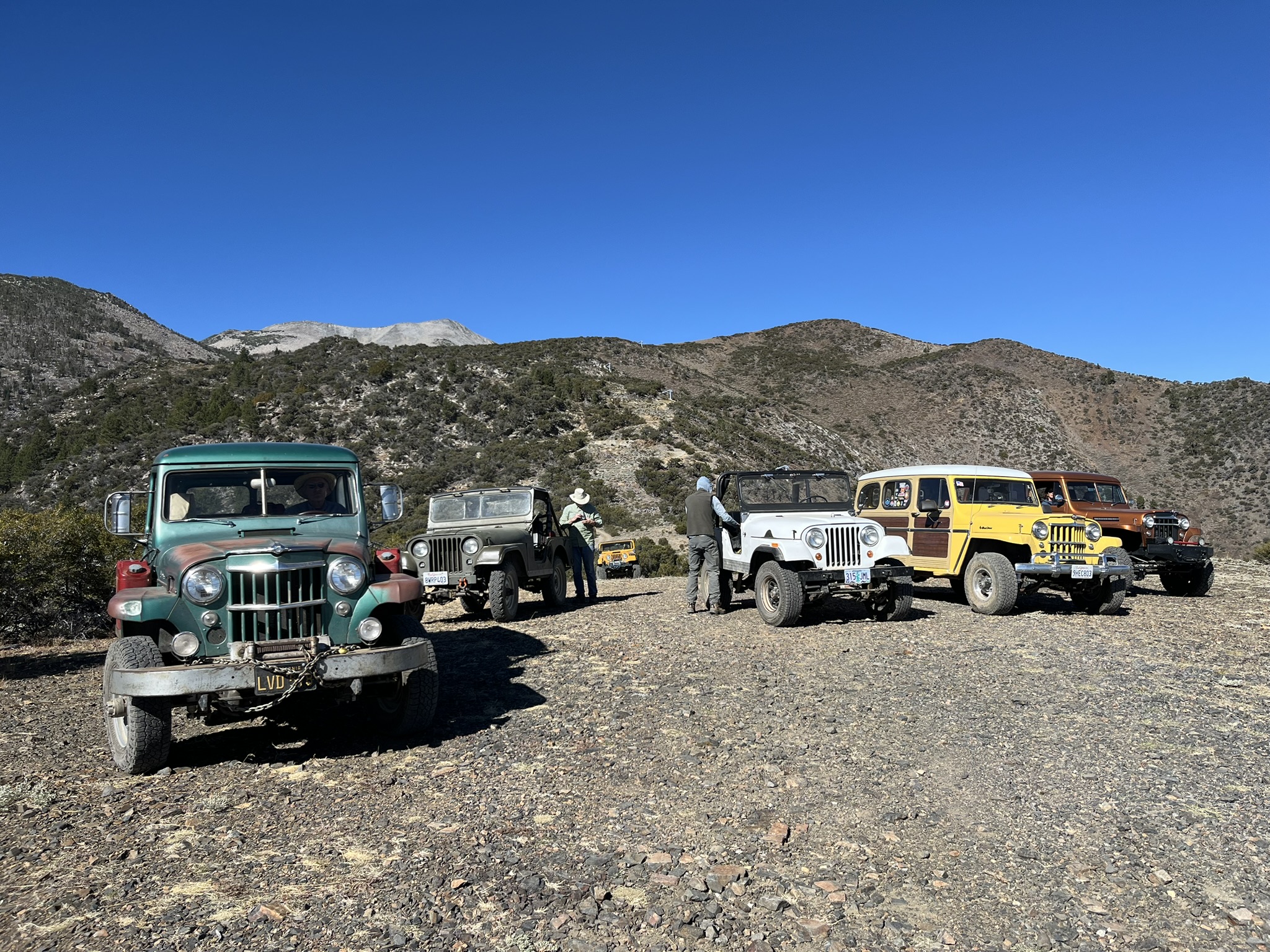
Today was Rich’s turn to miss the drive, thanks to a bad alternator. And then there was an issue with finding the right bolt length for the spare alternator he had in his truck. And Bob decided to drop out altogether as the Pitman arm in his wagon was giving him trouble. So we were reduced to three Jeeps and three wagons.
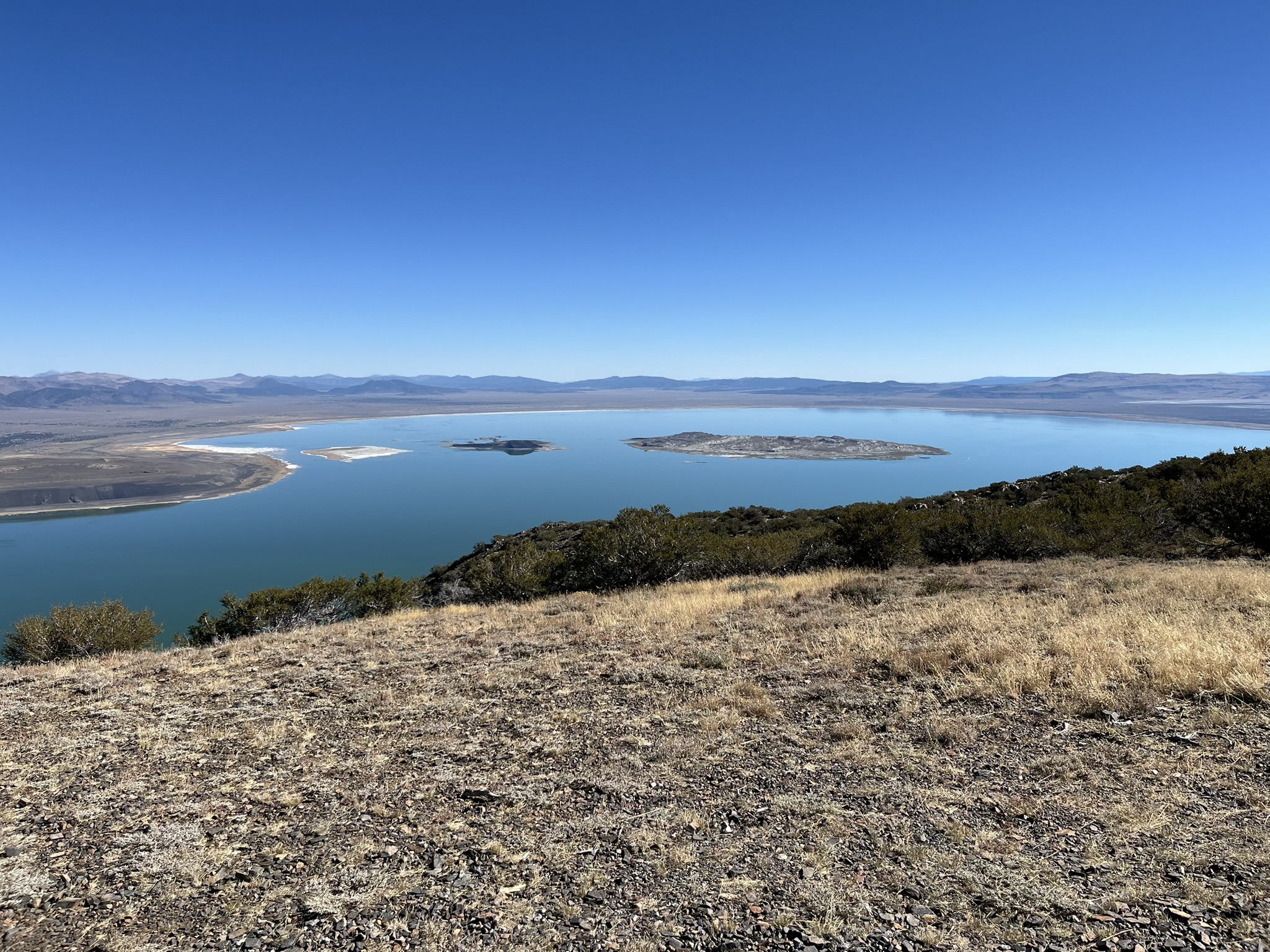
We stopped here on the way up to the mine to catch a great view of Mono Lake.
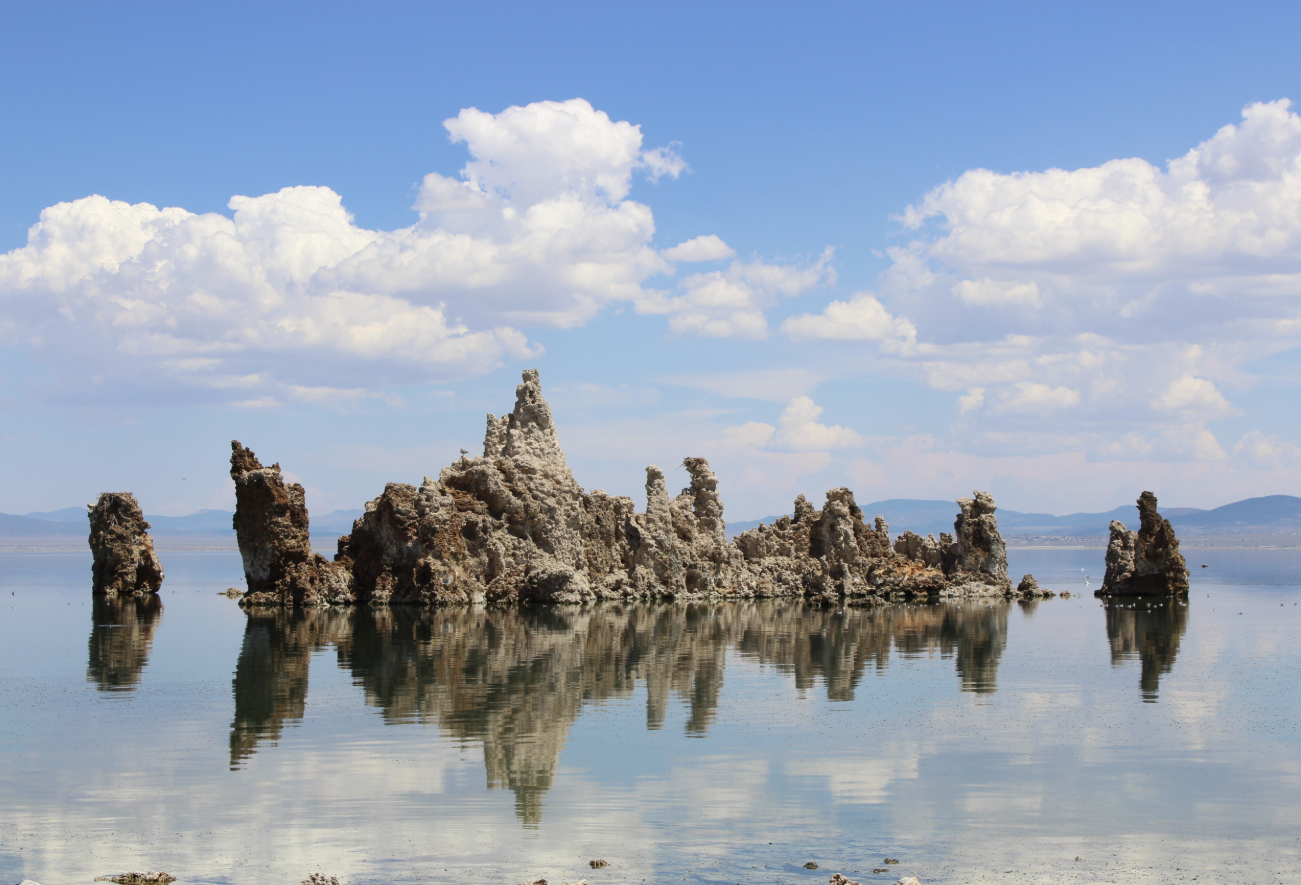
Mono Lake is a saline soda lake that has no outlet, causing the high salt levels and the unique tufa towers from the crystallization of salts. The City of Los Angeles began diverting inflows to Mono Lake for its municipal water supply, leading to a gradual reduction of its water level. When we lived in LA, “Save Mono Lake” bumper stickers were a common sight. Eventually a lawsuit ended most of the diversion, although the lake level is still not as high as it once was.
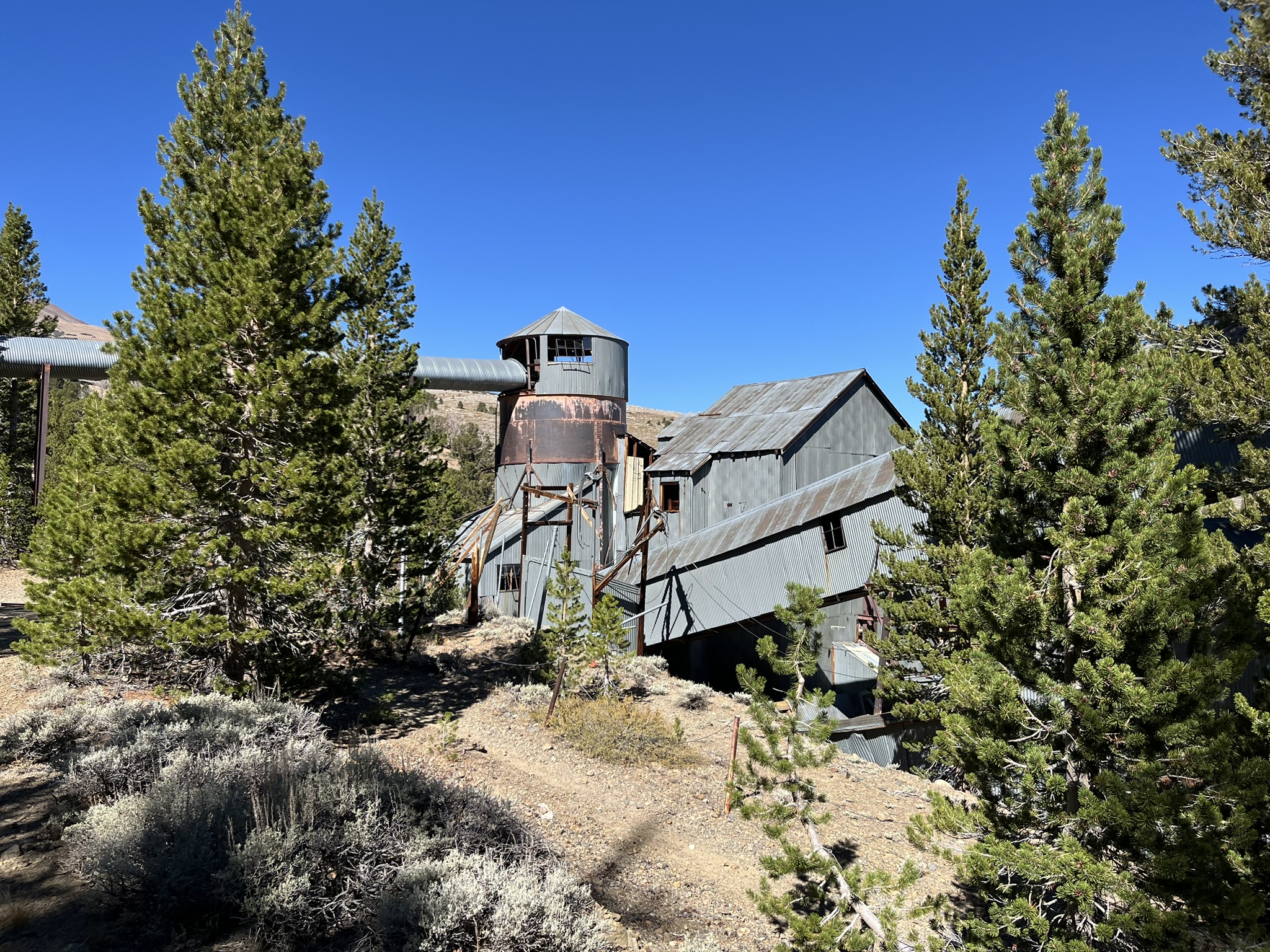
The Log Cabin Mine is relatively modern gold mine, with most of the buildings still standing dating to around 1939 when a significant investment was made to upgrade the facilities, including its own power generation. In the winter, when there were typically many feet of snow on the ground, supplies were brought in via a snowshoe trail.
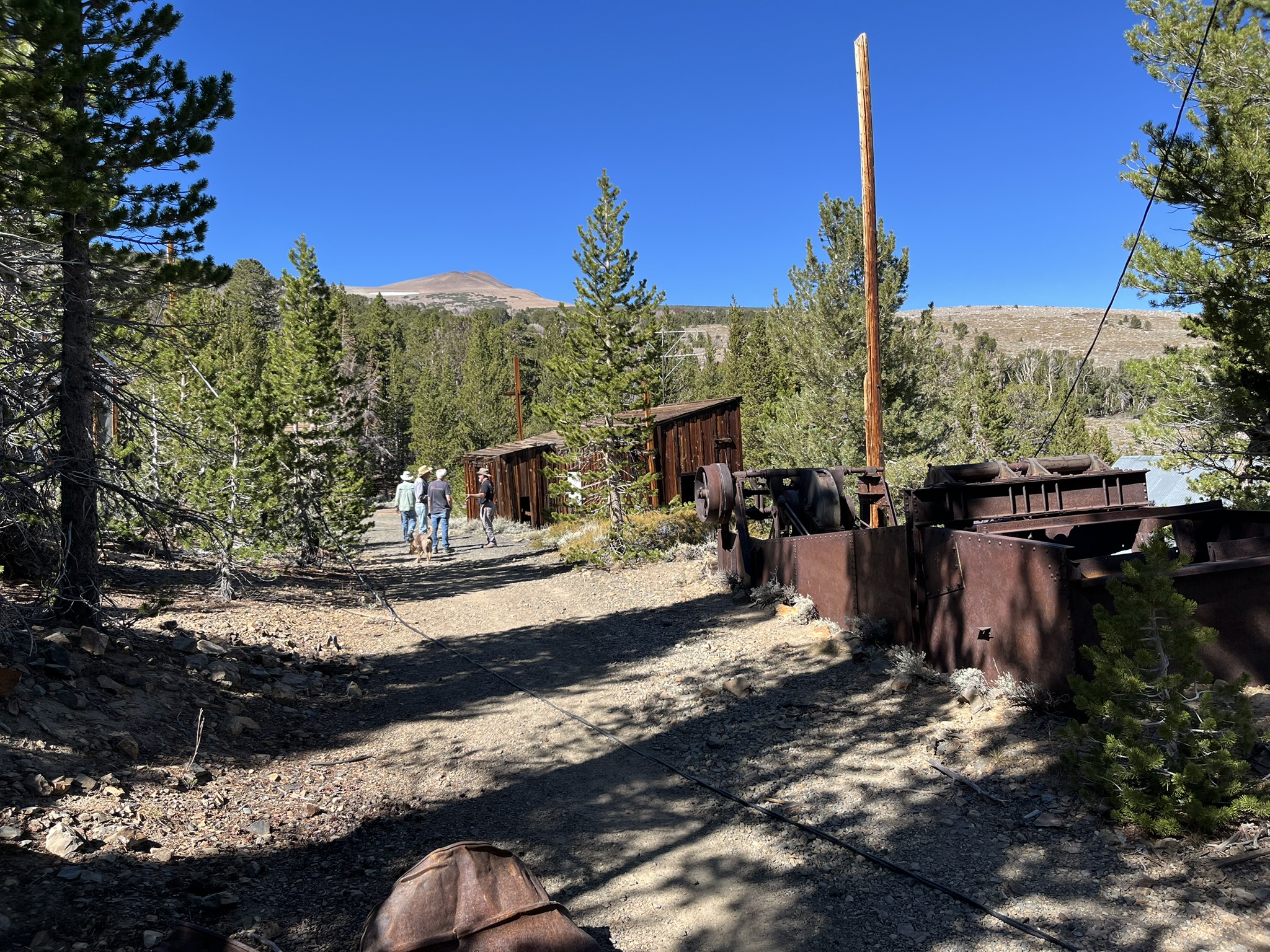
The mine closed during WW2, when an executive order by FDR shut down all non-strategic metal mining. It reopened for a while starting in 1946 but the fixed price of gold ($35/oz.) made it unprofitable. A caretaker lived there until he died in 1968.
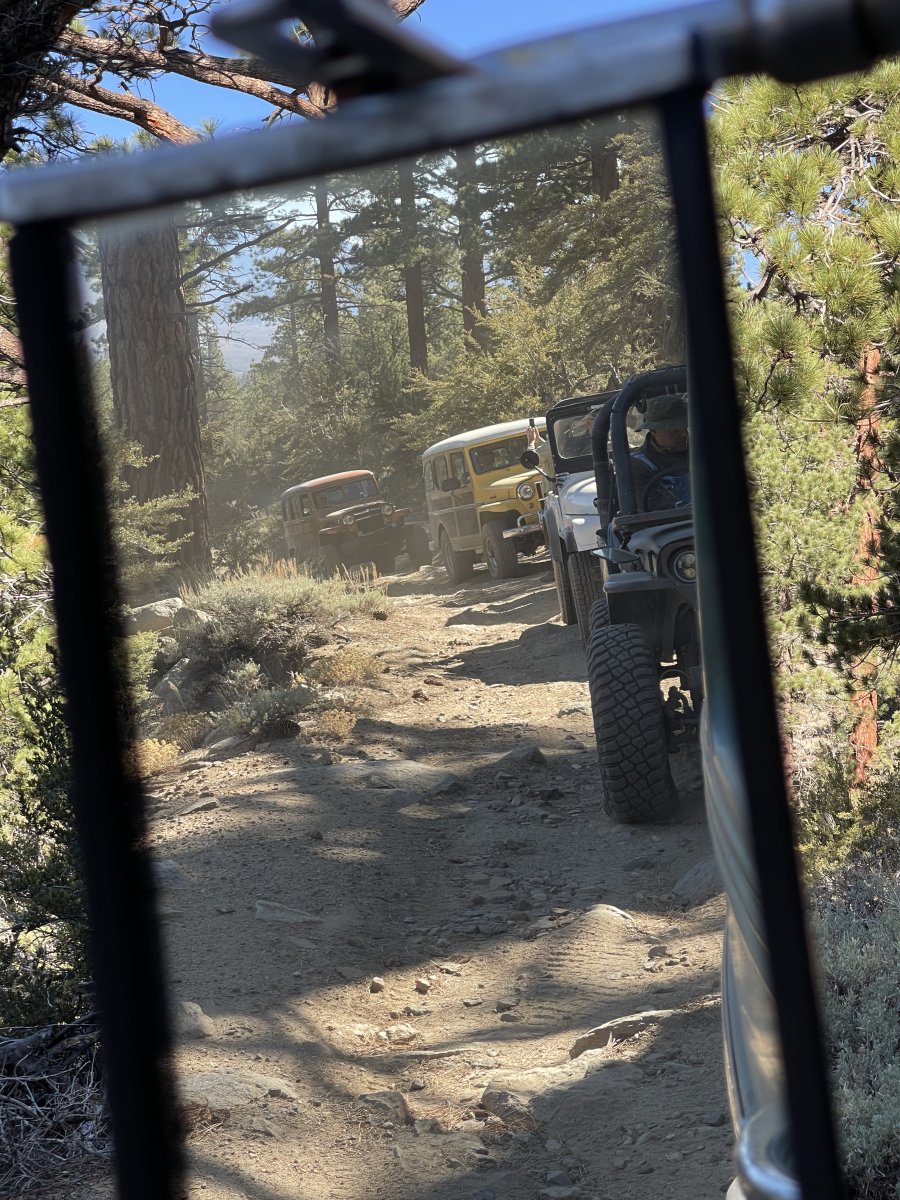
We continued up the steep road (this image from his rear view mirror is by Kurt).
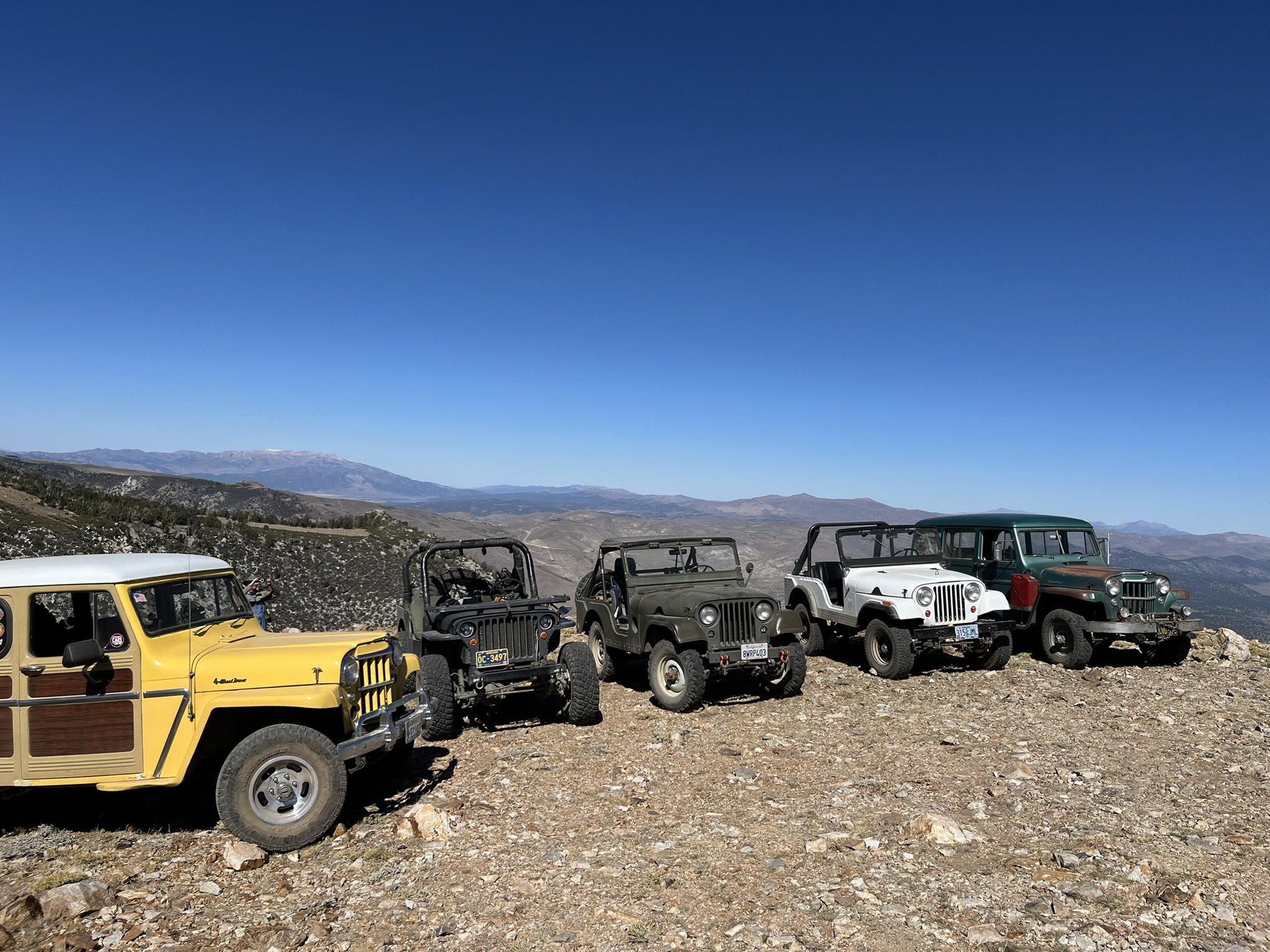
The end of the road. More stellar views.
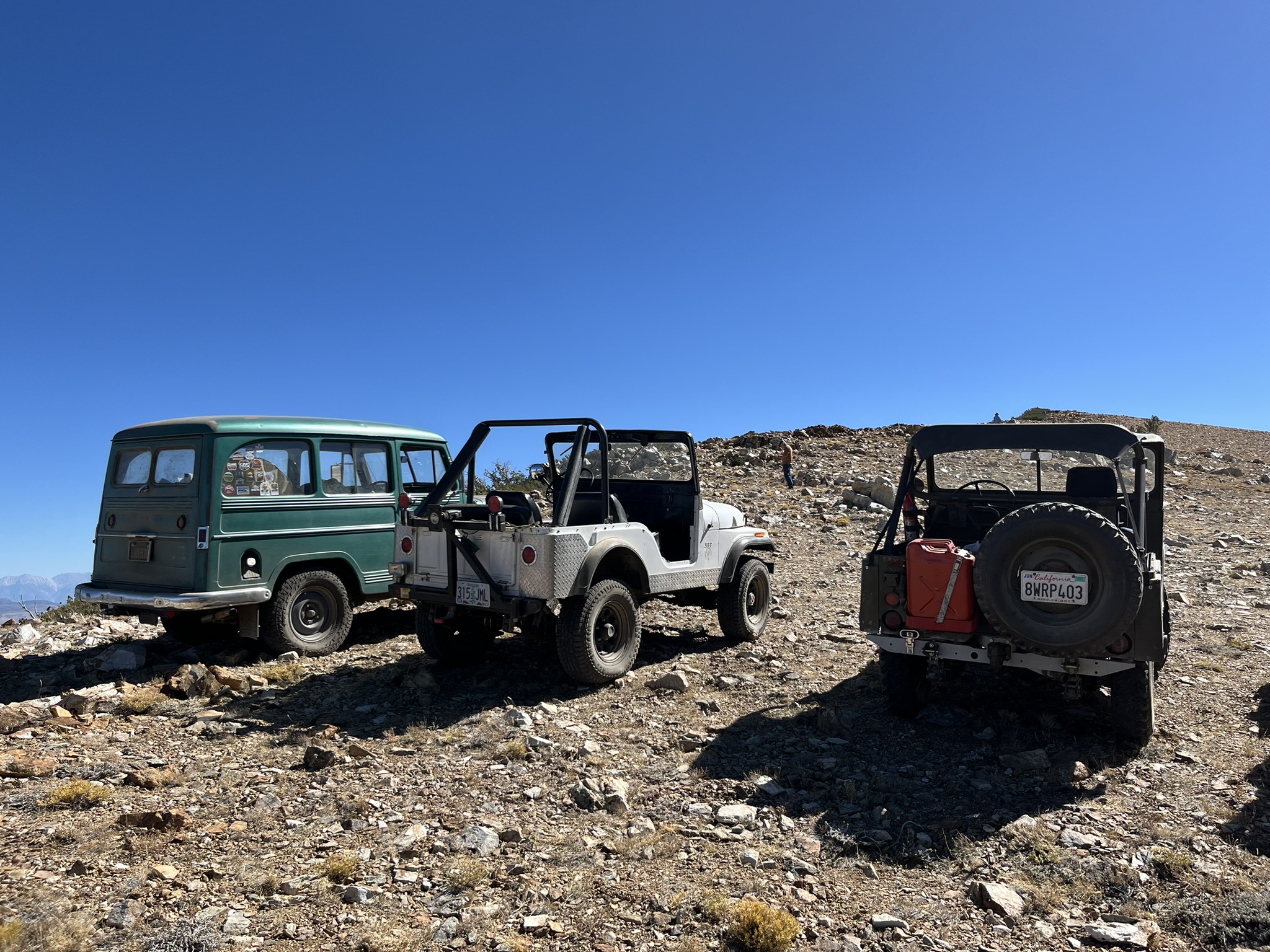
Even better ones awaited those who climbed up to the peak up there.
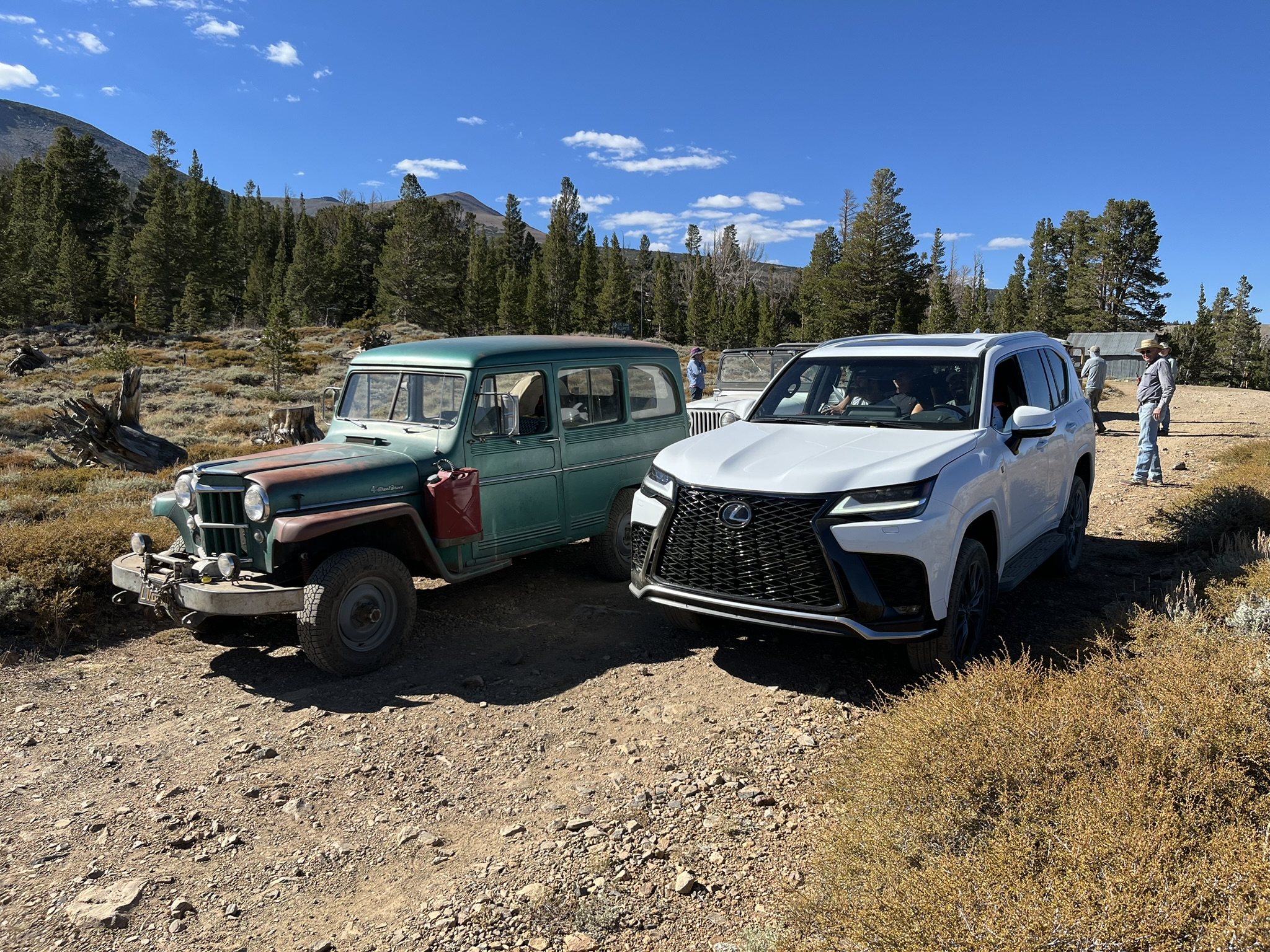
On the way down, when we were out of the very narrow and rugged wooded area, we encountered some guys in a brand new Lexus LX600. They asked if we thought they’d be ok going up the road we just came down. The answer was negative. Then they showed off its air suspension and raised it up to maximum height. The issue was getting scratched by the trees in the narrow section and they decided not to go.
Turns out they were out in the area shooting video and still photography to be used in Lexus commercials and marketing materials. They loved the old Jeeps and fell for Wanda and got her to pose for some shots. Then I had them stop next to Kurt’s Willys Wagon and pointed out that it was the world’s first real SUV. They got off on that and took more shots of the two together.
On the way down Dimitry took this video as we rolled through the golden aspens. Driving this old Jeep is always totally engaging. Between shifting the two sticks, the wonky steering, and the other vintage sensory inputs, there’s always a need for a lot of focus. Which is why I do this; it’s a constant challenge to make it as smooth and effortless-seeming as possible.
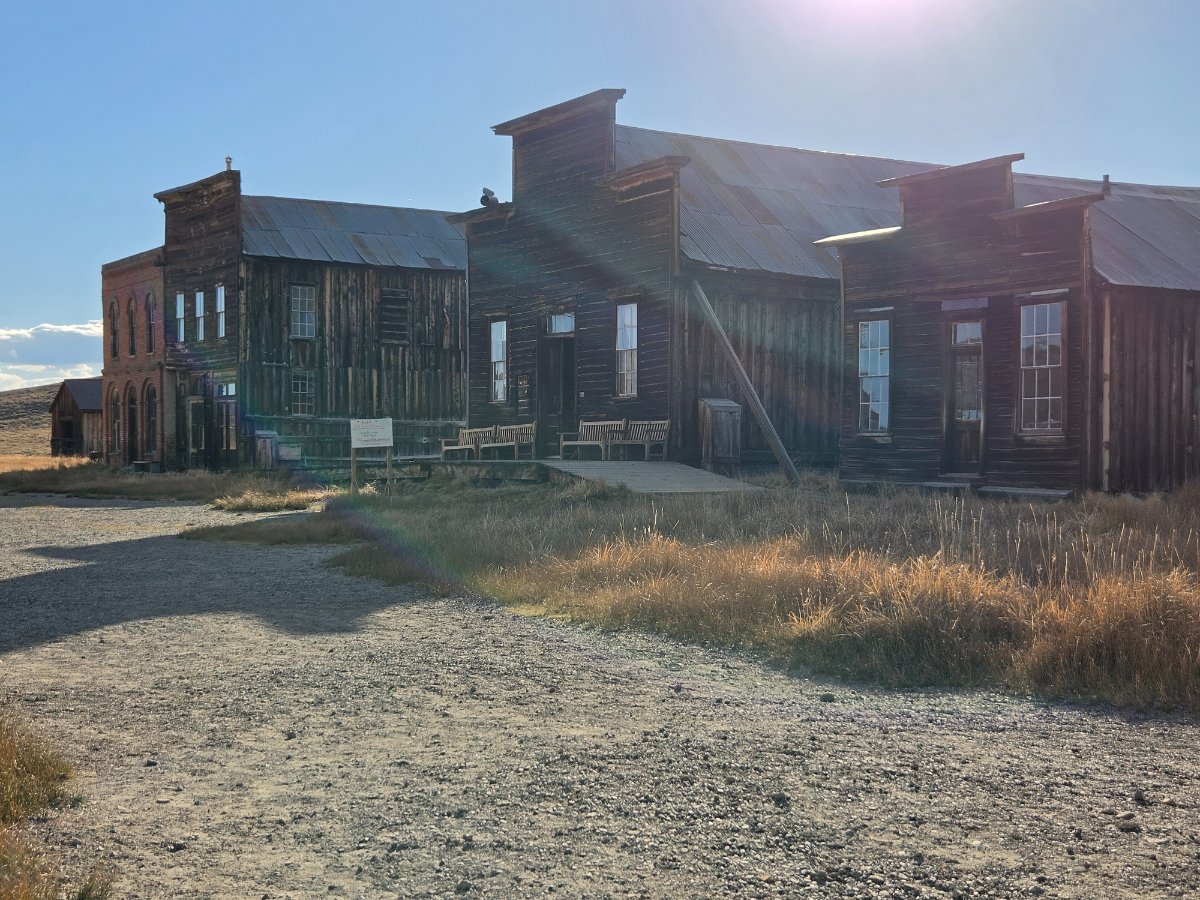
This was a relatively shorter drive, so some chose to drive to the preserved ghost town of Bodie, which is kept in excellent condition by state park employees who live here. I’ve been there, so I chose to have a quiet afternoon at camp after an intense couple of days.
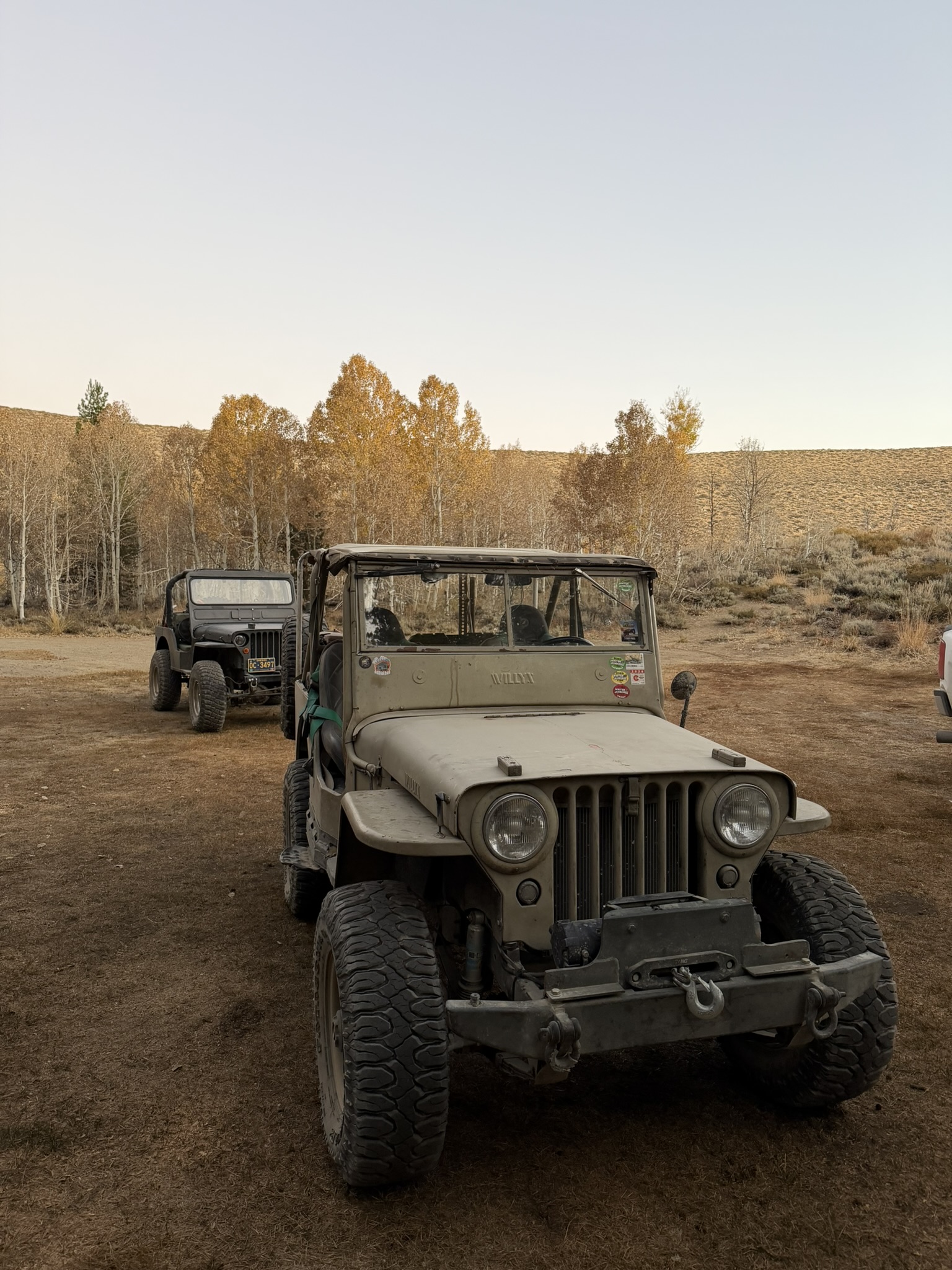
At around 7:30 PM I got a call from Allen, thanks to having a Star Link Mini set up. He was down on the gravel road heading up to the Green Creek area when his electric fan crapped out. A piece of foam insulation between it and the radiator came loose and stalled the fan blades, burning out the motor. Rich, who had just finished fixing his Jeep, hopped in it and towed him back to camp. It was too late and dark to deal with then, but here the two were in the morning as they had come in the night before.
Thursday, Oct. 8: Sweetwater Range and Mt. Patterson
This was the finale and would be the longest drive of this tour.
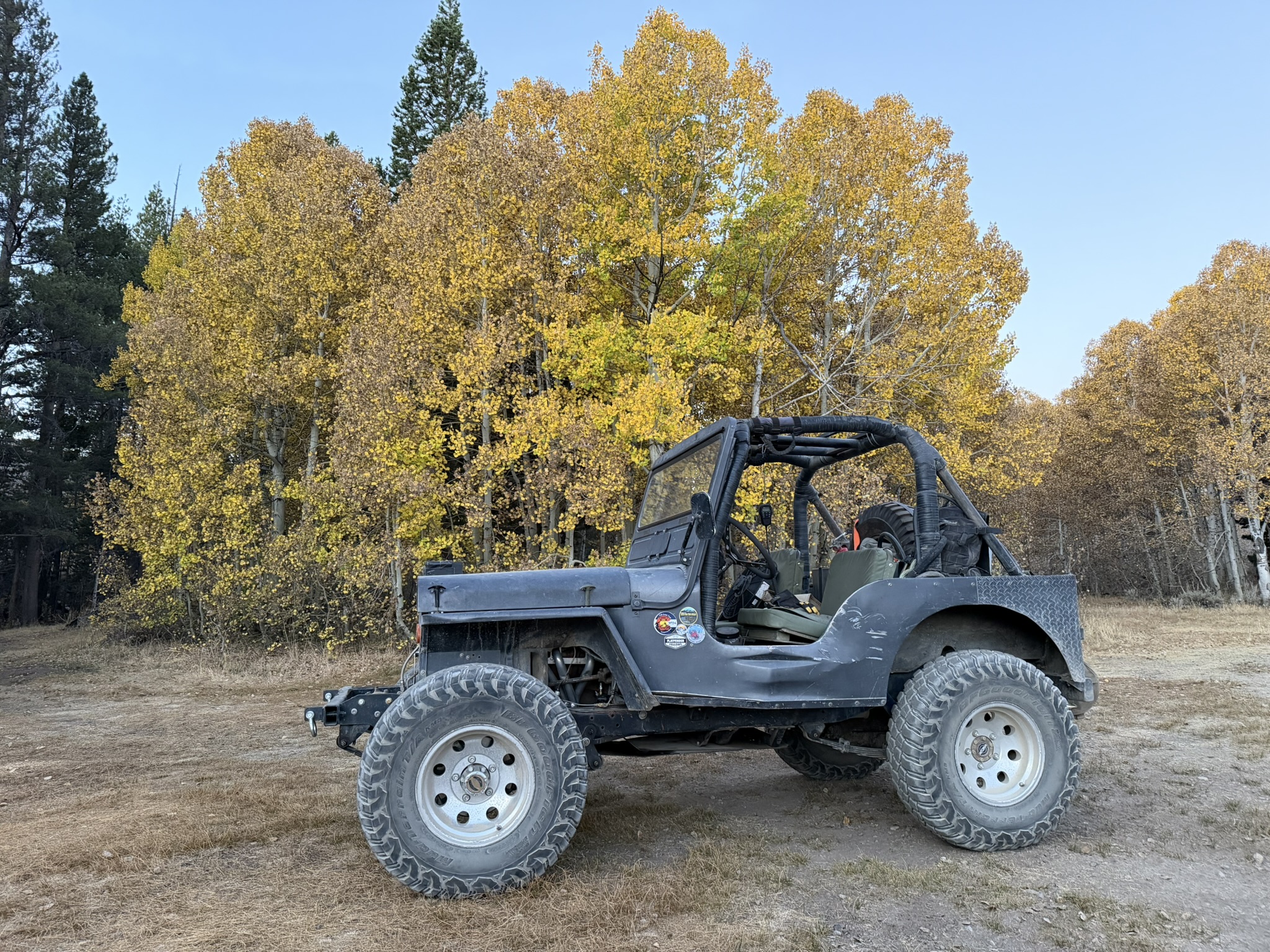
Alan’s Jeep, which is a gnarly Frankenstein consisting of a CJ-5 Frame and lifted springs, a Buick 225 V6, a truck four speed transmission with a super low first gear, a wider Dana 40 front axle, power steering, air lockers front and rear and big 33″ tires would be out of commission for the day. The scrapes on the side are from a three day trip on the Rubicon this summer. I’m not sure he ever put it into 4WD on this trip; with its super low first gear and those big, soft tires, he rarely ever needs it.
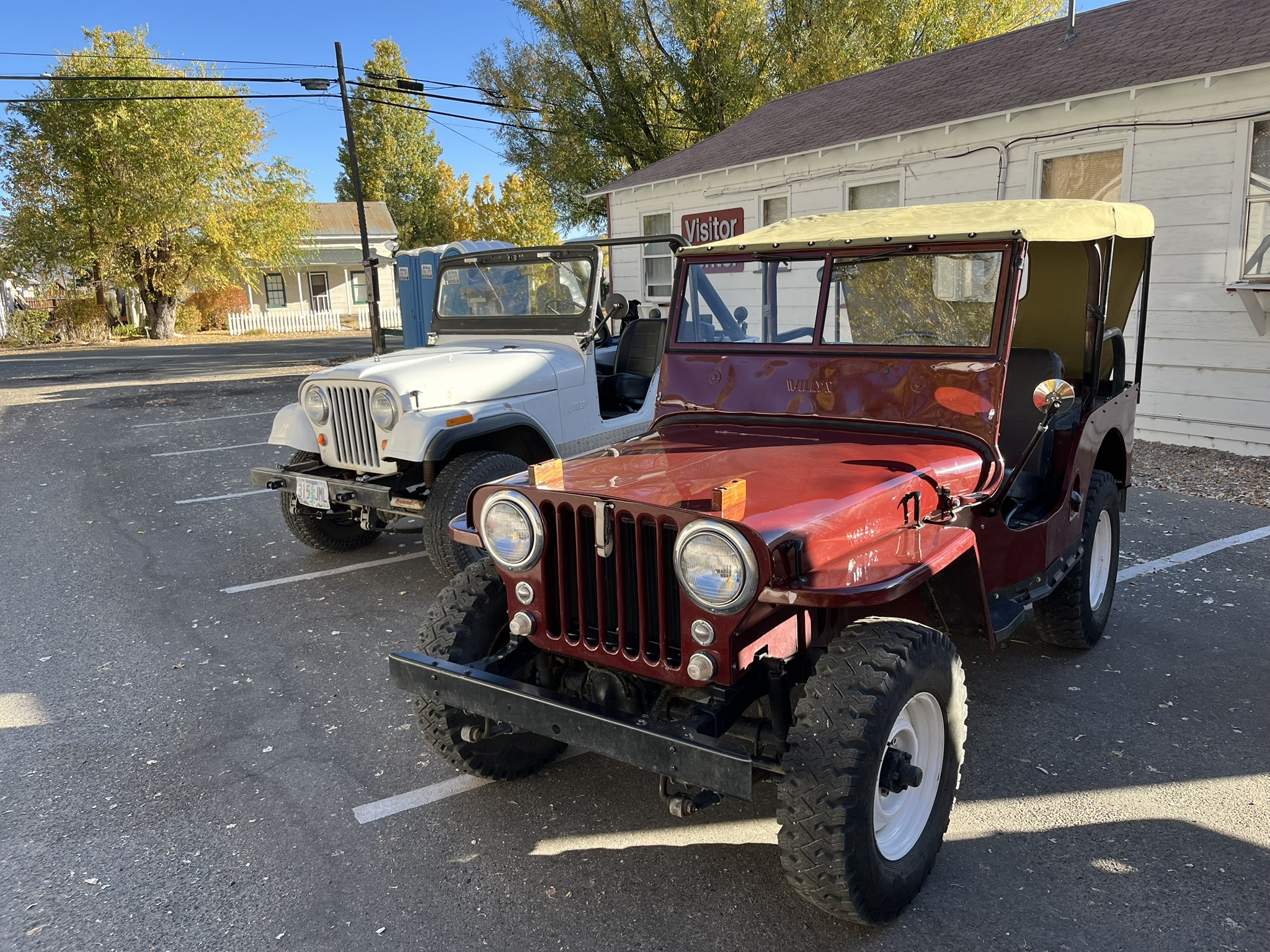
We met up in the Bridgeport City Park, and this beautifully CJ-2A owned and restored by John joined the party.
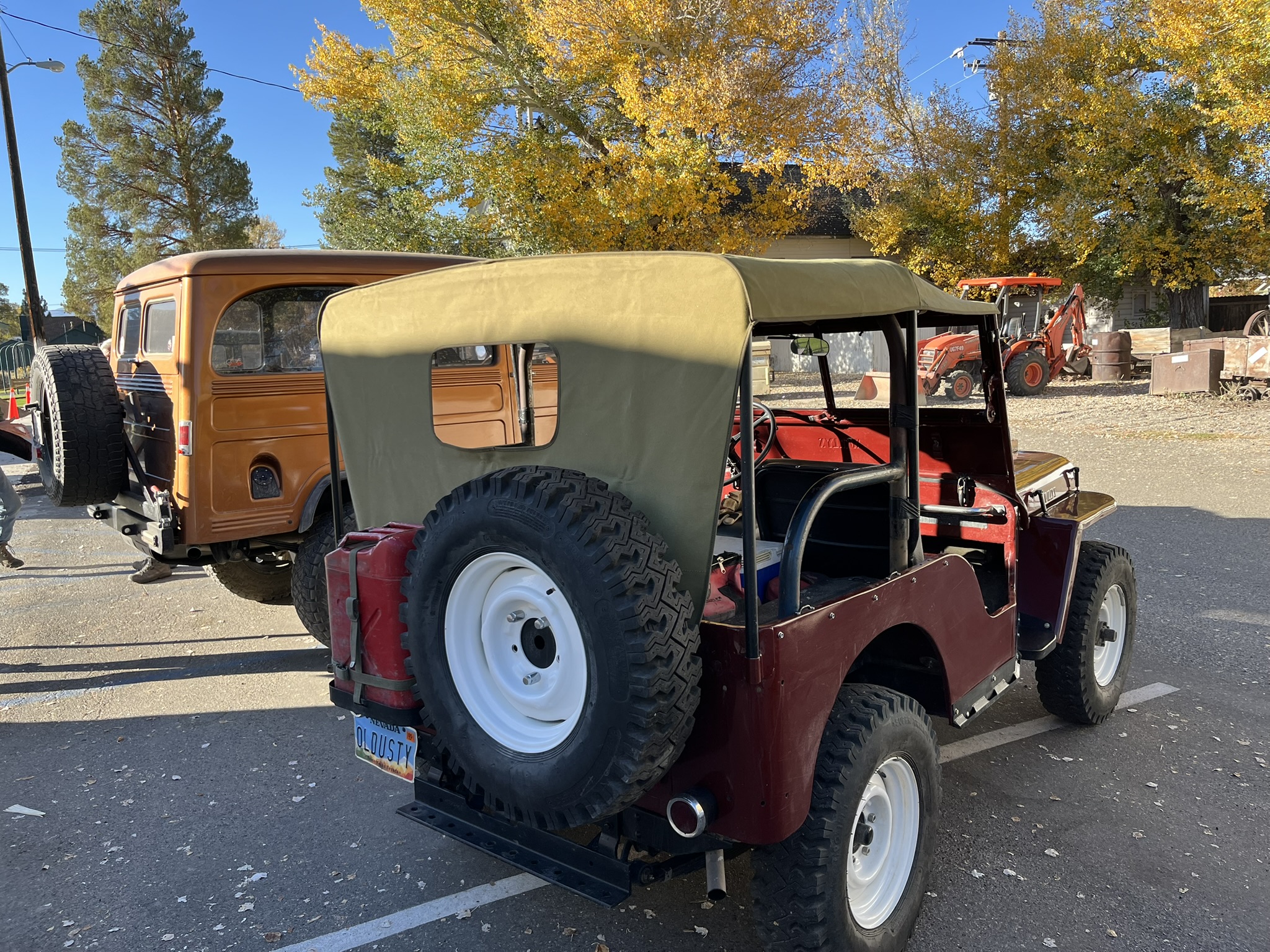
Don’t let its pristine condition fool you; John drove it fast and hard; I was impressed how it kept up on the highway, never mind on the steepest climbs. Part of me wishes I’d held out for one of these. Maybe I’ll drop a CJ-2A tub on my frame and drive train.
I don’t have any photos, but getting to these various day trips entailed some highway driving on CA 395, up to 20 miles or so. My Jeep tops out around 60 mph, and is very happy purring along at 55. I did see 65 or more on a few slight down grades but as soon as there’s a bit of an incline it slows down quickly. On the long and steep Conway Pass, I was down to 40-45 mph in second overdrive. It reminded more than a bit of my VW 1200 days, although it was a bit faster (72 mph).
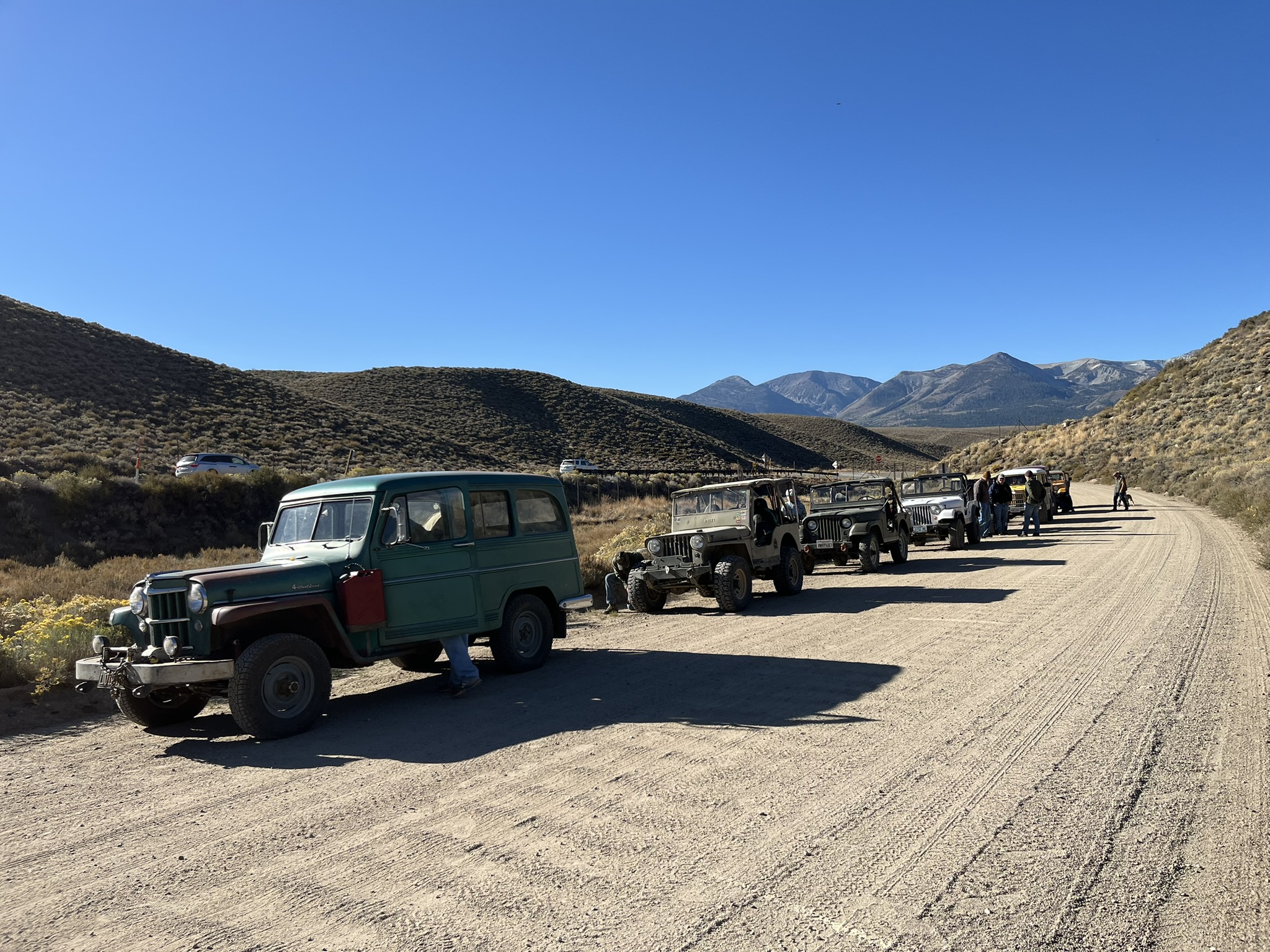
We pulled off the highway and aired down. Alan rode with Rich.
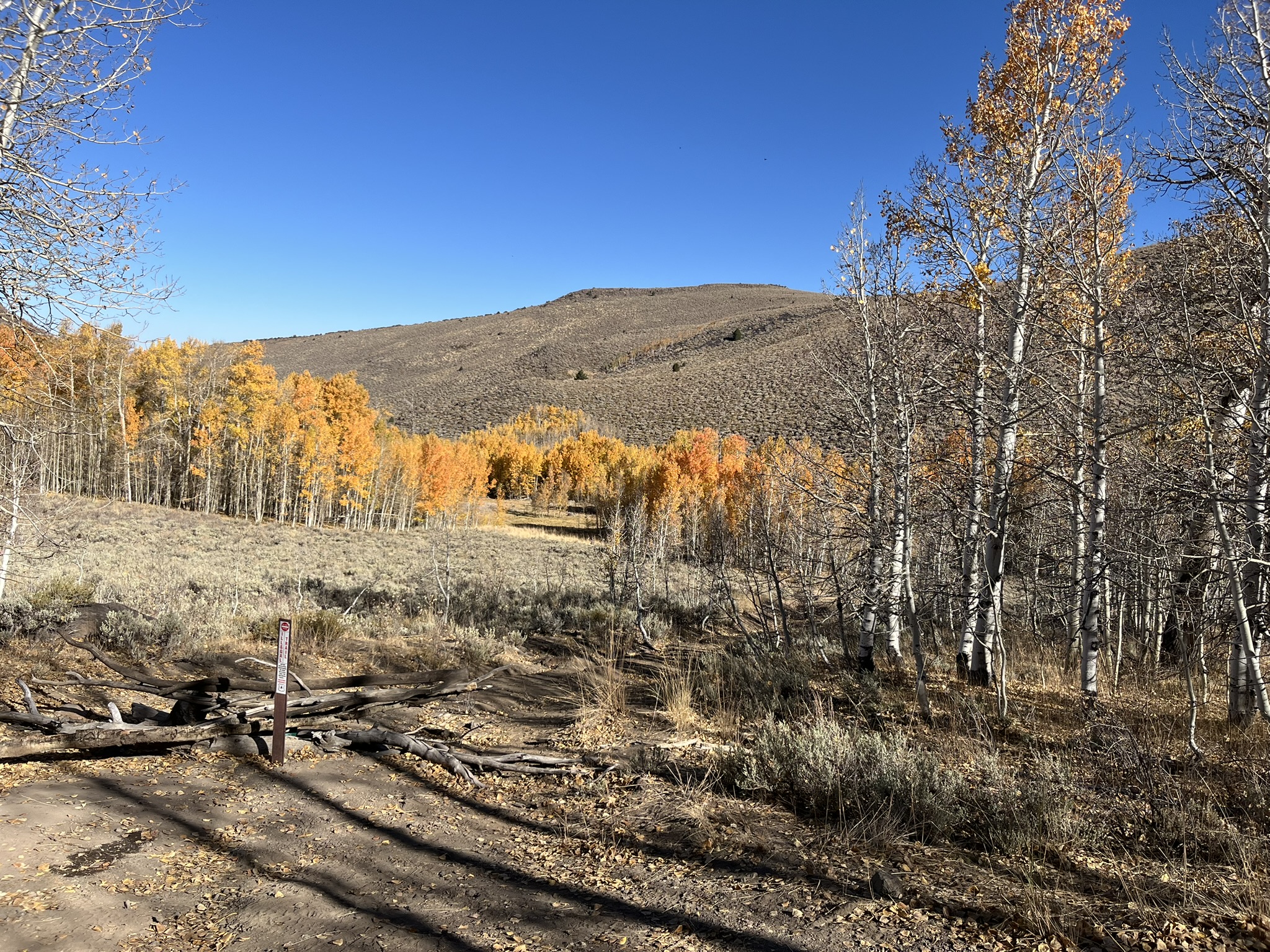
A couple of miles in, Kurt had us stop at a cultural site.
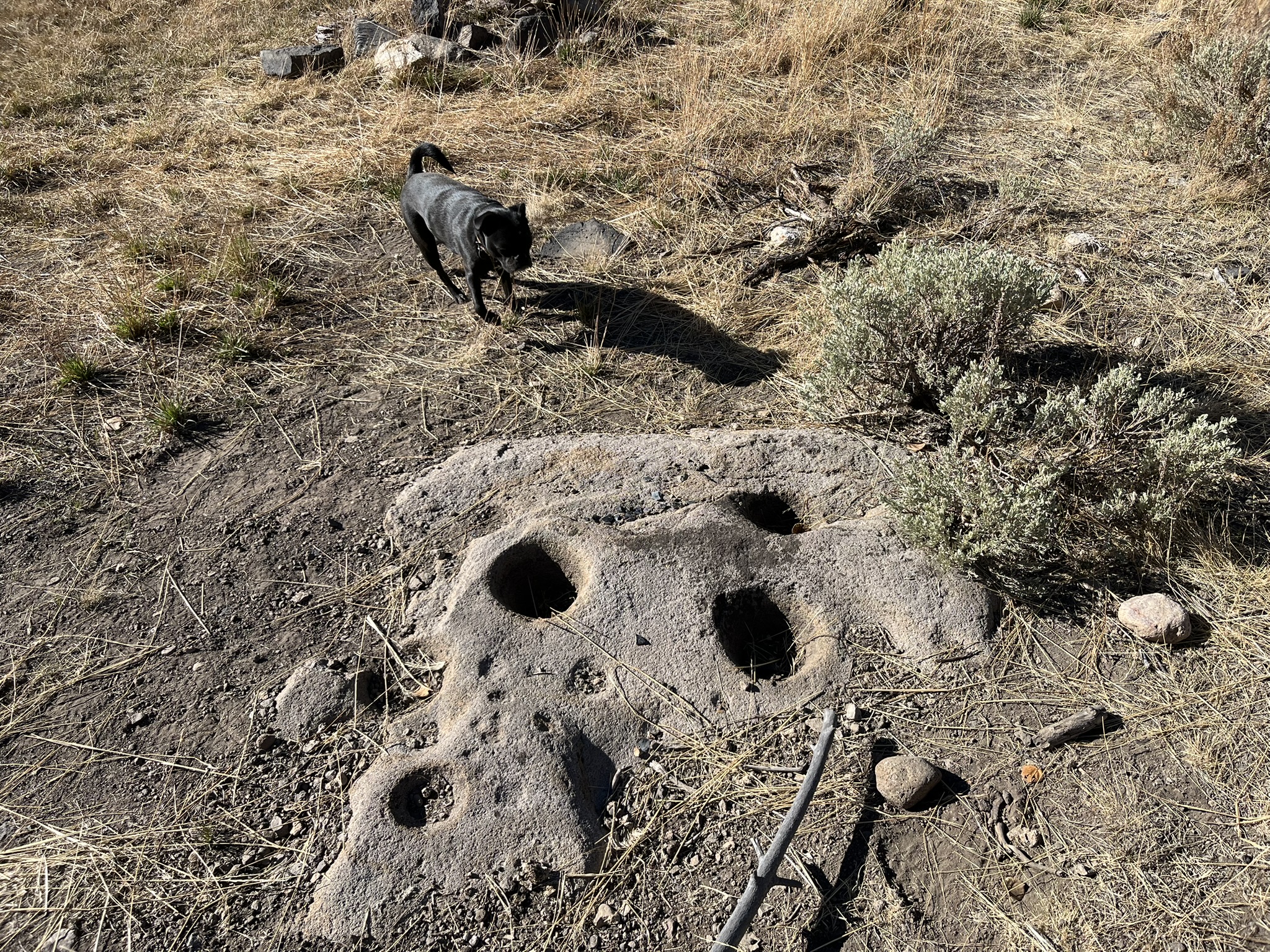
It was an ancient Indian grinding stone, where wild grains and such were ground into flour. While we were there a pickup drove up and the driver asked a bit about our interest in the site. He was a contractor to document the status of various historical and cultural sites. After he was convinced that we were not collectors, he said that there was an obsidian arrowhead very close by on the ground.
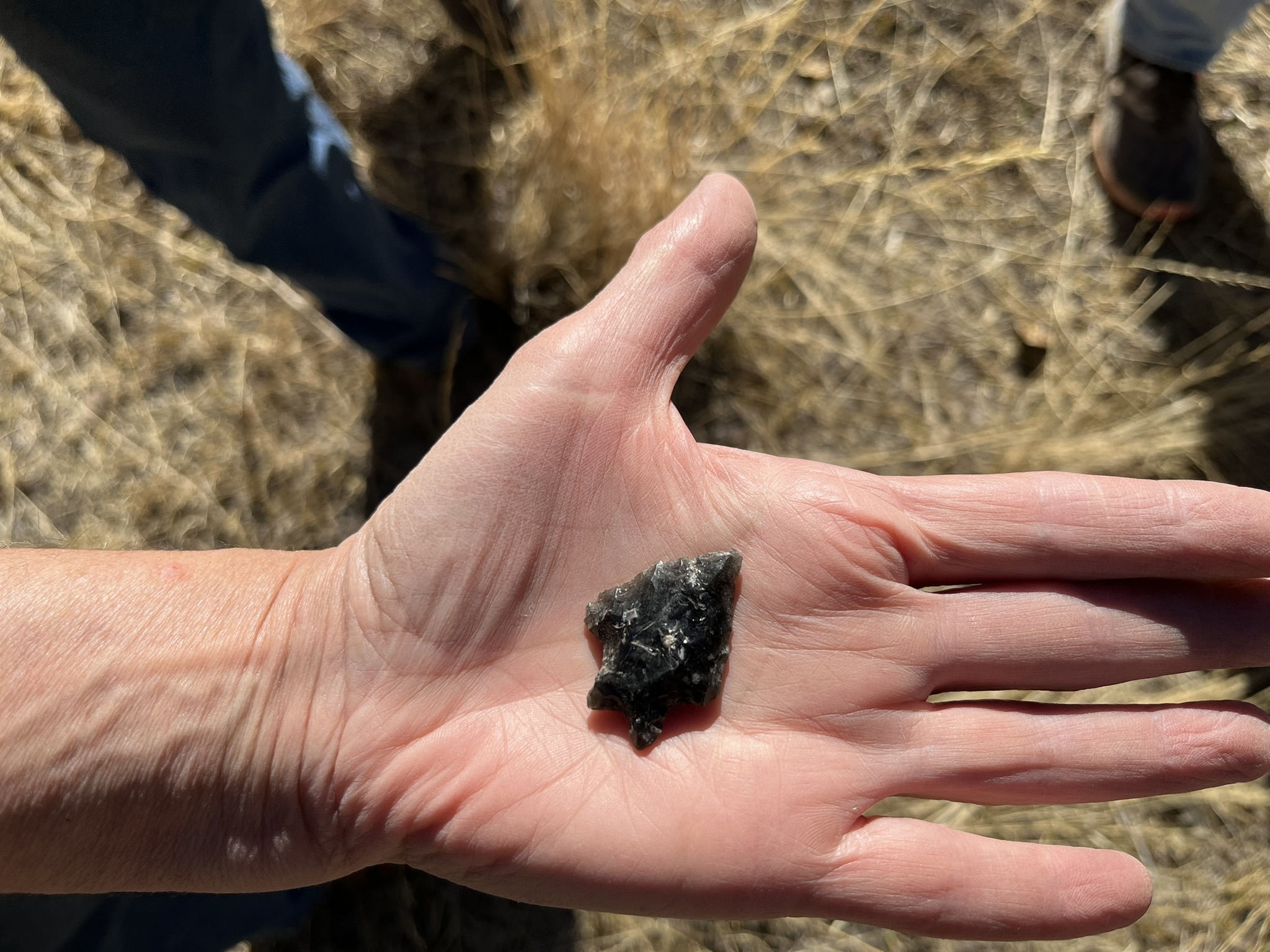
Eric’s wife Judy found it, and it was a gem. She hid it again under a grass tuft.
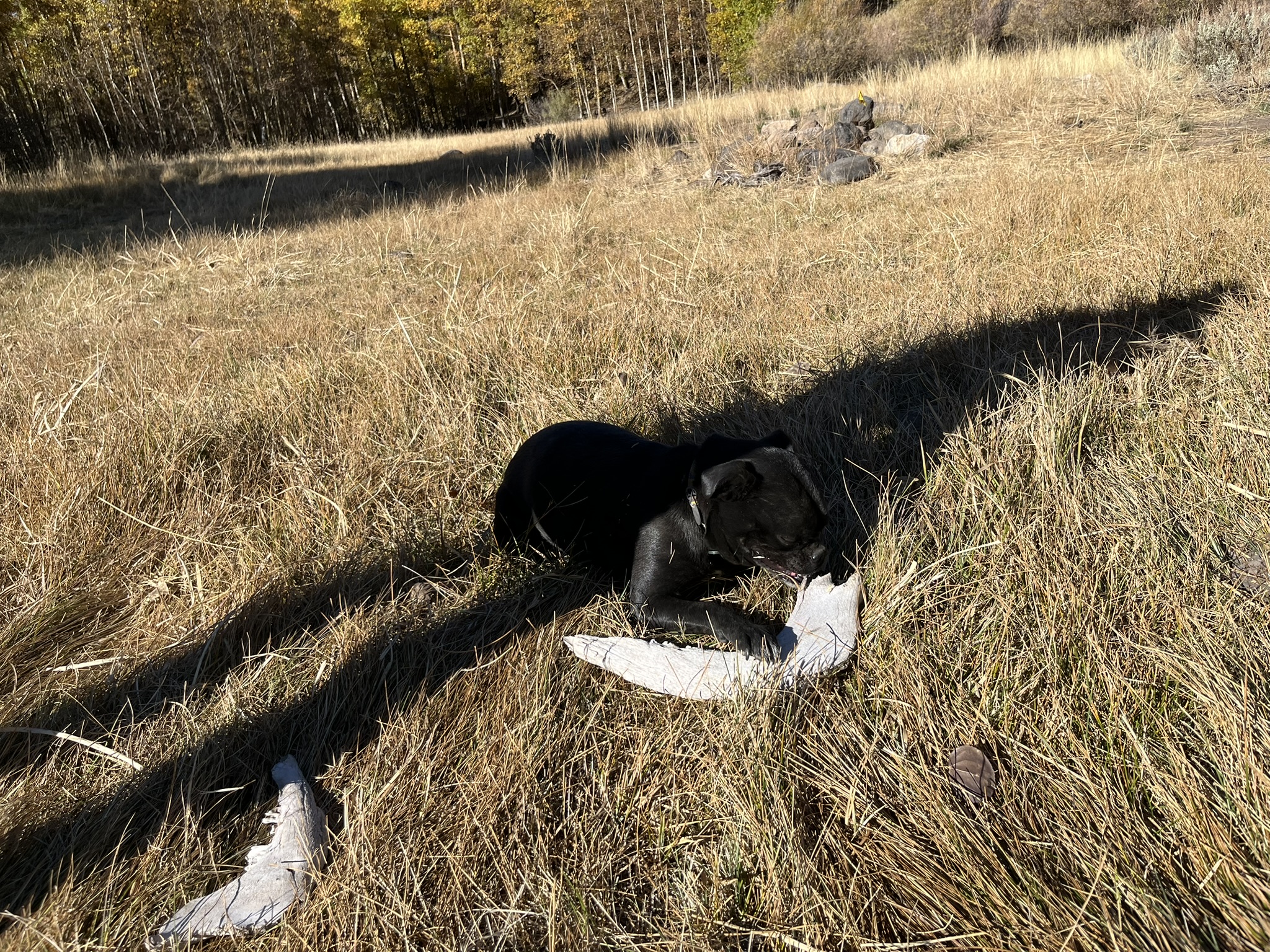
Meanwhile Wanda found an old cow or deer jawbone and set to chewing on it. It wasn’t protected.
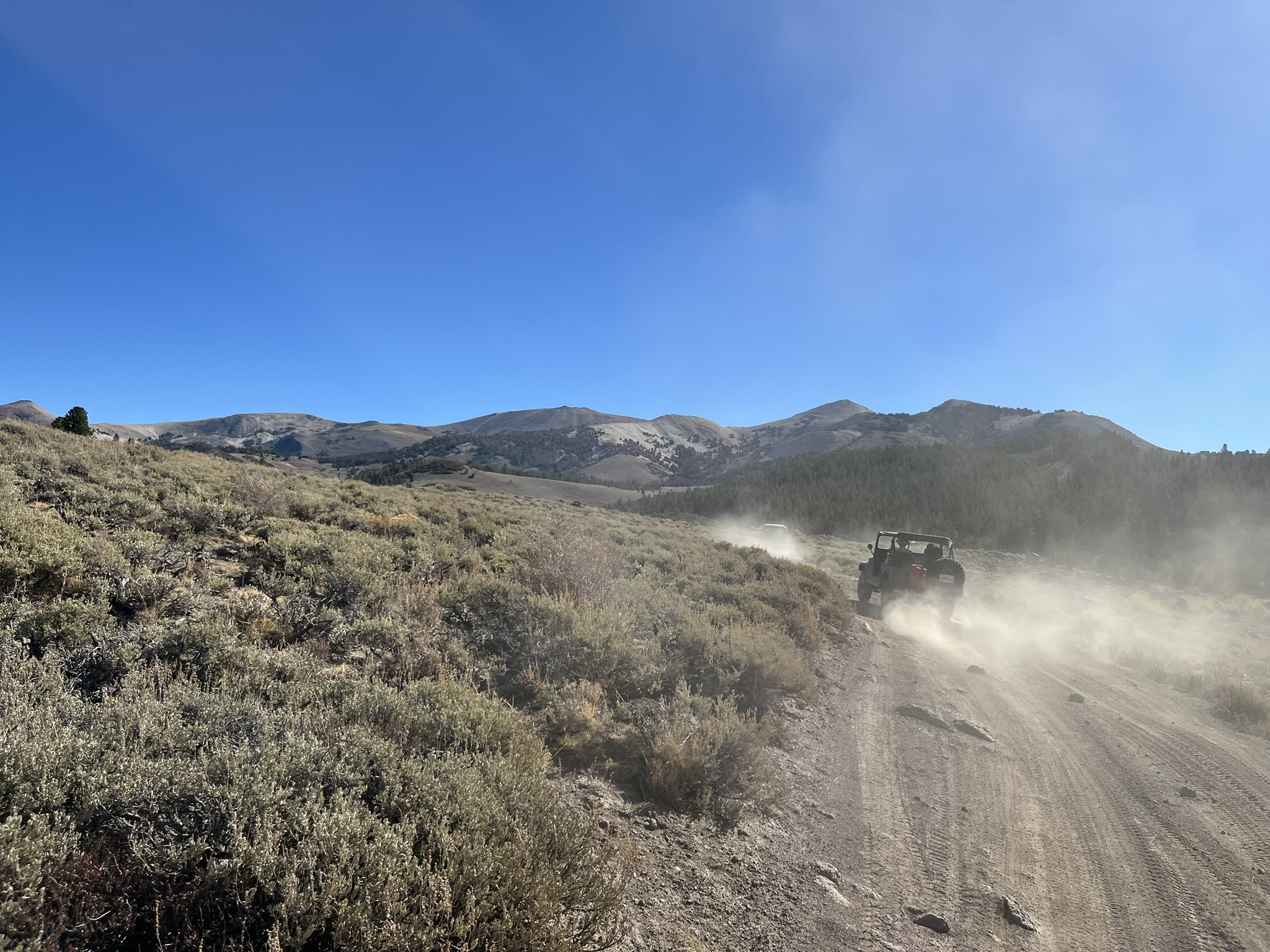
We set off for Mt. Patterson.
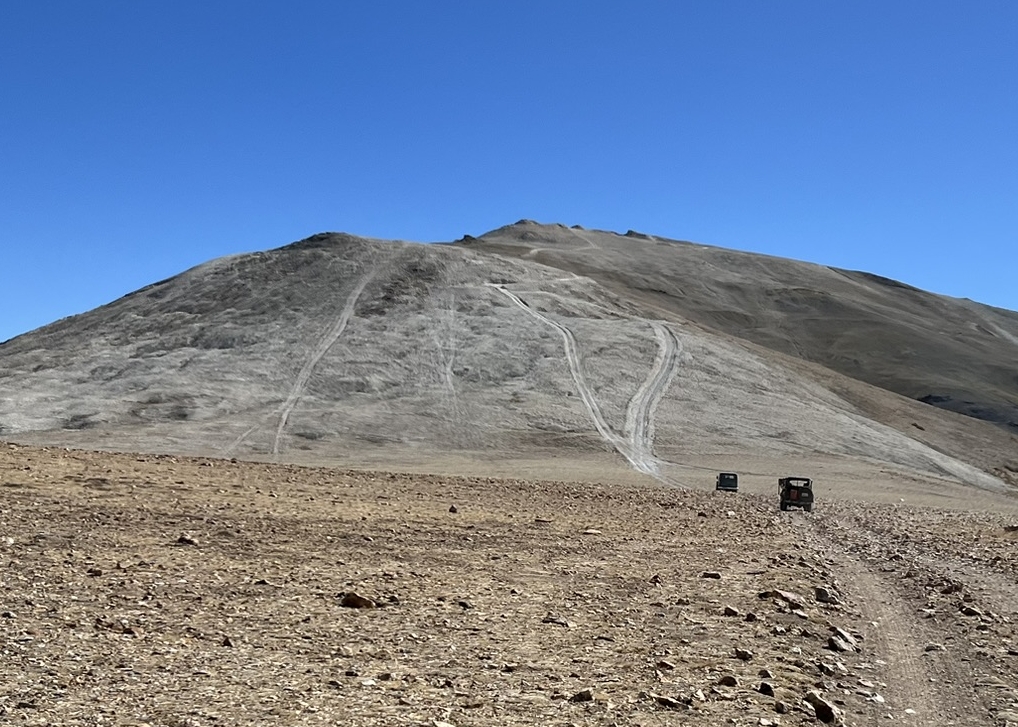
When we got to this high saddle before the final pull to the summit, I had a bit of an uh-oh moment. The tracks going up, especially the more direct one that branched off to the left, looked practically vertical from my perspective, due to the visual phenomenon of foreshortening, which makes all inclines and mountains look steeper than they are when we look at them straight on. Somewhat curiously, due to the lenses in cameras, that effect is not really there in the photographs, or nearly not as much so. It looked forbidding to me at the time, especially since my Jeep is not geared as low as it ideally should be.
But we put that off for the moment, as Kurt decided to take us down a side spur to an old mining cabin. He didn’t know just how steep it was, so I decided to leave my Jeep parked there and ride down in his Willys wagon, something I’d been hankering to do anyway.
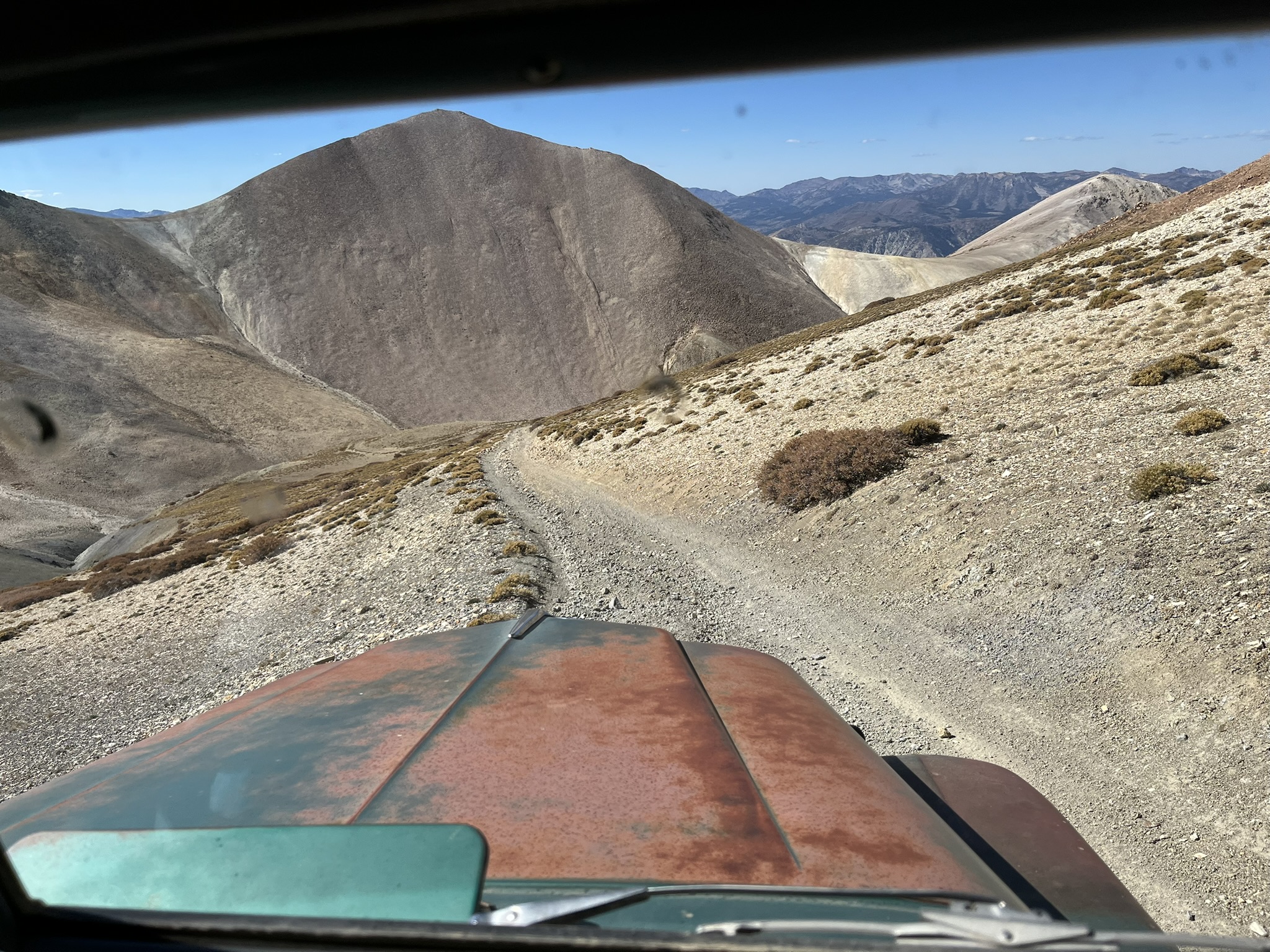
It turned out to be pretty steep, but not problematically so.
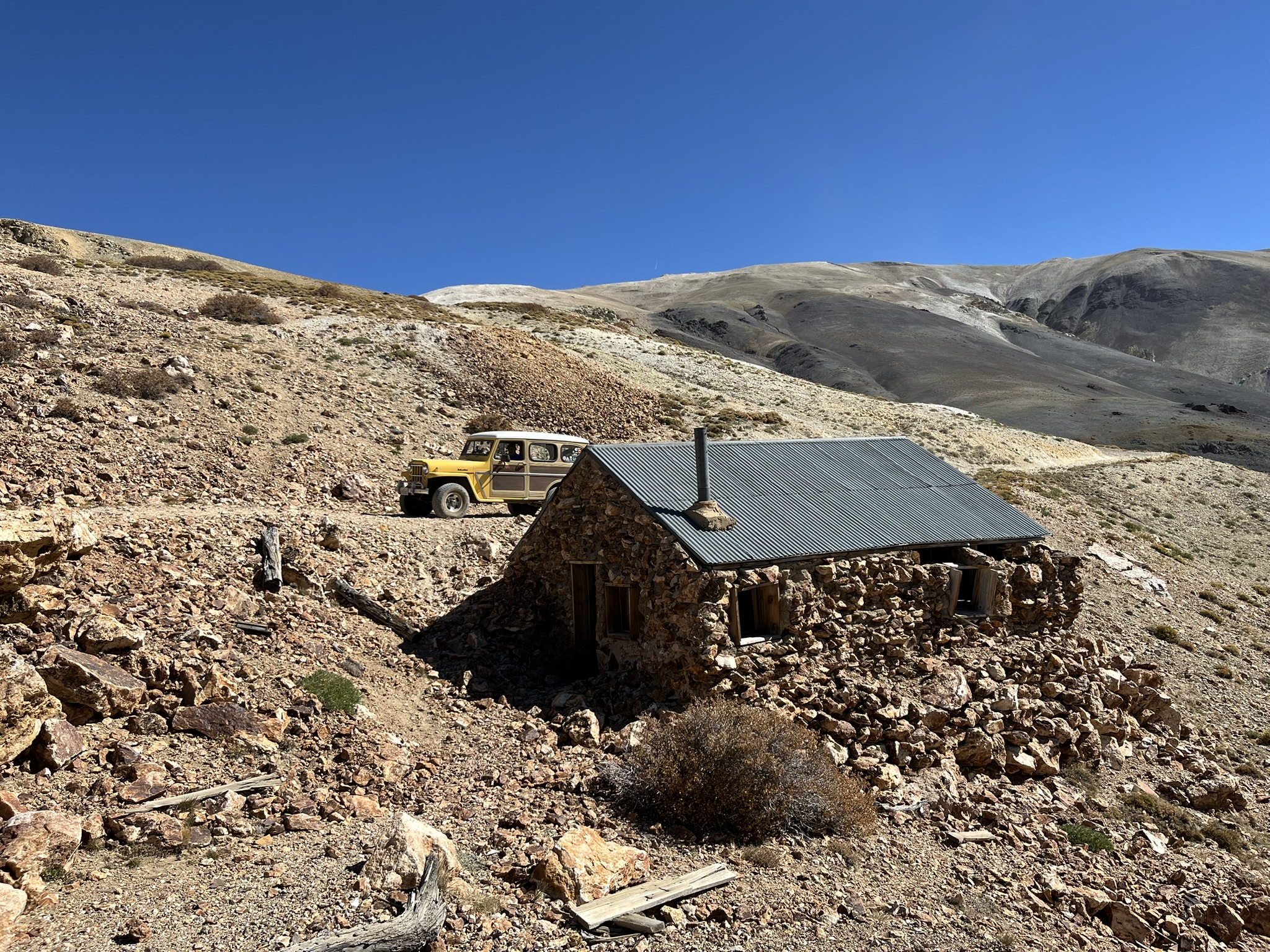
And what a gnarly old stone cabin it was.
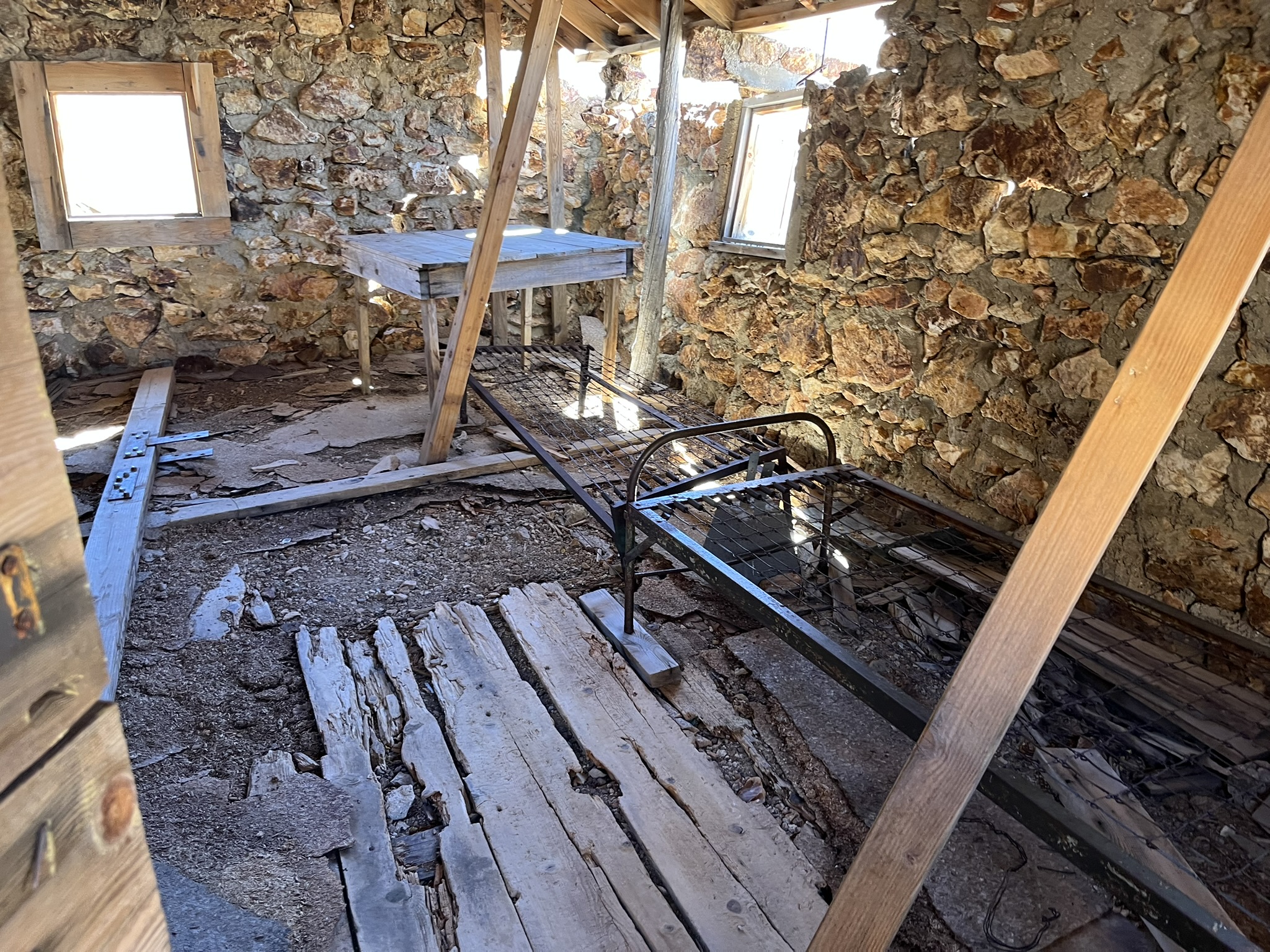
There were still a couple of bed frames and a table inside, as well as some shoring to keep the roof from collapsing. The stone wall on the far right is definitely leaning way out and at risk of falling over.
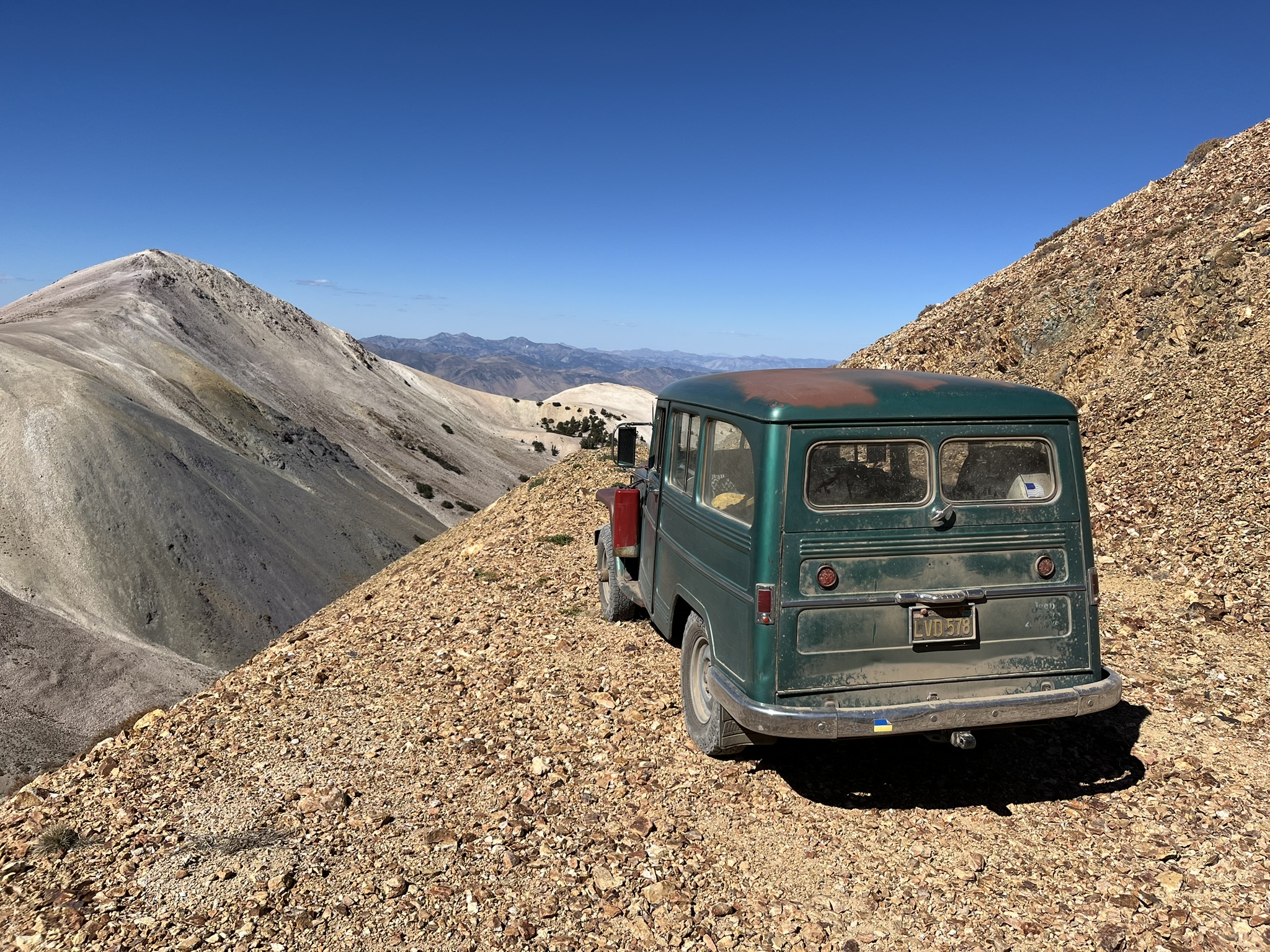
The geology of this Sweetwater Range, which is across the valley from the Sierra, is also very different, and has an almost Mars-like quality to it. Very stark.
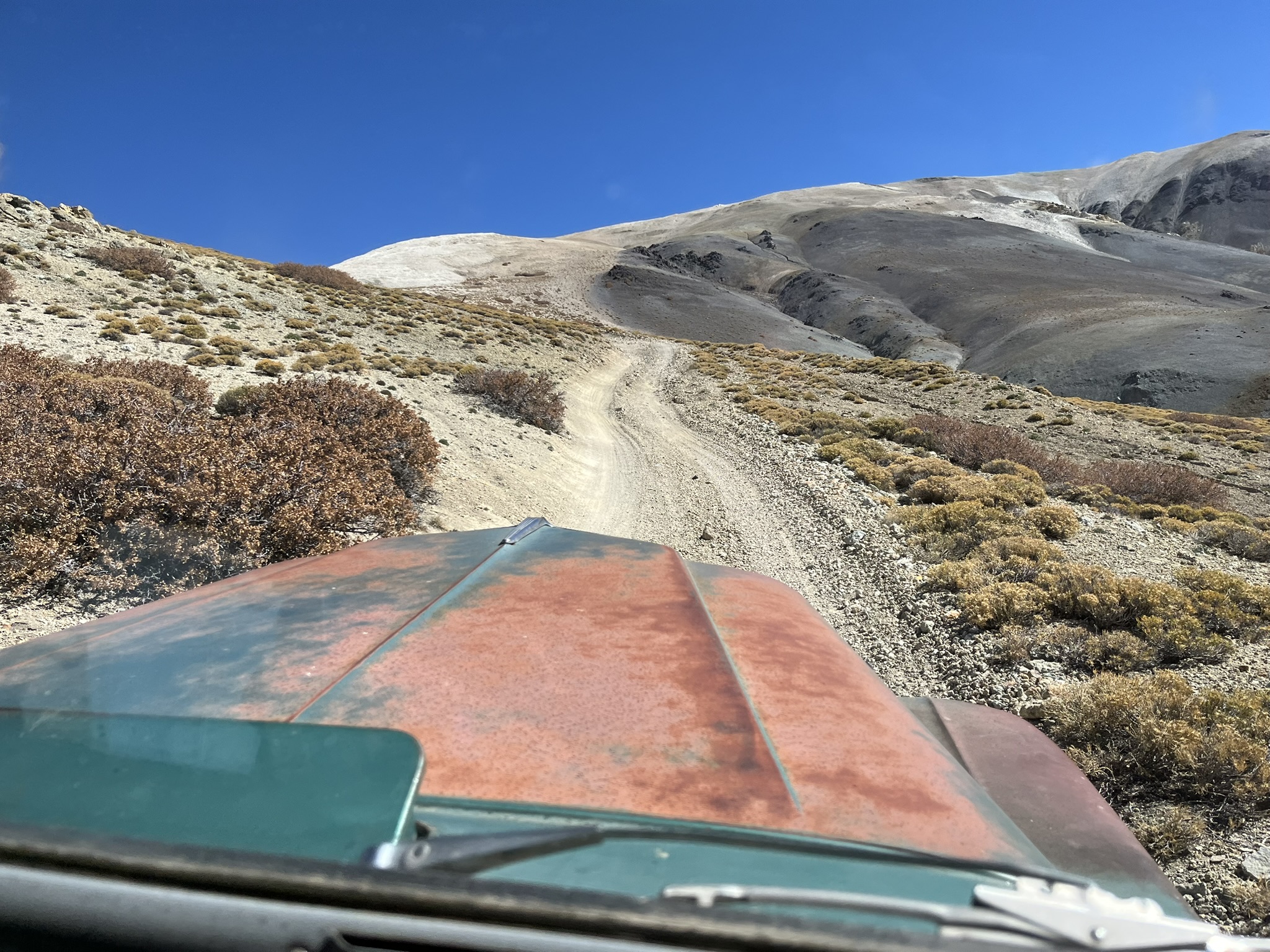
Kurt’s wagon had no problem getting back up, and the 226 flathead six made sonorous sounds through its glass pack muffler as it pulled hard. I love the sounds of all engine configurations, from singles to V12s, but the inline six does have perhaps the most musical purr of them all.
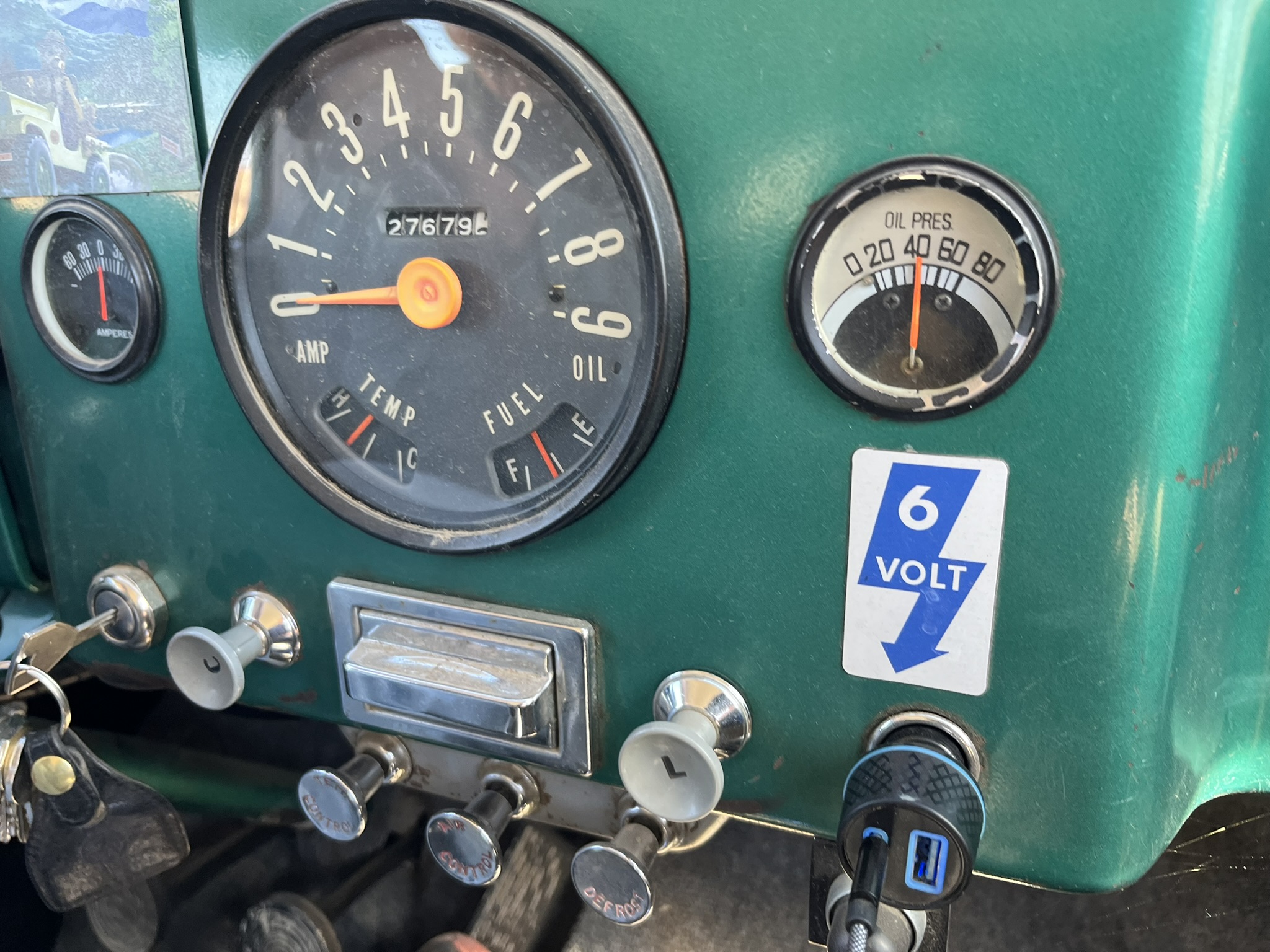
As I mentioned previously, Kurt’s wagon is stock, down to the 6V electrical system. I love this rig. But I do like being in an open Jeep for that more connected feeling with the outdoors. That’s a major part of the attraction for me. Unfortunately I couldn’t put the windshield down on mine as it lacks some of the hardware. I was too distracted to order that in time for this trip.
Rich and his heavily modified (Chevy 4.3 V6, etc.) flat fender Jeep made the steep climb look easy. As does the camera lens, which also makes the grade look less steep. Take my word for it; it was a pretty stiff grade.
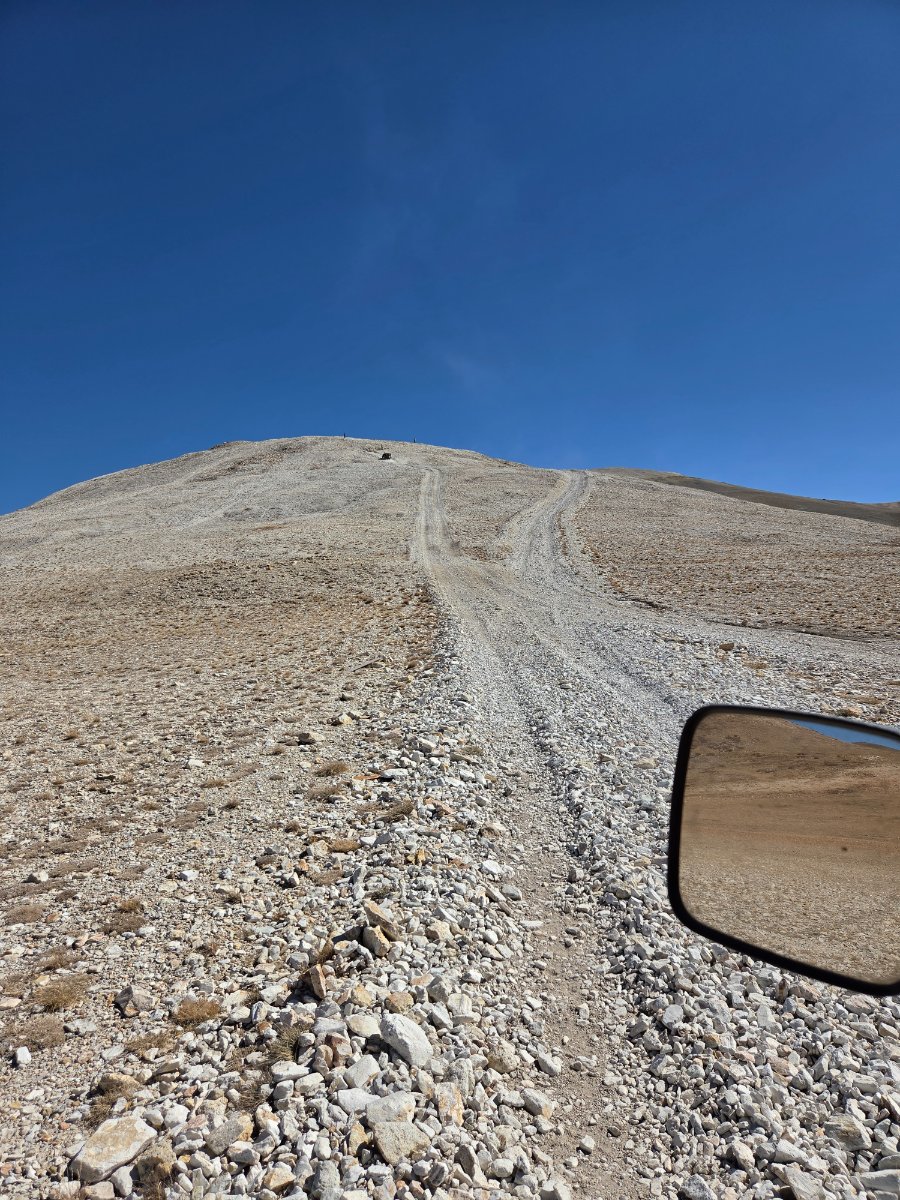
Eric in the M38 went next. I was asked by his wife Judy to video it on their phone, so this photo is also by Kurt. I was curious to see how his F134 powered M38 would do, although he did have 5.38 axles and smaller tires. When he bogged down on the really steep part, I gulped. If he couldn’t make it, then surely mine wouldn’t either. He rolled back a ways to where it was less steep and restarted and did make it up.
Based on his bogging down, I chickened out and took the slightly less steep (but rockier) right trail. I put the hammer down pretty hard and kept my speed up despite the rocks. The trickiest part turned out to be that left hand turn, which was steep and rocky. Given the poor turning radius of its front axle, I wondered if I could make it without having to do a three point turn. I nailed it just right; it was actually the moment I was most proud of.
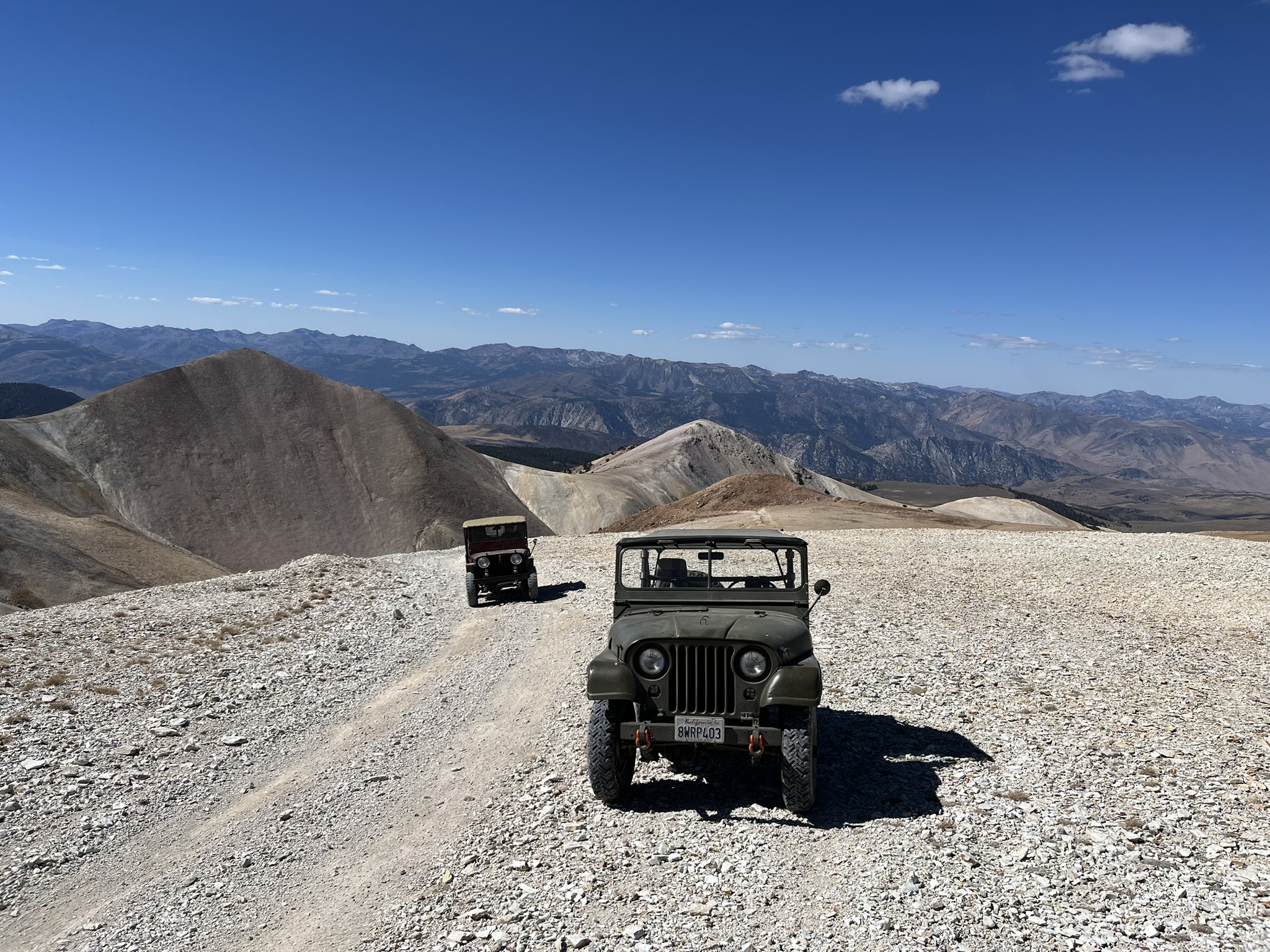
Well, it turns out that Eric tried to climb that grade in Low range second gear, maybe even in second overdrive! No wonder he bogged down. Jeez; if I’d known that I would have definitely taken the straight route. Oh well. John’s CJ2A also made it up without any difficulty.
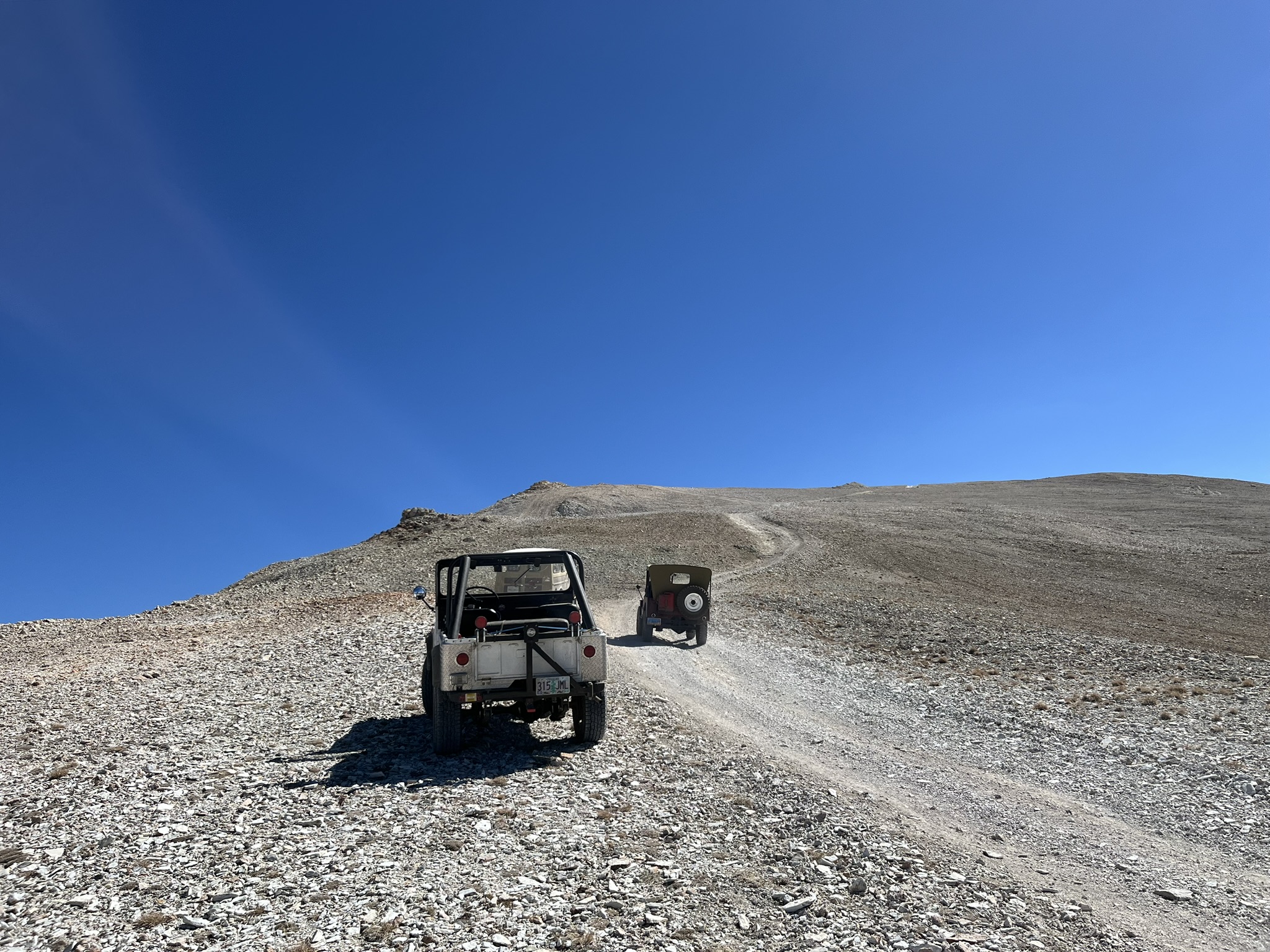
Off to the final pull to the summit.
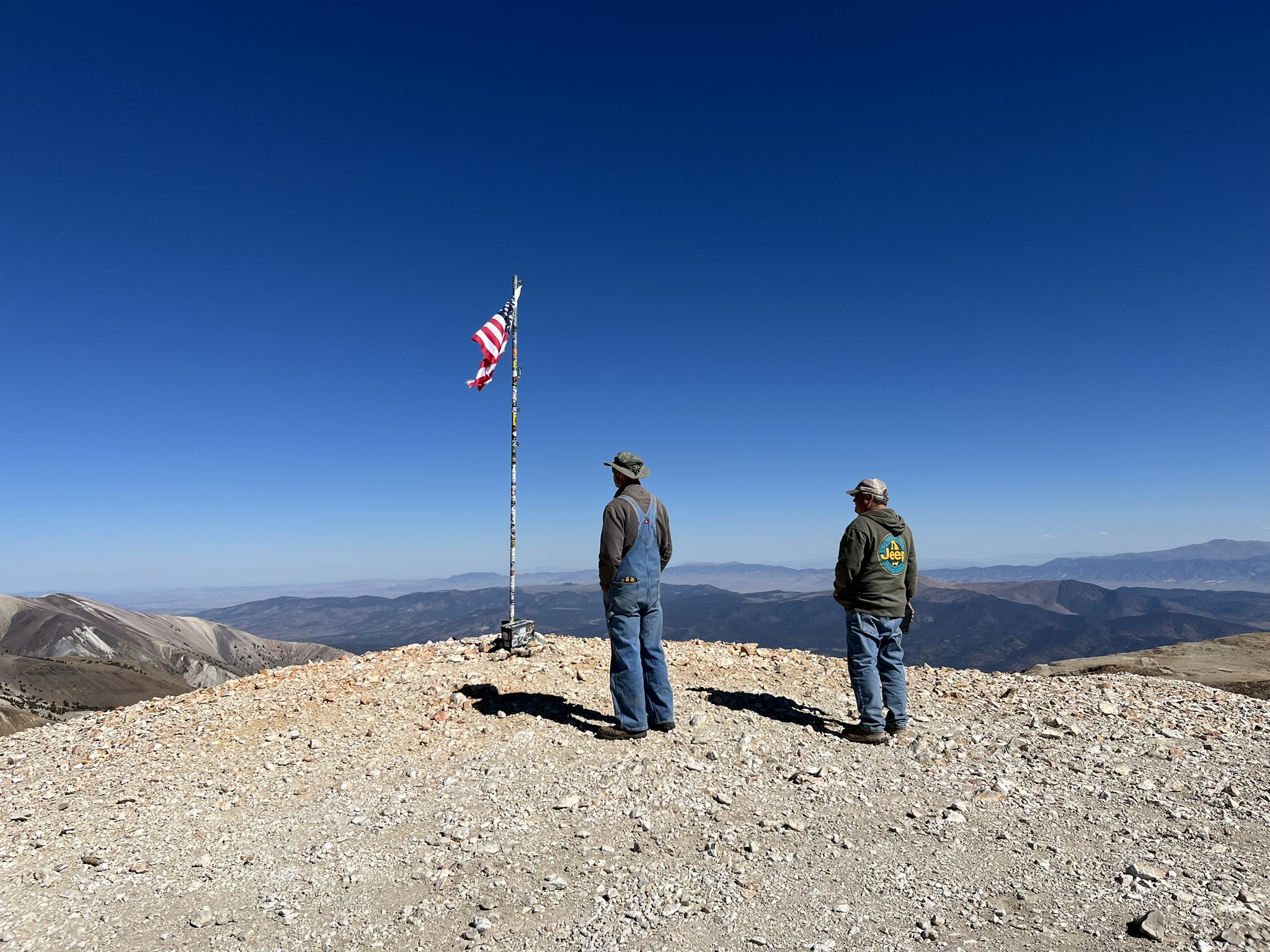
There was a flag on the summit (11,665′) and a register. The views were stellar; this is looking deep into Nevada.
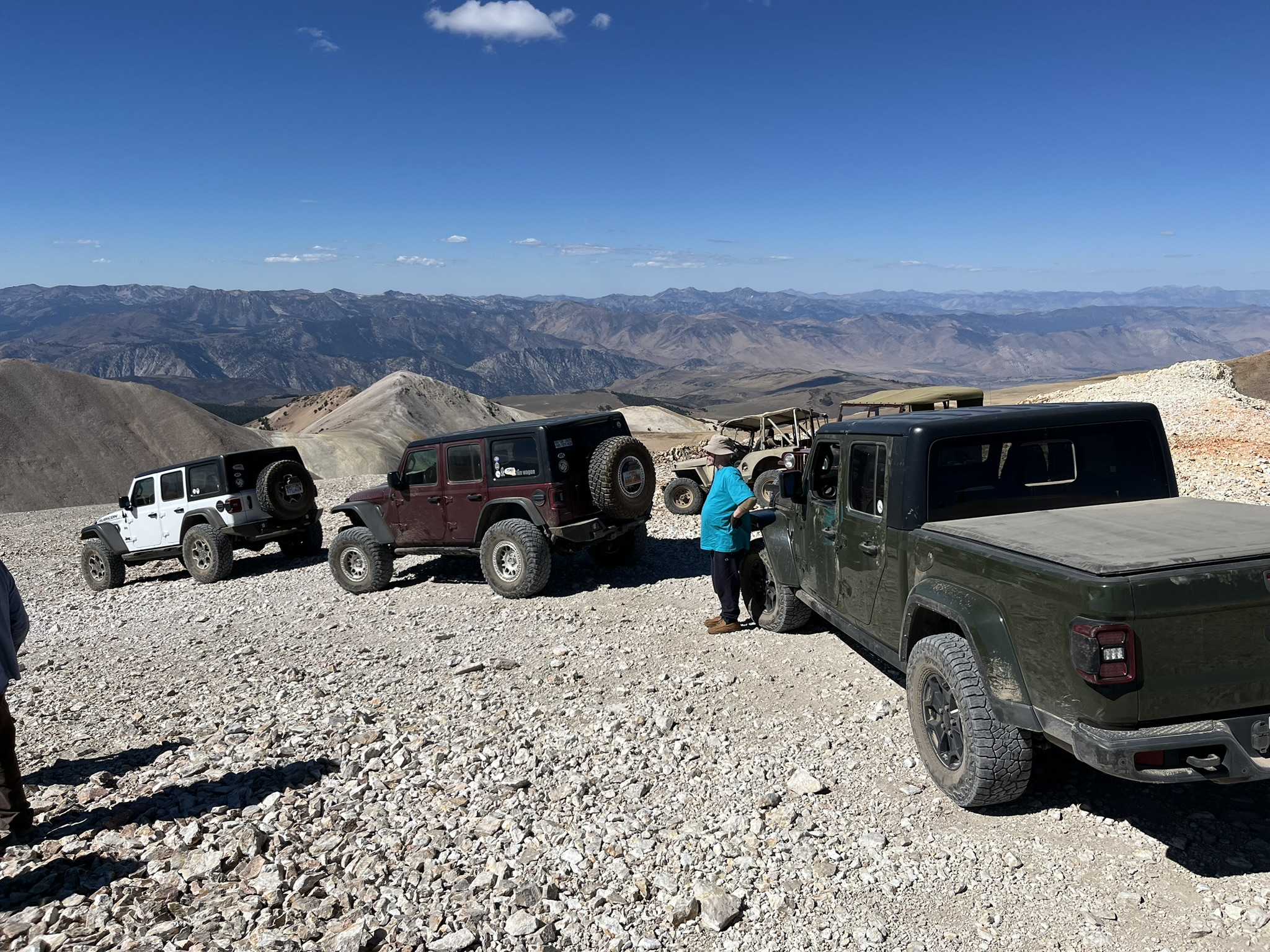
We were not alone; a group of three very modern Jeeps was just getting ready to head down as we arrived. The difference between the old ones and the new ones is pretty stark.
I understand the appeal, but to me the real fun of it is being out fully in the open and piloting a genuine antique, with all of its foibles and limitations.
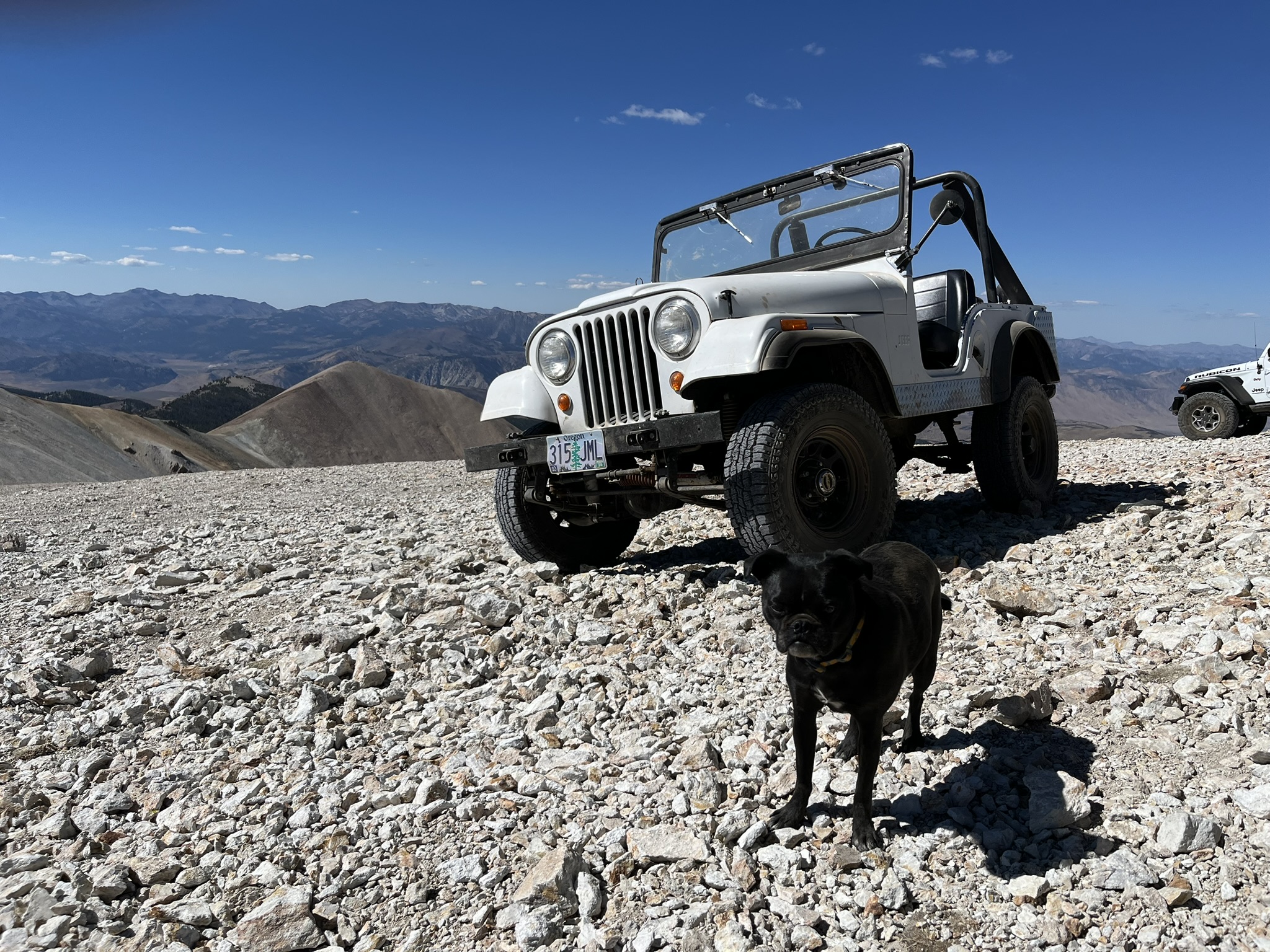
Needless to say, I was pretty stoked. In the course of just a bit over two weeks, I had gone from making an impulsive decision to making it to the top of a challenging drive in a vehicle that I was still learning much about.
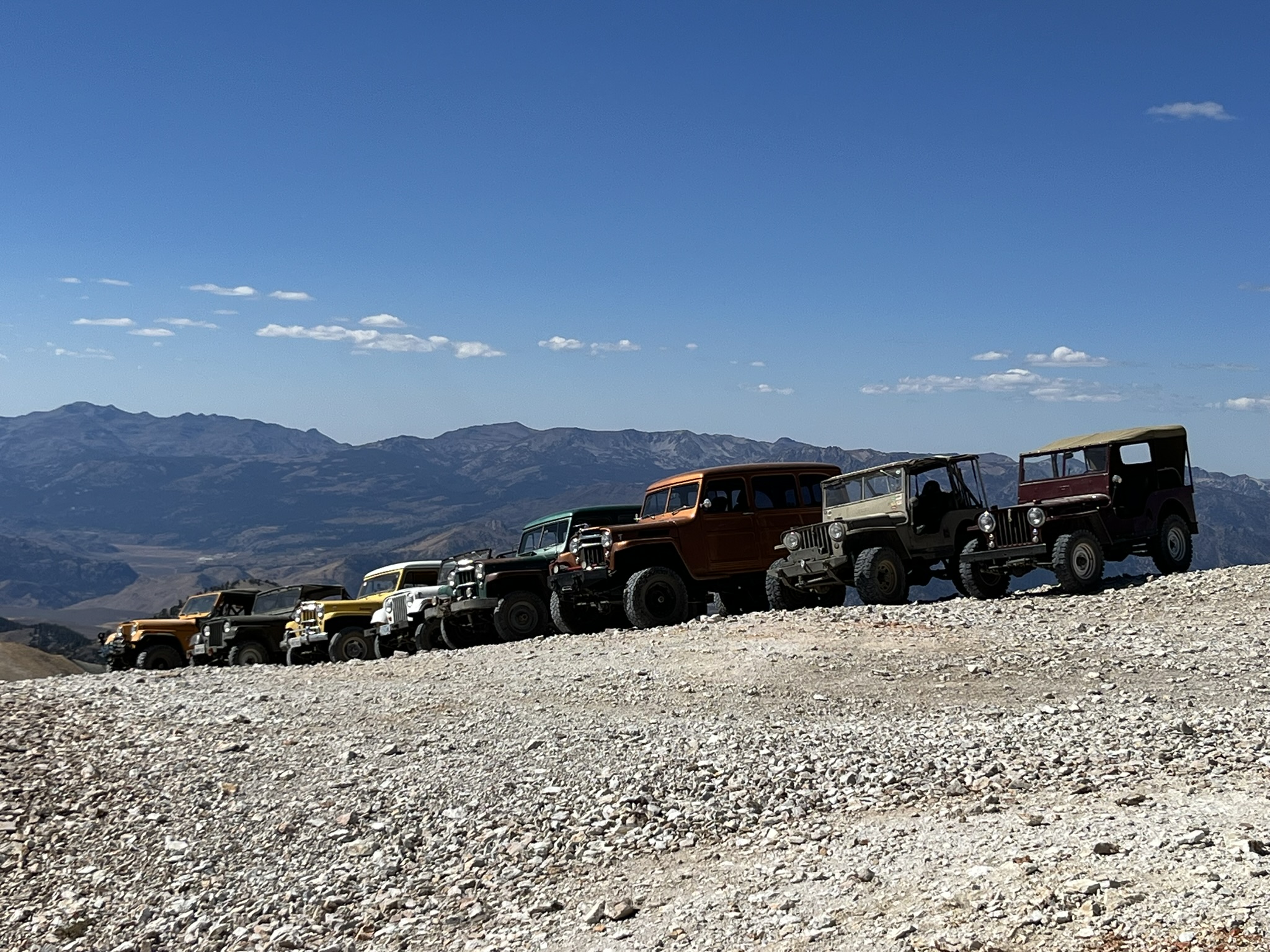
We lined up for the obligatory photo-op. Alan’s Jeep was missing, due to its broken electric fan, and Bob had decided to go home due to the steering issue in his wagon, but John’s CJ-2A made a welcome addition.
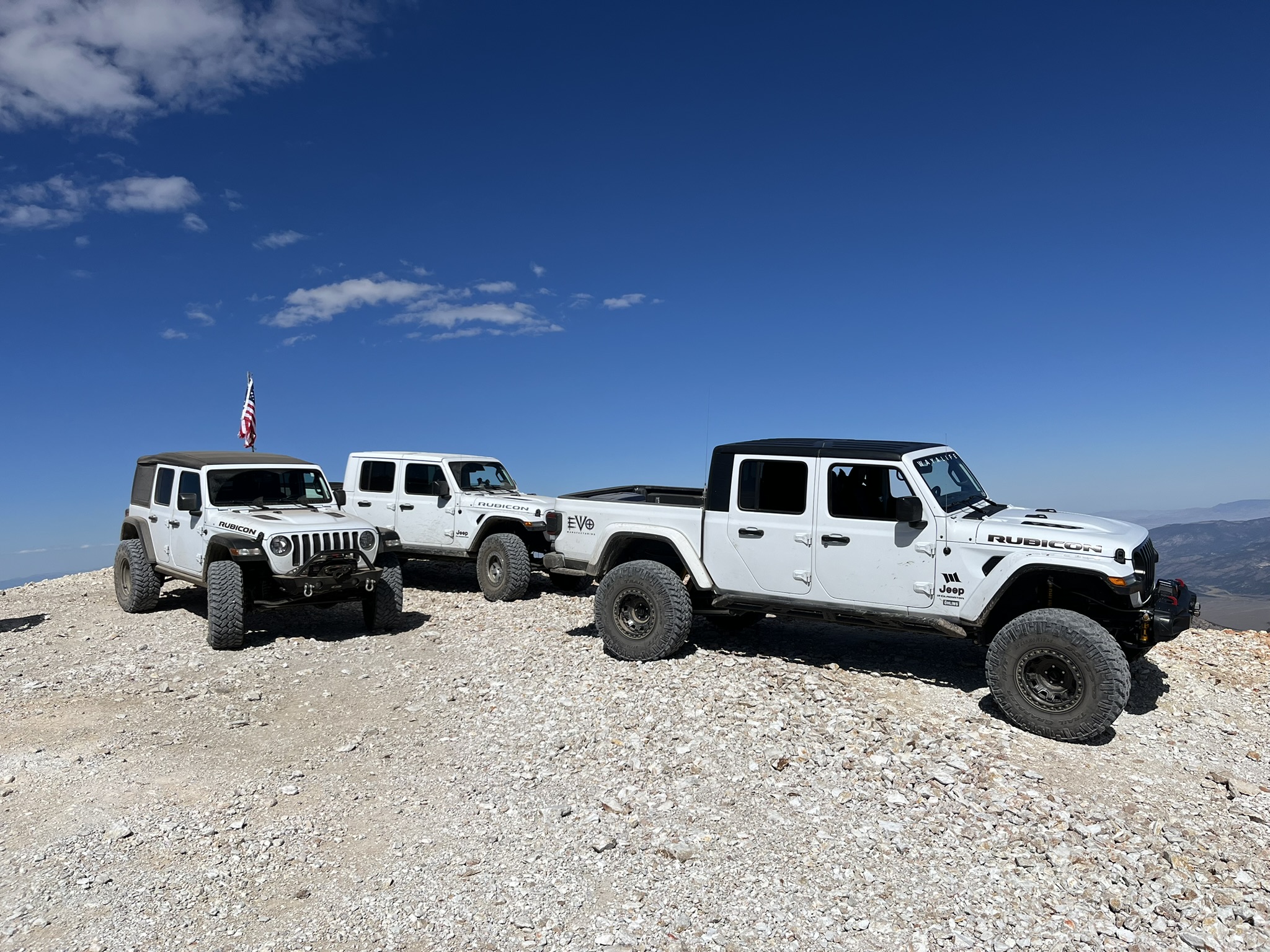
We ate some lunch and hung out and as we were getting ready to go, another group of three very recent Jeep Rubicons arrived. I imagine it was a rather effortless walk in the park for them. Just point and go; no worries as to whether their 75 hp four will make it up the steep grade.
Actually, they were a nice group of Jeepers who appreciated our old ones. One (or more) of them owned several vintage Jeeps, including an FC-150. Driving that up here would be a ball.
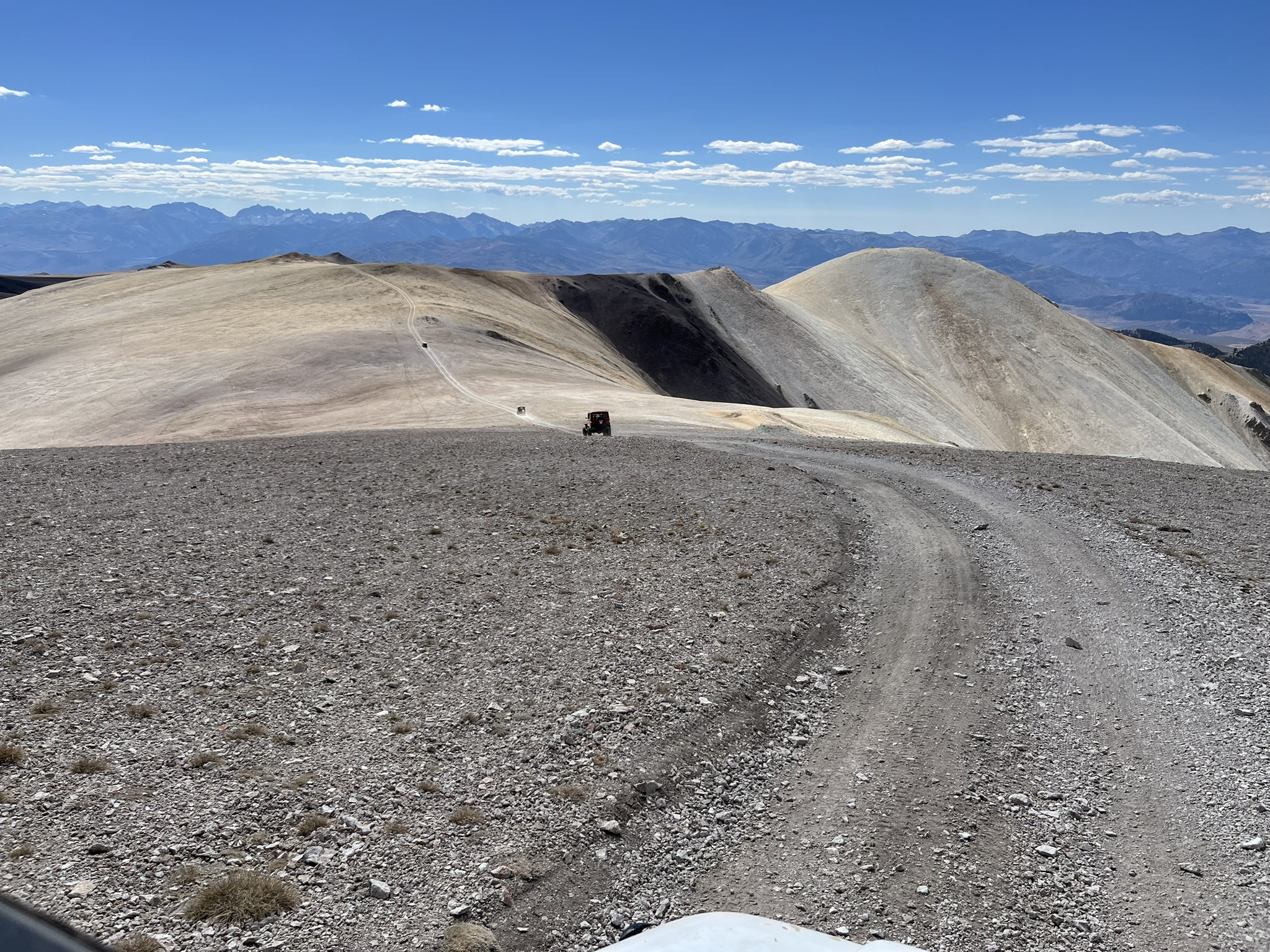
Time to head on, by continuing on to the far side of the range. The Sierra made such an impressive backdrop.
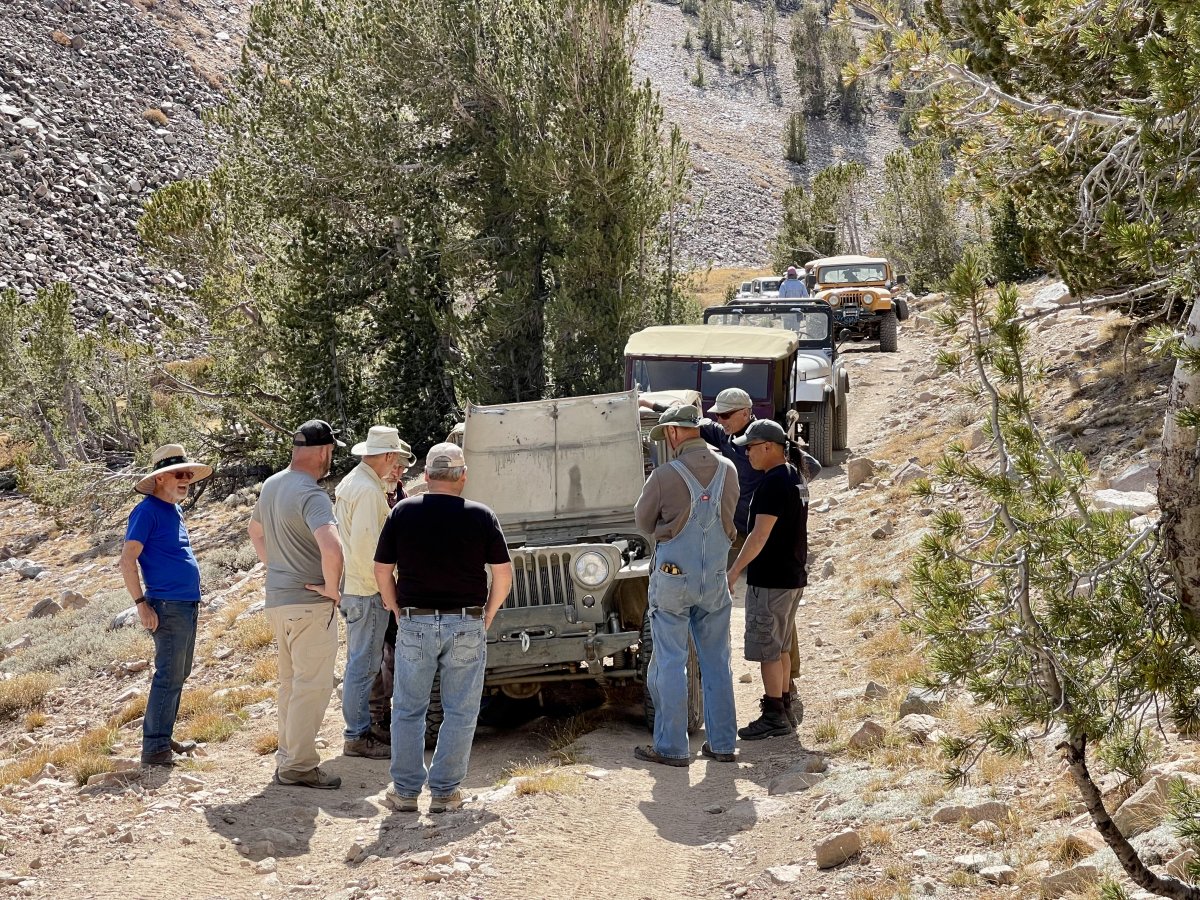
On the way down, Rich had another issue with his Jeep, which suddenly lost all electrical power. Thanks to lots of help, including one Electrical Engineer (Eric) the issue was quickly traced to the starter cable, which had rubbed off its insulation on the exhaust manifold and shorted out.
The trip over the Sweetwater Range required some more steep ascents before the final descent. This section is the serpentine, and since Alan was driving my Jeep for a spell, I was able to get a pretty nice video showing the rest of the group working its way up below us. This is the best video of the trip, so if you watch only one, this is it.
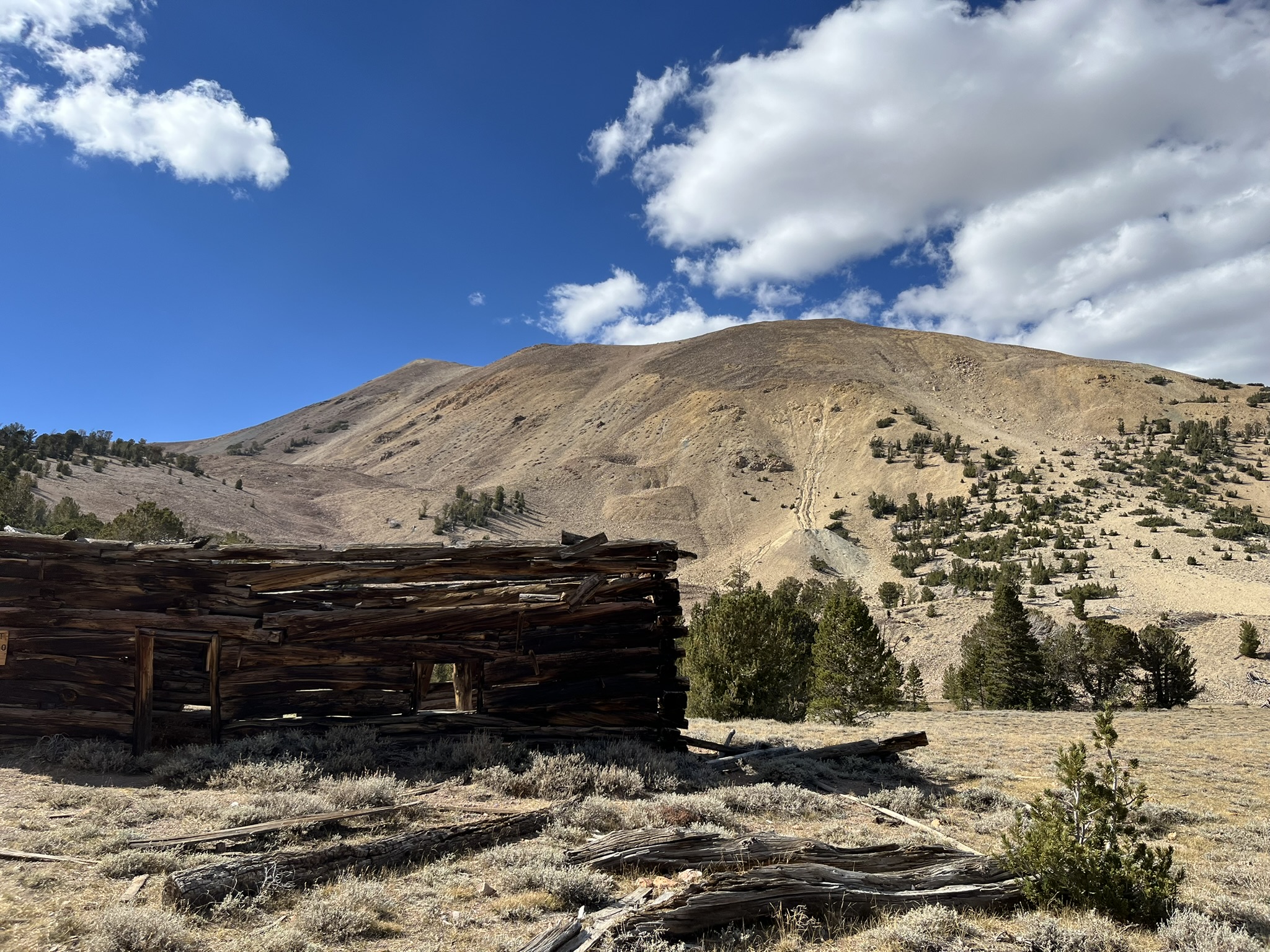
We stopped at Belfort, a mine active between 1880 and 1890. The actual mine and the tailings are clearly visible on the side of the mountain.
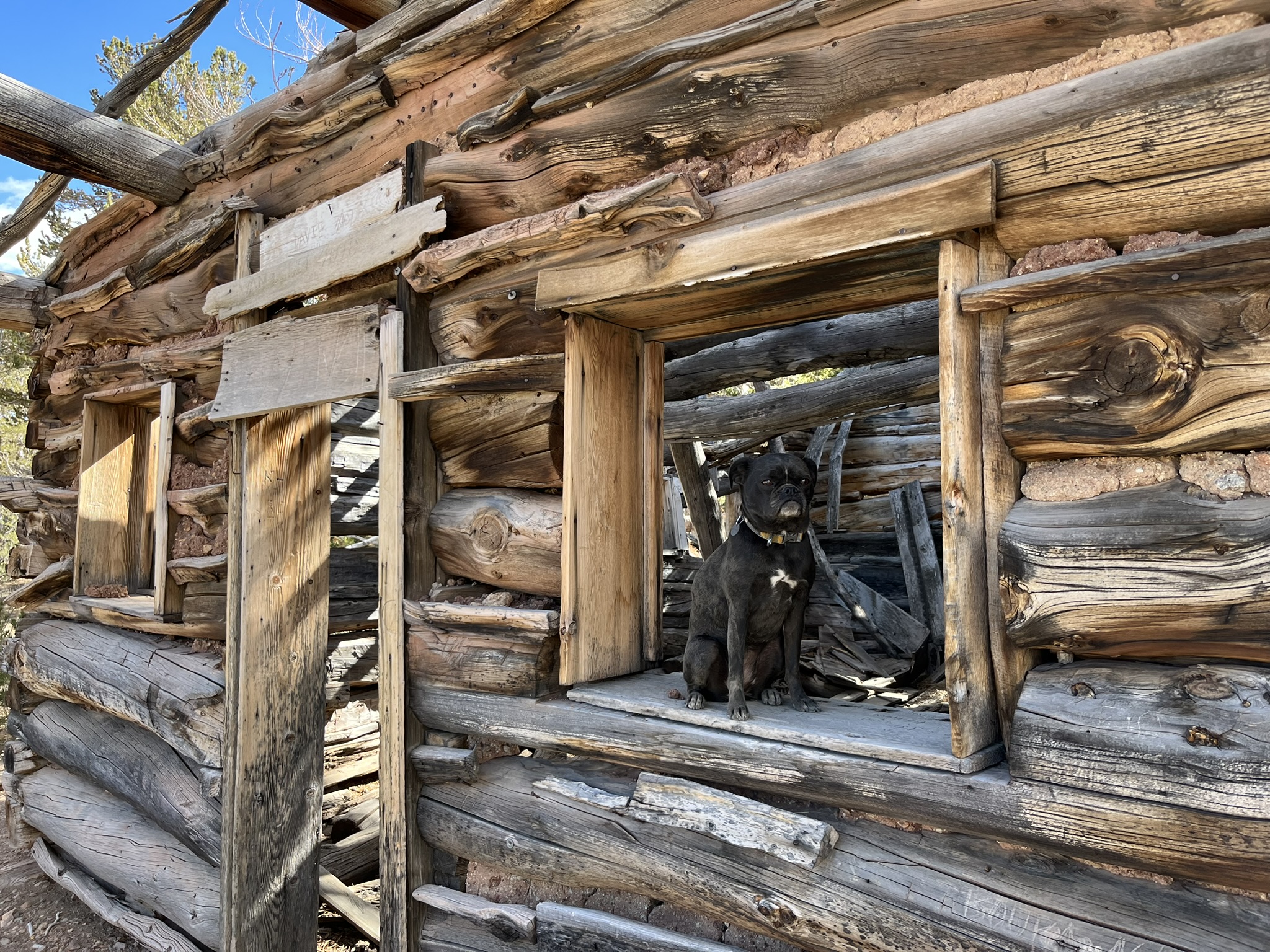
Can’t resist another photo-op with Wanda. She was getting a bit dusty by this point, but she was a great back seat companion, and always ready to hop in for more.
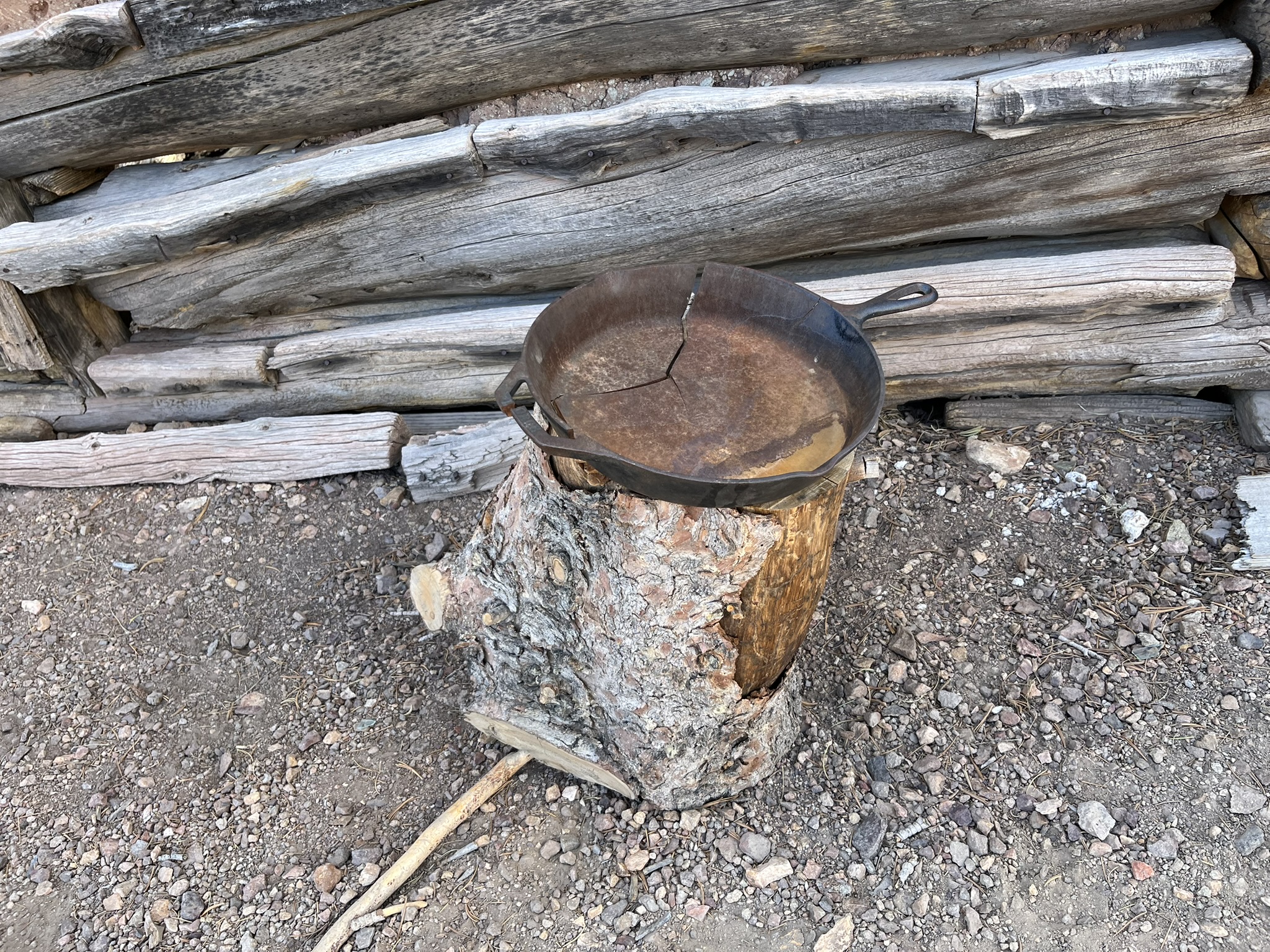
The frying pan was cracked but still there.
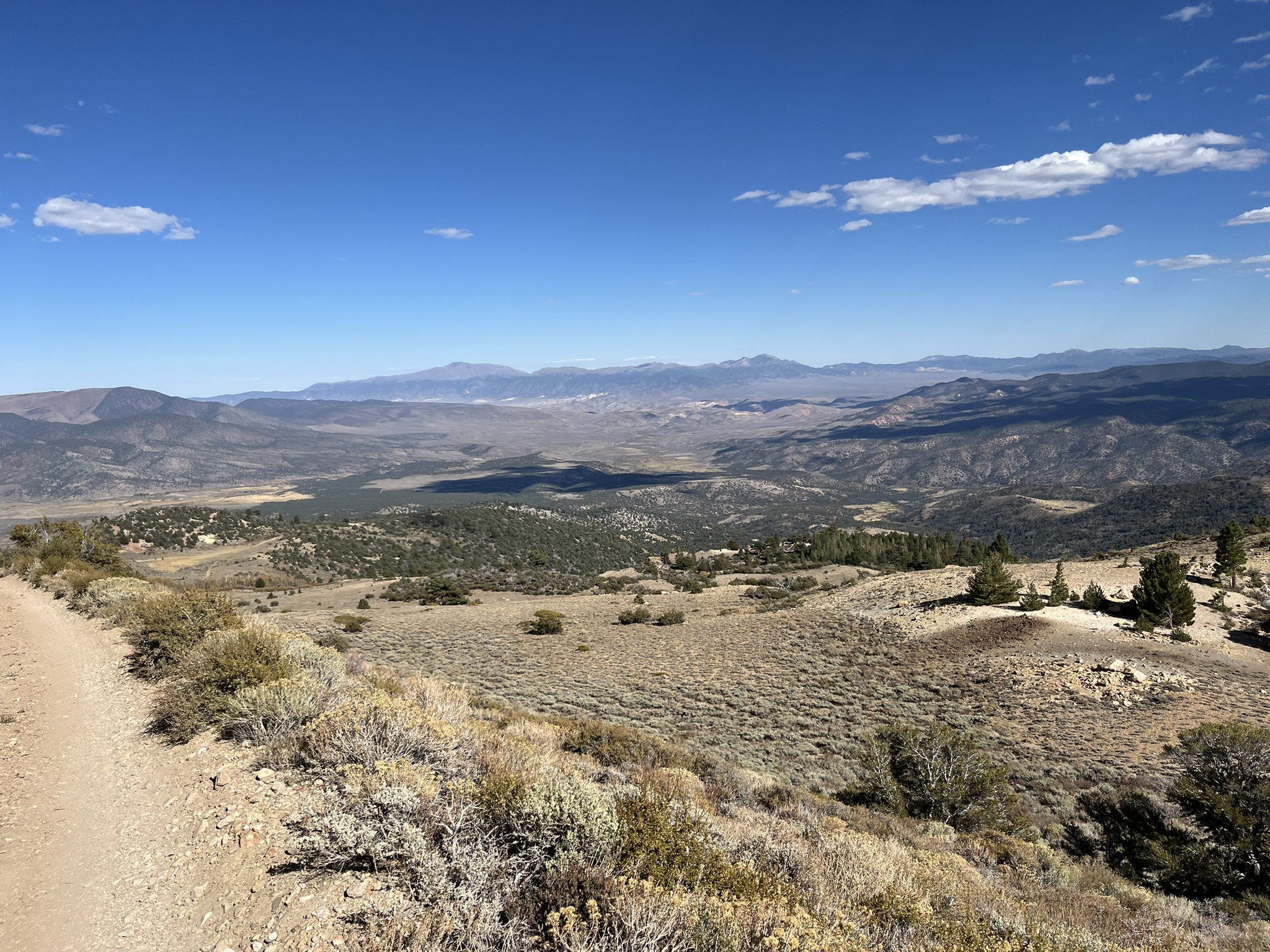
The rest of trip, through a section of Nevada, was uneventful. We retired to camp happy and pleasantly tired.
Friday, Oct. 9: “I’ve Got A Fan In The Back Of My Truck” And Another Drive
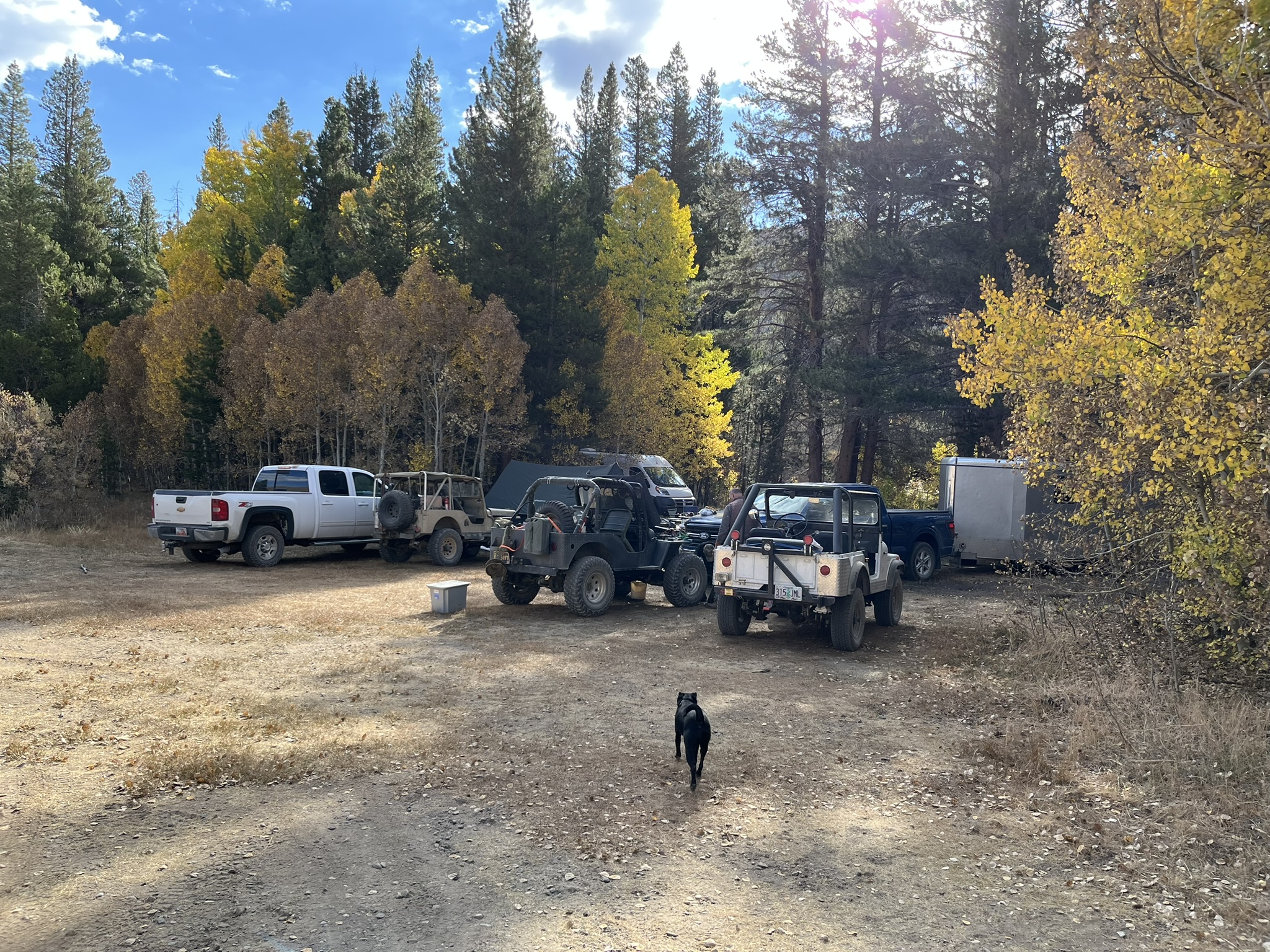
In the morning, Alan decided he was going to just pack up his Jeep (with the dead electric fan) into his 24′ cargo trailer and call it good. But then Rich said: “I’ve got an extra electric fan in the back of my truck”. Who would have thought? Got an extra engine back there too?
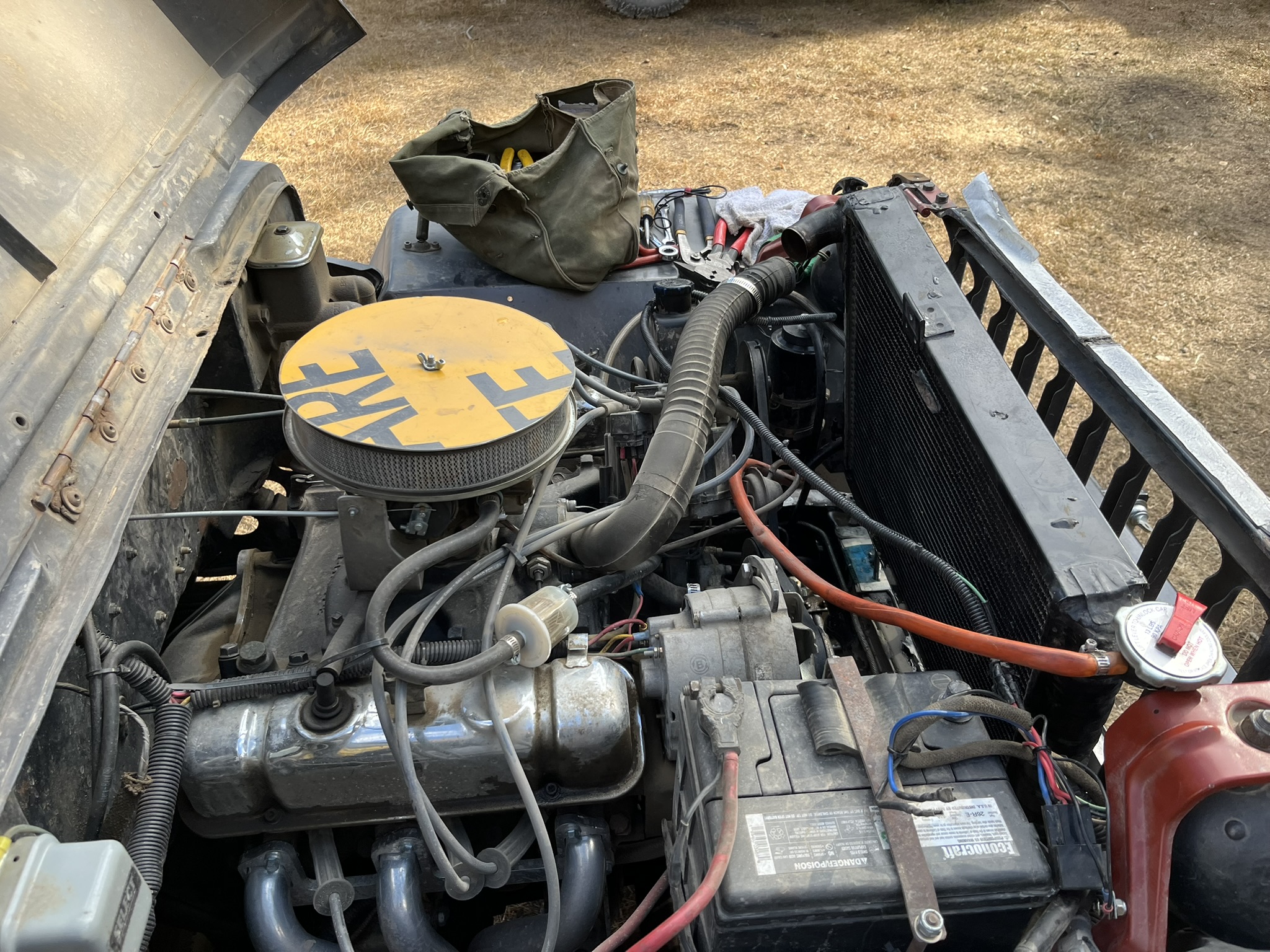
So Alan pulled his out and set about figuring out how to mount the new one, which was a bit different.
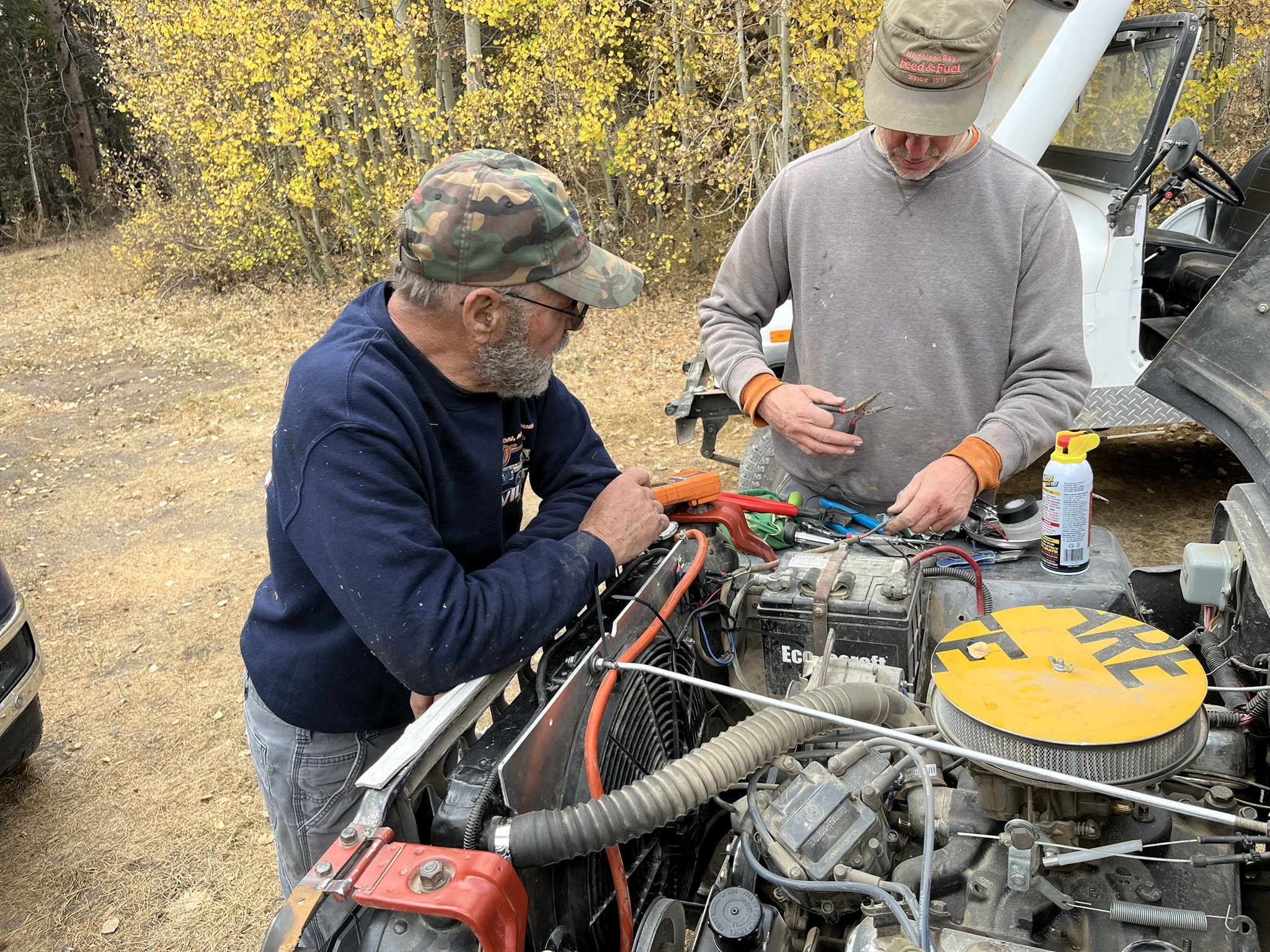
Not surprisingly, they managed to make it work and hooked it up. And it blew air. So after lunch we decided to go on another drive, just the three Jeeps, to check out some old mines.
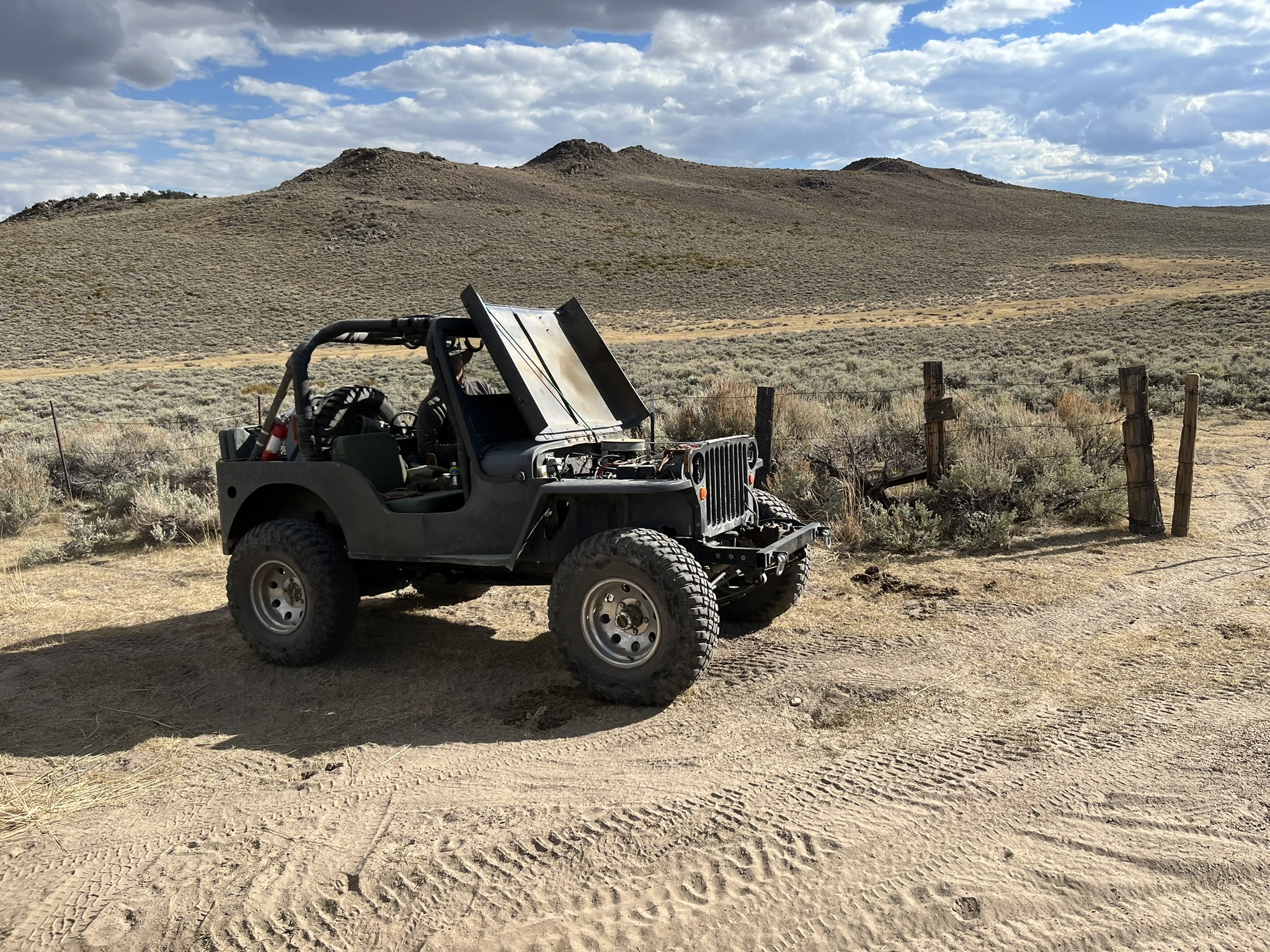
Turns out that the fan worked, but didn’t blow sufficient air volume, and Alan’s Jeep was running hot. He actually drove it up a steep hill with the hood open.
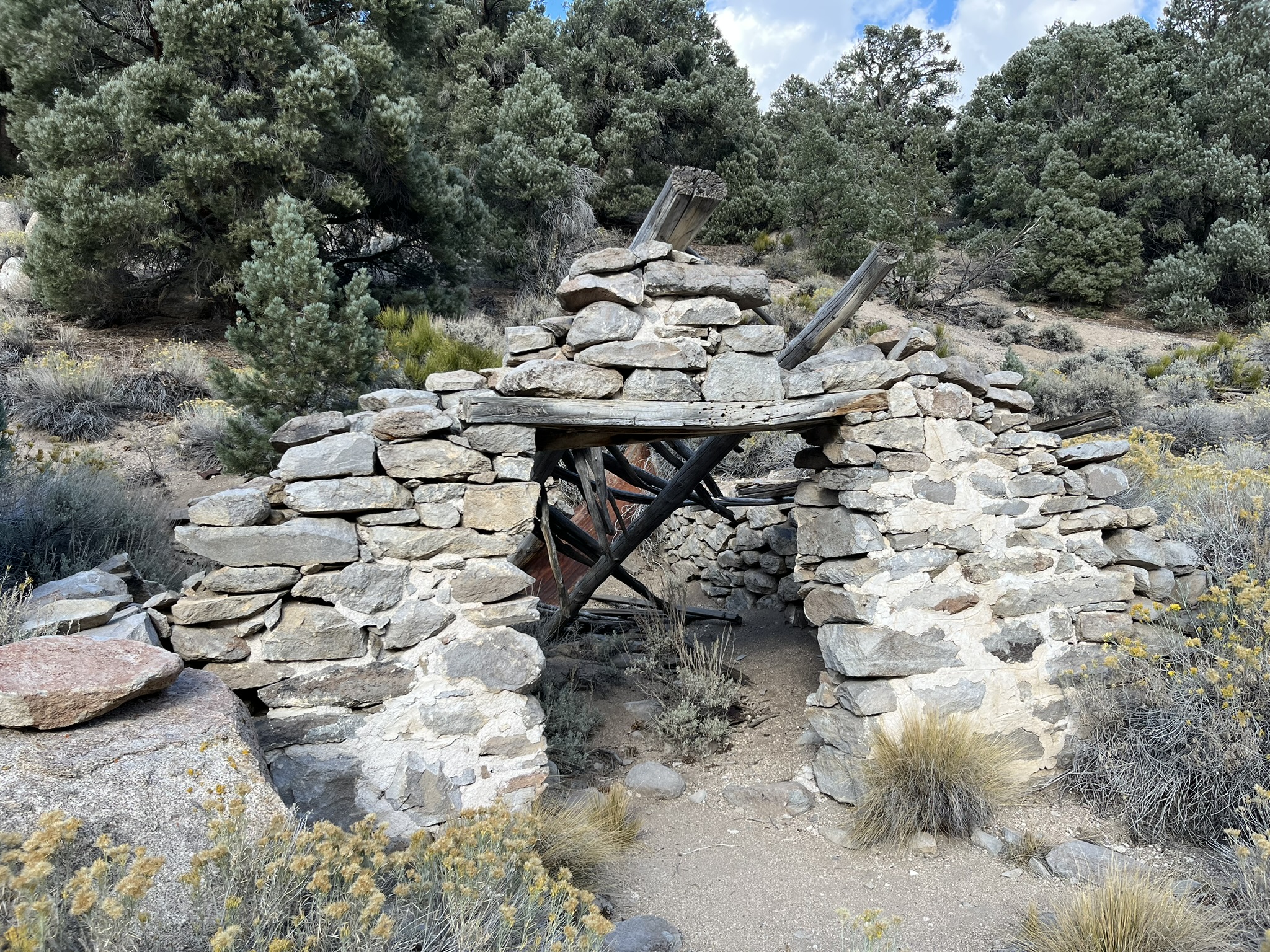
It was a pleasant drive, and we stopped at several old mine sites.
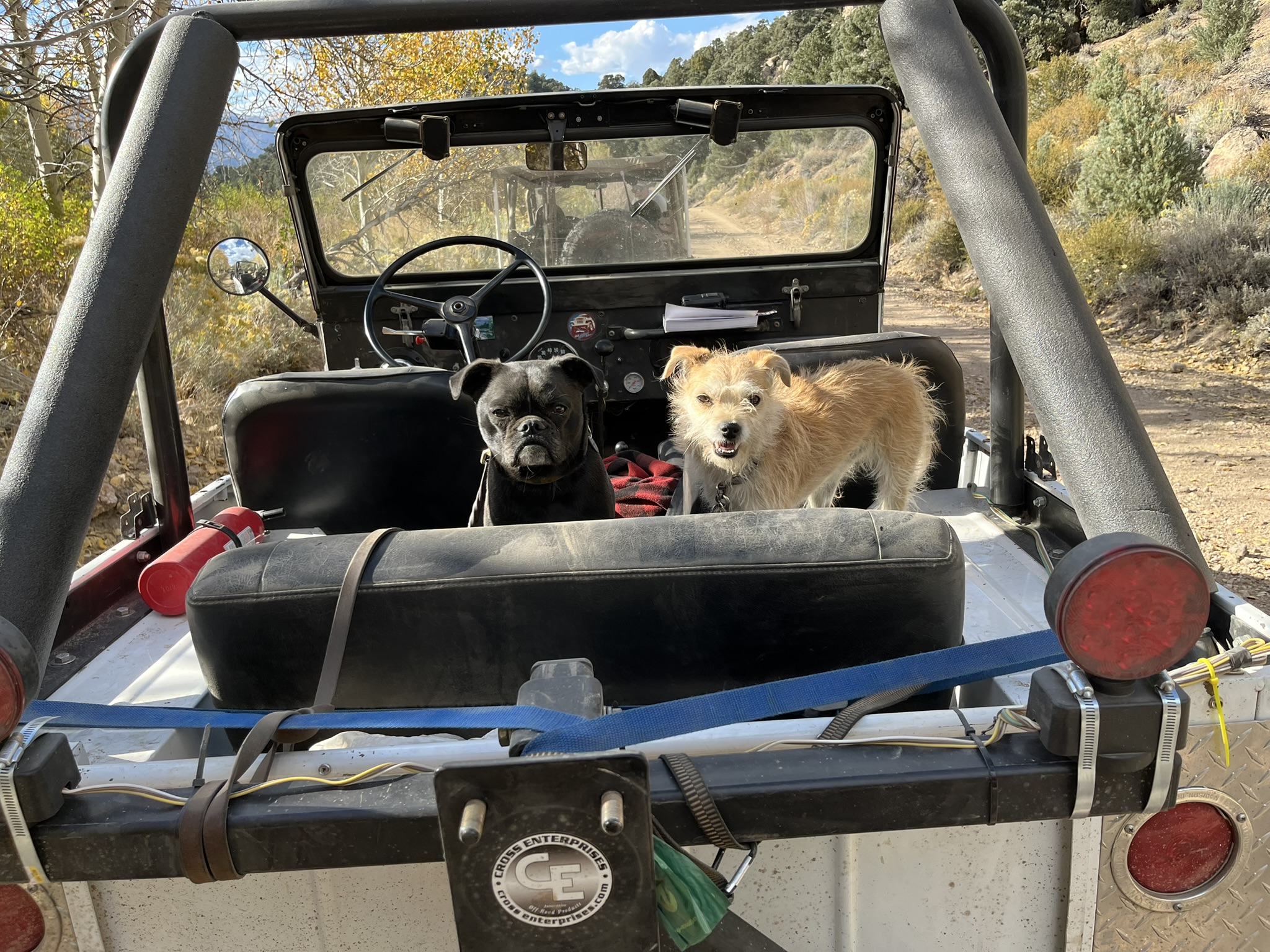
The dogs weren’t overly impressed.
I had to remove my spare tire and lash down the rack when Bob pointed out a couple of days earlier that the main middle mounting bracket was broken clean through.
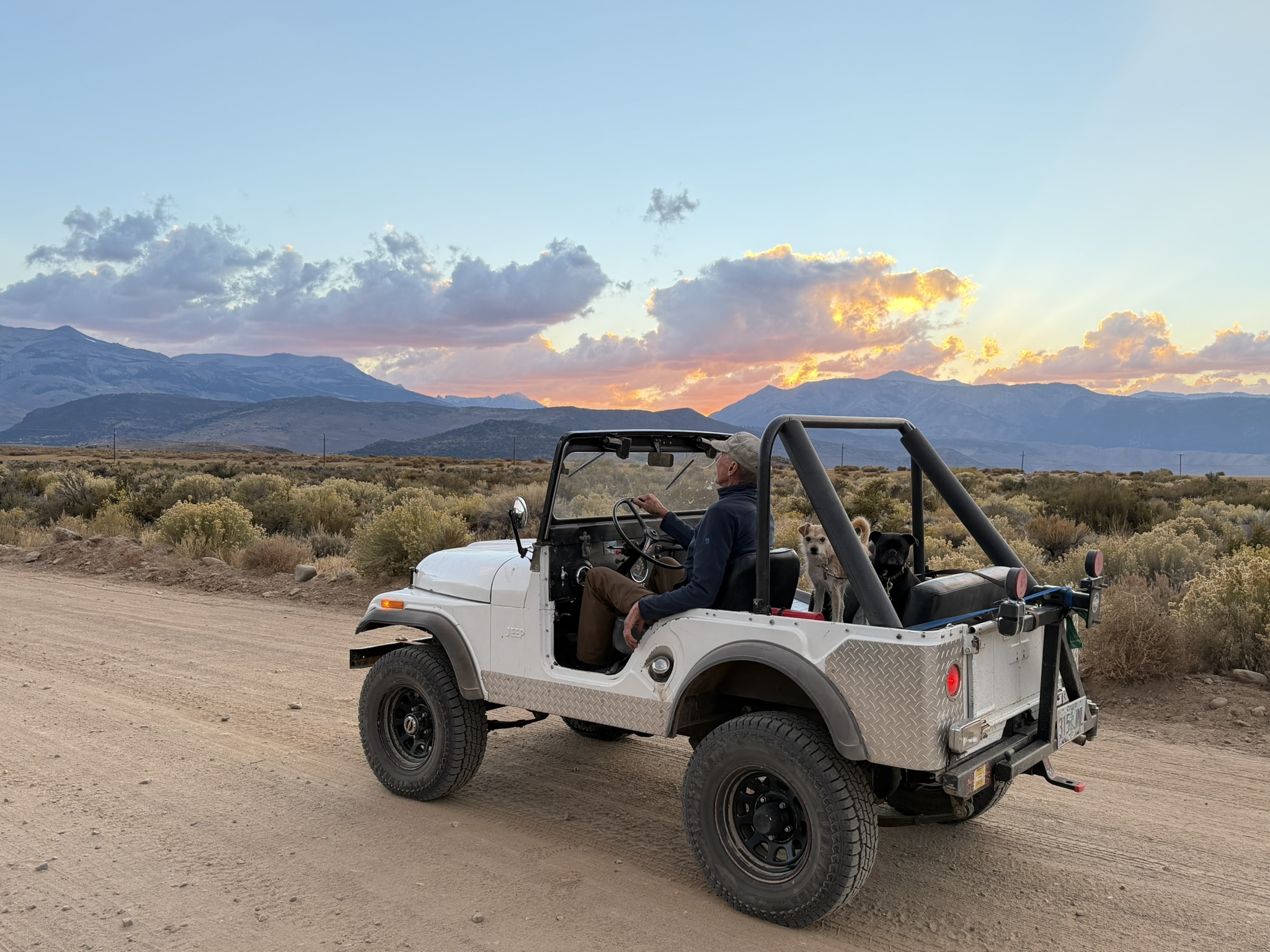
The last drive up to our campsite was a bit poignant; I could have stayed another week. And I would have, except that cold weather was coming; two inches of snow were forecast in Bridgeport, never mind up here in the higher country.
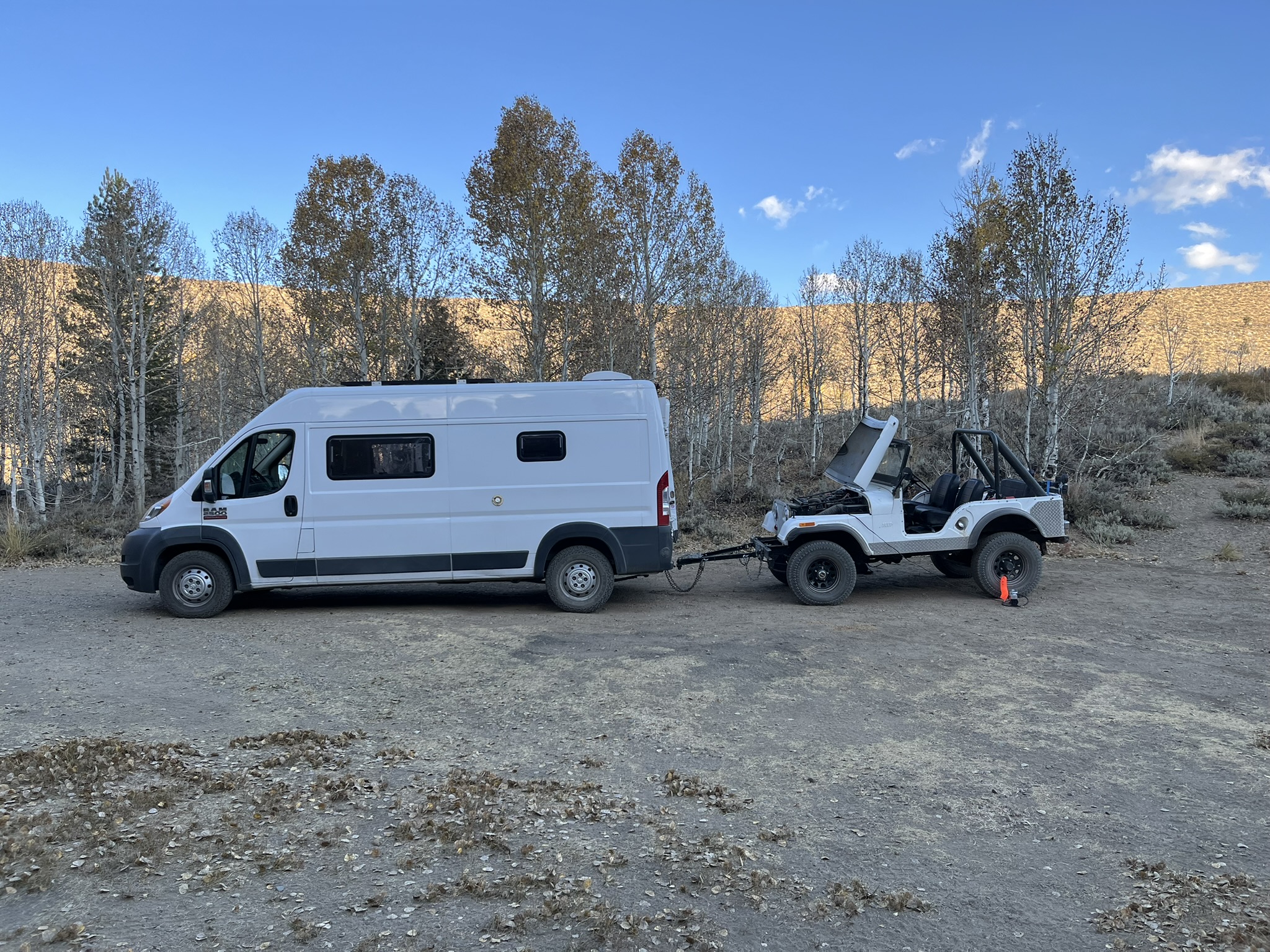
On Saturday morning we all hitched up our rigs and headed out. I had a 550 mile drive back to Eugene, but it was uneventful.
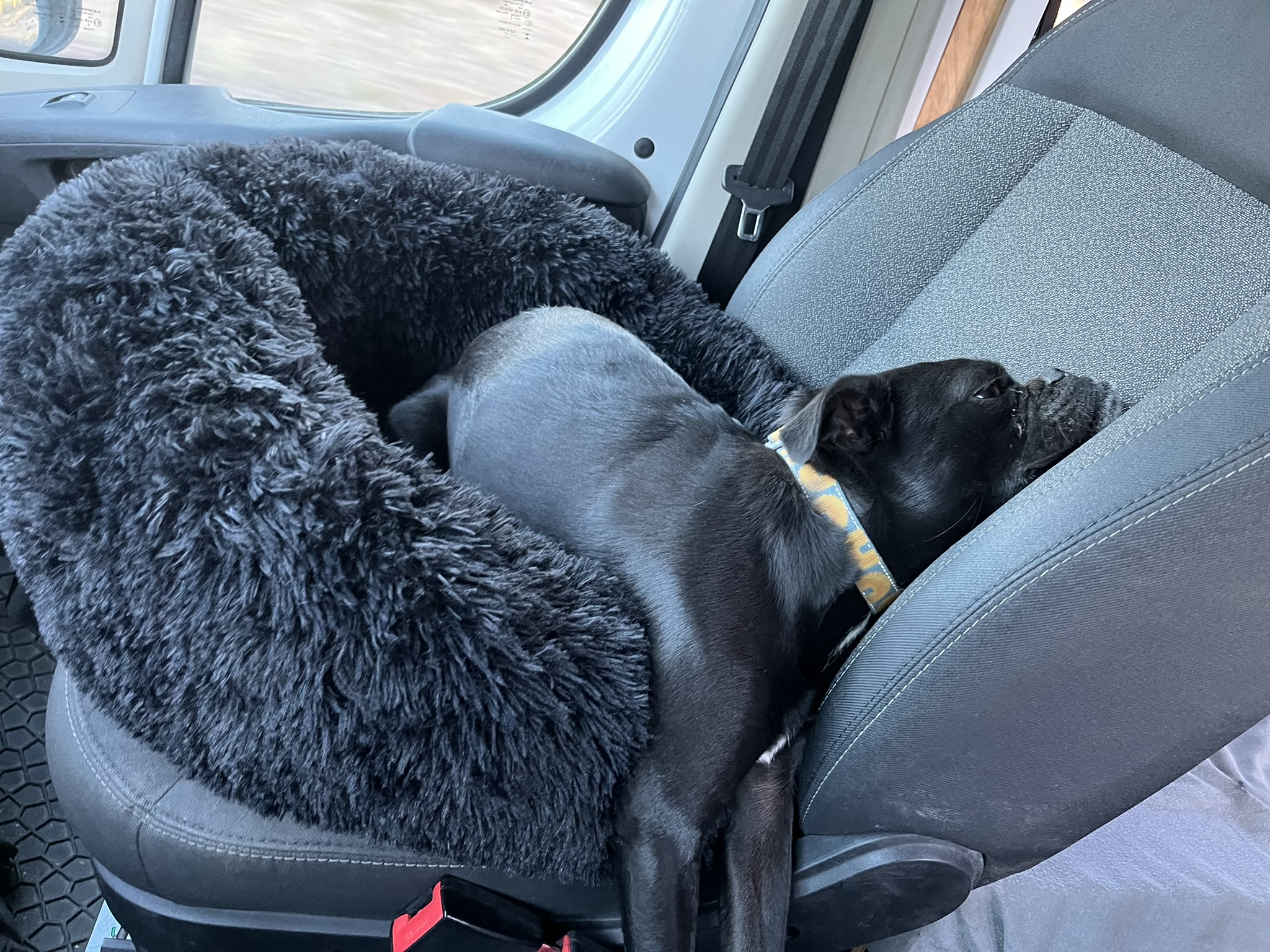
Towards the end, Wanda’s body language was clearly expressing boredom. Are we there yet?
Postscript: A Challenging Local Drive And Another Breakdown
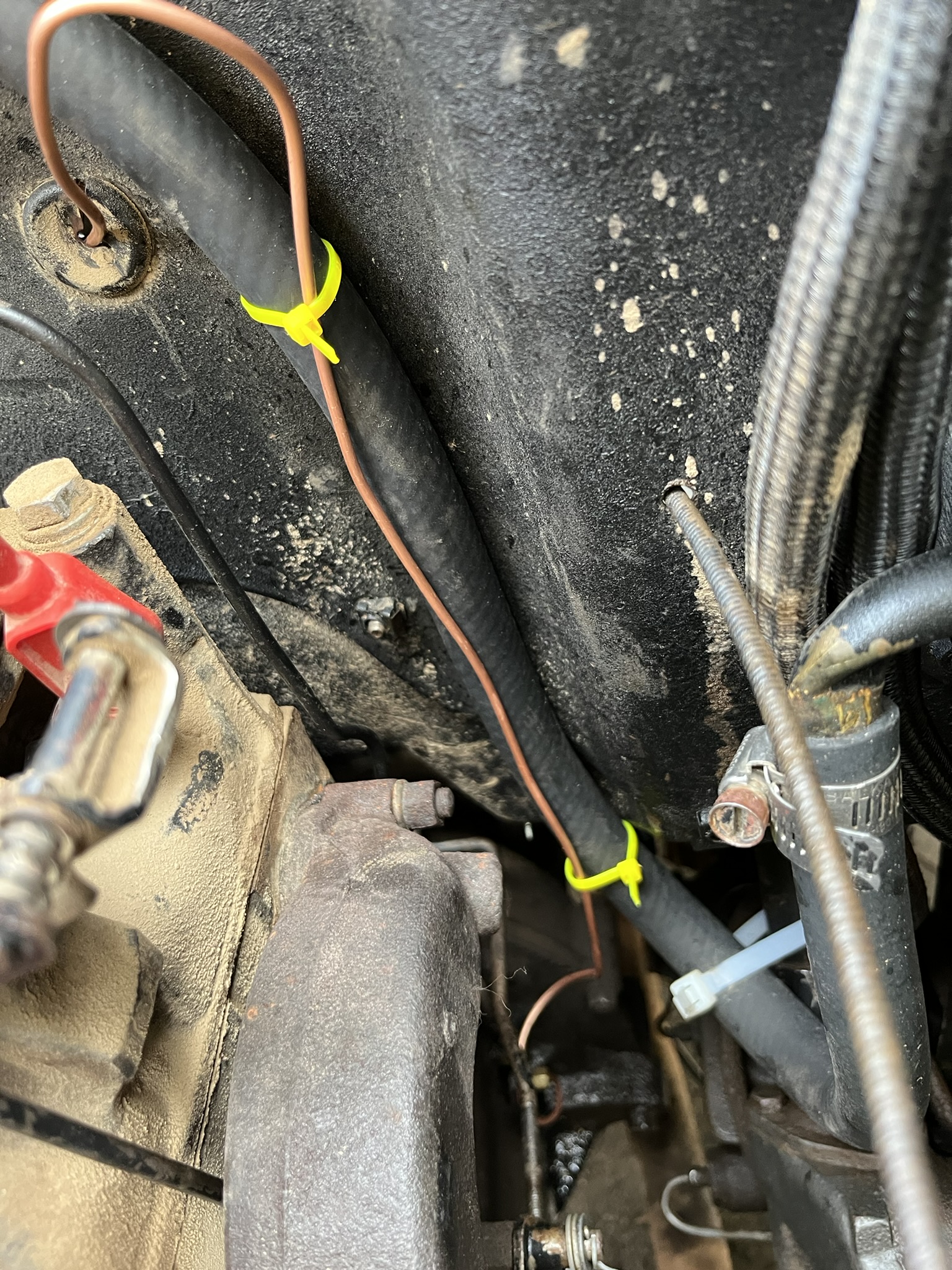
The first thing I did after getting home is to replace that plastic oil pressure gauge hose with some flexible 1/8″ copper tubing, and secure it properly.
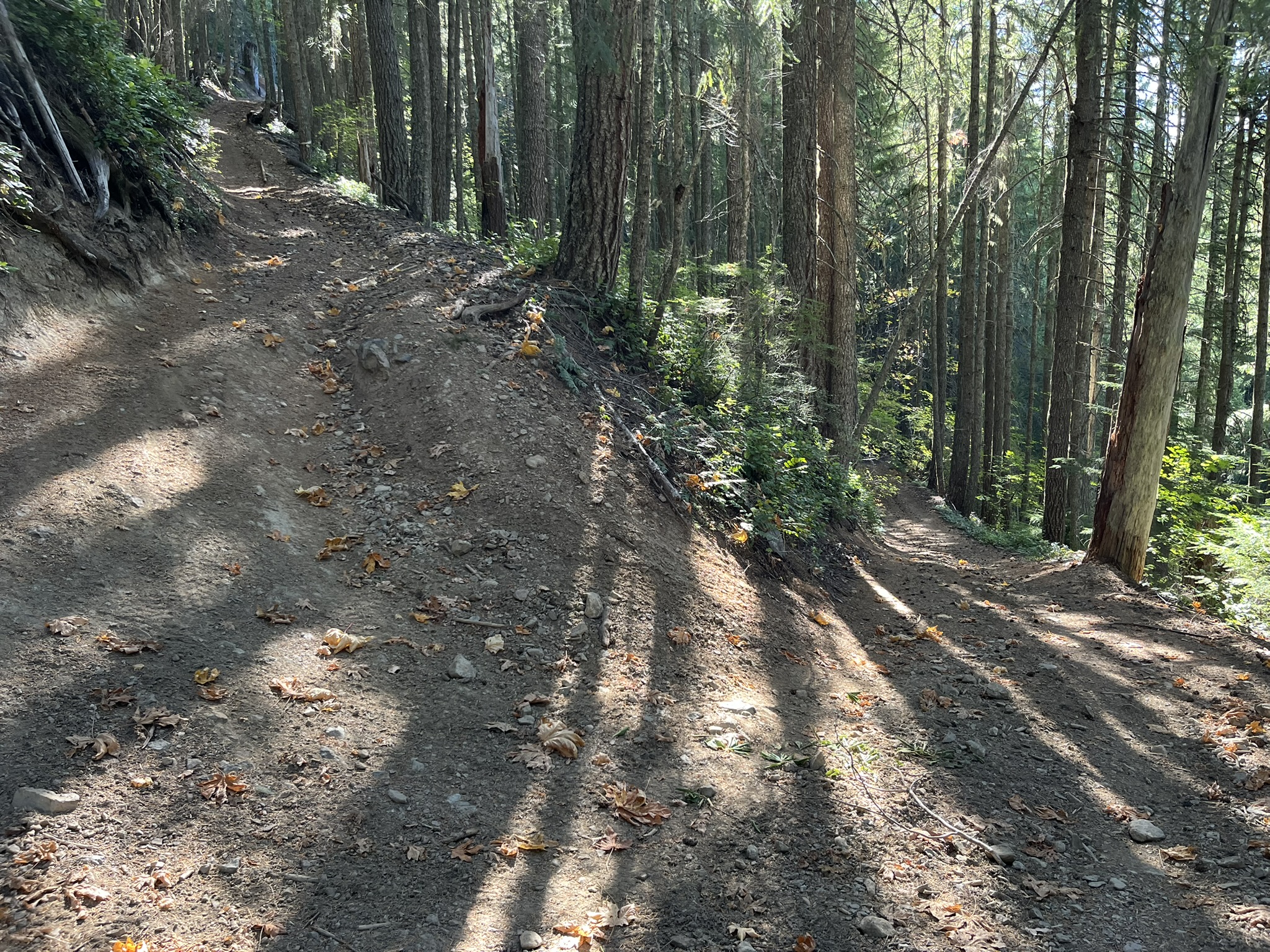
I decided to try to find some interesting local trails to take the Jeep on. Our area is not the greatest 4×4 trail area, as there are endless forest roads that are pleasant to drive but not at all challenging. Google came up with Noonday Wagon Road Trail, an old “road” hacked out of the steep woods in 1896 near Bohemia Mountain, an area with many mines. Bingo! I took a friend along to share the experience.
But as soon as I started on it, I was confronted with some pretty serious boulders. Whoa! And the “road” was steeper and rougher than I imagined, keeping me very focused and a bit concerned as we were all alone up here. It just kept working up the side of the mountain, with a few turns like this one. I couldn’t take photos while driving, but there were several more Aha! moments, including the biggest rock outcropping in the road that I’ve yet hopped over.
Here’s a Youtube video of an experienced driver with a modified Jeep leading a newbie in a stock Jeep on this trail. The two key moments are at about 10:00, when the newbie practically drives off the road to avoid an obstacle and has to be recovered, and the big rock I mentioned (at about 22:45), which took a couple of tries to get over.
It was a rather challenging and thrilling ride, given that I had not really researched this trail ahead of time and had no idea what I would be confronting. But we made it, without any issues or even stopping, except for three-point turns.
The very next day, I was driving back from a little hike a couple miles from my house when suddenly I lost a significant amount of power just as I was heading up a hill on a 55 mph parkway. Now what?! There was also some random clattering. Initially I feared the worst, some sort of catastrophic engine damage. I pulled over, raised the hood and started pulling spark plug wires. #1 cylinder was definitely dead. And the occasional rattling seemed to come from its upper reaches, like under the valve cover. it wasn’t getting any worse, so I put on the four way flashers and puttered up the hill at slow speed and nursed it back home.
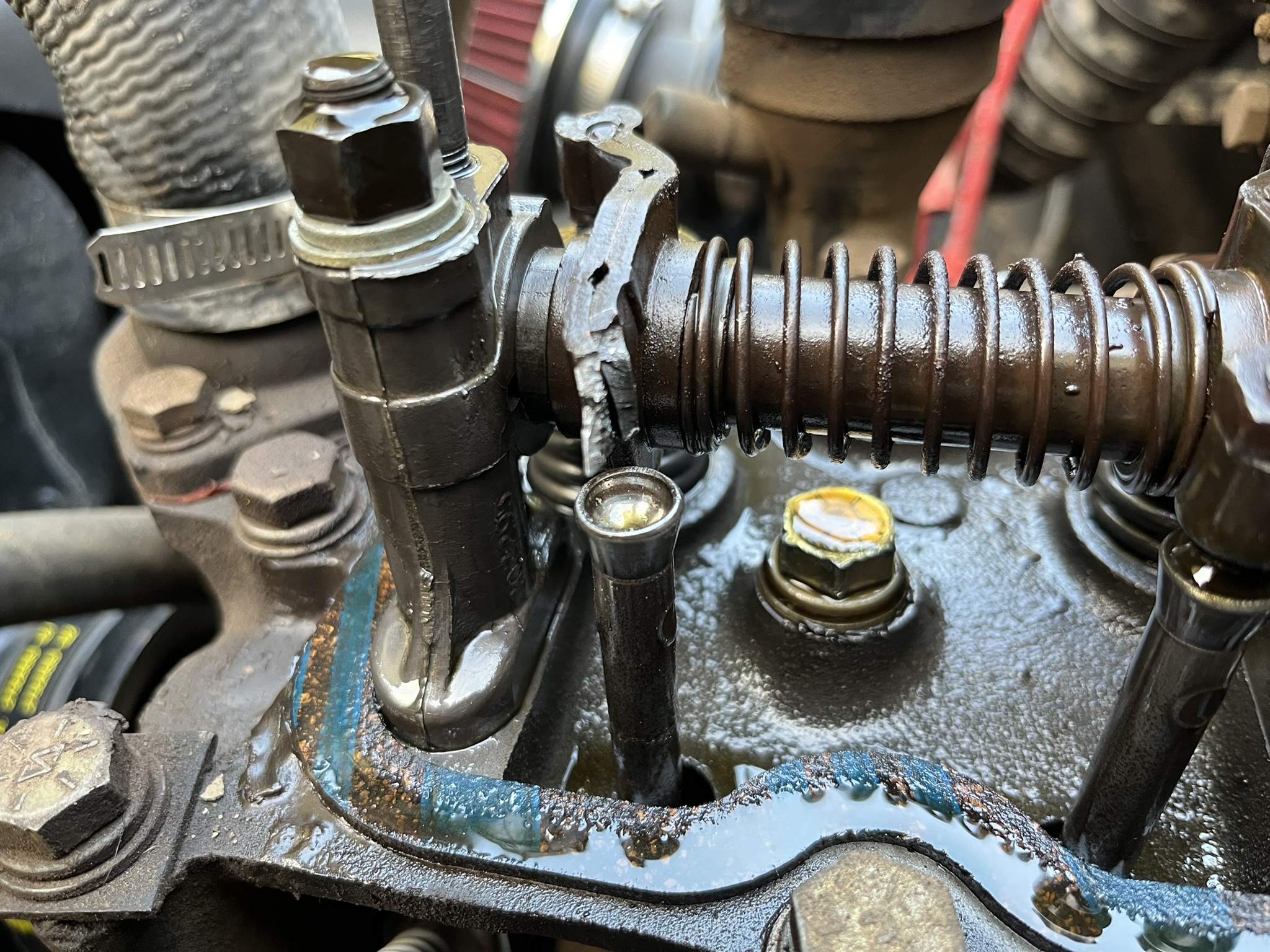
I immediately pulled the valve cover off and confirmed my suspicion: a broken rocker arm. And I suddenly remembered the seller telling me I might want to do a valve adjustment as that was called for after the 1200 miles since the engine rebuild. I was going to do that before the big trip…but the other issues were more pressing and I figured it would be ok for another hundred miles or so, even if they were hard ones. Apparently not, as I can’t think of another good explanation, as these rocker arms are not prone to breaking.
New ones are not available, but I found a Willys salvage place in the Midwest that has them, and it’s on the way.
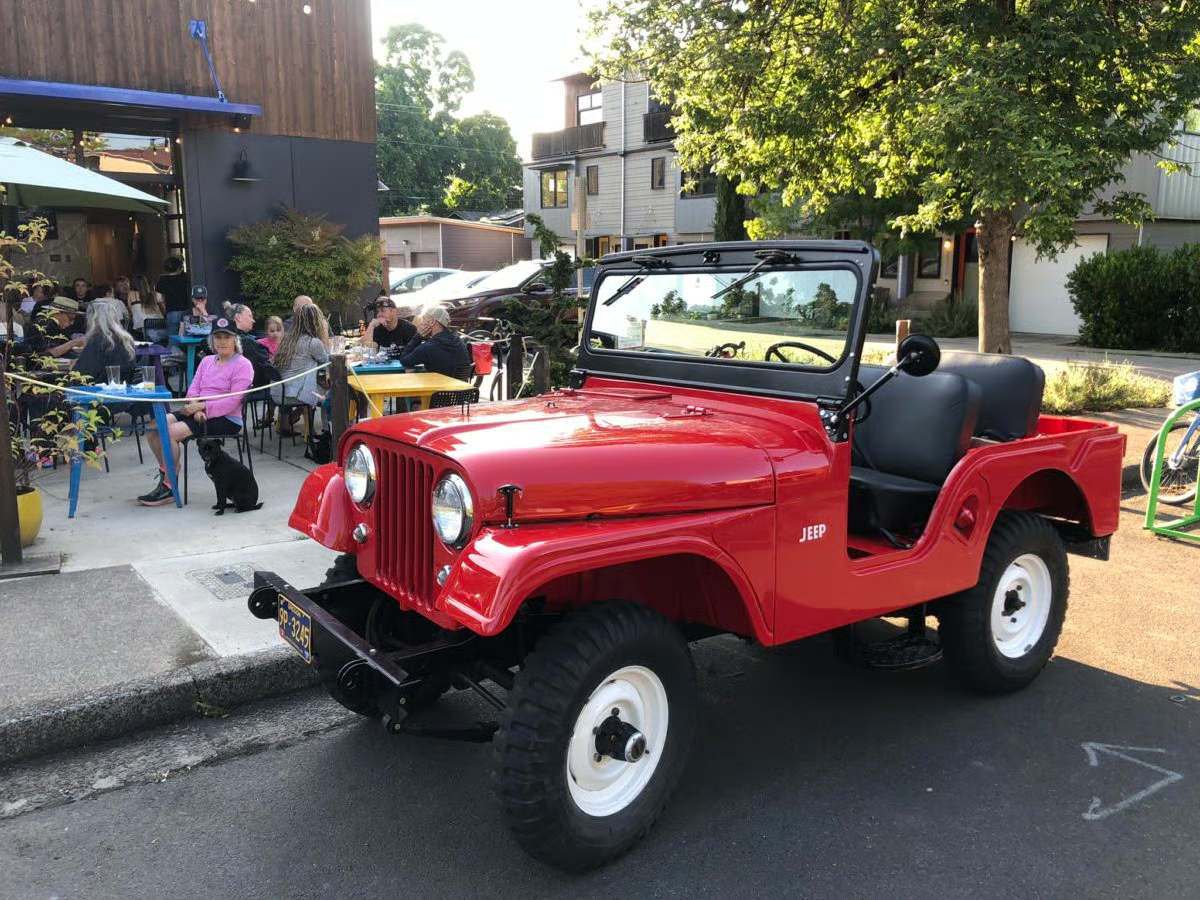
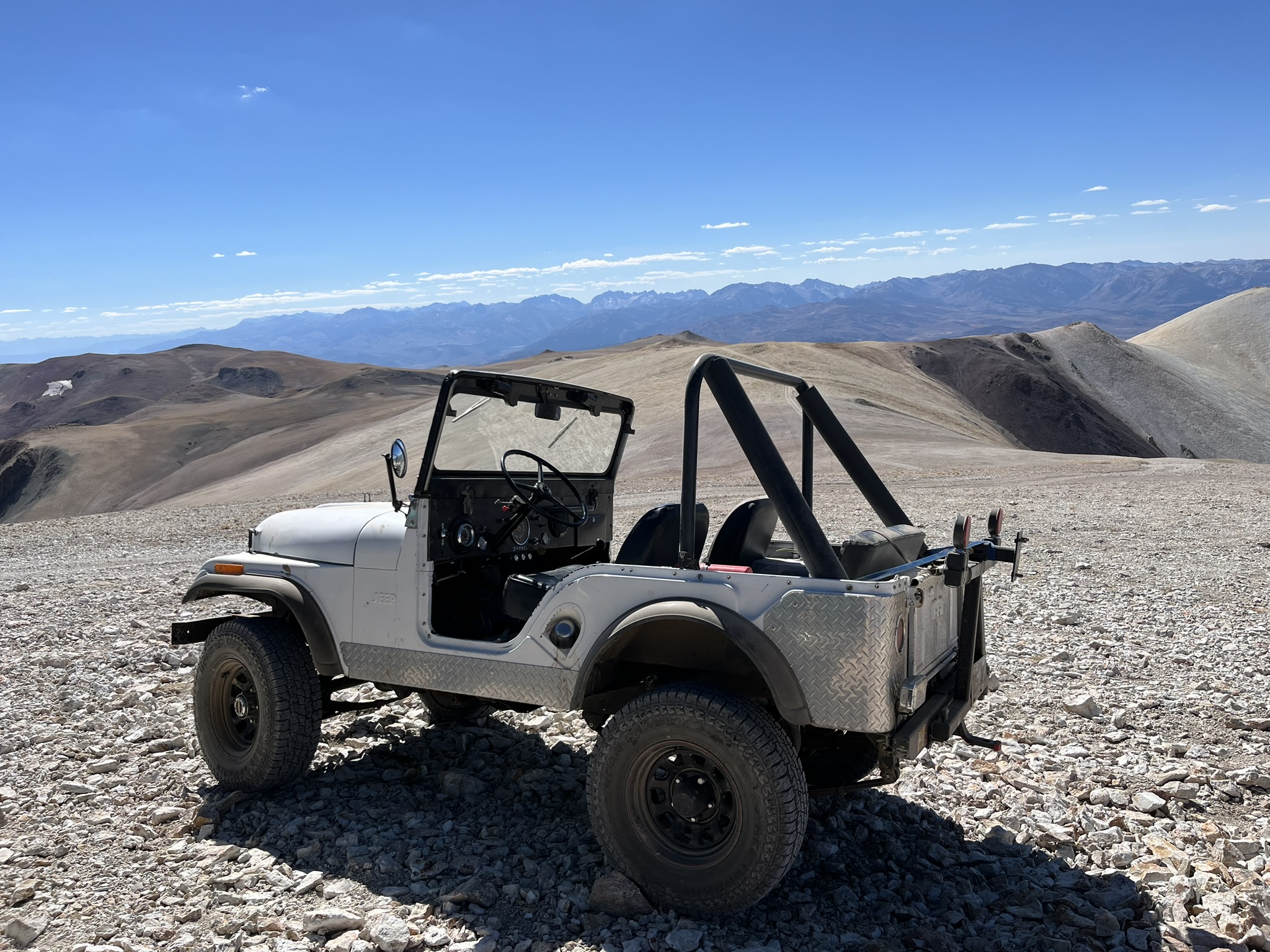
As to my future plans for the Jeep, they’re still evolving. I’m strongly leaning to finding stock steel wheels and mounting tires at stock height (28″-29″). And replacing the lift springs with stock ones. And removing the diamond plate. Taking it closer to the way a stock CJ-5 looked, like the one above. That includes the engine and drive train. I’m still learning a lot, but one thing is becoming clear: once one starts modifying a Jeep, it’s hard to stop, not just because of the usual reasons like getting carried away or wanting the perfect Jeep, but because changing one component affects the others. A more powerful engine and bigger tires can easily overpower the stock axles, for instance. A bigger engine also creates much more heat in a very small engine compartment, which then causes ripple effects.
So I’m still feeling my way on this project. Stay tuned.
Related CC Reading:
My New 1966 Jeep CJ-5 With F-Head 134 Four: Part 1 – “I’d Rather Drive Than Ride”
Curbside Classic: Willys Jeep CJ-5 (1955-1963) – The Making Of An Icon




Congratulations on being out there and living your best life!
Great travelogue, Paul…beautiful scenery, interesting history, great Jeeps (I too love those wagons), and a group of cool guys.
Oof, that rocker arm. The first thing that came to mind (and I hope I’m wrong) is that the valve is too tight in the guide. You mentioned that the engine was rebuilt, so I wonder if it had new guides put in and the clearance isn’t quite where it should be. I think I’d get a spare rocker arm and cross my fingers at this point, but I can’t imagine the adjustment causing that. If the valve clearance were too tight, the engine would run rough and/or miss, and if it were too loose, the valve would just clack (and it would have to be pretty loose to damage a rocker arm). Hmm…
I kind of wondered about that. And I recently watched a video of one these engines being meticulously rebuilt (Jim’s Machine Shop) on YouTube and he specifically made a point to check that and I think he touched one or two up with a little hone because they errr a bit tight.
I’ve wondered a bit just who rebuilt this engine and how good of a job it was. I’ll never know except to the extent issues arise like this. Hmm indeed.
I like their videos, even if I don’t always watch the whole “episode.” You know, it probably wouldn’t be all that involved or expensive to pull the head and have a local machine shop check out the guide clearance and hone them for you if no other damage has been done to the valve stems (it would only be four valves, too). That way, you could also check out the cylinder walls and maybe even check out the exhaust valve clearances while it’s apart. I don’t know how tough it is to do that on an F-Head Willys. You wouldn’t even have to pull the exhaust to get the head off, so even better!
Great story – being from the east coast, the Western Mountains are like a whole other planet to me, and the abandoned mines and cast off equipment that just pops up out of nowhere are fascinating. I have a friend in the Rockies that lets me borrow his CJ6 whenever I go out there, and have driven it on a few trips up the front range with other old Jeeps much like your expidition. Have to tip the hat to the Buick 225 V6, it’s seemingly the perfect engine for these old CJ’s and the chassis’s themselves are more capable than I’ll ever have the balls to be… Keep us posted on your future endeavors!
Thanks, Paul for allowing me to “ride along” on an exciting adventure that I will/would otherwise never do. The scenery was achingly beautiful, and the old camps/mines/towns were interesting as well! On a related note, I guess serious Jeep off roaders don’t engage in cluttering their dashes with a gaggle of duck figurines, as seems to be the style in urban areas
LOL!!! 🙂
This was great to read (and watch) – very impressive, and your impulse buy of Jeep looks like a great move. Simply incredible scenery… and Jeeps!
Epic trip! One advantage of using a copper line for your oil pressure gauge is that if you should happen to get a hole in that line or the gauge starts to leak all you need to do is cut the line and crimp it over with pliers. Dorman is doing great business with metal replacements for plastic thermostat housings, just used one on a friend’s Chevy Cruze.
What a wonderful adventure! And such interesting terrain.
And kudos to everyone brave enough to run such old machines in the way they intended. And that goes double for the stock wagon. The 226 in my pickup did make a nice sound.
I may just have to scratch this itch as well. I have a driveway with plenty of off road capacity but going old school would maybe bring me back to my roots a bit. The FJ40s and CJ2s and CJ7s I rode and drove in when I was many years younger still have a hold on me.
The brakes though. I don’t know I would have the nerve anymore to tackle steep stuff in a vintage truck.
I look forward to the next chapter in this story
Thanks Paul and the Old Willys guys for letting me (and Riley) tag along. My first ride after arriving was intended to be with Paul up to Kavanaugh Ridge, but with the oil leak in the CJ I rode in one of the wagons, one that was quite modernized (ie from 1950’s to 1980’s) with K5 Blazer running gear, an SBC and THM transmission. Power steering even. It was a comfortable ride in a very competent vehicle with a skilled driver, but the next few days riding shotgun with Paul were eye-opening and a lot of fun. Lots of fresh air, lots of dust, bumps, the ground RIGHT THERE with no doors, beautiful autumn colors and new perspectives on Eastern Sierra scenery I’ve seen lots of over the past 50 years.
I drove the CJ for just a few miles on an easy fire road, and came away with tremendous respect for Paul’s masterful handling of the gearbox and especially the steering on the tight and rough trails. And trust me, some of those grades were MUCH steeper than they look in the photos. But I will confess that when I got back in my ten year old Tacoma for the drive home, the heated seats and power steering, not to mention a real roof and doors and windows, felt pretty nice.
If I had a Pentastar engine with the plastic thermostat and oil cooler/filter housings, I’d replace them preemptively.
What a great experience, even if they did misspell the name of the trail. 🙂 All of those vintage Jeeps doing their thing would have been great to experience.
Is copper normally used on oil pressure lines? I know it can get brittle and doesn’t do well with vibration. Someone had used a short piece of copper for fuel line on my Model A. It eventually cracked from the vibration/movement between the engine and the cowl. Thank goodness for the underhood fuel shutoff.
Yes, copper has been the traditional material for oil pressure gauges although these nylon lines have been around for some decades. I did some Googling into the subject, long threads at HAMB and a vintage Mustang forum. Although there were a couple of incidents with copper lines, many more plastic lines were reported breaking. Some original copper lines on Corvettes many decades old are still reported doing fine.
I created a bit of a loop where it attached to the sending unit to allow for movement and vibration. And as someone else pointed out above, in the unlikely event of another break, the copper would be easy to crimp.
The only reason the plastic line broke was because it was allowed to be in contact with the steering gear, If it had been secured it undoubtedly would have been fine, especially as it was a recent addition. Some folks reported having plastic lines for a number of decades.