
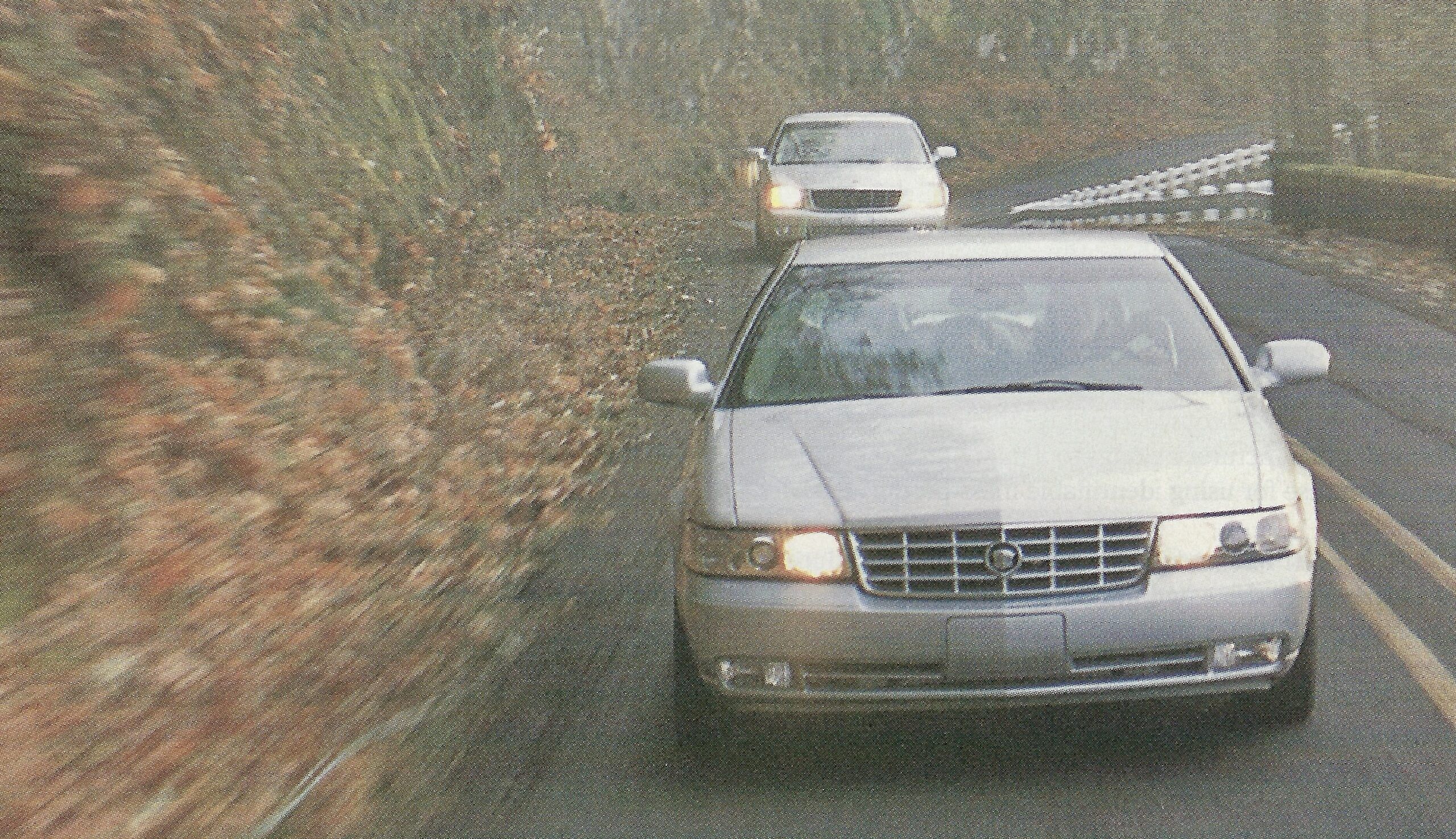
It’s often taken as gospel that the major car magazines don’t have much good to say about traditional American luxury cars, particularly Cadillacs. Or at least they hadn’t from sometime in the 70s through Cadillac’s lost decade of the 80s. Even when Cadillac started to turn things around with the ’92 Seville and the Northstar V8, there was still snickering.
Some of that was kinda deserved. I’m thinking of the barely mediocre Catera and its cringy “The Caddy That Zigs” advertising. And the original Escalade, GM’s hurry-up response to the smash-hit Lincoln Navigator, was essentially a Yukon Denali with the GMC badges pried off and a few wreaths and crests slapped on. Neither got much love from the buff books.
So, this feature story on the 2001 Cadillac DeVille DTS and Seville STS from the August 2001 issue of Automobile Magazine came as a surprise when it arrived in my mailbox. Hey Mikey, they liked it!
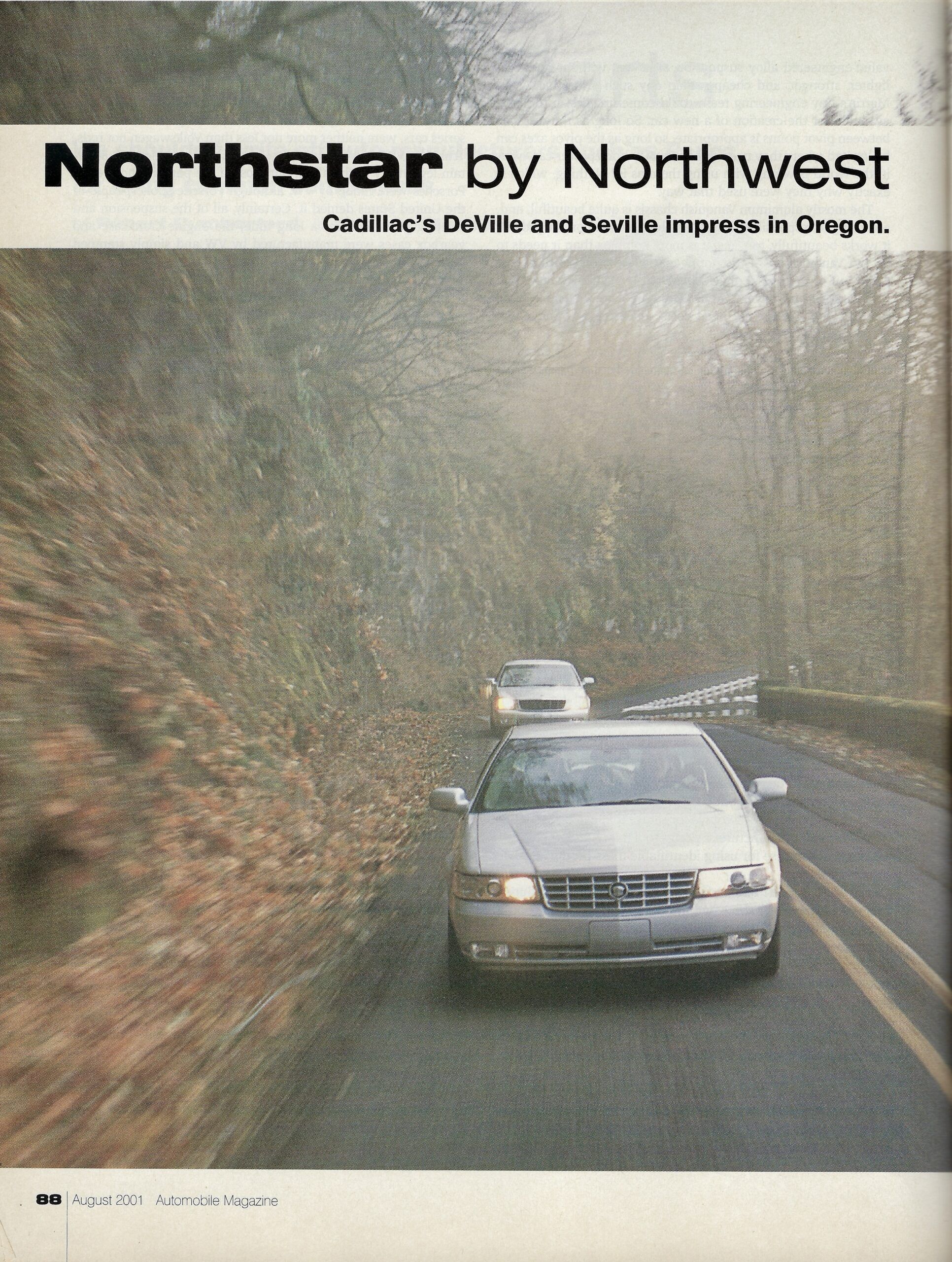
The praise was especially surprising because the writer of this article was Jamie Kitman, who was the U.S. editor of the snarky British magazines CAR and Top Gear. If American magazines like Car and Driver were critical of Cadillac and Lincoln, the British publications could get downright nasty about American luxury cars.
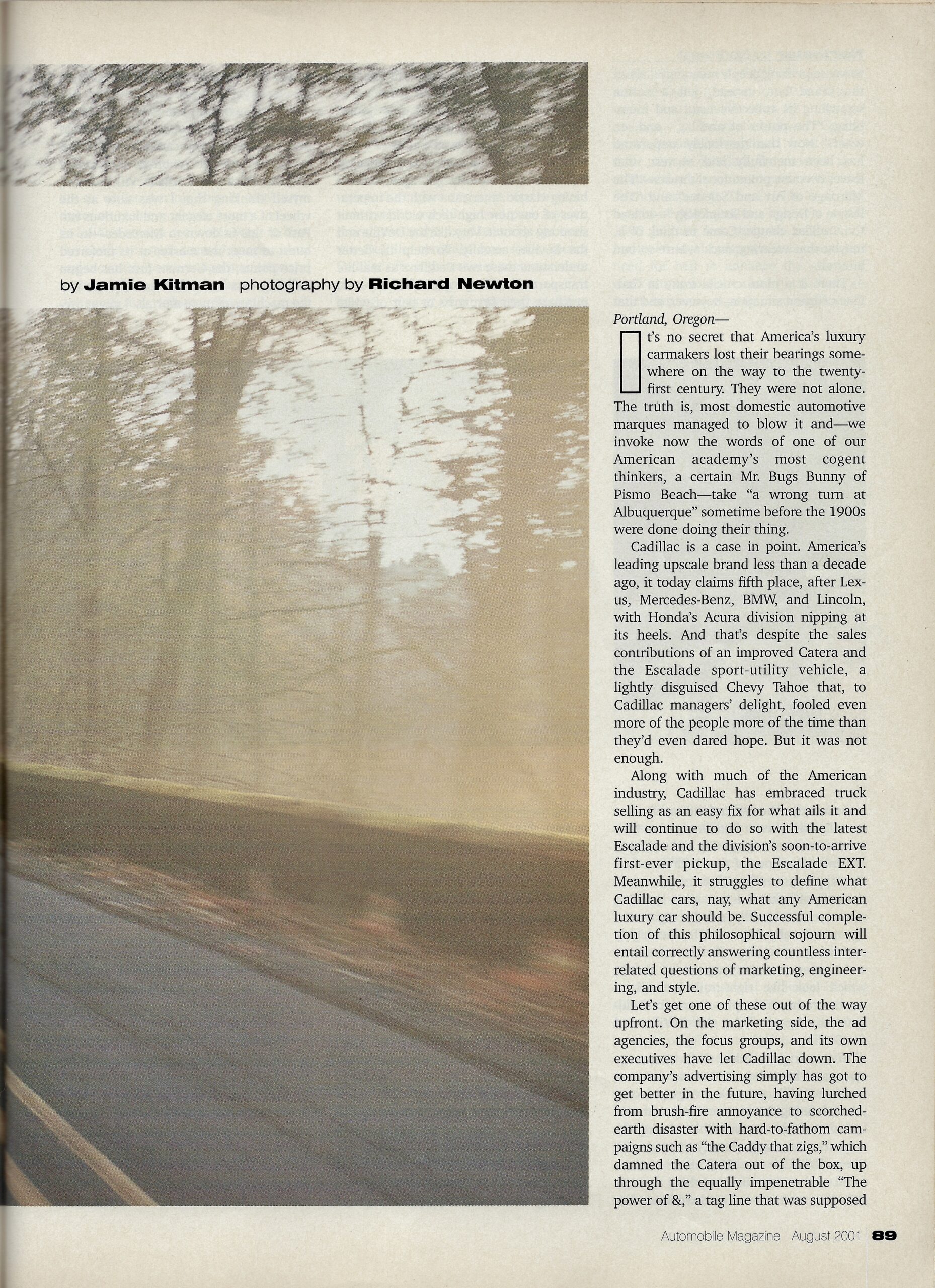
While Kitman still rightfully knocked Cadillac for some lousy marketing, they got the important part right — the cars themselves.
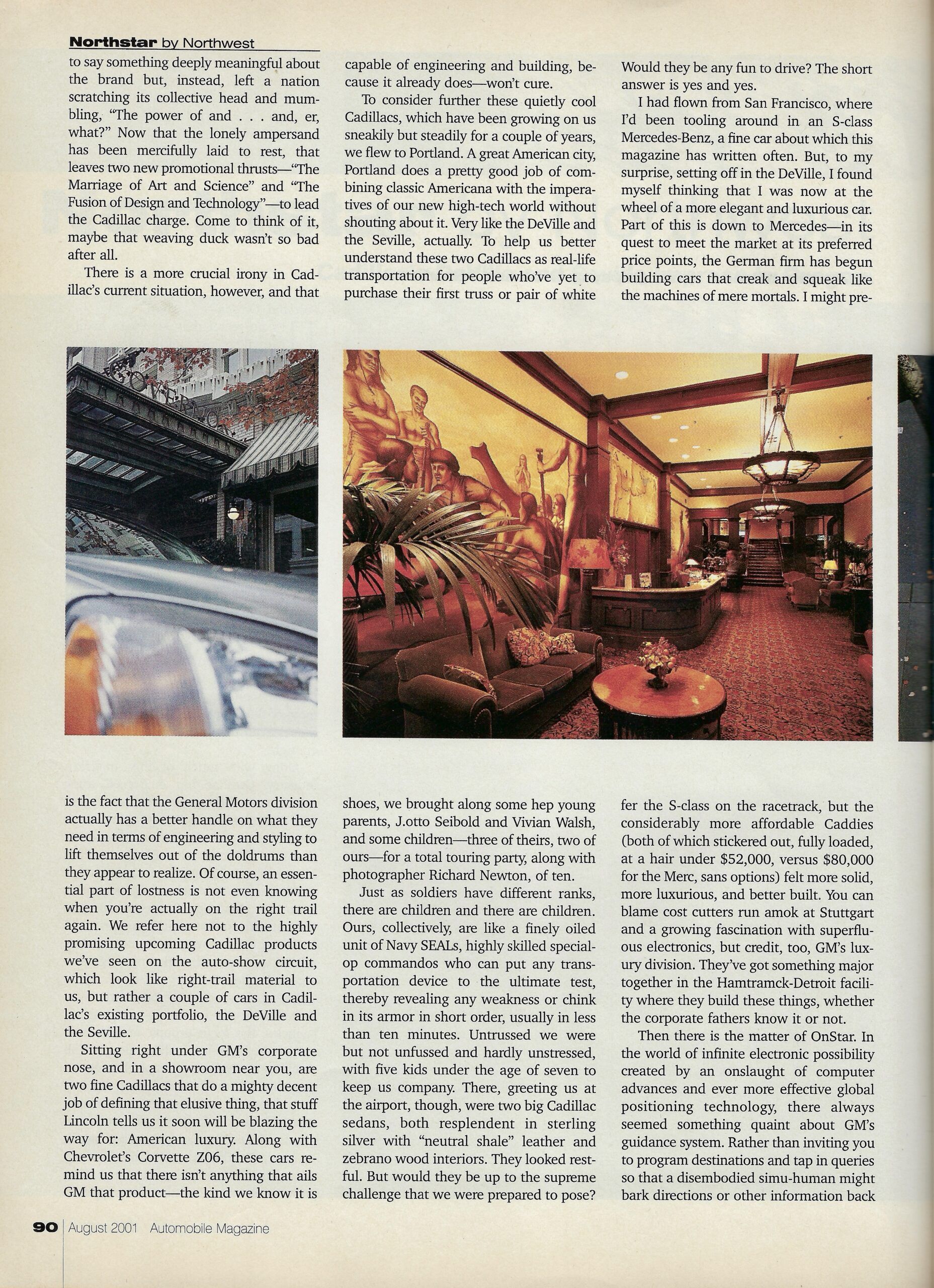
So much so that he compared the DeVille favorably to a Mercedes-Benz S-Class. Very favorably:
“To my surprise, setting off in the DeVille, I found myself thinking that I was now at the wheel of a more elegant and luxurious car. The considerably more affordable Caddies…felt more solid, more luxurious and better built.”
Take that, Stuttgart.
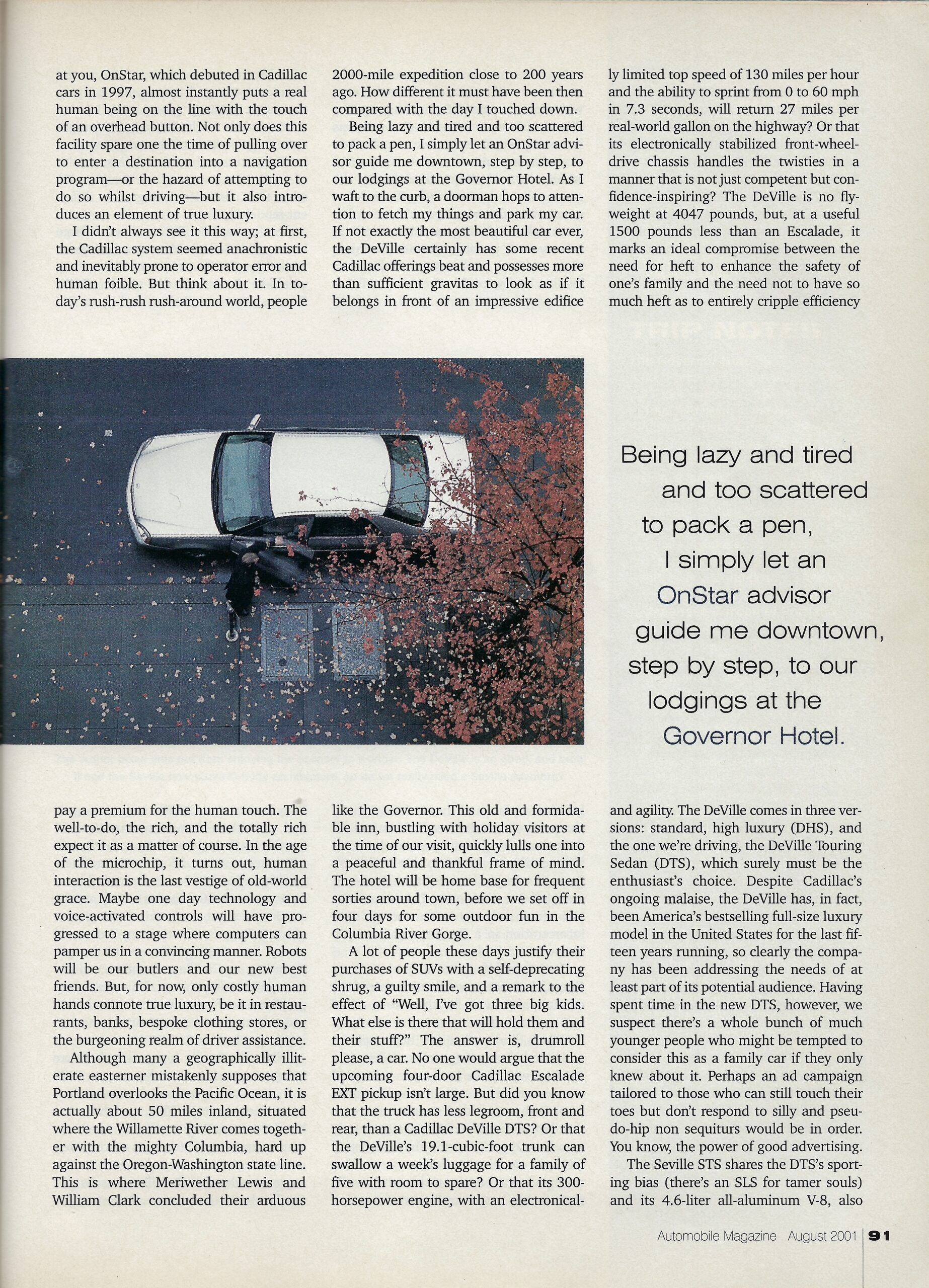
Kitman also had nice things to say about the Northstar:
“Call us sentimental softies, but the Northstar never disappoints, thanks to ongoing improvements and an inherent excellence that made it smooth, powerful and mellifluous from the get-go.”
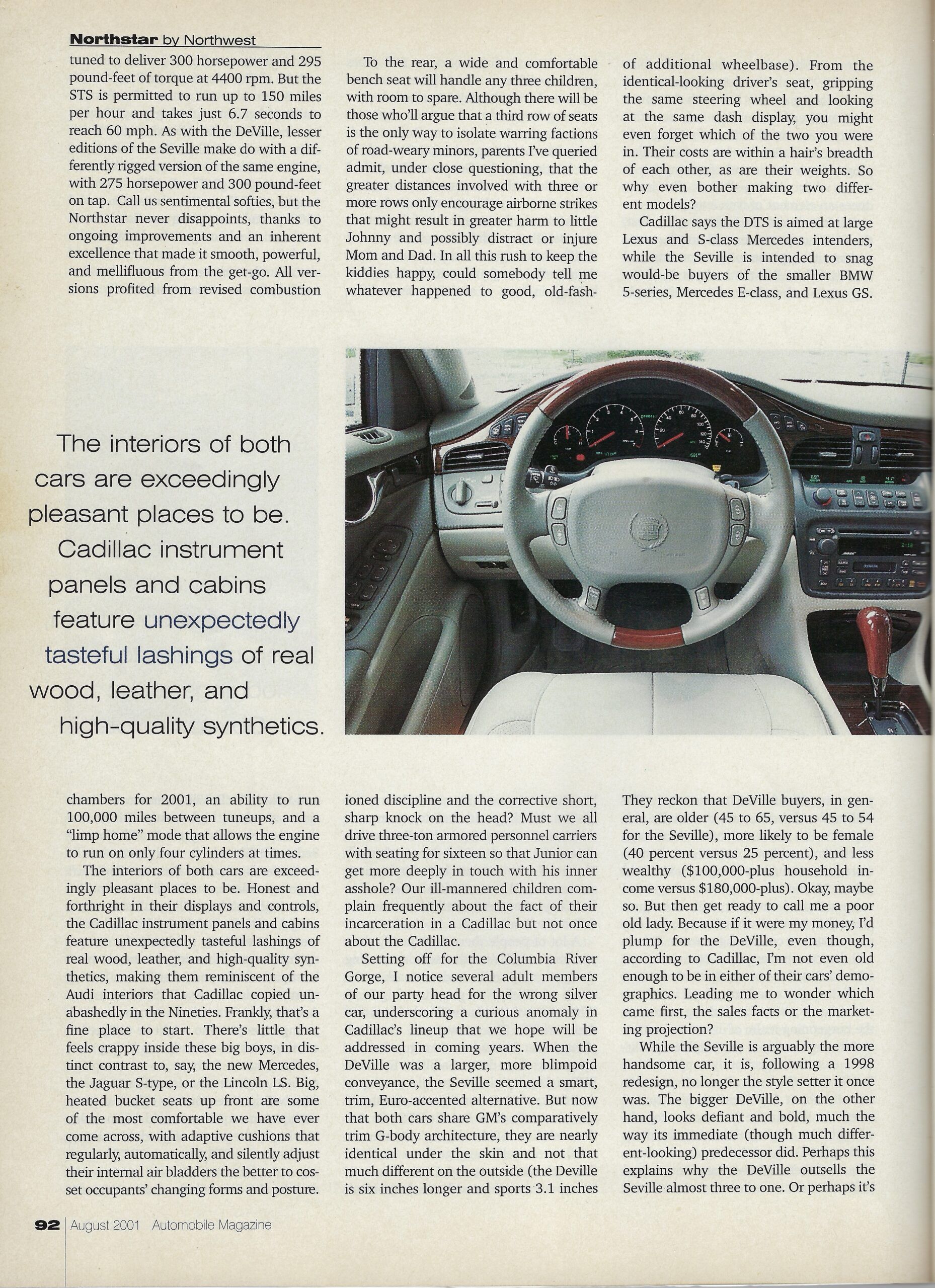
As well as the inside:
“The interiors of both cars are exceedingly pleasant places to be. Cadillac instrument panels and cabins feature unexpectedly tasteful lashings of real wood, leather and high-quality synthetics.”
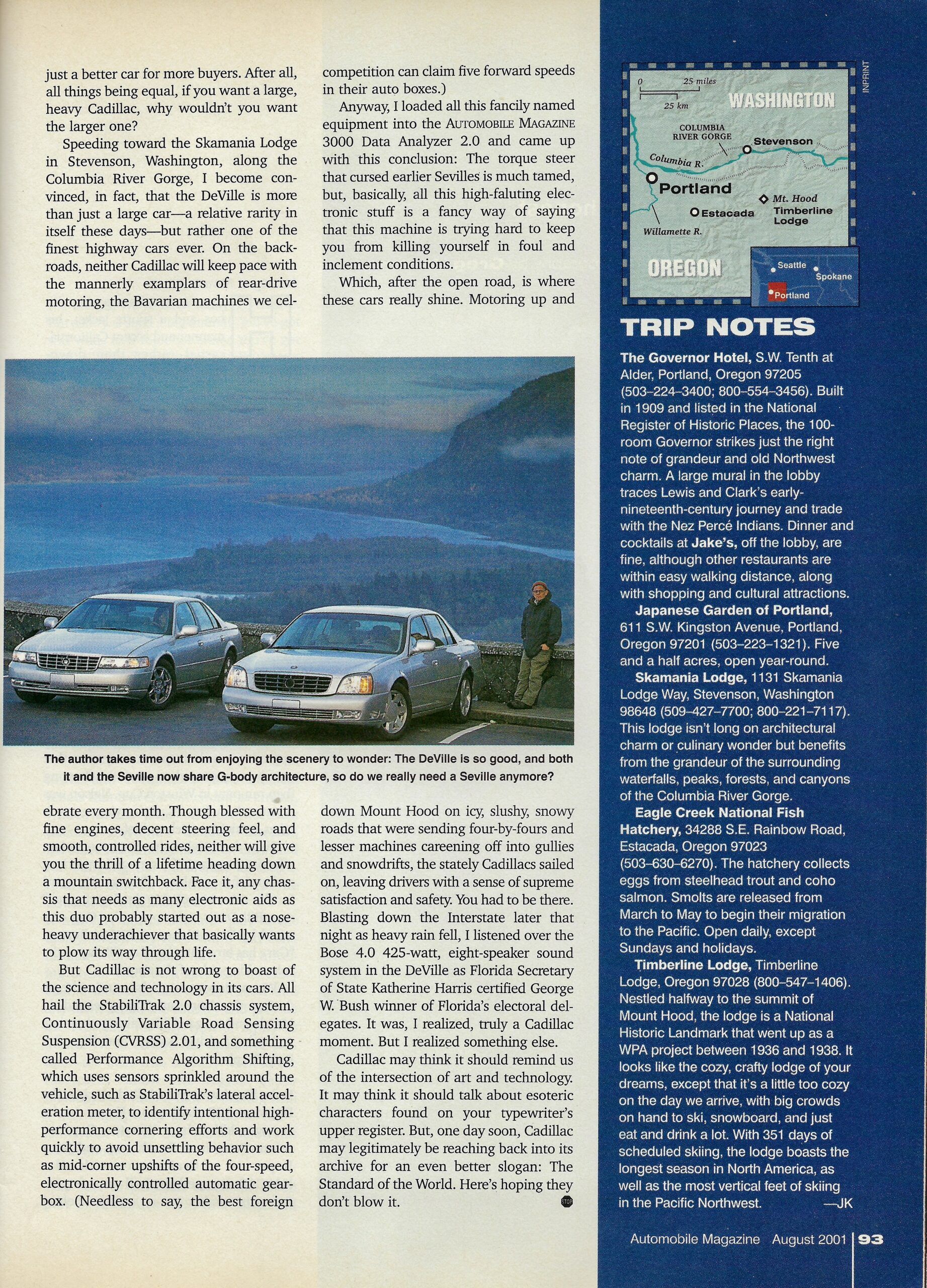
This isn’t a road test or even a comprehensive review. It’s a feature that weaves the story of these two surprisingly impressive Cadillacs (to the writer) around a travel journal in and around Portland, Oregon, including one of my favorite places, the Columbia Gorge.
When I first read this article, it was two years before I moved to Oregon and eight years before I owned my Seville. But it stuck with me (and in my bookcase). I dug it out again after finishing the story of my Seville. Reading it now reaffirms my assessment that Cadillac was making some genuinely good cars at a time when a lot of people weren’t paying attention.























Kitman has always had a way with words, including his tenure at Automobile magazine. Unfortunately, the Northstar was already getting a very bad reputation due to the head bolt fiasco. IIRC, they largely fixed that by 2001, but the damage had already been done.
I still like that era Seville, though. Taught and straightforward; however, I might prefer an Eldorado if the same vintage.
I’m sure I would have some nice things to say about these after four days in a luxury hotel, fine dining and driving them around in some of my favorite places. The classic junket.
None of this is to say that these weren’t quite fine automobiles, although they did nothing to slow down Cadillac’s slide at the time. Which Kitman essentially knew all too well but refused to acknowledge properly, as he knew what he was being paid to do. He suggests that Cadillac needed to advertise their sporty versions more aggressively to a younger demographic. Good luck with that; Cadillac’s image at the time was so deeply steeped in the white belt/old man era that Cadillac pursued so diligently in the ’70s – ’90s.
Cadillac actually did make a clean break in its advertising with the Breakthrough campaign featuring Led Zeppelin. I thought the first commercial, which may have debuted during the Super Bowl, did an excellent job of reminding viewers when Cadillac was the Standard of the World while looking forward with a bold new lineup designed to appeal to contemporary luxury car buyers.
I didn’t mean to imply they didn’t advertise; I meant the actual success of doing so.
My comment in reply was that with the Breakthrough campaign, Cadillac actually created some effective advertising that finally countered its white belt, old man image.
This advert was the first time Led Zeppelin allowed their recordings to be used in a commercial.
It did a good job of acknowledging that Cadillac knew it hadn’t really been the standard of the world for nearly half a century, but now they were back in the saddle with cars that were competitive with anything the world had to offer and would be appealing to younger buyers. Been a long time since they rock and rolled, indeed.
But did it help any? Not really. Cadillac’s market share continued to drop.
Too little,too late.
This was a pleasure to read for a few reasons. I’ve been thinking about Automobile Magazine recently because I was at an estate sale a few weeks ago that had several years’ worth of 1980s & ’90s Automobile issues. I didn’t buy them, and later regretted that. I used to enjoy reading articles like this, though at some point Automobile seemed to veer off and become more of a wine-and-cheese travelogue magazine. But this piece was enjoyable.
I agree with your assessment that Cadillac was making some good cars but few people noticed. “American luxury” had a lot of virtues – like comfort – and cars like these could have positioned themselves to grab a big niche of the luxury market. Too bad they didn’t.
One thing I learned from this article is that OnStar provided personalized, human directions. I never paid attention to OnStar (other than realizing that GM cars came equipped with it), so I thought it was more of an emergency-assistance aid than anything else. As an introvert who doesn’t like phone calls, I’d probably never utilize a live direction-assist feature, but I find it interesting that such a thing existed.
I thought it was more of an emergency-assistance aid than anything else. As an introvert who doesn’t like phone calls, I’d probably never utilize a live direction-assist feature, but I find it interesting that such a thing existed.
GM was taken on by the FTC for selling OnStar user’s private information and had to pay a $220 million penalty:
https://www.ftc.gov/news-events/news/press-releases/2025/01/ftc-takes-action-against-general-motors-sharing-drivers-precise-location-driving-behavior-data
A snippet from that order:
GM has offered OnStar as a service that will aid consumers during an emergency and provide hands-free voice assistance and real-time traffic and navigation. Over time, the company has increased the amount of data it collects through OnStar to include precise geolocation data—collected every three seconds for some users.
Tracking and collecting geolocation data can be extremely privacy invasive, revealing some of the most intimate details about a person’s life, such as whether they visited a hospital or other medical facility, and expose their daily routines.
Nice article about two nice cars. Cadillac of the era was in a real bind. It’s customers were dying off in droves and because of this, they went for the “youth market,” which is Cadillac speak had to be around age 45. Cadillac tried, and continues to try, the sport sedan thing. That’s not why anybody buys a Caddy. Said owners want isolation and a cushy driving experience. They get that with the Escalade but most the other Cadillac stuff has lost the plot. I rarely see new Cadillacs around here. The occasional Escalade is inevitably a livery service.
I have learned to take these car intro junkets with a huge grain of salt. When you are being wined and dined, it is pretty unlikely you’ll say anything negative about a car.
The author was not wrong about Mercedes however; their cost cutting and increasingly heavy use of unreliable electronics around the turn of the millenium was painfully evident, and the DTS and Seville were far from bad cars.
I think Cadillac’s problem is that since the 90s it was caught between Lexus and Mercedes on one side, BMW on the other, and tried to offer products that covered both the luxury-comfort and the luxury-sport segments, without maintaining a clear identity
Dang, I was going to post exactly the same thing. I’ve got a couple W126 Mercedes, and if something exists to rival the quality and understated brilliance of those interiors, it’s gotta cost close to half a million dollars by now. The early W140s were just as nice if not slightly nicer – noticeably better than any of the big three’s best – when they worked, anyway. Mercedes noticeably cut costs in the late-90s to the point where there was little or no difference – they slid to Cadillac’s level.
Cadillac and Lincoln both suffered from strategic indecision. The brand managers recognized the market made up of retirees to whom a Cadillac was the ultimate status symbol was drying up, but were so terrified of losing a shred of those sales that they blunted every effort to move in a new direction. I just read that Lincoln set a production land speed record with the then-new Mark VIII in 93, but not a whisper of that in the advertising. Don’t want granny thinking grandpa is buying some hot rod Lincoln, she’ll make him buy the boring-as-mud Eldorado instead.
Would have been the same story if it’d been Cadillac. The Navigator and Escalade bailed them out to some degree, but maybe did more damage in the long run because they granted cheap, short-term profits to directionless companies.
Cadillac never was the “Standard of the World”. That phrase was self-anointed and masterfully, indelibly cemented by advertising.
It refers back to Cadillac winning the 1908 Dewar Trophy for standardized parts – a big deal in early auto manufacturing. It had nothing to do with unmatched luxury, royal opulence, or being the undisputed best car on the planet.
Probably the greatest propaganda/advertising coup in automotive history was getting people to believe that Cadillac was ever the “Standard of the World”.