
Text by Patrick Bell.
Our feature today is a gallery of vintage experiences that for the most part were not fondly remembered, but were part of our lives nonetheless. Thankfully, technology has largely eliminated this type of “fun” in our daily lives. If you lived during these times you will instantly recognize many of these activities, so let’s hit the road and see what kind of trouble we can find.
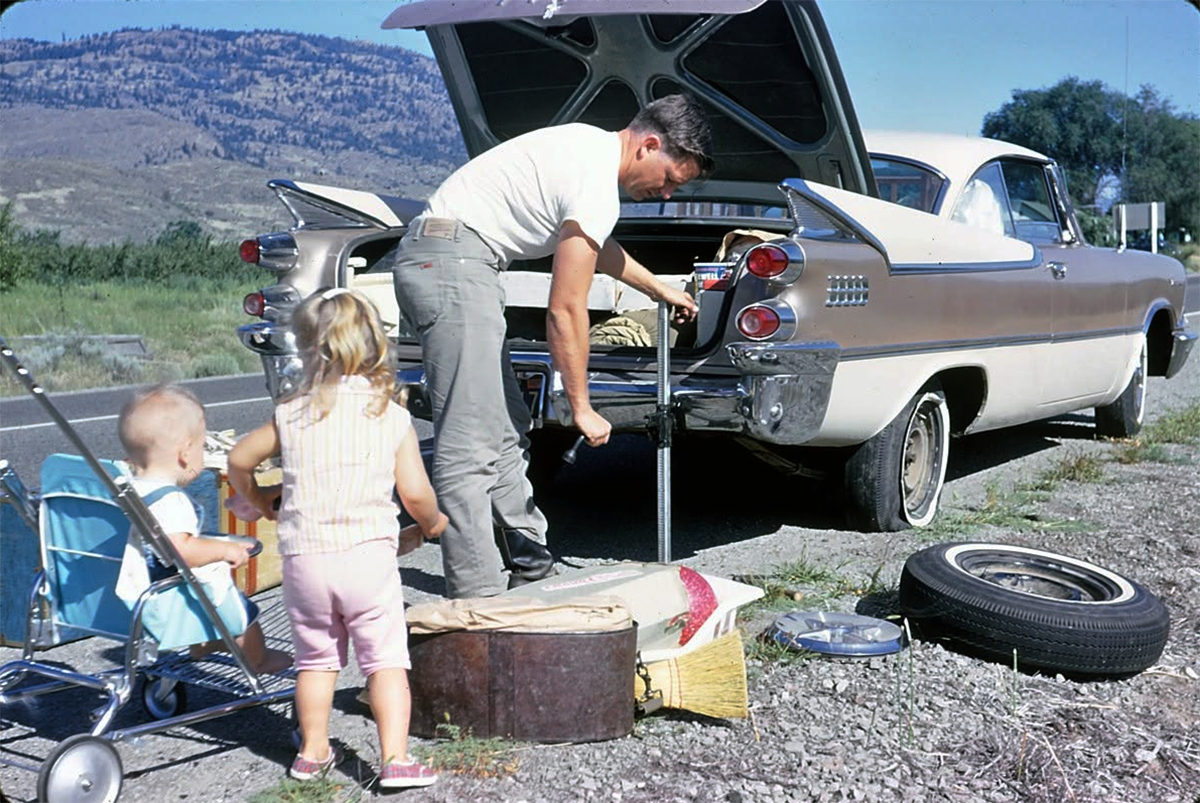
We begin with an experience that used to be very common; changing a flat tire on the road. Dad was working the bumper jack, while Mom was watching the kids and recording the event. They were traveling in a two tone 1959 Dodge Coronet Lancer 2 door hardtop with what appeared to be a California license plate. The flat tire had a white wall insert, a less expensive way to have white walls. Port-A-Wall is a brand that is still available. The spare on the ground looked like a regular white wall.
The Coronet was the entry level Dodge series, and this model could have been had with a 230 cubic inch Get-Away Six, or a 326 ci Red Ram V8.
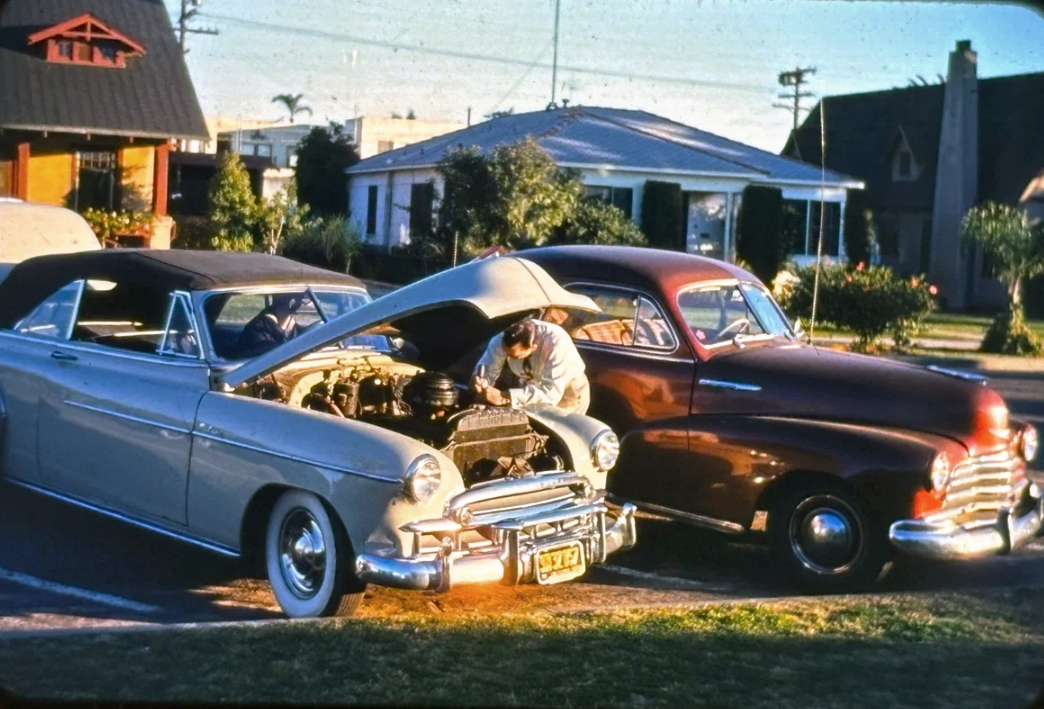
Two Chevrolets were in some pull in parking spaces across from residential housing. On the left was a 1949 Styleline De Luxe convertible that was dressed up with a grille guard, wheel discs, white wall tires, and it had a California license plate used from 1951-1955. It apparently had starting or running issues as there was a man behind the wheel, and one under the hood.
To the right was a 1947 Fleetmaster 5-Passenger Coupe with wheel trim rings. Both of them used the 216.5 ci 6 cylinder with 90 horsepower that was introduced in the 1941 model year.
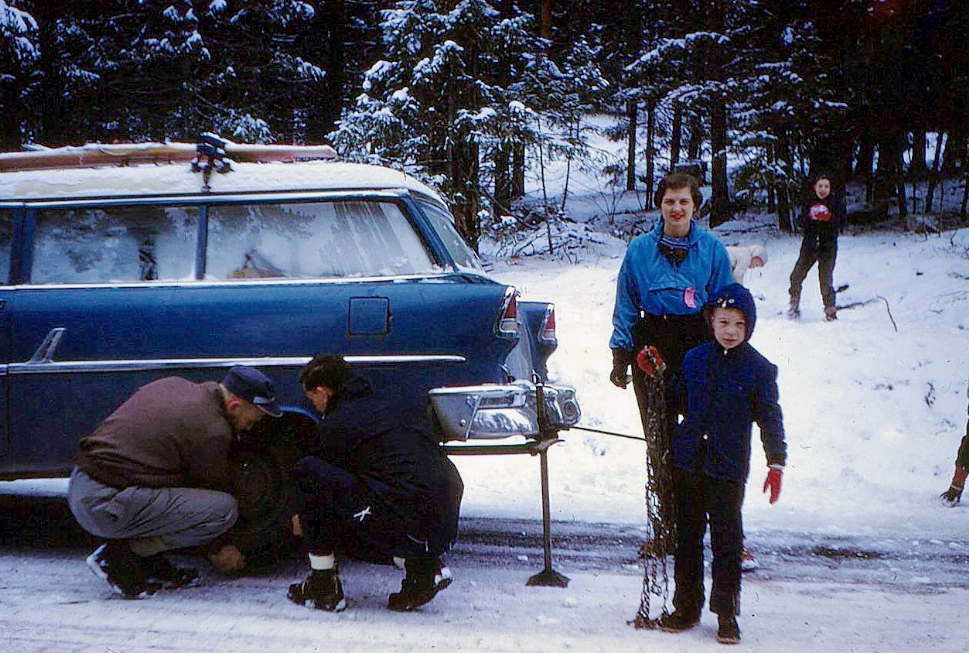
These folks were wiser than I ever was, that is installing tire chains before you really need them. I always waited until there was no other choice. They were on a skiing trip, so they likely knew where they were going. The boy in the foreground was helping by holding the other chain, while other kids were having a snowball fight.
The car was a 1955 Chevrolet Two-Ten Handyman 2 door wagon. It was equipped with one of the new 265 ci Turbo-Fire V8’s, two tone paint, accessory rear fender guards that were mounted on the bumper ends, and an extended tail pipe.
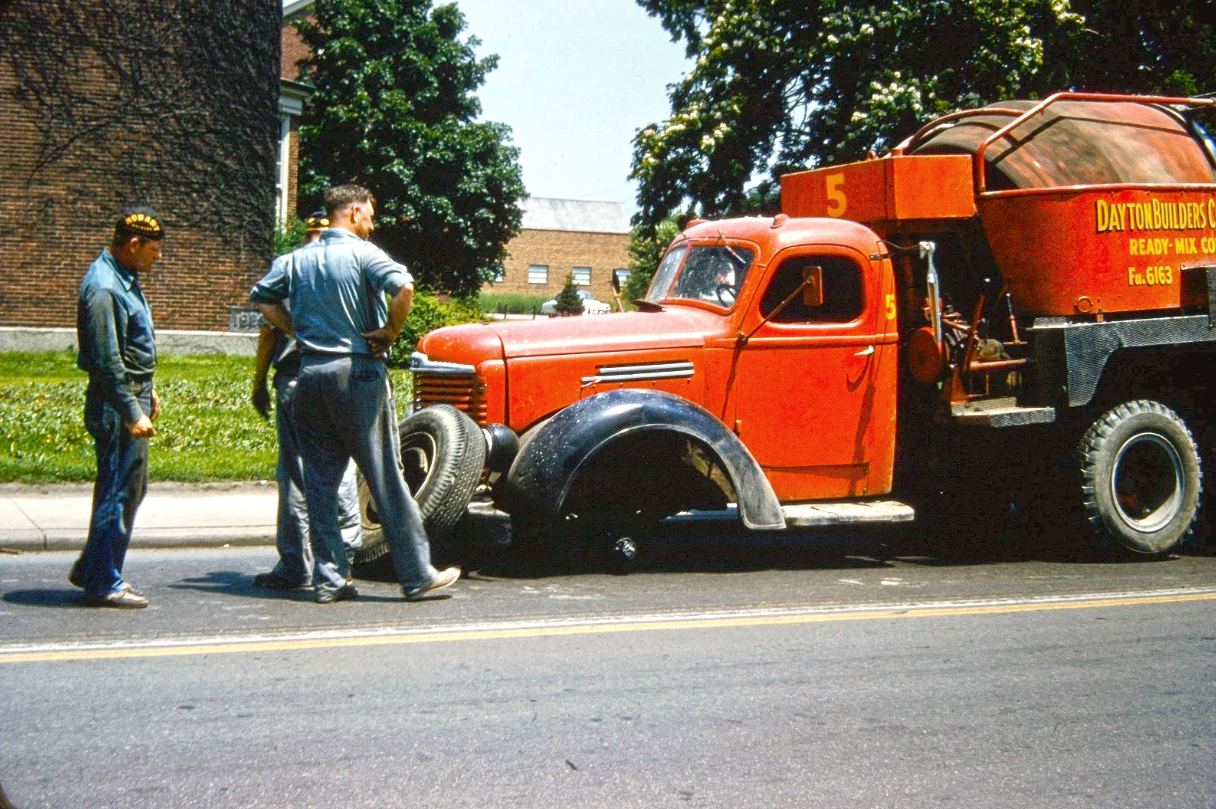
Old number 5 lost a wheel. How are we going to finish this delivery? It was a 1947-1949 International KB-7 concrete truck that was owned by Dayton Builders. It looks like the spindle broke off. I am sure it took more than a bumper jack for this job.
The K series trucks were introduced in 1940, and the slightly modernized KB series followed in 1947. The K-1 or KB-1 was a half ton pickup, and the numbering continued through the heavy duty line up to K-14 or KB-14, leaving out 9 and 13.
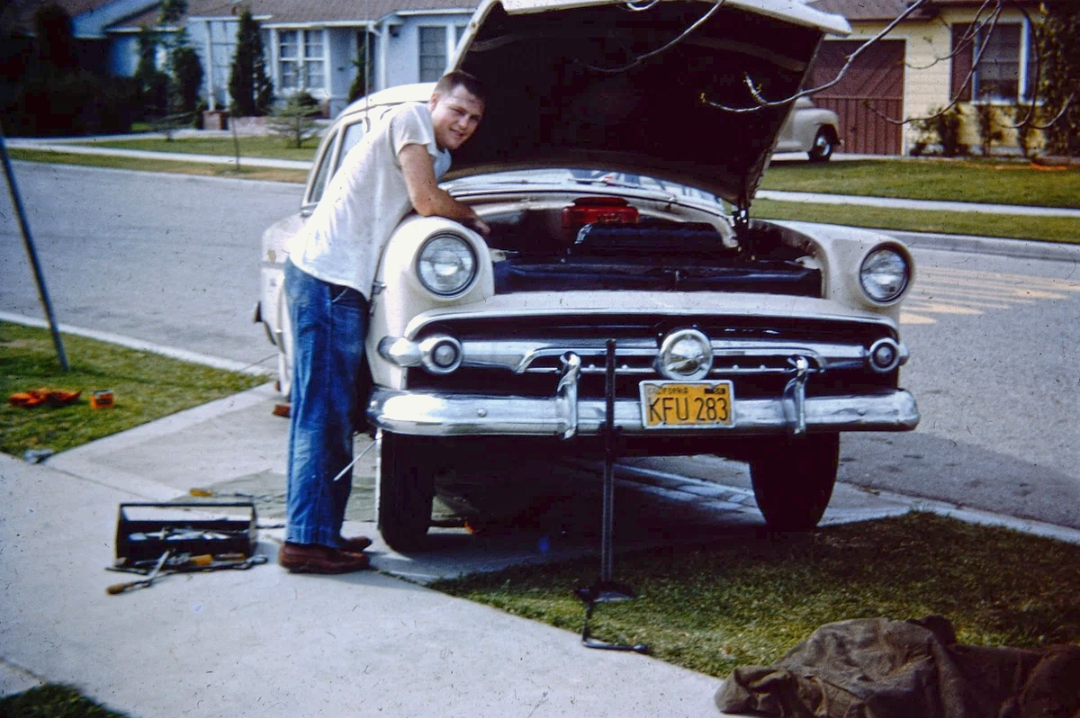
This fellow was taking advantage of a driveway cut to gain more space under the car. He was working on a 1954 Ford Customline Club Coupe or Tudor Sedan that was powered by the new 239.4 ci Y-Block V8 with 130 hp.
It is hard to tell exactly what he was doing, but he was into it with a tarp underneath, tools scattered about, and a greasy forehead. Across the street may have been a 1946-1948 Plymouth.
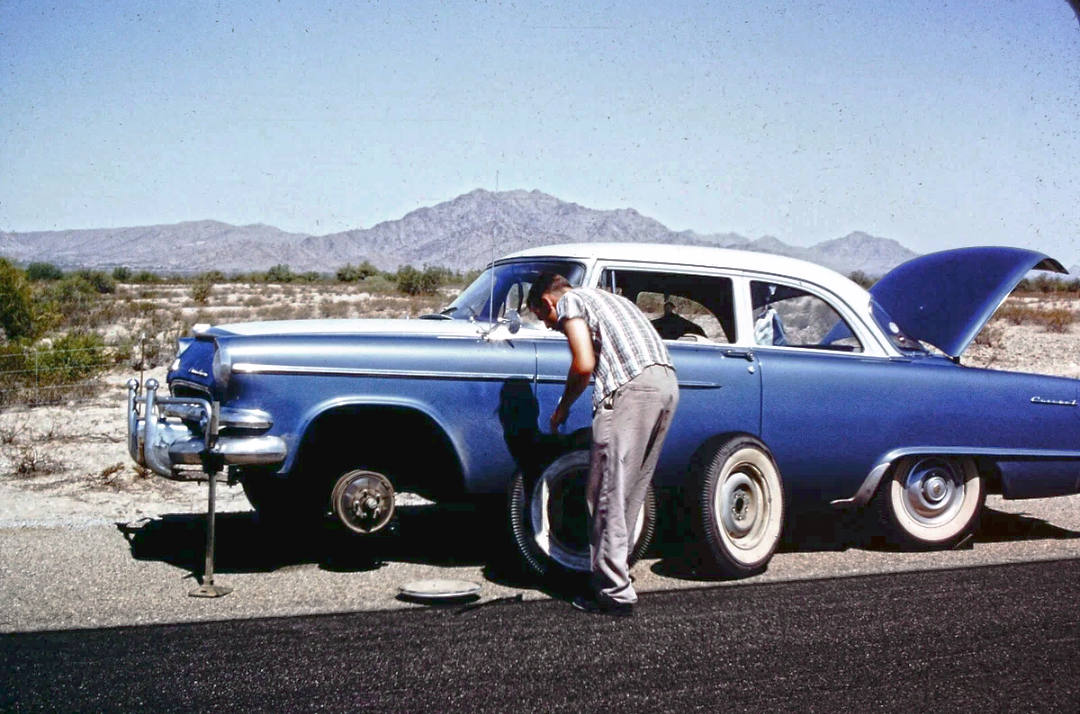
And another roadside flat tire change, this time on a 1955 Dodge Coronet 2 door sedan. It had a grille guard on the front bumper, which hindered the bumper jack, as you can see it was used on the corner. The road had a fresh layer of asphalt, which can add to the heat.
This was the entry level Dodge, and it had the 230 ci Get-Away Six for power. It was dressed up on the outside with two tone paint, full wheel covers, and white wall tires.
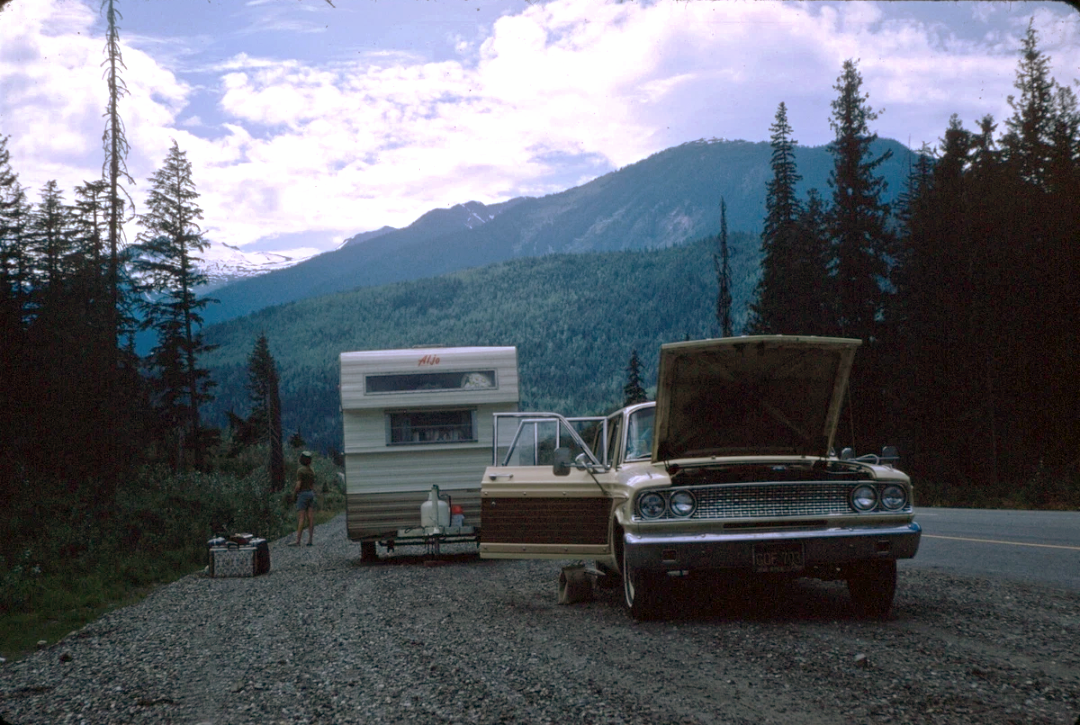
Here was a 1963 Ford Fairlane Squire from California that was having some kind of trouble while on vacation. They had unhitched the Aljo camp trailer, presumably to address the problem. The notes on the original slide said “breakdown near Revelstoke, B.C. – July 1967”.
Fairlane wagons were a 1963 addition to the line that was introduced in 1962. This one appeared to have one of the optional Challenger V8’s, which were a 221 ci with 145 hp, and a 260 ci with 164 hp.
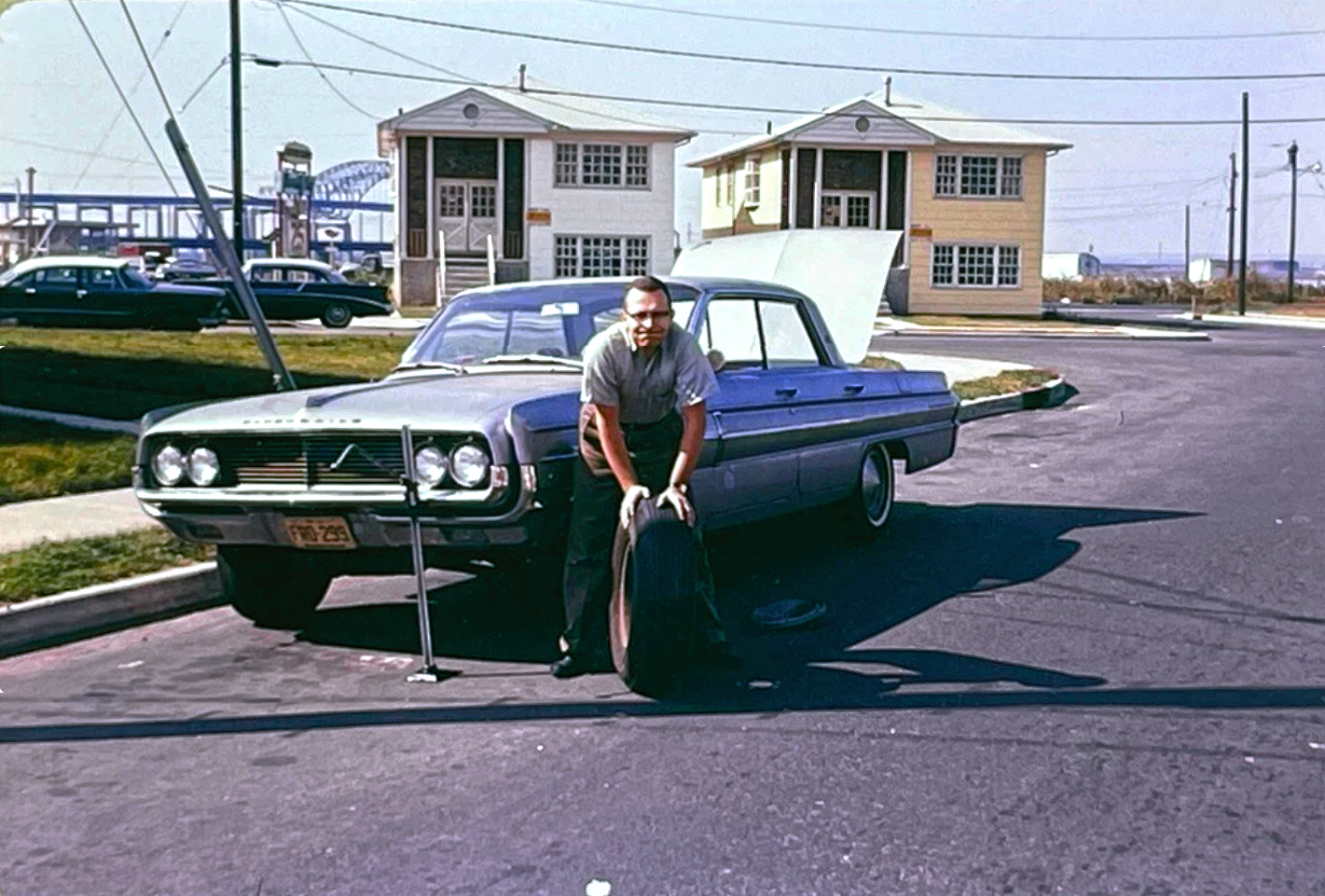
It was tire changing time again, this time on a 1962 Oldsmobile Super 88 Holiday Sedan with a New Jersey license plate. This one was on a side street, which always makes an unpleasant job less unpleasant. On the left edge in the background looked like a 1957 Plymouth Savoy 4 door sedan, and to the right a 1956 Chevrolet Bel Air 4 door sedan.
The Super 88 was the middle series of three, and the Holiday Sedan was the second best seller. Power came from a 394 ci Skyrocket V8 with 330 hp that was shared with the Ninety-Eight series.
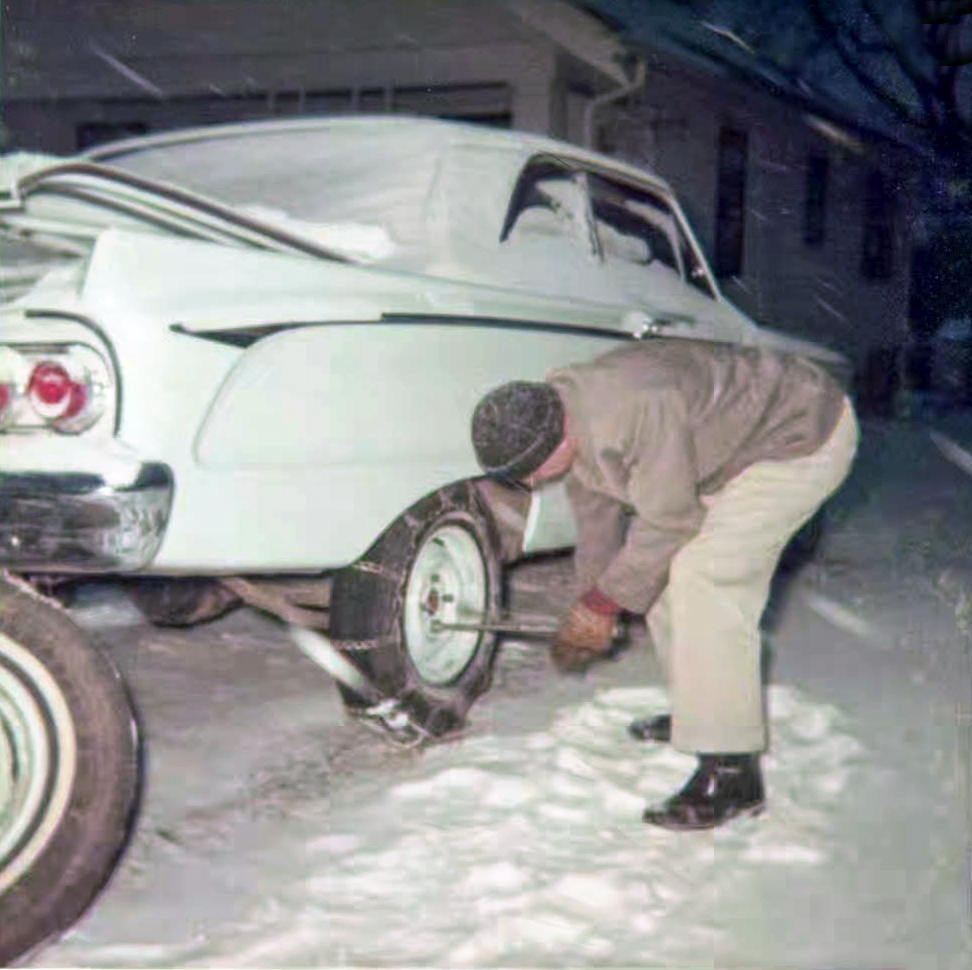
A 1962 Mercury Comet Custom 2 door sedan was having tire chains installed at home after a snow fall. It appears like he had an extra set of wheels with chains mounted, which could be helpful depending on conditions.
The Comet was Mercury’s successful compact line that was the top selling series that year.
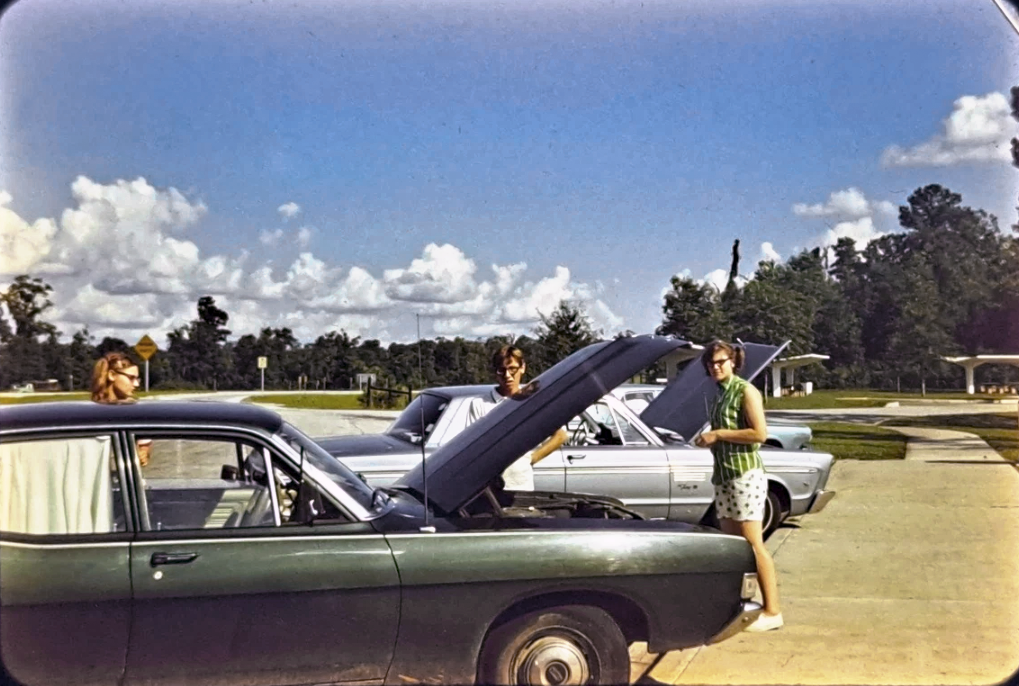
I am not sure what was going on in this 1969 image, but nobody looked very happy so there must have been some kind of trouble. They were gathered at a roadside rest stop on a summer day.
In the foreground was a 1968 or 1969 Ford Fairlane 4 door sedan, while the center spot was occupied by a 1965 Plymouth Fury III 4 door sedan or hardtop with a 318 ci V8. And on the far end was a 1964 Dodge Dart 4 door sedan.
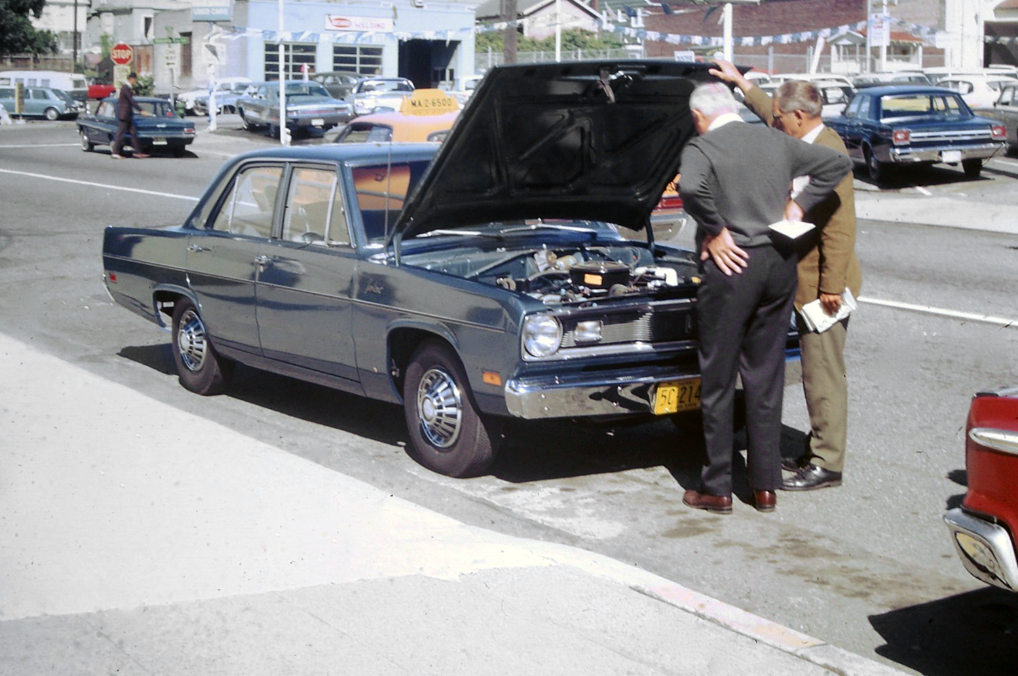
The setting here was a city street with what looked like a used car lot on the right, and a repair shop in the blue building on the left. Two men, perhaps from the car lot, were looking under the hood of a 1970 Plymouth Valiant 4 door sedan with a Slant Six engine, full wheel covers, and a Hawaii license plate used from 1969-1975. Passing by was a 1969 Plymouth Fury III 4 door hardtop taxi cab, and in the lower right corner was a red 1965 Dodge Coronet 440.
In the left background were a few imports of interest; one of the BMC ADO16 variants in turquoise, a Volkswagen T1 Transporter, and a white Hillman Minx. At the street corner was a 1961 Pontiac Tempest 4 door sedan, and to it’s right on the lot was a 1968 Chrysler New Yorker 2 door hardtop, and a 1969 Ford full size sedan.
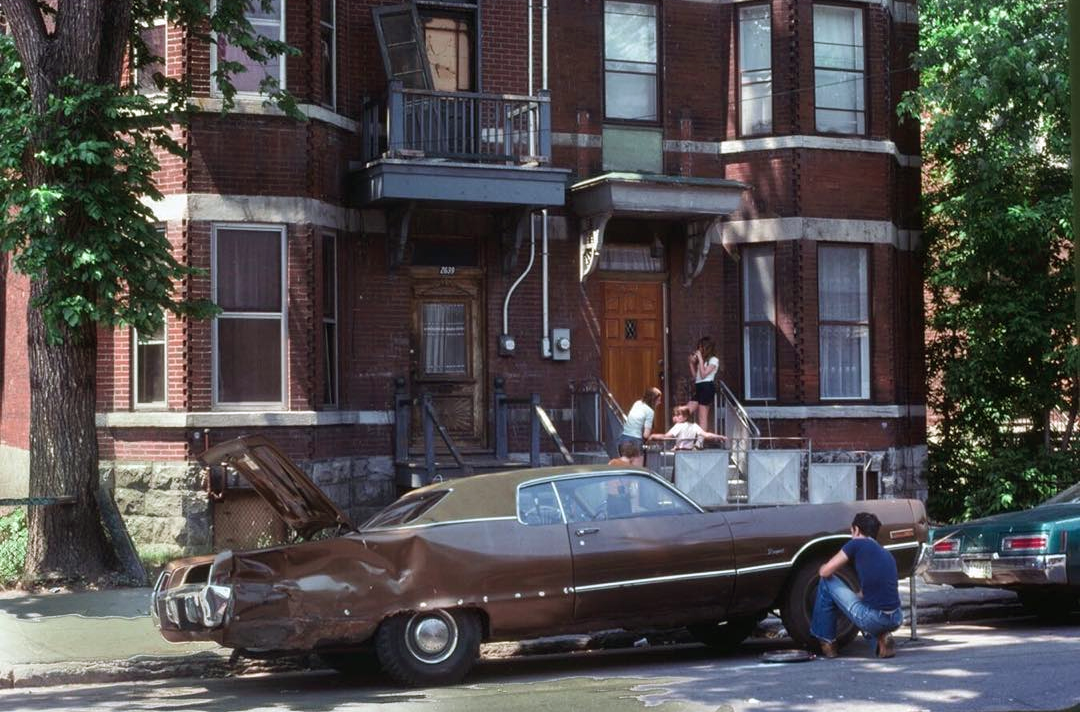
Here was a 1973 Chrysler Newport 2 door hardtop that had a tire change in process in an interesting looking old neighborhood. It has an aged vinyl roof and a seriously damaged and rusted quarter panel. Parked in front of it was a 1971 Pontiac Catalina or Bonneville.
The Newport was the entry level Chrysler, and had a 400 ci V8 with 185 net hp as standard equipment. The Catalina was Pontiac’s entry level full size, which came standard with a 350 ci V8 with 165 net hp. One step up was a Catalina Brougham, which had a standard 400 ci V8 with 185 net hp, and another step up was the Bonneville, with a standard 455 ci V8 with 190 net hp. All of them had more power on the option list.
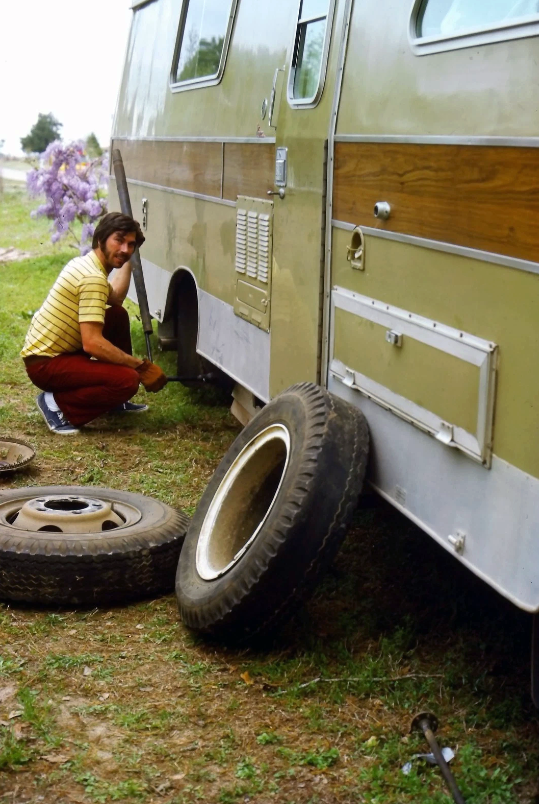
I am going to let someone else ID this motorhome, as I do not recognize it. It was undergoing a tire change, or possibly a two tire change. I hope the one leaning against the rig was one of the replaced tires, as it looks on the sad side.
We can’t see what type of jack he was using, but his lug wrench had a serious cheater bar attached to it.
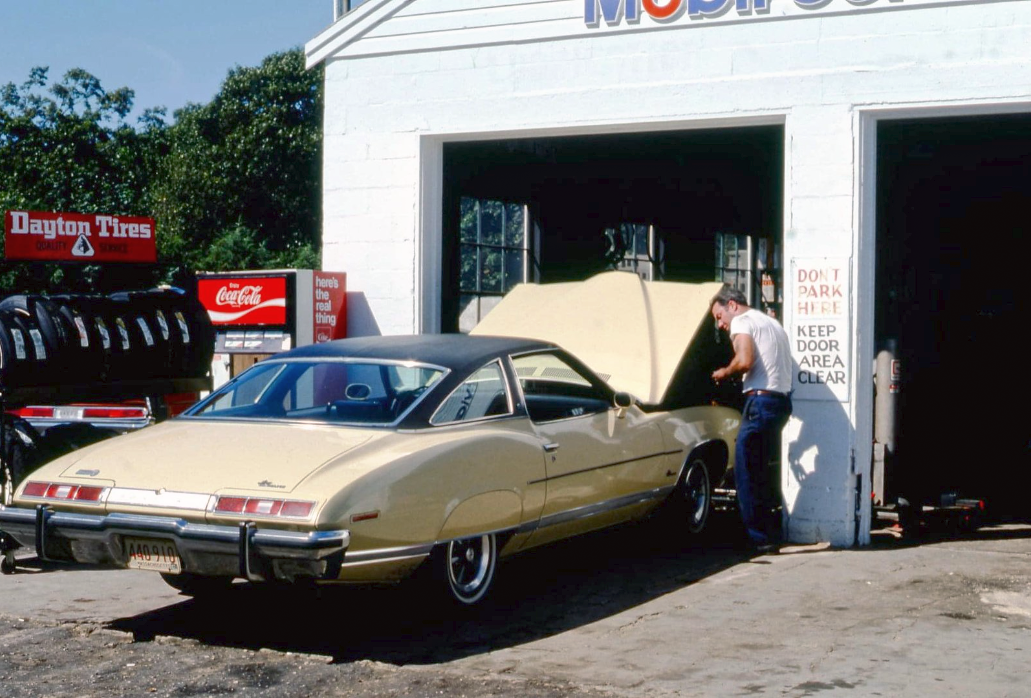
We close today with a slick looking 1973 Pontiac Luxury LeMans 2 door Colonnade hardtop from Massachusetts that was receiving some attention at a Mobil station. Hiding on the left side behind the tire rack was a 1970 Dodge Challenger.
The Luxury LeMans was in its first year of the Colonnade style that was in use through the 1977 model year. The full LeMans line began this cycle by outselling the Grand Prix, but in 1976 and 1977 that was reversed.
Thanks for joining us and have a great day!























The one with the damaged Chrysler Newport might be somewhere in Montreal or Quebec city. The licence plate of the Pontiac is a Quebec plate I think and instead of a Catalina or Bonneville, it might be a Canadian Laurentian or Parisienne.
Yes – I was just looking for that one, and I found the location in Montreal.
This was taken in the Pointe-Saint-Charles section of Montreal (2637 Rue de Rushbrooke). The houses in the photo are still standing, and it looks like the neighborhood has gentrified quite a bit in the last few decades.
The Pontiac’s license plate is a big clue because it appears to have seven characters, and I think the only North American jurisdictions using seven character plates during that period were Quebec and Louisiana (the Pontiac’s plate is probably from 1978-82).
Then-and-now comparison and Google StreetView link:
https://maps.app.goo.gl/pS1aaXgx3Vc5f37Y9
In the pre-radial tire days flats were common and a set of bias ply tires lasted maybe 12,000 miles. Blowouts were also a not infrequent occurrence and a cause of many serious accidents. Today flats are rare and I have 75,000 miles on the factory Bridgestones on my Acura MDX, with at least 5,000 miles left. Tires are so good today that many auto manufacturers have eliminated the spare. The radial tire has truly been one of the most consequential innovations in automotive history. The only downside is that today few drivers have any idea on how to change a tire.
The bridge in the background of the Super 88 shot is the Bayonne Bridge. It still spans the Kill Van Kull.
Boy, did I grow to hate bumper jacks after too many flats and tire rotations with my dad in the 80’s!
the 2 houses and location made me think of the Tom Cruise version of War of the Worlds
The ’62 Olds tire changer with the NJ plate may be doing so on Staten Island, NY, with what appears to be the Bayonne bridge in the background and 2 classic duplexes that are all over the borough in the fore. Makes for an interesting picture.
What a fun theme (well, for us in 2026) for a photo collection!
This all looks familiar to me—and I do take for granted the reliability (and long life) of autos and their tires nowadays. In the postwar 1940s my father was nursing an early-1930s car, and a flat tire “every month or two” was typical, he said.
For that 1954 Ford, the dampness under the car might suggest radiator stuff; another common get-underneath-the-car chore was putting in a rebuilt starter. Beats me about the motor home, but someone here will know for certain. Thanks!
I don’t miss bias-ply tires nor “Widow Maker” bumper jacks one bit .
I hope all here know to never, _EVER_ go underneath a vehicle so supported .
When changing a flat it’s wise to slide the off wheel under the side of the vehicle in case the jack fails or the vehicle falls off it.
-Nate
With regard to the 1959 Dodge in the first picture, I would not have had my kids in the immediate vicinity of that bumper jack.
The 54 Ford looks scary too, you know that guy was going underneath it
In the first picture I wouldn’t put my hand on top of the jack either. Roll forward, crush fingers (especially if the trunk lid is closed).
That motorhome is getting something more than a tire change, likely brake or bearing related work. That is based on the axle shaft laying on the ground near the front and the fact he has a breaker bar on it after the wheels and axle shaft have been removed.
Were bumper jacks that common? They seem more dangerous than scissor jacks… car could slide off. Or am I overthinking it?
Aussie cars came with both depending on brand my classic has a useless jack similar to a bumper jack it works on a sedan but not san estate as they have a larger diameter tyre, tried it once couldnt get a rear tyre clear of the ground so a small trolley jack lives in that car now but its never had a puncture since Ive owned it, daily drive came with a full size spare which is rare these days, but thats not a ‘new’ car either. Hate bumper jacks
You’re not overthinking it, bumper jacks were risky because they can easily tip over. That and changing car construction led to using jacking points on the sills or frame rails. Ironically deliberately knocking a vehicle off a high lift bumper jack is an actual off road recovery technique for getting a wheel out of a deep rut or hole.
You are not overthinking it!. More than once a bumper jack where the jack itself failed or more usually circumstances required a less than ideal surface to put the base onto. I do remember pulling a bruised leg out from under a fallen vehicle, the closest I came to disaster. Don’t know why I am alive after many instances crawling under and working on a car held up only by a bumper jack. And with one jack stand and the bumper jack at the other end it was only slightly less precarious. Placing a few stones or a brick behind the far end wheel was wise and recommended.
Always hated them. Even when they held the car up many times when later lowering the car the bumper was no longer level. The early bumper jacks hooked the lower bumper edge, in later designs the bumper had small vertical slots where the small hook on the jack would engage, requiring even more careful placement.
Scissors and alligator jacks are much better but even scissor jacks can be hazardous with out chocking other wheels. Always have it on good quality jack stands before going under.
It’s no exaggeration to say that cars made since 1990-ish are a quantum leap in ease of maintenance over what we now refer to as “vintage” automobiles. When I contemplated buying my first car, the idea of flat tires, overheating radiators, dead batteries, flooded carburetors, &c. was enough to give me pause and weigh the virtues of public transportation.
Old cars are lovely to look at, but give me today’s “set and forget” vehicles every time.
Virtually all US cars had bumper jacks well into the late 1970s at least.Tires, hoses and belts last so much longer than they used to.
Note the small black wooden wedge behind the tire of the ’55 Dodge. Most Chrysler cars came with them at least thru the ’50s, I have one that’s left from one of my ’58 Mopars behind the rear wheel of my Duster in my garage right now.
Was the 221 Challenger V8 still available in ’63? I thought the 260 quickly replaced it, not sure when though.
I’ve seen bumper jacks, and older cars with slots in the bumpers but never used one. By the time I was old enough we had European cars with jacking points in the sills. This does mean I’ve dealt with a lot of lug bolts, and a lot of scissor jacks and screw jacks. Seeing people under a car with just a bumper jack gives me the heebie jeebies, I used to at least stick a spare wheel under the car for minor jobs and use wheel ramps or jack stands for serious stuff.
I’ve also only owned cars with radial tires so no blowouts and only a few flats, including the freak incident where I drove around for a few days with a metal building screw embedded in a tire. The rubber washer sealed the hole so it wasn’t leaking and only the clicking noise gave it away. The oldest cars I’ve owned were from the 70s so apart from the 85 Ford Ranger they had fuel injection, and only one car had points, this also means my grease gun has barely been used.
As someone who has used chains, I have to ask, who jacks up their car to put on chains? I never did, and it’s seems to be a rather scary scenario that’s just asking for trouble.
The text clearly says: It appears like he had an extra set of wheels with chains mounted, which could be helpful depending on conditions. That’s pretty obvious as to what was going on here.
I was thinking more about the station wagon in the third picture.
The other one brings all sorts of other questions to my mind.
Aha. Yeah; I dunno. Were chains harder to put on back then? Hard to imagine.
Yeah, they were. I installed chains a few times on my parents’ car with the old style chains that are probably still used for HD trucks and off-road use. Between the type of fastening, more difficult adjustment and tight wheel wells it was faster to jack it up especially working solo. Modern chains usually have a semi-rigid inner section that you just push through behind the tire and clip together, and then do all the tightening with a “lever” on the outside that really lets you snug them up tight. A lot of times you barely need additional rubber band style tensioners.
Now that I think about it, you’re right; they were harder. The chains on my Promaster are a breeze, with their cam tighteners.
Man, that very first pic really makes me sick to think about those children behind the car like that. So dangerous and with traffic the way it is today, I’d hope nobody ever does that now.
Old Number 5’s crew might be in for a very long day and a lot of mandatory overtime if the concrete load sets up in the truck and has to be chipped out. If it’s full enough to need cutting and rewelding the drum, or just scrapping it and putting in a new drum – let’s just say if I were the fleet mechanic I’d want any recommendation of earlier spindle replacement being vetoed by Accounting or upper management to be well documented.
I started driving in the late ’70s, so this type of stuff was just everyday life. When I was a young boy we had a number of “adventures” involving Dad’s ’58 Bel Air in the wilds of British Columbia. The good old days were not as easy as folks who weren’t around then think.
Those bumper jacks were called widow makers for a reason. In my shop foreman days getting under a vehicle that wasn’t supported properly was a 2 day unpaid suspension. I never lost a grievance on it either, even the shop steward was on board with that one. I always carried a cheap jack stand with my tools back in my days of driving dodgy old cars.
The company I worked for owned a ready mix operation, an immobilzed mixer truck was an all hands on deck operation to get the load off before it hardened in the drum!
Ahh, the infamous bumper jack. I can recall numerous newspaper articles describing bumper jacks giving way and crushing the poor owner. I mean, the car makers could have included a wheel chock to make it somewhat safer. Even my 1974 Toyota Corolla came with one, even though it had a much safer scissors jack.
For decades I was lucky and didn’t get any flats. Then my luck ran out. I’ve had a flat in every car I have had since 2008. It’s always a pain changing a tire and in my Golf putting everything away requires a good memory as to where it goes.
With today being Halloween, the great write-up on a 1970 Cadillac hearse, along with this report about flat tires, reminded me of a story handed down through my family:
Uncle George was a funeral director who operated a small-town funeral home. One day, his hearse—with two living souls and one “dearly departed” aboard—was leading a procession to a cemetery outside town when it got a flat tire.
And where do you suppose they kept the spare tire in a hearse?
Yep. Under the casket.
The entire procession pulled over to the side of the road. Out came the casket. Out came the jack and spare. A few minutes later, the tire was changed, everything—and everyone—was back in place, and off they went.
And not a word of complaint from the passenger in back.
Citroen had the best jacking system. Raise the hydropneumatic suspension, place the supplied jack stand and lower the car onto the jack stand until the wheel came off of the ground. Easy and safe.
A car with chains and not a peep out of Howard?