

Text by Patrick Bell.
On this day in 1954 Ford unveiled its new Thunderbird at the Detroit Auto Show. Production began later that year and they went on sale in October as a 1955 model. In today’s gallery, we are going to highlight some examples from the first five generations of this personal luxury car pioneer.
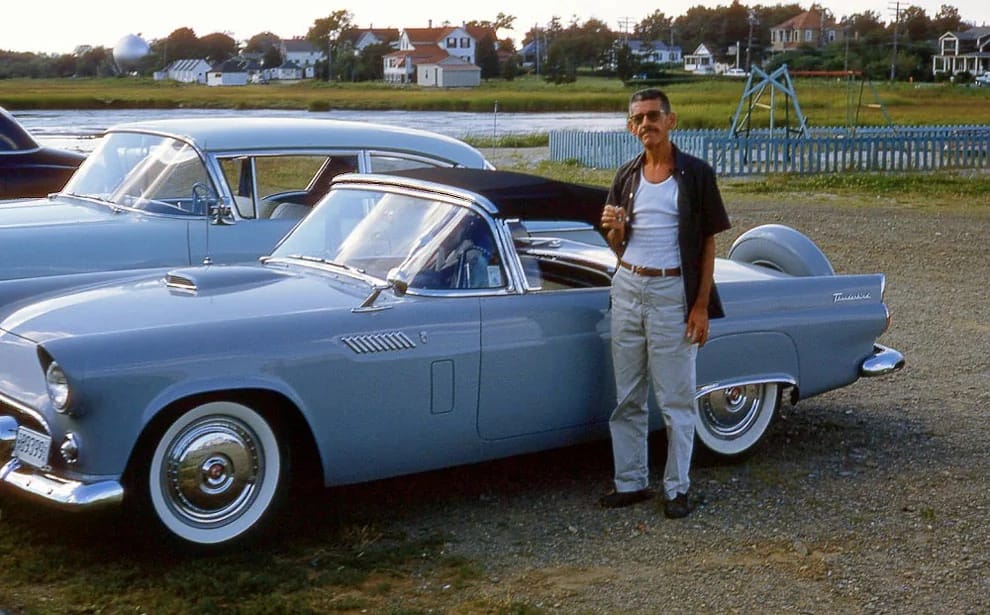
We begin with a gentleman posing along with a 1956 model with either a 1958 or 1960 Texas license plate. This view shows the new optional port style window in the top, and the standard continental kit. The standard power plant was a 292 cubic inch V8, with a 312 optional. The two seaters later became known as the Baby Birds. Parked at the curb to the right may have been a 1940 or 1941 Lincoln undergoing some paint work, and in the driveway was a 1955 Chevrolet One-Fifty or Two-Ten. If this looks familiar, you are correct; we used it in a recent Ford gallery HERE.

The 1955 Thunderbird was billed as “A personal car of distinction” in the sales brochure, which also mentioned it had an “all steel body”. Ford wanted to point out that their car was different than Chevrolet’s Corvette. The featured one in bright red did not have the optional fender skirts, but did have a radio, simulated wire wheels, and whitewall tires. The lone power plant was a 292 Y-block V8. I am unsure about the ID of the car to the left.

Here was another 1955 model, this one with the top removed or folded down. It was equipped with the standard hub caps, and visible options were the radio, outside mirror (aftermarket?), and whitewalls. The man behind the wheel looked pleased with it.

1958 brought the 4 passenger Thunderbird and began the three year Squarebird generation. Also new for the year was the standard Thunderbird 352 Special V8 with 300 horsepower. The one above was a 1958 model and had some damage on the quarter panel. It was equipped with fender skirts, full wheel covers, whitewall tires, and a continental kit, which did not show as a factory option, so it was likely aftermarket.
Another 1956 model is shown here, this one with a soft top and an aftermarket fender mounted mirror. Other options were a radio, fender skirts, full wheel covers and whitewalls. I don’t recognize and can’t read the details of the license plate. Parked on the other side of it was a 1958 Pontiac Chieftain 2 door sedan.

A different but very similar 1958 model was here in a view that showed the roof style that was adopted in the full size line for the 1959 model year. This one did not have fender skirts (they weren’t as obvious as the 2 passenger models), and had a 1959 Florida license plate that was issued in Broward County.

Moving forward to the Bullet Bird generation with this final year 1963 model with a Tennessee license plate issued in Shelby County. A new Thunderbird 390 Special V8 became standard in 1961, the first year of this generation. Along with that Cruise-o-Matic Drive, Power Steering and Brakes, remote control outside mirror, and full wheel covers were also now standard equipment. This car did have fender skirts, which were still optional. To the left was a similar vintage Volkswagen Type 1, and in the background from the left, a 1963 Pontiac Bonneville, a 1960 or 1961 Ford Falcon 4 door wagon, the gold car was a 1962 Chevrolet Impala Sport Sedan, and on the right edge, a 1964 Ford Galaxie 500.
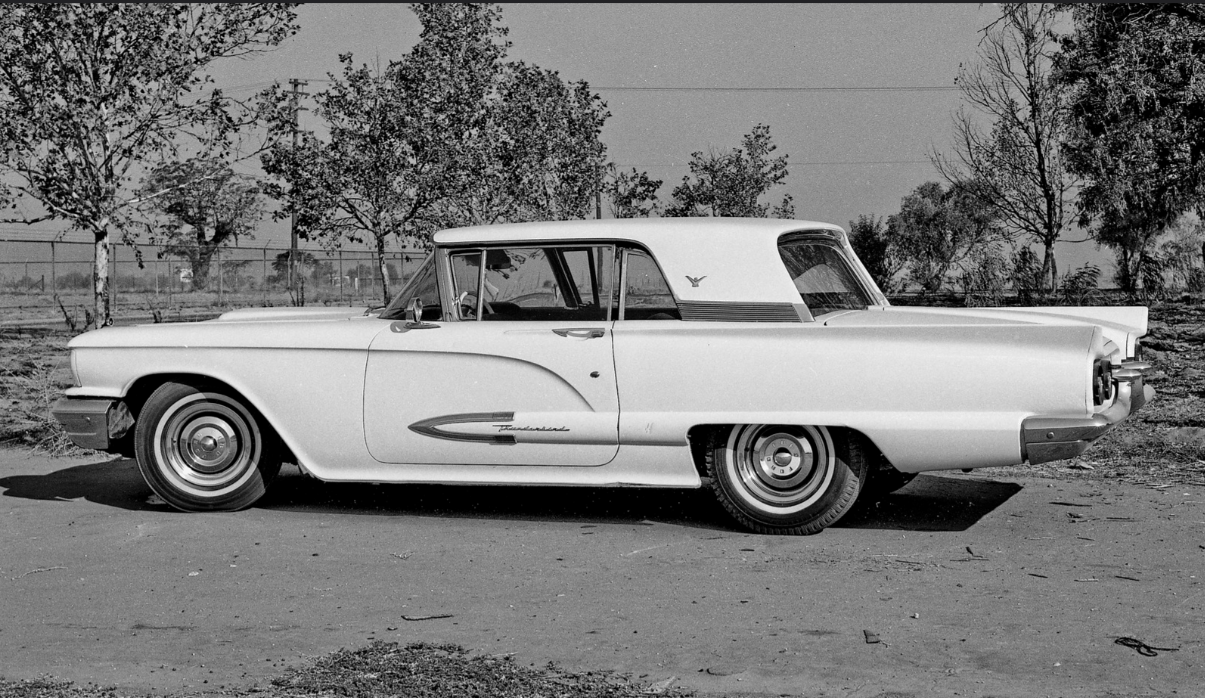
This one was a 1959 model, showing just trim updates for the year. The biggest news was the new optional Thunderbird 430 Special engine with 350 horsepower. The one above was a basic car option wise, with no fender skirts and standard hub caps. The trim rings were likely a later addition, along with the narrow band whitewalls.

Now we are viewing a 1963 Landau model that was on a camping trip. The Landau was introduced in 1962 and had as standard equipment the vinyl roof with “S” bars, and woodgrain dash and door trim. Plus this one had the optional fender skirts. The license plate is difficult to read, but it may be a 1965 Ohio issue.

This 1955 model was 14 years old per the photo date, and was modified with wider chrome wheels and it looked like it was jacked up in the rear. The body and paint also looked good, so it likely had been redone. These 2 seaters were considered classics as soon as they went out of production, and have remained that way ever since.

We have met Mr. GC from Connecticut before on these pages and have seen some of his other cars with his vanity license plates. He is/was a true car man, and I have to wonder if he is related to Aaron65, as they seem to have similar tastes. Today we see a 1963 Thunderbird that was wearing his license plate, and appeared to have a curb feeler on the front to protect that whitewall. In the background looks like the Nauset Beach Light on the Cape Cod National Seashore near Eastham, Massachusetts. For his previous photos see HERE, and HERE.

The 1964-1966 generation became known as the Flair Birds. The one above was a 1965 Landau with a California license plate, plus the optional wire wheels and fender skirts. New for 1965 were standard front disc brakes and sequential rear turn signals, plus various trim pieces.

The Glamour Bird was the next generation that consisted of the 1967-1971 model years. This was where the only four door Thunderbird came in, as well as hidden headlamps from 1967-1969. Fender skirts were out, and the convertible was retired for the rest of the century. The open wheel look was in. The above unit was a 1968 Two-Door Landau in a very common color combination. New for 1968 was the optional Thunder Jet 429 V8 that went on to become standard from 1969-1973. Parked in the driveway was a 1968 Ford Country Squire.

We will close with a last year Baby Bird, a 1957 model from Texas. This was another clean 14 year old car that likely had been refurbished at least to some degree, and looked good with those wire wheels. 1957 brought a longer and restyled body plus an upgraded interior. The 292 V8 remained standard, and four versions of the 312 V8 were now available including one with a supercharger and 300 horsepower. In the driveway was a 1967 Buick Electra 225 Sport Coupe, and in the left background looks like a 1967 or 1968 Plymouth Fury wagon.
Thanks for joining us and have a great day!
Note: If you wish to see your vintage photos featured at Curbside Classic, send them to us at [email protected].






Ha ha, Mr. GC does have great taste in cars, but I want to make it clear that I would never attach curb feelers to anything with my name on the title. 🙂
LOL, my wife needs curb feelers badly which is why she gets wheel covers only.
They we’re in vogue back then to keep your white walls scuff free… I remember cars having the static straps hanging off the bottom rear also…
I love all of these. But now I am wondering about the fender skirts on 1961-63 cars. I don’t recall ever seeing a 61 without them, although the brochure calls “fender shields” optional. I knew they were deleted from 62-63 Sports Roadsters because they would not clear the wire wheels, but wonder if the skirts were (in practice, at least) a mandatory option for all non-SR 61-63 cars.
As for the mystery car at the curb behind the red 55 Bird, my guess is a 49-52 Dodge Wayfarer 2 door sedan.
The plate on the ’56 Thunderbird (Picture #5) appears to be a New York State Thruway Permit. Based on the color, the die sizes and the stacked characters (what appears to be TWY on the left side, and numbers on the right side), I’d guess it’s from 1958. Below is an image of what these permits look like.
Oddly, I don’t recognize the windshield sticker as a New York inspections sticker. Maybe it’s something else.
Oh, and I’m amazed to see yet another photo of Mr. GC 54. He sure liked posing with his cars!
What is with the owners of the white 1958 that they park the car on lawns? This seems to be a car photo genre– drive the car to some open field to snap the picture. I understand car show pictures being on lawns. Car shows are held in parks or grass areas. But this isn’t a place to park and fish in the water, or any other activity. This car is just plain parked on a lawn.
I looked at the first picture and thought “Natty Dresser” .
Certainly all those show were well pleased with their T-Birds and why not ? .
My favorites remain the ’55 / ’56’s .
-Nate
My sister in her 1966 Flairbird, Vancouver 2004
[image didn’t upload for some reason]
Like that “68”, model.
My first car was a 1979 Thunderbird. It was a big bodied car but it was a very smooth ride.
Pl. Add the names of the people who are in the pictures , if possible. If you can add the names of the present owners and the names of the country and the places make nice. Very interesting.
Interesting to see another new 1955 Thunderbird (red) with original 1954 hubcaps and wire wheel covers over them. My 1955 came new with 1954 hubcaps/wire covers, where most came with 1955 hubcaps/wire covers. My thought is that the factory ran low on 1955 hubcaps and hence used 1954 hubcaps that were in stock. And my car was made on the 3rd to final day of production of the 1955 models.
I am a true T-Bird nut that started at age six, 1957. A neighbor lady would sometimes drive me to school in her pink w/white interior 1957 Bird. Mom bought a new 1960 T-Bird convertible, white w/turquoise interior. Dad bought a new 1963 hardtop, Heritage Burgundy w/pearl beige interior that was given to me on my 16th birthday, early 1967. Dad had already bought a new 1966 Bird Town Landau, blue with white top & dark blue interior. The Town Landau also became mine early 1970.
I have every book published on T-Birds, brochures, a wide range of scale model Birds, and almost all the gifts the factory sent to new T-Bird owners. My warm weather car today is a 1966 T-Bird convertible, yellow w/black interior. It came from the factory with every available option except six. Did not have the 428 engine, the reclining passenger seat, speed control, all vinyl interior or all leather interior, or fender skirts. Unique that my convertible was factory ordered with black vinyl seating w/black cloth inserts. It was delivered new to Dallas so perhaps that is why the purchaser wanted AC and the cloth seat inserts in a convertible. The interior of my car has been completely refurbished/restored with period correct all black vinyl seating that I prefer.
I will answer a comment above about the fender shields (skirts) on 1955-66 T-Birds. Skirts were always an option on all but the 1962-63 T-Bird Roadsters. Those two years were the only years for the Roadsters and they all came with factory wire wheels that would not fit under the skirts. A little detail regarding the skirts on 1964-66 Flair Birds. The 1966 model was the only one with SS trim around the wheel-wells. If the car was ordered without skirts the open rear wheel-well had SS trim, if ordered with skirts the skirts had SS trim on the bottom edge of the skirts. I have currently seen 1966 Birds without skirts but missing the now rare full open rear wheel-well SS trim. I have seen 1966 Birds with 1964-65 skirts that did not have the SS lower edge trim. I have been shocked to see a few 1966 T-Birds with incorrect 1964-65 skirts attached leaving the open wheel-well SS trim in place. Yes it can be done but the skirts don’t properly fit. I consider myself fortunate that my Bird previous owner paid attention to most, but not all of the little details. I still have the original factory SS trim for the open rear wheel-wells as it came from the factory, and also correct 1966 skirts with the lower edge SS trim. I have been using the skirts for about five years now, thinking of taking the skirts off this year and putting the SS trim back on the rear open wheel-wells. Where did I put the screws to attach the trim? Guess I have to place another order with one of the many T-Bird parts vendors.
I previously said I am a T-Bird nut so please forgive the long post.