

Text by Patrick Bell.
Today we have a good gallery of vintage photos of the pride of the Mopar fleet: Chrysler and Imperial. During this era, these were well-appointed and powerful road-going machines even in basic form. Let’s take a look.
We begin with the “Finest Expression of the Forward Look,” a 1957 Imperial 2-door Southampton hardtop. 1957 was Imperial’s third year as a separate make, and introduced the second generation of Chrysler styling chief Virgil Exner’s “Forward Look.” There were three model series in 1957: base Imperial, like the blue one above, Crown, and LeBaron. The Southampton name indicated a hardtop. The sole engine in the Imperial line was the Chrysler “FirePower” Hemi, which was now 392 cubic inches with 325 horsepower.
The featured Imperial had a California license plate, and California looked to have been the locale as well. Parked in the street at the right was another Forward Look car: a black 1957 Plymouth Belvedere 2-door hardtop.

Here we have two more California Chryslers. These ladies were posing with a pair of 1950 Chrysler Windsor 4-door sedans. The Windsor was the most popular Chrysler model that year, and the 4-door sedan was the most popular version. Along with the cheaper Chrysler Royal, the Windsor was a junior series, with a 125.5-inch wheelbase and a 250 cubic inch “Spitfire High-Compression Six” of the L-head variety, with 116 horsepower. Chrysler didn’t offer a fully automatic transmission at this time, but the 4-speed semi-automatic “Prestomatic Fluid Drive” transmission was available if you did not want to shift gears all the time. The two cars pictured above appeared to be twins except for the color.

Next, we move across the country to a Florida beach, where this 1951 or 1952 New Yorker 4-door sedan had already visited “Parrot Jungle” wildlife park (now called “Jungle Island”) outside of Miami. The New Yorker and Imperial were the senior Chrysler series. The New Yorker used a 131.5-inch wheelbase and the 331 cubic inch “FirePower” Hemi, which was new for 1951. A new option for 1951 Chrysler cars was “Hydraglide” power steering, the first power steering on a production car. The pictured New Yorker was equipped with a sun visor and a large spotlight. I can’t read its license plate.

For 1955, Chrysler restyled its entire line with Virgil Exner’s “100 Million Dollar Look.” With Imperial becoming a separate make, Chrysler model series were reduced to two, the Windsor Deluxe and New Yorker Deluxe, both on a 126-inch wheelbase. The Windsor Deluxe traded the previous six-cylinder engine for a 301 cubic inch “Spitfire” V8. There would not be another US-market six-cylinder Chrysler for over twenty years. Many Chryslers now had the optional “PowerFlite” two-speed automatic. The well-dressed society lady pictured in the photo above was posing with a new-looking 1955 Windsor Deluxe Town & Country station wagon. Wagons were not very common in the Chrysler line; there were 1,983 in the Windsor Deluxe series and another 1,036 in New Yorker Deluxe trim.

The pictured car is another 1955 Windsor Deluxe, photographed at Yellowstone National Park in 1960. It looked like it had been driving through an ice storm — probably without the headlights on, or the ice would have been at least partially melted. It is hard to tell at this angle what body style this car was, except that it wasn’t a convertible. The ice on the front end made the license plate impossible to read.

For 1956, Chrysler models got a facelift, which was advertised as “PowerStyle,” with “high swept rear fenders” — commonly known as tail fins. This lady was posing with a 1956 Chrysler Windsor 2-door hardtop. Chrysler offered two different 2-door hardtop models in the Windsor line for 1955 and 1956: the fancier Newport and the cheaper Nassau, which had slightly different exterior and interior trim. Unfortunately, the lady is standing in front of the trim that might have indicated whether this was a Nassau or a Newport.

Next, we jump ahead in time to 1962, and a 1962 Newport 2-door hardtop wearing a U.S. Forces in West Germany license plate. The Exner era had faded, and fins had gone out of style. Since 1961, the Newport name had been applied to the entry-level Chrysler series. The standard Newport engine was a 361 cubic inch V8 with wedge combustion chambers and a two-barrel carburetor; 383 and 413 cubic inch versions were optional. Curbside Classic previously featured the above photo in a vintage Motor Trend road test of the 1962 Newport.

For 1960, the Imperial was billed as “America’s most carefully built car.” It was the only 1960 Chrysler model that still had a full separate frame rather than “Unibody” unitized construction. The dark blue car pictured above was a 1960 Imperial LeBaron, which was the top of the Imperial line and the most expensive model except for the rare Crown Imperial limousine. The LeBaron was available both as a 4-door pillared sedan and a 4-door Southampton hardtop. From this angle, it is difficult to tell which body style this one was, but the hardtop was the more popular of the two, with 999 built compared to 692 sedans. This car had a Pennsylvania license plate. It was not equipped with the love it-or-hate-it Flight-Sweep Decklid, whose simulated spare tire was often compared to a toilet seat.

This fine-looking young feller was sitting on the hood of a 1963 Newport 4-door sedan with the optional bumper guards and remote control mirror. The 1963 Chryslers got a major restyle, which was the last one influenced by Virgil Exner, who left Chrysler in November 1961. Standard power was the 361 cubic inch “Firebolt 265” V8. The Newport was once again the least expensive and most popular Chrysler model. The truck in the background looks like a 1958 Chevrolet Viking series 40 or 50.

The 1964 Chrysler models got a minor facelift, carrying over the same trim series and engines. The New Yorker came with the 413 cubic inch “FirePower 340” V8 and pushbutton “TorqueFlite” automatic. The car pictured above was a 1964 New Yorker 4-door hardtop, which was towing a boat trailer. It was not new, since the black-and-gold car in the background was a 1970-1972 Oldsmobile Cutlass Supreme hardtop coupe.

1965 brought another complete restyle, which was the first to be completely designed under Virgil Exner’s successor, Elwood P. Engel. The blue car pictured above was a 1966 model, which had a minor facelift. The 1965-1966 Newport, which was once again the cheapest and most popular model, offered two different 4-door sedans: a 4-window style like the pictured car and a 6-window Town Sedan. Standard power was a 383 cubic inch V8 with 270 horsepower, but you could order a 325 horsepower version or a new “Firepower 440-cu.-in. TNT” V8 with 365 horsepower. The car parked to the right was a 1965 Chevrolet Chevelle.

Next, we will jump forward to the “Fuselage” generation, which was produced from 1969 to 1973. There were many changes in the Chrysler lineup in these years: A Newport Custom series was added for 1967, the Town & Country station wagon became its own series in 1969, and the Royal returned in mid-1971 as the entry-level price-leader series. These gentlemen were posing with a 1971 Newport 4-door sedan with whitewall tires and a remote mirror.

This is a promotional shot showing a stylish couple posing with the 1973 Imperial LeBaron 4-door hardtop in a dramatic mountain setting. (Although the car is parked on a dirt surface, notice that it has nary a speck of dust.) The Imperial now offered only the LeBaron series in 2- or 4-door hardtop styles, with the 440 cubic inch V8. For 1973, it had 215 net horsepower, down from 225 in 1972. The big news was new bumpers with rubber overriders to allow them to withstand a 5 mph frontal impact and a 2 1/2 mph rear impact. Air conditioning, power windows, and a vinyl roof were all standard equipment on Imperial, so the main options were radios, a power seat, a tilt wheel, and a sunroof. You could still order the Sure-Brake Anti-Skid system, the first ever four-wheel electronically controlled anti-lock braking system, which would be dropped after this year.
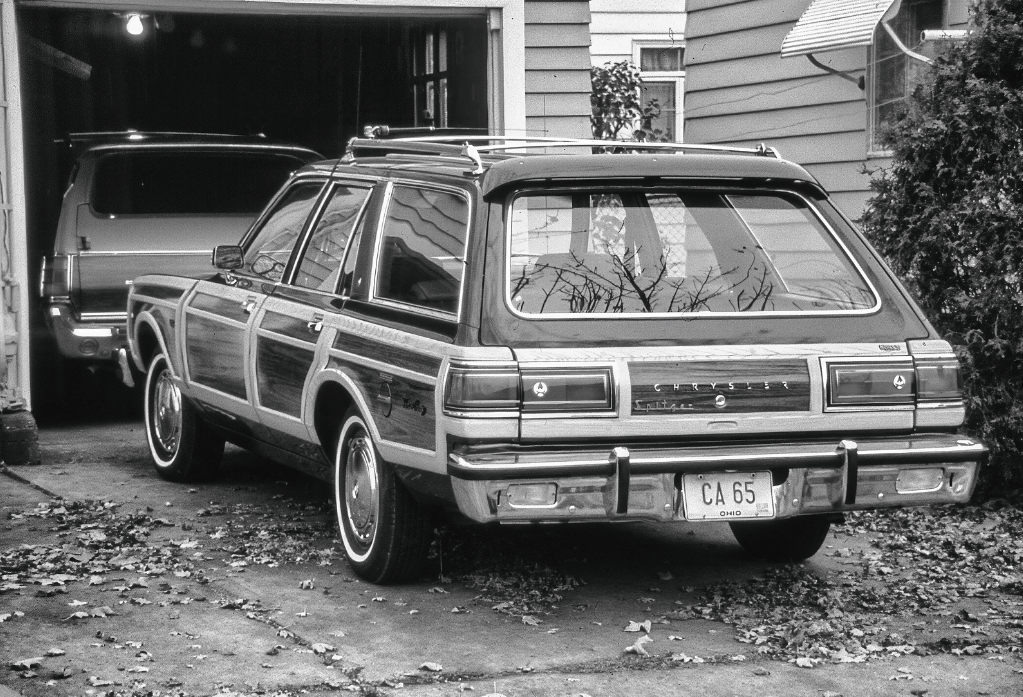
We end today with the ends of two Town & Country station wagons. After the Imperial nameplate was dropped in 1975, Chrysler recycled the LeBaron name for their new-for-’77 midsize line. The LeBaron didn’t offer a wagon in 1977, but that was the last year for the full-size Town & Country wagon, so for 1978, Chrysler added a midsize Town & Country wagon in the LeBaron line. The wagon nearer the camera, which had an Ohio license plate, was a 1978 or 1979 LeBaron Town & Country, while the one in the garage was a 1970 or 1971 Town & Country full-size wagon with the optional rear-facing third-row seat. Both wagons had plenty of simulated woodgrain trim.
Thanks for joining us and a belated Happy New Year!
Note: If you wish to see your vintage photos featured at Curbside Classic, send them to us at [email protected].























The Ohio license plate codes from that year indicate the Town & Country wagons are probably in Cuyahoga County, Ohio, which is also the area where Spitzer had most, but not all, of their dealerships, at that time. Perhaps this family had someone who worked at the Chrysler Twinsburg Stamping Plant (RIP) and got the employee discount.
Beat me to it. All the years I spent as a child visiting my Aunt Mary at Sts. Cyril & Methodius Church in Lakewood, and my Uncle Mike and Aunt Mame living six blocks east, seeing a Spitzer logo on the back of a car just screams “Cleveland” to me.
So much MoPar goodness .
Thank you .
-Nate
The snow covered Chrysler depicted at Yellowstone Park brings back memories of a family vacation at Yellowstone in the summer of 1996. I know winter weather is common there, but we were surprised to wake up on July 4th with 30 degree temps and a light snow falling.
I am now reminded of how much I liked those 1977-79 LeBaron and Diplomat wagons. They had really nice interiors and I liked the retro 40s T&C vibe of the fake paneling.
The first pic is absolutely gorgeous!
Regarding the ’55 in Yellowstone, where you note that its headlights had not been on in that snow/ice storm. Unlike today, that was essentially universal back then, to drive with the headlights off during daylight hours no matter the weather. It’s a modern phenomena, like so many other things we do now due to an increased awareness for safety and such.
It may be just the lighting in the photo, but the tailgate of that 1971 Town and Country in the last photo may have the optional “concealed” rear window washer. The tell would be the chrome filler cap – for the washer reservoir – that was on the left side just next to the glass. That might be what’s glinting in the photo.
I was totally fascinated with that option, which my family’s T&C had. I loved the chrome cap…which had a slot in it which you were supposed to turn with a coin…a big coin like a 50 cent piece at least. And most of all, I loved the idea of how the wiper was INSIDE of the tailgate. So, to use it, you had to roll down the rear glass (which of course could be done via a big button on the dash) and then press the “Rear Wiper” switch which would generate considerable buzzing and scraping sounds from inside the tailgate. Rolling the window back up would (hopefully) reveal clean glass. Even as a 10 year old, I did wonder just how the heck one was supposed to replace the wiper blade without taking the whole tailgate apart. I don’t remember if I ever figured that out.
When the 1978 Town & Country wagons were produced, there was a one-year option on interiors. That specifications was for white leather upholstery with color coordinated carpets, dash and door trim to the exterior color. As best as I can remember, the colors with the white are red, blue, black and gold. I would need someone else’s expertise on this, please. For 1979, the white leather option was not offered as it sold poorly. Yet, in the current markets and for some years, different manufacturers offer white leather interiors for SUV’s and crossovers. How times change. Of note, these 1978 and 1979 T&C wagons were a delight to drive, especially with 318 CID V-8 power.
Patrick, thank you for another wonderfully detailed writeup.
Just a small nitpick: Chrysler called its early power steering Hydraguide rather than Hydroguide.
https://www.mccandlesscollection.com/wp-content/uploads/2023/08/1951-Chrysler-steering.pdf
Keep up the good work!
Good catch! I should have noticed that since ‘hydro’ indicates water powered. That would have been interesting!
I believe your hp # in the ’72 Imperial leBaron, which I had one, is quoted wrong. No 440 had that low of hp. I think you meant at least 325nor more
The U.S. auto industry switched from gross to net horsepower ratings for 1972. “Gross” ratings are without accessories or mufflers, and are considerably higher than actual as-installed net horsepower. For 1971, many automakers listed both gross and net ratings for the same engines. The 440 in the Imperial was rated at 335 horsepower gross, 230 hp net. For 1972, Chrysler released only the net rating, which was now 225 hp. If the ’72 had still had a gross rating, it would probably have still been in the realm of 325 hp, but it didn’t, and it was down 5 actual horsepower from 1971.
I hsd a ’71 Newport. Worst piece of crsp I ever had. Last Chrysler Corp. I owned.
Love the fuselage Imperials, sort of CC effect, last night watched a Youtube video of an Imperial like the in the 2nd last pic driving around.
They are magnificent looking cars.
The 72 Imperial picture is not a 72, t’s a 73
I think you’re right — I’ve amended the text.
I wasn’t meaning to be picky, I owned a 73 for 15 years so I’m very familiar with its face. I really enjoy your web page and I look at it regularly. Thank you for your fine work!
You are correct, Dave. Thanks for your comment.
The LeBaron wagon in the last pic looks almost exactly like my ’79. It must have been built on a Monday or a Friday because it was absolutely the worst car I ever owned. The faux woody effect wrinkled and there was a computer attached to the carburetor which was supposed to regulate air and fuel intake for more efficient mileage. In reality, it combined low power and poor fuel efficiency. As well, the revs would drop off at over 50 mph.It was back to the dealer so often that they told me, “Chrysler can’t afford all this warranty work” ! Finally, the transmission blew, stranding us in the national park.
Just a lemon,, I guess, so my next car was still a Chrysler and was wonderful.
There’s nothing elegant about most Chryslers made before 1953. They were tall boxes with no style. They improved somewhat in ’53 and ’54 and were much improved after the beginning of the Forward Look in ’55. The LeBaron, a “badge engineered” Aspen/Volarie was an absolute low point, eclipsed to only by the awful K-Car variants.
I can get on board with this assessment.
🙂