

Even though an automobile is technically a “modern” product, automakers have historically given their vehicles carriage-era names like “Brougham,” “Phaeton,” and yes “Coupé” (originally pronounced “coo-PAY,” from the French word meaning to cut–since a coupé was a shortened version of a coach, with the back seats cut off). When studying the two pictures above, you can see that Cadillac was trying to recapture the elegance of a bygone day. In fact, this final Coupe de Ville may be the last really elegant car Cadillac ever built.
From Facebook Marketplace:

I have a problem in that I love classical elegance and beauty. I say “a problem” because in many cases, that’s “not cool.” Especially if you’re a younger adult. If you’re driving a car like this, people will think “Oh, he got it from his grandpa.” Because according to conventional opinion, no young person would actually want to be driving around in an old Coupe de Ville. I oppose this kind of limitation–the idea that you shouldn’t be “allowed” to like certain things. I believe that people should be free to do what they’re inspired to do, and like what they like, without discouragement.

In 1985 when Cadillac downsized its standard line of cars, I was not impressed. To me they looked unnaturally stubby and non-distinctive–“Who would want to buy these oddly shrunken compromise-mobiles, which had almost none of the gravitas and charisma of the Cadillacs of yore?” Yet, a lot of people did buy them, quite often because everyone was spooked by that boogeyman–“The Energy Crisis,” with its slavish devotion to “Fuel Economy.” However, those concerns eventually eased up somewhat, and in 1989 the Cadillac design was revised–longer, richer looking, heavier–refreshingly more “Cadillac” in appearance. While not perfect, I thought it was a welcome change for the better.


Usually I think that solid black on a Cadillac or Lincoln often looks too “funereal,” too formal. But because this is a coupe, I think the black looks great, showing off the chrome accents really well and exuding a feeling of class.

And I bet this really was “grandpa’s car” because of the still-in-use blue NJ license plates, which would have been issued in the early 1980s (and transferred over from the same owner’s previous car).
The Facebook ad only included exterior shots, so I searched for engine and interior photos of a 1993 Coupe de Ville and found these pics sourced from Carlisle Auctions and Streetside Classics:

Even though these Cadillacs are downsized and have front wheel drive, you still got a real V-8 engine under the hood. I thought this was a real draw, especially since my father had predicted some years before that the V-8 engine would soon be dead as a design concept, and all cars would be fours and sixes.

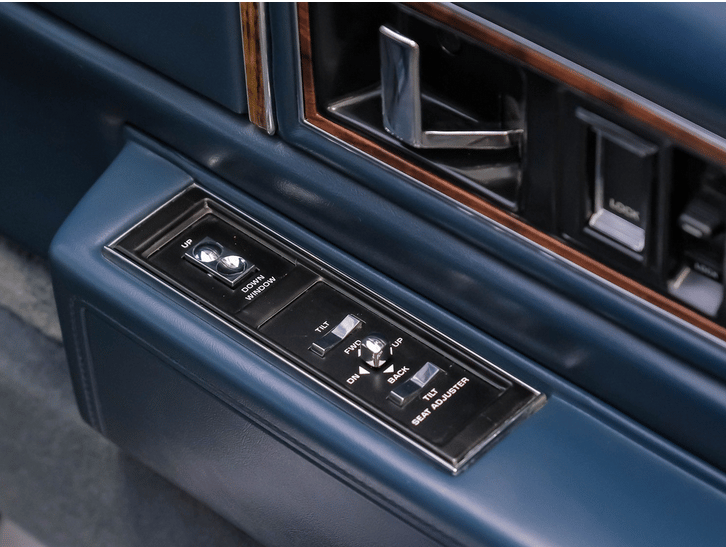
Here’s where Cadillac really turned on the luxury. Lots of leather, wood trim (fake but tasteful)–when you sit down in those cushy seats, you really get a cozy feeling of opulence and rich comfort.


As Cadillac TV commercial spokeswoman Arlene Francis said when introducing the 1957 Cadillac, “…elegant new fabrics and richly grained leathers. Go ahead, Ibby, touch them! OOooooo…YES!”

Digital readouts like a high-end stereo set of the time. “Club room” tradition meets high technology.

Despite the high-tech sophistication, most controls are intuitive and simple to use. Wouldn’t you want two real knobs on the radio of your hideously complicated late model vehicle?

Light switch: Just like the ’30s to ’70s models–pull out one detent for parking lights, two detents for headlights. Rotate the knob to dim the dash lights. The way God intended.
Now I want to tell you about my own personal experience with this generation of Cadillac:

In the year 1998, I was looking to replace my aging ’72 Mercedes 250 sedan, which I had owned for the previous nine years. Once you’ve driven a Mercedes for that long, buying something not in the luxury car class seems like a real step down. Some people who lived two blocks away from me were selling a really nice 1989 Cadillac Sedan de Ville in a lovely light blue with silver/gray undercladding, like the car shown above.

I took it for a short test drive. My reaction was, “Wow, this car drives so nice!” It was smooth without being too “boaty,” decently powerful, with really soft, comfortable seats. I felt really rich and important driving it. Everything from wipers to horn to radio seemed to work just fine. I was dreaming about future me driving around in this fabulous car–commuting, running errands, taking short trips and long. (I realized this would be a great highway car). The asking price was $5900. I offered $5500. The seller replied, “I think we can do that.” I’m in!
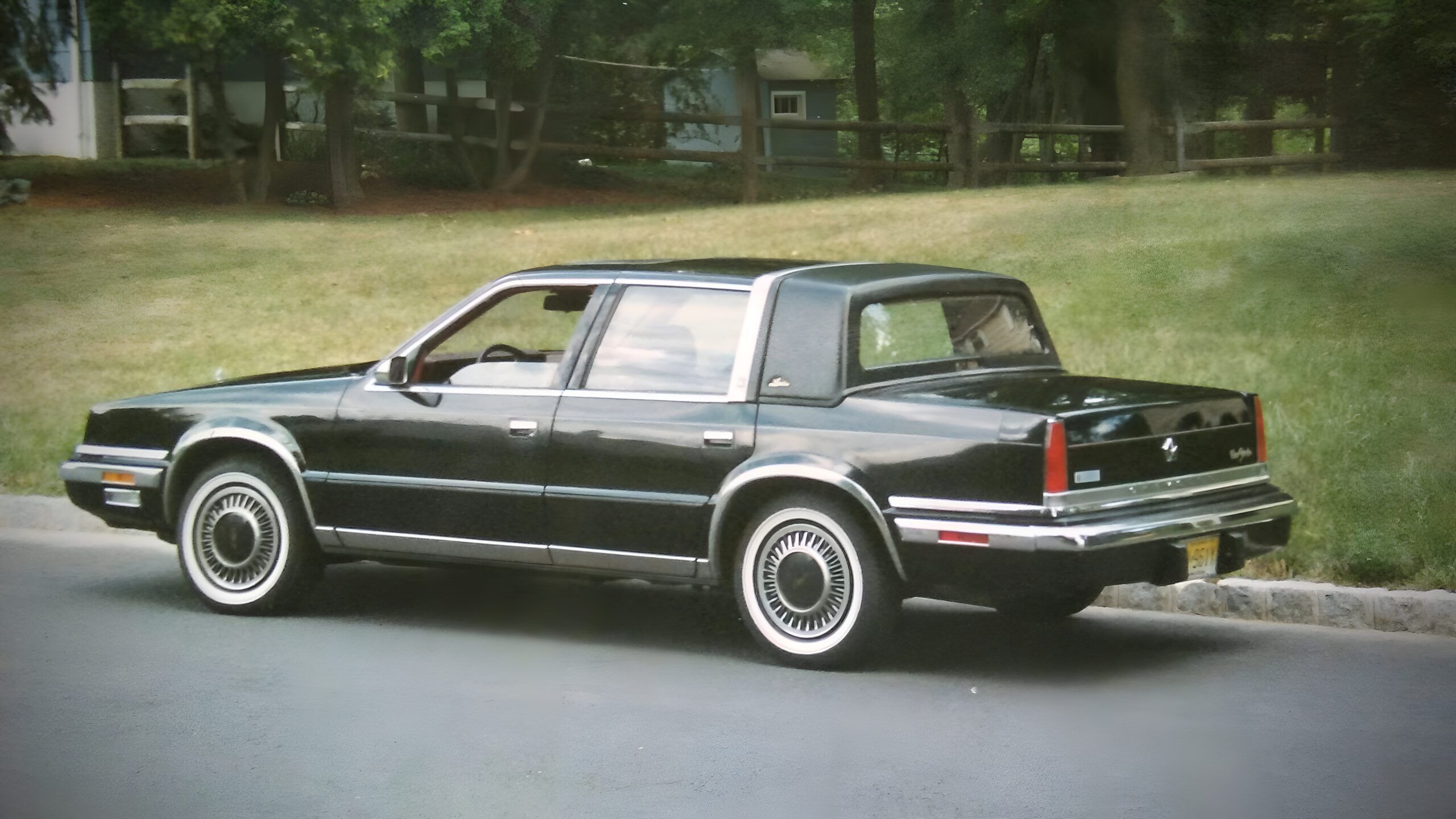
Not quite. A short time later the seller called: “We’ve decided to sell it to someone else.” Oh, well–that’s that. Another dream shattered. But shortly thereafter I managed to pick up this 1989 Chrysler New Yorker Landau (another elegant carriage like our featured Coupe de Ville). This New Yorker had a really beautiful burgundy tufted leather interior. Sadly, this car was totalled in an accident three years later, and I replaced it with a 1990 Chrysler Imperial (silver, also with burgundy leather).

Returning to our featured car, I actually think this is potentially a great value at $3750. You have to go into it knowing that you’ll probably need to spend one or two grand fixing the cosmetic flaws and anything else that might come up. We also don’t know what the condition of the interior is like. And 200,000 miles is a lot–but if it runs and drives fine, who cares? You’re getting a lot of rarity, luxury and distinction for a five or six grand outlay.

Some people might say, “But a Japanese or German car is better…blah, blah, blah.” But what the critics don’t see or understand, is that this Cadillac has a certain charisma–a genuinely American character that no other nation can or ever will duplicate. You see it in the lavish interior, the classical styling–the heritage that Cadillac represents. The Japanese luxury brands especially can be so bland–they just don’t have it. If you read about actual owner experiences on Reddit or cars.com, you find that people love this Cadillac’s looks, ride, power, and distinction–and yes, even reliability!

Here’s the modern counterpart–a 2025 Cadillac CT4 Premium Luxury Sedan in black. There are no more coupes; and except for the large grille badge, you might not recognize it as a Cadillac.

I’m sure it’s a nice car though, and drives beautifully. But whereas the 1993 model had that certain cozy “club room” atmosphere, this interior seems a little stark. It’s as if we’re back to the late ’50s mentality–a car as a highly complex, intergalatic star cruiser, not a tribute to the horse-drawn carriage days of old. It seems that no matter what Cadillac does, then or now, the professional critics have a problem with it. I would say, I still love many of the cars Cadillac has produced, and I’m glad the division is still in business producing cars, despite all the challenges of the decades. The Cadillac name still means something–a car that is special in a certain way. This is the golden thread of continuity through all Cadillac models.
Related CC Reading
CC Outtake: 1992 Cadillac Coupe de Ville–The Real Jackpot by Brendan Saur
Curbside Classic: 1991 Cadillac Coupe de Ville–Triple White Birthday Cake by Tom Klockau














The comment about Japanese cars – or modern Cadillacs being bland is an interesting one. I remember Jeremy Clarkson writing 20-25 years ago about this and noting that Japanese cars are at their best when they’re distinctive. It makes sense – a 240z or a Toyota Crown (let alone a Century) couldn’t be from anywhere else. Similarly I can’t help but agree with you that Cadillacs worked wonderfully when they were in a distinctively US idiom and much less so in the modern era. The 2000s “art and science” was starting to define that quite well but I can’t help feel they’ve lost their way a little.
I think they all have, globalized world models might be good for business but there’s virtually nothing to define a brand and its regional traits besides marketing fluff and the inertia of past prestige. You could tell American cars from Japanese cars, Japanese cars from British cars, British from Italian, German etc in the way the car looks and feels.
Cadillac was suffering that identity crisis even in the Art & Science era. I give credit that GM was really trying to carve out a distinct stylistic identity with it but I don’t think it was truly successful by the time they pulled the plug, and ultimately outside of styling they were essentially trying to block up to the standards of BMWs and Mercedes. Cadillac’s problem is its most enduring identity in the US idiom was with cars that simply couldn’t ever be made again in the modern era. Their most successful vehicle for the last 25 years being the Escalade isn’t a coincidence.
I still struggle to like these cars. Actually, I still struggle to like any Cadillac made after 1968, but I am farther along on my personal appreciation curve on the older ones. I do like the fact that they were offering a decent V8 engine by this time, and also like that they were apparently quite durable cars for someone willing to keep up with only the most basic of maintenance. And by all accounts, they combine a competent chassis with very nicely upholstered seats.
But the styling on these coupes is just all wrong, and I fear that if I have not come to terms with it by now, I never will.
I definitely think there was a place for a car like this in Cadillac’s line in the mid/late ’80s, the problem was that they all looked like this. By ’93 they finally had a modern looking Seville and this generation Deville was on runout (and about to lose the coupe model) but it was still the equivalent of showing up at the country club in 1990 unironically wearing a full Herb Tarlek brown polyester suit with wide tie.
I agree, the pictures shows what may well be a good deal at $3,700.00 .
For a Cadillac Man this would be just the ticket for his new daily driver .
Before purchase get it up on a hoist to check the rust situation then dicker the price whilst you and the seller are looking at it from underneath .
-Nate
Because according to conventional opinion, no young person would actually want to be driving around in an old Coupe de Ville.
My observations are that it is almost universally younger people that drive these now, and not just because they got it from grandpa. They like them for being very different than cars are now, and for just being an old Cadillac. They actually are cool now, and most of these younger drivers aren’t ;likely even aware of the stigma these Cadillacs had.
I loved my 91
I was a teenager when these were new and they were pretty popular……three identical ones showed up at the same party!
Great on the freeway; moderately easy to work on and good gas mileage. Plus the bench seat could hold the cat crate and she could watch me drive and be happy.
Stephen, I feel you! When I was growing up in the early ’60’s I was surrounded by Cadillacs of the 1950’s, ’60’s and later through the 1970’s. I became a young Cadillac fan and made it my goal to actually own as many as I could over the years. There was nothing “ironic” about my love for the marque. They all looked big and impressive, they had fancy interiors, and they were among the fastest widely available road cars. Since they were status items, once older, their high depreciation made them very affordable as older used cars. Besides, in my eyes they were true high performance vehicles. Their area of performance was impressive looks, fancy interiors, comfort, space, and roadburner speed. This was something that you could use and enjoy everyday. A sports or muscle car was faster and handled a bit better, but I wasn’t planning on driving through a drag strip, or auto crossing on my way to work everyday.
The Coupe deVIlle or convertible was the “sporty” personal model before the personal luxury car became popular as a type of car. Cadillac introduced their ’67 ELDorado as the prototypical PLC and lower priced models from the volume marques became extremely popular late in the ’70’s.
There was something special about Cadillac up into the 1970’s. After that, changing tastes and buyer demographics made it a challenge for Cadillac to stay relevant.
The younger generation has embraced the Escalade as a legit Cadillac. I had a younger coworker in his late 30’s that bought a new Escalade and he was quite enthusiastic about it. He had never considered a Cadillac before, and was quite impressed with the utility,comfort, and performance.
Cadillac went the route of the sport sedan and has recently built quite a few impressive models. However I will always prefer the models from their heyday.
I agree whole heartedly with the author’s assertion that you should drive what you want despite the “stigma” that might be attached to it. At age twenty-five, I bought a brand new version of the featured car. However, mine had a simulated convertible top and wire wheel covers. To say it was sharp was an understatement. Not only was it beautiful, but it served me without issue for seven years. I would do it again in a heartbeat if they were still being produced.
Lovely condition, but to my mind the basic shape is wrong. And the photograph Stephen has chosen to open with illustrates this.
With the horse-drawn coupe, you have the length of the horses and the driver’s seat out front, then the noticeably short cabin, without even provision for luggage (in this case) out back. From my reading of history, this says your luggage would be carried by an accompanying vehicle; you are rich enough to afford such extravagance. If not, there would probably have been a discreet folding rack for a single trunk between those large rear wheels.
Long front, close-coupled passenger quarters, mounted lower than you would usually get on a coach, luggage an afterthought: the proportioning is distinctive, and draws the eye.
This would have been a stunning equipage 150 years ago.
This Cadillac being front-drive does not need that long front end, long associated in the public mind with the powerful engine of a prestige car. But there’s your problem. Optimizing the packaging for front wheel drive (as you would) removes one of the fundamental prestige cues. How are we to tell this is properly a ‘prestige automobile’ and not just merely a biggish car? If you’re ’80s GM, you apply the rest of the Cadillac design language from the past twenty-odd years. While the surfacing and detailing may look familiar-Cadillac, the overall proportions do not – giving rise to a mental disconnect among would-be buyers between ‘what a Cadillac is’ and ‘what this looks like’.
I know what they were trying to do, and I’m thankful I wasn’t there trying to work it out with them.
Indeed; its biggest sin is the ludicrous rear overhang, runner-up is the front.
I give you the two-door Ford Del Rey, just to show it’s not really a Cadillac thing. The Sedan’s wheelbase corrects it somewhat.
At least it doesn’t commit the Buick sin of a vertical rear window and a lean-forward rear panel, which just looks [choose your epithet] every time. Nor does the Del Rey, fortunately…
I’ve been to ‘clubs’ and the DJ/fine cigars/armchair luxury isn’t really my thang – perhaps that’s why I don’t really get the interior appeal of these – or certain British brands. It’s a big club and I ain’t in it…
I do however find it fascinating that such things are coming into vogue with younger enthusiasts – modern cars have definitely lost something along the way. It also appeals to my cognitive dissonance that certain cars that are far too pretentious or self-indulgent when purchased new somehow become cool once they become classics.
By the time these got the emergency facelift that lengthened the rear overhang, the coupe was very much an afterthought. The sedan got a wheelbase stretch that brought the overhang back into proportion.
PS – still chuckling at ‘Twilight Sentinel’. I had to look it up…
Def: Marketing-speak for a pretentiometer. Presumably after a Cadillac-trunk-length line of Charlie.
Off to write a superhero action book…
Word of the day: pretentiometer!
A Good morning I’m looking for one exactly like this in black on black !!!!! Under 70.000 please contact if you find one