
Text by Patrick Bell.
Today we are going to tour some vintage neighborhoods and soak in these sights of the 1950s – 1970s. There is a lot to see with cars, houses, and people, so here we go!
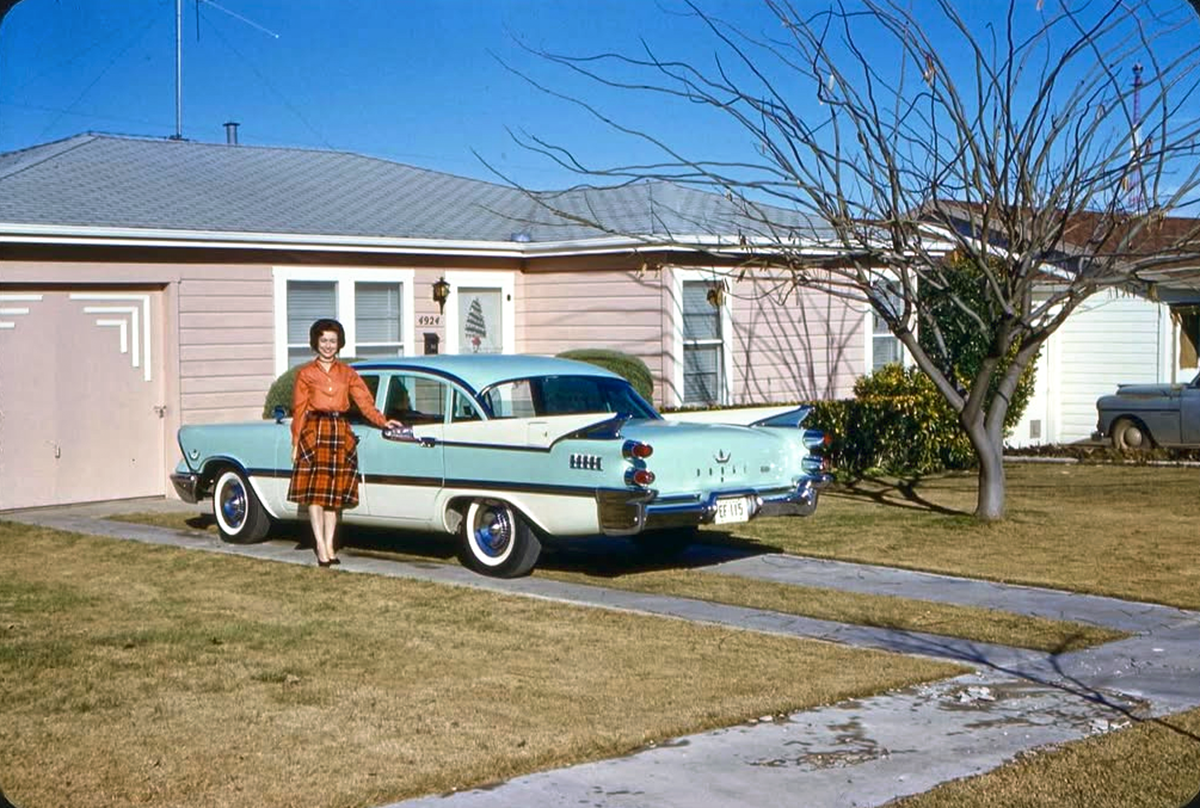
Our lead image was a lady posing with a 1959 Dodge Custom Royal 4 door sedan on a winter day. A Christmas tree decoration was mounted on the front door indicating it was likely that time of year.
The Custom Royal was the top of the line series that year, and the sedan was the most popular body style. The Super Red Ram 361 cubic inch V8 coupled with the TorqueFlite automatic transmission was standard equipment. On the right edge looks like another Dodge, a 1950 model.
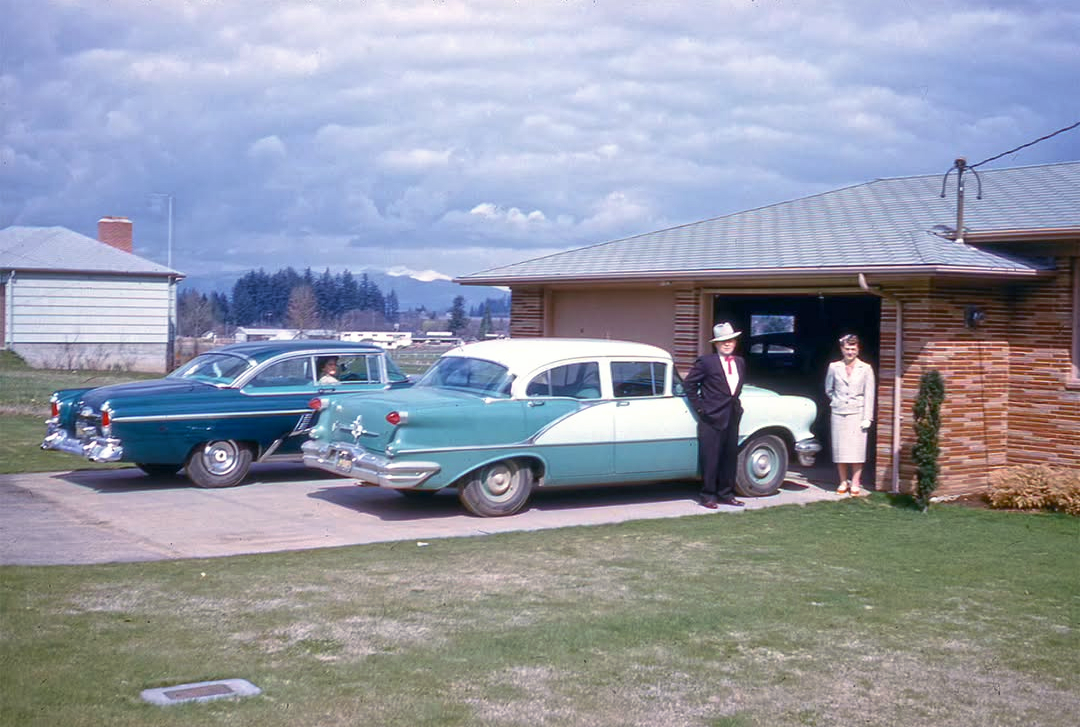
Here was a well dressed couple, and in one of the cars was a lady waiting, probably for the photographer. Both cars were 1956 models, with a Mercury Montclair Coupe on the left, and an Oldsmobile Super 88 4 door sedan on the right.
The Montclair Coupe was the best selling Mercury that year, while the Super 88 4 door sedan was the second best selling Oldsmobile. The Super 88 had the standard hubcaps, and both of them had black wall tires.
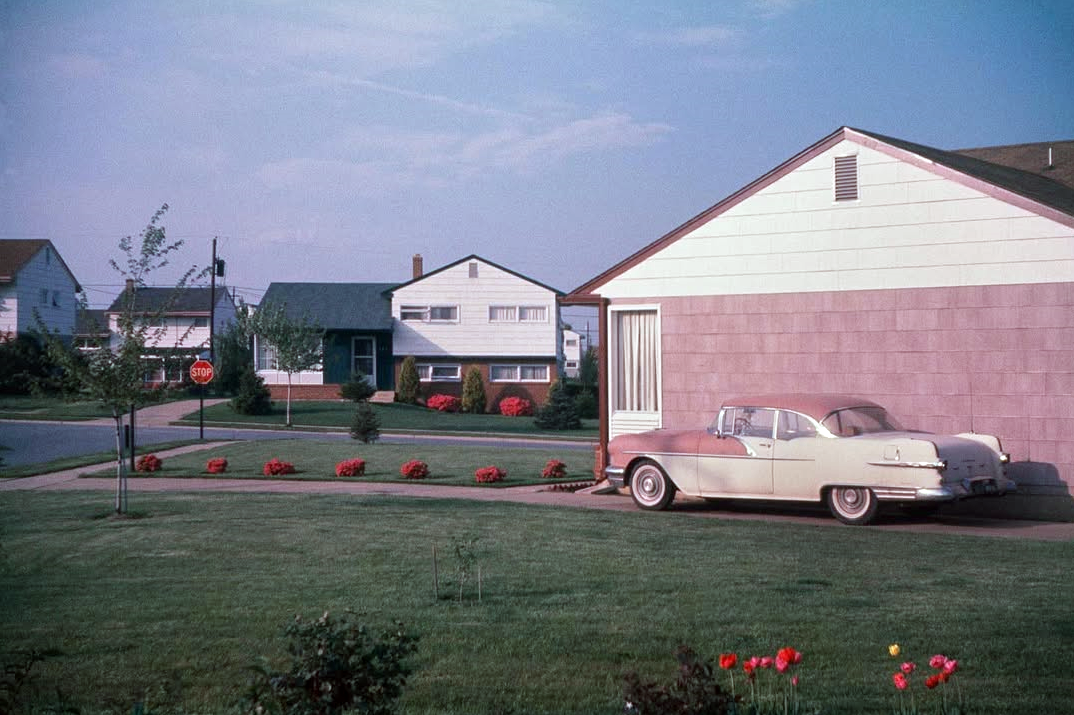
And another 1956 model, a Pontiac Star Chief 2 door Catalina hardtop that was color matched to the house, which was in a modern suburban neighborhood.
The new for 1955 Strato-Streak V8 received a boost in size and power for 1956. It was now 316.6 ci, and the Star Chief version had 216 or 227 horsepower, depending on transmission choice.
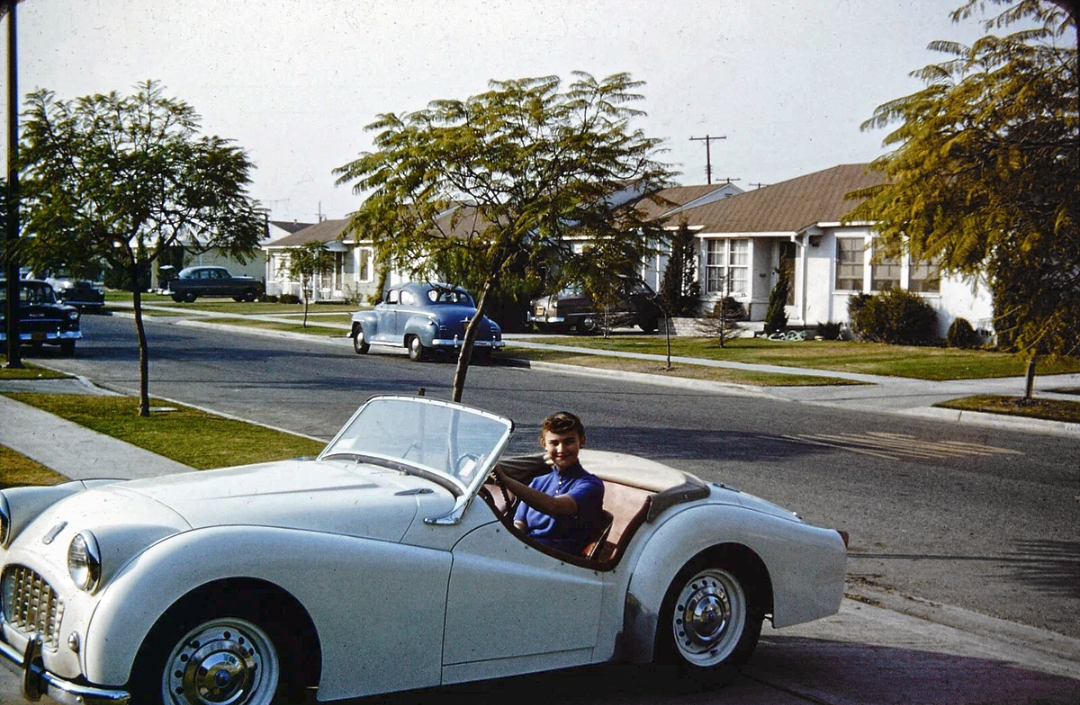
This lady seemed pleased to be at the wheel of a new looking Triumph TR3, which was produced from 1955-1957. The paper in the right side of the windshield may have been a buyer’s tag.
In the background from the left were three Chevrolet’s; a 1955 sedan and a 1947-1953 Advance Design pickup, both in the street. In the driveway was a 1954 Two-Ten 4 door sedan with the trunk open. Further to the right was a blue 1946-1948 Plymouth Club Coupe, and in the driveway was a brown 1950 Ford Fordor Sedan.
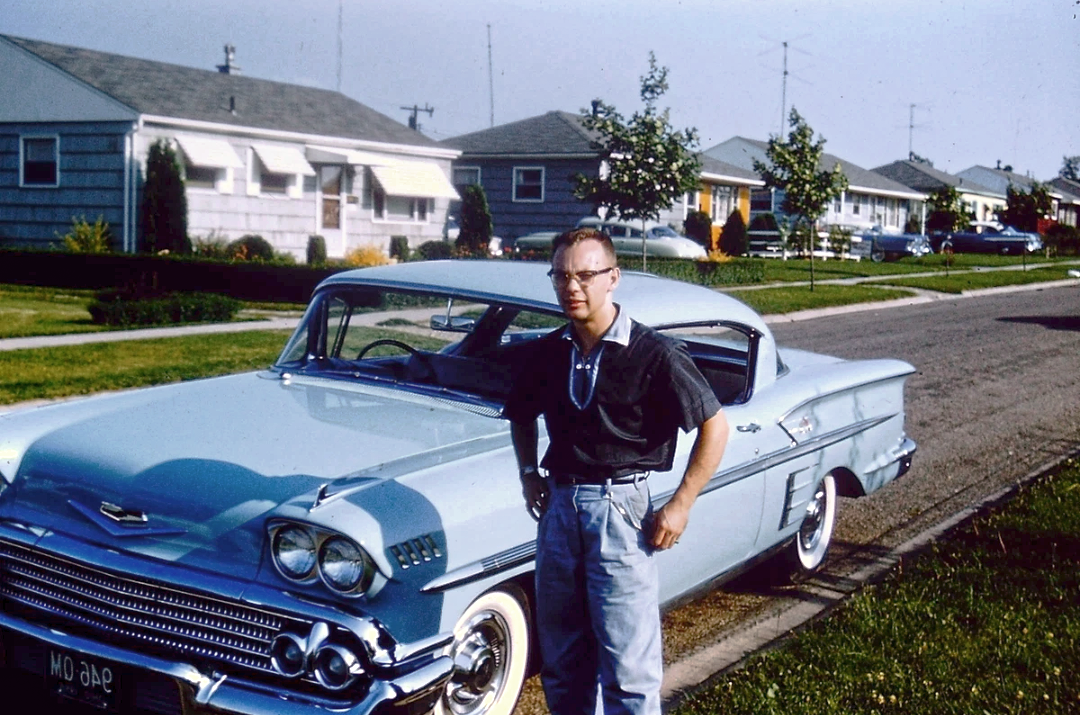
A man and a sharp 1958 Chevrolet Bel Air Impala Sport Coupe were out on likely a spring day as there were fruit trees blooming and the grass was green. This was the first year for the Impala, and this one looked close to new and was V8 powered, and had what appeared to be an Ohio license plate.
Across the street was a grey 1952 or 1953 Hudson, and further down a blue 1958 Oldsmobile. On the end was a blue 1956 Ford Mainline Fordor Sedan.
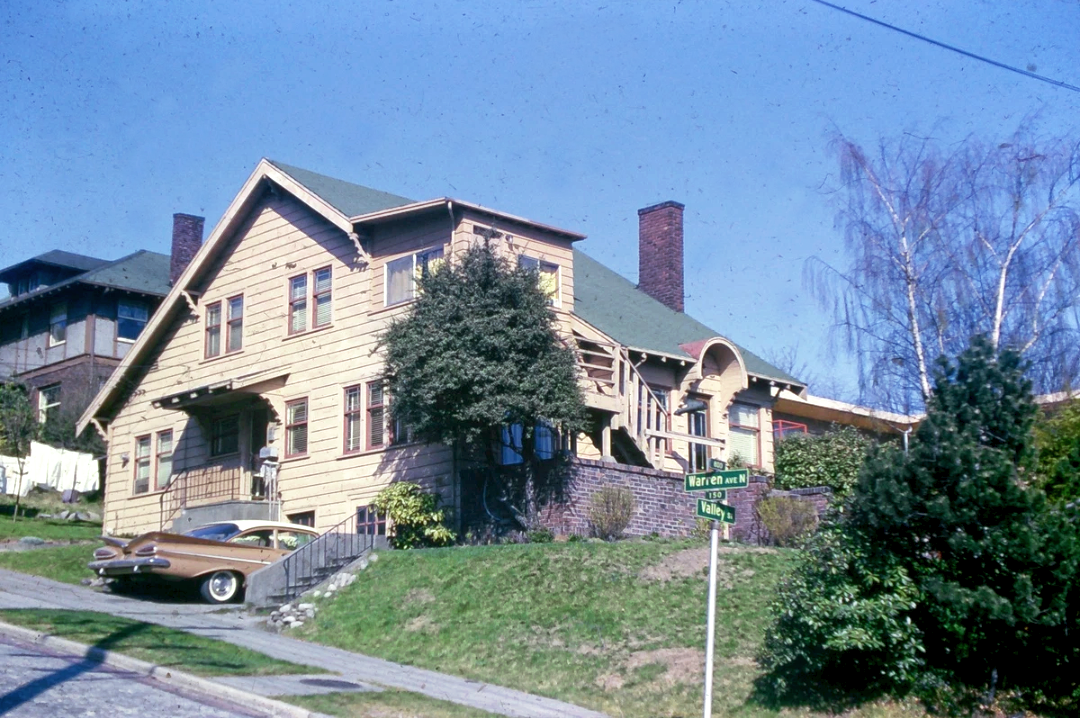
We appear to be in the Queen Anne neighborhood of Seattle, Washington, though if so, these houses have been replaced by an apartment building. A 1959 Chevrolet Bel Air 2 door sedan was parked in the driveway, with its bat wing fins ready to catch any sidewalk users passing by.
The Bel Air got demoted to second tier status when the Impala arrived, but still was a strong seller.
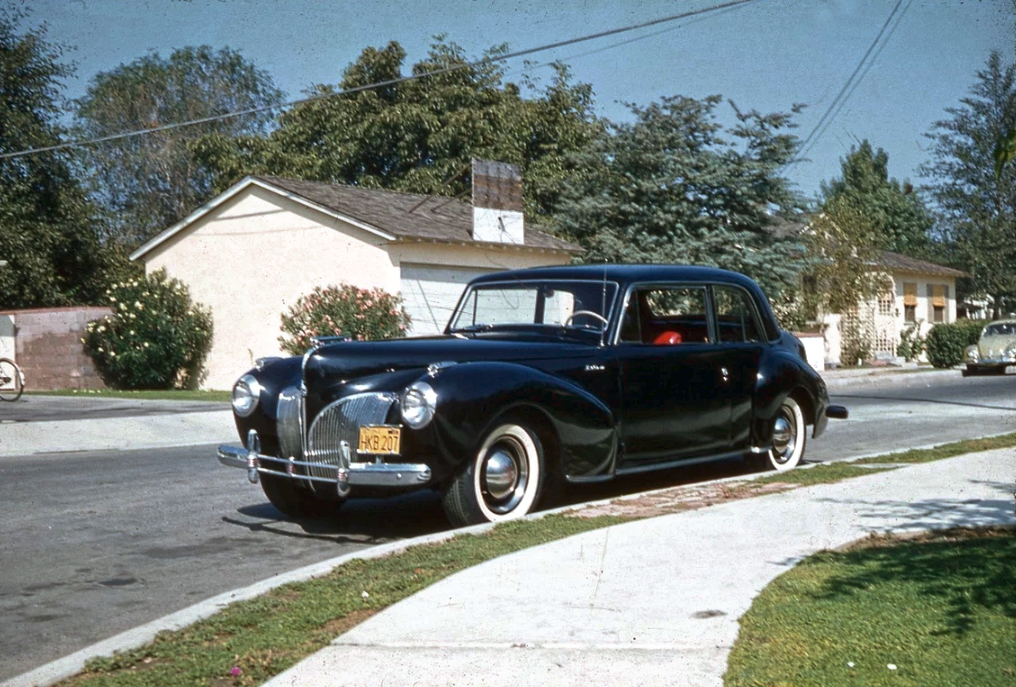
Here was a rare one, a 1941 Lincoln Continental Coupe with a California license plate used from 1956-1962. On the right edge was the nose of a Volkswagen Type I. It appears to have the enlarged windshield of 1958, but not the fender top signal lamps of 1959, so we will go with a 1958 model.
The Lincoln was in the first series of Continental’s that was produced from 1940-1942. It was powered by a 292 ci V12 with 120 hp. Production numbers in 1941 for the Coupe amounted to 850, and 400 Cabriolet’s were built as well.
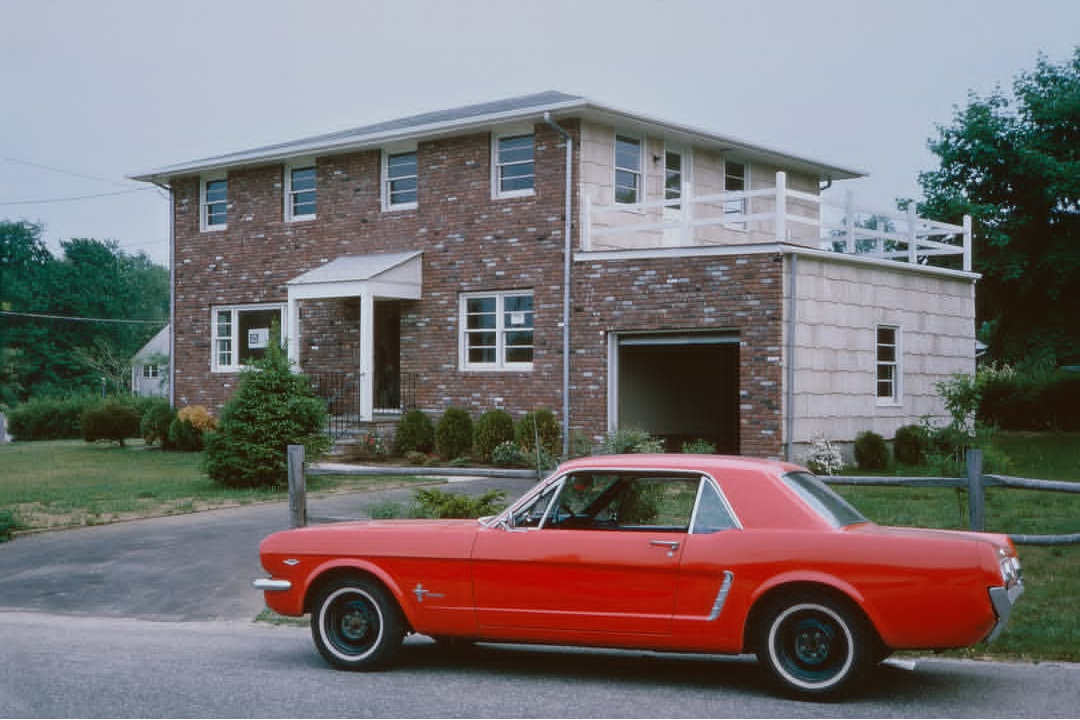
It is hard to go wrong with a red Mustang, especially a V8 powered 1965 Hardtop as shown. A nice set of original wheel covers would do it wonders, or even upgraded wheels if you are so inclined. It would look good in any neighborhood.
The house appeared vacant, and looked to have a new set of windows. Maybe the Mustang was about to move in.
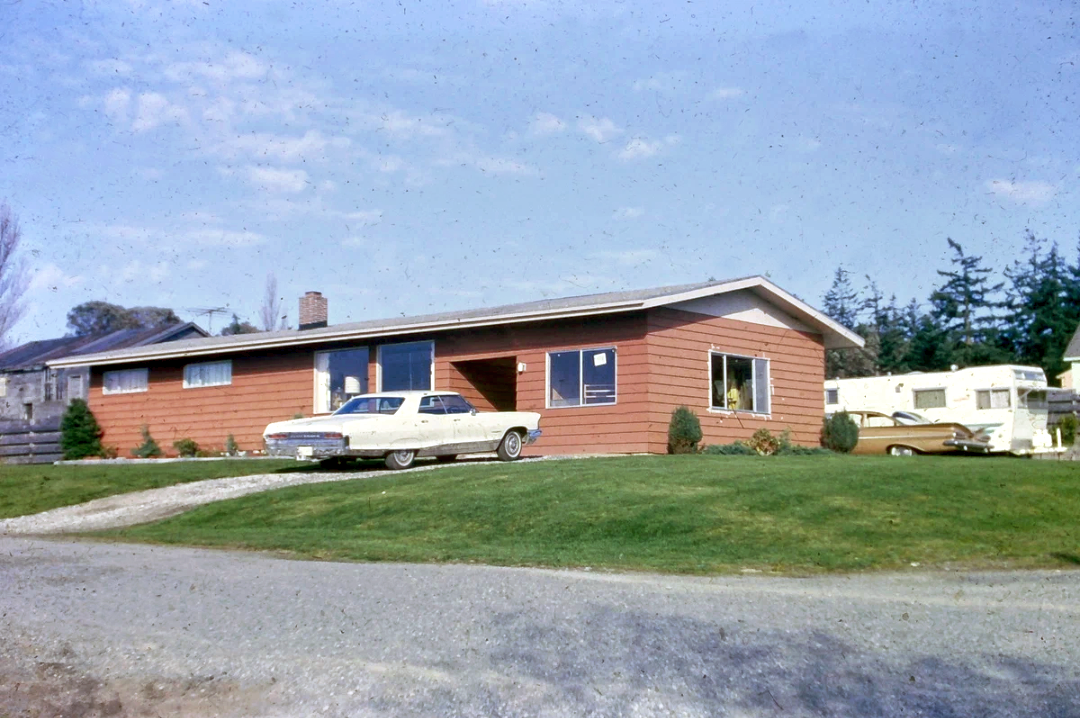
This was a rural neighborhood, where the roads were paved but without curbs and gutters. In the driveway was a 1965 Pontiac Bonneville 4 door Vista hardtop that was equipped to tow the travel trailer in the back yard. Also in the back yard was a 1959 Chevrolet Bel Air 2 door sedan just like the one in image #6, and even in the same pose. Could it be the same one? I think there is a decent chance it was. The Bonneville license plate was not readable, but Washington license plates were white during that era.
Bonneville was the top of the line series at the Pontiac house, and as you might imagine, the 4 door hardtop was the most popular body style. Standard power came from a 389 ci V8 with 325 hp, and for extra trailer towing power a 421 ci was available in 338, 356, or 376 horsepower ratings.
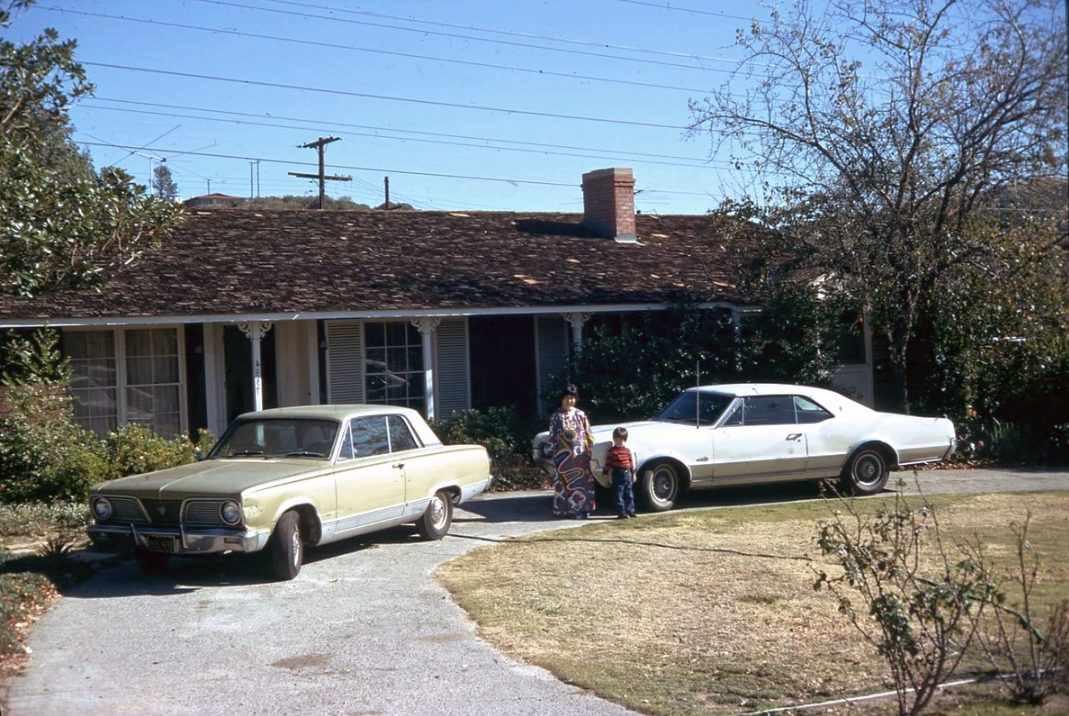
Mom and son were posing outside on a fall day with two cars parked on the circular driveway. On the right was a 1966 Plymouth Valiant Signet 2 door hardtop with body damage all the way down the side. The small emblem on the rear part of the fender indicated it was V8 powered, and it also had bumper guards, standard hub caps, and black wall tires. Behind it was a 1967 Oldsmobile Cutlass Supreme Holiday Coupe with wire wheel covers and white wall tires.
Signet was the sporty model with a bucket seat interior, and the optional V8 was 273 ci in 180 or 235 hp versions. The Cutlass Supreme was the luxury model, and had the Jetaway Rocket 330 ci V8 with 320 hp as standard equipment.
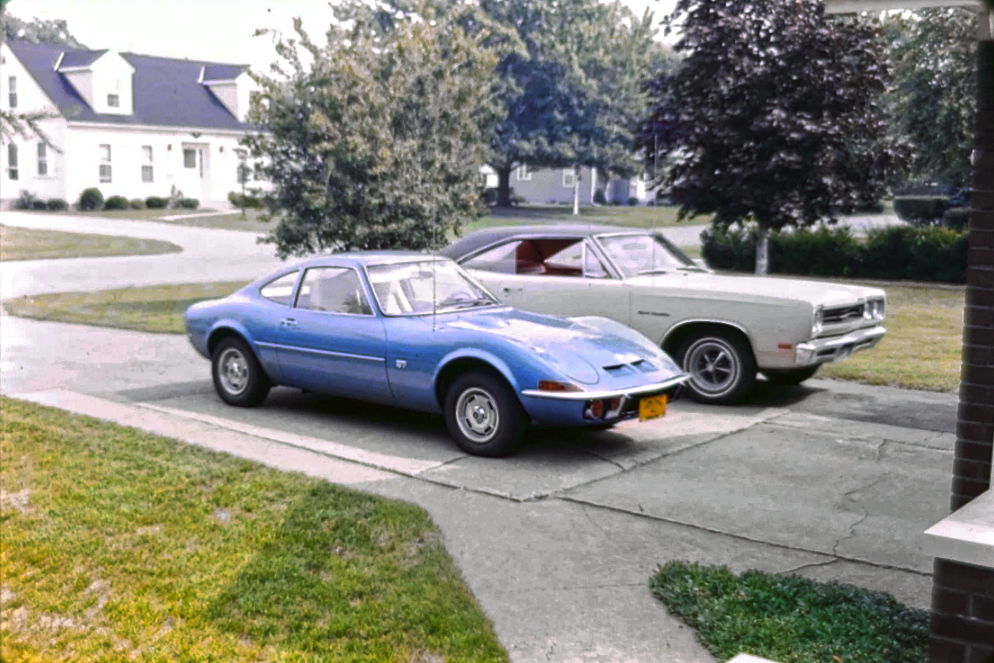
Here was a nice pair to have in your driveway. On the left was an Opel GT that may have been new with a dealer’s advertising tag still mounted. To the right was a sharp 1969 Plymouth Sport Satellite 2 door hardtop with a vinyl roof, chrome plated steel road wheels, and narrow band white walls.
The Opel GT was built from 1968-1973 with little change. They were fun cars but did not rank high in practicality. Standard power on the Sport Satellite was a 318 ci V8, with a 383 ci optional in 290 or 330 hp.
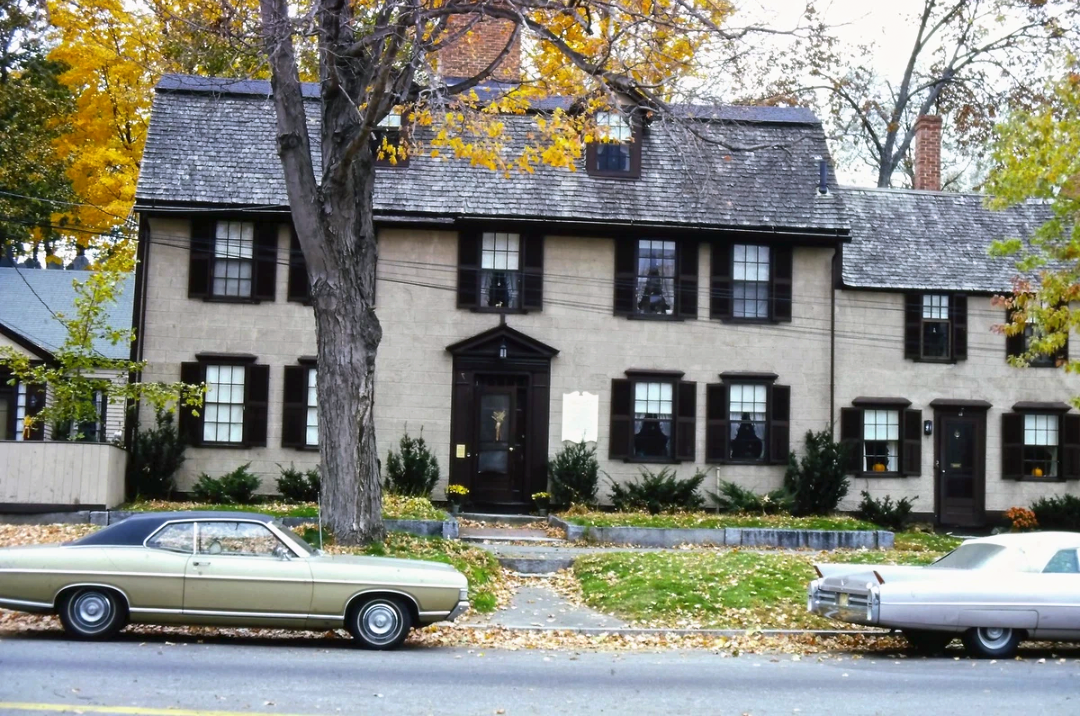
Now we are looking at a stately home that likely had some historical status as there was a large plaque by the front door that is not readable. October would be a safe guess as far as time of year goes, with the condition of the trees and the pumpkins in the windows.
Parked in the street from the left was a 1963 Cadillac Sixty-Two convertible, and a 1969 Ford Fairlane 500 2 door hardtop with a vinyl roof, full wheel covers, and white wall tires.
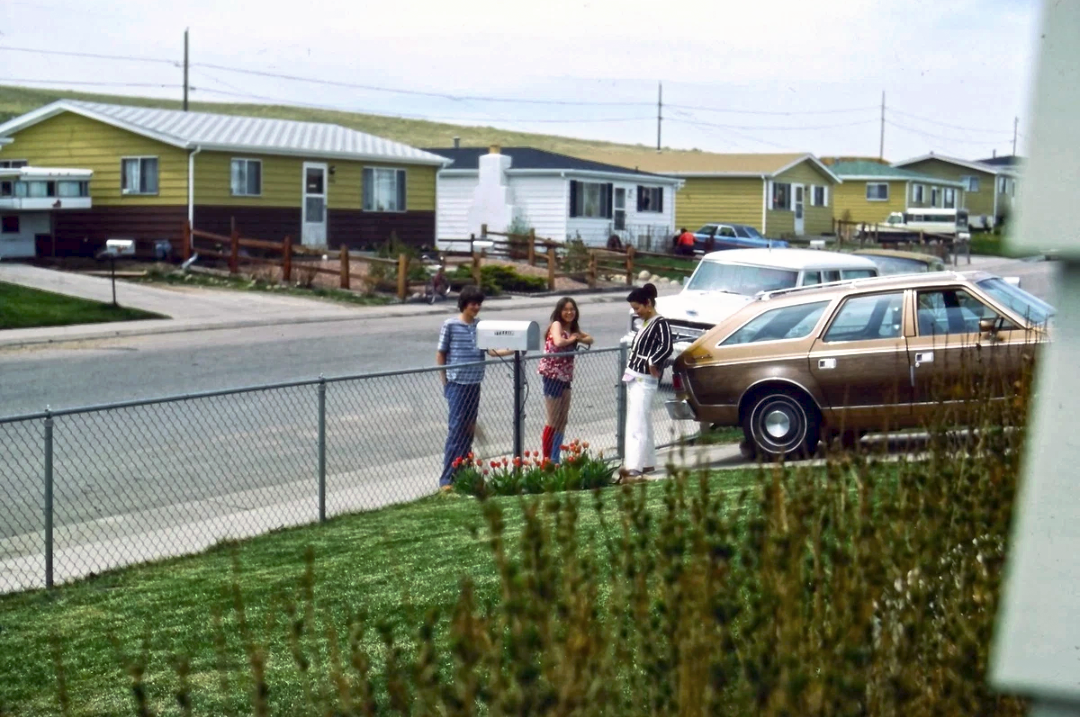
This looks like a neighborhood of manufactured homes with paved streets, and the homeowners had landscaped their yards. A conversation between neighbors was ongoing in front of a yard.
In the driveway was a 1974-1976 AMC Hornet Sportabout D/L wagon, a popular model during that decade. It was the only U.S. compact wagon built in the early 1970’s. Parked in the street was a 1969 or 1970 Chevrolet Suburban.
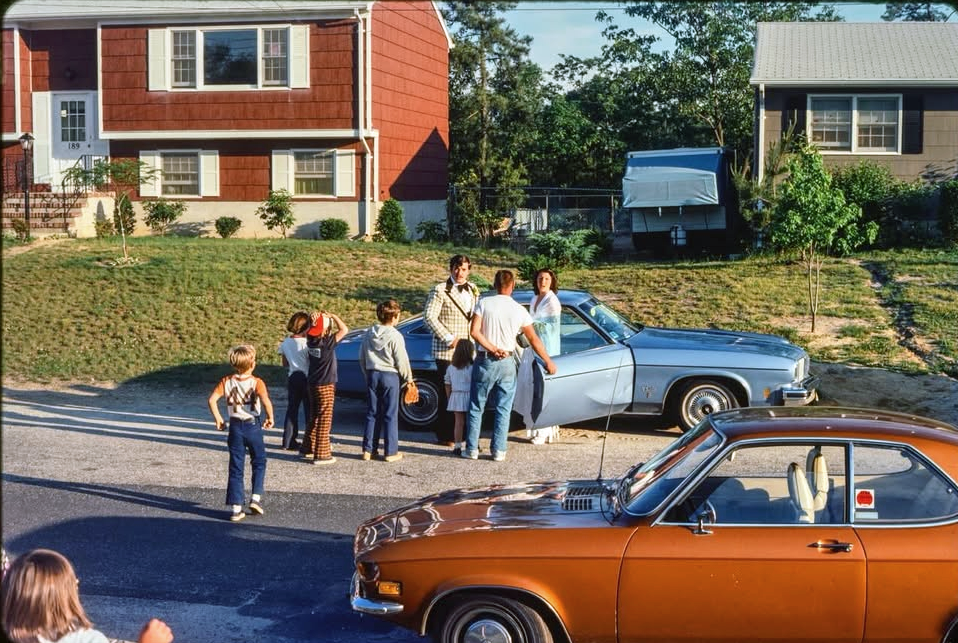
The whole gang was headed out to meet someone who had just arrived, likely the dude in the fancy duds. It was another rural neighborhood that had at least one split level home.
In the foreground was an 1971-1973 Opel 1900 Sport Coupe/Manta, a captive import sold by Buick dealers. In the background was a 1974 Oldsmobile Cutlass S Colonnade Coupe with full wheel covers and white walls. In the distant background was someone’s pop up camp trailer, all set up for use.
Thanks for joining us and have a great day!





Your lead photo looks a lot like this picture I took in 1986 near Long Valley, NJ.
In my pic the car is a Royal, not a Custom Royal.
I think we are looking at 4 wheel snow tires on this one. Great pic.
A wonderful collection of vintage family transportation with perfectly descriptive captions to help us ID all the various models in view.
I frequently “borrow” car themed photos online that I add to my personal collection of screen savers. With this collection, several of the pictures reversed themselves when clicked on to enlarge and isolate them. They twisted horizontally, from left-to-right to right-to-left. Seeing American cars suddenly become right-hand-drive was one of the obvious tipoffs. Not a problem, though: I can reverse them back to normal before saving them to my screen saver collection. Interesting glitch, though. 😏 Good Luck if you save them. 🍀🍀🍀
Nice pictures from my long ago youth .
-Nate
The 59 Bel Air looks ready for takeoff. Somehow this view makes it looks squintier than usual. Enjoyed these pics.
I remember as a kid riding on the shelf under the rear window of a ’59 Chevy:(sans seat belt, cup holders & screens), observing the stars. It was the same year, same “calf-shit brown”, as my dad referred to the color.
Growing up in the ’50s these really hit home with memories. The cars are fun but one thing I recall: notice how modest most of these houses are, very typical of post-WWII well into the ’60s. This was a time when most people didn’t have show-off delusions of grandeur. Houses were often 1000-1200 sq ft in size. Our neighborhood in Towson was a nice one but some of the houses were 2 BR 1 bath, while most were 3 BR, but few were over 2000 sq ft. What is needed now is more “starter” size houses so as to be affordable by new buyers… back to the future.
Always nice to see cars of the past pictured during everyday life. The photograph of the Star Chief could be a postcard!
Great stuff, not just the cars but the architecture and fashion too.
Like the Mercury Montclair Coupe in picture 2. Great color combination.
Caught my eye as well. Even in their day, they’d a been few in #.
So many newly planted trees. I wonder how big they are now?
These pictures bring back memories of growing up in that era.
Love the blue 58 Bel Air Impala coupe. He has all the windows rolled down for that open air look. The 58 Impalas were very rare in northeastern Indiana where I grew up. Practical folks there bought four door sedans, or on an adventurous day a four-door hardtop, but definitely not two-door hardtops and convertibles. I remember clearly the first 58 Impala I saw was at the summer county fair, in a tent display by the local Chevrolet dealer. It was a salmon pink coupe. As a little kid I was mesmerized by the model specific roof design, elongated trunk, triple taillights, and the fake roof vents. My parents had to drag me away.
The 65 Mustang with wheel covers removed: In most instances if you ordered a new car with full wheel covers, the wheels were black, not painted body color as on cars with hub caps. A lot of young guys immediately pulled off the wheel covers as it was considered cool to drive around with the uncovered black wheels on display. That look began to fade when muscle cars began offering optional aluminum and rally styled steel wheels.