
Text by Patrick Bell.
A streetcar tour is on the itinerary today, as we view some vintage streetcars at work in various sites across the U.S. Of course there are towns and cars to check out as well, so let’s hit the tracks!
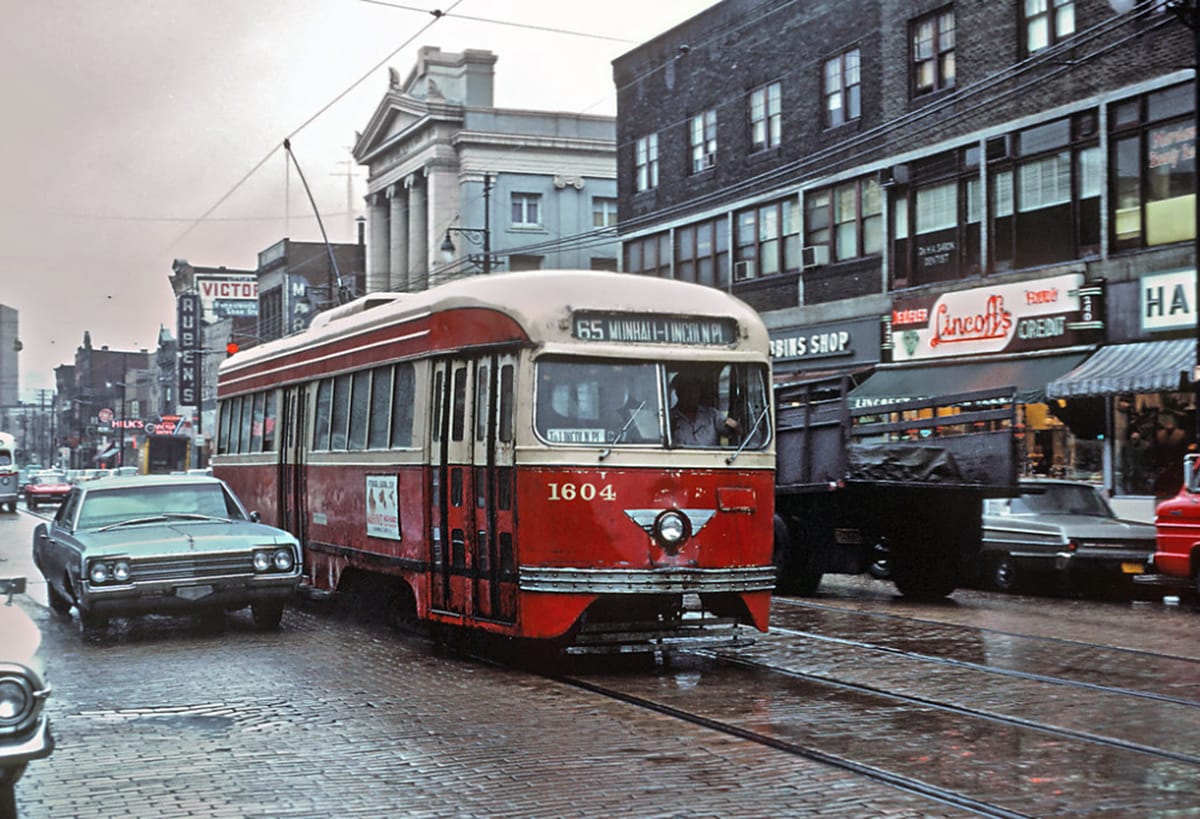
We begin in the 200 block of East 8th Avenue in Homestead, Pennsylvania. Amity Street was the next cross street to the right, while Ann Street was the one visible in this 1965 photo. The blue building in the center, and the one to the left remain. The building to the right is gone with a Valero gas station in it’s place. The brick road and tracks have been replaced by asphalt.
This was a PCC streetcar that was operated by the Port Authority of Allegheny County (PAAC), and this line ceased operations that year.
On the left edge was a white 1960 Chevrolet Impala, and double parked was a 1965 Oldsmobile Jetstar 88 or Dynamic 88 Celebrity Sedan. Behind it in the background was a red C2 Corvette convertible. On the right side was a grey 1965 Plymouth Fury I sedan, and a red Chevrolet Corvair Corvan or pickup.
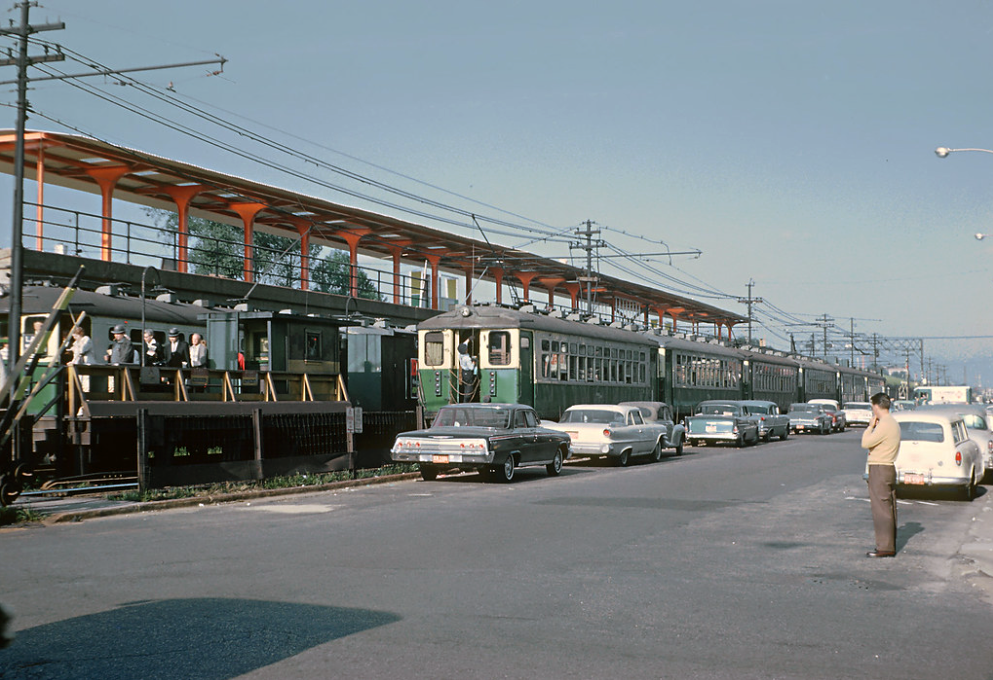
Let’s head to Chicago, Illinois, on West Lake Street (now West Corcoran Place) near the intersection of North Parkside Avenue, which was behind the camera. A new station was nearly complete on the upper level as they were about to eliminate the street level trains. This line is currently still in use.
The Chicago Transit Authority (CTA) operated this eastbound “L” train as shown in this 1962 image.
On the left side was a black 1962 Chevrolet Impala 4 door sedan, a 1960 Dodge Dart Seneca 2 door sedan, a Morris Minor convertible, and a 1957 Chevrolet One-Fifty 2 door sedan. On the right was a 1958-1960 Rambler American wagon.
And we are off to the corner of Hamilton and Enright Avenues in St. Louis, Missouri, per image notes. I did confirm this was Hamilton Avenue, but the cross street is unconfirmed. If the notes are correct, then nothing remains from this 1963 image. Maybe Urban Renewal left its mark.
The streetcar was another PCC, and the Bi-State Development Agency was the operator.
The left side had three Chevrolets; a spiffy, new 1963 Impala or Impala SS convertible, a 1961 Bel Air or Impala Sport Sedan, and seen behind the streetcar a 1959 Impala convertible. In the driving lane was a red 1962 Plymouth taxi, and on the right was a 1961 Ford Thunderbird Hardtop, and a 1963 Oldsmobile F-85 Cutlass convertible.
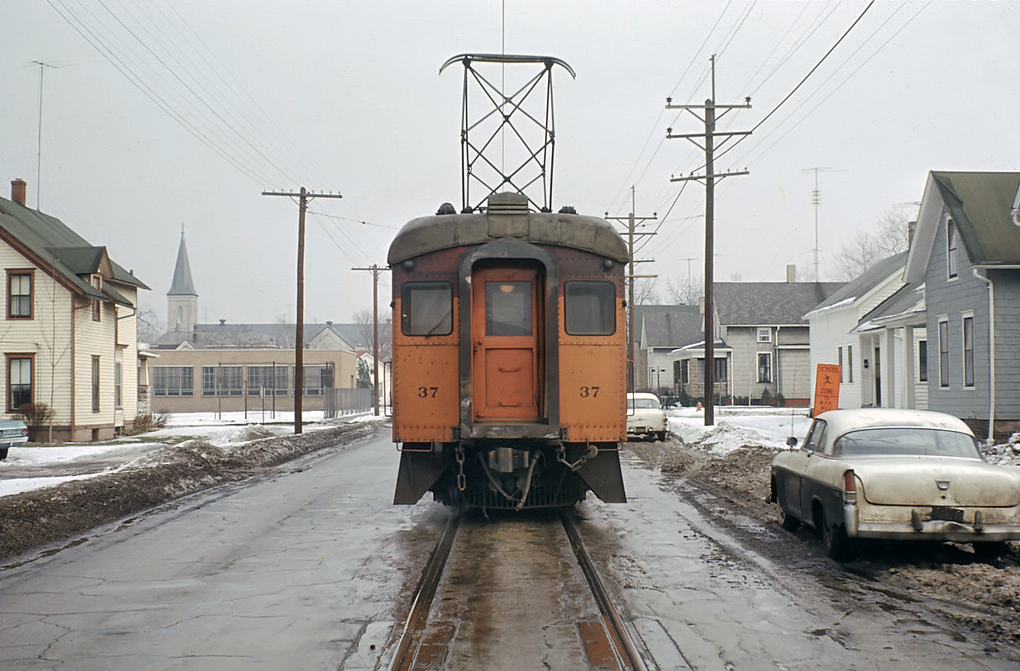
Michigan City, Indiana was the location of this 1963 image, on West 11th Street, with Ohio Street just ahead. The street now has two tracks and one driving lane on the right. The tracks are fenced on both sides, so the only crossings are at the intersections. On the left the tan house remains, while the flat roofed building has been replaced by a fire station. The white house and church in the background have survived. The first grey house on the right is still there with the white one next door gone. The grey house with the stone porch remains, as well as the houses beyond it.
The orange #37 was operated by the Chicago South Shore and South Bend Railroad (CSS&SB), and was the South Shore Line.
On the left edge was the taillight of a 1962 Rambler Classic Custom or 400, and on the right a 1956 Chrysler Windsor 2 door Newport Hardtop, with a 1955 Pontiac ahead.
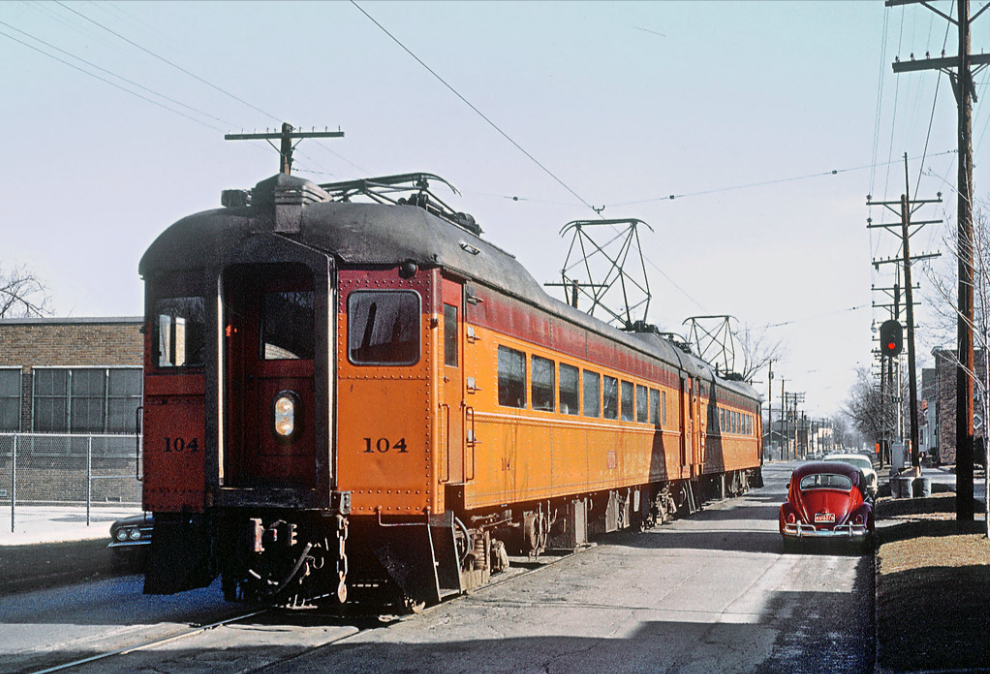
We are still in Michigan City, in a 1964 image at nearly the same location, West 11th and Ohio Streets. The flat roofed building on the left with a chain link fence appears in both images.
This one was #104 on the South Shore Line.
Peeking out on the left side was a 1962 Buick Special, while on the right was a red Volkswagen Type 1, and a white 1956 Buick ahead of it.
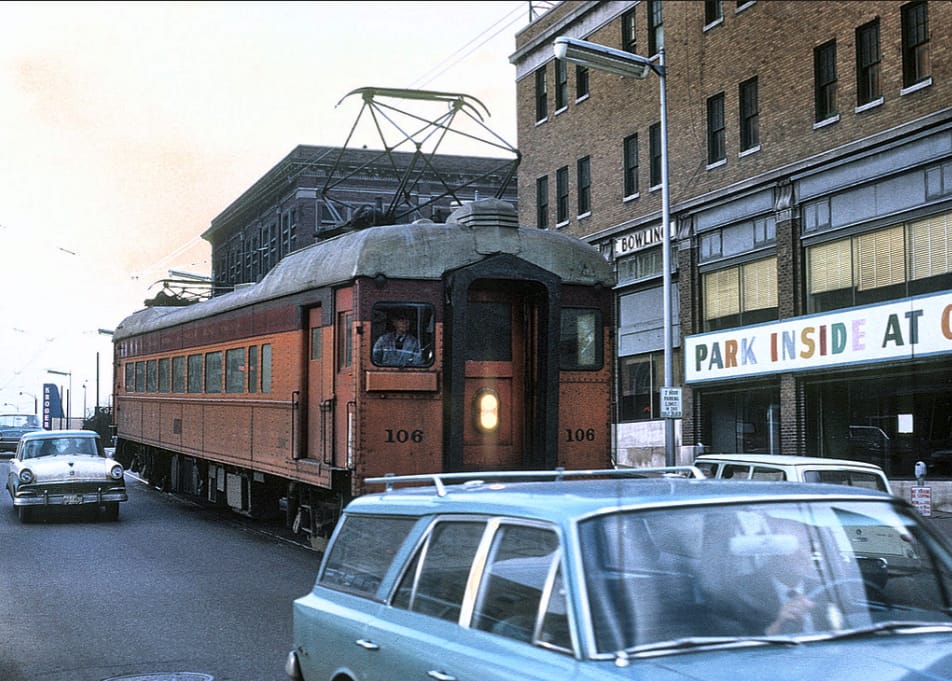
We are now about 35 miles east in South Bend, Indiana, in the downtown area. The exact location of this 1964 photo is unknown (at least by me). The building on the right apparently had a bowling alley and inside parking.
#106 was also on the South Shore Line with the CSS&SB.
On the left was a 1956 Ford Customline Fordor Sedan, in the foreground was a 1963 or 1964 Rambler Classic 550 Cross Country wagon, and at the right curb was a white 1959 or 1960 Studebaker Lark 2 door wagon.
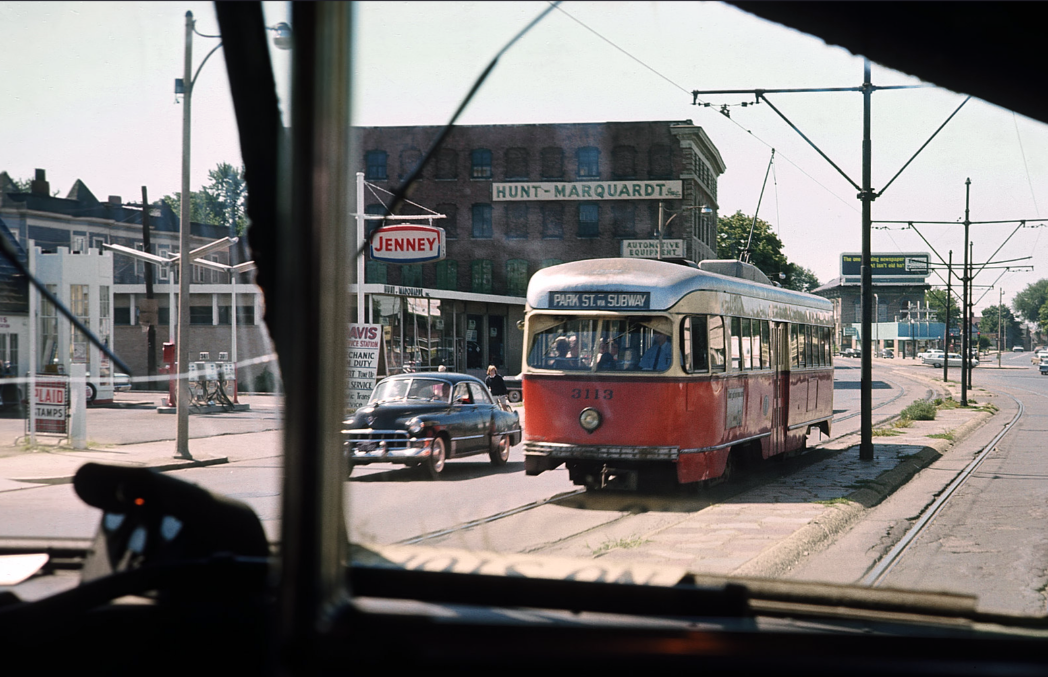
Let’s head to Boston, Massachusetts, to Commonwealth Avenue as per the notes on this 1965 image. That area has completely changed, so this location is unverified. On the left was Davis Gas Station where a mechanic was on duty, you could buy Jenney gasoline, and they offered Plaid Stamps.
Massachusetts Bay Transit Authority (MBTA) operated this PCC streetcar, which evidently was heading to a subway station to get you to Park Street.
To the left of the streetcar was a 1949 Cadillac Series Sixty-Two Touring Sedan that looked good for it’s age. And it was the only one close enough to ID.
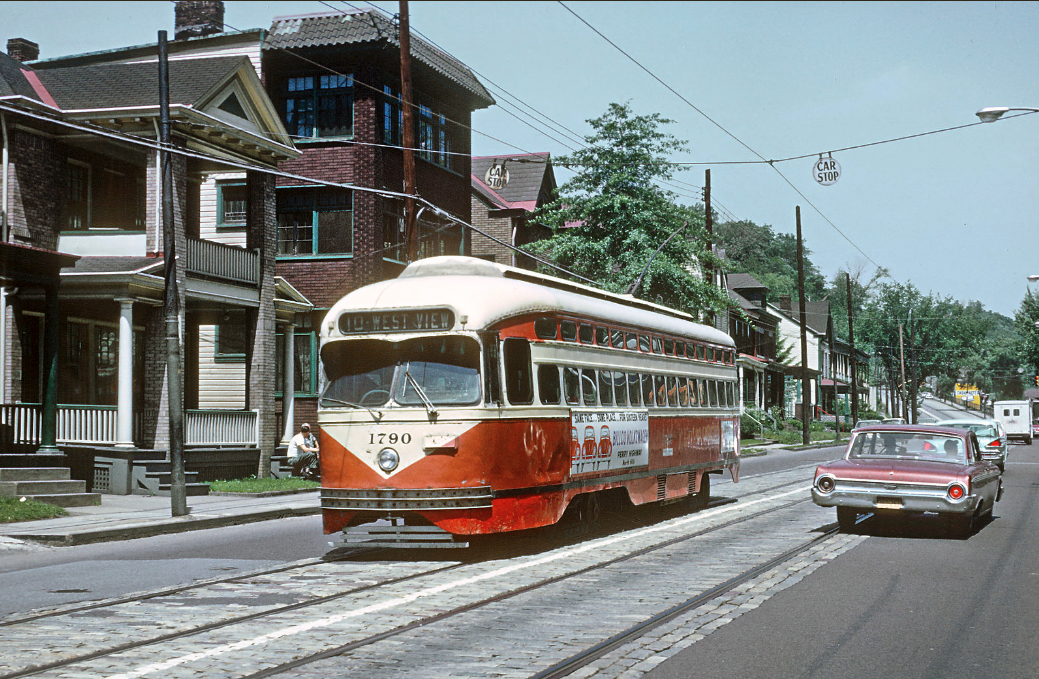
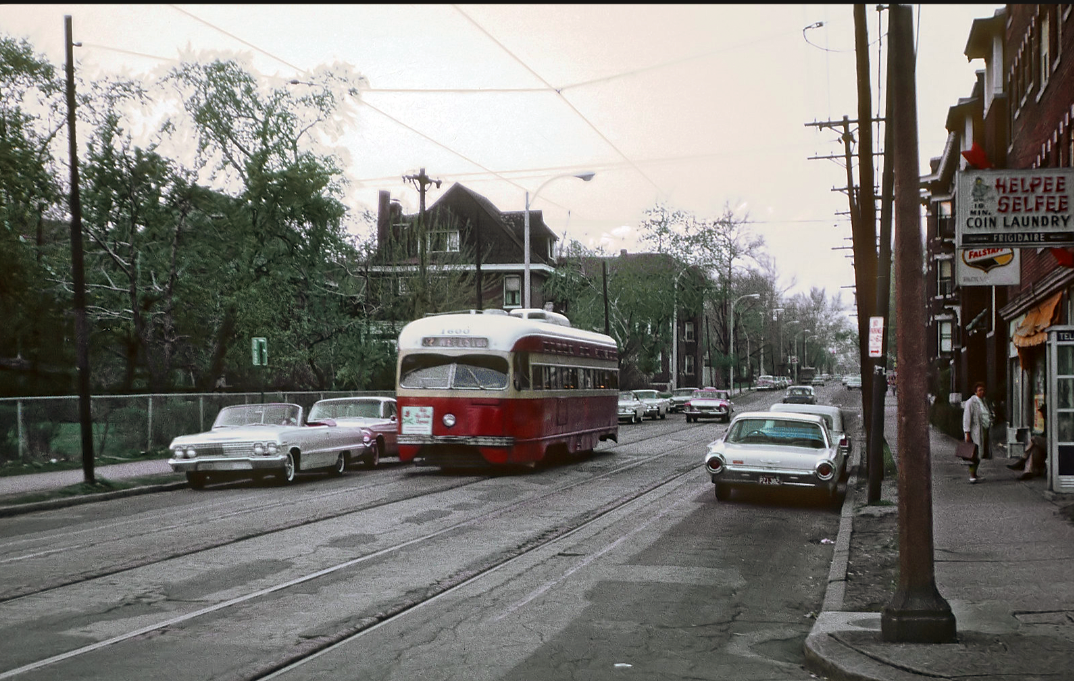
This was East Street in Pittsburgh, Pennsylvania, in a 1965 image. The information is reputable, but I have been unable to find the location.
PAAC was the operator of this PCC #1790 that was on Route 10 to West View.
A 1962 Ford Galaxie 500 Club Sedan was heading the opposite direction, with a 1959 Mercury Montclair or Park Lane in front of it.
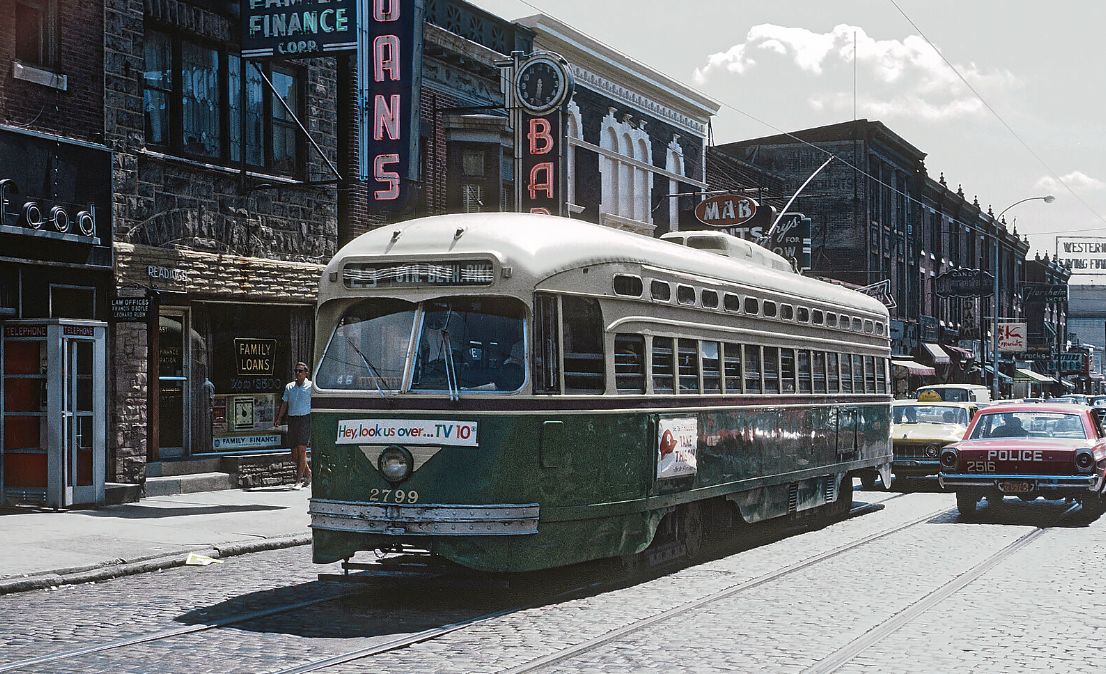
Now we are in Philadelphia, in the 3600 block of Germantown Avenue, with West Erie Avenue crossing behind the camera. Much has changed since this 1965 image, but most if not all of the buildings shown here have survived. The street has been paved, but the old tracks are still there.
The Philadelphia Transportation Company (PTC) was operating this PCC streetcar on Route 23 to Bethlehem Pike.
Behind the streetcar was a 1962 Plymouth taxi, and heading away was a red 1965 Ford Custom police car.
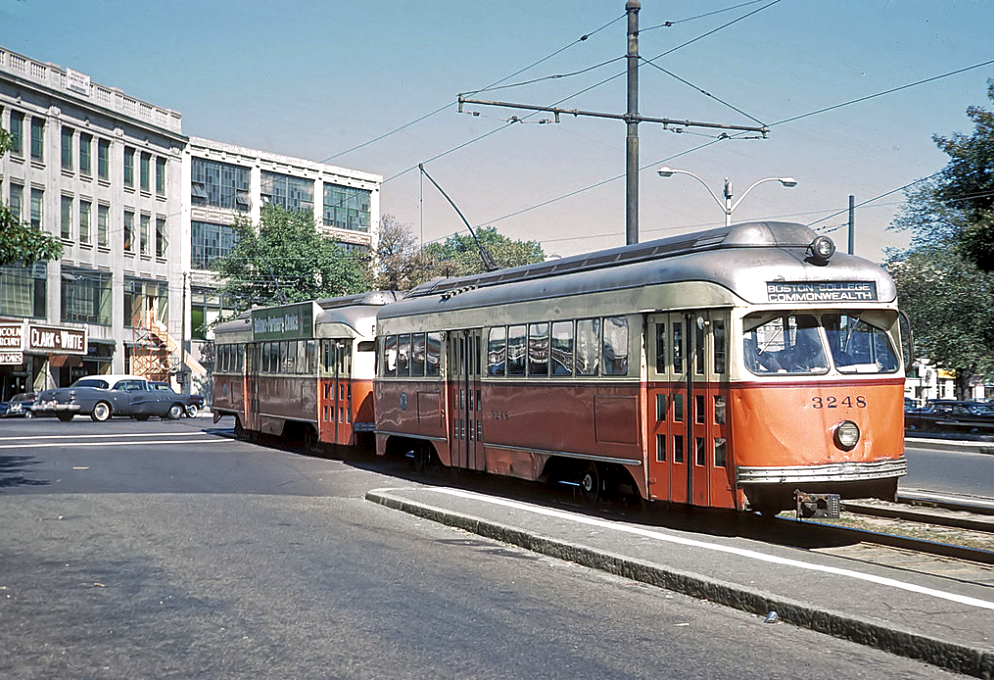
We are back in Boston, at Packard’s Corner, which is Commonwealth and Brighton Avenues, in another 1965 photo. The building on the right appears to have been replaced, while the left side building remains. Both of them, plus more out of the picture to the left, are currently in the process of revitalization. The Clark & White establishment on the left edge appeared to be a Lincoln-Mercury dealer.
This was one on the MBTA’s PCC streetcars that was on the Boston College route via Commonwealth.
A two tone 1954 Buick Super 2 door Riviera hardtop with a dented door was seen in the left distance, while in the left background was a black 1964 Ford Galaxie. The black car between the Buick and streetcar had the look of a 1960-1963 Mercury Comet.
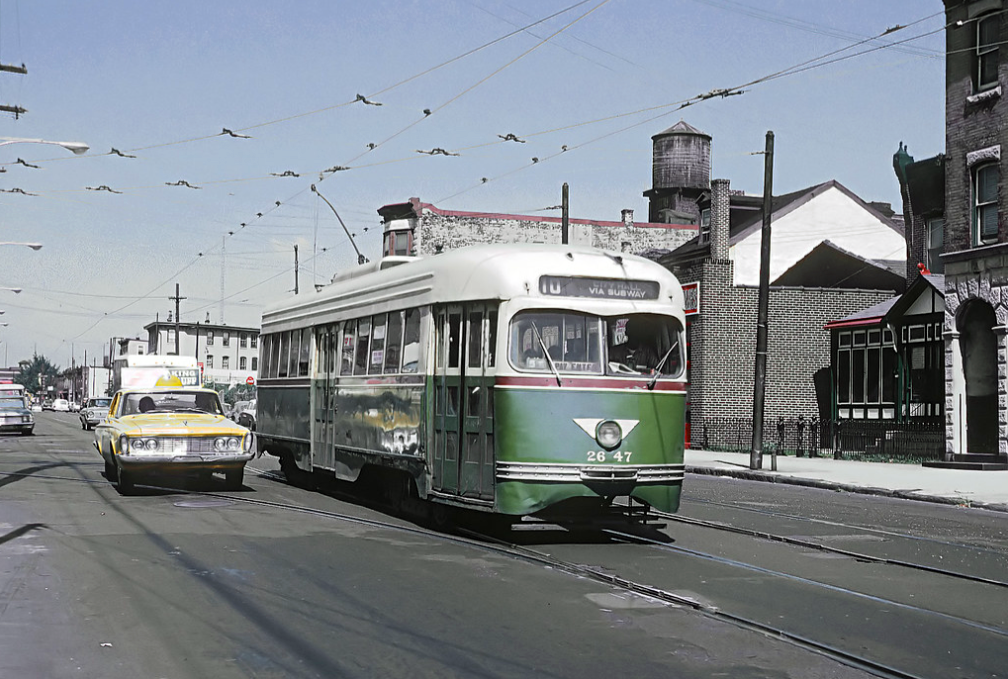
This was the 4800 block of Lancaster Avenue in Philadelphia. West Girard Avenue angles in from the left at this point, as can be seen by the curved tracks, which still exist. The buildings on the right with red trim, the two story with a bay window on the top above the streetcar, and the first multi-story in the distance have all survived.
PCC #2647 that was operated by the PTC was on Route 10 heading for a subway to take you to City Hall.
In the driving lane was a 1963 Plymouth Savoy taxi followed by a 1965 Rambler American. Everything else was too blurry to ID.
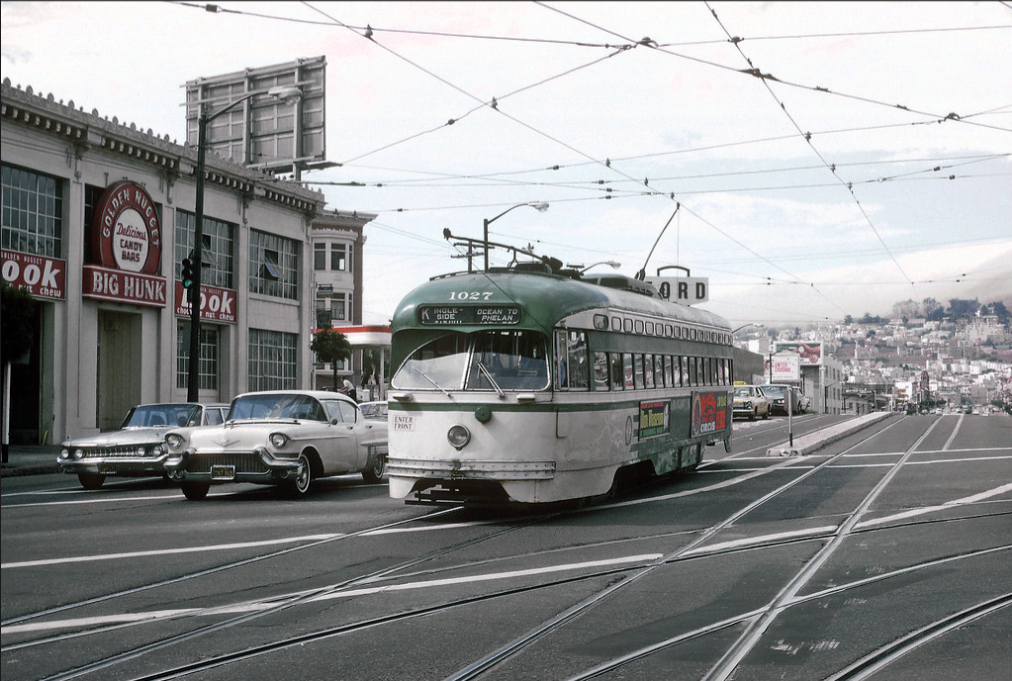
Now we are the west coast in San Francisco, California, on Market Street at Duboce Avenue. The only building you can really see here was the one on the left, which has been replaced. The tracks in the street still exist.
The San Francisco Municipal Railway (Muni) was operating PCC #1027 in this 1967 image.
On the left was a 1961 Mercury 4 door sedan with a 1957 Cadillac Sedan de Ville next to it. Seen behind the streetcar was a full size 1966 Ford taxi, and a full size 1965 Oldsmobile was behind it.
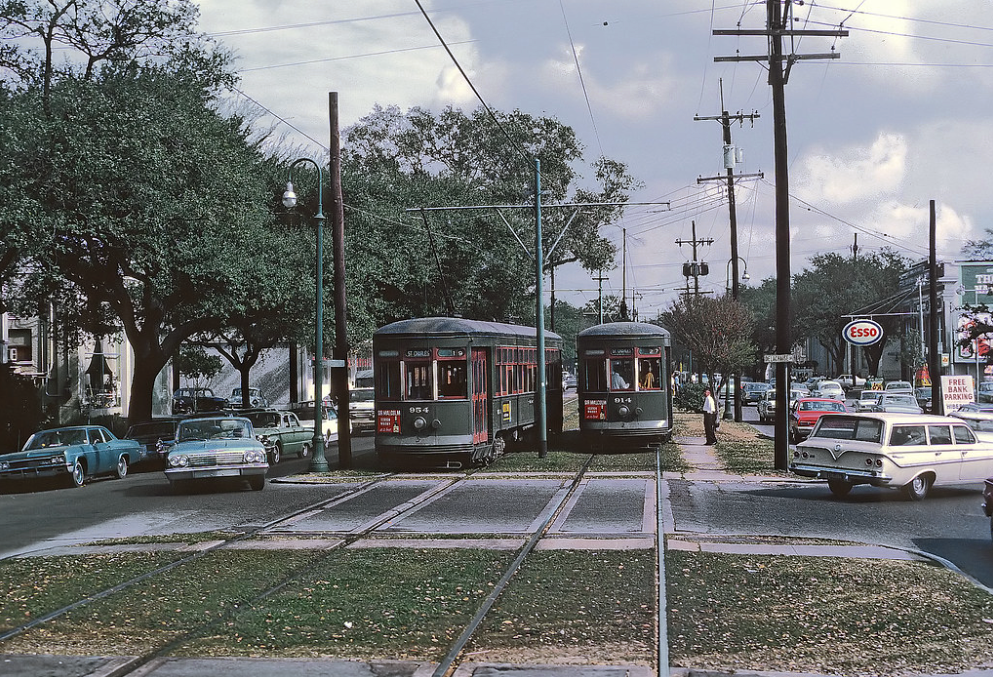
New Orleans, Louisiana, is the location here, on St. Charles Avenue at Delachaise Street. It was a partly overcast and busy day shown in this November of 1967 image. Beyond the first house on the left is now a parking lot, and the Esso station on the right has been rebuilt as a neighborhood convenience store with gas pumps.
Two Perley Thomas streetcars operated by New Orleans Public Service Inc. (NOPSI) were stopped likely for passenger loading.
Three Chevrolets were the closest to the camera beginning on the left with a 1966 Bel Air 2 door sedan, and a 1962 full size model turning the corner. To the right was a 1961 Parkwood wagon turning the other corner. Others on the left include a dark blue or black 1965 Cadillac. There were two Mercury Comets; a green 1962 door sedan on the left, and a red 1966 202 or Capri to the right. Also on the right was a silver 1966 Plymouth Valiant.
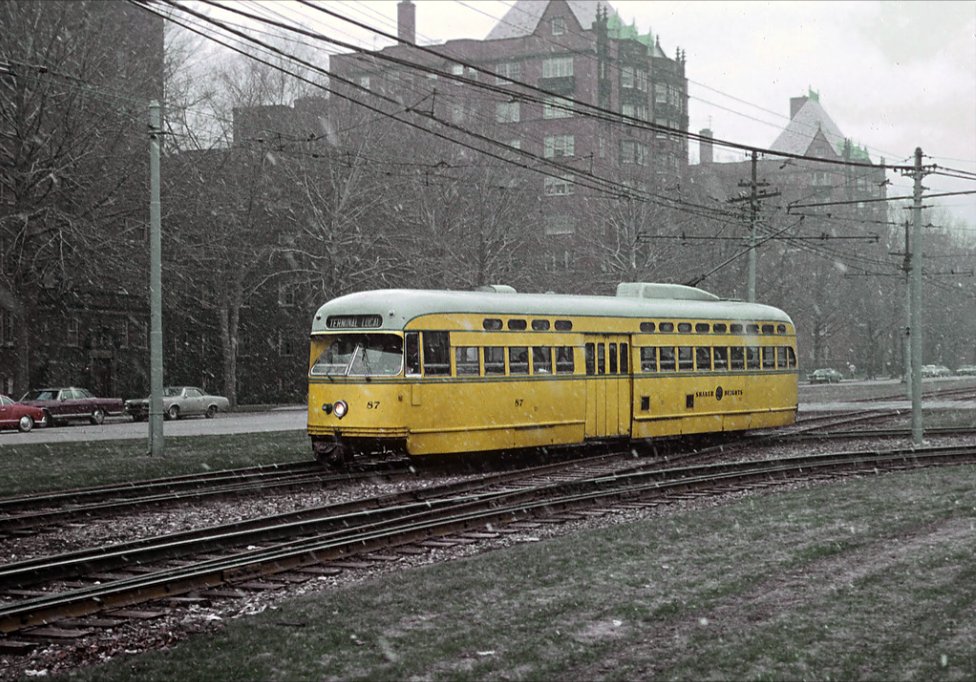
Let’s take a quick stop in Shaker Heights, Ohio, a planned community and suburb of Cleveland. The road in the background is Shaker Boulevard, and the buildings are part of the Moreland Courts complex, and are upscale housing. It was snowing the day this image was taken in 1971.
This was another PCC and was operated by the Shaker Heights Rapid Transit. It was turning onto Shaker Boulevard from Van Aken Boulevard heading towards Cleveland.
On the left edge was a red 1968 or 1969 Volkswagen Karmann Ghia, followed by a maroon 1966 Buick Electra 225 4 door sedan that was missing a fender skirt, and a grey 1966 or 1967 Pontiac Tempest, LeMans, or GTO Hardtop Coupe.
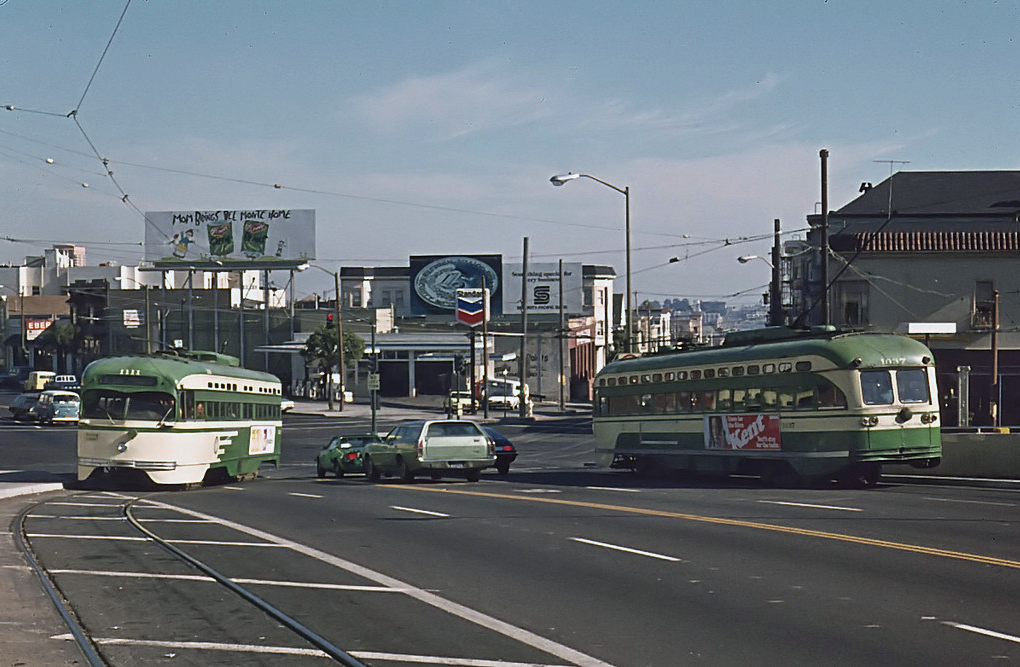
We will finish the tour in San Francisco on an unknown street in a 1976 photo. The only building I can ID was the Standard Station in the center.
A pair of Muni operated PCC streetcars were passing on their respective routes.
In the left background was a Volkswagen T2 Transporter waiting at the light, and further back was a yellow mid 1950’s Jeep Station Wagon. In the center looks like a 1973 Ford Torino wagon with a Fiat X1/9 in front of it. And to the right of the Torino was a 1975-1980 GM H-body fastback.
Thanks for joining us and to all good day!























Wow, THANK YOU for these wonderful images of my long gone childhood .
In the early 1960’s I rode everywhere the MTA went in those PCC cars, home wasn’t a good place so I’d often ride until the system closed down around midnight .
-Nate
So many PCC cars, and even a few shown in San Francisco where these were a huge part of my youth. But what caught my eye was the Big Hunk candy company in the SF waterfront photo. A brand that had totally disappeared from my memory. I only had them a few times as a kid; they were so hard and took forever to soften in my mouth. I just didn’t get any enjoyment from them. It just felt like work, unlike the instant gratification of a chocolate bar. I couldn’t tell you the location of the other SF photo but it’s away from downtown, maybe the outer Mission or even further west or south. Unfortunately the streetcar lines are not visible.
I’d say further south given the city skyline in the far background. Clearly somewhere with a raised elevation. This link no doubt has it once one does some research. Lots and lots of great pictures of MUNI’s history. It’s interactive. Just hover over a picture and it will highlight where in the MUNI system. Too bad one can’t see what line. I’ll guess J or K line.
https://sfstreetcars.co/
Got it. Market, Castro, and 17th Street. Now Chevron there instead of Standard after name change. Note two different liveries in streetcar picture.
After years of abolishing the light rail car in urban areas, in the last two decades it again revives. Even in LA where once had a massive street car network, it now has the light rail mixed in the street. In NYC, city plans to develop a new inter borough light rail between Brooklyn and Queens. However in my opinion it is a wrong type of car in today world. Rather it will be better to use a large articulated bus configuration, the one used in Brazil city Curitiba, powered either diesel, electric battery and fuel cells. Along with the upcoming autonomous driving technology, this setup will be much more economical. Instead, the proposed New York System is much more close to the above ground subway system, rail, power stations and signal systems.
I suspect that the location on East Street in Pittsburgh, PA, no longer exists. The East Street Valley neighborhoods were torn down for the Parkway North. Closer to the city, St. Boniface survived as preservationists and the parishioners fought to preserve it. There are some houses adjacent to the parkway that I thought were on East Street but Google Maps says it’s Evergreen Road.
Yeah. It’s a goner.
I’m a big rail fan and have always liked street cars – it was one of the things that attracted me about Boston. They still run PCC cars on the Ashmont line but the rest have been replaced by modern (and air-conditioned) cars. The Brighton Ave line that split at Packards corner was eliminated some time ago. Before that, late at night, they sent cars on that line to be serviced at the Watertown yard. Fun article, thanks!
Another great tour, thank you for the effort to bring it back to life.
I don’t know if anyone else answered this, but the last picture was taken at the intersection of Market/17th Street/Castro Street. Behind the street car to the right in the photo is the famous Twin Peaks Bar. I don’t know what year the street cars were taken out of service, but they were brought back to service in the mid 90s.
Two from the “burgh”!! Awesome.
Someone had the great presence of mind to shoot multiple reels of colour film of the British Columbia Electric Railway ‘Interurban’ street car lines in Vancouver c.1950, as they were beginning to be removed and replaced by electric trolley buses. Commentary was added some decades later by men who had worked on the system. This segment begins on the outskirts of the downtown area.
The last segment shows street wiring being removed, and some of the cars being burned under the Burrard Street bridge.
I will never really understand why in North America, street car lines were mostly torn up and replaced by diesel busses. In Europe, however, practically every city has a tram system. It is really easy and convenient to hop on a tram in a city like Amsterdam, and the fares are reasonable. I suppose historically high fuel prices in Europe had something to do with it.
Toronto kept its street cars, mostly because there was no money to replace them. Vancouver still has trolley busses, which are kind of the best of both worlds.
Why? Follow the money: “How a Lawyer, a Businessman, and the Mafia Destroyed Public Transit in the Twin Cities”
https://tinyurl.com/ydryt6pj
Additionally, here is one of the most interesting transportation volumes I’ve ever read. You can find nice used copies
online in the $10-$15 range.
Great pictures and commentary!
The photo of Lancaster Ave. in Philadelphia was just about a half mile away from where my father grew up (though before that photo was taken). His whole family lived in that neighborhood.
Philadelphia, in the 3600 block of Germantown Avenue, with West Erie Avenue crossing behind the camera. Much has changed since this 1965 image, but most if not all of the buildings shown here have survived. The street has been paved, but the old tracks are still there.
The other Philadelphia shot (on cobblestone Germantown Ave.) contains an interesting piece of Philly automotive history. The 1965 Ford police car was red – not too many other police departments had red cars. In Philadelphia, red police cars stretched back to the 1910s, when police vehicles were a brand new phenomenon, and were painted red until the early 1970s. Red police cars were so ingrained in the City’s residents that people often referred to the police themselves as “red cars” (i.e., “we need to call a red car!”).
Mayor Frank Rizzo, who was a former police commissioner, changed the police cars’ color to blue shortly after he took office in 1972. It took about 2 years for the department’s fleet to be completely changed. Rizzo thought, as did others, that red was too confrontational of a color for police work, and that blue presented a more calming image (plus, red was associated more with the fire department).
New Orleans, Louisiana:
I rode those NOPSI street cars to high school many a rainy morning. As time progressed, the service whittled down to one line (St Charles Ave). However, in the last 15 to 20 years, the number of lines has grown following previous routes.
When I have visitors from out of town, I take them for a ride on the St Charles line which they very much enjoy.