

Text by Patrick Bell.
Automotive styling underwent a lot of change in the 1950s decade, and chrome played a big part in that change. In the meantime, General Motors was unquestionably at the top of their game and led the way. Today we have a large gallery of their offerings from that era, so let’s take a look.
Our lead photo represents GM’s greatest hit of the ’50s, the 1955 Chevrolet. It was all new in most respects, including a 265 cubic inch V8 that brought Chevrolet into the horsepower race. The car in the lead image was a new-looking Two-Ten 4-door sedan from Texas, and was basic transportation with two-tone paint and whitewall tires. The lady seemed pleased to be there.

If you are a fan of toothy grins, it is hard to beat a 1950 Buick. This one was a Special 4-door Jetback Sedan with a 1951 issue New York license plate, and was the least expensive way into a 4-door Buick that year, with a base price of $1809. The standard drive train was a 248.1 cubic inch overhead valve straight eight with a three-speed manual transmission. Dynaflow Drive automatic was optional, and larger engines came in the upper-series models.

A young girl was posing by a 1951 Cadillac Series 62 Coupe de Ville, with likely her mom behind the wheel. The “Standard of the World” was America’s luxury car and handily outsold all the competition during the ’50’s. General Motors pioneered the hardtop body style in their senior divisions (Oldsmobile, Buick and Cadillac) in 1949.
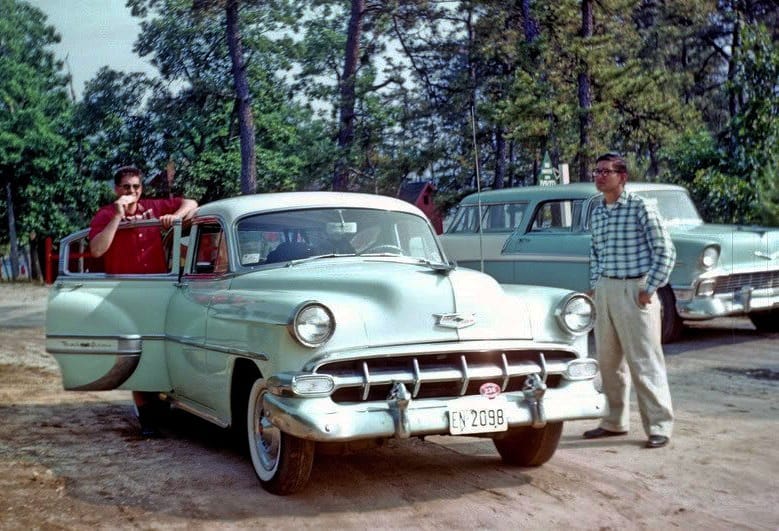
Here were two green and white Chevrolets, a 1954 Bel Air 4-door sedan on the left with a 1956 Bel Air Nomad wagon on the right. The 1954 model was a carryover with a few changes from 1953, and this one was equipped with full wheel covers, whitewall tires, and a Texas license plate.
Meanwhile, the 1956 models were a minor update on the hugely successful new design in 1955, and the only option I see on this one was the V8 engine and there was no front license plate.

All 1953 “Dual Streak” Pontiac models were available with six- or eight-cylinder engines, but over 10 times as many eights were produced. Dual-Range Hydra-Matic Drive was a popular option, and power steering was available for the first time this year. Shown here was a Chieftain Special 2-door sedan, which in six-cylinder form was the least expensive model of the year.

Someone took a photo of their close-to-new 1953 Oldsmobile Ninety-Eight Holiday Coupe that was registered in Jerome County, Idaho, where the seat is a city of the same name. It was powered by a 303 cubic inch Rocket V8 and the standard transmission was the 3-speed manual, although I am sure most of them were equipped with the optional Hydra-Matic Super Drive. The Ninety-Eight was the longtime flagship of the Oldsmobile line.

Buick toned their grin down somewhat by 1953 when this Super 2-door Riviera from New Jersey was built. Their new 322 cubic inch “Fireball” V8 was standard in the Super and Roadmaster series, while the old straight eight soldiered on in the Special for another year. And the Dynaflow Drive was standard on Roadmaster models and optional on the other two.

Here was the top of the heap for GM in 1953, a Cadillac Eldorado. It was its first year, and a limited production model with 532 built for the year. The list price was $7,750, which was an 87% premium over the Series 62 convertible’s list of $4,144. It was a production version of the 1952 El Dorado concept car built for Cadillac’s Golden Anniversary, which along with its two cousins (Buick Skylark and Oldsmobile Starfire), were especially loved by Harley Earl, GM’s styling chief.
As an aside, Earl (1893-1969), who was a GM employee from 1927-1958, was born on November 22nd, 132 years ago yesterday.

A Pontiac Star Chief Custom Catalina for 1954, which was the first year for the Star Chief name and the last year for the Straight Eight motor. It had a curb feeler on the front, a Connecticut license plate, and was at the top of Pontiac’s line up.

Oldsmobile’s 88 was another long running nameplate that was used from 1949-1998, and was very popular over the years. It was entry level status by the time this 1955 4-door sedan rolled around, and had a 185 horsepower version of the 324 cubic inch V8 as the only engine available.

GM was also the first to offer a four door hardtop which debuted for the 1955 model year in the Oldsmobile and Buick lines. This one was a 1955 Buick Century 4-door Riviera, which was the “performance” model that shared the short wheelbase with the Special and the large motor with the upper series. It had a 1966 Michigan license plate issued in Ingham County, where the seat is Mason, and it looked good for an 11-year old rust country car.

The 1955 Chevrolet Bel Air Sport Coupe was a favorite when new and has remained one ever since. This one looked in very good condition, and had non stock hub caps that may have come from a 1966 Chevelle.

Here was an Oldsmobile version of the first four door hardtop, a 1956 Ninety-Eight De Luxe Holiday Sedan. Like the two door models, they were an immediate hit in the sales department, and within a year or two all car makers had developed one of their own. Their popularity continued until hardtops went away in the ’70s.

Pontiac for 1956 was a good-looking machine, as shown here in the flagship Star Chief 2-door Catalina. It was powered by a “Strato-Streak” 316 cubic inch V8 that was available in a couple of different outputs, a bored out version of the new engine introduced in 1955. But the new Star Chief 4-door Catalina (hardtop) was the better seller that year.

Not that it mattered to most Cadillac buyers, but this 1957 Series Sixty-Two Coupe from California was the least expensive Cadillac that year, with a base list price of $4,677, or roughly a dollar per pound. Other GM products in this parking lot were all on the left side; a white 1954 Cadillac Series 62 Sedan, white over blue 1955 Buick, white over turquoise 1957 Chevrolet Bel Air Sport Coupe, and a red and white 1956 Bel Air, perhaps a Sport Sedan.

The photographer and friends were out for a fall ride in a 1957 Buick Century convertible with a combination spot light mirror and a Michigan license plate of the same vintage issued in Genesee County, where the seat is Flint. The V8 engine was increased to 364 cubic inches, and of course the Century came with the 300 horsepower version, as did the upper series. Also standard was the Variable Pitch Dynaflow transmission, and on the convertible power windows and seat.

1958 brought a “lower, wider and longer” Chevrolet, and the Impala was introduced in Sport Coupe (shown) and convertible models. Also a new 348 cubic inch V8 in two versions, a “Turbo-Thrust” with a four barrel carburetor, and a “Super Turbo-Thrust” with three two barrels. Both furthered their stake in the horsepower race.

1958 was also the peak year for the use of chrome, and this Oldsmobile Super 88 Holiday Coupe from Ohio shows it well. The Super 88 was the mid level series and the standard engine was the 305 horsepower version of the 371 cubic inch Rocket V8. Optional was the J-2 Rocket V8 with three two barrel carburetors that boosted the horsepower to 312.
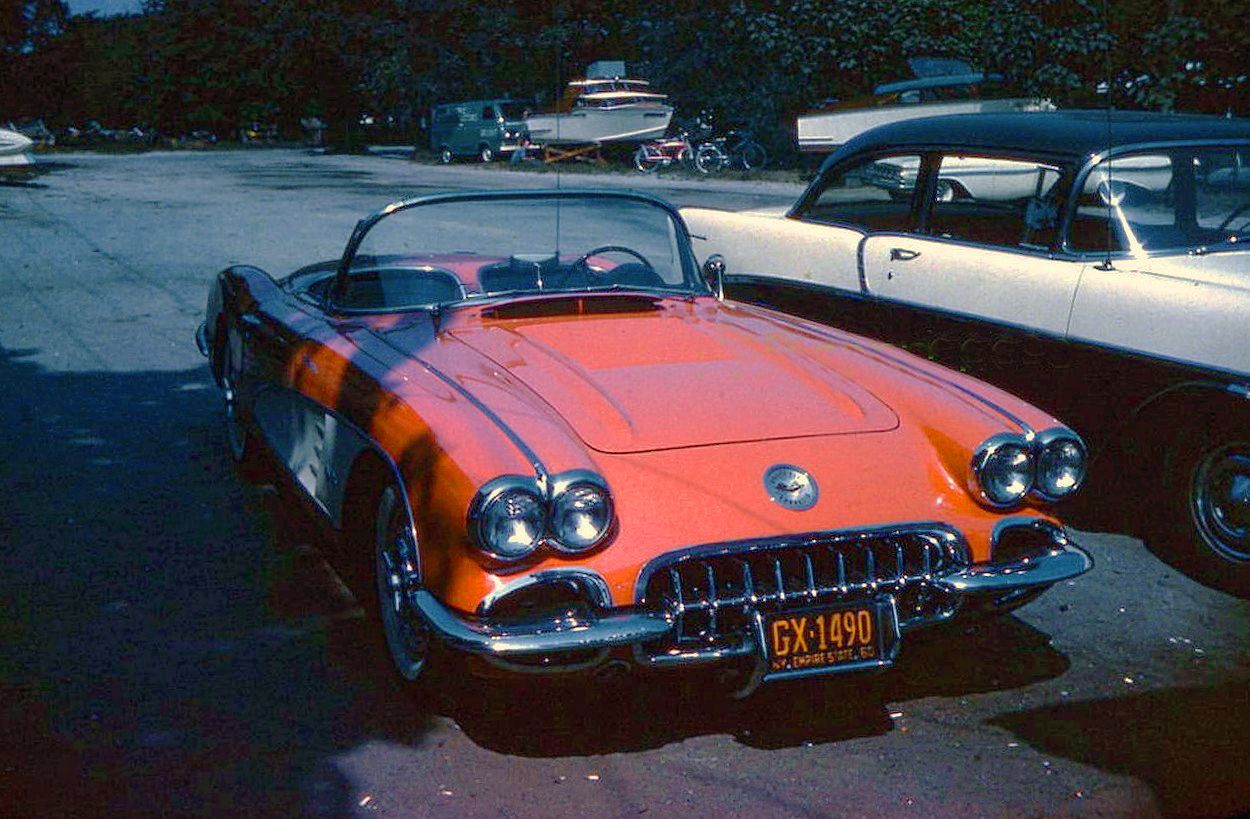
The Chevrolet Corvette is an American icon having stayed true to its mission of a 2-seater sports car for over seventy years. This one from New York was a 1958 model in Signet Red with Snowcrest White coves. The other GM products in sight were the 1956 Chevrolet Two-Ten 2-door sedan to the right with a white 1959 Impala visible through it. And on the left edge was the left rear corner of a 1961 Oldsmobile full size.

Another restyle across the board came to General Motors for 1959, and for Chevrolet it brought the “batwing” tail fins as shown on this Impala convertible. This looks like a promotional shot, perhaps for a dealer going by the 1959 Massachusetts license plate that may have been a dealer plate, though I can’t confirm that. Peeking around the corner in the background was a 1951 or 1952 Buick.

Buick’s version of the new for 1959 style had “delta-wing” tail fins plus all new series names; LeSabre, Invicta and Electra. The little guy was standing in front of the nameplate, so I can’t determine whether this was an Invicta or Electra 4-door hardtop. The 364 cubic inch V8 carried over for the LeSabre, and a new 401 cubic inch V8 was standard on the upper series. It looks like it was lunchtime on the side of the road.

The late ’50s were when the tail fin race went to the extremes, and GM’s topped out in 1959 with Cadillac the most extreme. This Sedan de Ville 4 window was registered in Linn County, Iowa, the home of Cedar Rapids. The Cadillac V8 grew to 390 cubic inches this year, but was outpaced by Oldsmobile’s new 394 and Buick’s new 401.
Thanks for joining us and to all good day!























Chrome, fins, and monster V8s made America Great in 58. Where is a 58 Cadillac Sixty Special? IMO the best of OTT extravagant, overchromed LAND YACHTS. Followed closely by 58 Buicks. Harley knew how to apply chrome with a trowel. Proposed 59s would have added even more. Once again, TOO much is NEVER enough. Chrysler may have won the Fin wars, but GM won the Chrome.
As usual, I stand With Rick.
Although, ..”a Trowel”? I think they just backed up the Dump truck.
😉
The ’53 Eldorado was attending an old car show at what looks like a county fairground. Too bad the photographer wasn’t interested in the old cars!
The ’53 Pontiac stripper is in front of a similar building, perhaps also attending the event?
I love these, the 1950’s cars from GM were all good drivers to boot and easy to keep n a good state of tune .
Those “Dagmar” Cadillacs still send me .
-Nate
They left out the prettiest of all… the 1956 Chevy Bel Aire. Turquoise and white…
Those were the days.
’58 was the year GM went off the rails. Love the styling of all the 1950s years. Had about 20 of them, all GM and Forward Look Mopars, including a crazy ’58 Olds that I loved, a classic 300c convertible, and that ’56 Holiday Sedan in Rose Pink & Arctic White with A/C! But if US makers had stuck to the sensible size and height of the ’55 Chevy they might have still been ruling the auto world to this day. They went too far in size for most folks, however must say I loved that good ol’ Murican excess as well!
Looks like the ’59 Impala Convertible photo was taken at Leader Chevrolet in West Springfield, Massachusetts (675 Memorial Ave.). The features in that photo (service door, bollards, No Parking sign, etc.) all match this slightly earlier photo that has a dealership sign atop the loading door as well. Plus, the topography matches. The site, now Central Chevrolet, is directly across the street from the West Springfield rail yards, which is slightly elevated from the the road, just like in the vintage shot.
Current StreetView of the location (though a service bay addition was built onto the end of the building where this photo was taken):
https://maps.app.goo.gl/AZ3XD8A6VEBta7JU9
I would not call the ’56 Chevy an “update” but a step backwards. Ugliest of the tri-fives in my opinion, and I’m not alone on that matter.
Harley Earl must have been livid when he saw how the ’55 turned out too clean with little chrome. ’56 added more and the result was a bit more Olds-like, IMO. In a few years the contrast between the ’55 and ’58 (which I dislike) is amazing.
Nothing was released from the design studio without Harley Earl’s approval in the 1950s.
Early in the model year, some dealers and potential customers complained that Chevy’s 1955 grille was too plain. The 1956 model was the result.
Yup. Been saying this forever. Front and Rear. 55, then 57, then………………………………………….. 56.
IMO
The ugly one was the ’57 with silly tacked on fins and it’s shrunken A cup “Dagmars”…imo.
I liked the new 1955 Chevrolet when it came out in 1954 — especially the grille. I was sorely disappointed when the 1956 model showed-up with a more “standard” front end styling. But the 1956 was caught in-between as a hybrid of sorts. Chevy already knew what they were going to do for 1957, and the side-trim on the ’56 hinted at it, whilst retaining much of the ’55 in facelifted form. The 1957 was a masterpiece, in my view, despite its being “old” as the final version of a three-year body-run. Then I loved the all-new 1958. The 1959 was all-new once again, and a giant step into UGG-LEE!
Pontiac, on the other hand, pleased me from 1942 forward. And while the all-new 1949 contrasted greatly, it somehow still looked “Pontiac”. They refined it a bit each year through 1952; then came the modernising 1953 facelift, which I always loved. The ’54 was okay, looked still more modern, but I preferred the ’53. However, what they did in 1955 was ingenius: faced with an entirely new body, they still managed to make their 1955s absolutely PONTIAC, and not something dropped in from outer space as the ’55 Chevys and ’49 Fords and ’55 Plymouths were. Pontiacs through those years had a consistent and eye-friendly identity which I appreciated. And THEN… came the late ‘fifties, and… OH well…
Regarding the young man who is proudly showing off his new blue 1958 Chevrolet Impala Sport Coupe, there are several pictures of him with his car that can be found on the Internet. It’s one of the few 1958 Impalas with a six cylinder engine.
Wow, my grandfather had a new ’55 Chevy identical to the one in the lead photo, except his didn’t have white wall tires. I don’t have any color photos of that car, so it’s nice to see this one in color.
His Chevy was the most mainstream car I remember him having, with a ’50 Hillman Minx preceding it, and 3 Ramblers following.
“If it won’t go, chrome it”,,was the sign above the Moreway Auto counter. It’s funny ( not ha-ha funny) how chrome has all but disappeared from our lives. Growing up, chrome was everywhere. Just its shimmering application, turned the mundane into glitz. On our cars, it’s as if chrome was applied with a patching trowel. Our 1950 Packard had things chromed you didn’t even see. Then we “progressed” to chrome plated plastic, with razor sharp edges, to maybe a chrome strip on the dash today, if that. I remember JC Whitney sold something that hooked up to the battery(?), and was supposed to re-chrome things with ease. Not sure that worked, but I believe chrome plating is an extensive process, and detrimental to the environment and the health for people that worked with it,, big time, and was gradually phased out. Try and find someone today that does chrome plating.
I do so very much enjoy these picture laden articles! Takes me back to my childhood of the late 1950’s and 1960’s. (And still today according to some people, HaHaHa).
The first picture of the 1955 Chevy 4 door is indicative of many of the cars in my just barely middle class tract housing development neighborhood during my mentioned time period.
The flashier Bel-Air hardtops and convertibles were not all that common in my neighborhood.
Deftly Done, Patrick Bell.
My 65 Comet 404 had very few options. 200 6 cyl, 3 on the tree, but chrome wiper arms. When the sun hit those just right…glad I had my aviator’s.
Thank you, mark.
My Gosh, they’re all so beautiful.
Imagine showing someone that 53 Buick (who had never seen them) and explaining that this was a “Toned Down” grille.
The 55 Bel Air ‘Guy’ looks like Terry (Toad) from American Graffiti.
LOVE the 55. Well, and the Buicks, and Caddys. And the 58 Impala, and Obviously, especially the 59 Buick.
Of course, I’d take any of them.
A great collection of photos. One can tell that many of these owners were quite proud of their sharp new GM car. For that matter, the 11-year-old 1955 Buick looks quite good, too – particularly for a car that had spent its life in Michigan!
The photo of the 1953 Eldorado at an old-car show is quite interesting. One wonders if the local dealer brought it to the show. That was a very expensive car for 1953. The Oldsmobile specialty convertible actually produced for 1953 was called the Fiesta, not Starfire.
You are correct, Geeber, thanks. I usually confirm my first thoughts but I forgot to on this one.
These cars require too much exterior maintenance. I clearly remember sitting on the ground with chrome polish for what seemed an hour every Saturday coating, hand rubbing and buffing 45 beveled chrome rectangles in my father’s 1959 Buick’s grille. Then the skeg fins on the 1961 Oldsmobile and those bumpers. They rusted, pitted and discolored within five years. Sorry, but I’m a fan of today’s easy care, non-rusting vehicles.
I just want the body color bumpers to go back to some type of chrome/ aluminum, or the like.
The painted bumpers, with all the scrapes, chips, scuffs make the car look old in about two years.
My first late model good condition car was a ’59 Impala bat wing convertible ..white with red interior. . ..had to sell it when I was drafted. ..Just wish I could have kept it …they are worth huge dollars today.