

(2012; updated 2/20/2026) The Great American Diesel Epoch (1975 – 1986) included an astonishing array of cars and trucks that have mostly disappeared from the streets as well as our memories. One of the rarer ones was Dodge’s second (more on the first below) foray into diesels in their light trucks, a dozen years before the big Cummins 6BT finally found a long-term home in them. In 1978, Dodge’s partnership with Mitsubishi resulted in the 6DR5 diesel being available in the 1978 (and possibly 1979) D100, D200, and (technically) the B-series van. There’s still a few of those pickups clattering away, but good luck finding one of those vans.
Update: Some diesel vans were built, apparently all or most in RV conversions and such. Whether any regular passenger or cargo vans were built with the diesel is still unresolved.

At the time, the idea of a diesel Dodge van was rather intriguing to me. I should have ordered one, because it might be the only one on the planet. Although some 2,835 diesel pickups were known to be built, I can’t find any record of anyone actually owning one of the vans. Even finding good info and pics of one of the diesel pickups is hard; these very nice ones are courtesy of Marc Lerner, posted at nissandiesel.dyndns.org.

Why didn’t it sell better? How about the fact that it made all of 105 hp (and 163 ft. lbs of torque, less than the slant six)? This was a naturally-aspirated unit, like so many in the first half of the Great Diesel Epoch. There is talk of folks retrofitting them with turbos, but who knows if any are still intact. Anyway, owners of them say they will trundle along at sixty or so, and get a solid 20 mpg doing it. Needless to say, acceleration is very leisurely (a Popular Science review clocked it at 34 seconds from 0-60 mph). Transmission was a choice of a four-speed stick or A727 Loadflite.

There have been some comments left at this post from persons who have seen or know of diesel vans, including this camper van conversion offered for sale recently, but so far, no confirmed sightings of any regular cargo or passenger vans. There have also been some reports of a large Dodge motorhome with this Mitsubishi diesel.

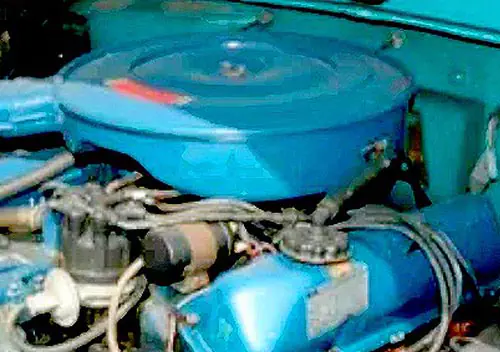
Here’s a picture of the engine in the Dodge Explorer van above. This is more than adequate proof. And undoubtedly, this heavy camper is very slow.

Just to make the pre-Cummins Dodge diesel history lesson complete, here’s a shot of a Perkins six cylinder that was available as an option on the 1962 D-Series pickup. Perkins had been available on export-only Dodges for some years, including some sedans, but in 1962, it was listed as an option for US buyers too. Since only some 1,000 were sold, it quickly dropped off the radar again. It took three tries for Dodge to score with a diesel truck, but that one was a home run.

















I learn something new everyday about cars on this site.
Ditto. Among the people I know I know more about cars than anybody. It’s great to come here and never fail to learn something new, not just from the posts, but also from the comments.
+1 🙂
I have one of the pickups
My name is Charlie Grose and I have a 78D 100 with a Mitsubishi diesel. Underpowered is not a word to describe this Truck. But trying to find somebody to work on it is even harder. I had the fuel pump rebuilt couple years ago and I found out then that it was made by two different companies. We were lucky enough to find a man who worked on 1/2 and was familiar with the other half so I got it rebuilt relatively cheap at 500 bucks. If anybody would like to see it I live in Milan Ohio and my phone number is 734-308-9627. If I don’t recognize the number I usually don’t answer so I would advise texting me first and I’ll return your call.
I read somewhere the engine was also used in Mitsubishi forklifts.Would have been a larger forklift
I just missed shooting one of the 70s Diesel Dodge pickups. I had seen an old green late 70s Dodge pickup sitting at a particular house that I passed regularly. One day it was gone, and shortly another CC-worthy vehicle showed up. The owner happened to be outside and allowed me to photograph his vehicle (which I have not yet written up).
I mentioned that I had thought of stopping and photographing his pickup, and it was then that he told me that it was one of the few with a Mitsu diesel and that he had just sold it. I had never even remembered that those were made, and he told me that I had a lot of company. I missed it by about 3 weeks, and have not seen it since.
Wow; I can only vaguely remember seeing one or two ages ago with that Diesel Power badge. My congratulations as well as condolences. You’re not likely to find another.
I went to buy a 1998 dodge off of a guy and I had traveled many miles to get it… and he sold it…..so i settled for the 78 dodge he had bought it for 1300 hundred bucks worked on the brakes for ever and still had to pay 300 bucks to have shipped oh ya the truck was at a friends house and I paid him and he ran after giving me the title….but it was 4×4 so that’s was a plus in my eyes….and then I find out it is diesel and to find parts for small stuff like filters,oil return line seals, glow plugs,r hard to find first I was told it was a truck that was made from a bunch of truck,,,,then with research I find out that I have a very rare truck with a 6dr5…..I almost sold it im glad I didn’t….this site has help me a bunch ty. oh and please with any thing u can tell about what I have email me at [email protected] or text me 618 571 4404….
I have only seen one of those diesels I think it was a 1979 half ton. I accidentally stumbled across that walking into a Quality Dairy convenience store in Okemos Michigan thankfully the guy left it running. If he hadn’t left it running I would have had no clue it kind of sounded like a 6 cylinder 225 and I thought it was because of the Rockers were making a little bit of noise and it threw me a little bit. But then I smell the exhaust and all of a sudden it hit me like a hammer holy smokes this thing as a diesel I wish I had the guys name and number but I don’t. It was an old red and white faded out half ton 2 wheel drive conventional cab Style.
I have a 78 2×4 dodge diesel Mitsubishi motor I’m selling
SHOOTING one of these monstrosities won’t help! Try DYNAMITE next time! LMBO!
About 2 years ago I did see a ’78 Dodge with the Mitsu diesel for sale on ebay. It was out west, likely Wyoming. I knew it was rare; now I know how rare.
I have seen one of the vans- with some caveats. In 1995 or so, I was going to school (driving my 73 B200 van) and a small motor home with a Dodge van front end came through the lot. The grille was 71-73 but that grille would fit 71-78, so it could have been any of those years. My buddy and I went over to check it out. It had factory Diesel badges on the fenders. The owner said it had been swapped to a gas v8 years before but had originally come with a small diesel.
Am I seeing dual oil filters?
Likely, it is not uncommon for diesel engines to have two, many times one is a conventional full flow unit and the other a by-pass style filter with lower micron rating. Other times it’s just two full flow.
Typical commercial truck thing. When I worked on the big trucks, they all had two oil filters. Sometimes 3.
Thanx Fred! Say hi to Ferd, Fannie and the rest of the Farkle family for me…friend! (Rowan & Martin’s Laugh In) (=
Yes they have 2 oil filters
yep i have one but its got a turbo and it has 3 filters
It is interesting that they chose to use a Mitsu unit since Chrysler was the US distributor for Nissan Diesel engines which is why the unit in the Scout is technically the CN-33, for Chrysler Nissan. Though it is best known as the SD-33. Granted it was a little under powered in the Scout but there was the CN-33T which developed 101 HP in the Scout. I’ve read that Chrysler somehow helped in the development of the engines and were somehow involved in the production of the engines that were painted yellow when they left the factory. The 4cyl version, the SD-22 is what powered the Datsun/Nissan diesel pickups, and was under consideration for the 1981 Scout II.
I always thought that Dodge used the Nissan diesel as well. As others have said, you learn something new every day here. 🙂
I’ve seen pics that someone posted online of an old Chrysler (1968 I think) they found in the wreckers that had a Nissan diesel transplanted into it.
A friend of my dad’s did a couple of mods to his D150. Originally it had a 318 2-bbl., but he wasn’t happy with both power and gas mileage. He dropped a 6-33 in there, which required quite a bit of modifications, but he got it to work.
However, while he was tickled pink over the fuel mileage (like 22-25 mpg) he eventually got tired of the lack of power, especially when trying to haul anything the bed. He swapped it out and put a 383 in there. Then, it had all the power in the world. Pass everything but a gas station.
I think he eventually settled on a 360 4-bbl. and just lived with the compromise of slightly better than “okie-dokie” gas mileage and having enough power to haul anything the truck could hold.
I’d heard in the day about the Diesel Dodge pickup, but from that era the only vehicle similar I ever saw was a Scout II at a new car show (San Francisco) loaded to the gills with the Chrysler-Nissan unit.
i have a sd 33-T for sale for 650$. no one wants it. its complete with the trans t case (dana 300) motor mounts starter turbo. not seezed. what a shame no one wants to even look at it. anyone who would like this can contact me on face book, my name is pat timms. i have a shit ton of 1972-1993 dodge trucks. im not hard to find.
needyeartelephonenumberpatsoicanecLlyou
Pat, call me 330.831.5324
I have a 75 D200 crew 4×4 engine is gone. Been thinking diesel…
I know this is an old ad but thought id ask is still avail.
Wish you still had it. I would definitely like to have it. My number is 305.527.1762. Just in case. Thx !
Keep in mind in the 70’s and 80’s Dodge used to own 15% share of mitsubishi. Hence why many cars were mitsu with a chrysler name. So it made sense they would just get a mitsu engine as they owned part of the company just like the D50 had the diesel option as well.
Chrysler has (had?) a stake in Nissan, but they had a stake in Mitsubishi first. Starting in the 1960’s, all the American car manufacturers realized the imports weren’t going away and the Japanese imports were doing their homework and acutally putting out a decent product, albeit a bit tiny and underpowered, but they were learning.
So as a way to help each other out (especially once the fuel crisis hit and the supreme fuel mileage the Japanese imports were citing, became known and appealing to American buyers), certain Japanese makers aligned themselves with certain Amercian makers, in order to gain a foot hold in the market. Hoping to gain public acceptance a bit faser than Nissan’s excrutiatingly slow rise to popularity.
Mazda (or rather, Matsuda) aligned themselves with Ford. Isuzu chose GM and Chrysler paired up with Mitsubishi.
Nissan, Honda, Toyota and Subaru were the only Japanese makers who decided to not pair up with an American auto maker (Nissan’s relatonship with Chrysler would come years after they landed in the American market).
This is why Chysler tried working with the Mitsubishi engine in their own trucks. That was their main Japanese counterpart.
I beleive the deal between Nissan and International-Harvester (now Navistar) was a separate thing and Chrysler was not involved at all.
I remember when the diesel Scout came out and I’ve never heard Chrysler’s name uttered within the confines of that deal.
I believe there was also a turbo option towards the end of the diesel Scout production. I remember engine performance specs were something like 101 HP and 175 ft.lbs. of torque, which is a nice step up from 92 HP and 137.5 ft.lbs. of torque for the NA version.
Didn’t GM use the Honda V6’s in their SUV’s. Down here in Nova Scotia ( the land of salt and honey)the plastic body panels were the best thing since slice bread. We put over 400K, kms, 250 miles on those V6’s engines. Lots of snot but no snort for towing.
Not that I ever heard of.
Honda may have assisted in designing certain engines for GM, but I don’t recall a direct buy by GM of any of their engines.
I know Nissan bought the rights and the design of the V6 that was used in the GMC trucks back in the 1960’s.
They shrunk it down so it would fit their cars and released it as the 3.0L V6. That was the engine in the 300ZX.
You can still see the spark plugs mounted on top of the head, next to the intake manifold, just like the old GMC’s.
Jeep also used the little 60 degree V6 GM engines in the Cherokees and Grand Wagoneers in the 90’s (possibly the 80’s too).
Diesel hp is virtually irrelevant torque is where its at
No its not. The torque curve of a diesel may be fatter low down, which may affect gearing issues and shift points, but ultimately, horsepower is the final word on how much power an engine makes.
A 220hp 2 liter Honda S2000 engine mounted in a semi truck and a 220 hp 16 liter Cummins diesel (from the 60s) are both capable of pulling the same semi-truck down the road (or up a hill) at exactly the same rate. It would just take very different gearing, and more gears (for the Honda).
Of course, the Honda might not last as long, but that’s a different issue.
There is a good reason large trucks engines are rated first (and most importantly) in how much horsepower they make. It determines how much power what they’re capable of producing.
An engine that makes lots of torque but not much hp will require less shifting, but ultimately, its hp rating will determine how fast it can go, and how much load it can pull, and at what grade.
BTW, that Mitsu diesel six made 163 ft. lbs of torque, less than the 225 slant six, which made 170 ft. lbs. Keep in mind that it did not have a turbo.
Torque is a force, HP is the rate of application of that force. Torque can be multiplied by gear reduction but HP cannot. HP is what determines how fast you can do work.
Technically, torque is the moment of a force, which is why it has units of foot-pounds, rather than just pounds.
5 pounds applied at 2 feet produces the same torque as 10 pounds applied at 1 foot, or 1 pound applied at 10 feet.
That’s a very good way to put that, Eric VanBuren.
I’ve seen 1 HP defined as the ability to move 330 lbs., one foot in one second.
It was originally devised as a way to gauge how many horses were needed to haul coal out of a mine, thus the term, ‘HORSE Power”.
A typical load of coal that one horse could pull was 330 pounds.
On a more technical level, horsepower = torque x RPM / 5252
You can make the same peak horsepower by increasing torque or by increasing RPM. The former favors a larger engine or super/turbocharging, while the latter favors a small engine with lightweight internals.
The old sayings “There is no replacement for displacement” and “Horsepower sells cars, torque wins races” are saying the same thing: torque is king. One big reason is that you’re not accelerating if you’re shifting, and a small high-revving engine with a peaky torque curve needs to do lots of shifting to stay in its useable torque band.
Any way you slice it though, that Mitsu engine seems rather marginal for a fullsize pickup. If it had mild gears it would probably do okay on the highway, but load capacity would suffer, and you’d want a larger transmission cooler for that 727. Today an overdrive transmission could be retrofitted to get the best of both options. Our ’78 Olds diesel is rated 120hp and 220ft.lb. There’s not much acceleration left when you’re on highway at 70MPH, but it has tons of torque at launch, even with the mild gearing it has. The car could probably do well with an overdrive gear.
An interesting aside:Look at the hp and torque curve graph for any engine. If they on the same scale and the numbers are not doctored, the horsepower and torque curves will cross at 5252 RPM.
An interesting aside:Look at the hp and torque curve graph for any engine. If they on the same scale and the numbers are not doctored, the horsepower and torque curves will cross at 5252 RPM.
If the engine can turn that fast.
That of course is why most diesels show such low HP numbers vs the torque numbers. If you can’t spin it any faster than 3-4000 rpm you just cant make that big of an HP number.
I once had a 1980 VW Rabbit diesel.
Last year for the original VW diesel engine, the 1471cc inline four.
That engine was govered to 5500 rpm, and to the best of my knowledge, is still the fastest diesel engine ever put in a commercially produced car.
The old sayings “There is no replacement for displacement” and “Horsepower sells cars, torque wins races” are saying the same thing: torque is king. One big reason is that you’re not accelerating if you’re shifting, and a small high-revving engine with a peaky torque curve needs to do lots of shifting to stay in its useable torque band.
May work in theory, doesn’t work in real life. Don’t you remember when <a href="http://www.curbsideclassic.com/blog/curbside-drama-billy-takes-his-nova-to-the-races/"Billy took his Nova to the races? He made the same “less gears” argument – hell, it’s common sense! – and look how poorly that worked out for him.
They don’t have much torque but they are a high rpm diesel
Another interesting – and undoubtedly rare – diesel was the Nissan conversions done with Valiants, Mavericks and Novas in the early- to mid-1970s.
I’ve never actually seen one, and only know about them from reading old issues of Popular Science on Google Books: http://books.google.com/books?id=BQEMDqBjzHwC&pg=PA16&dq=Nissan+diesel+maverick+nova&hl=en&sa=X&ei=M8CzUOuPHumwyQG4kICQAw&ved=0CEAQ6AEwAA#v=onepage&q&f=false.
Thanks for the link, very interesting. I’m surprised that Chrysler had a set up to put their AT behind the CN33 at that point, especially for the Valiant. The engien was mainly sold for use in forklifts, stationary applications and for marine use, none of which would normally use an automotive style AT.
The Scouts with the CN33 that were equipped with an automatic trans used a 727 with the big block Mopar flywheel housing pattern. Instead of the SAE #4 flywheel housing the engine was normally shipped with and used in 4sp Scouts. Since IH only used the 727, even behind the AMC 6 and IH 4 I understand why they wanted the 727 but if Chrysler had a small block pattern flywheel housing why didn’t they ship the Scout ones like that?
It does make we wonder if the engineers at IH read that article when they were considering a diesel. The records do show that they tested a number of other engines before deciding on the CN unit. Buying it from Chrysler did make for a single supplier for engines and automatics.
A used car dealership in a nearby town advertised a late 60s/early 70s Valiant with a diesel conversion this summer. The ad said the engine used was a Mercedes unit but I wonder now if it was 1 of those Nissan engined conversions.
IIRC perkins and chrysler go back a long way. I seem to remember plymouths with diesel engines that saw duty in Britain after the war. Don’t think it was all after market stuff. Too lazy to google right now.
I’m guessing that this pickup might weigh around the same 4100lb as my uncle’s HJ75 Landcruiser pickup, which has similar power and a bit more torque (~177lb-ft) from the 4.0 n/a diesel. With a 5 speed gearbox it has enough power for what it is, you could even say it is a safety feature – when it is heavily loaded (6700lb GVM and 12200lb GCM) you can’t go fast! Newer diesels make a lot more power and torque but they are not as simple and understressed as these old mechanical indirect-injection diesels.
Interesting, I had no idea this existed either. If there were ~2,500 pickups with the option I bet there had to be at least a few vans with it as well. The few parts sites I checked just now did show it as an available engine, but that doesn’t necessarily mean anything…
I’m always intrigued by automotive vaporware and phantom engines. The internet has blown my mind on that front a few times with stuff I was convinced didn’t exist. Still waiting to find an elusive 1st generation US Ford Escort Turbo GT, though!
I once owned an ’84 Firebird that came stock with the iron duke/5 speed which soon met its demise via a rod through the block. I swapped in a 2.8 HO v6 thinking that it would be much better, only to soon be shamed at a stoplight by one of these turbo Escorts. It literally left my ‘bird sitting still with the sound of screeching tires. I was impressed even though I despised Fords back in the day.
Found one! (almost – it’s a 4dr, I think) Not quite a barn find, but…There is one at Cushing Field Airport in northern Illinois. One of the pilots is a diesel head and owns it. Its a runner. Slightly darker red than in the ad.
Confirmed its a two door. Engine is fairly fresh (recent rebuild) and the owner is a motivated seller. (7charliefoxtrot at gmail dot com)
that is definitely a rare find. Good stuff
Here is another one with quite a bit of detailed information including the sales contract from summer of 1979 for a price of $11,087. This one has AC, Loadflite 727 AT, PS and even tilt wheel! It’s geared quite tallish although it will smoothly (almost escaping perception) into drive at an indicated 20mph or less.
Click on “OF” to see a photoalbum with more detailed pix of these than I’ve seen anywhere.
yes own and drive one of these every day I am the 2 nd owner and it is a78 d-200 with 727 auto 4.10 gears dana 60 166000 miles pretty much all ariginal 2 wheel drive 3/4 ton singel cab 8 foot bed. While it is a bit under powered it is vary usabel easy to work on and future upgrades will improve it.
A friend and I have a 1978 D100 with the Mitsubishi in it. 78,000 miles on it, and it runs out great. Its been turboed. It is in a 4wd configuration.
Cory, I have questions about the injection pump on the 6DR50. Do you have a good knowledge of it, or know someone who does? I have a ’73 Newport with one it it, and really want to find a manual for it, or someone knowledgeable. Thank you! 330-831-5324
A friend and I have a 1978 D100 with the Mitsubishi in it. 78,000 miles on it, and it runs out great. Its been turboed. It is in a 4wd configuration.
I have 1978 d200 78000miles rear wheel 4spd diesal for sale im second owener. It was bot new kept on the farm pretty much rust free
Interesting page for sure! I have a 1973 Chrysler Newport with the 6dr50. No, it was not factory. A rancher in Montana bought the car new and then bought a new Dodge pickup in 1978. The truck was totaled in a rollover on the ranch with less than 10K on it. In 1980, he pulled the 400 from the Newport and in went the 6dr50. It is a beautiful swap and looks like it belongs there. The car is driven daily, but is in the shop now for new radiator and to remove the WVO system I have run for the past three years. It is turbocharged and gets the job done nicely.
That’s awesome! Would love to see some pics of this. (Unfortunately Don Garver probably won’t see this, as the above comment appears to be the only one he ever made here.)
BigOldChryslers, I did take some time away but the car has just been brought out of the garage after sitting for quite some time. Fired it up last night after some love to the injection pump and all is well. I will get back here and post some pics. The car was ordered new in Montana and has a (I am sure) rare option: rear window area heater from the factory. It is a complete unit from front to back and I am going to remove it. If any one wants this rare option for a restoration, please speak up. 330.831.5324 Don
I just recently acquired a very complete version of this engine, along with the manual transmission bell housing and a majority of the peripheral accessories. It uses a unique flywheel, with the Mitusbishi bolt pattern, however the bell housing is the same unit as used behind the 400 and 440 in the Dodge trucks. The bell housing uses the same lower inspection cover as the 400/440 trucks, however, the starter hole is blocked off with a tin plate, presumably to keep debris out. The starter is mounted to a spacer, not unlike how Cummins does in their applications. The starter is definitely a one-of deal. I intend to do some clean-up, set up a radiator to run it on, and try to fire the old gal up on the ground in the near future.
We have just purchased a 1978 dodge pickup that nearly identical to the one above but I have some confusion with this year truck, question is…are all Dodge pickups from 1978 diesel fuel….the name of the pickup we were told is Dodge Elran? I have never heard of that so I started looking it up it wasn’t until I dropped the “Elran” out of the search that I found this one I will post a photo because side by side they look identical except the pictured one above has a diesel sign and another sign near the door which isn’t present on our truck …and finally we’ve had it a week and it seems to be a fantastic truck and has driven beautifully until today where it has stalled and died several times and we can’t seem to keep it running though there is a half tank of gas in it…..are we supposed to be putting diesel in it or what? Anybody who can answer any thing above that I’ve written would be greatly appreciated Colleen
No, only an extremely few of them were diesel. You’d know if it was.
I know where the van is at, a ’78 Dodge Xplorer RV/Camper van, still in good, original condition.
another pic
Otherwise it probably not a diesel but any ideas of why it may be stalling now …I’m not sure but I think it has not been drive with great frequency?
I would like to know if you know or have any information about a dodge truck made in 1977 and 1978 it was called a dude I looked at them in my home town of Louisville Ky and almost bought one the list price was $ 5500.00 it was a nice looking truck would like any thing you may have on one. I have looked on line but can not fine anything about them
Thanke
I know it’s late, but this is what I found on the Dudes:
http://dodgedude.com/options.php
I’m not sure if they made them into 1977. I tohught they were 1970/1971s. Maybe they did, or maybe it’s a clone???
That’s all I know…
I thought I’d drop a quick note and tell you that I have a ’79 Midland class C motorhome equipped with a 6dr5. Unfortunately, the coach was rotten and has been removed but painted right on the side of it in the graphics was “Midland Diesel” I can’t find any info on these MH’s anywhere.
Hi Dean!
This link might help you with info about your Midland Motorhome.
https://www.nadaguides.com/rvs/1979/Midland/Motorhomes
(I Googled “Midland Motor Coaches” to find that)
Hi,
I live in Ecuador, South America, and recently saw an ad for a 1978 Dodge RAM Van with a diesel engine, I was wondering if it is a good buy? How reliable are these things? Are parts redly available? etc…
I am attaching a link to a pic of the van where it is listed.
http://daule.olx.com.ec/de-oportunidad-furgoneta-a-diesel-iid-793935071
thanks,
Ivan
It must have been a special version for export, or someone installed a diesel engine later, as no Dodge diesel vans were ever sold in the US. If it has the Mitsubishi diesel engine, it’s considered to be a pretty tough motor.
I can’t help you any more than that.
Just saw 78 dodge diesel on ebay for sale thought u people would like to know thx
I HAVE A 1978 DODGE 3/4 TON PICKUP WITH THE MITSUBISHI 6 CYL DIESEL ENGINE. I BOUGHT THIS TRUCK NEW IN 1978. IT HAS ABOUT 65,000 MILES ON IT, IS NOT RUSTED OUT OR WEATHERED AS IT WAS USED FOR FARM DUTIES AND NEVER WAS A DAILY DRIVER. I AM INTERESTED IN SELLING IT FOR $1,200.00.
COLUNBUS, OHIO, AREA.
614.352.4662 LEAVE MESSAGE.
I’ve got 2of these diesels setting in my garage
Is this still for sale?
I. Noticed your ad is several years old but hey you never know. I’m interested in Pick up trucks from the 60″s thru the early 90″s preferably Mopar and 4×4 but I’ll consider Ford,Chevy,G.M.C as long as their priced between $1000- and $$6000- for a super clean example. Pls let me know if u happen to know of anything possibly available. Maybe willing to pay more for the right Power Wagon with certain options. Thank you very much, Greg Williams. Email address ; [email protected]
Saw a dead one of those in Potrero, Ca a few years back. We have a Toro mower at work with a turbo 4 cyl version of that motor. Getting small Mitsubishi diesel parts has been problematic and VERY expensive. Almost $70 for 1 piston ring set. We are not talking a set for the whole motor, but 3 measly rings for 1 piston.
YES IT IS FOR SALE!
Is there a way to post pics of it on here. I am a little interested, but I think there is quite a distance to cover here.
A friend of mine bought one of these new, in 1978, it was silver and it was flat out dangerous when you tried to merge onto the freeway, as 60 or so was about as fast as it would go, and a freeway ramp wasn’t nearly long enough to get it much past 45. My ’77 Power wagon, with it’s stock gutless 360, was a rocket compared to his truck, even though it was agonizingly slow. After engine mods, my truck could keep up with his without my foot on the accelerator at all to about 30MPH After about a year my friend couldn’t take it anymore, and the Dodge got traded in on a new F150, which had many issues culminating with the crank breaking where the harmonic balancer was attached, causing a huge amount of damage as it flew around and bounced off things before falling onto the road.
There’s a 78 Dodge pickup with a Mitsubishi diesel engine on ebay.
http://www.ebay.com/itm/272068516589?_trksid=p2055119.m1438.l2648&ssPageName=STRK%3AMEBIDX%3AIT
here’s a picture of the 78 Dodge pickup on ebay for sale. And here’s a you tube video of it running https://youtu.be/XuaNnwAOEHY
Hey, I have a 1978 dodge with the Mitsubishi diesel in it. but the guy who owned it before me retrofitted a rotomaster turbo to it. Ive been trying to find specs for it but i cant. could you help me? I dont know how much oil it takes. If someone could just tell me.. but Im also trying to find a whole dash because mine just kinda fell apart. Thank you
I have a 1978 Mitsubishi diesel with the 2 oil filters and the inline 6 – 243 not too many where made does any one know how much it would sell for Thanks
Hi, do you have the truck or just the motor? I’m interested in either.
Its Still In The Pickup And Runs Like A Top Has A Little Over 100000 Miles On It
I have a truck running motor great condition
Hello. I’ve been reading everyone’s comments about the early dodge diesel pickup. I had first hand experience with one built in the late 70’s. It was a terrible truck and still the butt of many jokes since I was actually passed by a ford pinto that was pulling a trailer on flat ground.. I’m not kidding !!! Anyway here is the story of that shiny bright red diesel as best as I can remember.. For some reason I keep thinking it was in 1976 but it could have been in 1978. My uncle Bill brought home a brand new red Dodge 1/2 ton pickup with a fascinating tale about how he had aquired it. He said that while he was shopping for a new truck at the dealership in Dallas a transporter unloaded this truck and what caught his eye was the large decal near the back of the bed that said diesel power. He asked the dealer about it and as far as the dealer knew it was just another truck although neither had ever heard of a 1/2 ton diesel made by dodge. So Bill bought it only to have the dealer call a couple days later and say that he had to return it because paper work had arrived stating that it was to never be sold and was only to be displayed then sent to another dealership. Bill refused to return it and there was a lot of legal stuff threatened but nothing they could do because Bill paid cash and had a legal bill of sale and title. Old Bill was prone to tell a lot of tall tales and I never really believed him until I ran across a small article in Hot Rod magazine about ” The Truck That Never Was” It told a story about Dodge installing some Japanese diesel engines in 4 red 1/2 ton pickups as a concept idea and that they were such a terrible failure that the idea was scrapped.. And to top it off they included a photo of them. All 4 of them were red and had that large decal saying diesel power just like Uncle Bills. Also 3 were destroyed and 1 was lost. I remember thinking no it isn’t lost, it’s sitting out side and is a family curse, come get it. Not a single one of us hadn’t been stranded at least once by this horrible truck. I sent pictures of it to Hot Rod but never heard anything back from them. The truck was a standard 1/2 ton single cab Dodge with no options except an automatic transmission.It had silver foil backed insulation everywhere under the hood to quieten it but that didn’t work. Even at idle the engine was so noisy and buzzy that you couldn’t hear the radio at full volume. It wouldn’t begin to start until the glow plug light on the dash went out and then you actually prayed that it would start. I remember one winter morning it took 10 minutes before that light went out and then i still had to use starting fluid to get it running. You never left the house without telling someone where you were going and when to expect you back just in case you needed rescuing. Because it was always breaking down Old Bill was on a first name basis with an old diesel mechanic in south Dallas and he actually gave him that truck one day when it broke the fuel pump housing and there was no way to get any parts to fix it. I still get a lot of kidding about the day “The Pinto Blew My Doors Off “
Hi all, I have a 1978 D200 diesel over here in Finland.
The car has been sitting under a tree for some 15years. Slowly I’m trying to get it on the road again but it has a lot of work. I’ve got the water pump rebuild and the engine running. Now all breaks must be fixed, wiring is a big mess, lots of welding and all kinds of small things?.
Just a long way to go to get it trough inspection.
But one day I will experience how slow it will be.
@Mike,nice story about you uncle Bill’so truck
I have a Dodge motor home with the Mits 6DR5 w/turbo in the shop for demolition. The owner thought the engine might be useable for something else (gosh knows what). I have no paperwork, and the motorhome looks worse for wear. The owner used it to tour through rural Mexico and the southwestern US. He says it handled the mountains OK. (I don’t believe it. I’ll bet the foothills were scary in this beast.). After finding this story, now I’m wondering what to do with it. Could this be a variation on the ‘missing’ van?
Can you please post a picture or two?
Since it’s a turbo, I suspect it was a custom build. Does it have a Dodge van front end/cab?
It is a ‘Dodge’ motor home – the big fiberglass blunt shaped vehicles sold by Dodge after they acquired Travco. I don’t know about custom install at this point – I’m told it has a 727 trans behind the engine. Photos to follow.
Apparently you missed my post back in September of 2014… Mine was in a standard dodge van front end/ cab motorhome. You could tell it was a little long for the available space because the radiator support was trimmed to move the radiator forward. Other than that it fits the chassis just fine. I pulled the engine and transmission out and my son and I put it in his ’79 Dodge B200 custom van, essentially building what Dodge offered in the sales brochure but never built. It was featured in issue 11 of Custom Vanner magazine.
Here’s that diesel van brochure you were looking for
I drive a 1978 dodge d150 diesel daily
Hi there everyone. I ran across these post while looking for information on my newly purchased showroom 1978 Dodge Club Cab Adventurer, SE150 Mitsubishi six cylinder diesel. It’s Maroon over Cream, 44000 original miles. It was previously owned by Ron Hackenberger of Norwalk, Ohio. He bought it new, drove it for four years and put it in storage. At 81 years of age, he decided to sell his collection of more than 800 cars, trucks, semi’s, buggies, bumper cars and such. He had many rare and hard to find items including a Delorean in running condition. If I can figure out how to post pictures I will do so.
john, do you still have the engine?
Don, I sure do. At this very moment it’s being flushed of all the old fluids: diesel, brake, radiator, everything. What ever it needs to get roadworthy again.
Found this in a 1973 Scout II, looks like diesel swap mitsubishi 6DR5
I have a 1978 pick up.
The clutch needs replacement.
But I can’t find it anywhere.
Does anyone know what type I need?
Is it a Dodge or Mitsubishi clutch?
It’s a Dodge clutch.
Interesting find. I’ve not se n one of these in years. I did get to drive a couple of these back in the day. If they were as slow to die as they were to drive they would still most all be around lol. One thing is sure. They would not go quietly.
I have this engine in a 69 ford f100 the water pump went out and no one seems to be able to find it for me if any one could help me out I’d appreciate it so much
You guys want to buy a Mitubishi Diesel?? 500.00 ran when pulled. 785 713 2091. Same one as featured above. Was fitted with an automatic. Starter and adapter is there. Alt bracket and powersteering brackets also.
The first time I saw a Mitsubishi diesel-powered 1978 Dodge truck up close was around 1981 when I worked at a gas station that sold diesel fuel. It was very clean inside and out, and was the popular two-tone ‘Bright Tan/Light Tan’ color combination outside. I offered to buy it on the spot, but the owner was not interested in selling. In fact, I would not be surprised if he still owns it provided his health is holding out, although I’ve never seen it appear at local car shows. What I do remember was the typical discrete silver-with-black-outline stick-on ‘Unleaded Fuel Only’ label immediately above the fuel filler seen on nearly all Chrysler products from that era replaced with a similar silver/black outline ‘Diesel Fuel Only’ sticker. For some reason, I don’t recall seeing any other mention of ‘Diesel’ on the truck. I have seen a few International Scouts with the Nissan 633 and 633-T (turbo) diesels, though.
I just bought a 78 truck with the Mitsubishi motor today pretty decent shape was fitted with a turbo off a gleaner combine
There did exist, a custom built 1976 Chev. half ton pick-up, with the Mitsubishi 6DR50A engine, coupled to a New Process 4 speed floor shift manual transmission. Dual oil filters, dual 6 volt batteries, Bostrom Viking T Bar drivers seat and Bostrum Companion seat.
This vehicle was the work of Bob Richards late 1976 in North Western New Jersey. He later sold the truck in 1989 to some one in Ringwood, N.J. Do not know the present whereabouts of Bob or the truck.
I’m so looking to building or buying me a 1976 Chevy Pickup in honor to the year i was born. Not an easy task. What a great year to be born in.
Ohh the vans exist!
Yes, the vans did exist, there used to be a salvage yard in Minnesota that had a van with the 4.0L Mitsu diesel. Always wanted to take a trip just to see it, kind of wondered if it wouldn’t be a suitable engine for a Dakota although there’s no turbo on them.
I live in minneasota id check it ot an take pics of the van i recently bot d200 4speed dieasl 2wheel pretty much rust free 78000 from one owener last plates2019 its adaily driver its for sale 3202123828 call
I worked on a horse farm in Lexington , Kentucky in 1984. They had a 78 Dodge diesel ATD cab long bed automatic truck. The name of the farm was Pharamond Farm. The owner (Mrs. Fisher) was obsessed with diesel powered anything. We also had a International Scout Terra II with a Nissan 6 cyl diesel automatic and 4 WD. Any piece of equipment she could get with a diesel she would by. Besides the normal farm tractors (John Deere, Massey Ferguson, Ford & case) we had 2 smaller Yan Mar yard tractors, a 4 cylinder about the size of a Cub Cadette and a smaller 2 cylinder one the size of a regular riding mower. Both were 4WD, and had belly mowers on them. They also had. Hydraulic seats, PTO drive and exhaust that pointed up with a rain flap on them.
Hello everyone, I have a 1978 dodge short bed 4 speed manual sitting in my driveway with stock Mitsubishi diesel sitting in it with only 72000 miles on it.. there is still a few of them out there and I’m happy to say I own one. Truck runs great but a little slow
I All So Have One In Line 6 243 Long Box With Around 100,000 Miles Runs Great !!
I Have One Two Its A 8 Foot Box With About A 100000 Miles Runs Great In Good Shape . What Is This Worth Only around 2000 Of Them Made !
“A one two! A one two three four….!” 😛
Here is some pictures for who are interested in these old diesel trucks.. I picked this truck up a short time ago down in Fillmore Utah and let me tell you it was a slow 3 hour drive on backroads home but motor ran strong! This truck is 100% original.
YES! ‘Clattering’ away is right! Diesels are NOISY and SMELLY, not a good combination!
We had a 1978 Dodge 3/4 ton 2wd shop truck at a place I worked many years ago, that started life as a Diesel with a 4 speed. It was supposedly purchased at a wrecking yard circa 1983 with a seized engine… a quicklube mishap that rendered it a write-off. It was converted to a flatbed and had a 360 2bbl and an automatic swapped in when I worked there… the former clutch pedal still dangled lifelessly from its bracket and swung back and forth when you accelerated or braked hard.
What was the displacement of the 1978 diesel engine? I had a 1980 D100 with the 225 slant 6 and 4 speed manual. That was a decent powertrain, adequate IMO and decent fuel economy for a full size (RWD) truck.
A neighbor had a Dodge Aries with the same engine and transmission. At least I assume a 4 speed, it was a floor mounted shift. Maybe not the same exact transmission in the car.
243 cubic inches was the displacement of that diesel engine. Here is a comparison test of Dodge, Chev, and International diesel pickup trucks from the May 1978 issue of Popular Science.
(Your neighbour might’ve had a Dodge Aspen with the 225 Slant-6 and overdrive 4-speed, but the Aries was a front-drive car with only 4-cylinder engines available.)
“Your neighbour might’ve had a Dodge Aspen…” Duhh, yes I meant Dodge Aspen! I had a Plymouth Volare wagon as a company vehicle 40+ years ago. That had the 3 speed automatic.
Thanks for the catch and the link! I love reading old vehicle reviews. This will be a very interesting one.
Maybe it’s been mentioned elsewhere in the comments, one of the “agents” at Cold War Motors has a nearly pristine example of one of these trucks that he located in the US, and imported into Canada. Somewhere in their videos over the last year, maybe two, they feature it.
I finally went to the magazine link. Very interesting to look at a magazine of this vintage, including ads like the one for the telephone answering system with remote access. The ‘remote access’ being a separate tone generator to emit a tone placed near the calling phone’s transmitter.
The diesel pickup truck reviews would indicate sales for those were on the few side. Acceleration of the Dodge was especially slow, 0 – 60 in 34.3 seconds. By today’s standards, the economy of those diesel trucks wasn’t great, but considerably better than the gas engine trucks at 10 – 12 mpg city. Thanks again for the link.
I still have the issue of DIESEL DIGEST magazine that talks about Dodge’s upcoming plans to offer a Mitsubishi 6-55 diesel engine in their line of pickups and vans.
Look in a fb page called underapreciated survivors. There you will find one very lucky owner of a ’78 D150 with the mighty Mitsubishi 4.0ltr Diesel.
Was there a V8 diesel option? The first 2 photos appear to be that.
That’s an inline six if ever there was one.
What you see is an intake manifold in one and a sheet metal cover over the exhaust manifold in the other.
(Roger) “Didn’t GM use the Honda V6’s in their SUV’s.” The Saturn (GM) could have an optional Honda 3.5 V6.
Now I see! I was looking at the second photo, kind of looked like a valve cover on the side.
My neighbor has a newer Ram 2500 with the 3.0L diesel 6. Seems small for the size the truck is but I guess those new turbo diesels generate ample power, especially torque.
Yeah, no kidding.
3 litres is only like 183 cu.in.
Never even heard of one…..interesting….
Yes, seems wicked small for the truck! Sounds just like a typical diesel, but quieter than the old inline Cummins 5.9L (360 cu in, like the V8). Looks like it’s available in the 1500 as well.
Thanks for the explanation re: the intake manifold and sheet metal cover on engine in the 1978 Dodge.
You’re welcome.
A ‘typical’ diesel was a SMELLY, and NOISY contraption to me as I grew older and wiser!
I bought a 70s Ford van on PROPANE circa 1993. Fuel was HALF the price of gas back then! 20-25 cents per liter.
Yeah, but who buys gas by the litre?
20-25 cents a litre is about a buck a gallon and the price of gas didn’t exceed that until the 70’s was almost over.
…and speaking of smelly! I was a forklift mechanic for a short time at a lumber mill. That stuff smells to high heaven, too.
Plus the mods you had to make to the carburetor made them finicky as well.
There’s a reason LPG didn’t catch on as a gasoline alternative.
When I worked at Tysinger Motor Company in Hampton VA, we had two customers with Dodge Diesel trucks, one was a comercial fishing boat owner and they came from Virginia’s Eastern Shore to Tysinger in Hampton, a good 2 hour drive each way. The complaint they had was lack of power. I found that the injection pump linkage was way out of adjustment, gas pedal on the floor, Torqueflite throttle lever was all the way to kickdown, injection pump still had a good 1/4 of it’s travel left. I should probably mention that we owned one of the other 1978 Diesels, an Oldsmobile Delta 88 Royale. It didn’t run real well at first either, pump was installed retarded at the factory. Since I had been trained on Diesel engines in the USMC. I had a pretty good idea how one should run. I adjusted the injection pump linkage to reach full at the same time as the transmission reached it’s internal stop. After the owners picked the truck they called back to let me know how much better it ran.
Amazing how powerful a car seems, once you get it running correctly. =)
Good catch, Bill. -b
First time you drive it you go through the windshield, hydroboost brakes, I had one years ago, got 27mpg and would hit 75, problem was it was in a 25 year old Dodge from Maine, more rust then steel and parts are harder to find then hens teeth
I just recently bought one of these rare survivors from a guy in Minnesota so she has some rust but I’m getting her ready to see the road once again
For those who didn’t know the Dodge Vans with the Mitsu Diesels were mostly if not all conversion Vans or Motorhome style.
https://www.facebook.com/DandLAutoSales/posts/1978-dodge-b350-diesel-xplorer-24259000-odometer-miles695000wayland-michigan-we-/1260405316095685/